Mythology (which includes consumerism, politics, and religion)
Media (institutions and organisations that use no.1)
Bow explores ‘the cut’ – essay’s main aim is to explore suggestions that Cartesian world view has become unhelpful. We’ve outgrown it. Barad’s work introduces concepts from quantum understanding that challenge Cartesian lens including the concept of the cut. It is arguable that photography often inadvertently propagates Cartesian view even when it claims to be addressing salient issues, for a variety of probable reasons – then look at ways this can be addressed.
Semantic analysis – page 83 Zuboff – ‘squeeze meaning’ out of users movements
‘Brew’
Include in – Indeterminism section
Page 85 Zuboff – surveillance capitalism “not an inherent result of tech or expression of information capitalism”
Have lost the word ad (advert) from a comment made by Ai and need to reintroduce it – important to include
Must include Barad’s explanation of how micro (quantum) and macro describe the same world – through a different lens – not two sperate worlds
A useful and extremely relevant article worth referring to:
Yesterday I submitted an iteration of the essay knowing I had a great deal still to do. That includes:
Figure out a consistent way of dating people I refer to. If they’re dead I should make sure everyone has DOB and DOD in brackets next to their names. Only some have that at the moment.
But what about people who are alive? Not everyone’s DOB is available? So should I just not include this convention for those who are alive? What’s the rule on this?
I went through citations this morning listing everyone mentioned so I can double-check the bibliography- I reckon I’ll need a day set aside to make sure it’s absolutely accurate – far from it right now.
I’ll need to be certain of secondary citations too.
Look for sloppy sentences – have identified some which need editing to say what I mean more accurately ie change unconscious to preconscious re Klingemann
Any advice from anyone who knows for sure about dating people would be welcome.
I almost changed the title to The Case Against Representationalism but switched back to its current one. I think it’s more accurate. However, I will discuss that with my tutor.
List of names to double check against bibliography after reading through this morning
Still feeling it’s far too big a topic for 5000 words but it nevertheless feels such an important thing to be investigating and talking about that maybe that outweighs the inadequate space/length.
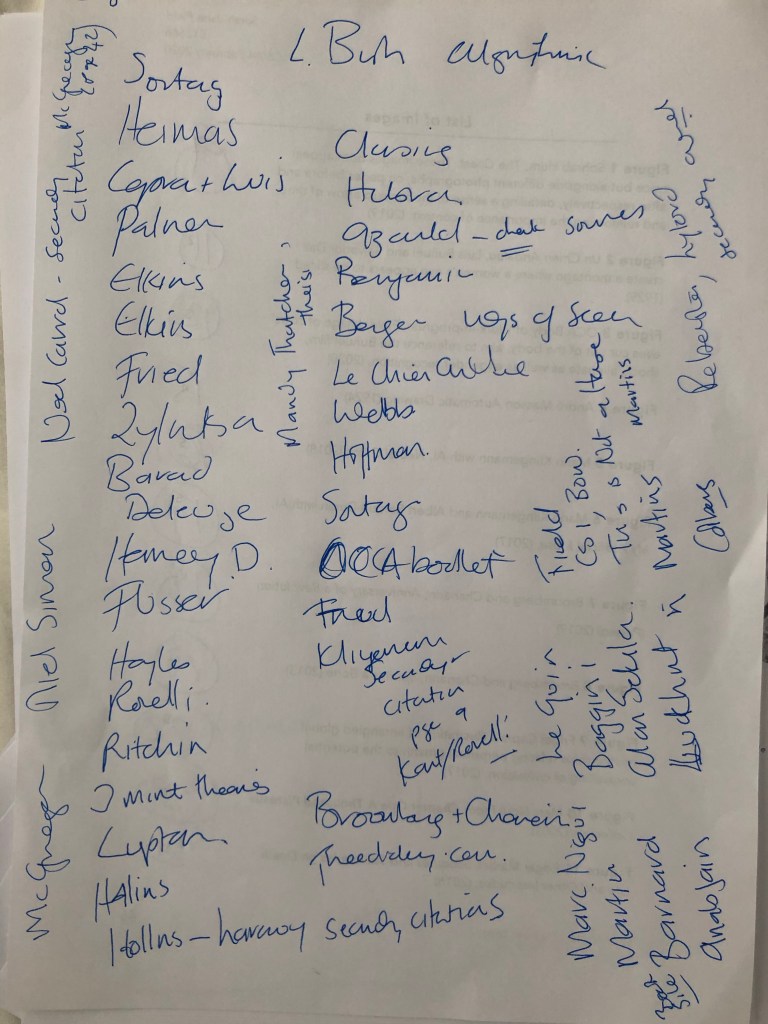
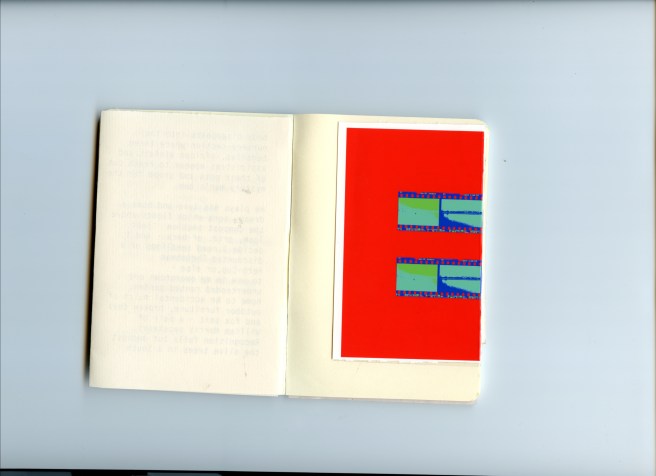
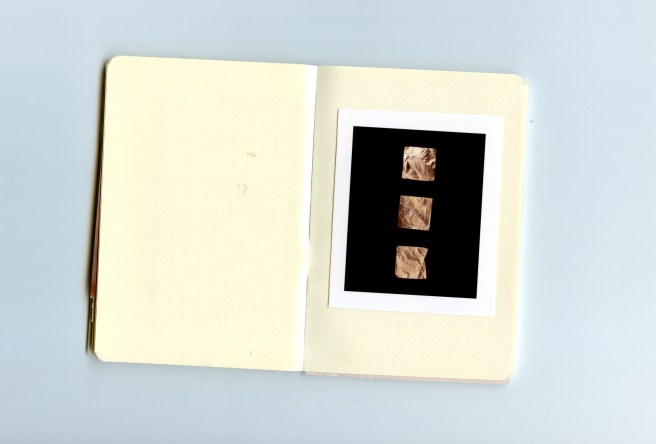
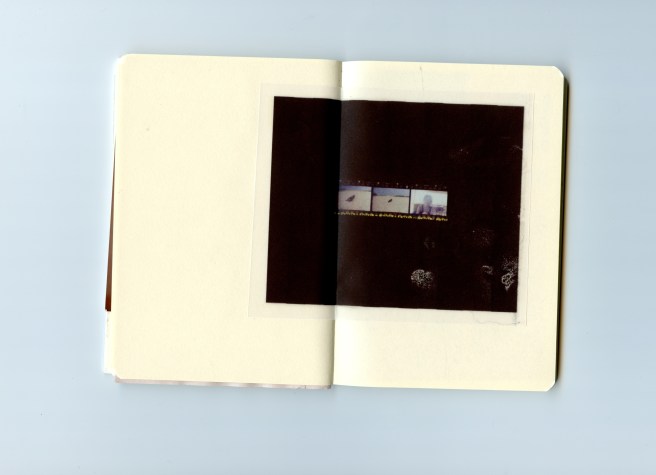
Making this – bringing the work off the screen was incredibly useful. I was asked if it will be this size… no. (This booklet was handy – I owe my son a stocking-filler though). I will make the book in ID over the next ten days or so and fix a size but whatever happens in the making of it is open to need and further development.
This is not a fixed sequence, in fact, I scanned it in the wrong sequence because I’m tired and kept missing pages – it’s not a fixed anything, just a step in the journey. There is lots more writing which I never got to include in this initial manifestation plus some images but that is what I need to work on some more. The writing is driving this at the moment rather than photography. That’s ok. I have countless notes on my phone, phrases and thoughts, sentences, ideas which keep coming (see example below) and so I have to let that continue. No, this colour scheme is not it. The book is from Tiger…
I like the idea of having a random paragraph on the cover and no title in fact. that can go on the cover page. It breaks the boundaries and establishes the fact of the alternative cut immediately. My son (interested in design) liked the raggedy cut due to a borrowed guillotine – which I now understand is in the cupboard not being used for a reason. But I will try to photograph a tear with the macro in daylight as a result of our conversation.This is a real blade and I would very much like to include it as such in a version. I wonder about making an expensive version of the book which has this and other interesting things like a fold-out page (see below) for assessment but if/when exhibiting make a zine run which will need it to be a photograph. I would need help with a book and have mentioned this to another student who made a very beautiful book. I know where my skills lie and bookmaking is not one of them.I am likely to use either a frame from processing for this or the shot with the female scattered. or a sequenceFolds out because of the size but in a finished product would not.
Mistake with printer which I liked split over two pages in fact, then didn’t like all the yellow on this and next page, so tried the red. My son loves this colour mix, I don’t, and will remake using specific negs I have identified. Scanned.
Will use something from Three Sisters or Uncle Vanya. Wasn’t sure but then realised the unconscious entanglement meant something – this book is about meaning emerging out of entangled interactions so will keep but not sure what passage.Like this combo but will play with other versions of selfies
Mistake covered up with something lying around – like it. but need to find another or make sure I can take this out and scan it well enough. I do like these colours and wall paper.
As mentioned, some notes from my phone with ideas, writing, things I’ve heard etc. I actually like the randomness and unstructuredness of some of this as-is, there is a freedom to it that isn’ in the earlier stuff:
The traumatised grown up
Sons hand me their hatred to carry around
To the academics who fail to recognise their privileged booty
Manifesto for the digitised self/age
/ Alexa I’d like a wife
Sure, it’s fine for Philip Larkin to peer out of his train window and scoff at cheap fabric and gaudy hats
Behind the shopfront, beneath the surfaceeveryday consumer
Transactions – film world
Trapped inside these words which cannot entertain a different world
Split atom
Colonialism
Sum
Of
The
Time
&
Other
Entanglements
Reality is fucking with you
Void realm
Simpering
Deity, divine, godhood, diabolical, decapitation, apotheosis, Ex rain god, enchantment/ Zeus sat down with Greta Garbo– they don’t know how to create gods anymore, they worship objects. Laughter/ Zeus, my children don’t listen to me, I might as well not exist, I despaired then you and your friends came along, but then it was like the old days, not like that guy who wanted sole charge. He got it all wrong,
There are no photographic records of my Czechoslovakian relatives, brewers who perished under the Nazi’s, in camps and ghettoes – missing images
Mushroom, beige, magnolia
Cut advert, cutting room floor, shiny nose, cut hair, terrible ‘boyfriend’ jerk, more money than any other job, least money with the BBC – most recognizable.
Add peer feedback comments and response to relevant page CS A2
Make adjustments to draft where necessary
Update where I’m at with BOW A3 planning and ideas
Begin writing (in note form if necessary) CS A3
It’s busy here (pre Xmas/school/work etc.) and I am feeling a little overwhelmed with everything that needs doing in order to keep on top of deadlines, as well as not losing touch with the unfolding thread. I think the hardest thing is about this – other than the difficulty of pulling apart thoughts relating to a tricky subject – is doing two courses together. Managing time and thoughts is incredibly challenging.
Ordering of the above:
Update where I am with BOW A3 planning/ideas
Add peer feedback to CS A2
Make adjustments to CS A2 where I can at this time
This article by Daniel Rubinstein confirms my recognition of Freid’s conservativism and does a super job of helping me to more fully comprehend some of the ideas in Barad’s essay. Beneath the argument about theatricality and anti-theatricality, it explores the changing nature of being and knowledge – or ontology and epistemology, as expressed via quantum sciences and philosophies, namely Barad (2003), Lupton (2019), Rovelli (2017), Capra (2014) – leading to what Barad terms “Onto-epistem-ology”[which is] —the study of practices of knowing in being—is probably a better way to think about the kind of understandings that are needed to come to terms with how specific intra-actions matter.” (2003: 829) (See Rovelli and Kant in the previous blog.)
However, Barad argues against what she calls representationalism, which is; “the belief in the ontological distinction between representations and that which they purport to represent; in particular, that which is represented is held to be independent of all practices of representing. That is, there are assumed to be two distinct and independent kinds of entities—representations and entities to be represented” (804) If you can overcome this and see “representationalism as a Cartesian by-product—a particularly inconspicuous consequence of the Cartesian division between “internal” and “external” that breaks along the line of the knowing subject.” (Rouse, 1996: 209, Barad, 2003:805) then the arguments made be Fried begin to disintegrate. As – “it is possible to develop coherent philosophical positions that deny that there are representations on the one hand and ontologically separate entities awaiting representation on the other” (807) relying instead on emergence. And ff you see theatre as a laboratory (not just Growtowski’s but the entire history of it) then perhaps Fried’s entire argument collapses – although I am not sure Rubinstein gets there with this.
Some quotes below and perhaps an occasional note:
by way of identifying the dualist oppositions and the ideological investments that establish the ontological significance of this text. (44)
Fried is not criticising the work of certain artists, but devising a universal method for distinguishing true art from ‘objecthood’, based on the assumption that (Fried’s) consciousness can distinguish physical reality from art (44) (religiosity)
this rejection leads him to adopt a conception of art that is hierarchical, analytical and traditionalist (45)
contemporary philosophical thought that studies theatricality as part of the logocentric apparatus inherited from the Renaissance (45)
The conception of ‘objecthood’ in contemporary art can be traced to Duchamp’s readymades which he created by selecting, modifying and rectifying mass-produced objects (46)
this opposition between the image and the real has its roots in Platonism, where the sensible world is produced as a copy of the world of ideas, and it is the task of reason to overcome the errors of the copy in order to arrive at the truth (46) Far more simply explained here than in Barad’s essay
The touchstone for this distinction is whether the image declares itself to be an image (the fable of the cave is told as a fable) or whether the image pretends not to be one, disguising itself as an object (47)
Plato’s demand for ‘primary distinction’ between images and models is motivated by the moral need to protect the idea of truth from the dangerous world of simulacra. (47) In CS A2, I argue the shadows on the wall of the attic are the actual real – what looks like the simulacra is just as real as the flesh and blood version watching the slides – although more likely they exist together, both real, both valuable (see Jung – dream world equal to waking world)
The artworks that Fried designates as ‘theatrical’ seem to have a common denominator: they strive to take over the real, to immerse and to overwhelm us by replacing the real with a readymade and truth with simulacrum until we are no longer able to distinguish the artwork from the real, the referent from the sign, and the subject from the object. (48)
Critical opposition to theatricality will not get one very far, as opposition itself is a theatrical requisite (49)
Quote Fried, “The Platonic division of the cave, which is effectively the theatrical division between a real outside and an inside simulating this outside … The thing stands for something else, and it is less than what it represents. In order that it be what it is, there has been a lack of being. What is given to us, insofar as it is not similitude itself, is deficient in force. The theatricality of representation implies this deficiency, this depression. (pp. 68, 71, emphases in original)” (49) See Barad and her refusal of representation being something that acts as a sign for something previous and original. (50)
Here the antinomy to the ‘theatrical cube’ is being revealed not as anti- theatricality, but as an infinite movement of surfaces that continuously self- replicate and morph into each other (50)
If the origin of theatre is in negation, and if its operation is representational, then the deeper reason Fried can speak of a ‘war’ between theatricality and real art becomes clear. (51)
Anti-theatricality, in other words, implies that in order to be meaningful, accessible and ‘true’, the artwork has to inhabit some form of transcendental negation, or excluded middle or some other form of metaphysical ground (51)
by arguing against the dualism of theatricality and for the monism of ‘real’ art, he is unable to move beyond the very dualism he is trying to unsettle as his thought is chained to the common-sense notion that representation is a natural, ordinary, everyday occurrence (52)
The deeper structure of Fried’s argument is that true knowledge can transcend mere appearances and grasp their underlying presence. As Luce Irigaray (1985[1974]) has shown, this framework is based on the notion of a stable subject that comprehends – like Rodin’s Thinker – a world that is also stable and unchanging. (53)
Freid’s description of Caro’s sculptures are ‘performative’ therefore theatrical (53) They are also elitist and come about due to a his privileged and educated position.
according to Fried, the greatest danger: under the auspice of theatre, art loses its spiritual, sensual and theological dimension. When art is stripped of its mystical, spiritual powers, of its direct link with experience through the unmediated connection with life, all that remains is the theatre: a pale re-enactment of the mysteries of the sacrificial ritual. (53) This is a bizarre argument given theatre’s roots are deeply embedded in the spiritual and mystical, and was born out of attempts to commune with the gods (the universe).
Putting the object first will not work because the opposition between art and non-art is itself the product of an ideology that asserts that there is a real world that can be taken up and represented as an image (53) which Barad argues against using quantum knowledge.
Edited 01/09/2009 to correct the spelling of Rubinstein’s name
Barad, K. (2003) ‘Posthumanist Performativity: Toward an Understanding of How Matter Comes to Matter’ In: Signs: Journal of Women in Culture and Society 28 (3) pp.801–831. At: https://www.journals.uchicago.edu/doi/abs/10.1086/345321 (Accessed 30/10/2019).
Capra, F. and Luisi, P. L. (2014) The Systems View of Life: A Unifying Vision. (1 edition) Cambridge: Cambridge University Press.
Rovelli, C. (2017) Reality is not what it seems: the journey to quantum gravity. London: Penguin
Rubinstein, D. (2017) ‘Failure to Engage: Art Criticism in the Age of Simulacrum’ In: Journal of Visual Culture 16 (1) pp.43–55. At: https://doi.org/10.1177/1470412917690970 (Accessed 30/10/2019).
Lupton, D. (2019) Data selves: more-than-human perspectives. Cambridge, UK ; Medford, MA: Polity.
I am not sure when I started following Deborah Lupton’s blog or how I came across it but as we were preparing the installation for Pic London, I read her post about the forthcoming publication of her book Data Selves in my WordPress app. The word ‘assemblage’ stood out as one of the other artists, Josh Phillips had mentioned it several times. I wrote about it here and mentioned a discomfort with the word as it felt like an adjective that was being used as a noun. I have become used to the word now and it no longer jars every time I hear it. (I am not sure why I felt annoyed by the word – irrational irritation perhaps.)
Whatever the reasons, the work our group constructed, A rumour reached the village (2019) might be described as an assemblage of many smaller assemblages. There is something fractal about the ‘village’ of things we constructed. And so after reading Lupton’s blog, I ordered her book and am glad to have read it now, not only because it seems so relevant to my overall inquiry in which I am attempting to make sense of the way in which digital culture is changing the structural nature of existence, but because it led me to Karen Barad’s work. Actually, Barad had been mentioned to me before by another of my Pic London collaborators, Rowan Lear. But her name only sunk in while reading Data Selves.
I expect I will need to investigate Barad further for CS and BOW but in the meantime here are some quotations from Lipton’s book with page numbers that could come in handy.
“Popular representations of these personal data and their futures often lean towards polar extremes.” (4)
“lively data” and “these data can continue to be lively even once the human they refer to is dead” (6)
“function creep” – tech used in ways that go beyond their original purpose. (8)
“predictions that are made by data analytics can result in predictive privacy harms, in which people can be categorized against within certain social groups” (8) (See end of book where she talks about the limitations of data analytics – how our paranoia that too much is known about us prevents us from seeing how basic and limiting the categorisations can be (124)
(13 – NB pa) Personal data blur and challenge many of the binary oppositions and cultural boundaries that dominate in contemporary Western societies.
Rather than user – exister Amanda Lagerkvist (2017)
“In new materialism, the poststructuralist emphasis on language, discourse, and symbolic representation is enhanced by a turn torwards the material: particularly human embodied practices and interactions with objects, space and place.” (15)
“Braidotti (2018) terms ‘critical posthumanities’, in which the concept of human exceptionalism is done away with. This more-than-human approach sees human bodies as extending beyond their fleshy envelopes into the physicalenvironmentt, while the environment likewise colonised human bodies” (15)
“If we view personal digital data as manifestations of vitality, as recording, monitoring and influencing human lives, generating biolvalue and indeed as essentially part of humans, then they become part fo the domain of biopolitics.” (15)
“Feminist new materialists celebrate the renewal and liveliness of the capacities that human-nonhuman assemblages generate at the same time as identifying the ways in which these capacities can be closed off or limit the freedoms and potentials of some people or social groups or generate harm for the more-than-human world, as in environmental degradation, global warming, species extinction, pollution and climate change.” (17)
“While digital data assemblages are often conceptualised as immaterial, invisible and intangible, I contend that they are things that are generated in and through material devices (smartphones, computers, sensors), stored in material archives (data repositories), materialised in a range of formats that invite human sensory responses and have material effects on human bodies (documenting and having recursive effects on human flesh (19)
See quote by Koro-Ljungber et al. 2017; Taylor et al. 2018) NB
Diffractive methodology – making entanglements visible. Barad suggests a diffractive approach is “good to think with”. (21) I agree. (Also 29)
More-than-human rather than posthuman (22) good para over to 23 – “interconnected and trans-agential.” Life, or vitality is not seen as possessed by any individual actor, but rather as constantly generated” (24)
Line about Caterisan dualism between mind and body (but see Alan Jasanoff (2018) for this too)
Animism – (25) quotes Haraway ” human ontologies must be understood as multiple and dynamic rather than fixed and essential (Bhavnani and Haraway, 1994)
Haraway’s ‘composite’ theory (26) See my own comments in BOW A2. (tentacular thinking)
Barad – “humans don’t know about the world because they are observing from outside it. They know about the world because they are inseparably part of it” (27)
Re agential cuts (29) And “Photographs make agential cuts that produce life forms rather than simply documenting them. “It is a way of giving form to matter” (Kember and Sylinska 2012:84) See 45 Years in lit review. more about agential cuts here: https://newmaterialism.eu/almanac/a/agential-cut.html – “Any attempt to impose meaning and order” […] “inevitably part of the matter it seeks to preserve or document” . Link this to Flusser and apparatus – what he says about photographers (funny!)
Thing power and enchantment (30) “strange ability of ordinary, man-made items to exceed their status as objects and to manifest traces of independence and aliveness, constituting the outside of our own experience” Quoting Jane Bennett (2001 and 2009) – compare this to OOO Graham Harmen
Page 31 – assemblage “function of grouping of different things in an assemblage, each operating in conjunction with the others (including humans)” (Bennett 2004: 354)
32 – Bennett recognises “mass-produced commodities as possible sites of enchantment” NB para
33 – others working in technological design …recognise “humans invest digital devices with animistic or magical properties” See Marx and use-value.
39 “death is more of a continuum” see page 40 too (Re mummies text)
42/43 Summary about human and non-human entanglement inc. data and machine.
Liquid metaphor “data sweat” (Melissa Gregg 2015) ; data leaking, emerging from within the body to outside – reveal ambivalence to data as it moves between “high value and useless – or even disgusting – waste product” (Abjection) 46
63 – emphasis on all senses, not just visual “data physicalisations” See http://dataphys.org. Plenty of artists listed who are making alternative to visual art drawn from data
68 NB – bias/visual data materialisations – instead list artists making “multisensory, unconventional and surprising” materialisations
Doing Data chapter – less than critical of some of the neoliberal ways in which data is enmeshed with people’s lives, potentially making them more rather less neurotic. Little critical analysis, more reporting of her data about how this affects people who use the data.
Sharing and exploiting data – caring/intimate surveillance concerns 103
The first section of the book is probably the most useful to me as it expresses ideas that I have found while reading about systems, a move away from mind-body dualism and digitisation’s impact on our perception of a less fragmented world. It is one of many books and articles which follow on from Kathryn Hayle’s posthuman book which has been so influential for me. I am inundated by such essays on Academia since reading a number of them. I like the sensible and pragmatic relationship Lupton has with data and technology even though she doesn’t seem all that critical of some aspects of data monitoring which strike me as nuts/unhealthy/hellish such as the constant surveillance of babies breathing – this kind of thing is very telling about our society and I could probably write a thesis on it alone.
To be clear; here I discuss the topic I am aiming for as I plan for the extended essay. I mention several key texts that I think will be helpful and which I will include in my A2 Literature Review. A previous blog also links to several important texts but there is minimal reflection in that one:
I need to get on with writing the literature review element of my extended essay. I am still thinking and gathering – but wanted to just put something down in writing to help me clarify where I’m at at the moment.
I’ve identified a key problem so far – how do I relate my inquiry which I think is about ‘the loss/destruction of reality (as it has been construed)’ to photography? After all, the degree has photography in its title and I need to link the central theme to that discussion. Photography has played its part in that destruction – although there are plenty of other factors/actors.
NB Destruction might also be seen astransformation. I believe this is what my BOW A1.2 is expressing.
Photography’s role in mythmaking
As I said in parenthesis in A1, “photography may have been a very brief interlude in the journey that begun with cave drawing, developed to become printing, followed by the invention of mechanisation, and moving towards a total simulated reality” (2019; 6) In response, Roberta suggested, “Although this has not diminished the demand for those other media – indeed it has given them a new lease of life.”
Printing is in trouble – we do still buy books but it is in a terrible competition with digital text. Painting, not mentioned above, which played such a big role in expressing religious propaganda existed in a feedback loop of development for that purpose. Although people still paint, I wonder if it is fair to say it is no longer used for what it was originally developed for – and that is a relic like still photography is perhaps becoming. People will continue to revel in it but they are making ghosts – sorry to all painters and still photographers. I do not intend to be dismissive – I understand lots of people still gain pleasure from these media.
2. I am also aware that my first essay could be read as a justification for moving away from photography ‘proper’ and focusing instead on moving image.
3. It seems like a key question in that essay and previous ones, along with the way my work is going is: Why is it more useful/fun/relevant/interesting to look at how images are used rather than the making of them? This is where Postmodernism is relevant.
But I’m not sure that’s really what I believe or what I want to ask.
If the construction of reality is a continuous re-invention of the moment we’re in (which I think is a simplistic way of describing current scientific understanding), the conscious self relies on…
i. memory – an intangible remnant of consciousness which we sometimes exteriorise using various forms/materials;
ii. our hyperdyadic* existence – perhaps represented by collage made with appropriated material;
iii. and mechanical construction (which includes language as a technology – see Andy Clark) – perhaps represented by the output of machinery we have invented, and which to greater or lesser extent becomes prosthetic – i.e. phones.
*dyadic – interconnection between two things. Hyerdyadic – interconnection between many – lots of people but also the environment
4. Whatever route I take, James Elkins book What Photography Is (2011)is an entire book which isn’t really about photography, even though its title suggests that’s all it is about. It’s a response to Barthes’ Camera Lucida (1980), another book which suggests photography is its main topic but it might also be read as an elderly man coming to terms with his mother’s – and so his own impending – death. I need to learn from them.
How do I keep this related to photography?
I think I need to state early on – that I am looking at the moving image as well as still and come up with a generic term to encompass both. I might use ‘image’ and then qualify that. Image, therefore, might refer to drawing /painting/film. In which case, is there space or a need to address the arguments made about differences between each of these forms and attempt to lay them to rest for the sake of the discussion? (See Barthes – indexicality of photography and also Elkins’).
Perhaps I need to also talk about why moving image is key nowadays, and perhaps more so than still – as the masses embrace technology which makes video recording so easy, and advertisers use it more and more as it can potentially grab our attention with its movements and flickers more successfully than still. Or at least suggest we can make that assumption with some certainty. This feels a bit like a justification again and might take up too many words, but it feels crucial.
Although it may seem like I am dismissing still photography, I am not. In amongst the plethora of photographic projects and bodies of work which all seem very similar and flaccid, there are a number of photographers making potent and striking work, such as (but not exclusively) Thomas Ruff and Zanele Muholi.
(Intention is key)
Elkin says, “beyond that, talking about the surround as I did for the photograph of the greyhound reveals that the surround is boring, and possibly also that photography as a whole is, in the end, also a bit boring.” (loc 1706) Perhaps, I will suggest that if this is true it is because we as a society are desensitised to photography, now that its initial magic qualities have faded. Seeing a photograph in 1845 must have been incredible and exciting and perhaps awe-inspiring. To capture a person and then have them rendered as delicately as those older processes were capable of would have seemed extraordinary. But now it is mundane and every day. Now our representations move, can be built by anyone – even children as young as two, and offer adventure and flexible narratives. They are engrossing and enticing and overstimulating. So the poor old still photograph has a great deal to compete with. While some, perhaps people with time on their hands, may revel in the luxury of contemplating an image of a leaf or a fragment of a person or people, or the emptiness of a blank page, others are fed a diet of shiny, fast-paced, noisy and enticing media. Most of us have this latter fodder in our lives and perhaps that is where the mythology I am interested in exists. If still photography (academic art) is to remain relevant, then perhaps it can a useful tool for deconstructing the myth I’m exploring.
Art photography is often inherently elitist. Not always, but so much of it can’t help being so – refs from Elkins:
“It is easy to agree that photography’s apparent realism has been formed by the middle-class hope that the photographs give us reality itself (as Bourdieu says).” (loc 762)“‘photography is most frequently nothing but the reproduction of the image that a group produces of its own integration’. (Bordieu, Un Art moyen, 48)” (loc 707)“For Bourdieu, photography is bourgeois to its bones, and it even includes its own futile anti-bourgeois gestures, like my own attraction to things that aren’t family photographs.” (loc 716)
Still photography is one fragment of a re-enactment of our biological processes – by focusing on it alone we persist with a Cartesian construction/understanding of reality. But it might be more relevant nowadays to explore these topics more holistically. Intro/preface?
Mythmaking
Hoffman’s book below references advertising and images extensively. Held within these images are myths.
I have become really interested in mythology – and the relationship between science and religion. It seems to me that both do the same things, i.e. put difficult concepts into narratives we can try to manage.
The following is from the author, Jonathan Raban’s biography A Passage to Juneau.
“Within the last 9,000 to 12,000 years, when people were present to witness such events, they would have seen the sea close over islands as earthquakes rearranged topography. You couldn’t look at the delicate compromise made here between land and sea without imagining the Flood: and you couldn’t imagine the flood without inventing a Noah or a Gilgamesh” (1999) (Perhaps this quote will be on the cover page or at the top of the essay).
Books
Return of the Real Hal Foster 1996
The Case Against Reality Donald D Hoffman 2019 (see below) (He mentions Plato’s Cave his description may be useful to quote.)
How we Became Posthuman Kathryn Hayles 1999 (in particular Chapter 7, Turning Reality Inside Out and Right Side Out: Boundary Work in the Mid Sixties of Philip K. Dick)
I need to look at Deleuze but I do not know his work and have no idea where to start.
Popular Culture, films, TV
The AO (Netflix) 2016-19 TV – Series One explores a kind of inverted Plato’s Cave which becomes a metaphor for digital culture. As part of my research, I have been watching plenty of reality-bending films and TV, this being one of them.
Total Recall, 1990 and 2012 Film
Inception, 2010 Film (this leads to Memento – also directed by Christopher Nolan but I am trying to avoid clinging to memory as a key theme, even though that is an important topic.)
(In the link above, I talk about several influencing works which had fed into my own practice but which may also be useful for the essay.
I will need to revisit this at Tate Britain as there is much to link to, moving image, youth culture, myth, everydayness.
2. Katinka Schuett, Cosmic Drive – I have only just come across this work and will look at it as a possible example of still photography looking at similar themes. ““Cosmic Drive primarily explores the way humans handle ignorance,” says Katinka Schuett of her Female in Focus winning series, which examines the contradictory spheres of fantasy and hard science. “I am interested in our perceptions of space, and the question of whether or not life can be found in the universe.” Schuett is as concerned with fantasy as she is with facts, merging the two to consider the illusions we create when there is a void of information. ” (Roberts, 2019)
I probably need to have a few more references here.
Blog Conclusion (not essay) – is there a question/title here yet?
I’m not sure … perhaps:
Should we re-evaluate our relationship to myth/humanity’s need to create myth? (And what role does the image play?)
I feel it will be necessary to use the word image in the extended essay rather than photography – because photography is such a nebulous term and describes a range of activities – and perhaps I need to explain in a preface. Does a preface count towards word count? Something to ask when submitting the review.
Something I’ve not addressed here which I think fits but which may be too far outside the inquiry – the body/blood/softness/boundaries/flesh. Hayle’s looks at this and references Donna Harraway several times – I don’t think I fully comprehend what’s going on here yet and need to read these sections again, as well as Haraway’s Cyborg essay which I’ve only read once so far (and found it a little bewildering – perhaps I was tired/distracted).
I know I am interested in the fractal nature of reality and our conscious understanding of it. So, we function (construct reality) in a certain way and the patterns of that construction are evident in our expressions (media – films/adverts.any narratives, the way we produce them.)
I still think I’m focusing too much on why photography is becoming irrelevant and need to look more at boundaries/flesh/death – life/self-other; I suppose these things to tie into myth and the breaking down of self as a definitive object as technology and science evolve. Therefore perhaps we might say, “it is a myth that you and I exist at all” – however, this myth is all we have and so we need to take it seriously even though we understand it is a myth.”
“Sometime in the not-too-distant future, anyone will be able to take a picture without a camera. Instead, we will be able to generate photographs, indistinguishable from those made by a camera, using artificial intelligence (AI) software. You will be able to create an image by simply typing out a description of the scene, or describing it to (presumably) Siri. “Siri,” you’ll say. “I’d like an image of a red-haired woman walking through a park in autumn, the breeze blowing red, orange, and yellow leaves around her.” And—though it may require more detail than that—presto! Your phone will provide various options on the screen to choose from.” (Palumbo 2018)
Other refs:
Raban, J. 1999 A Passage to Juneau, Picador, Basingstoke and Oxford
Write a 1,000–1,500-word essay that relates your current work (the work that you made or are making in Body of Work) to an aspect of visual culture discussed in Part One.
Your text should be fully referenced and illustrated with your own photographs plus supporting figures where appropriate. Submit your essay to your tutor by whatever means agreed, either a hard copy in the post or a Microsoft Word or PDF document in an email.
You may find it difficult initially to identify which of the five concepts discussed in Part One (i.e. modernism, postmodernism, poststructuralism, photography and reality, globalisation) are relevant to your practice. However, this challenge is part of the objective of the exercise. Consult your tutor if you are experiencing difficulties.
Modernism
It becomes increasingly obvious to me that separating photography and its invention from the world in which it exists is risky. Recalling Ariella Azoulay’s comments which I included in DI&C A3, ““To take this excursion to 1492 as the origin of photography—exploring this with and through photography—requires one to abandon the imperial linear temporality and the way it separates tenses: past, present, and future. One has to engage with the imperial world from a non-imperial perspective and be committed to the idea of revoking rather than ignoring or denying imperial rights manufactured and distributed as part of the destruction of diverse worlds” (2018) This is reminiscent of some of the theories about time which emerge from Quantum science – theories that are desperately difficult to comprehend.
Nevertheless, Modernism appears to be a very specific awakening. We humans can breakdown and dissect reality. However, the first stirrings did not begin then, and Leanoardo’s much earlier famous drawings are an obvious testament to a growing understanding of what human consciousness is capable of.
Perhaps Modernism is a moment we can pinpoint where a gradual turning inwards, or an increasingly inverted look, can be charted as having sped up.
If the Greeks looked upwards towards the stars and saw how big everything was culminating in the Rennaissance and Newtonian physics, then the Modernists were really getting humans busy with looking inwards and at the very small which continues apace with quantum exploration – and this tussle with the arrow of time.
Pages 392 – 397 in Blue Print summation of history’s journey as the understanding of human relationship with self and nature evolves
Post-Modernism
‘a rejection of meta-narratives’ (Lyotard, 1979) (OCA CS folder, page 17) – due perhaps to the underlying scientific narrative which posits context and relationship “The theory [quantum gravity] does not describe how things are; it describes how things occur and how they interact with each other.” or “relations between physical systems” – particle A meets particle B and something occurs but without that interaction particle A and B are meaningless. Particle A’s interaction with Particle C may be entirely different from the previous interaction. What’s more A, B and C never operate in a vacuum are entirely affected by environment. They are not discrete objects in a universe but part of the fabric of the universe
pluralism (ibid)
Tagg – “photography evolves by a process of internal self-criticism towards the ever-sharper definition of what the medium uniquely is” (page 18) – in my, but not the photography purist’s opinion – the ability to harness light using chemicals (at that time) and make a naive copy of reality which has since become increasingly more sophisticated, leading to the inevitable; photography is part of a journey whereby reality will having turned inwards be able to give birth to itself. And therefore photography cannot be uniquely anything as it is one element of many within a much larger human project
See above, inwards and small – this happens in tandem with the development of science and computing which relies increasingly heavily on quantum sciences as well as multi-disciplinary endeavors such as the Macy conferences.
Photography cannot go it alone despite many wishing or thinking it were so
“a hybrid construction of the self emerging from cultural theory and technology” Brown, 2008
Again, Tagg is critical of feminist or socialist histories for similar reasons – they overlook context.
NB – “Good people can do bad things (and visa versa) simply as a result of the structure of the network in which they are embedded, regardless of the convictions they hold or that the group espouses. It is not just a matter of being connected to ‘bad’ people; the number and pattern of social connections is also crucial” (Christakis, 2019. 106) Context, the shape and nature of the connections made seem, at every level of reality, to be all-important. Therefore, attempting to draw photography out and see it in isolation renders any conversation about it potentially meaningless.
Post-Structuralism and the language of photography
I have been convinced that this is where my work is situated. I am just fascinated by semiotics and how our reality is contained in the language we use. For me, this is the most interesting work to be persuing. But it seems very much tied up with the next section. The language we use, which emerges from us and also feeds back is the material out of which reality is built so both this section and the next section are important to me.
Early seeds for BOW, which I have started recording on my Sketchbook pertain to the performance of identity and experience, how we perform our roles and accept scripts handed to us by the narratives we watch/read/hear. We learn these scenes, responses, actions from the films and TV, now games, we engage with – and therefore the Bate quote on page 21 of the course folder may be worth delving into further.
My work on the previous course looked at this – the language of film and music which I grew up with and experienced in early adulthood.
Photography and reality
There seems to be a catastrophic breakdown of trust in reality itself, within the West, at any rate, as a collective loss of trust in what was once certain emerges. Truth is not reliable and in its place exists an overriding sense of skepticism. If nothing’s real, then why should anything matter? At least, that appears to be the mentality. Or perhaps, this dissolution I describe brings about abject terror and so certain groups feel compelled to retreat to a place where they imagine the rules of life were more tangible, less confusing. Men were men, women women – and everyone knew their place.
See notes in S&O and DI&C on cybernetics and the development on self and communal reality.
Digital photography and it’s potential and possibility are both immensely exciting and terrifying as nothing is certain – see Modernism notes.
See Lars Von Triers Nymphomaniac and the separate photo book by Casper Sejerson Belongs to Joe as a template – photography and text used to convey, as well as being linked to and explored, various universal themes – all of which feed into developing ideas about reality, learning, human knowledge and ability to understand him/herself, such as fishing, the Fibonacci Sequence, trees, and music theory. The book and films (regardless of whether we like them) are multi-layered and complex
As is reality
Reality cannot, in my view, be explored purely via photography critique but the form and technique need to be looked at systemically, as elements of form all of which feed into our relationship with reality
Photography and the global age
This heading is the least interesting for me – simply because of all of the above links directly to it anyway – and so feel I can’t fulfill a separate heading. However, I am interested in briefly discussing comments about art and finance. It becomes increasingly clear to me that art, and photography in my experience, is so much about money, snobbery, elitism, and privilege. A person can buy oneself a career if they have the funds and time to do so. Of course, any endeavor whether in the arts or not is often reliant on networking and ‘playing a certain game’ – and it’s impossible to escape that kind of thing. It’s probably always horrible and I’m very uncomfortable with it – it feels grotesque and very ugly indeed to me. It means some artists are at an advantage before they’ve even made anything at all. I also notice how art is used in the City or people’s homes to demonstrate wealth and status. The information contained in certain pieces of work is less about the artists’ claimed original intention and more about money and showing off. Perhaps it’s not Salgado’s fault but his work does this for me and recent experiences of this type of thing as I’ve met people in the industry have made me feel really awful and like running away into the hills never to be seen again.
Refs and possible research links
Brown, A . 2008 Demonic Fictions, Cybernetics and PostModernism






 SJField - OCA Level Three Study Blog