Like anyone on Academia.edu I’m bombarded and overwhelmed with potentially relevant titles from them and have had to put a mental block in front of any response to them for fear of information overload. But this title is immensely relevant for me.
As discussed I attended three workshops organised by Pic London at LCC, led by Una Hamilton Helle and Joshua Bilton who were original members of a group called Hal Silver.
Pic London’s site told us:
The workshops will be experimental in nature and the focus of each session will be on collective forms of making, improvisation and group dynamics. This could take the form of games, role-play, unskilled mask and costume making, photography, video and sound recording. These process-led activities can be gathered into a final exhibition display, the form of which will be established throughout the workshop sessions. (2019)
Improvising in the dark at LCC with Hal Silver Courtesy of Pic London
We played a number of improvisation games including some vocal games devised by Pauline Oliveros called Sonic Meditations. (See below) These games reminded me of the kind of thing I did at drama school (1991-94). I introduced this exercise to the OCA Music Collective when Emma and I shared Sirens.
We also played an imaginary game where each of us had to come up with a character and then imagine ourselves in a village. Someone, it was rumoured, might have done something untoward and the rest of us had to make a decision about whether it was true or not. People were ejected from the game/executed/banished if individuals believed the story others told about them. We played it several times and invented many strange and bizarre tragedies which we blamed on eachother.
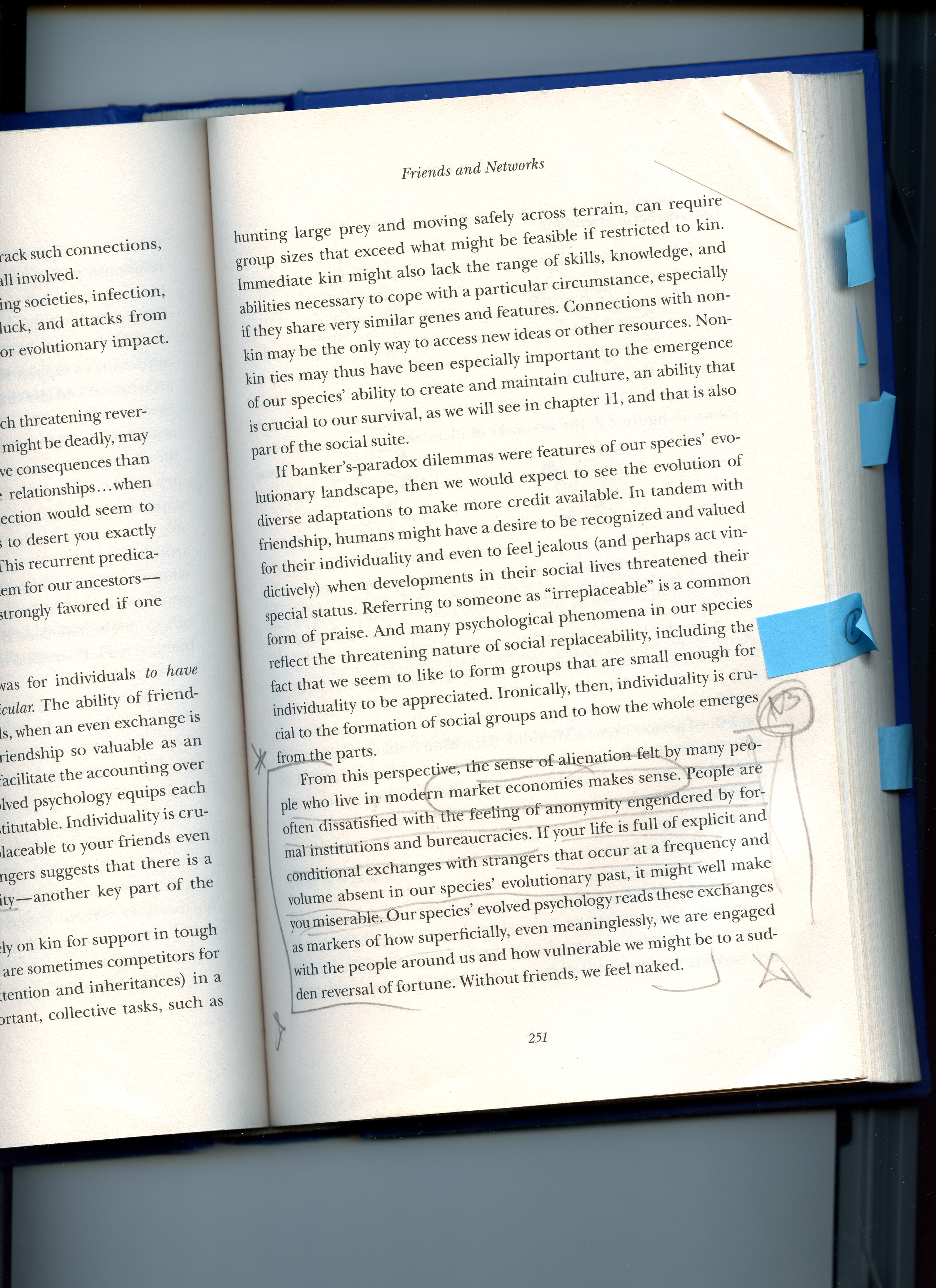
The Goodness Paradox: How Evolution Made Us Both More and Less Violent Kindle Edition, Richard Wrangham, 2019 and Blueprint: The Evolutionary Origins of a Good Society, Nicholas A Christakis 2019
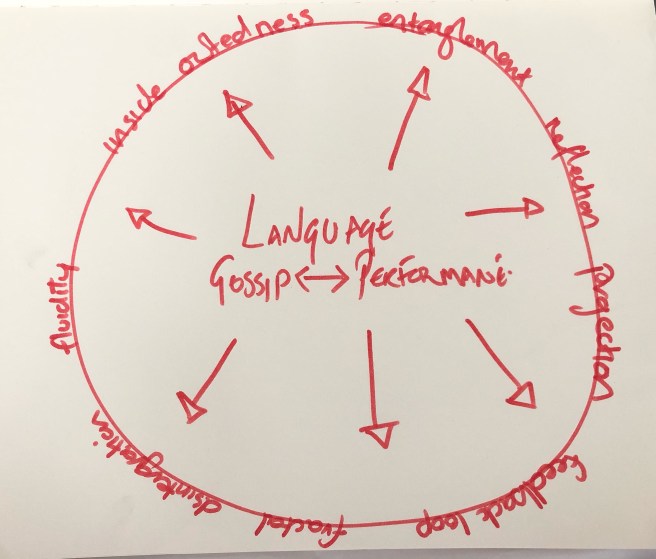
I had just finished reading the above books both of which deal with the way in which societies keep themselves in order (or not). Wrangham’s central thesis is that humans are the most violent and the most passive of primates at the same time and that it is language which enables this paradox. Language gives us the opportunity to gossip. Once we have that capacity we can lie, protect oursleves and send blame in a different direction. Cliques form which protects the group – the most cost-effective way to ensure survival for the individual and the group. Outsiders are seen as a threat to the group. To deviate from the norm is to invite extreme danger, ultimately execution. Through language, violence is planned and carried out over time, thereby distancing oneself from spontaneous aggression, but often finding ways to be far more aggressive in the long term. This distancing is contained in the law.
A photo I found on Twitter showing executions during the Spanish Civil War (will need to do a bit of digging to make sure that’s right and find the link)
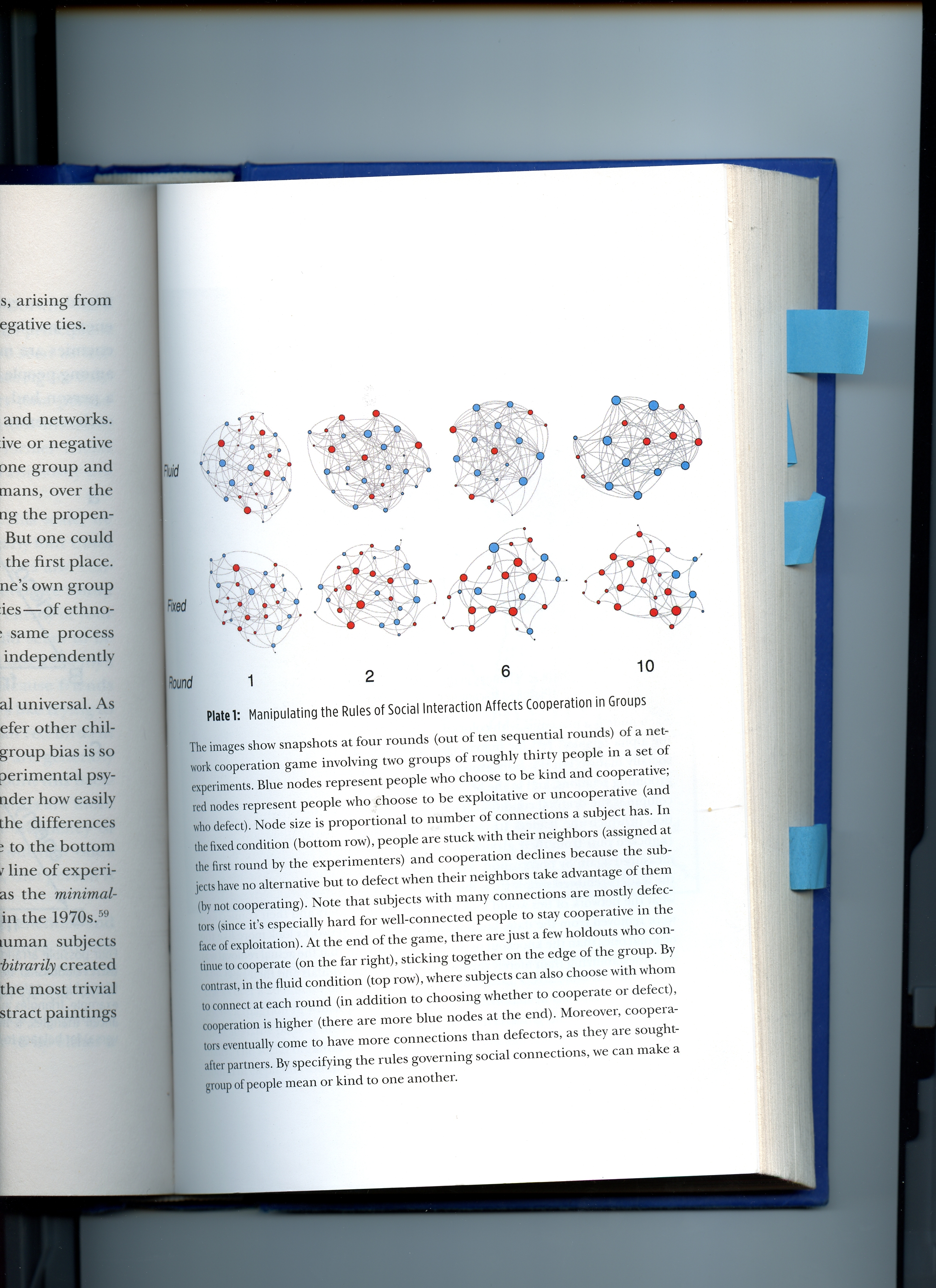
The second book covers some of the same ground but also looks at networks and co-operation. It is a more expansive thesis than Wrangham’s.
However, the two main themes emerged from the games and which I had just read about in these books; the role of language in establishing and maintaining groups and the networked nature of human existence.
A group discussion also led the circular nature of existence, history, culture and relationships.
Bringing objects, books, and games to the group.
We were all asked to bring some items to the second workshop – these could be objects, photos, text or games for instance.
I provided a range of things but the following have stuck.
Text from Christakis’ book
Books by the Situationists which focus on circles
A stick game I used to play at drama school which demonstrates to the players where your connection is strong and where it breaks down. At university, we might have used this as a warm-up game or as rehearsal support with lines.
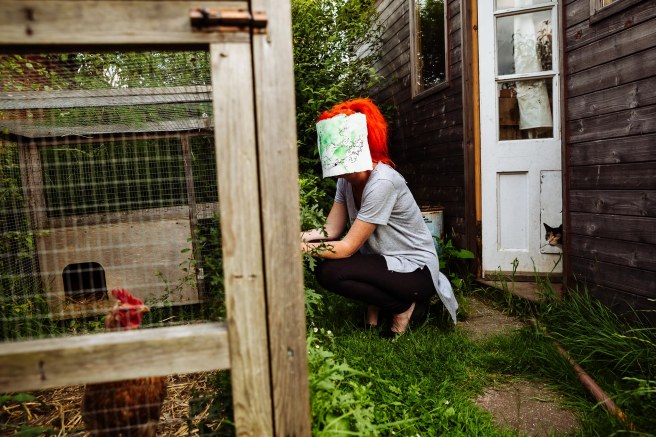
In the spirit of collaboration here are some cropped images on one of the member’s of our group – Eva Louisa’s – Instagram feed which I took during a meeting at the end of the summer while playing the stick game. I should share it with my old head of school Niamh Dowling, now head of Rose Bruford – I suspect she would be pleased to see it. I think this image is being used by Pic London so I will wait and see and share that with her if so.
For me, the most interesting aspect of all of this is the language.
I am the oldest in the group and therefore immediately the outsider. There is one other person who is probably slightly older than the majority but everyone else is early-to-mid-twenties.
I grew up the 80s and the early to mid-90s were my heyday.
However, that is the least of it, I am sure. As another collaborator said to me when we worked together at the beginning of Self & Other while discussing the meaning and implications of other, “But what about your otherness, Sarah-Jane?”
Image from Self & Other A1 (2017)
And then how did we maintain satisfactory communications across social media? This was the only route open to us since we would all be scattered across the globe for the duration of the summer. Of course, prior to social media’s existence, we would have had letters and the telephone to use. We now have more opportunity than ever. However, it felt to me that we struggled to genuinely connect despite digital access – which was often unreliable, frustrating and fragmented. Or so it felt to me.
Most of the time I sensed I was talking into a void. I felt isolated and alone, often paranoid and like an outsider, a freak. Of course, some of that must be me – I do sometimes feel that way but it’s been a while since I’ve felt it with such force. Perhaps while I was married and in relation to some other mothers in the playground (but I know lots of other mothers feel this way in the playground too), certainly while I quite insanely joined the PTA after my dad died in 2010 (a short-lived experiment!), and when I was in a play at the Library Theatre shortly after graduating. Everyone else in the cast lived in London. I lived in Manchester and got the job at the last minute after someone dropped out. I felt horribly inadequate and was suffering the most awful acne at the time too. When I was a child I had this same feeling when I was sent to boarding school. A few months after being there I told all the boys about the girls wearing bras which was a desperately self-defeating thing to have done – I was the outsider and felt so wretched about it I made it worse by making sure I had to remain an outsider for even longer.
This sense is, I am well aware, partly self-generated but then some sort of transference and counter-transference starts taking place. I mention all of this as the poem I will likely include in some way is very much informed these feelings and my personal history with my own mother.
Continuing the improvisation across social media
Perhaps my history with impro or the fact that I meet OCA people regularly online meant I was flummoxed when attempts to get this going failed. I felt like a disappointed child realising that all the other children were really very grown-up and somewhat irritated by my enthusiasm.
Instagram
At our first online meeting (where it was very difficult to hear and see what people were saying) we agreed we would set up an IG account and post collectively there, responding to each other and attempting to continue playing improvisations games. One member suggested each taking it in turns to give another a task – out of which a resulting photo or text should be posted on the IG. We said we would start with some thought experiments. Then each of us should pass the baton on. Of course, if no-one started or passed it on the game would die.
Well, the game barely lived at all. And I got bored of waiting so set someone a task. They did it, posted an image prompted by the task and then stopped I think.
Nevertheless, we began to post images. I suspect some more than others. I posted images promoted by discussions online and in the workshops and in response to images by others.
Thought experiments provided by another group member as prompts/ideas for tasks being set. No-one had to use these but it was hoped they would prove useful.
I played quite a lot although did not share everything I made. My phone then stopped working altogether! And I was stuck in Italy. this was probably, in the long run, a good thing. I had a much-needed break from social media and had already posted quite a few pictures and videos anyway.
Click in individual images.
I don’t have all my images anymore after the phone broke and there was no wifi in Italy. So sadly I lost some originals but they are still on the IG account.
This account has led to a book which will act as a research footnote to the exhibition. I will add a low res PDF of the book after it opens. Massive thanks to Rowan Lear for organising this.
Research and Ideas
All the time I was in Italy I kept thinking about the village I was staying in, Ferentillo. I wrote about it here. It is a village I have stayed in and made work about several times as can be evidenced in my Sketch Book blog and in Self & Other A5.
Image from Self & Other A5 i will have call you (2018) made in Ferentillo, exploring the boundaries between life and death via mirrors in the landscape, phone apps and filters, and moving image.
This Family Too (2017) (A project which I never resolved and should return to – take some of these out and look again at the images and sequence. I recall wanting to make sure the sequence was random and could ask a fellow OCA person I know about setting this up in Processing.
And I submitted a book for TAOP A5 which was made in Ferentillo and included written work as well as images.
Notes which I shared about some of this work with the group:
Alain Fleischer, Mummy, mummies – a photography book with text in which Fleisher photographs the mummies for which Ferentillo is famous.
As discussed in several blogs above this work is mentioned in The interphototextual dimension of Annie Ernaux and Marc Marie’s L’usage de la photo‘ by Ari J. Blatt.
What caught my eye was the following:
“If Bazin offers a compelling theorization of the photograph as mummified presence, in his wistful recent book Mummy, mummies Alain Fleischer plays with that paradigm and examines the mummy itself as evocative of the photographic process. In this combination of essay and fiction that focuses upon a group of mummified bodies housed for eternity in the museum crypts at Ferentillo and Palermo in Italy, Fleischer conceptualizes the relationship between mummified and photographic traces: ‘Mummification and photography are united against the disappearance of appearances: they are alike in their materiality, their techniques, and their codes of resemblance.’”
Blatt, Ari J.(2009) ‘The interphototextual dimension of Annie Ernaux and Marc Marie’s L’usage de la photo‘, Word & Image, 25: 1, 46 — 55, 27 – Alain Fleischer, Mummy, mummies (Lagrasse: E ́ditions Verdier, 2002), pp. 15–16. Translations mine. (Blatt) Available at: https://www.tcd.ie/French/assets/doc/BlattOnErnauxMarie.pdf [Accessed: 24.May.2017]
I sent this document to the group and one of them picked up on another sentence where the darkness in the tombs is stressed.
Fiore
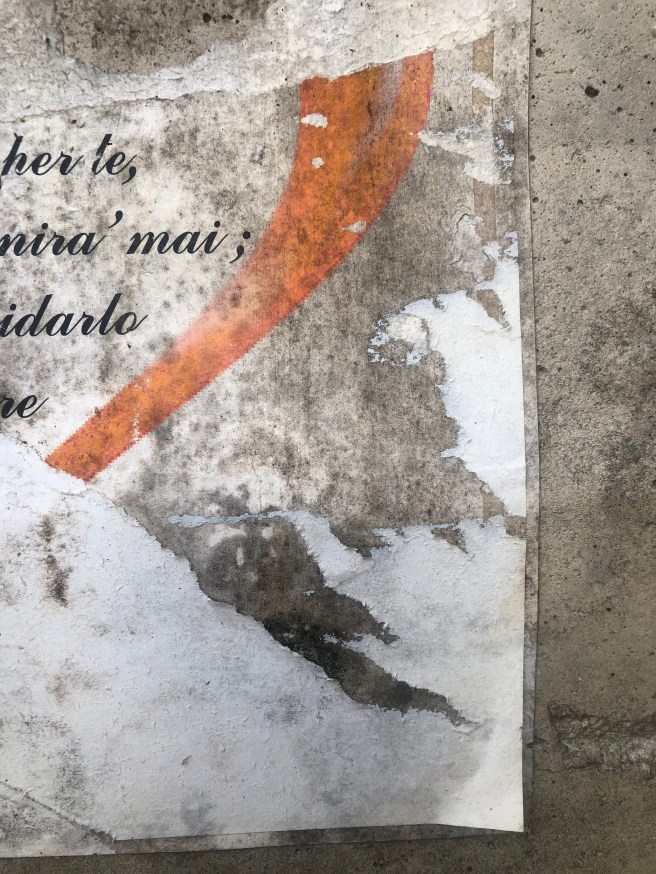
I thought about Fiore (mentioned in the poem) and all the other tragic stories – suicide, cancer, airplane crashes and wondered why there so many of them. I suspect it is the fact everyone knows each other. Death is also everywhere in the village – a Catholic community with a cemetery on the edge and posters announcing death all over the town as is the Italian habit.
And I thought about darkness and the work isolating. Before we got going with the IG, I had suggested a task – a self-portrait based on the character we had constructed in the game. This was blocked and portraits referred to as ‘isolating’. I felt this was unhelpful as self-portrait could be interpreted in many ways. I also wanted to say, that is what language is – isolating. All these happenings led to the flash images:
The film is made by adding all these fragments together. Although it may seem incomprehensible, I think perhaps that is what I am after as that is how I felt – as if life and language and being in the group were incomprehensible. I am not a Millenial. I grew up in the 80s as everything was changing and being set for the digital bubble to come in the 90s. (See Adam Curtis’s Hypernormalisation 2016).
However, now that I have worked on it this morning and added the Game Boy music as the only audio (which will be available online only so people can hold their devices and listen through headphones in the gallery is they want to – but a bit like holding a Nintendo Gameboy). Version 24th September 2019, Password Village3
Some further thoughts
Thinking back to the books I mentioned above – Wrangham and Christakis’, I have, throughout this process and while in Ferentillo, been thinking about the way societies evolve. Umbria is a perfect landscape/example for Virilio’s thesis whereby war is the main motivator of all technology stating that is what has driven civilisation’s development (1985). Throughout Umbria there are hilltop towns and castles demonstrating this aspect of human nature; villages maintaining boundaries between themselves and the outsiders. And yet their history is filled with outsiders – Chinese tourists in the crypts which were photographed by Fleisher, Assyrian refugees painted in local abbey’s. And how art has such a huge history here – the purpose of it – in chapels and churches for instance; and the very long history. Below the Twitter link, there are some images from books on Umbria and I’ve focused in particular on the faces of the people from that other time.
Blatt, Ari J.(2009) ‘The interphototextual dimension of Annie Ernaux and Marc Marie’s L’usage de la photo‘, Word & Image, 25: 1, 46 — 55, 27 – Alain Fleischer, Mummy, mummies (Lagrasse: E ́ditions Verdier, 2002), pp. 15–16. Translations mine. (Blatt) Available at: https://www.tcd.ie/French/assets/doc/BlattOnErnauxMarie.pdf [Accessed: 24.May.2017]
A short film to be shown in a group show on a platform or in a circle which functions as a village of work made by the collective.
Latest iteration following feedback: Password Village3
Following some constructive (and helpful) feedback from the regular OCA online hangout I attend, plus some comments from Ruth in my last tutorial, I have continued to develop this film (See earlier versions below). It is half the length than it was and has a less fragmented audio track. I am thinking I will only provide the audio online and visitors must use their phones to hear it in the gallery or on a computer at home, not least of all because it will drive the invigilators completely insane if it is on the whole time. There are further reasons to do this but I will discuss that on my blog. I need to match some clips up with obvious bits in the music still, but I think this is a much more accessible idea – although still incomprehensible I’m sure to some. In an accompanying brief statement, I need to say something like the following:
An audiovisual moving image collage, which contains themes and fragments that emerged out of a conversation with 5 other artists, and took place over several months as we were researching and developing the overall inquiry into what a village might be. Images, mostly found but some original, are combined with music from a well-known computer game from the 80s which was usually played on a portable handheld device, a precursor to today’s ubiquitous mobile phone. (When I played it, aged 11 or so, my three brothers were horribly annoyed that I reached the high score and saw the prize before any of them did.)
Flowers for Donald is, as stated on Eddi-Jone’s website, “is a series of digital collage work begun in the days following the 2016 U.S. election” (2016-18). I saw these at the Foam exhibtion I went to earlier this year but I must admit they did not draw me in initially. (It was very busy when I went to see the exhibtion and not an ideal scneario for looking – too many people strainging to be seen there that evening.) It was only when looking for references to flowers recently that I really took notice.
I really like that the artists says, “I wouldn’t feel right with myself to make work that doesn’t address this very significant social and political paradigm shift we are undergoing. It is too large to ignore.” I agree.
The work references dadaesque montage which Eddi-Jones suggests are, “strategies of appropriation, collage, and aesthetics of absurdity to reflect instability in political and media environments.” Thinking back to what I wrote yesterday as I responded to Roberta’s feedback , I could refer to Flowers for Donald in my essay however, I’m not sure it addresses her query about why it – “it make no sense to talk about the original photo or film” in post-modernist appropraition work. (I think that is what she means). In my notes yesterday I talked about the articualted nature of Dada montage and the fluidity of today’s infomation language – I think I would try to incoporate that into anything I do today. Although Eddi-Jones does not do that, he does include screen grabs from news about the election and other remnants of the ‘spectacle’ -note he also includes the iconic opening shot from Society of the Spectacle film. And I mentioed being brave myself and grabbing modern contemporary imagary.
I particualry like the way Eddi-Jones has taken a text as his starting point and the challenge “the role and function of art itself in politically turbulent times” (2016-18)
I’m not doing this in the order I would usually do things. I was away from home for 4/5 weeks and didn’t want to fall too far behind, so I packed up a selection of books I thought would be useful and planned to write my essay once I’d arrived in Italy. I hoped this would be a good place to write. After all, I was away from London and my paid work demands, plus able to live in a kind of denial about the stresses and financial difficulties of life for a little while. However, family, lack of WIFI and other tech issues made it challenging. So research was a bit tricky… Although I loved being away, I really longed for a quiet, properly resourced space. I mention all of this because while there an article about women not having time or space to think, to create and make work went viral.
Brigid Shults wrote in The Guardian, “Women’s time has been interrupted and fragmented throughout history, the rhythms of their days circumscribed by the sisyphean tasks of housework, childcare and kin work – keeping family and community ties strong. If what it takes to create are long stretches of uninterrupted, concentrated time, time you can choose to do with as you will, time that you can control, that’s something women have never had the luxury to expect, at least not without getting slammed for unseemly selfishness.” (2019)
I think there is probably something to retain for possible future developments about this fragmentation of time and focus, the stop/start way of working and ceaseless interruptions women live with and that successful creative men have been able to live without. I suspect at some point I may want/be able to weave something of this into some work. And of course, not forgetting the shame. Even as I write this I feel tremendously guilty for sounding unappreciative of the time I took, and how I was able to catch up with so much reading. I feel compelled to express my gratitude for all that was given. (And a great deal, not only in terms of time, was gratefully received by me.
Essay
I wrote the essay which I sent to Roberta and warned her that I would look at it again after a few weeks and see where I could make better connections. Predictably, the minute I sent it off I noticed that I had relied on quotes I’d used in previous essays and I was sort of repeating myself. I don’t think there is too much wrong with this as I refine ideas and rely on really important concepts that are at the core of my developing work. However, I felt I was beginning to limit myself.
Therefore, I will take the comments that Roberta made plus a few I made myself and respond, sometimes based on reading I did following submission. Then I hope to have a short online meeting with her and following that I will fill in the formative feedback form taking edited highlights from this document and anything vital form our talk.
Comments
Essay text in green, Roberta’s comments in orang
“However, rather than, or perhaps in addition to lamenting time past, these signs also make reference to Baudrillard’s writing on simulation and simulacra – the constructed non-reality of the reality of modern life via modern media, where everything is lived on the surface, removed from the real but therefore rendered so.” (p3)
You might want to tease this out a little more in order and make a stab at defining these terms and their historical emergence.Also, see David Harvey, The Condition of Postmodernity.This may be reminiscent of techniques used by Adam Curtis in documentaries such as Bitter Lake (2015) or Hypernormalisation (2017) where vintage footage is also used to investigate our current reality. (p3/4)
again, as above can you push this a little further. Curtis is a good example
I ordered a cheap second-hand copy of the Harvey book which was waiting for me when I arrived home and read Chapter 1 where Modernism is discussed yesterday. I am really grateful for this suggestion as it’s a great book; lively, fascinating, and no verbosity (yay!) My favourite line so far – and be warned I will be repeating this several times – refers to what Benjamin calls ‘auratic art’ – Once reproduction and mechanisation arrived, in order to add value to work, “the artist had to assume an aura of creativity… to produce a cultural object” of value. “The result was often highly individualistic, aristocratic, disdainful (particularly of popular culture), and even arrogant in perspective on the part of the cultural producers, but it also indicated how our reality might be constructed through aesthetically informed activity.” (p22, 1990)The disdainful attitude has not gone away, or if it ever did, it seems to have returned with alacrity. I am often appalled by the supercilious, superior and condemnatory way in which some people/artists/photographers look down their noses at practically everything, including forms they don’t themselves use, the general population who don’t have the luxury of an expensive education at their disposal, nor decades of reading interminable circular texts about the ethics of photography behind them, nor the time, space or money to wallow in historical processes. All of this is made worse when artists, as echoed by Harvey, on one hand, “mythologise(d) the proletariat” (p33) while also behaving like the “elite-international avant-garde”. (p25) The following may still be an accurate description in some circles: “Artists, for all their predilection for anti-establishment and anti-bourgeois rhetoric, spent much more energy struggling with each other and against their own traditions in order to sell their products than they did in any real political action.” (p22)
The other critical element in this first chapter is how the articulated machinery on which Industrialisation relied affected perception and therefore artistic practice. The difference today is how digital machinery produces a far less articulated reality – and instead, there is a perceived flow as information travels and morphs and transforms. I was struck by the many references to machinery, “houses and cities could be openly conceived of as ‘machines for living in” (p32). Nowadays, existence is often written about in computer-related metaphor. Donald Hoffman’s recently published The Case Against Reality (2019) (which I will write about elsewhere) contains a hypothesis which describes reality as a series of desktop icons on a computer interface – and so, if one is wary of the current tendency to think of the brain as a computer, you have to tread quite carefully through his arguments in order to avoid being reductive. However, this loss of a fixed stable reality that is always around even when we’re not, which according to Harvey could be felt and was being expressed towards the end of the Modernist period, seems now in full swing.
I realise I digressed slightly with my rant about the irony of snobbish artists who peer down their noses at so much while at the same time claim to be something other than and often better (more valuable) than the ‘bourgeoisie or petit-bourgeoisie’ – however, my desire to embrace popular culture as I did in Self & Other when I made work using Snapchat, and when I use proprietary filters is related to this aspect. Recently I have focused on vintage material downloaded from the internet, i.e. rendered digital, and where signs of age are fetishised, but it may be that at some point I need to be really brave and grab material that has none of that safety-net.
But perhaps more importantly, the changes happening to our understanding of reality, the theories of which then go on to help design our technology are having the most seismic and profound impact on who we are and how we see ourselves. And I think that is probably at the core of what I’m aiming to explore.
“In Sirens and Origin of the Common-Place the medium, its source, and transformative journey are as critical as the content. Marshall McLuhan’s mantra “the medium is the message” is relevant.” (p4)
Why and how is McLuhan’s statement relevant? Can you explain in a little more detail
As a practitioner, currently and internally there is a tension in me, an argument between the value of process and representation. I feel I am trapped in representation while the art world values process more highly and wish I could find a way out of representation, which is what I know and where I come from – what I feel most comfortable with. I will say something more about this at the end of this section. However, the making of these films, the downloading of digital data on my computer at home and then the reconstitution of them, again at home on my computer or even my phone is critical to the work. Today I can take films – which were once the preserve of institutions – and transform them and make them my own. I have some element of autonomy over the message which is (was) fed to me. I can take the slop that was served up and do what I want with it, as long as I can master the easy to use technology and retain access to it. This is a big change in the way we interact with media and certainly very different from the fixed frescos on church walls that people bowed down before in the middle-ages.
McLuhan, and later others such as Kathryn Hayles in How We Became Post Human (1999) (a very important book for me) discuss how we instantiate technology; i.e. how the media we use becomes an extension of our nervous systems and how we internalise it. McLuhan’s ideas inform systems theory; not only does the type of media rather than the message have an impact on us – there is a feedback loop, both language (whatever media is used) and we exist in a living, dynamic symbiotic relationship. Andy Clarke is another philosopher who suggests that language itself – the process of speaking – is a prosthetic extension, a technological tool which has changed (through feedback loops) the way we evolved.As perception of fixed Cartesian concepts dissolve, replaced or added to by dynamic atomic units, and as relationship and context become more and more valued, perhaps it might be appropriate to say, you cannot view one without the other – the chosen medium and the content together are the message and to try and separate them risks being reductive.
In reference to representation – perhaps I am worrying too much about this. Hoffman’s book about reality suggests that the way in which we construct our so-called ‘real’ representation is absolutely critical to how we animals experience existence – and so maybe how I make things that end up looking and sounding and feeling a certain way is key. But what appears is also key and one cannot separate the two – or else it risks being reductive. Of course, lots of art seems to deliberately aim for reductiveness as perhaps it strives to make sense or unpick tiny aspects of living.
As the barriers between exterior and interior, or between physical and metaphysical break down
Again as above – see Harvey
I think this could become a very important subject for me. As well as Harvey, the later chapters in Hayles’ book explore this a great deal. I also posted some work by Albarado Morell recently which looks at it and further comments here. But perhaps Hayles in more relevant. Chapter 7 – Turning Reality Inside Out and Ride Side Out: Boundary Work in the Mid Sixties Novels of Philip K. Dick is absolutely teeming with relevant information and I have touched on this previously. Before the summer, on my Sketchbook blog, I was recording Random Notes for Short Story. I do not know where it is going or what I will do with these but I suppose I will continue and they may inform or become part of any BOW work. #12 in particular references this change in human experience and links back to media.
(And before that, drawings, which suggests still photography may have been a very brief interlude in the journey that began with cave drawing, developed to become printing, followed by the invention of mechanization, and moving towards a total simulated reality) (sp. corrected, p6) Although this has not diminished the demand for those other media – indeed it has given them a new lease of life.
Exactly, so why is Photography at times so neurotic and defensive? Why can’t it get over itself and stop trying to prove it really is in Art.
Barthes’ death of authorship may be easier to accept than the suggestion that all meaning is negated leaving us with a zero sign. In Sirens and other appropriated work, it might be argued, signification is transformed rather than nullified, even if the reader doesn’t particularly agree with or ‘like’ the altered content. death of the author – which gave birth to the reader’s primary role in creating meaning – hence one of the biggest problems is in visual literacy in particular – and literacy more generally. Increasingly it becomes more difficult to distinguish fact from fiction, truth from lies – for many it does not even matter (your Cambridge Analytica is one extreme example). See Francois Lyotard.
For the time being, I would always argue that photography, like all language, exists within a rich, complex, dynamic interplay – (recognised in the death of the author which might also be understood as the birth of the collaborative producer who understands that their work doesn’t emerge until there is a receptor, even if that consists of only one person) one of many nebulous elements that emerge and feedback in the process of reality construction. I don’t believe there is a zero sign, only that some ‘actors’ say things which bear little relation to their pretended intentions; there is still meaning, it is simply more difficult to unpick. Advertisers, fascists, narcissists are all excellent examples of those who employ such tactics. As an actor who studied Stanislavskian uniting of text – it is very difficult to accept that the sign could actually be empty. And I think that metaphor comes from a world in which discrete objects exist in the universe rather than one which emerges through relationship.
I also wonder when in our history the human population was ever able to determine fact from fiction. Our species is riddled with false assumptions about what and who we are, the majority of us left in the dark while those in power play merry havoc with our world while living off our efforts. It may be true that groups such CA have been able to flourish in these early pioneering days of a new epoch but there has to be hope – And I hope I am not overly optimistic, referencing Hayles as she says “Only if one thinks of the subject as an autonomous self, independent of the environment is one likely to experience the panic performed by Norbert Weiners Cybernetics and Bernard Wolf’s Limbo. This view of the self authorizes that fear that is boundaries are breached at all, there will be nothing left to stop the self’s complete dissolution. By contrast, when the human is seen as part of a distributed system, the full expression of human capability can be seen precisely to depend on n the splice rather than be imperiled but it.” (p290)
The collaborative nature of Sirens can be seen as another example of dissolving walls, modern-day fluidity, not only, as mentioned earlier between inner and outer worlds but also between individuals; systems which were perhaps previously considered closed but which might become viewed as open, as technology continues to penetrate or dissolve barriers.
Although, in other ways, it builds walls eg above re literacy. sure you can have access to cheap technology but you’ll be so bombarded with advertising – penetrating the mind while depriving most viewers/readers of an education that will provide them of the means to engage critically.
I do believe these walls have always existed. We see them more nowadays because that’s what digital technology does. It makes the structures visible. That’s not to say that digital technology hasn’t made it worse. See my response about the complex, dynamic interrelated process of reality below.Saying all that, I find collaboration incredibly challenging at the moment – and although there are many diverse reasons for this, I think it is interesting psychologically speaking that my reference to relationship below, although meant broadly, might also be suggestive of something more personal. I disagreed with Will Self’s comment about ‘there being no other’ in this new Millenial world of ours (how perfect that a man called Self should say this) but as I interact with people from a younger generation I am beginning to find it harder and harder to stray true to my conviction that he must be wrong. I mention this as it seems important to the whole issue of supposed ‘post-humanism’ and Hayle’s references literature that deals with the isolated individual.
Repetition flirts with tautology, but perhaps, in the case of my own work, various video-editing techniques help to transform rather than mirror.
and perhaps thwart the definition of photography as a ‘mirror with a memory’, so that you want to argue that photography, like language, constructs reality rather than reflecting reality,
For the time being, I would always argue that photography, like all language – it is, after all, a language itself, exists as part of a rich, complex, dynamic interplay – one of many nebulous elements that emerge and feedback in the process of reality construction.
Comments from the reflection section: Yes, it is good to read more widely but state your case for doing so too. – the world is changing so much – I think it’s incredibly important to place what we read about photography in broader context otherwise it becomes insular, circular and drier and drier, and irrelevant. I can’t see the point in simply re-stating what has already been said when the world we live in today is informed by new ideas. Saying that I love reading perspicacious texts which could describe the digital world long before the internet was conceived of, such as Guy Debord’s’ Society of the Spectacle. It reminds me not to be parochial about time which can lead to us thinking that the issues we are facing are all about us and us alone now, rather than stemming from historical processes. I think it will be more a question of greater depth of analysis of the avenues you touch on here: montage, structuralism, post-structuralism and its impact on film art. I totally understand that I will need to find a way to discuss things in more depth – this I think is the challenging (exhausting!) thing that I need to overcome. Making a bold ‘claim’ is good. You then want to then back that up and place your own work within a wider context (historical theoretical etc). I re-read James Elkins who has given me much fodder for suggesting that photography is at high risk of being tautological, if not damn boring. There is no problem at all using first person now in academic writing. The argument is that knowledge is not neutral and that all knowledge should be situated. I’m not convinced the OCA is up to speed with this and will discuss when we meet.
Overall, I could do with going back and fleshing out one of two topics while dropping others for now. Roberta wrote in an email “ease out your idea a little more so that you give yourself space to explore structuralism/post-structuralism in relation to photography and to film – and to why both have become so central within art discourse – esp. as it makes no sense to talk about the original photo or film. My suggestion would be to begin to look at theories you use in more depth. Montage/bricolage in relation to Modernism and structuralism/post-structuralism in relation to Postmodernism…also of course ideas of sole sovereign authorship: ‘The Author’ or ‘The Artist’ are put under strain by those theories – collaboration is, of course, interesting here” (2019)
Hayles, K. (1999). How we became posthuman: virtual bodies in cybernetics, literature, and informatics. KINDLE Edition Chicago, Ill, University of Chicago Press.
Harvey, D. (1990) The Condition of Postmodernity, London Blackwell
I’ve been alluding to what I understand as a relatively new phenomena recently in my CS1 essay and in one of the short story fragments; others’ exteriorisation emerging internally in individuals due to technology’s ability to do away with traditional boundaries between individuals. (How interesting this should have come about in an era when individualism has been so highly valued.) I think is something I should look into more and am re-reading (and reading some chapters for the first time) Hayles’ How We Became Posthuman. Chapter 7 Turning Reality Inside Out: boundary work in the mid-sixties Novels of Philip K Dick is probably going to be useful and clearly demonstrates how these issues arose prior to the internet – although made far far tangible and evident by its now overwhelming presence.
“When system boundaries are defined by information flows and feedback loops rather than epidermal surfaces, the subject becomes a system to be assembled and disassembled rather than an entity whose organic wholeness can be assumed” (160)
… “the weaker system is made to serve the goals of the stronger rather than pursuing its own system unity” (ibid)
“… a persistent suspicion that the objects surrounding us – and indeed reality itself – are fakes” (161)
And finally for now …
“The interpellation of the individual into market relations so thoroughly defines the characters of these novels that it is impossible to think of the characters apart from the economic institutions into which they are incorporated” (162)
When I responded to the call out for collaborators to work on projects under the banner of the OCA New Music Collective, I had no intention of using any work made for BOW/CS or L3. Rather, I saw it as an opportunity to experiment with original music but I also wanted to continue my ongoing investigations into imagery and its affect on us. Additionally, as I’ve done in previous projects, I hoped to explore the transitional structural state I believe we are experiencing today, by comparing and investigating how we respond to various media, i.e. sound, imagery, text (if at all possible). I was assigned to a composing student who I will refer to on my blogs simply as Emma, at her request. We began our journey together about three or four months ago.
Lately, I have been working more and more with moving image, and with appropriated found footage influenced by work I looked at during Digital Image & Culture, so it felt natural to keep heading in the same direction. Unlike my DI&C film Origin of the Common-Place, however, the work I made for the NMC does not contain still images, so I was a little concerned it might not be appropriate for BOW A1. However, after liaising with my tutor, Ruth, I felt that the work demonstrates where ‘I’m at’ for now, better than a set of random still images might. It also deals with some of the themes I identified in my proposal – ‘the language of actresses and fairy tales’ although as I pointed out in my email to Ruth, in this case myth might be a better word.
Although I did not originally intend to submit this work, I did, however, keep a record of of development and reflection on my Sketchbook blog. (Once I’m back in London, if I’ve not had a chance to do so beforehand, I will transfer some of these notes to the correct menu on this blog.)
Film
The film was shown to a group of OCA students and tutors on 20 June 2019 at Toynbee Hall. An improvised live ‘choir’ (volunteers I cop-opted from the NMC) joined in during the final section. The following text was not shared with the group and I am not certain how much of it would be needed by an audience – or if some of it is merely a part of my own private background work. The indented paragraph is probably a draft statement and the following text a description for study purposes.
Voyage to the Planet of Prehistoric Women is a 1967 film about a journey to Venus where a group of intrepid male astronauts encounter a host of dangers in the form of a crash, a range of monsters and a band of sirens. Despite being about a world inhabited by women lasting nearly one and a half hours, the film contains roughly eleven minutes of footage where the women appear alone. That increases to just under twenty minutes if you include scenes where the women carry a dead fishy creature or appear alongside impending disasters or monsters.
This re-imagined film is a journey through time and a sample of the visual representation of sirens.
Sirens is a visual and audio poem which consists of three verses, and the entire length amounts to roughly the same time given to the women themselves in the original film.
Verse 1 contains the original film, sped up.
Verse 2 A version of the footage, containing the women, is reversed and blended with a negative copy of itself.
Verse 3 is a further representation of the women modified by a proprietary app and will be accompanied by a series of live vocal improvisations as we attempt to bring the sirens to life in the present.
I have discussed this film in my first Contextual Studies essay.
Live voice
When Emma and I showed the work we included a live improvised choir of the Sirens based on the sort of exercises devised by Pauline Oliveros which she calls Sonic Meditations. I wrote on my Sketchbook:
“While developing our film I had the thought that it would be great to introduce human voices in the final section but we did not have the time to write for and organise a choir. I had recently done some improvisation games with the Pic London group, which were very much like the ones I spent three years doing while at drama school (1991-94). Although I have not acted in some years now, the skills – I have recently learned – are still embedded within me; and improvisation and performance seem to be a language I am relatively fluent in. Revisiting has felt like a wonderful ‘awakening’ and these experiences are encouraging me to keep heading in this direction. I suggested to Emma we try out the improvised vocal games with volunteers, to see how that goes, and she was open to the idea.” (2019)
The improvisation went well and was effective as described in my post. What’s more, from a personal point of view, it feels like a significant step towards literally using my own voice in my work, and perhaps reflecting the more metaphorical meaning too, i.e. finding my voice.
Collaboration
The collaboration was not an immediate easy one, as Emma will no doubt also admit. We are quite different people with different backgrounds. I have talked about this a bit more on my other blog. I am very grateful to Emma for the extremely suitable and excellent music she wrote in the end. But I think will need to develop my communication skills and be more confident with my intentions – plus understand that I might be coming from a very different place to new collaborators initially. However, I approached the project with the expectation that we would really collaborate from scratch and I wouldn’t simply give instructions about the sort of music a finished project might require. We got there in the end but I think Emma was expecting me to work in a more traditional way.
Earlier versions – some of which are quite rough indeed:
Other slightly removed BOW work
As well as working on this project, I have been slowly writing very short fragments of short stories. I am not sure yet whether these will ultimately develop into something usable or not. But I felt they were worth recording as possible BOW work on my Sketchbook blog and I do intend to keep writing them as they keep popping into my mind.
Reflection
Demonstration of technical and visual skills
I always find it a bit tricky to write about this, as with this sort of work I am deliberately looking for the sort of artifacts in the found footage that modern photography does its best to avoid. I did manage to do some work in Premier Pro after fixing a long standing issue with my desktop and software, although in the end, for the sake of time, I edited it mostly on my phone and in iMovie. I suspect previous editing experiments have paid off as I become more fluid with the technology I do manage to use.
Quality of Outcome
The early experiments were a bit limited and it wasn’t until I felt slightly panicked as described in my notes that I found a way to make this project work visually. The middle section where I blended backward moving film with negative layer of itself went a long way towards bringing the film up a level.
Demonstration of creativity
This work is original and perhaps challenging for people who are looking for straight photographs, especially as I deliberately challenge notions of taste and simplicity, and by using proprietary apps – hopefully referencing apps such as Snapchat, filters, and the coded language used everyday by regular people. However, I hope to continue finding new ways to explore the subjects and themes I am interested in, and that may well lead me back to using my camera in a traditional way.
Context
The notes I have made in the coursework are probably at a good enough level for this stage in the course. This work does link to the concerns I discussed in both BOW and CS.
We are asked to look at Chapter 2 “Photography” by Richard Howells (2011). To begin with, the chapter sums up the very short history of photography. Although not Areilla Azoulay’s non-Cartesian version, which I talked about in my DI&C essay, and which posits that we cannot separate the invention of photography from its related activities, that of empire building which began in the 14th century when Columbus sailed across the Atlantic and began the process of taking people and land on behalf of European conquerors. I’ll touch on this briefly later. However, the author does take us back to cave-drawing (as far back as 25 000 years rather than 40 000 which is where academics have placed the earliest discoveries; coded symbols that can found over eons of space and time). This is important because photography is simply one more way for us to exteriorise our inner selves, to other the self, to store consciousness. That it’s mechanical is important but doesn’t render it less than.
It was interesting to touch base with the received story again, having read about it in various books while studying but specifically, in a wonderfully entertaining book called Capturing the Light by Helen Rappaport and Roger Watson (2013) which goes into much greater detail, although with less critical depth.
However, I found it difficult after reading the chapter to get beyond the inclusion of Roger Scruton’s essay, Photography and Representation‘ in “The Aesthetic Understanding‘, Essays in the Philosophy of Art and Culture‘ (1983). Scruton isn’t only a Conservative, he is a reactionary extremist who promotes the most appalling ideas and is a friend of the Spiked bunch, who, quite frankly, seem completely nuts. (And I used to quite like some of what Frank Ferudi said about parenting.) Scruton was recently sacked from his position at the head of the Government funded Building Better, Building Beautiful Commission (what he was doing there, is anybody’s guess – a mate of a mate, no doubt) for making comments that aren’t even worth repeating. He has spent his whole life offending people and seems to feel hard done by, having ostracised himself from various British academic institutions. His own father was, by all accounts, chaotic and damaged and very anti-establishment. Read into that what you will.
I appreciate that the original chapter was written some time ago (2003) and Scruton may, in keeping with the times and contemporary discourse, have virulently amplified his conservative message in recent years. But I find his argument sort of ridiculous – and Howell talks about it being flawed. I also know difference of opinion is important and having both sides of any argument is thought to bring about some form of synthesis, leading to a balanced idea of reality. However, modern science and philosophy are rendering the arguments included in Howell’s chapter and in particular Scruton’s, not only flawed but almost irrelevant. Before introducing Scruton, Howell tells us how some people felt that photography cannot be art because it merely records the natural world, reality, as it is, which is where Scruton we are told, positions himself.
For a moment, I’ll deviate here and talk a bit about ‘reality’.
Two years or so ago I got off a train at a station beyond my intended stop. I realised my mistake but wasn’t sure how long I’d been distracted by my book, and looked at the map on the platform to see where I was and where I needed to get to. For a short moment, but long enough to cause a sense of panic and alarm, my memory stopped working. I recognised the signs on the maps as signs but had no recollection of what any of them meant, no access to their meaning. It was like looking at a map in a foreign language at the same time as not even knowing what a language might be. It may have been an early sign of something sinister healthwise to come, however, it has not happened since and I hope and suspect it was simply a brain glitch brought about by stress, tiredness, and distraction. It felt like it lasted about a minute. The experience, however, demonstrated what my consciousness and its integral function, memory, does for me. It enables me to get from A to B so I can survive. Without that ability I would not be able to move about in the world, feeding myself, interacting with people, finding a mate – doing all the things that keep the genes alive and reproducing. This is what our consciousness is – an evolved survival mechanism. And as hard as it is to accept, we have evolved to see only what we need to see in order to exist. We have a limited, locally based view of reality that is myopic but highly specialised. Some criticise this materialist view suggesting it leads to emptiness, an existence that lacks meaning, but the illusion of reality is literally all we have and to belittle or undervalue it isn’t automatic or necessary. One hopes we can afford to be honest with ourselves, although as we look about today, it does at times seem perilous and perhaps terrifying for people.
I am looking forward to receiving my delayed copy of “The Case Against Reality” by Donald D Hoffman. But since 2015 I have been reading as much as I can to understand this illusion of reality including Reality is Not What is Seems Rovelli (2016), The Ego Trick Baggini (2015), and The Biological Mind Jasonoff (2018) amongst many others which look at life systemically. I think the science contained in these books potentially nullifies any arguments about photography being simply a recording of reality – because our reality is SO subjective and particularly nowadays when digital technology is fundamentally changing what we expect from reality – and because any language form, photography included, is an emergent property which is what is so fascinating about mark making – however we choose to do it. And that’s before we even touch on individual subjectivity (as opposed to species subjectivity), technical ability, and choice, or processing whether in the darkroom or your desktop.
And in any case, the arguments against photography of any description being an art form because it is a copy, where photographers simply record rather than dictate what’s included, were made redundant the moment a urinal was placed in an art gallery. If you think photographs merely copy reality, then they are the ultimate readymade. Although I do see some conservatives are likely to dismiss appropriation as a viable art form too, missing the point of it entirely. But like the evolving nature of gods and God as civilisation develops, what we need from art changes too. And conceptualism rather than dogmatic religious iconography is clearly more relevant today as the nature of reality is unpicked and newly understood. Photography, being an emergent property that came along with the evolution of technology over several centuries alongside its sibling, or perhaps its close cousin, Capitalism, is not only interesting as a concept but crucial to the way we see and understand life today, and therefore an integral form in any artistic exploration regardless of whether it ‘ideal or real’ (Scruton’s distinctions). Even if all the artist is doing is making something pretty, which is of course just as valid as documenting society, or commenting on language. These distinctions are as silly as the ones about digital technology not being ‘lovely’ enough to produce art.
I am looking forward to receiving my book by Hoffman so I can keep investigating this subject and bringing it into my own work. In the meantime, I used to think that all the technological advances we relied on were changing our evolutionary path whereas now I see that they are part and parcel of our evolutionary path. They are expressions which lead to feedback loops. I think that’s why distinguishing between forms and saying one is art and one isn’t is a limited and limiting view.
Thanks to Dawn Langly for remembering John Clang for me – I was certain I’d kept a record of this work but couldn’t find it. I wanted to send it on to a group of people I have been working with via Pic London, as technology will be integral to how we are able to keep in touch, in much the same way I do with various OCA people.
Clang writes on his site “In this series, ” webcam was used to do live recording of my family in Singapore. The recording was then transmitted via Skype to New York City and projected onto my living space. This is how families, dis(membered) through time and space, can be re(membered) and made whole again through the use of a third space, a site that is able to reassemble them together within the photographic space that we call a family portrait.” (2010)
I am reminded of Virilio’s comments/arguments about the perils of making it possible to put time and space on top of each other in this way.
“Speed is violence” (45)
“The obscenity of technology” (46)
Virilio also speaks of heading towards worldwide consciousness. “the fragmentation of historical reality is the dawn(were still being metaphorical) of an identity, a worldwide consciousness.” (50)
(I was minded to think about Santiago’s theory of cognition and what Virilio might have made it – however, the idea of worldwide conscious consciousness, as I think Virilio describes, is rather different from the idea of Santiago’s theory of cognition. COgnition and consciousness are not the same thing at all. Although they do appear to be related. We, humans, have a symbolic system into which we can pour our cognition – thereby construct ideas and express ourselves. it distances us from our basest cognitive activities (unconscious drives))
“Living systems are cognitive systems, and living as a process is a process of cognition. This statement is valid for all organisms, with or without a nervous system”. This can be applied to the smallest system to the largest – i.e. the entire universe.)
I have written NB next to the following in my copy of Virilio’s Pure War (2008)
“At the same time it’s the death of intimacy. All the reflection of these last years on an exploded ‘schizophrenic’ model of subjectivity corresponds to the great aesthetic of the collage. The ego is not continuous, it’s made up of a series of little deaths and partial identities which don’t come back together; or which only manage to come back to together by paying the price of anxiety” (51)
Ref:
Virillio P & Lotringer S, 2008 Pure War, Pasadena CA, Semiotext(e)







 SJField - OCA Level Three Study Blog