BOW: A3, what if…

Thinking about shadow puppets and how they were used, and how we make images today – I do quite like this and have no problem with the obvious altering in PS (perhaps as long as there is some stuff included not altered), which there is currently – and relevant. There was criticism of Martins for using PS when he did a series of houses for the NY Timesbut would they say the same about Alma Hassar’s image of Andy Clark in the New Yorker? Where are they cutting their lines between what is acceptable and what isn’t? Thinking always of Hoffman’s book on seeing – which admittedly frustrates many people. I wonder if I would be happier with my puppets looking like this in the sequence… something to think about. It’s the opposite of how they’d have been seen originally, which I really like.

IMG_2173

BOW: A3 dummy booklet

Making this  – bringing the work off the screen was incredibly useful. I was asked if it will be this size… no. (This booklet was handy – I owe my son a stocking-filler though). I will make the book in ID over the next ten days or so and fix a size but whatever happens in the making of it is open to need and further development.

This is not a fixed sequence, in fact, I scanned it in the wrong sequence because I’m tired and kept missing pages – it’s not a fixed anything, just a step in the journey. There is lots more writing which I never got to include in this initial manifestation plus some images but that is what I need to work on some more. The writing is driving this at the moment rather than photography. That’s ok. I have countless notes on my phone, phrases and thoughts, sentences, ideas which keep coming (see example below) and so I have to let that continue. No, this colour scheme is not it. The book is from Tiger…


Dummy book 1001
I like the idea of having a random paragraph on the cover and no title in fact. that can go on the cover page. It breaks the boundaries and establishes the fact of the alternative cut immediately. My son (interested in design) liked the raggedy cut due to a borrowed guillotine –  which I now understand is in the cupboard not being used for a reason. But I will try to photograph a tear with the macro in daylight as a result of our conversation.
Dummy book 1002
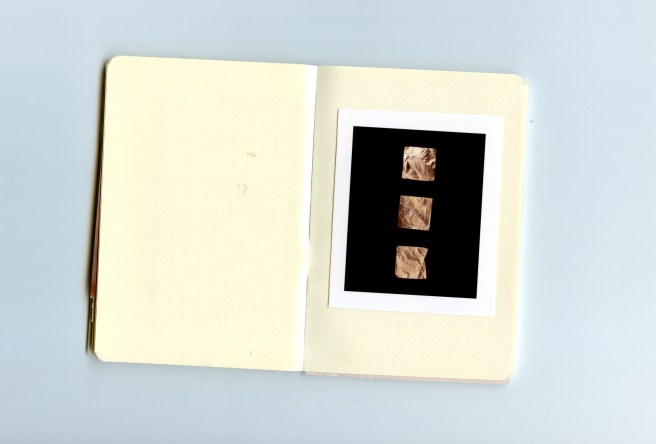
This is a real blade and I would very much like to include it as such in a version. I wonder about making an expensive version of the book which has this and other interesting things like a fold-out page  (see below) for assessment but if/when exhibiting make a zine run which will need it to be a photograph. I would need help with a book and have mentioned this to another student who made a very beautiful book. I know where my skills lie and bookmaking is not one of them.
Dummy book 1003
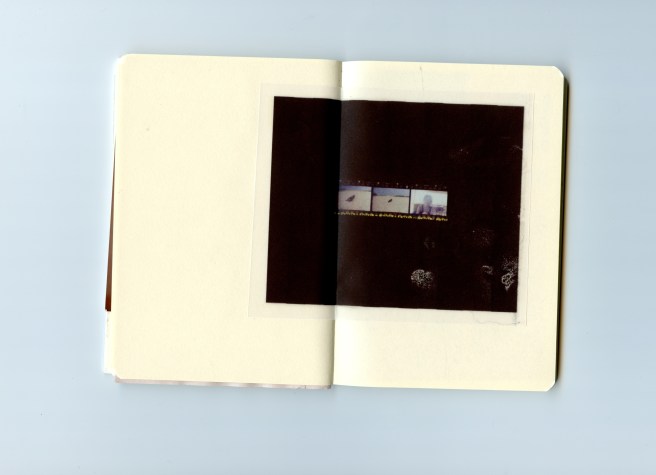
I am likely to use either a frame from processing for this or the shot with the female scattered. or a sequence
Dummy book 1004
Folds out because of the size but in a finished product would not.


Dummy book 1006
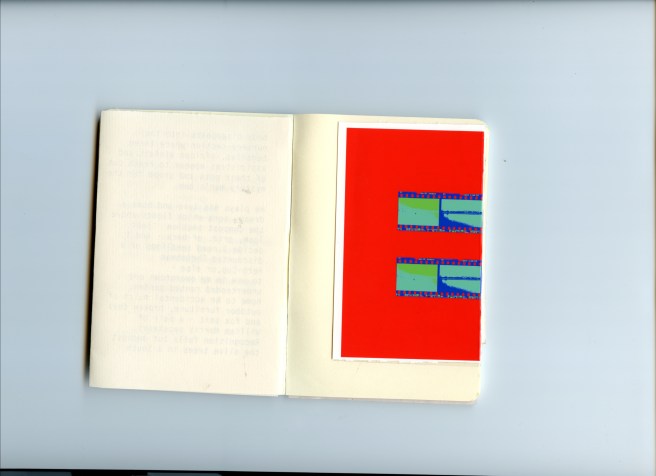
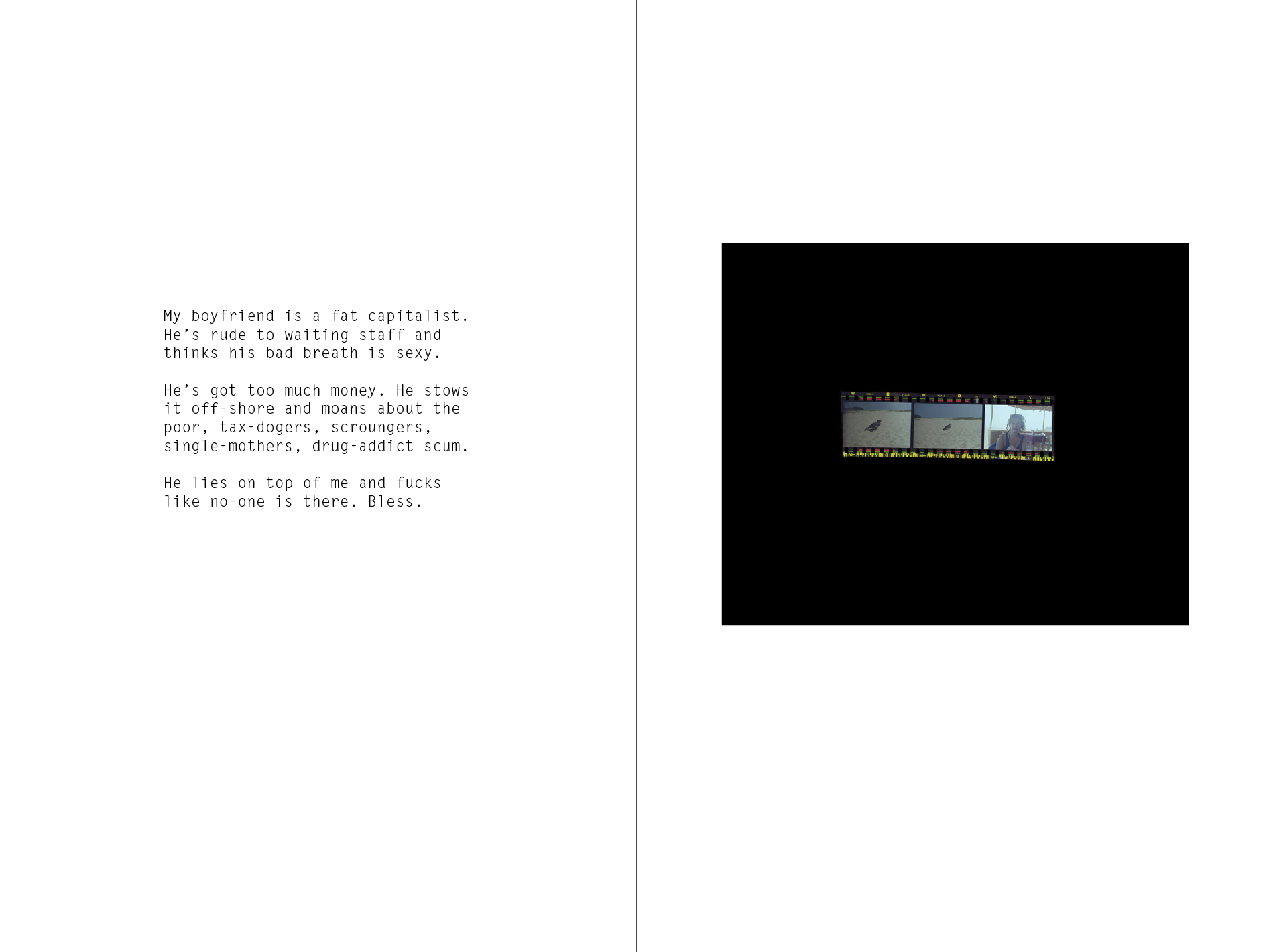
Mistake with printer which I liked split over two pages in fact, then didn’t like all the yellow on this and next page, so tried the red. My son loves this colour mix, I don’t, and will remake using specific negs I have identified. Scanned.

Dummy book 1005

Dummy book 1007
Will use something from Three Sisters or Uncle Vanya. Wasn’t sure but then realised the unconscious entanglement meant something – this book is about meaning emerging out of entangled interactions so will keep but not sure what passage.
Dummy book 1008
Like this combo but will play with other versions of selfies

Dummy book 1009

Dummy book 1010
Mistake covered up with something lying around  – like it. but need to find another or make sure I can take this out and scan it well enough. I do like these colours and wall paper.

Dummy book 1011Dummy book 1012


As mentioned, some notes from my phone with ideas, writing, things I’ve heard etc. I actually like the randomness and unstructuredness of some of this as-is, there is a freedom to it that isn’ in the earlier stuff:

The traumatised grown up

Sons hand me their hatred to carry around 

To the academics who fail to recognise their privileged booty 

Manifesto for the digitised self/age 

/ Alexa I’d like a wife

Sure, it’s fine for Philip Larkin to peer out of his train window and scoff at cheap fabric and gaudy hats 

Behind the shopfront, beneath the surface  everyday consumer 

Transactions – film world 

Trapped inside these words which cannot entertain a different world  

Split atom

Colonialism 

Sum

Of

The

Time 

&

Other 

Entanglements 

Reality is fucking with you 

Void realm 

Simpering 

Deity, divine, godhood, diabolical, decapitation, apotheosis, Ex rain god, enchantment  / Zeus sat down with Greta Garbo  – they don’t know how to create gods anymore, they worship objects. Laughter/ Zeus, my children don’t listen to me, I might as well not exist, I despaired then you and your friends came along, but then it was like the old days, not like that guy who wanted sole charge. He got it all wrong, 

There are no photographic records of my Czechoslovakian relatives, brewers who perished under the Nazi’s, in camps and ghettoes – missing images 

Mushroom, beige, magnolia 

Cut advert, cutting room floor, shiny nose, cut hair, terrible ‘boyfriend’ jerk, more money than any other job, least money with the BBC – most recognizable.

Floor, my entanglement with Tom 

Artist: More thoughts on Edgar Martins, Soliloquies book

Some fellow students may recall my angst about spending money on an Edgars Martins book just after Christmas. I had already seen a few books advertised which I knew might be helpful for research but out of financial reach right now – but this particular book seemed so pertinent, I couldn’t let it go. I was lucky enough to get hold of the last copy from Moth House and it has indeed been helpful.

One of my main interests was exploring how Martins uses material from a range of sources in the same project. He does this across his projects but the suicide and death topic reminded me of my own Self & Other A5, so I was keen to see the book, shown as prints in an exhibition and can include video format there and online too. The series contains found, original, archive and text. There are tropes and conventions in his work which I have found myself engaging with over the last couple of years, and that is absolutely what I am interested in too.

The essays have been excellent resources and will undoubtedly be referenced in my CS work. Here I want to point to two sentences that are of particular significance.

From Roger Luckhurst’s essay (118): After discussing various sources for images including ‘found’, ‘puzzling insertions of landscapes’ ‘stereoscopic views, vintage newspaper photographs’ ‘odd theatrical and enigmatic visions’, he writes, ‘These seem to work to derail the over-coherence any series or display or exhibition of book inevitably imposes, fighting to keep the grid of meaning open, defying the dread determinism of forensic files.’

(114) ‘tugging at the links that have been reinforced by dominant theories of photography, since at least Sontag and Barthes.’ (I find the phrase ‘at least’ a bit odd actually – yes these names are the dominant ones, but photography has been around for a nanosecond of time in the grand scale of art – its own sense of grandiosity belies its infancy. However, it echoes the status quo, of course.)

Martins is, like me, looking at ‘the cut’ – how we define things, how we are entrained to catalogue and categorise – and asking us to not make assumptions. He does this here through the doorway of death, suicide, forensics. It didn’t take long when I started looking at his history to find references to quantum philosophy but where I look at the concept of indeterminism (Barad, Rovelli, Bohr) he ‘sacrifices’ cohesion for the notion of countless probabilities (Heisenberg). Whichever, there is an interest in overcoming the fixity of Cartesian thought or Newtonian certainty.

In 2018, ex OCA student (now studying with Oxford Brooks) John Umney sent me a message and he has agreed I can share our interaction here. (29/09/18)

Screenshot 2020-01-19 at 17.37.50

I had been experimenting with blocks of colour, filters, covering up faces as the filters do, the ease with which we can all manipulate images, adding new/modernity/digital tropes to old images, intervening on analogue surfaces with digital animation. I guess my main interest was how easy it was becoming to intervene, to manipulate and to be manipulated. In fact, I started a project which I then abandoned called Manipulated. It seemed too trite a title and I wasn’t that keen on the images I was making but the idea of moving image with still, audio with still, and layering has stuck, modern and old together has stuck. And the filter we place over our faces, the regular circle of profile pics. Below, one of my own examples from that time – curated, found, added to. (Lots of this in 2018/19)

ThreePeoplehavingDrinks001cropped

It is hard not to notice the tropes in Martins’ work running through my own. I must be frank, I took a very brief look through the book and stopped, heading instead to the essays. The images were too familiar and similar to what I have been doing with scans and negatives and paper for my current project. I was worried if I kept looking, I’d be frozen with fear of being too similar. I have continued to worry about this – but I know Martins is one of several artists such as Eric Kessels, Alexandra Lethridge, Joe Rudko and Thomas Hauser to name a few who make work in this way, using these non-conventions, sourcing the old and adding to it with the new. Something Catherine said about one of my efforts having the air of forensics worried me as Martins’ work is highly influenced by that – but again, how can mine not be when I have been reading Tagg and Sekula? So I will keep going and hope to goodness my writings and feminine view give it something that is just me. But what I have noted about his work is that it is very clear contained and demarcated  – the indeterminism is held quite securely. I don’t think mine is. We shall see. And I will look at the beautiful book more carefully when I have completed this project. Incidentally, it’s not for resale – I think I will come to love it. But I have some others by popular artists that are if anyone is interested!

On another note re-books, I am going to borrow Hura’s The Coast which I was so keen to look at which pleases me immensely. I think the combination of text and image plus his interest in context and relation will be useful.


BOW: A bit more work

  • I may have secured a way to create an image of film stock (or at any rate a tiny bit of the silver halide crystals) at extremely high magnification on a scanning electron microscope (SEM). This is not as high/deep as a scanning tunnelling microscope but nevertheless exciting. See the difference here. Quoted from the linked article – ‘The scanning tunneling microscope (STM) differs significantly from the SEM. It is capable of imaging objects at ten times the lateral resolution, to 0.1 nanometer. This is well down into the quantum realm.’ I am excited about this and will keep looking to see if it would be possible to look at the atomic level too. If this does happen the images will be for a later iteration as I must wait until half-term to get it sorted.
  • I keep trying to make time to take more images (with my usual bashed up old canon) and really need to  – I may well have a bit of time tomorrow but I don’t yet have the objects I have been trying to gather, so I will use the time to reshoot some of the things I shot the other day (see notes in PDF below  – but needs opening up in Adobe, so see screenshot).
  • I played around a bit with the images I took last week and the text. There are notes beside images, but basically, I need to reshoot, shoot more, work on the writing, make the Processing files I’ve been considering and pull an edit together in the next ten days or so  – plus print something because I can take it along to a study visit this weekend.  And finish off the Part 3 coursework (which won’t take long but needs doing) What a lot to do. Cuttings 1Screen Shot 2020-01-14 at 21.20.23
  • Oh yes, for now, a working title but perhaps it will stick – not sure of the subtitle but the main one seems to encapsulate the project and has a multitude of relevant meanings. Cuttings: manifesto for a digitised life

Some screenshots of combinations I liked when playing around with versions last night.


Screen Shot 2020-01-14 at 19.52.30

Bow/CS: Life After New Media, Kember & Zylinska 2012

Some useful references: see artists highlighted in chapter below

See  –  https://www.richardgalpin.co.uk – an excellent visual metaphor

See – http://www.ninasellars.com/?catID=30 Final section in chapter provides a useful analysis

Possible inclusion for CS: The compulsion to define photography in an essay (see CS A3 and early drafts fo DI&C essay) is not merely a means of identifying what the inquiry is about. It goes to the heart of the matter which is querying the ‘Cartesian habit of mind’ (Barad, 2007). This can be resolved by seeing ‘the cut’ for what it is – a way of making meaning out of the chaos and creating matter (material or discursive). I do this making words and categories, painting, sculpting – or by capturing photons when creating images – regardless of what I do with those photons thereafter i.e. add traces together to create movement or give the illusion of stillness  – a freeze. What happens thereafter is not is being explored in this instance. It’s complex though because the thing that I do to make order (cut) compels me to want to cut photography up into a hierarchical system.

Ultimately, it is not the material, equipment or medium which is being critiqued – but the mindset.

Backed up by the following which also helps to define the cut. Highlighted sentences from a critical chapter of Life After New Media: Mediation as a Vital Process by Sarah Kember and Joanna Zylinska (2012)

With Notes – 3 Cut! The Imperative of Photographic Mediation

Kember, S. and Zylinska, J. (2012) Life after new media: mediation as a vital process. Cambridge, Mass: MIT Press. At: http://topologicalmedialab.net/xinwei/classes/readings/KemberZylinska/LANM.pdf(Accessed 11/01/2020).

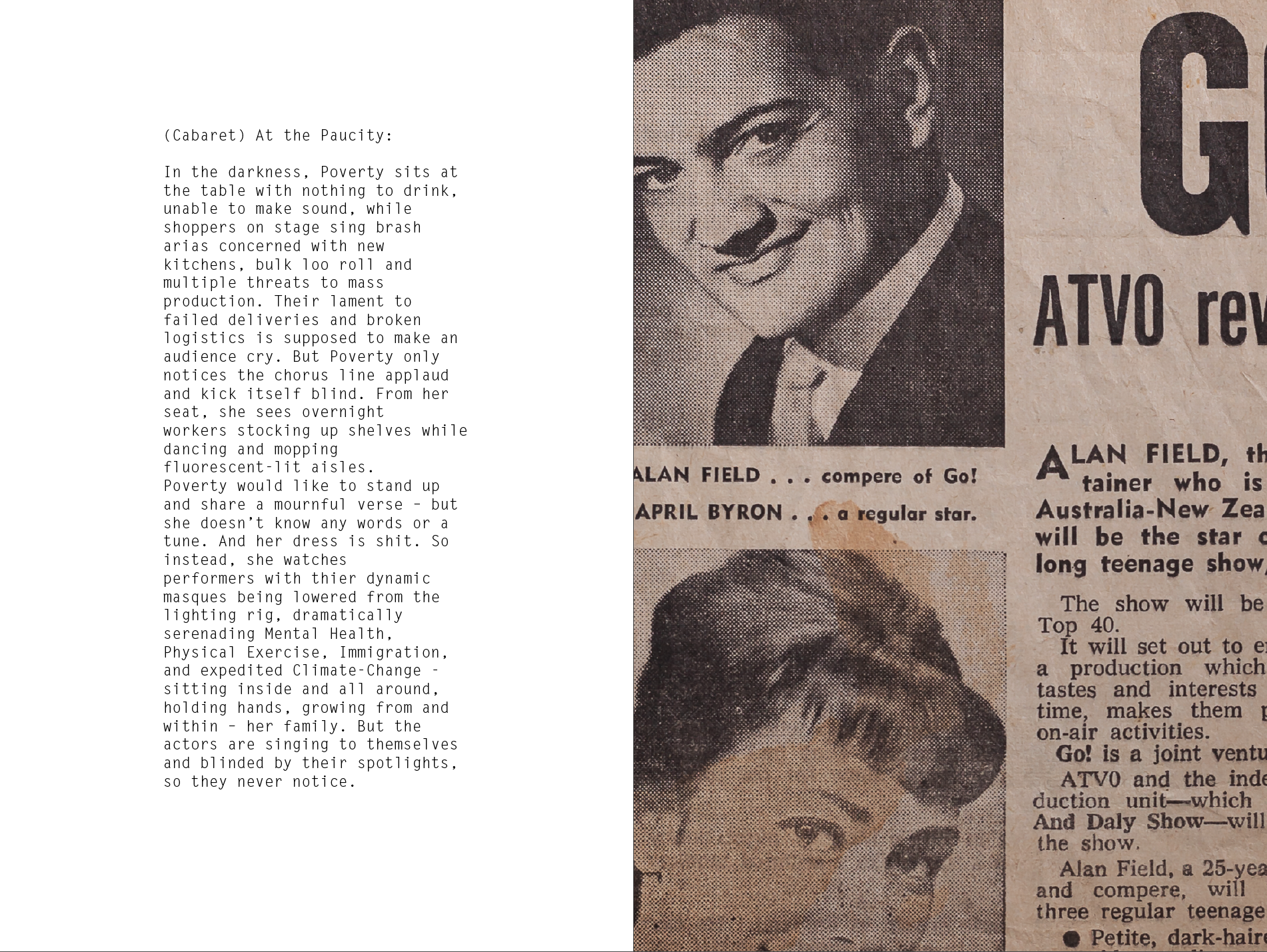
BOW A3: Text’s rewritten and placed in a suggested format

I have spent the evening rewriting some of the texts and placing them into a book form – I’ve rejected the first ten or eleven I wrote but after that, they started to improve. -although still needed attention.

No doubt I will continue to write and make changes and add other writings. (Plus there are likely to be typos – editing straight into ID is not really ideal for me – I’ll have to transform to word and spell check later.)

I have not identified images to include but now that I can see an arc, I feel what is necessary will begin to emerge. I am interested in the Processing exercise I experimented with the other day using Tom’s First Film. (Not included any writing prompted by that in the collection below yet – will do later and then will see if it fits.) The possibility of corrupted, machine-informed collages might be just what is needed. Having put these texts into a format, I feel I can get on with that – I feel I have time and space ahead now (although received feedback from Matt for CSA3 which I need to write up and post too.). It would certainly fit the remit of ‘Chance’ to do things that way.

The theme of selfies seems to have emerged as significant which is hilarious given I stated quite clearly I was not interested in making a project about selfies in an earlier reflection.

This way of working feels completely counter to all I’ve been advised and learned the last few years… but it’s the way that’s led to something so I need to keep going. Saying that – it does feel emergent and informed and organic.

I have left space for images in the book as laid out  – I think space will be very important. But the order is not fixed, nor is the layout, or the texts included, or the size –  and there are no images (yes, I know, it’s a photography degree…) except for the ones I experimented with earlier. But I don’t think they are right at all.

And there is a bit of writing yet to be done – I have entered a heading on that page to show where it would go.

BOW A3

BOW: A3 ideas

  • Book
  • Website
  • Working towards installation consisting of moving image, still, text and objects

Main themes

  • Consumerism
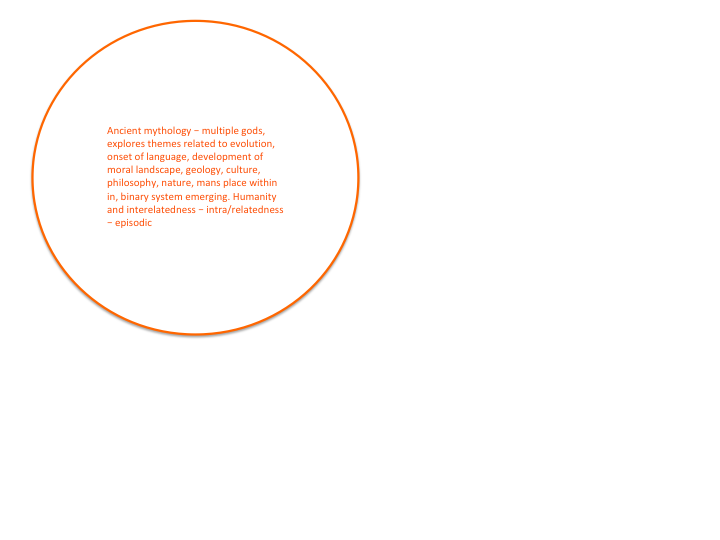
  • Mythology (classical and modern) See below

https://vimeo.com/376661589


Click on slide below to see what each says – the animation above is meant o to indicate how all these are ‘entangled’ and part of the mesh life intra-active reality we live in today.

See more here: https://sjflevel3.photo.blog/2019/12/01/bow-ca-an-attempt-to-put-bubbling-concept-outside-of-me/

Current concepts to contain this:

Main Title – ‘????’  (Random notes for a short story?)

Subtitle – ‘ :a manifesto for the digitised self’

Will keep playing and thinking re the above – not there yet.

Need to focus on making work now – have been writing some of which is on Sketchbook blog – need to go back and re-look at quite a lot of the text, do rewrites etc. Feel The writing is the driver and the images playing second fiddle for now… need to change that. But in most cases, it was the writing which came first although Tom’s First Film (to be written) is inspired by the images in the film I bought to eBay. And having done that, I am returning to other films I’ve downloaded and looking for ‘kindling’ – i.e. frames that trigger texts. Below is a possibility for inclusion. Over the next several days (and beyond but in the immediate future, in order to submit A3), I hope to upload as many of these as possible and then will edit out much as one would with a sequence of images. using different materials to make ‘image’. This is an old image, incidentally, made while exploring S&O but not used.

Selfie-2  – A PDF to see what might look like in book form.

Selfie-1 –  Variation on a theme but prefer the above.

Many many more of these micro-stories to produce now….


BOW A3: Tom’s first film

Tom’s first film (1971), which I bought from eBay is a bit of a shallow pool which I’ve been thinking about and looking at for some days now… How am I going to make work with the actual imagery? – I can, however, think of several possible ways to play with the object. Once the kids are back at school I will have space and time to take some photographs of the actual film which I wanted to do but goodness knows what to do with the footage…

The film has, alongside other activities, helped to further consolidate directions. And I wonder if the film will part be of the journey rather than anything final.

So far I have made two experiments, here’s one of them. If shown in a live setting, it would be preferable to have the processing running live rather than a screen recording like this. This video is generated by code in Processing  – by randomly relaying screenshots from the film (i.e ‘agential cuts’ into Tom’s amorphous and unformed recording).  The film reminded a friend of a Goerges Braque image in tone and structure, which was encouraging as I stared at it wondering whether it was anything or not (see below). Braque’s is called Violin and Candlestick (1910) and I guess I might call this Processing experiment Camera and Food Processor. I need to ask Simon C. who did the Processing course at the TPG with me how to stop the random placements from all heading in the same direction. I wish I could do the course again to augment some of what we learnt as I am currently picking through old files from the tutors very slowly as I try to figure out how to do things. I might also get the code to record the iterations and then handpick still combinations that are most striking. When its running live, I particularly like the frames where the food processor appears many times at once – with black holes all over the screen.


Violin_and_Candlestick
Georges Braque Violin and Candlestick (1910)


CS Research: (97) (PDF) ‘Lights, Camera, Algorithm: Digital Photography’s Algorithmic Conditions’ in Sean Cubitt, Daniel Palmer & Nate Tkacz (eds.), Digital Light (London: Fibreculture Book Series, Open Humanities Press, 2015), 144–62. | Daniel Palmer – Academia.edu

This has some useful references included and the phrase ‘marginal’ referring to decisive moment photography which may be useful alongside ‘boring’ (Elkins) ‘conservative’ (Blight) and ‘tautological’ (me).

(97) (PDF) ‘Lights, Camera, Algorithm: Digital Photography’s Algorithmic Conditions’ in Sean Cubitt, Daniel Palmer & Nate Tkacz (eds.), Digital Light (London: Fibreculture Book Series, Open Humanities Press, 2015), 144–62. | Daniel Palmer – Academia.edu
— Read on www.academia.edu/30168558/_Lights_Camera_Algorithm_Digital_Photography_s_Algorithmic_Conditions_in_Sean_Cubitt_Daniel_Palmer_and_Nate_Tkacz_eds._Digital_Light_London_Fibreculture_Book_Series_Open_Humanities_Press_2015_144_62