According to Donald Hoffman’s theory which I have discussed several times (Literature review ), we did not evolve to see reality as it truly is, as has been argued. Rather, we evolved to see the sort of reality we need to see to for ‘optimal fitness’. We perceive far less than there actually is because to see it all would be unhelpful. What’s more, according to Hoffman, the objects we see, including space and time are like desktop icons – constructed objects that represent the goal we are either after or trying to avoid. As hard as this is to understand, and Hoffman admits he may very well be wrong but that his theory makes the ‘hard problem’ of consciousness approachable, his idea sits well with many of the other theories I have been reading about since I picked up The Ego Trip by Julian Baggini (2011) (when I began UVC) followed by a raft of other books exploring similar themes.
I have been trying to express and understand these subjects in my writing, and looking at and photographing objects and phenomena in the world. The photoshopped images below are attempts to explore these ways of thinking about the world.
Fred Ritchin’s After Photography (2009) has some good sentences which I will introduce into my Lit Review and no doubt take forward into the essay.
“…some quantum theorists, foremost amongst them, Neils Bhor and Heisenberg himself, argued that fundamental reality is essentially indeterminate, that there is no clear fixed, underlying ‘something’ to our daily existence that can ever be known. Everything about reality is and remains a matter of probabilities […] We have tried to use the photograph to concretize the probabilities (isn’t that what the “decisive moment” is all about?), reassuring us that reality is more solid than what our theories tell us.” (180)
In Data Selves (2019) Deborah Lupton quotes Kember and Zylinska (2012) to describe how photography is an “agential cut” aimed at imposing “meaning and order” and “delimiting choices” (29). As Ritchin says an alternative “may be too disconcerting, if not terrifying.” (ibid) As he describes, digital technology and photography in particular “can begin to be receptive to the oddities described by newer theories” [quantum and consciousness related]. (177) Superpositions, endless possibilities, entanglement, for instance, can all be alluded to using malleable data either as a process or a representation (which if one takes Hoffman’s idea on board are completely intra-related in any case).
Some sketches – I wonder if these would benefit from more contemporary mixes (a bit like Flowers for Donald). Still a bit Guardian headline pics for my liking :
Isle of White – windswept hilltopSimilar to above but layered with an anonymous 17th-century pencil landscape downloaded from Google Art and supplied by the Metropolitan Museum of Art
Windswept tree – shaped by the elements – differentiation reduced by processing decisions.
(See Orpheus story – trees to this day in shape of dance to his music)
Hoffman, D. D. (2019) The case against reality: how evolution hid the truth from our eyes. London: Allen Lane.
One of things about studying this way (as opposed to in a classroom) is there’s plenty of freedom to go off and explore – which I do a-plenty. But because I tend to stray quite far (which is a good thing, I think, despite unavoidable pitfalls) I am prone to missing out on some basics which would make things simpler for me if I’d visited them before approaching certain topics, or at the start of doing so. I probably should have read the following and along with notes on philosopher John Austin before tackling Karen Barad’s paper. Having done a bit of digging, I get a much clearer picture about her rejection of language in favour of matter although I probably stand by my arguments for seeing language as a form of matter. I am also certain my experience of ‘actioning’ a script is going to inform my understanding and will be invaluable. I will add to this post once I’ve read Moya Lloyd’s chapter below.
To read and makes notes:
Metaphore widely used – perform
Derives from performance studies – dramatic terms OR sociology to perform a function in everyday life
Connote different things – 1 to act out or 2 to achieve an acceptable level of proficiency – a 50s man reached pique performance if he went to work and provided for the wife who achieved hers if she provided supper and slippers, etc. (no matter the cost to either) – etymologically different:
“late a5c., “accomplishment” (of something), from perform + -ance. Meaning “a thing performed” is from 1590s; that of “action of performing a play, etc.” is from 1610s; that of “a public entertainment” is from 1709. Performance art is attested from 1971.”
Difference between performance – performance studies and performativity from linguistic studies – (verbal acts which have an effect on the world)
Bulter in Gender trouble suggests both gender and sex are performative (3)
Austin JL – originates from
Beauvoir (Second Sex) body is not a ‘natural fact’ but an ‘historical idea’ (4)
An identity through a ‘stylized repetition of acts’ (Beauvior, 1988-519) (5)
Butler – Turner, life as a ritual social drama – depends on repetition of social performances – (see Chater) page 6
repeated social performances (6)
replication of corporeal repertoire (7)
a gendered subject is produced (little autonomy or volition) NBNBNB
Collective rules around acting out gender and sexuality
Page 11/12/13 Erving Goffman – “frames”
Sociological sorting 1977:302-3
Doing gender is unavoidable page 14/15 west and Zimmerman 1987:137
Differences in gender performance between Goffman and Butler page 17
(Remember entanglement – Barrie who wants value non-linguistic elements of an assembly that results in)
How to do things with words
MacKinnon 1987: 171 page 18 pornography see example in S&O – nail polish NB page
I just discovered this as a draft – but never posted. The following passage is great.
“We might also beg questions of photography’s current relationship to non-representational theory here, a space in which we attempt to do away with the linguistic connotations of “reading photographs”. For as Piere Taminiaux notes in his The Paradox of Photography (2009) ‘Photography thus signifies both an end and a beginning to representation.’ Whichever theory of representation one might support, let’s remember John Harvey’s lines in his Photography and Spirit (2007), as both a criticism and a warning against such inconsistencies, which seem to forget that in the context of photography (and pertinently in the case of the algorithm), magic might not be made by the makers of photographs at all: ‘Pseudo-photographic relics and spirit photographs share not only the mystery and miracle of their manufacture but also the status of being representations of the spirit by the spirit’ [my italics].” (2015)
Update after finding post:
It seems that scientific theory is heading towards rendering representation key to our existence (Hoffman, 2019), I am not sure what to make of “Photography thus signifies both an end and a beginning to representation.’ It’s an odd sentence which I can’t make head nor tale of.
I do know Representation is under suspicion. On the one hand, science tells us we might only exist in a world of representation and reality is an illusion – on the other, science suggests phenomena rather than representation matters most. (Barad, 2003) Barad’s critique/thesis “refuses the representationalist fixation on “words” and “things” and the problematic of their relationality, advocating instead a causal relationship between specific exclusionary practices embodied as specific material configurations of the world (i.e., discursive practices/(con)figurations rather than “words”) and specific material phenomena (i.e., relations rather than “things”).”
Daniel Rubenstein argues against Michael Freid’s negation of theatre as art, quoting Lyotard. ” In Libidinal Economy Lyotard proposed that the role of the artist is to lay bare the mechanisms of theatrical [perhaps here we don’t even need the word theatrical] representation, to show that if there is anything real about representation, it is because there also exists a fully real virtual domain constructed not from objects and things, but from intensities, desires and surfaces” (2017)
As I figure out what my A3 research question is – the word representation seems to be one of the key subjects along with performativity and the collapse of fixed and certain boundaries (which representation seems so reliant on). I keep thinking about the conundrum of maths – supposedly the least emotive language that exists. Is maths a language or is it a real thing. Apparently, the clever people can’t make up their minds. But what if it’s both?
Hoffman’s book on reality paints a picture (see the video on Aeon in references) that seems to suggest that our reality is *one giant representation – a user interface, the purpose of which is to ‘hide reality’ which allows us to ‘control [our] reality’. Our objects are icons that we recognise to work out our best fitness choices – otherwise, we would be distracted by reality. Not sure yet where the maths conundrum fits here – but I do think if Hoffman’s theory has any credence then the illusion we create is the only reality we know and have, therefore it is real to us least, even though it is also representation. (“As an actor, I was not trying to fake it – I was trying to live it” – the most extreme example, the Method.)
*”When I see an apple it is a data structure – I am rendering it when I look at it. This rendering happens in everyday life (a description of fitness payoffs.)
data structure
rendering
space-time itself is a data structure
conscious agents – passing experiences back and forth
reality is like a vast social network
Emergence
Entanglement
Barad, K. (2003) ‘Posthumanist Performativity: Toward an Understanding of How Matter Comes to Matter‘ In: Signs: Journal of Women in Culture and Society 28 (3) pp.801–831. At: https://www.journals.uchicago.edu/doi/abs/10.1086/345321 (Accessed 30/10/2019).
I have a meeting with Matt White on Monday and waiting to hear from Ruth te A2.
I feel the Pic London project introduced me to useful ideas, concepts, and practices that were good to come into contact with. The actual work produced feels more exploratory and research-led than anything – however, the image of the inside of the cave which has been in my work previously seems to have played a significant role. I am not sure how I take some of my frustrations forward re. the group’s inability to make the improvisations function. I have thought about attempting it with other people. I could suggest trying it with the Pic London group but I am not sure they are up for it. It’s very difficult to read what’s going on there – perhaps because we were only ever able to talk online, I cannot work it out. One of the things I noticed in the Ballpark Collective’s statement is how very clear the rules were and how they didn’t speak about the work outside of the game:
“The parameters of this involve creating a moving image from 5 individual works, each made by one of the artists. Through the random act of ‘pulling sticks,’ the collective decided on a chronological order to respond and react. The artist who pulled the shortest straw started the process by creating a moving image piece based on their response to the theme Interdependence. The work was presented to the next artist, who then responded with a work informed by their interpretation, or reaction to it. There was no discussion between the artists outside the ritual of passing the work to the next, allowing the process to highlight individual perspectives and the gaps in communication. When the process was complete, each of the works was edited together to create a whole.” (2019)
These images seemed to be expressing a sense of existing in what I referred to as my ‘grief cave’. I think I even wrote a short thing about it – falling into the cave and bumping into a projection down there, an imp who played tricks and wasn’t real but was.
I need to revisit some work I began last year which I called “Manipulated: My Leica and I, Leica Amateurs show their Pictures (1937) rephotographed, edited, uploaded; phone & proprietary apps only (c)SJField2018. Some examples from the page at the end of this blog. However, I am not sure about continuing with the Leica book for BOW but I may transfer the basic premise to another or film or text of some description. https://www.instagram.com/fieldsarahjane Also, the experiments there are too static, not dynamic enough. (Not that all need to be the same – variety of unstable imagery was what I was going for – also the base image needs to move and come out of its place.)
Returning to the TAOP A3 (colour) assignment briefly – As far back as then I was focused on the use of the word theatre which has so often been associated with photography – I included the following slide at the start of the assignment:
It’s been fascinating reading through Fried and then various responses to his thoughts on theatricality and anti-theatricality, and then seeing the use of the words performativity used by Barad. I’ve noticed several related words on the Contents page of Feminist Futures of Spatial Practice: Materialisms, Activisms, Dialogues, Pedagogies, Projections 2017 [PDF] – such as dance, masked, imaginary, rehearsal, acting out, play. I think Fried’s negation of theatre is a complete misnomer and that theatre and theatricality are at the core of what it is to be.
I really had no idea that I would find myself revisiting the first dissertation (1994). This has all come about after asking other students for an alternative view to James Elkins’ statement that photography might actually be rather dull. Freid was recommended and now here I am – See previous blogs on Barad – performativity, and Rubenstein on theatricality and Fried. I have no copy of my first dissertation and no way of finding one. I could barely write at the time but I suspect it dragged my overall grade up from a 2.2 to a 2.1. I looked at the ritualistic origins of theatre. I explored ‘commune’. One of the things I noticed in the Rubenstein response to Freid was how everyone sees theatre as intrinsically about representation, a separateness between viewer and action, othering – but it strikes me that the origins of theatre are about oneness – an attempt to re-engage with the universe rather than draw away from it. It’s an early church.
I wrote about trying to create a universe in my BOW A2. Theatre is a reality laboratory. It’s not about trying to create a fake. Well, at least, once Stanislavski got hold of it, it no longer was. And then there’s the Method. Maybe Stansilavski was simply taking theatre back to its origins. Isn’t it funny that the fakeness of a diorama is where photography purportedly began (putting aside Azoulay’s ant-Cartesian reading of the origins of photography). I feel I do need to revisit these ideas – although I am not sure how just yet.
Below – a couple of the Manipulated (2018) posts. Visit for more.
To be clear; here I discuss the topic I am aiming for as I plan for the extended essay. I mention several key texts that I think will be helpful and which I will include in my A2 Literature Review. A previous blog also links to several important texts but there is minimal reflection in that one:
I need to get on with writing the literature review element of my extended essay. I am still thinking and gathering – but wanted to just put something down in writing to help me clarify where I’m at at the moment.
I’ve identified a key problem so far – how do I relate my inquiry which I think is about ‘the loss/destruction of reality (as it has been construed)’ to photography? After all, the degree has photography in its title and I need to link the central theme to that discussion. Photography has played its part in that destruction – although there are plenty of other factors/actors.
NB Destruction might also be seen astransformation. I believe this is what my BOW A1.2 is expressing.
Photography’s role in mythmaking
As I said in parenthesis in A1, “photography may have been a very brief interlude in the journey that begun with cave drawing, developed to become printing, followed by the invention of mechanisation, and moving towards a total simulated reality” (2019; 6) In response, Roberta suggested, “Although this has not diminished the demand for those other media – indeed it has given them a new lease of life.”
Printing is in trouble – we do still buy books but it is in a terrible competition with digital text. Painting, not mentioned above, which played such a big role in expressing religious propaganda existed in a feedback loop of development for that purpose. Although people still paint, I wonder if it is fair to say it is no longer used for what it was originally developed for – and that is a relic like still photography is perhaps becoming. People will continue to revel in it but they are making ghosts – sorry to all painters and still photographers. I do not intend to be dismissive – I understand lots of people still gain pleasure from these media.
2. I am also aware that my first essay could be read as a justification for moving away from photography ‘proper’ and focusing instead on moving image.
3. It seems like a key question in that essay and previous ones, along with the way my work is going is: Why is it more useful/fun/relevant/interesting to look at how images are used rather than the making of them? This is where Postmodernism is relevant.
But I’m not sure that’s really what I believe or what I want to ask.
If the construction of reality is a continuous re-invention of the moment we’re in (which I think is a simplistic way of describing current scientific understanding), the conscious self relies on…
i. memory – an intangible remnant of consciousness which we sometimes exteriorise using various forms/materials;
ii. our hyperdyadic* existence – perhaps represented by collage made with appropriated material;
iii. and mechanical construction (which includes language as a technology – see Andy Clark) – perhaps represented by the output of machinery we have invented, and which to greater or lesser extent becomes prosthetic – i.e. phones.
*dyadic – interconnection between two things. Hyerdyadic – interconnection between many – lots of people but also the environment
4. Whatever route I take, James Elkins book What Photography Is (2011)is an entire book which isn’t really about photography, even though its title suggests that’s all it is about. It’s a response to Barthes’ Camera Lucida (1980), another book which suggests photography is its main topic but it might also be read as an elderly man coming to terms with his mother’s – and so his own impending – death. I need to learn from them.
How do I keep this related to photography?
I think I need to state early on – that I am looking at the moving image as well as still and come up with a generic term to encompass both. I might use ‘image’ and then qualify that. Image, therefore, might refer to drawing /painting/film. In which case, is there space or a need to address the arguments made about differences between each of these forms and attempt to lay them to rest for the sake of the discussion? (See Barthes – indexicality of photography and also Elkins’).
Perhaps I need to also talk about why moving image is key nowadays, and perhaps more so than still – as the masses embrace technology which makes video recording so easy, and advertisers use it more and more as it can potentially grab our attention with its movements and flickers more successfully than still. Or at least suggest we can make that assumption with some certainty. This feels a bit like a justification again and might take up too many words, but it feels crucial.
Although it may seem like I am dismissing still photography, I am not. In amongst the plethora of photographic projects and bodies of work which all seem very similar and flaccid, there are a number of photographers making potent and striking work, such as (but not exclusively) Thomas Ruff and Zanele Muholi.
(Intention is key)
Elkin says, “beyond that, talking about the surround as I did for the photograph of the greyhound reveals that the surround is boring, and possibly also that photography as a whole is, in the end, also a bit boring.” (loc 1706) Perhaps, I will suggest that if this is true it is because we as a society are desensitised to photography, now that its initial magic qualities have faded. Seeing a photograph in 1845 must have been incredible and exciting and perhaps awe-inspiring. To capture a person and then have them rendered as delicately as those older processes were capable of would have seemed extraordinary. But now it is mundane and every day. Now our representations move, can be built by anyone – even children as young as two, and offer adventure and flexible narratives. They are engrossing and enticing and overstimulating. So the poor old still photograph has a great deal to compete with. While some, perhaps people with time on their hands, may revel in the luxury of contemplating an image of a leaf or a fragment of a person or people, or the emptiness of a blank page, others are fed a diet of shiny, fast-paced, noisy and enticing media. Most of us have this latter fodder in our lives and perhaps that is where the mythology I am interested in exists. If still photography (academic art) is to remain relevant, then perhaps it can a useful tool for deconstructing the myth I’m exploring.
Art photography is often inherently elitist. Not always, but so much of it can’t help being so – refs from Elkins:
“It is easy to agree that photography’s apparent realism has been formed by the middle-class hope that the photographs give us reality itself (as Bourdieu says).” (loc 762)“‘photography is most frequently nothing but the reproduction of the image that a group produces of its own integration’. (Bordieu, Un Art moyen, 48)” (loc 707)“For Bourdieu, photography is bourgeois to its bones, and it even includes its own futile anti-bourgeois gestures, like my own attraction to things that aren’t family photographs.” (loc 716)
Still photography is one fragment of a re-enactment of our biological processes – by focusing on it alone we persist with a Cartesian construction/understanding of reality. But it might be more relevant nowadays to explore these topics more holistically. Intro/preface?
Mythmaking
Hoffman’s book below references advertising and images extensively. Held within these images are myths.
I have become really interested in mythology – and the relationship between science and religion. It seems to me that both do the same things, i.e. put difficult concepts into narratives we can try to manage.
The following is from the author, Jonathan Raban’s biography A Passage to Juneau.
“Within the last 9,000 to 12,000 years, when people were present to witness such events, they would have seen the sea close over islands as earthquakes rearranged topography. You couldn’t look at the delicate compromise made here between land and sea without imagining the Flood: and you couldn’t imagine the flood without inventing a Noah or a Gilgamesh” (1999) (Perhaps this quote will be on the cover page or at the top of the essay).
Books
Return of the Real Hal Foster 1996
The Case Against Reality Donald D Hoffman 2019 (see below) (He mentions Plato’s Cave his description may be useful to quote.)
How we Became Posthuman Kathryn Hayles 1999 (in particular Chapter 7, Turning Reality Inside Out and Right Side Out: Boundary Work in the Mid Sixties of Philip K. Dick)
I need to look at Deleuze but I do not know his work and have no idea where to start.
Popular Culture, films, TV
The AO (Netflix) 2016-19 TV – Series One explores a kind of inverted Plato’s Cave which becomes a metaphor for digital culture. As part of my research, I have been watching plenty of reality-bending films and TV, this being one of them.
Total Recall, 1990 and 2012 Film
Inception, 2010 Film (this leads to Memento – also directed by Christopher Nolan but I am trying to avoid clinging to memory as a key theme, even though that is an important topic.)
(In the link above, I talk about several influencing works which had fed into my own practice but which may also be useful for the essay.
I will need to revisit this at Tate Britain as there is much to link to, moving image, youth culture, myth, everydayness.
2. Katinka Schuett, Cosmic Drive – I have only just come across this work and will look at it as a possible example of still photography looking at similar themes. ““Cosmic Drive primarily explores the way humans handle ignorance,” says Katinka Schuett of her Female in Focus winning series, which examines the contradictory spheres of fantasy and hard science. “I am interested in our perceptions of space, and the question of whether or not life can be found in the universe.” Schuett is as concerned with fantasy as she is with facts, merging the two to consider the illusions we create when there is a void of information. ” (Roberts, 2019)
I probably need to have a few more references here.
Blog Conclusion (not essay) – is there a question/title here yet?
I’m not sure … perhaps:
Should we re-evaluate our relationship to myth/humanity’s need to create myth? (And what role does the image play?)
I feel it will be necessary to use the word image in the extended essay rather than photography – because photography is such a nebulous term and describes a range of activities – and perhaps I need to explain in a preface. Does a preface count towards word count? Something to ask when submitting the review.
Something I’ve not addressed here which I think fits but which may be too far outside the inquiry – the body/blood/softness/boundaries/flesh. Hayle’s looks at this and references Donna Harraway several times – I don’t think I fully comprehend what’s going on here yet and need to read these sections again, as well as Haraway’s Cyborg essay which I’ve only read once so far (and found it a little bewildering – perhaps I was tired/distracted).
I know I am interested in the fractal nature of reality and our conscious understanding of it. So, we function (construct reality) in a certain way and the patterns of that construction are evident in our expressions (media – films/adverts.any narratives, the way we produce them.)
I still think I’m focusing too much on why photography is becoming irrelevant and need to look more at boundaries/flesh/death – life/self-other; I suppose these things to tie into myth and the breaking down of self as a definitive object as technology and science evolve. Therefore perhaps we might say, “it is a myth that you and I exist at all” – however, this myth is all we have and so we need to take it seriously even though we understand it is a myth.”
“Sometime in the not-too-distant future, anyone will be able to take a picture without a camera. Instead, we will be able to generate photographs, indistinguishable from those made by a camera, using artificial intelligence (AI) software. You will be able to create an image by simply typing out a description of the scene, or describing it to (presumably) Siri. “Siri,” you’ll say. “I’d like an image of a red-haired woman walking through a park in autumn, the breeze blowing red, orange, and yellow leaves around her.” And—though it may require more detail than that—presto! Your phone will provide various options on the screen to choose from.” (Palumbo 2018)
Other refs:
Raban, J. 1999 A Passage to Juneau, Picador, Basingstoke and Oxford
I have removed my own images taken with flash. I really don’t know what to do with the poem or those pictures. I don’t think they fit but are part of the process.
Or else, if they are anything, they are separate albeit related work.
Ruth really liked the poem and I am glad she did. But every time I think about adding it in some way, I feel now like I am shoe-horning it in. When I look at Ruth’s work, I think I can see why this appeals to her more than the montage film.
Here is the film as it is today. Same password as before.
But it does repeat what I have done before.
After thinking about adding the poem and images to the film in some at the end as an epilogue perhaps, I will now try somethings out with it in PS or Illustrator. I read yesterday in a group email from someone who attended Unseen in Amsterdam that much of the work was alternative processes and that there were hardly any digital prints at all. Why would everyone rush to do the same thing? I will keep exploring digital – how can we not at this time in our history? When digital is having such an effect?
The following are some specific influences in the work I’m making for BOW 1.2 (actually A2 in the file but I’ve been referring to it as A1.2 all this time…)
I learned about Joan Jonas last year during her show at the Tate and so much was useful for my own practice – such as layering moving image, sometimes mixing performance with other mediums, and all related to working from a feminist perspective, eschewing or perhaps exploring and offering alternatives to historical-artistic habits which might be construed as coming from the masculine i.e. relating it Irigray’s suggestion that the female subject cannot exist within current constructs. But perhaps one of the most helpful things Jonas said was when she asked viewers not to try and understand her work, but rather, allow themselves to experience it.
“My work is all about layering, because I think that’s the way our brains function.” Jonas argues that we always see and think of several things concurrently: “We see one picture and there’s another picture on top of it. And so I think in a way my work represents that way of seeing the world – putting things together in order to say something.” When Jonas started incorporating video into her performances in 1970, this presented new technical possibilities as she could not only do everything herself, but was also able to show different aspects simultaneously. Furthermore, it provided her with new ways of exploring the notion of “female imagery” in the prime of the feminist movement: “Women were kind of bursting out of their seams.” (2016)
Jonas makes work which attempts to operate in a different realm where instinct isn’t jettisoned and emotions are triggered although we may not fully comprehend why. And that is the kind of work I am experimenting with. I do this by trying not to think about what and how I’m making the work too much, influenced by Dada and Surrealism – and automatic writing. I might simply grab footage that appeals to me in some way, perhaps it is related loosely to themes I’m investigating, and then edit them together without thinking too carefully, to begin with. When I look at what I’ve made, I can find meaning and signifiers that make some sense (to me at any rate) and might develop certain threads which I recognise as having a connection.
2. Re-evaluation of strict rational/logical
I do not eschew rationality but we have throughout Western history (Logocentricism) valued it more highly than instinct in our culture. However, there are many instances nowadays in popular culture where the non-rational is being re-examined and celebrated – any superhero film, but also and more specifically, although the list is much longer than this: Inception (2010) film, The Lost Room, (2006) TV, The OA, (2016/19) TV, Russion Doll (2019) TV. (I do plan to write about the bleakness in many of these shows and relate it to Leckey’s work – see below as well as the blurring of boundaries between life and death, this world and some other world, about the loss of reality which might also be described by some as ‘the end of history – Hegel etc.).
Neuroscientists are also more inclined nowadays to suggest non-rational thought has been under-valued, instinct has something positive to offer, and that we may have lost something along the way.
“Indeed, relying on your intuition generally has a bad reputation, especially in the Western part of the world where analytic thinking has been steadily promoted over the past decades. Gradually, many have come to think that humans have progressed from relying on primitive, magical and religious thinking to analytic and scientific thinking. As a result, they view emotions and intuition as fallible, even whimsical, tools.”
“However, this attitude is based on a myth of cognitive progress. Emotions are actually not dumb responses that always need to be ignored or even corrected by rational faculties. They are appraisals of what you have just experienced or thought of – in this sense, they are also a form of information processing.” van Mulukum (2018)
However, this revaluation of rationality also seems dangerous in many instances, such as the growth of the anti-vax movement or the Flat Earthers (I am convinced some Flat Earthers are simply ‘taking the almighty piss’ – Australia is a hoax, for instance, is just too, too mad.) Even so, I can’t help but see that the story of Cassandra as salutary – in it, the symbolic and the rational are valued but the imaginary and instinct aren’t. The feminine and the traditionally related non-rational, are dismissed as the mad ravings of a lunatic even though in the end Cassandra, condemned never to be understood, was right.
The desire to revisit tales of witchcraft (as seen in the collaborative work with Pic London – some are exploring elements) is also related to this trend. One of the workshop leaders Una Hamilton Helle is part of another collaboration – Waking the Witch:
“Traditional witchcraft has a strong connection to the earth with an intimate knowledge of herbs, plants and the elements – as well as the human body. As gatekeepers to altered consciousness witches have been both feared and sought out for their dealings with the unknown. Historically persecuted as an outsider, the witch has been taken on by artists as a challenging force to prevailing norms and as a symbol of dissidence. Looking to symbols, tools and the coven as a space for focusing collective intent, the artists in this exhibition explore the path of the witch as one for how we can connect with the earth and each other.” (wakingthewitch.uk)
3. Walter Benjamin as quoted in James Elkins What Photography is (2011)
Another reason for making work this way, is because my head is filled with fragments of emotive information gathered from a lifetime of watching films and TV.
Loc 1311 – “…film he said, creates a percussive shock to the consciousness by continuously changing scenes, “I can no longer think what I want to think.” he writes. “My thoughts have been replaced by moving images.” (The Work of Art, in Illuminations, 238)
See mention of Virillo below – who also discussed fragmentation and film.
4. Hannah Höch
I have been a fan of Höch since seeing her work at the Whitechapel when I first started with the OCA. I couldn’t believe I’d not learned about her before. Strangely before going, I was not particularly looking forward to seeing her work and didn’t think much of montage! “I didn’t think I was going to enjoy the Hannah Hoch show quite as much I as did, despite having read somewhere that it was the must-go-to show of the moment. I’m not sure why, especially as I’d been in a reenactment of The Cabaret Voltaire at Manchester Metropolitan University, shortly after graduating in 1994 and enjoyed it immensely.” (Field 2014)
“Photomontages were the original remix. In the early 20th century, a group of European artists spliced together images they’d found in popular media, creating singular artworks via a strategy of sampling. The results show both individual statements by their makers and cross-sections of visual culture from a particular historical moment… []
… one of the few female members recognized by the movement, offered a refreshing antithesis to such macho constructions. Her own photomontages offer kaleidoscopic visions of German culture during the interwar era, often from a distinctly queer, feminist perspective.” (Cohen, 2019)
Collage is a representation of fragmentation and may be an expression of the sort of continuous changing scenes as mentioned by Benjamin and also Paul Virilio who I quoted in DI&C A2.
“The cinema shows us what our consciousness is. Our consciousness is an effect of montage. There is no continuous consciousness; there are only compositions of consciousness […] collage, cutting, and splicing. We’re in the age of micro-narratives, the art of the fragment.” Paul Virilio (1932-2018)
In my work, I make collage although it is moving-image and contains audio as that is more relevant for today when we are surrounded by adverts that flicker and emit sound constantly – on our phones which we carry around but also in adverts, on escalators, everywhere. This is explored in plenty of science fictions films too, for example, Blade Runner (both 2017 and 1982) and Total Recall (1990 and 2012).
Fragmentation was embraced in theatre, and Brecht’s desire to move away from soporific shows that hypnotised people into accepting their lot in life was replaced by episodic writing of his Epic Theatre which he hoped would make people angry and to act. Ironically, TV today routinely follows the same pattern and time is chopped up and edited, especially in soap-opera’s and sit-coms which are also often accused of hypnotising the masses into accepting their lot in life.
5. Mark Leckey
I had not heard of Mark Leckey until my friend, a filmmaker who I showed DI&C A5 to, said that the first section reminded her of Leckey’s Fiorucci Made Me Hardcore (1990). Then Catherine (OCA student) suggested meeting up and we chose Leckey’s new show at Tate Britain – O’ MAGIC POWER OF BLEAKNESS (thank you Catherine for kindly suggesting something she knew would be useful for me). I went along and watched the film and spent the whole time thinking, “F*%K! This guy is doing what I do and including signifiers such as networks and space and noise and computer-generated pixels. Except he has way more money and lots of amazing audio and huge screens and other equipment with which to do it!! I am very much committed to a Brechtian eschewing of expense and prefer to embrace using everyday objects, to beg, borrow and steal, to creating Heath-Robinson contraptions. But I was nevertheless somewhat envious as I’m currently desperately trying to bring something together with no money and no tech skills.
However, watching his work also gave me the confidence to keep going.
The overriding sense was, as mentioned in the title, bleakness. The AO (Netflix) also generates something of this in relation to youth culture – and it is this bleakness and indeed horror which sends the characters into different realms. (Which of course also relates to quantum suggestions about multiple universes – I keep thinking about how this relates to myth in general – and the relationship between science and religion.)
Ruth suggested Painlevé’s work and they are indeed beautiful films which look at the strange and wonderful creatures that are part of our world, and which looks bizarre to us but we are no doubt horrifying to them. In my work, I look at the very small and liken their worlds to ours. What I rather like about is the music which is more like something you’d expect from a Hitchcock film. Constructing realities…
7. Rivane Neuenschwander born 1967, Cao Guimarães born 1965
Continuing from above – looking at creatures smaller than us, I loved the film described below when I saw it at Tate Modern recently. Although there is no montage here, the focus on creatures with which we share the world and who interact with us, even though we may not know it, is key.
“Quarta-Feira de Cinzas / Epilogue 2006 is a single-channel video lasting 5 minutes and 48 seconds and shown on a loop. It features a ground-level, close-up view of red and black ants carrying coloured confetti across the floor of the Brazilian rainforest. The film starts with one ant carrying a piece of gold confetti over a gritty surface, followed by shots of differently sized ants attempting to grip or drag confetti across soil and tree trunks. As the video progresses it begins to show multiple ants per scene: a pair collaborate to move a disc up a small hill, and a group fights over a piece of silver confetti.” (Karmen, 2018)
Rist was suggested as someone I might look at in feedback for BOW A1. I wrote about her in S&O. I have been influenced by her work in many ways and love how she discusses language. While thinking about how/what to do with the poem, I have been reminded about Rist’s recent work – pressed up against the glass. This glass screen image has been referenced in Netflix’s The AO too – where young people (Millenials) are imprisoned in glass tanks, like fish – unable to touch each other, as if locked behind screens and reliant on a powerful but far from perfect and punitive God-like character what manages their time/food, etc. (A metaphor for the keepers of the technology that imprisons us).
I need to work out why I thought of this. I think it came about by thinking about filming my mouth speaking the text – but this feels a bit hackneyed.
Although the poem doesn’t mention glass or social media, but as Ruth (happily) picked up on it is very much about now, about being unconnected and existing in some sort of limbo much like the imprisoned Millenials in The AO.
One of the things Ruth said about the earlier iteration of the film is that it didn’t feel political in the same way the text did. I hope by simplifying I have rectified that. (All my work aims to be deeply political).
James Elkins What Photography Is (2011)
I am adding this after writing about my Literature Review. Elkins spend a great deal of time examining the same sort of things I am referencing in the film and the poem.
The very small and the way technology is used to make the A-bomb and then dissect it. perhaps this inspection of what reality is the same inquiry into what a photograph is.
As discussed I attended three workshops organised by Pic London at LCC, led by Una Hamilton Helle and Joshua Bilton who were original members of a group called Hal Silver.
Pic London’s site told us:
The workshops will be experimental in nature and the focus of each session will be on collective forms of making, improvisation and group dynamics. This could take the form of games, role-play, unskilled mask and costume making, photography, video and sound recording. These process-led activities can be gathered into a final exhibition display, the form of which will be established throughout the workshop sessions. (2019)
Improvising in the dark at LCC with Hal Silver Courtesy of Pic London
We played a number of improvisation games including some vocal games devised by Pauline Oliveros called Sonic Meditations. (See below) These games reminded me of the kind of thing I did at drama school (1991-94). I introduced this exercise to the OCA Music Collective when Emma and I shared Sirens.
We also played an imaginary game where each of us had to come up with a character and then imagine ourselves in a village. Someone, it was rumoured, might have done something untoward and the rest of us had to make a decision about whether it was true or not. People were ejected from the game/executed/banished if individuals believed the story others told about them. We played it several times and invented many strange and bizarre tragedies which we blamed on eachother.
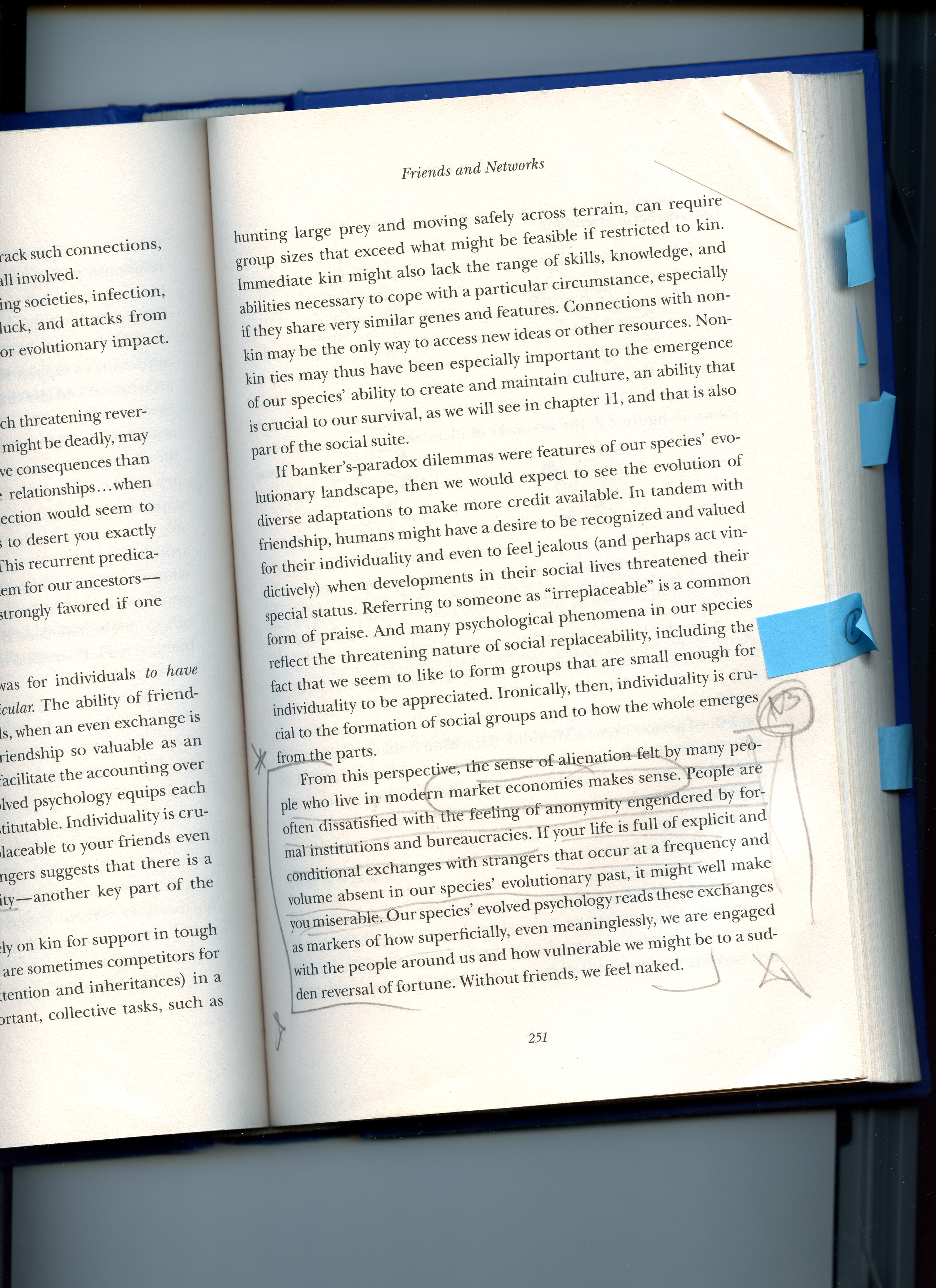
The Goodness Paradox: How Evolution Made Us Both More and Less Violent Kindle Edition, Richard Wrangham, 2019 and Blueprint: The Evolutionary Origins of a Good Society, Nicholas A Christakis 2019
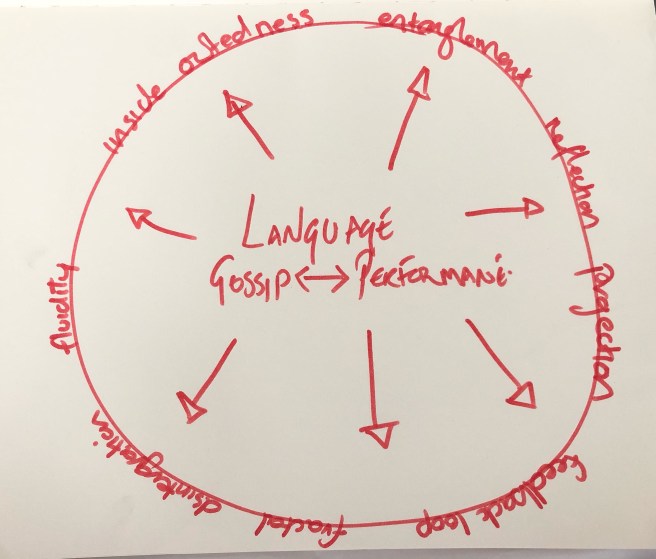
I had just finished reading the above books both of which deal with the way in which societies keep themselves in order (or not). Wrangham’s central thesis is that humans are the most violent and the most passive of primates at the same time and that it is language which enables this paradox. Language gives us the opportunity to gossip. Once we have that capacity we can lie, protect oursleves and send blame in a different direction. Cliques form which protects the group – the most cost-effective way to ensure survival for the individual and the group. Outsiders are seen as a threat to the group. To deviate from the norm is to invite extreme danger, ultimately execution. Through language, violence is planned and carried out over time, thereby distancing oneself from spontaneous aggression, but often finding ways to be far more aggressive in the long term. This distancing is contained in the law.
A photo I found on Twitter showing executions during the Spanish Civil War (will need to do a bit of digging to make sure that’s right and find the link)
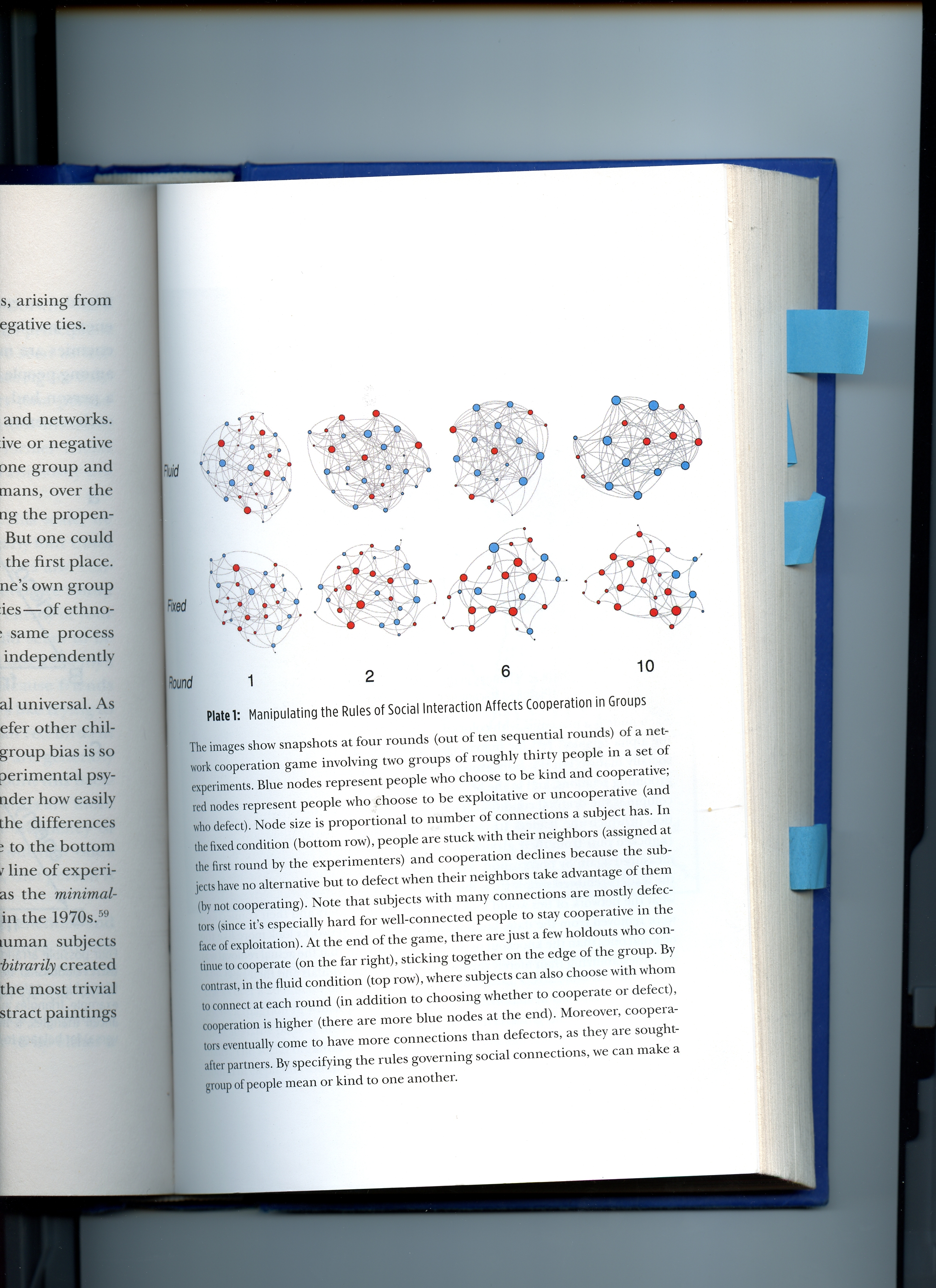
The second book covers some of the same ground but also looks at networks and co-operation. It is a more expansive thesis than Wrangham’s.
However, the two main themes emerged from the games and which I had just read about in these books; the role of language in establishing and maintaining groups and the networked nature of human existence.
A group discussion also led the circular nature of existence, history, culture and relationships.
Bringing objects, books, and games to the group.
We were all asked to bring some items to the second workshop – these could be objects, photos, text or games for instance.
I provided a range of things but the following have stuck.
Text from Christakis’ book
Books by the Situationists which focus on circles
A stick game I used to play at drama school which demonstrates to the players where your connection is strong and where it breaks down. At university, we might have used this as a warm-up game or as rehearsal support with lines.
In the spirit of collaboration here are some cropped images on one of the member’s of our group – Eva Louisa’s – Instagram feed which I took during a meeting at the end of the summer while playing the stick game. I should share it with my old head of school Niamh Dowling, now head of Rose Bruford – I suspect she would be pleased to see it. I think this image is being used by Pic London so I will wait and see and share that with her if so.
For me, the most interesting aspect of all of this is the language.
I am the oldest in the group and therefore immediately the outsider. There is one other person who is probably slightly older than the majority but everyone else is early-to-mid-twenties.
I grew up the 80s and the early to mid-90s were my heyday.
However, that is the least of it, I am sure. As another collaborator said to me when we worked together at the beginning of Self & Other while discussing the meaning and implications of other, “But what about your otherness, Sarah-Jane?”
Image from Self & Other A1 (2017)
And then how did we maintain satisfactory communications across social media? This was the only route open to us since we would all be scattered across the globe for the duration of the summer. Of course, prior to social media’s existence, we would have had letters and the telephone to use. We now have more opportunity than ever. However, it felt to me that we struggled to genuinely connect despite digital access – which was often unreliable, frustrating and fragmented. Or so it felt to me.
Most of the time I sensed I was talking into a void. I felt isolated and alone, often paranoid and like an outsider, a freak. Of course, some of that must be me – I do sometimes feel that way but it’s been a while since I’ve felt it with such force. Perhaps while I was married and in relation to some other mothers in the playground (but I know lots of other mothers feel this way in the playground too), certainly while I quite insanely joined the PTA after my dad died in 2010 (a short-lived experiment!), and when I was in a play at the Library Theatre shortly after graduating. Everyone else in the cast lived in London. I lived in Manchester and got the job at the last minute after someone dropped out. I felt horribly inadequate and was suffering the most awful acne at the time too. When I was a child I had this same feeling when I was sent to boarding school. A few months after being there I told all the boys about the girls wearing bras which was a desperately self-defeating thing to have done – I was the outsider and felt so wretched about it I made it worse by making sure I had to remain an outsider for even longer.
This sense is, I am well aware, partly self-generated but then some sort of transference and counter-transference starts taking place. I mention all of this as the poem I will likely include in some way is very much informed these feelings and my personal history with my own mother.
Continuing the improvisation across social media
Perhaps my history with impro or the fact that I meet OCA people regularly online meant I was flummoxed when attempts to get this going failed. I felt like a disappointed child realising that all the other children were really very grown-up and somewhat irritated by my enthusiasm.
Instagram
At our first online meeting (where it was very difficult to hear and see what people were saying) we agreed we would set up an IG account and post collectively there, responding to each other and attempting to continue playing improvisations games. One member suggested each taking it in turns to give another a task – out of which a resulting photo or text should be posted on the IG. We said we would start with some thought experiments. Then each of us should pass the baton on. Of course, if no-one started or passed it on the game would die.
Well, the game barely lived at all. And I got bored of waiting so set someone a task. They did it, posted an image prompted by the task and then stopped I think.
Nevertheless, we began to post images. I suspect some more than others. I posted images promoted by discussions online and in the workshops and in response to images by others.
Thought experiments provided by another group member as prompts/ideas for tasks being set. No-one had to use these but it was hoped they would prove useful.
I played quite a lot although did not share everything I made. My phone then stopped working altogether! And I was stuck in Italy. this was probably, in the long run, a good thing. I had a much-needed break from social media and had already posted quite a few pictures and videos anyway.
Click in individual images.
I don’t have all my images anymore after the phone broke and there was no wifi in Italy. So sadly I lost some originals but they are still on the IG account.
This account has led to a book which will act as a research footnote to the exhibition. I will add a low res PDF of the book after it opens. Massive thanks to Rowan Lear for organising this.
Research and Ideas
All the time I was in Italy I kept thinking about the village I was staying in, Ferentillo. I wrote about it here. It is a village I have stayed in and made work about several times as can be evidenced in my Sketch Book blog and in Self & Other A5.
Image from Self & Other A5 i will have call you (2018) made in Ferentillo, exploring the boundaries between life and death via mirrors in the landscape, phone apps and filters, and moving image.
This Family Too (2017) (A project which I never resolved and should return to – take some of these out and look again at the images and sequence. I recall wanting to make sure the sequence was random and could ask a fellow OCA person I know about setting this up in Processing.
And I submitted a book for TAOP A5 which was made in Ferentillo and included written work as well as images.
Notes which I shared about some of this work with the group:
Alain Fleischer, Mummy, mummies – a photography book with text in which Fleisher photographs the mummies for which Ferentillo is famous.
As discussed in several blogs above this work is mentioned in The interphototextual dimension of Annie Ernaux and Marc Marie’s L’usage de la photo‘ by Ari J. Blatt.
What caught my eye was the following:
“If Bazin offers a compelling theorization of the photograph as mummified presence, in his wistful recent book Mummy, mummies Alain Fleischer plays with that paradigm and examines the mummy itself as evocative of the photographic process. In this combination of essay and fiction that focuses upon a group of mummified bodies housed for eternity in the museum crypts at Ferentillo and Palermo in Italy, Fleischer conceptualizes the relationship between mummified and photographic traces: ‘Mummification and photography are united against the disappearance of appearances: they are alike in their materiality, their techniques, and their codes of resemblance.’”
Blatt, Ari J.(2009) ‘The interphototextual dimension of Annie Ernaux and Marc Marie’s L’usage de la photo‘, Word & Image, 25: 1, 46 — 55, 27 – Alain Fleischer, Mummy, mummies (Lagrasse: E ́ditions Verdier, 2002), pp. 15–16. Translations mine. (Blatt) Available at: https://www.tcd.ie/French/assets/doc/BlattOnErnauxMarie.pdf [Accessed: 24.May.2017]
I sent this document to the group and one of them picked up on another sentence where the darkness in the tombs is stressed.
Fiore
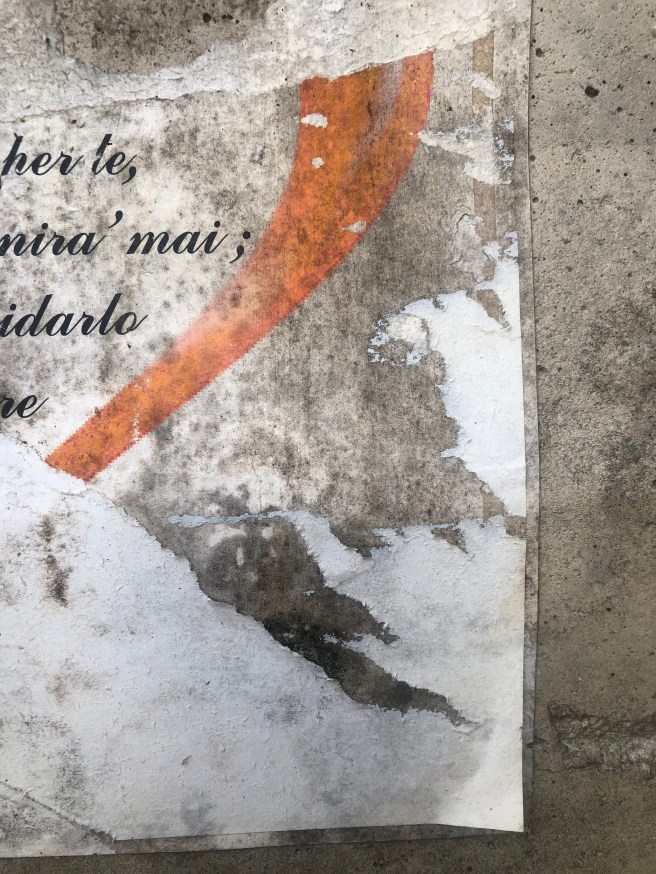
I thought about Fiore (mentioned in the poem) and all the other tragic stories – suicide, cancer, airplane crashes and wondered why there so many of them. I suspect it is the fact everyone knows each other. Death is also everywhere in the village – a Catholic community with a cemetery on the edge and posters announcing death all over the town as is the Italian habit.
And I thought about darkness and the work isolating. Before we got going with the IG, I had suggested a task – a self-portrait based on the character we had constructed in the game. This was blocked and portraits referred to as ‘isolating’. I felt this was unhelpful as self-portrait could be interpreted in many ways. I also wanted to say, that is what language is – isolating. All these happenings led to the flash images:
The film is made by adding all these fragments together. Although it may seem incomprehensible, I think perhaps that is what I am after as that is how I felt – as if life and language and being in the group were incomprehensible. I am not a Millenial. I grew up in the 80s as everything was changing and being set for the digital bubble to come in the 90s. (See Adam Curtis’s Hypernormalisation 2016).
However, now that I have worked on it this morning and added the Game Boy music as the only audio (which will be available online only so people can hold their devices and listen through headphones in the gallery is they want to – but a bit like holding a Nintendo Gameboy). Version 24th September 2019, Password Village3
Some further thoughts
Thinking back to the books I mentioned above – Wrangham and Christakis’, I have, throughout this process and while in Ferentillo, been thinking about the way societies evolve. Umbria is a perfect landscape/example for Virilio’s thesis whereby war is the main motivator of all technology stating that is what has driven civilisation’s development (1985). Throughout Umbria there are hilltop towns and castles demonstrating this aspect of human nature; villages maintaining boundaries between themselves and the outsiders. And yet their history is filled with outsiders – Chinese tourists in the crypts which were photographed by Fleisher, Assyrian refugees painted in local abbey’s. And how art has such a huge history here – the purpose of it – in chapels and churches for instance; and the very long history. Below the Twitter link, there are some images from books on Umbria and I’ve focused in particular on the faces of the people from that other time.
Blatt, Ari J.(2009) ‘The interphototextual dimension of Annie Ernaux and Marc Marie’s L’usage de la photo‘, Word & Image, 25: 1, 46 — 55, 27 – Alain Fleischer, Mummy, mummies (Lagrasse: E ́ditions Verdier, 2002), pp. 15–16. Translations mine. (Blatt) Available at: https://www.tcd.ie/French/assets/doc/BlattOnErnauxMarie.pdf [Accessed: 24.May.2017]
I have had some feedback from Ruth for BOW A1 and have a meeting planned later today.
The BOW course is structured so that the initial assignment is reworked and split into two sections. Reworking the film is tricky for two reasons.
It’s a collaboration and any editing would entail asking Emma to make time to collaborate again on the rework. I’m not sure this is viable. I cannot mess with the music without her as it would undermine the work she put in in the first place.
The other issue is the central and underlying concept, which I must admit always felt somewhat contrived, revolves around the limited amount of footage of women, sans monsters and disasters, in the overall film; an irony, given it’s about visiting a planet populated by women only. In fact, eleven-minutes is probably not all that accurate. The women in the film certainly don’t appear for as long as the men. But I could have calculated a more exact time. We might also have been more robust with the concept. I suspect one reason for this failure is due to a lack of genuinely deep collaboration between Emma and me and a panicked feeling of needing to have something to show.
While the eleven-minute figure is a little tenuous, going back to start again and unravelling it all would mean starting from scratch with the same film and I just can’t see Emma having the time or inclination.
One of Ruth’s suggestions in her feedback is to shorten the film; “Overall sense of the film: it could be much shorter and thereby allow the viewer to be swept up in the whirl of the imagery and music but not start figuring out what is going on. The length somewhat detracts from the open-endedness of the film, and suggests a potential narrative.” (2019)
I agree with Ruth – but I also feel that work is done – for better or worse and it was a useful exercise from which I learned a great deal.
I have since worked on a subsequent film, also the result of a collaboration – and the things I learned while producing Sirens have been applied in this new project, and Ruth’s advice about length, avoiding fixed and typical narratives, rhythms, etc are all constantly whirling around in my head. It feels, therefore, a far better use of time to submit this second film for A1.2
Another reason for doing this is to keep both these early experiments as far away from the end result of BOW as possible. Both will inform where I venture next, but neither is yet in the vicinity of where I hope to arrive (no idea where that may be either).
Pic London Project
What I will suggest is submitting the collaborative work I’ve produced for the Pic London project I’ve been involved with rather than a reworking of Sirens.
I am in a group who worked with Hal Silver (I’ll explain who that is if/when I submit this work in a more expansive blog). However, the group working together consist of six early-career artists/students recently graduated, or in their final year.
Here is a draft text about the collaborative project (written collectively):
A collective inquiry that began in a game set in an imaginary village, riven with rumours of witchcraft and industry. Over three months, six artists exchanged challenges and responses, out of which common themes emerged: loops and circles, colonies and growth, architecture and language, nature and storytelling. The exhibition is a settlement of images, objects, installations, moving image and living bacterial cultures, questioning what it means to form a community and, furthermore, emphasises the stories and concepts the community is built on.
Each artist will contribute work which they made in response – joining in greater or lesser degrees with other members of the group. The work will be shown in/on a circular three-dimensional ‘set’.
The main element I have contributed is a film – work in progress.
Password Village3
The film is a representation of feelings, words, and phrases which I arrived at after having conversations, reading responses, noticing mine – with or related to the group both off and online. These words prompted me to look for certain clips/footage.
Collective
Rumour
Gossip
Execution
Village
Publican
Fire
Isolating
Darkness
Yeast
Network
Growth
Contagion/Hyperdyadic
Fiore – Flower – Berlusconi the Goat
That Goddam Enlightenment
Suicide
Small – Big
Particles
Language
The impossibility of
Walls
War
Civilisation
Pink dᴉuʞ
Garden
(Of)
Earthly Delight(s)
Community
Loss
Circle
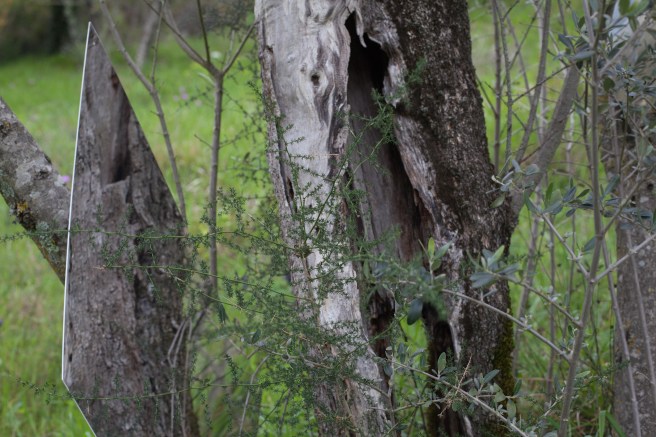
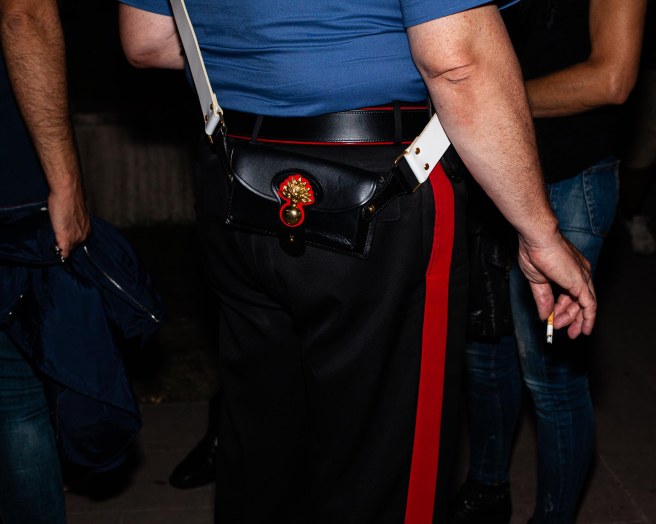
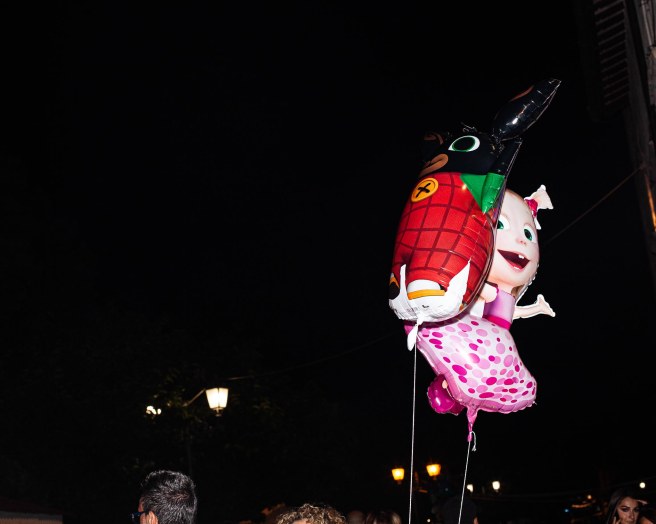
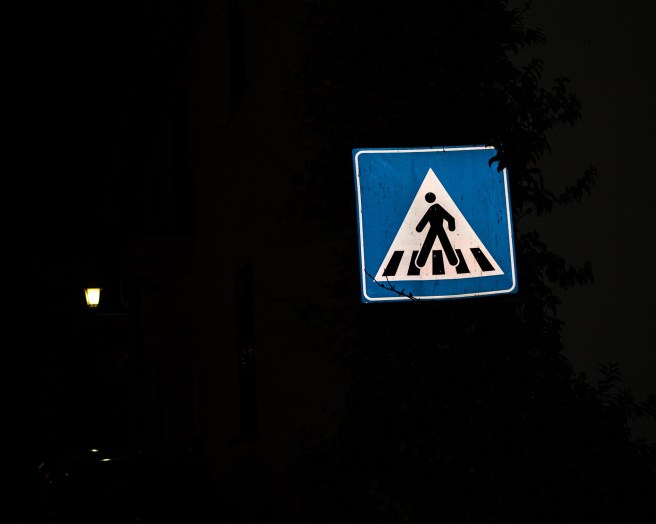
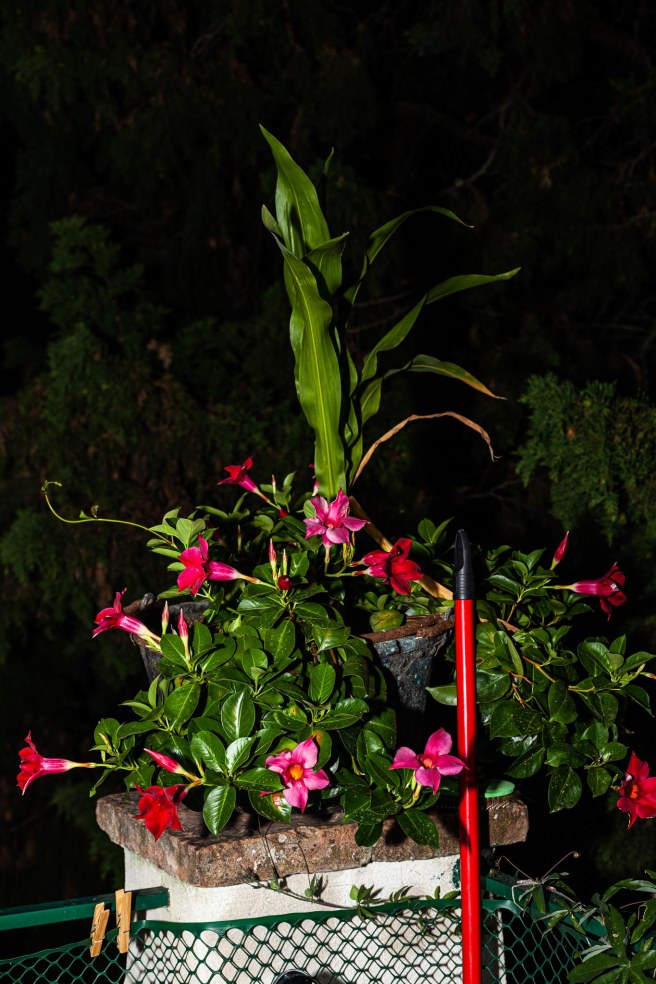
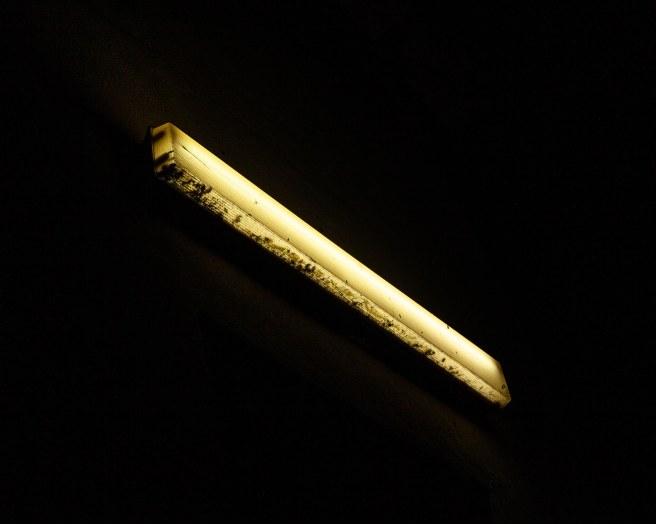
Here are images which I took myself (in no particular sequence). Some of these but not all are in the film. They were taken in the village I spent the summer in.
A sketch by artist/recent graduate Christel Pilkaerthomsen illustrating how we plan to show the work
2. Section 2 (Bits I made while thinking/preparing but which I don’t think fit, but including here to demonstrate development)
Here is a poem I wrote while living in a village over the summer and was prompted by my research and development for this project – I shared it with the group to be included in an accompanying book, however, I just don’t think it fits any more with the work – perhaps/we will see.
On the edge of the village
On the edge of the village, too far for the water to reach
two mummies lay on plastic sun loungers,
hoping and waiting for a glimpse of death in the sky. It was dark,
but the moon was full and high.
“When I was little, you told me the stars were dead people,” said the younger mummy, accusingly. Then excitedly, “There’s one! Did you see it?” Death lights up for a microsecond.
Don’t blink.
The older mummy missed it.
“I thought the sky was filled with ghosts looking down at me.”
On the edge of the village, beyond the reach of the bin men,
the mummies remember Fiore who lived in the barn below,
a second home for the summer months. His main
house was in the village square. But he was rarely there.
“When Fiore died, who inherited everything?” the younger mummy asked.
Long ago cancer killed his wife, then his daughter did it to herself. “And another!” Ephemeral, mortal, gone.
Never put bricks in your eyes.
The younger mummy smiled.
“I think it must have been the housekeeper. She and Fiore were close.”
Far from the men who grabbed the older mummy or the women
who took against her after her own husband died,
they lay there and waited for death to arrive. Too much light
makes it difficult to see though.
“Why wouldn’t he eat Berlusconi, his badly behaved goat?” wondered the younger mummy. Then she sat up and cried, “Look! That one lasted forever.” The planet’s demise was fantastic so the mummy made a wish.
Listen instead.
Both mummies lay still.
“I think it was because he loved him,” thought the older mummy. Though she kept quiet.
Some images that might have worked with that text. (In no particular order) At the moment, they are not included in the project anywhere but I could print and place on the circular platform.
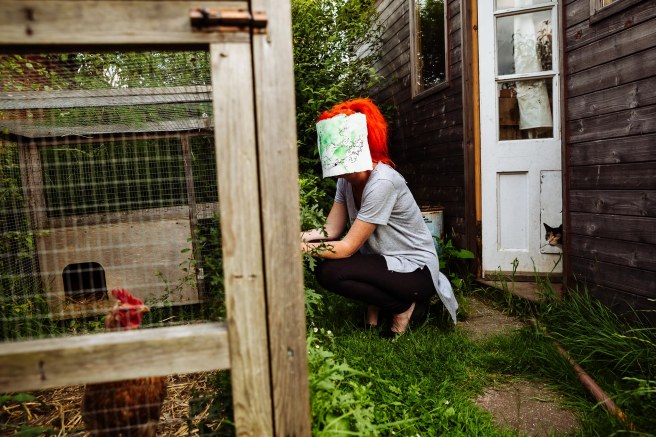
A collective Instagram Account where each of us was able to post images, research, and ideas.














 SJField - OCA Level Three Study Blog