It was good to hear someone say don’t separate CS & BOW. Students keep saying, you don’t need to connect CS to BOW and I can’t for the life of me understand why you wouldn’t connect them or why you’d want to disconnect them either. I have actually been thinking about these reflections which are are usually relevant for both and wondering how to rearrange the menu system as both modules become more and more interconnected.
It was also useful to think CS A3 as a research document setting out my plans and suggested research question – which I have yet to identify.
The other useful thing that came out of the session for me was thinking about overarching topics I’ve been investigating since the end of UVC, and how I can put those into some kind of tangible form. Here is an attempt to pin down some of these very big themes and links to relevant subtopics.
Inside Outedness
From my Sketchbook blog:
For millennia, language was on the outside. We could, in retrospect, usually see it. On walls, in caves, then tablets, scrolls and eventually in books. [Lately on advertising hoarding and signs telling us how fast we can drive, where we can park, if we play, enter, stay out, smoke, shop, make noise, and of course, what we can buy, how much better we will be if we buy whatever it is.]
Today, as many but not all are aware, it [language] somehow exists more and more on the inside [but not the inside of us as it did before emerging – although I think it is generally thought of as outside – rather the inside of machines and devices]. And in places it can’t be seen.
This means we often have no idea what’s being said. We are less able to read the signs [Or even see them]. Vast dynamic archives of language exist – somewhere – affecting everything. We know they are there. But they’re invisible. We see the flimsy surface only.
It’s true, in the past archives tended to be secreted, were often sacred, and contained as well as emanated power.
Very few would have had access.
It’s just that today the whole world is one big archive. And it’s hard to imagine how anyone escapes. [Could do with expanding the final thought.]
Random notes for a short story #12
Derrida’s Archive Fever, University of Chicago Press; Reprint edition (19 Sept. 2017)(The first chapter may be useful here)
Chapter 7, Turning Reality Inside Out and Right Side Out: Boundary Work in the Mid Sixties of Philip K. Dick, Hayles, K. (1999) How we became posthuman: virtual bodies in cybernetics, literature, and informatics. Chicago, Ill: University of Chicago Press.
When I was a child a boy in my class used to turn his eyelids out. It revolted me. The other boys found it hilarious. I hated seeing him do it. It hurt to look at and to think about, and still does. Seeing my reaction, he did it all the more to taunt me.
Gossip & Performance
I believe these aspects of our existence are inter-related. From my BOW A2 assignment:
As part of my on-going research into language, culture and reality, I’d been reading Richard Wrangham’s The Goodness Paradox (2019) and books by Nicholas Christakis who wrote Connected (2009) which is about social networks (in general, not just digital ones.)
Wrangham’s book centres around the idea that human beings evolved with an ability to temper their immediate aggression, while simultaneously developing a propensity for calm, rationally-considered, pre-planned violence. Humans also became hyper-co-operative; today collaboration is part of our DNA. Wrangham suggests these trends are underwritten by our ability to talk to and about each other, and that we have an ever-present unconscious fear someone might be watching, gossiping, and planning to do away with us if we don’t conform. Gossip allows us to conjure up stories, deny and blame others, and plan punishment for anyone deemed a deviant. Wrangham’s theory along with Christakis’ ideas about connection sit at the centre of my contribution to the project. (2019a)
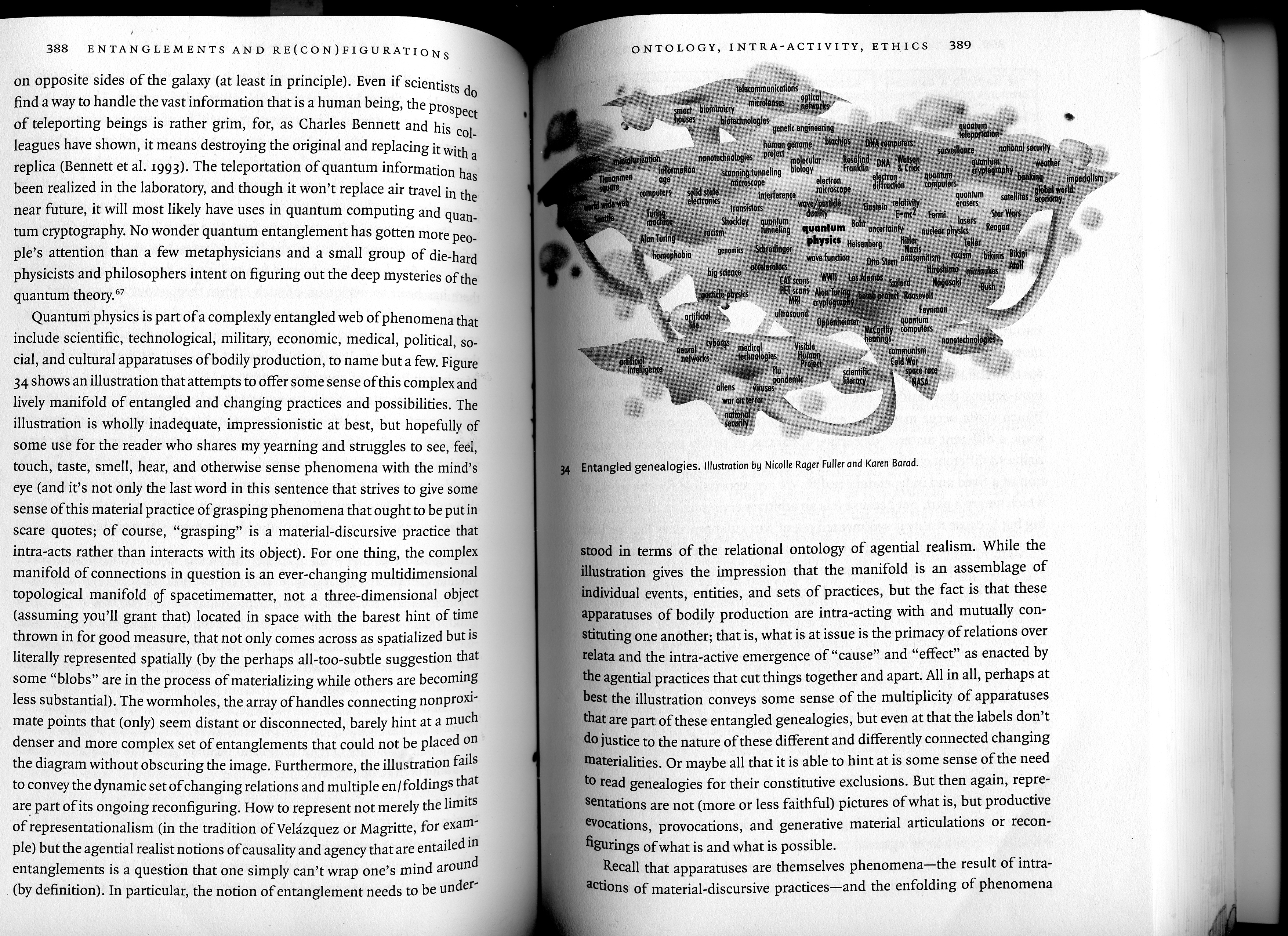
Performance grows out of the knowledge we will be seen and so we must ‘act’ the part in order to be accepted, to survive in the group. However, as Karen Barad tells us – entanglement is critical and without it perhaps nothing at all emerges. Her description changes my understanding of the conscious agent which I wrote about CS A2 – assuming a notion which I accepted in books about systems. However, Barad says something which fundamentally changes the underlying nature of performance and I’m still trying to get my ehad around it: ““A phenomenon is a specific intra-action of an ‘object’; and the ‘measuring agencies’; the object and the measuring agencies emerge from, rather than precede, the intra-action that produces them.” (Barad, 2007, p. 128). From Sauzet, 2018 – https://newmaterialism.eu/almanac/p/phenomena-agential-realism.html Accessed 21/10/2019 From https://sjflevel3.photo.blog/2019/10/21/bow-cs-notes-research-karen-barad/
Today we appear to perform for ourselves and the manifestation of such is available for all to see on social media. But there are also more private performances which people don’t necessarily share widely (although some do) which emerges from tracking devices. See Lupton’s Data Selves book.
Langauge
At the beginning of Self & Other I wrote about Léopold Szondi. After reading The Body & the Archive by Allan Sekula I was reminded about his thoughts on language. I said, “Szondi was also I believe interested in those ‘in-between spaces’ I’m so keen to find out more about. “language is a ‘social fact’. It is the glue that holds society together; through ‘language a child becomes integrated with a social community,’ and ‘it serves to maintain social interaction’. Since dialogue is the primary vehicle of interpersonal relations – what Szondi calls the sphere of the between -it lords it over traditional theatre” (Holmberg, 1996; 67).”
Notes: The Body and the Archive Allan Sekula
I am interested in the changing nature of language, the structural implications of a language which is coded and incomprehensible to most of us. Flusser’s thoughts on the ease with which we use devices compared to the complex nature of them which bypasses most of us may be useful to revisit.
Flusser, V. (2012) Towards a philosophy of photography. London: Reaktion Books.
Data Selves by Deborah Lupton also contains useful content about language and its relationship to new materialism. “In new materialism, the poststructuralist emphasis on language, discourse, and symbolic representation is enhanced by a turn towards the material: particularly human embodied practices and interactions with objects, space and place.” (2019: 15) However, she also writes a great deal about how data (language) manifests as those things – so although data seems immaterial, “things that are generated in and through material devices (smartphones, computers, sensors), stored in material archives (data repositories), materialised in a range of formats that invite human sensory responses and have material effects on human bodies (documenting and having recursive effects on human flesh” (19).
I need to revisit Barthes’ Myth Today (1957) https://uvcsjf.wordpress.com/2016/07/18/notes-project-3-3-myth-is-a-type-of-speech/
I suspect Karen Barad’s ideas are going to be important. And I suspect they will inform all three of these key themes. I need to investigate further before adding them here. However, I think I have identified three key topics: Inside Outedness, Gossip & Performance and Language. I wonder if the latter is the umbrella under which Inside Outedness, Gossip & Performance exist. And the term assemblage which I’ve talked about quite a lot lately is not a theme but rather a structural reality, and our modern form of assemblages are what’s resulting in inside outedness. How I bring any of this into a semi-coherent work yet is anyone’s guess a this time!





 SJField - OCA Level Three Study Blog