THIS WAS THE DRAFT FOR A2 BUT IN THE END, I DECIDED TO SUBMIT QUITE A DIFFERENTLY REALISED PROJECT – ALTHOUGH USING THE SAME MATERIAL AND SO HAVE LEFT THIS UNFINISHED AS A RECORD OF MY PROCESS
Spend some time reviewing your personal reflection and your tutor feedback. Develop a series of carefully considered images that moves your idea forward. Hand in this series to your tutor together with a new reflective commentary setting out where you plan to go from here.
After discussing my plans with Ruth, I decided to submit new work rather than developing the first assignment any further. However, it has many of the same qualities/tropes, and moves my practice forward, i.e. exploring versions of collaboration, working with archival images and text, and moving-image collage.
Quotes below were not included in the final work but the work circles around these ideas and if I pull together a booklet for assessment, they wouldn’t be out of place.
“It is hard to imagine [] considering the inherent silliness, cruelty and superstition of the human race, how it has contrived to last as long as it has. The witch-hunting, the torturing, the gullibility, the massacres, the intolerance, the wild futility of human behaviour over the centuries is hardly credible.”
Noel Coward quoted in The Goodness Complex by Richard Wrangham, 2019
**
“[Quantum mechanics] does not describe things as they are: it describes how things occur and how they interact with each other… [] Reality is reduced to a relation.”
Reality is Not What it Seems by Carlo Rovelli, 2014
**
“Just as brains can do things that no single neuron can do, so social networks can do things that no single person can do.”
Connected: The Amazing Power of Social Networks by Nicholas Christakis and James Fowler, 2019
**
“There is a glut of images in the world and a stubborn obsession with holding on to them… [] Far from satisfying our need for information, the ungraspable abundance of indiscriminate data leaves us just as ignorant but much more confused .”
Pandora’s Camera by Joan Fontcuberta, 2014
The Goodness Complex by Richard Wrangham centres around the idea that human beings evolved with an ability to temper their immediate aggression, and simultaneously developed a propensity for calm, rationally-considered, pre-planned violence, for which language is needed. Humans also became hyper-co-operative across all activities, in particular with childcare and hunting/gathering, and are unlikely to have been the success they are without collaboration. Alongside that drive, there is an inherent desire to be good even when there is seemingly no payoff.
Wrangham suggests these paradoxes were facilitated by our ability to talk to and about each other, and that even when we aren’t necessarily being spoken about, there is always an unconscious awareness that we will be. Once humans were able to gossip, they could avert blame, conjure up stories and plan punishment for anyone who deviated or might be seen as a threat. Gossip, in these terms, underpins who and what we are as a species.
Wrangham’s theory sits at the centre of my contribution to this project.
Work to be included here:
About Pic London:
Workshops:
About Hal Silver:
Artists involved in the collaboration:
Resulting work:
Group Statement:
A rumour reached the village is a collective inquiry that began in a game set in an imagined community, riven with witchcraft, industry and accusation. Over three months, six artists exchanged challenges and responses, out of which common themes emerged: loops and circles, colonies and growth, architecture and language, nature and storytelling. The culminating exhibition is a settlement of images, objects, moving image and living cultures, questioning the stories and materials on which communities are built.
Images of Group set-up and links to relevant collaborator’s work where possible:
Individual work within exhibition:
Gossip emerged from the original game via an imagined midwife and evolved over time during off-and-online conversations with the other artists/characters in the group. The result is a reflection and response to that interaction; a mixture of text and, downloaded from the Internet, appropriated still frames, moving image, and sounds from space.
There are two versions of the video. Each has the same footage and edit but the gallery version has a simple audio track of sounds from space from the Nasa website. This will be/was shown on an electronic tablet in amongst the other objects and accompanied by some text and still frames from the film captured and printed in newsprint.
A second version of the video is available on my website. There is an instruction to visit it built into the installation (assemblage.) This online edition has music from a well-known game from the eighties which was played on an early handheld device.
Research booklet:
Additional Context
” The circle is timeless but also modern and hi-tech: lenses, records, cogs and clocks. Time is circular on Napoleon’s personal carriage clock, seized at Waterloo, the hands always showing the hours past as well as those to come. And perhaps space is circular too, at least in the mind of Anish Kapoor.” Cumming, L. (2016) Seeing Round Corners: The Art of the Circle review – the joy of life in the round, The Guardian [online review] Available at: https://www.theguardian.com/artanddesign/2016/may/29/seeing-round-corners-the-art-of-the-circle-review-turner-contemporary-margate [Accessed 13/10/2019]
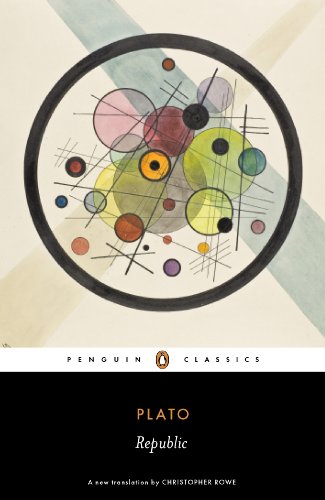
Given my growing focus on Plato’s Cave and contemporary references in popular culture to similar metaphors, I thought it was interesting to see the Penguin edition uses one of Kandinsky’s image of Circles (1923) on the cover.

Exhibition talk and any educational visits:
All of the following links are available under Research & Reflection in the relevant menu item but these are probably key.
Background https://sjflevel3.photo.blog/2019/09/23/bow-1-2-background/
Influences https://sjflevel3.photo.blog/2019/09/26/bow-1-2-artistic-and-cultural-influences/
Collage & assemblage https://sjflevel3.photo.blog/2019/10/02/bow-assemblage/
Reflection:
Other possible related information:
Neurophilosopher, Patricia Churchland discusses the biological origins of empathy here. Her article includes:
“The overlap of moral virtues across cultures is striking, even though the relative ranking of the virtues may vary with a clan’s history and environment. Typically, vindictiveness and cheating are discouraged, while cooperation, modesty and courage are praised. These universal norms far predate the concept of any moralising God or written law. Instead, they are rooted in the similarity of basic human needs and our shared mechanisms for learning and problem-solving.”
And ends with:
“Neuroscience reminds us that our social nature and cultural practices, including the ones we call morality, are products of evolution, constrained by our biological heritage. Perhaps that knowledge, of a sense of morality rooted in nothing more than our mammalian origins, makes us a little less likely to be infatuated with our own moral superiority, and more likely to cast a sceptical eye on those who peddle utopian remedies to our problems.” (2019)





 SJField - OCA Level Three Study Blog