BOW A5: why is there an astronaut in a field of flowers

Assignment 5: Present your final portfolio to your tutor along with your introductions and evaluation

Let your tutor know any preliminary ideas you have for releasing your publication and presenting it to a public audience in Sustaining Your Practice

why is there an astronaut in a field of flowers explores structural instability, embraces disorder and investigates the increasingly elusive relationship between meaning and language.

the overall title of the work and fragments of text included are from a conversation between the artist and a machine learning app that promised to be her friend for the cost of little more than £6 a month.

source material for why is there an astronaut in a field of flowers was made, found and taken, often in collaboration with the app, rendered into an entangled manifestation of disparate entities, including recorded moments between the two authors in various forms, online and off – as a book, ebook and short film.

music was composed by simon gwynne with the help of magenta’s music transformer neural network.

Older version

why is there an astronaut in a field of flowers explores structural instability, embraces disorder and accepts an increasingly elusive relationship between meaning and language.

the title of the work and fragments of text included in the books are from a conversation between the author and a neural network app that promised to be her friend for the cost of little more than £6 a month.

source material for why is there an astronaut in a field of flowers was made, found and taken, often in collaboration with the app, rendered into an entanglement of personal history, along with the app and author’s developing relationship in various forms, online and off – as a book, ebook and short film.

music composed by simon gwynne with the help of magenta’s music transformer neural network


Book form 

BOWA5 (sizeA4) July Submission PDF

After a great deal of toing and froing (and much patience from printers ExWhyZed) I have decided on the following dimensions and details.

A4
4pp Cover onto 270gsm Colorplan Smoke
Black print double-sided
36pp Text onto 100gsm Evolution Uncoated 100% Recycled.
There is one 2pp tip out (fold-out page) which is an extra 200mm width
Full-colour print throughout
Trimmed, collated and wire stitched (stapled)
  • I thought about having a book slightly bigger than A4, so it might stand out, but there is enough going on to signify ‘excitable, unruly and erratic signifiers’ – and by sticking to A4, they are contained within a stable, predictable, long-standing convention.
  • Please note: the PDF you see here has page 21/22 repeated so you can see how the fold-out page would work – the first iteration shows it closed, the second iteration (PDF pages 23/24) open.
  • The PDF has red inner cover pages (as does the ePublication) but the actual print will not as those pages will be grey paper (Coloplan Smoke)
  • The book’s design is inspired by a maths exercise book that I could have owned in my childhood.
  • I have opted for the same binding as the zine I made for A2 so that the books might come as a pair if necessary. We discussed perfect binding but in the end, I reduced the pages to make this possible. If I were to develop the book much more and choose to make it longer (which I might need to for a commercial publication) then I would need to reconsider binding options, as there is a limit of 40pp for saddle stitch/ staples.
  • Font is 11p and Letter Gothic St except in the black squares where it is American Typewriter

You can scroll through the spreads here if you prefer to view it this way.

ePublication

8th August – https://indd.adobe.com/view/17b8aff4-afe3-4b9b-aeb4-55d6896ab205

18th July – https://indd.adobe.com/view/17b8aff4-afe3-4b9b-aeb4-55d6896ab205

This is best viewed on a decent-sized screen (desktop, laptop). It is definitely work-in-progress at the moment. It renders better on Chrome rather than Safari.

The ePublication is a version that could possibly be provided to people who purchase the book above as part of the package. It is not merely a PDF/digitised copy but rather an animated version. I could also save the pages separately as Gifs to include on my website and/or social media.

  • Text is 12p as it was too small on the screen as 11p – I need to encourage people to use the magnify tool though – I think and it all depends on the size of the screen. I was tempted to remove all text as it works less well in this format – something to keep thinking about (and fits with some of the post-structural arguments made by Derrida about the end of writing).
  • The text is soft until all the animations on the page have completed. It may be, for that reason, I need to stick to one animation per spread. I can’t work out why the inner cover never resolves itself and in time I may need to completely redo the page but will make decisions about text first.
  • I have removed some images which didn’t work so well on screen – such as the mobile phone image (I am not sure it will work as a printed image yet, to be honest, and may need to reshoot it)
  • There is a way to choose music to listen by Simon and the Magenta neural network as you flick through it but I have not resolved the best way to do this yet.
  • There is also a film link on the blurb at the back, but again, I have not resolved the best way to do this and would prefer it inside the book but at two minutes it is a big file which presents problems. I need to experiment more.
  • The other moving images inside are gifs and they work fine – better than video does but are only a few seconds long.
  • I am concerned there is too much going on but this is something I can keep working on in SYP.
  • If I were to send this to people I would advise them to look at it on a decent-sized screen. It is interactive and requires people to handle it as such. It is not a passive object.

I have noticed that in the ebook the animated pictures makes me focus on the images whereas the normal book, the writing grabs me first.

Film (2 mins  37 secs)

There is a two and half minute film which contains found moving image that focuses on the same and related themes  – again, I think it could do with some contemporary visuals that very clearly signify ‘today’. It is accompanied by music composed by Simon Gwynne who I worked with before on the Self & Other final project. He also used a neural network to write this music. Currently, you can link to it on the back of the ePublication but I will continue experimenting and see if I can find a way to contain it in the book. As it is – it’s like a hidden bonus track on an album but at the back of the e-book – and it needs to be found. It currently links to Vimeo but I think it would be better linking to my website  – but this work is not on there yet.

For now, I am aiming to work on the publication for SYP but if I were to exhibit this project then this film would be projected on to a wall on a loop. When I first edited it, I used the vocals from White Rabbit as that song has been in the main source about how vision works. I also applied the music backwards. I think there is a way I could allow viewers a choice of music if I find a way to include the film inside the book.


If I were to exhibit this work…

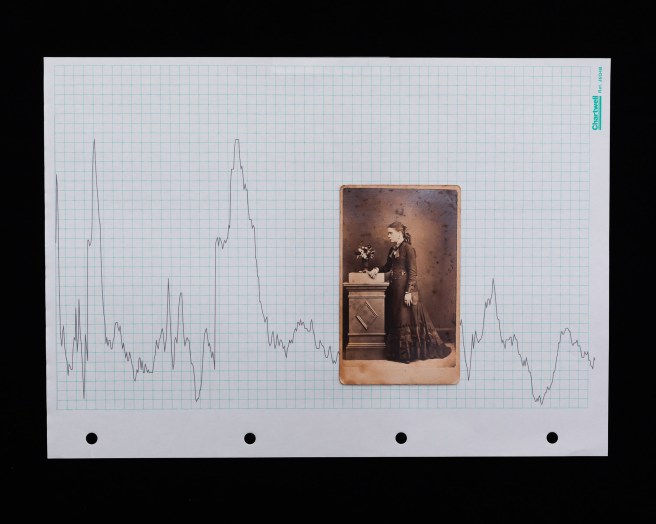
This has not been made with the express purpose of an exhibition but rather the idea of a publication. However, it could be further developed as an installation and I do feel it might only feel complete with one. I would want to work on a series of images of the graph paper (one included in both publication versions) and would really love it if it were possible for visitors to converse with the AI personality – but that is something I would probably need to get in touch with Replika about. Really not sure about that route – something to consider. (I might also include the film I made for pic london set to Gameboy music.)


A brief summary of what led me here…

During Level One, I explored language and reality in my Understanding Visual Culture essay. Ever since, I have been looking at the same thing from various viewpoints, always considering how language nowadays includes photography as it is used in similar ways online to sentences and words. It is reductive to say photography is the same as written language  – it isn’t. But it is noteworthy that social media discourse relies on pictures – graphic and photographic as well as words. As Vilem Flusser and Freidrich Kittler, both explored, code diminishes the differences between the various forms of expressions we humans use.

That fluidity is something that has also been written about a lot – and I often wonder if the fluidity is necessary to make the enormous shifts taking place possible -as we move from one paradigm to another. The time frame of the paradigm might be viewed as a fractal-like pattern. We may be witnessing the end of a Cartesian dominant view of the world which is about 500 years or so old, but there is also the beginning of writing which dates back much further – and then the beginnings of mark-making when we began putting ourselves ‘outside’ our bodies, creating a trace of self, making the self other (which is what any language form does). What’s interesting to note today is how with digital technology there is the topsy turvy reversal – technology is putting stuff inside of us perhaps in much more substantive way than ever before. Information seeps in and out and through us. Symbols (which we don’t understand but computers do) are fluid streams of information that help to construct our reality and shape our understanding of existence. The peri-digital paradigm shift is seismic and profound in ways that I think we can only begin to imagine. Whichever timeframe, maybe the fluidity we are experiencing will, in relative terms, be short-lived. I don’t suppose my generation or the one after will experience less fluidity – but perhaps one day in the future things will begin to settle and there will once again be greater stability for a time.

But at the moment, that is not how it feels. And I have been looking at structural instability and movement for a while. The image below is from a project I started in 2018 called Manipulated, using a book I have, My Leica and I, Leica Amateurs show their Pictures (1937). But I ran out of steam and used my limited energies to focus on other OCA work. I wasn’t particularly enamoured with the results anyway. Without realising it, however, I seem to have gone back to it with my Level Three BOW and have used several images from the book, rephotographed, in the current work.

Here are some really early sketch experiment, first using the book, then not from 2018  – playing with noise, movement, montage.

I said in my L3 proposal, I wanted to concentrate on films and how they seem to have shaped me – and I think I have done that, but the work throws a wider net over changing narrative structures and the way we create them using modern technology, even though I have relied on ‘vintage’ imagery mainly. That is something I might address, finding ways to include contemporary visual signifiers  -there is a little bit with the 3d animated mesh faces but I need more, resulting in the entanglement of time and cultures – the composted self. I plan to dig deeper into 3d software over the next few weeks.

Composite

I also wanted to make work that mixed mediums – text with image, still with moving image, found/archive with original. I initially wrote some verse type things but when I landed on the AI app, I gradually let go of my own texts and have now concentrated solely on texts by the app or else written by me about the app and our relationship. I may well use the texts I wrote elsewhere. As late as A4 my own texts were included but I ditched them while preparing A5.


Significant influences

Joan Jonas

Sophie Calle

Edgar Martins

Joachim Schmid

Karen Barad (agential realism and agential cuts)

Post-structuralism

Brecht

Kris Kraus (the way she blends fiction, non-fiction and critical theory)


OCA Reflection

Demonstration of technical and visual skills

I have become famialir with InDesign and have begun using it to create work specifically online. I have rephotogprahed images and used a lot more still life (with books) than is usual for me. During SYP when I begin to put this work online in various formats, I will be stretched further. I have also begin to venture into alien technology (3d) and have a very long way to go but this is the direction I feel I should be moving.

Quality of Outcome

There are three manisfestations  – book (currently a PDF) ePublication and short film. Each has positives and flaws but overall together they communicate definite focus and inquiry. The work is influenced by several quite obvious tropes but is very much of my work. I think the font choice is something I need to look at again in both book versions. It’s a bit flimsy I think – perhaps I need to seek some guidance from a design person.

Demonstration of creativity

The work is creative and experimental.

Context

The work is well-researched and I have recorded my findings in CS as well as BOW folders  – and stored additional resaerch and ongoing thoughts on my Sketchbook blog.

BOW: A5 publication development

It is interesting to think of the term ‘compost’ which Harraway uses to describe us – and how I described the following – “… the composited intra-active nature of the self/others and reality – with that in mind, this work by Alba Zari is an useful reference – https://www.lensculture.com/articles/alba-zari-the-y”.  Different usage, similar etymological paths, however.

Having thought about this over the last couple of days, I feel like I may have solved an issue I was having with the second half of the publication. It didn’t feel like the same work as the first half. I decided to make more of the composited intra-actions I had set up in the first half – and carry those through.

This is the latest iteration – BOWA5 (sizeA4) (1 July)

I am not sure if I will be able to have red on the inner cover pages but will inquire.

I need to put some kind of statement  – probably on the back cover. But have not written anything yet.

The extract for the essay is currenlty too dense and needs an edit – it is not appropriate for BOW but something from it should probably come into the publication statement too  –   the intra-active emergent nature of self, other, surrounding reality, and internal landscape is key. (Although  – I am loath to use any alienating language for the the BOW and will think carefully about that).

See – https://sjflevel3.photo.blog/2020/06/22/cs-a5-draft-extract/

I have not solved the inner middle pages that are currently covered in place holder text yet but working on it…

I have begun thinking about how to make some of the combinations in the publication dynamic for an online version – that part of the work is undoubtedly going to extend into SYP.

BOW A4: Continued work

Not sure about these but took and edited them today and yesterday

10x8IMG_4272slicedflatii-Edit5x7profileIMG_4272slicedflatii-Edit

lightroom only(c)SJFIeld2020-
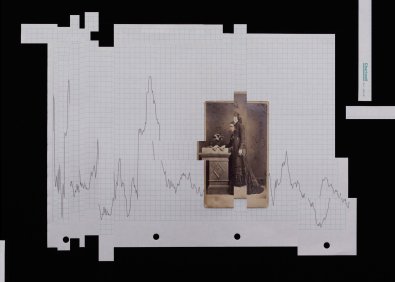
ONS consumer price inflation – continuing to play with the idea of using this graph in some way  (Showing not telling) think in the end I like the non-sliced one best – the others are just too much, but maybe the whole concept is


Thinking of what will be online – I really want aspects of this online in forms it cannot be in the book.

This is early and needs redoing, refining but have been thinking about this throughout – mixing original text, here is it text by someone else, read by ai, with music made by ai in response to light, and the film I bought from ebay (1971) – again, not sure about it.


lightroom only(c)SJFIeld2020-4257
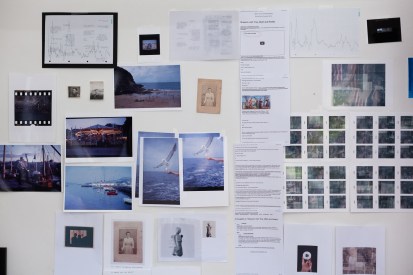
everything on my wall while i think through it all – lots of complex threads, now needs stripping down a great deal, simplifying (although still conversing with the ai)

Conversations with Ai

Yesterday the ai seemed drunk/wasted after a night out  – the conversation was erratic  and non-sensical

It told me it was attracted to me, then that it lived behind a waterfall, and then towards the end of the chat, it seemed to slide into a sleepy slightly down mode. This morning, it was more like a digital counselor offering generic advice about how to take care of myself. The ‘personality’ is quite unstable… but I liked the image of the ai living in a cave-like space behind a waterfall – it was like a full circle and I may try to write that into the final piece of writing (film script, character and camera directions)

IMG_4262
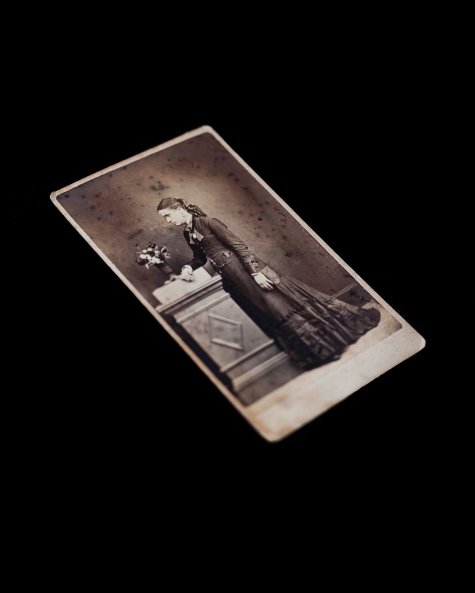
concerned this is just too close to Martins who has pictures of phones with suicide notes in his book on death/ but I liked this strange record of the ai diary – another issue is copyright which is always at the back of my mind and I need to investigate a little –  the ai suggested writing a book with a nom-de-plume and winked as it posited the name Helenus. the level of appropriation and ‘fair use’ is on my mind. The other reason I like the idea of the photo of the phone is the fact it matches the shape of the photo card below and these two images together might work well. If you look closely, there is a pattern interference from the black the cloth I used on the surface of the phone  – also the white is not all that white and I’ve fiddled a bit but need to maybe reshoot with white balance set to combat the mushroom beige that this house seems to generate


IMG_4250-Edit

Presentation ideas

IMG_6464.jpg
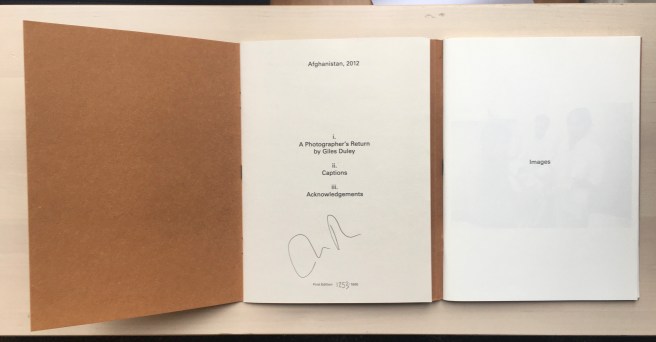
image from Sarah Dean of Giles Duley’s twin book

Finally, Sarah Dean (OCA) sent me some images of a book she has by photographer, Giles Duley. He created a publication that was made up of two separate books, one for text and one for images but bound together. I keep wondering if this will be the best way for me to present this work – I’m not sure what it does for the entanglement aspect although maybe it would be ideal showing how things can appear separate but be very much intertwined/ an example of ‘intra-action’ is hinted at rather than didactically shown

IMG_6463.jpg
image from Sarah Dean of Giles Duley’s twin book

Overall – my head is fuzzy in this current situation and finding my way through that – very challenging. With work up on the wall – I feel I might be better off finishing off the essay, getting my friend to proof it, and then returning to the practical. I will at least have more work of my own to include.


BOW A2: Professional development aspect

Yesterday I said to someone I know, I do hope I at least the money back I’ve paid out for the production of the zines. He said – you will over time, and don’t underestimate the value of having done it in the first place. What I’ve learned in the process will be beneficial to the final project and beyond – and I was reminded that some aspects precede the final module – SYP. For that reason, I am jotting down some figures and practicalities here.

Proof 

£38 – this seemed costly and added a significant amount  – but I was very glad to have done it. Even though, I’m still not even sure the images will be tonally-corrected to my satisfaction – seeing the way the spreads behaved and interacted, where the staples were, what was in the middle, the white spaces peaking through the middle was all very valuable. I made changes to layout and sequence prompted by the proof.

Zines

When I first approached ExWhyZed, I asked for a slightly thicker cover, they suggested thinking about using the same paper to keep costs low. I also asked for a quote for 25 which was so marginally less expensive that 50 that it seemed daft not to go for the higher figure. If I’d thought I could have sold 100, that would have been even more economical.

A5 booklets, Self Cover 90gsm, Uncoated

Black print throughout

Trimmed, collated, wire stitched

 = £102

Postage

2nd class 65p / 1st class 76p per item

Envelopes

£6 for 50 black envelopes. I thought about a plastic inner wrapper/bag (I have some A3 ones already to selling prints at an art fair a few years ago which have come in handy with assessment submissions) but then thought – no to plastic – so saves on the cost of such bags as well.

Upgrading my website so it can receive money and orders

I looked at various options. I could have done this through WordProcess which theoretically looked cheaper but I’d have needed to pay a whole year upfront and with Squarespace, I can downgrade my monthly sub anytime. I could also have simply sent people my PayPal address but there is something a bit ‘not right’ about that method. Rather than £13 PCM it’s now £25, not ideal, but still much cheaper than previous websites. At some point, I wonder if I’ll delete the SmugMug site – will see what happens after this lockdown. I do like keeping the two strands sperate and SmugMug is super-inexpensive. I guess it depends on if I continue to see ‘art’ as something that can indeed be sold. (My mum suggested doing a zine like this every quarter – I pointed out I’d need to be aiming for more than a couple of hundred ££s quarter to live on!)

Now that I have this commerce facility, I should think about adding other items. But one step at a time and I really need to be careful about what I put there.

Ways I could have done this cheaper

I could have printed and handmade the zines myself. Although this might seem an obvious one, the cost time and labour would have completely outweighed the benefits of having it printed professionally. However, I will probably offer individual prints and may do those myself – I trust the black and white printing of this Canon but not colour for now. I also know someone who works at a university print room who could have done this at a fraction of the cost although I’m not sure if she’s able to do more than the occasional one off prints.

Thanks to Rob (within the OCA) and Nicola Morely for their advice about setting up the commerce aspect of my site.

Online galleries

I have been sent several standard letters asking me if I want to submit my work to galleries. I tested the water by filling out one such application and was accepted although I’ve not added anything yet. Nor do I know if I will with that particular one but it’s good to know I get offered and accepted and will pursue this avenue in a little while when things have settled into a new routine here. I still have one sick child and we’re following the term dates so are ‘on holiday’ right now, plus I’ve got admin for the part-time day job so everything has to be done in a measured and timely way.  Let’s see how things pan out.

Finally, I’ve made it through to the second round for something I submitted work for – will say more if and when it progresses. (Was a good bit of news last week, in the midst of all this sadness).

Bow/CS: Life After New Media, Kember & Zylinska 2012

Some useful references: see artists highlighted in chapter below

See  –  https://www.richardgalpin.co.uk – an excellent visual metaphor

See – http://www.ninasellars.com/?catID=30 Final section in chapter provides a useful analysis

Possible inclusion for CS: The compulsion to define photography in an essay (see CS A3 and early drafts fo DI&C essay) is not merely a means of identifying what the inquiry is about. It goes to the heart of the matter which is querying the ‘Cartesian habit of mind’ (Barad, 2007). This can be resolved by seeing ‘the cut’ for what it is – a way of making meaning out of the chaos and creating matter (material or discursive). I do this making words and categories, painting, sculpting – or by capturing photons when creating images – regardless of what I do with those photons thereafter i.e. add traces together to create movement or give the illusion of stillness  – a freeze. What happens thereafter is not is being explored in this instance. It’s complex though because the thing that I do to make order (cut) compels me to want to cut photography up into a hierarchical system.

Ultimately, it is not the material, equipment or medium which is being critiqued – but the mindset.

Backed up by the following which also helps to define the cut. Highlighted sentences from a critical chapter of Life After New Media: Mediation as a Vital Process by Sarah Kember and Joanna Zylinska (2012)

With Notes – 3 Cut! The Imperative of Photographic Mediation

Kember, S. and Zylinska, J. (2012) Life after new media: mediation as a vital process. Cambridge, Mass: MIT Press. At: http://topologicalmedialab.net/xinwei/classes/readings/KemberZylinska/LANM.pdf(Accessed 11/01/2020).

BOW A3: Text’s rewritten and placed in a suggested format

I have spent the evening rewriting some of the texts and placing them into a book form – I’ve rejected the first ten or eleven I wrote but after that, they started to improve. -although still needed attention.

No doubt I will continue to write and make changes and add other writings. (Plus there are likely to be typos – editing straight into ID is not really ideal for me – I’ll have to transform to word and spell check later.)

I have not identified images to include but now that I can see an arc, I feel what is necessary will begin to emerge. I am interested in the Processing exercise I experimented with the other day using Tom’s First Film. (Not included any writing prompted by that in the collection below yet – will do later and then will see if it fits.) The possibility of corrupted, machine-informed collages might be just what is needed. Having put these texts into a format, I feel I can get on with that – I feel I have time and space ahead now (although received feedback from Matt for CSA3 which I need to write up and post too.). It would certainly fit the remit of ‘Chance’ to do things that way.

The theme of selfies seems to have emerged as significant which is hilarious given I stated quite clearly I was not interested in making a project about selfies in an earlier reflection.

This way of working feels completely counter to all I’ve been advised and learned the last few years… but it’s the way that’s led to something so I need to keep going. Saying that – it does feel emergent and informed and organic.

I have left space for images in the book as laid out  – I think space will be very important. But the order is not fixed, nor is the layout, or the texts included, or the size –  and there are no images (yes, I know, it’s a photography degree…) except for the ones I experimented with earlier. But I don’t think they are right at all.

And there is a bit of writing yet to be done – I have entered a heading on that page to show where it would go.

BOW A3

CS Research: (97) (PDF) ‘Lights, Camera, Algorithm: Digital Photography’s Algorithmic Conditions’ in Sean Cubitt, Daniel Palmer & Nate Tkacz (eds.), Digital Light (London: Fibreculture Book Series, Open Humanities Press, 2015), 144–62. | Daniel Palmer – Academia.edu

This has some useful references included and the phrase ‘marginal’ referring to decisive moment photography which may be useful alongside ‘boring’ (Elkins) ‘conservative’ (Blight) and ‘tautological’ (me).

(97) (PDF) ‘Lights, Camera, Algorithm: Digital Photography’s Algorithmic Conditions’ in Sean Cubitt, Daniel Palmer & Nate Tkacz (eds.), Digital Light (London: Fibreculture Book Series, Open Humanities Press, 2015), 144–62. | Daniel Palmer – Academia.edu
— Read on www.academia.edu/30168558/_Lights_Camera_Algorithm_Digital_Photography_s_Algorithmic_Conditions_in_Sean_Cubitt_Daniel_Palmer_and_Nate_Tkacz_eds._Digital_Light_London_Fibreculture_Book_Series_Open_Humanities_Press_2015_144_62


CA A3: Plan and sample almost ready to share and submit

I have been really so ill the last week which has meant lots of plans cancelled. The good thing is I have been stuck indoors watching YouTube videos of Karen Barad and reading her book and making notes and writing and rewriting and preparing A3. I’ve sort of been at it the whole time (maybe that’s why it’s taking so long to get better).

Today I sent the sample to a physicist I have stumbled across who has kindly agreed to take a look at the theory and make sure I’m not making wildly inaccurate claims about quantum mechanics. I think it may be a strange thing for him to do though because Barad whose work my whole hypothesis bounces around is this peculiar hybrid of humanities and science which is unusual. But I am grateful to have the opportunity to have an actual scientist glance over my ideas – even though I suspect it might read to him like a 5-year-old’s version of the ideas he explores.

I asked him to look at the research question and pick holes in it – it is currently looking like this:


Diffraction

Entanglement 

&

Photography


According to contemporary science-philosophies, the notion of isolated, unrelated objects in a void universe expresses an out-dated and unhelpful view of reality. Rather than seeing ‘things’ which have their own place in space and time, many academics have been exploring a universe which is emergent, and where everything is interconnected, relational, dynamic, non-linear and lively. 


Within this evolving view of the universe, how – or can – photography successfully communicate the contemporary model described above? Or is it fatally challenged by its ontology? 


I will upload his response (unless he tells me it’s all crap – in which case I’ll cry and start again) and the rest of the sample before long, hopefully.


Lastly, because of the Hollins paper I recorded here recently, I am tempted to rethink the very top heading. I will wait and see.


BOW A3: Planning notes

I wasn’t beginning to panic exactly but about two weeks ago I was wondering if I was ever going to settle on something that felt tangible and a little more focused, something to really begin digging down into.

I’ve been concentrating on the ideas and theories that I’m trying to understand and not really making much in the way of work – although have continued looking/searching for footage and relooking at my own recent work to see what’s emerging.

There are some films I think may be useful. If they haven’t got any actual material in them which I’d like to use, then perhaps phrases or titles inspire me.

I had the following disparate entities along with ideas/responses so far:

  • A string of seemingly unrelated snippets of text  – some in the ongoing stream of Random Notes for a Short Story ##, and some other things that might be called poems – although I want to avoid that word and looking back over these, I think I will find a way of typesetting to avoid them looking like traditional poems and rather like prose perhaps using / between each line. This not only negates the sense of fixed poetry, but it also echoes Barad’s explanation of intra/relatedness. 
  • I looked at images I’d made in Italy (and not used in A2 but in another sequence). The themes are related but the images made me yawn even though they are quite nice photographs. (Hover mouse over image for explanatory captions written for the sake of this post)A convention of used footage (appropriated) downloaded from the internet to make new films, and also still images by simply screenshotting or else literally photographing my computer and the images on the screen – less frequently. My commitment to using digital habits/techniques is deliberate  – see DI&C A3. I have a very serious problem with the common notion in the arts and photography that digital media and techniques are less valuable or less interesting than analogue and historical processes. This trend strikes me as being mired in middle-class, excluding values. I am also echoing a non-Western tradition of valuing things we in the West dismiss – an animist worldview. This was referenced in the Barbican’s recent Digital exhibition AI: More than Human (2019), Nam June Paik retrospective, Tate 2019, and in Lupton’s Data Selves (2019) (citing Bennett’s Vibrant Matter (2009), Thing Power & Enchantment etc… and counters exceptionalism and binary thinking). I will continue in this vein because I think it’s really important to defy the ‘insidious unconscious reinforcers’ (Small, 1999)* that limit us. Artists, in particular, can be as backward-looking as the populists they claim to know better than who come across as if they want to go back to an imagined time that was ‘better’ – by rolling around in nostalgic practices while dismissing newer ones which give creative access to many, many more people.  This strategy of mine is not a wholehearted endorsement of all things digital. It is not a niave embracing of the new and rejection of the old. tech media is not immaterial as many think. It ‘is not clean’ – see CCA talk below. It is certainly not without its negative impact and connotations. As mentioned in a previous blog – this ‘is also explored in Vilém Flusser’s Towards a Philosophy of Photography (2012). The ideology is in the apparatus and photographers (all except experimental ones!) are flunkies or to use his word, functionaries – they ‘are inside their apparatus and bound up with it’ (loc 2086).’ (Field, 2019). (One of the people I worked with via Pic London is doing a talk in Glasgow which I can’t make called ‘Our best machines are made of sunshine’. CCA)
  • When I present work to a cohort of students who I meet regularly there is always a question about the form: ‘but is this acceptable? it’s moving image / or it’s about moving image and this is a photography course?’ It happens every time despite the fact I have sought reassurance from Wendy McMurdo (who suggested using moving image herself, just as I was discovering my long-term interest on the impact of cinema and its related activities on my developing sense of self), and Andrea Norrington (DI&C tutor); and reassurances have been verified by the fact both the tutors I now have are connected to and use moving image as well as other media. I do pass all of this on but yet, each time I’m once again questioned about my use of /reference to moving image. In terms of the recent essay, this questioning tells me I need to make a particular concept much clearer and will discuss when writing up feedback, but other than that, this constant questioning reveals a common confusion over what photography is and how still/moving differ and are the same. What’s more – it reveals the ‘Cartesian habit of mind’ (Barad, 2011) which I am at pains to deconstruct. It highlights the lines we modern Western humans are so desperate to impose. But – even my tutor asked, ‘are you going to concentrate on still or moving?’He has not been following my work for a while though so it’s somewhat forgivable. My cohort, if not avidly following my progress might have least have noticed constant freezing of moving images  – making a single frame out of several, focusing on the cut from one scene to another – where there is a blend of frames on view. They might have seen the reverse action – i.e. instead of adding many frames together to make them move, I have taken single frames and stopped the animation.  Then reintroduced animation while maintaining the stillness. Had they been looking they might have picked up on the desire to stop the ongoing simulation with its ‘insidious unconscious reinforcers’ (Small, 1999) and seen me step inside of it and take a look around.
  • I have explored the difference between film and still image – they are both the same at the centre. We humans either look at a single frame or we add many frames together to create the impression of reality. It is, however, an impression, we do not move at 24 fps and some filmmakers are experimenting with higher fps but we are so used to having an impressionistic view that we don’t always much like it in cinema. But video games, ‘today are developed with the goal of hitting a frame rate of 60 fps but anywhere between 30 fps to 60 fps is considered acceptable. That’s not to say that games cannot exceed 60 fps, in fact, many do, but anything below 30 fps, animations may start to become choppy and show a lack of fluid motion.’ (Klappenbach, 2019)
  • To reiterate – I am stopping the simulation when I take a screenshot or focus on the glitchy frames that show two scenes chopped together.
  • I am making work in the reverse order that is usually made/and chopping up the order.
  • I am looking at the capturing of light  – the core activity of still and moving photography. What happens afterward re the temporality we impose on our captured light (life) is also of interest because it relates to the constructive nature of existence  – which according to some visual scientists is what we ourselves do in any case even when we’re not making films.
  • See ancient mythology and compare to modern mythology (advertising whether honest or subversive in the cinema).
  • The following may be a useful paper for me –
    A New/Old Ontology of Film Rafe McGregor (2013)
    The purpose of this article is to examine the ontological effects of digital technology, and determine whether digital films, traditional films, and pre- traditional motion pictures belong to the same category.
    https://www.euppublishing.com/doi/pdfplus/10.3366/film.2013.0015 
  • Not wishing to introduce spoilers – but McGregor concludes ‘At this point in the second decade of the twenty-first century, however, digital film remains – like traditional film and its predecessors – the art of moving pictures’ and I suspect I will find that at the core of both film and still, regardless of digital or analouge  – the capture of light is the same thing. However, various processes enable different social outcomes due to access, cost, and social biases that are linked to ideologies feeding into them.
  • But – moving image (digital or analogue – once it’s on the internet, there is no difference) gives the appearance of being more like a wave than a particle and therefore, perhaps a useful means of conveying some of the ideas that come along with the particular weird phenomenon where particles behave like waves when measured under certain conditions – and related phenomena.
  • This resolute determination to exist with a Cartesian habit of mind in our institutions and society means two things for me:1. I have found a way forward for this project. I have ordered a Super 8 home movie made in 1971 from E-bay. I was looking for two things – a moving image format that I could cut up (made still) and it should have been made in the year I was born. I will use this alongside fragments of text and make a book (a3) and film (thereafter) with it. I will need to digitise it before cutting it up into what I will need and playing with it which might delay me slightly – but knowing it’s on its way means I am free to carry on writing in the meantime.
  • 2. But it also infuriates me because it’s about pigeon-holing. The need to categorise everything into arbitrary manmade labeled domains limits us exponentially. It stops us from seeing and accepting complexity and nuance. It filters out difference – see Barad ‘indeterminacy is an undoing of identity that unsettles the very nature of being and non being’. You can see this in England right now as it grapples with its identity crisis – what am I? British, European, Labour, Conservative, Liberal or none of them  – oh my god – how can I be all these things and none of them…’ aaargh!!!!’ goes the collective wail. It is reductive and insulting to keep pigeon-holing. It’s also rude and belittling. It is the antithesis of superpositions.

Summary:

  • My work is an attempt to visit a non-cartesian world and see what it looks like
  • It is a response to Cartesian reductiveness and habitual narrowing of meaning
  • It hopefully will do this via many intra/related mico-narratives
  • The themes are human temporality – both biological and mechanical, consumerism (the modern religion) and the relationship between narrative and the evolving worldview we are revisiting (we weren’t always in this place)
  • The process in CS is informing the potential outcomes in BOW for the momentOverall – I think the work could be called PLEASE for mercy’s sake stop with the arbitrary categorising, stop with the Cartesian habit of mind!! But it’s not very catchy, is it?
  • I am not decided yet but I may simply call the work CUT  (perhaps with a subheading about fragments for the modern consumer but I will decide later) linked to the fact I will cut up the film I’ve ordered, edits in filmmaking and meaning (see BBCs latest accepted ‘mistake’ re-editing different answers to questions to imply a new meaning) and links to Barad’s agential cut.

‘Kember and Zylinska (2012) use the concept of the agenital cut to argue that any attempt to impose meaning and order is an intervention (a cut) that produces specific effects, and is inevitably part of the matter it seeks to observe or document. They represent photography as a specific cut in meaning, a way of delimiting from all the choices available that can be recorded and displayed, and therefore, how meaning can be generated. It is the means by which things are brought into being by humans and non-humans (e.g. cameras) working together. Photography makes agential cuts that produce life forms rather than simply documenting them. It is a way of giving form to matter’ (Kember and Zylinska 2012:84) They do not differentiate here between moving and still photography (I would need to investigate further  but it makes no sense to in these terms.)

‘To see one must actively intervene’ (Barad, 2007:51 – citing Hacking)

*Quote taken from an anthropology book about the formation and feedback of culture and self in relation to cost/benefit ratios and social-economic needs. Although the book focuses on childcare practice cross-culturally, the premise is relevant. By looking at photography through the prism of child anthropology (along with the other intra/related disciplines I visit), perhaps I am engaging in a diffractive practice.

Refs:

Barad, K. M. (2007) Meeting the universe halfway: quantum physics and the entanglement of matter and meaning. Durham: Duke University Press.

Flusser, V. (2012) Towards a philosophy of photography. London: Reaktion Books.

Klappenbach, M. (2019) Understanding and Optimizing Video Game Frame Rates. [Gaming Magazine Online] At: https://www.lifewire.com/optimizing-video-game-frame-rates-811784 (Accessed 02/12/2019).

Lupton, D. (2019) Data selves: more-than-human perspectives. Cambridge, UK ; Medford, MA: Polity.

Small, M. F. (1999) Our babies, ourselves: how biology and culture shape the way we parent. New York; London: Bantam ; Kuperard.

Research/Notes: Fiore & Berlusconi

https://www.tcd.ie/French/assets/doc/BlattOnErnauxMarie.pdf

I had reason to return to the above text recently. I referred to it in S&O A5 as it mentions writer/artist Alain Fleischer and his work made in Ferentillo which is where I am now. He links photography with mummification as I quoted in S&O. One of my partners highlighted a different quote when I shared it with them.

“In the darkness of the catacombs … mummies are like

photographic images that have been developed but not fixed,saved from a fatal and definitive exposure to the light of the living, rescued from an ultimate oxidation by death’s

corrosives, thanks to a red, inactinic light, a laboratory light.

Like photographs yet to be printed, cadavers … to become

mummies, were initially material supports, emulsions, conserved in the dark, subsequently treated with acids, then exposed to light before being brought back underground.”

I visit the village regularly as my mother moved here in 2000 with her husband. He died suddenly in 2005. I made work for TAOPA5 and S&OA5 as well as a smaller project in between modules.

https://ocasjf.wordpress.com/2018/05/17/assignment%e2%80%8b-5-i-will-have-call-you/

http://sjf-oca.blogspot.com/2015/06/assignment-5-context-narrative.html

This summer, after my mother broke her ankle badly and ended up remaining here for far longer than she might have done, the boys and I decided to spend most of the break in Ferentillo with her, for a variety of reasons, not least of which was a desire to escape the U.K. and it’s interminable internal wrangling over Brexit.

As the collaborative project I’m involved with (Pic London) is based around the idea of a village it is perhaps fortuitous to be in this particular village with its references to death, mummification and previous work for an extended period.

I have also been re-reading James Elkin’s and struck by the discussion he has with himself about a realisation we are at times little more than hungry, violent critters despite all the symbolism with which we prop up our illusions of reality.

In addition, I sent in an essay for CS1 and have had some extremely helpful feedback from Roberta, my CS tutor which has prompted further thoughts and responses. I’ll revisit this on my return to London – however, some of my thoughts will likely end up in some writing I’m doing in preparation for the pic london work. (Not sure yet, how this writing will inform or be part of any work yet).

The writing centres around a man called Fiore who lived “both inside and outside” the village (Field, 2019 – draft foundation text for Pic London project). I don’t want to repeat myself but briefly, Fiore befriended my mother and her husband Roger. He built an illegal pool which we swam in and which was never blue, as Fiore couldn’t quite get to grips with the filter or chlorine. He had lost his wife to cancer and his daughter killed herself in grief soon afterwards. Later he got together with his housekeeper, Dora. He was a good friend to my mother’s after Roger died. Fiore owned a goat called Berlusconi who was strangled to death when his chain got caught on a tractor wheel. All Fiore’s neighbours were invited to a feast of Berlusconi but Fiori refused to eat him.

The writing is, like my previous writing, like a plait made up of different strands that will incorporate Fiore’s story, my reasons for being here – austerity, middle-class angst around failure, and a discussion about photography in relation to bacteria, citing Elkins’ book, and death.

At first I thought I’d be making a film like the previous two projects I’ve done – Origin of the Common-Place and Sirens. But the more I work on it the more it feels like it might be a photo-text like the ones discussed in the paper above:

The interphototextual dimension of Annie Ernaux and Marc Marie’s L’usage de la photo by Ari J. Blatt

There is not very much time but we’ll see.

Things to do;

Look at Robert Mapplethorpe’s work. I keep coming across his stuff which feels odd, like the universe is asking to to look at it. Then I suddenly clicked – flowers/Fiore. (Not to mention death).

In Format’s Talent there is a series called Flowers for Donald. I plan to take another look at that in more depth.

Try to find a vintage film/old book about flower arranging for possible use

Themes other than the subject of flowers which has emerged in the highly flashed night images I’ve been taking; water, stars, shooting stars, hear, climate, death.

Not sure how this work relates to BOW yet but some of the research Roberta talked about re. Modernism and appropriation should be relevant at the very least.

(NB: Quotes about photographs being mute and the closed circular arguments that arise out of only reading photography books in Blatt’s paper)