Emma P sent me a useful reference – which I may well include in CS and/or BOW context. Geibl, like me, has played with entangled narratives from different points in time/place to explore the construction of reality today – her work, however, seems aesthetically far more ‘grown-up’ than mine. However, there are key differences and the statement (for me) somehow detracts from the work as it reiterates ideas that are fast becoming old questions as technology and science continue to develop apace. Having attempted a statement, I am only too aware of how difficult it is to convey the complexity of an idea in a clear and concise way, and presumably, Geibl is writing in a foreign language here which must make it doubly difficult (I can barely explain myself in English and it’s my only language!). Geibl’s statement says,
“How we used to think about the world is changing radically every day. Religion is replaced by science, we are flooded by images every day, we want instant access to knowledge. Photography as a medium has the ability to capture everything that’s in front of the camera, the machinery sees even what the human eye is not capable of. We can see universes, stars exploding, microscopic worlds, atom bomb detonation with the safety of the far distance. Through these images, we think we can get closer to understand how the world is functioning without ever experiencing or seeing it through our own eyes.
In series Sisyphus, I constructed an imaginary laboratory where it’s up to the reader to decide where the line lies between fiction and reality without any scientific explanation.” (2018)
Some statements worth investigating in these rough-thinking-as-I-type notes:
‘Photography as a medium has the ability to capture everything that’s in front of the camera’ – this could be accused of being a limited view of photography, one firmly connected to visual sight (I am aware many of my metaphors are too – so powerful within our culture is the idea of ‘sight’ dominating). Using code and AI, modern-day photography can creep around corners, peer beyond boundaries, make calculated guesses about things that are behind it, or the other side of a planet. It is no longer merely ‘photo’, light-based. The whole idea of ‘what we see’ vs. what is actually real is being investigated today – and Geibl creates a narrative which is suspicious of actors creating these untrustworthy realities. Traditional photography creates a boundary, in the same way painting also used to. It suggests the (limited) world is in front of the viewfinder and separate from it (rather than an entangled part of the process which leads the emergence of a manifestation we call ‘the view’)
‘the machinary sees what the human eye is not capable of’ (sic) – this is true and not true at the same time. Old photography equipment has less of a spectrum than any biological eye, as does the rendering equipment (printers, screens). So it sees less than we do – but its limitations lead to realities that somehow see more than reality, a hyperreality, i.e. expressionistic outputs that add to reality. Modern seeing machines decode and recode our perception of reality which is necessarily limited so that we can comprehend it – some contemporary views suggest, we are myopic creatures that have evolved to see/experience only what we need to see/experience in order to continue mating and surviving. Or rather see/experience in a way that is useful for our survival. The notion of photography (especially traditional) is the ultimate manifestation of a fixed view, of what we see being actual reality. Modern technology undermines that.
‘We can see universes, stars exploding, microscopic worlds, atom bomb detonation with the safety of the far distance’ Am reminded of Virilio (often am when looking at modern tech and reality) and time and space being on top of each other, life sped up exponentially. Technology condenses and collapses perception of spacetime (?) at the same time as fragmenting it – separating us from parts of ourselves, scattering individualism, dissolving the lines that kept it in a certain place. Fiction and ‘reality’ are entangled.
Having said all that, I really like the work. Visually, for me at any rate, its interesting, intriguing and aesthetically appealing. The concept, closely related to mine, seems like it misses something crucial and remains tied to slightly predictable questions – “Who is manipulating us? We can’t trust photography, who can we trust? Our visual media is untrustworthy.” Perhaps my own statement might say, “whether or not we can trust the things we see/experience to be true has in recent times very quickly become an irrelevant question. We all exist in an entanglement of varied realities – your reality and mine can never the same, but there will be meeting points – intersections and nodes consisting of common threads.” (…. etc, and something else besides.)
Following is not a review (see Guardian for that) or a precis but rather some notes jotted down on my phone detailing thoughts that came to me during and following the visit:
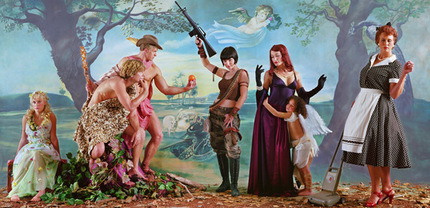
Eleanor Antin, Judgment of Paris (after Rubens)—Light Helen, 2007, color photograph, 62 x 118“. From the series ”Helen’s Odyssey.” (ArtForum.com – accessed 3/2/2020)
Clytemnestra
The final piece may mention gods from other cultures ??
Clay
Motivated perception
1:
Entity – emergent entity, not formed, a glitchy moment, never developed fully, so no material, no mass but information exists
leads to conversation
A: You can’t put me under a microscope and inspect me
B: What can you do? Can you do special things
A: I’m here aren’t I? But I don’t take up space. You can see me but it’s not easy, you’ve lost the knack. I live on the edge of your imagination
B: Are you a god
A: Haha, Perhaps I am
2:
A person who is a negative / ‘I never fully developed’
3:
Virgil and Tristram Shandy are planning a duel (maybe over the protagonist?). She laments, ‘One is quite dead and the other literally a figment of someone’s imagination’. Nevertheless, she tells them it’s illegal and what’s more, utterly out of fashion nowadays. And in any case, she’s not a thing, an object to be won, or to die for. But they take no notice.
Use BOW A1 in an installation on its own – leave alone now
5: Penelope the perfect wife
Tom’s first film? Perhaps – still undecided there
6: Some responses to the title cutting suggest a reading of ‘self-harm’ – while I am interested in the idea of a society doing itself enormous harm as I believe the West currently is, it seems there are connotations which don’t work for me there. I had unconsciously started referring to it in my head as ‘Script‘ for a moment… I may allow myself to follow that intention through. Letting it sit with me. The underlying idea remains ‘the cut’ but I think Script can contain that
Possible statement: an entanglement of historical and contemporary possibilities – (out of which novel relationships emerge ??)
Thought: Tautology is an insecurity (See Barthes’)
To be clear; here I discuss the topic I am aiming for as I plan for the extended essay. I mention several key texts that I think will be helpful and which I will include in my A2 Literature Review. A previous blog also links to several important texts but there is minimal reflection in that one:
I need to get on with writing the literature review element of my extended essay. I am still thinking and gathering – but wanted to just put something down in writing to help me clarify where I’m at at the moment.
I’ve identified a key problem so far – how do I relate my inquiry which I think is about ‘the loss/destruction of reality (as it has been construed)’ to photography? After all, the degree has photography in its title and I need to link the central theme to that discussion. Photography has played its part in that destruction – although there are plenty of other factors/actors.
NB Destruction might also be seen astransformation. I believe this is what my BOW A1.2 is expressing.
Photography’s role in mythmaking
As I said in parenthesis in A1, “photography may have been a very brief interlude in the journey that begun with cave drawing, developed to become printing, followed by the invention of mechanisation, and moving towards a total simulated reality” (2019; 6) In response, Roberta suggested, “Although this has not diminished the demand for those other media – indeed it has given them a new lease of life.”
Printing is in trouble – we do still buy books but it is in a terrible competition with digital text. Painting, not mentioned above, which played such a big role in expressing religious propaganda existed in a feedback loop of development for that purpose. Although people still paint, I wonder if it is fair to say it is no longer used for what it was originally developed for – and that is a relic like still photography is perhaps becoming. People will continue to revel in it but they are making ghosts – sorry to all painters and still photographers. I do not intend to be dismissive – I understand lots of people still gain pleasure from these media.
2. I am also aware that my first essay could be read as a justification for moving away from photography ‘proper’ and focusing instead on moving image.
3. It seems like a key question in that essay and previous ones, along with the way my work is going is: Why is it more useful/fun/relevant/interesting to look at how images are used rather than the making of them? This is where Postmodernism is relevant.
But I’m not sure that’s really what I believe or what I want to ask.
If the construction of reality is a continuous re-invention of the moment we’re in (which I think is a simplistic way of describing current scientific understanding), the conscious self relies on…
i. memory – an intangible remnant of consciousness which we sometimes exteriorise using various forms/materials;
ii. our hyperdyadic* existence – perhaps represented by collage made with appropriated material;
iii. and mechanical construction (which includes language as a technology – see Andy Clark) – perhaps represented by the output of machinery we have invented, and which to greater or lesser extent becomes prosthetic – i.e. phones.
*dyadic – interconnection between two things. Hyerdyadic – interconnection between many – lots of people but also the environment
4. Whatever route I take, James Elkins book What Photography Is (2011)is an entire book which isn’t really about photography, even though its title suggests that’s all it is about. It’s a response to Barthes’ Camera Lucida (1980), another book which suggests photography is its main topic but it might also be read as an elderly man coming to terms with his mother’s – and so his own impending – death. I need to learn from them.
How do I keep this related to photography?
I think I need to state early on – that I am looking at the moving image as well as still and come up with a generic term to encompass both. I might use ‘image’ and then qualify that. Image, therefore, might refer to drawing /painting/film. In which case, is there space or a need to address the arguments made about differences between each of these forms and attempt to lay them to rest for the sake of the discussion? (See Barthes – indexicality of photography and also Elkins’).
Perhaps I need to also talk about why moving image is key nowadays, and perhaps more so than still – as the masses embrace technology which makes video recording so easy, and advertisers use it more and more as it can potentially grab our attention with its movements and flickers more successfully than still. Or at least suggest we can make that assumption with some certainty. This feels a bit like a justification again and might take up too many words, but it feels crucial.
Although it may seem like I am dismissing still photography, I am not. In amongst the plethora of photographic projects and bodies of work which all seem very similar and flaccid, there are a number of photographers making potent and striking work, such as (but not exclusively) Thomas Ruff and Zanele Muholi.
(Intention is key)
Elkin says, “beyond that, talking about the surround as I did for the photograph of the greyhound reveals that the surround is boring, and possibly also that photography as a whole is, in the end, also a bit boring.” (loc 1706) Perhaps, I will suggest that if this is true it is because we as a society are desensitised to photography, now that its initial magic qualities have faded. Seeing a photograph in 1845 must have been incredible and exciting and perhaps awe-inspiring. To capture a person and then have them rendered as delicately as those older processes were capable of would have seemed extraordinary. But now it is mundane and every day. Now our representations move, can be built by anyone – even children as young as two, and offer adventure and flexible narratives. They are engrossing and enticing and overstimulating. So the poor old still photograph has a great deal to compete with. While some, perhaps people with time on their hands, may revel in the luxury of contemplating an image of a leaf or a fragment of a person or people, or the emptiness of a blank page, others are fed a diet of shiny, fast-paced, noisy and enticing media. Most of us have this latter fodder in our lives and perhaps that is where the mythology I am interested in exists. If still photography (academic art) is to remain relevant, then perhaps it can a useful tool for deconstructing the myth I’m exploring.
Art photography is often inherently elitist. Not always, but so much of it can’t help being so – refs from Elkins:
“It is easy to agree that photography’s apparent realism has been formed by the middle-class hope that the photographs give us reality itself (as Bourdieu says).” (loc 762)“‘photography is most frequently nothing but the reproduction of the image that a group produces of its own integration’. (Bordieu, Un Art moyen, 48)” (loc 707)“For Bourdieu, photography is bourgeois to its bones, and it even includes its own futile anti-bourgeois gestures, like my own attraction to things that aren’t family photographs.” (loc 716)
Still photography is one fragment of a re-enactment of our biological processes – by focusing on it alone we persist with a Cartesian construction/understanding of reality. But it might be more relevant nowadays to explore these topics more holistically. Intro/preface?
Mythmaking
Hoffman’s book below references advertising and images extensively. Held within these images are myths.
I have become really interested in mythology – and the relationship between science and religion. It seems to me that both do the same things, i.e. put difficult concepts into narratives we can try to manage.
The following is from the author, Jonathan Raban’s biography A Passage to Juneau.
“Within the last 9,000 to 12,000 years, when people were present to witness such events, they would have seen the sea close over islands as earthquakes rearranged topography. You couldn’t look at the delicate compromise made here between land and sea without imagining the Flood: and you couldn’t imagine the flood without inventing a Noah or a Gilgamesh” (1999) (Perhaps this quote will be on the cover page or at the top of the essay).
Books
Return of the Real Hal Foster 1996
The Case Against Reality Donald D Hoffman 2019 (see below) (He mentions Plato’s Cave his description may be useful to quote.)
How we Became Posthuman Kathryn Hayles 1999 (in particular Chapter 7, Turning Reality Inside Out and Right Side Out: Boundary Work in the Mid Sixties of Philip K. Dick)
I need to look at Deleuze but I do not know his work and have no idea where to start.
Popular Culture, films, TV
The AO (Netflix) 2016-19 TV – Series One explores a kind of inverted Plato’s Cave which becomes a metaphor for digital culture. As part of my research, I have been watching plenty of reality-bending films and TV, this being one of them.
Total Recall, 1990 and 2012 Film
Inception, 2010 Film (this leads to Memento – also directed by Christopher Nolan but I am trying to avoid clinging to memory as a key theme, even though that is an important topic.)
(In the link above, I talk about several influencing works which had fed into my own practice but which may also be useful for the essay.
I will need to revisit this at Tate Britain as there is much to link to, moving image, youth culture, myth, everydayness.
2. Katinka Schuett, Cosmic Drive – I have only just come across this work and will look at it as a possible example of still photography looking at similar themes. ““Cosmic Drive primarily explores the way humans handle ignorance,” says Katinka Schuett of her Female in Focus winning series, which examines the contradictory spheres of fantasy and hard science. “I am interested in our perceptions of space, and the question of whether or not life can be found in the universe.” Schuett is as concerned with fantasy as she is with facts, merging the two to consider the illusions we create when there is a void of information. ” (Roberts, 2019)
I probably need to have a few more references here.
Blog Conclusion (not essay) – is there a question/title here yet?
I’m not sure … perhaps:
Should we re-evaluate our relationship to myth/humanity’s need to create myth? (And what role does the image play?)
I feel it will be necessary to use the word image in the extended essay rather than photography – because photography is such a nebulous term and describes a range of activities – and perhaps I need to explain in a preface. Does a preface count towards word count? Something to ask when submitting the review.
Something I’ve not addressed here which I think fits but which may be too far outside the inquiry – the body/blood/softness/boundaries/flesh. Hayle’s looks at this and references Donna Harraway several times – I don’t think I fully comprehend what’s going on here yet and need to read these sections again, as well as Haraway’s Cyborg essay which I’ve only read once so far (and found it a little bewildering – perhaps I was tired/distracted).
I know I am interested in the fractal nature of reality and our conscious understanding of it. So, we function (construct reality) in a certain way and the patterns of that construction are evident in our expressions (media – films/adverts.any narratives, the way we produce them.)
I still think I’m focusing too much on why photography is becoming irrelevant and need to look more at boundaries/flesh/death – life/self-other; I suppose these things to tie into myth and the breaking down of self as a definitive object as technology and science evolve. Therefore perhaps we might say, “it is a myth that you and I exist at all” – however, this myth is all we have and so we need to take it seriously even though we understand it is a myth.”
“Sometime in the not-too-distant future, anyone will be able to take a picture without a camera. Instead, we will be able to generate photographs, indistinguishable from those made by a camera, using artificial intelligence (AI) software. You will be able to create an image by simply typing out a description of the scene, or describing it to (presumably) Siri. “Siri,” you’ll say. “I’d like an image of a red-haired woman walking through a park in autumn, the breeze blowing red, orange, and yellow leaves around her.” And—though it may require more detail than that—presto! Your phone will provide various options on the screen to choose from.” (Palumbo 2018)
Other refs:
Raban, J. 1999 A Passage to Juneau, Picador, Basingstoke and Oxford
 SJField - OCA Level Three Study Blog