CS A2: Rewritten following feedback

Added here 01/09/2020

Adjustments made to citations and referencing and a couple of sentences rewritten – submitted for assessment.

December 2019:

Following feedback from various sources including Matt, and while continuing to work on CA A3, attached is an updated version of the Portfolio Review assignment.

(Things to do – double check captions beneath mages.)

December 2019 CS A2 Can I be dead and alive a the same time .edited

BOW A3: Planning notes

I wasn’t beginning to panic exactly but about two weeks ago I was wondering if I was ever going to settle on something that felt tangible and a little more focused, something to really begin digging down into.

I’ve been concentrating on the ideas and theories that I’m trying to understand and not really making much in the way of work – although have continued looking/searching for footage and relooking at my own recent work to see what’s emerging.

There are some films I think may be useful. If they haven’t got any actual material in them which I’d like to use, then perhaps phrases or titles inspire me.

I had the following disparate entities along with ideas/responses so far:

  • A string of seemingly unrelated snippets of text  – some in the ongoing stream of Random Notes for a Short Story ##, and some other things that might be called poems – although I want to avoid that word and looking back over these, I think I will find a way of typesetting to avoid them looking like traditional poems and rather like prose perhaps using / between each line. This not only negates the sense of fixed poetry, but it also echoes Barad’s explanation of intra/relatedness. 
  • I looked at images I’d made in Italy (and not used in A2 but in another sequence). The themes are related but the images made me yawn even though they are quite nice photographs. (Hover mouse over image for explanatory captions written for the sake of this post)A convention of used footage (appropriated) downloaded from the internet to make new films, and also still images by simply screenshotting or else literally photographing my computer and the images on the screen – less frequently. My commitment to using digital habits/techniques is deliberate  – see DI&C A3. I have a very serious problem with the common notion in the arts and photography that digital media and techniques are less valuable or less interesting than analogue and historical processes. This trend strikes me as being mired in middle-class, excluding values. I am also echoing a non-Western tradition of valuing things we in the West dismiss – an animist worldview. This was referenced in the Barbican’s recent Digital exhibition AI: More than Human (2019), Nam June Paik retrospective, Tate 2019, and in Lupton’s Data Selves (2019) (citing Bennett’s Vibrant Matter (2009), Thing Power & Enchantment etc… and counters exceptionalism and binary thinking). I will continue in this vein because I think it’s really important to defy the ‘insidious unconscious reinforcers’ (Small, 1999)* that limit us. Artists, in particular, can be as backward-looking as the populists they claim to know better than who come across as if they want to go back to an imagined time that was ‘better’ – by rolling around in nostalgic practices while dismissing newer ones which give creative access to many, many more people.  This strategy of mine is not a wholehearted endorsement of all things digital. It is not a niave embracing of the new and rejection of the old. tech media is not immaterial as many think. It ‘is not clean’ – see CCA talk below. It is certainly not without its negative impact and connotations. As mentioned in a previous blog – this ‘is also explored in Vilém Flusser’s Towards a Philosophy of Photography (2012). The ideology is in the apparatus and photographers (all except experimental ones!) are flunkies or to use his word, functionaries – they ‘are inside their apparatus and bound up with it’ (loc 2086).’ (Field, 2019). (One of the people I worked with via Pic London is doing a talk in Glasgow which I can’t make called ‘Our best machines are made of sunshine’. CCA)
  • When I present work to a cohort of students who I meet regularly there is always a question about the form: ‘but is this acceptable? it’s moving image / or it’s about moving image and this is a photography course?’ It happens every time despite the fact I have sought reassurance from Wendy McMurdo (who suggested using moving image herself, just as I was discovering my long-term interest on the impact of cinema and its related activities on my developing sense of self), and Andrea Norrington (DI&C tutor); and reassurances have been verified by the fact both the tutors I now have are connected to and use moving image as well as other media. I do pass all of this on but yet, each time I’m once again questioned about my use of /reference to moving image. In terms of the recent essay, this questioning tells me I need to make a particular concept much clearer and will discuss when writing up feedback, but other than that, this constant questioning reveals a common confusion over what photography is and how still/moving differ and are the same. What’s more – it reveals the ‘Cartesian habit of mind’ (Barad, 2011) which I am at pains to deconstruct. It highlights the lines we modern Western humans are so desperate to impose. But – even my tutor asked, ‘are you going to concentrate on still or moving?’He has not been following my work for a while though so it’s somewhat forgivable. My cohort, if not avidly following my progress might have least have noticed constant freezing of moving images  – making a single frame out of several, focusing on the cut from one scene to another – where there is a blend of frames on view. They might have seen the reverse action – i.e. instead of adding many frames together to make them move, I have taken single frames and stopped the animation.  Then reintroduced animation while maintaining the stillness. Had they been looking they might have picked up on the desire to stop the ongoing simulation with its ‘insidious unconscious reinforcers’ (Small, 1999) and seen me step inside of it and take a look around.
  • I have explored the difference between film and still image – they are both the same at the centre. We humans either look at a single frame or we add many frames together to create the impression of reality. It is, however, an impression, we do not move at 24 fps and some filmmakers are experimenting with higher fps but we are so used to having an impressionistic view that we don’t always much like it in cinema. But video games, ‘today are developed with the goal of hitting a frame rate of 60 fps but anywhere between 30 fps to 60 fps is considered acceptable. That’s not to say that games cannot exceed 60 fps, in fact, many do, but anything below 30 fps, animations may start to become choppy and show a lack of fluid motion.’ (Klappenbach, 2019)
  • To reiterate – I am stopping the simulation when I take a screenshot or focus on the glitchy frames that show two scenes chopped together.
  • I am making work in the reverse order that is usually made/and chopping up the order.
  • I am looking at the capturing of light  – the core activity of still and moving photography. What happens afterward re the temporality we impose on our captured light (life) is also of interest because it relates to the constructive nature of existence  – which according to some visual scientists is what we ourselves do in any case even when we’re not making films.
  • See ancient mythology and compare to modern mythology (advertising whether honest or subversive in the cinema).
  • The following may be a useful paper for me –
    A New/Old Ontology of Film Rafe McGregor (2013)
    The purpose of this article is to examine the ontological effects of digital technology, and determine whether digital films, traditional films, and pre- traditional motion pictures belong to the same category.
    https://www.euppublishing.com/doi/pdfplus/10.3366/film.2013.0015 
  • Not wishing to introduce spoilers – but McGregor concludes ‘At this point in the second decade of the twenty-first century, however, digital film remains – like traditional film and its predecessors – the art of moving pictures’ and I suspect I will find that at the core of both film and still, regardless of digital or analouge  – the capture of light is the same thing. However, various processes enable different social outcomes due to access, cost, and social biases that are linked to ideologies feeding into them.
  • But – moving image (digital or analogue – once it’s on the internet, there is no difference) gives the appearance of being more like a wave than a particle and therefore, perhaps a useful means of conveying some of the ideas that come along with the particular weird phenomenon where particles behave like waves when measured under certain conditions – and related phenomena.
  • This resolute determination to exist with a Cartesian habit of mind in our institutions and society means two things for me:1. I have found a way forward for this project. I have ordered a Super 8 home movie made in 1971 from E-bay. I was looking for two things – a moving image format that I could cut up (made still) and it should have been made in the year I was born. I will use this alongside fragments of text and make a book (a3) and film (thereafter) with it. I will need to digitise it before cutting it up into what I will need and playing with it which might delay me slightly – but knowing it’s on its way means I am free to carry on writing in the meantime.
  • 2. But it also infuriates me because it’s about pigeon-holing. The need to categorise everything into arbitrary manmade labeled domains limits us exponentially. It stops us from seeing and accepting complexity and nuance. It filters out difference – see Barad ‘indeterminacy is an undoing of identity that unsettles the very nature of being and non being’. You can see this in England right now as it grapples with its identity crisis – what am I? British, European, Labour, Conservative, Liberal or none of them  – oh my god – how can I be all these things and none of them…’ aaargh!!!!’ goes the collective wail. It is reductive and insulting to keep pigeon-holing. It’s also rude and belittling. It is the antithesis of superpositions.

Summary:

  • My work is an attempt to visit a non-cartesian world and see what it looks like
  • It is a response to Cartesian reductiveness and habitual narrowing of meaning
  • It hopefully will do this via many intra/related mico-narratives
  • The themes are human temporality – both biological and mechanical, consumerism (the modern religion) and the relationship between narrative and the evolving worldview we are revisiting (we weren’t always in this place)
  • The process in CS is informing the potential outcomes in BOW for the momentOverall – I think the work could be called PLEASE for mercy’s sake stop with the arbitrary categorising, stop with the Cartesian habit of mind!! But it’s not very catchy, is it?
  • I am not decided yet but I may simply call the work CUT  (perhaps with a subheading about fragments for the modern consumer but I will decide later) linked to the fact I will cut up the film I’ve ordered, edits in filmmaking and meaning (see BBCs latest accepted ‘mistake’ re-editing different answers to questions to imply a new meaning) and links to Barad’s agential cut.

‘Kember and Zylinska (2012) use the concept of the agenital cut to argue that any attempt to impose meaning and order is an intervention (a cut) that produces specific effects, and is inevitably part of the matter it seeks to observe or document. They represent photography as a specific cut in meaning, a way of delimiting from all the choices available that can be recorded and displayed, and therefore, how meaning can be generated. It is the means by which things are brought into being by humans and non-humans (e.g. cameras) working together. Photography makes agential cuts that produce life forms rather than simply documenting them. It is a way of giving form to matter’ (Kember and Zylinska 2012:84) They do not differentiate here between moving and still photography (I would need to investigate further  but it makes no sense to in these terms.)

‘To see one must actively intervene’ (Barad, 2007:51 – citing Hacking)

*Quote taken from an anthropology book about the formation and feedback of culture and self in relation to cost/benefit ratios and social-economic needs. Although the book focuses on childcare practice cross-culturally, the premise is relevant. By looking at photography through the prism of child anthropology (along with the other intra/related disciplines I visit), perhaps I am engaging in a diffractive practice.

Refs:

Barad, K. M. (2007) Meeting the universe halfway: quantum physics and the entanglement of matter and meaning. Durham: Duke University Press.

Flusser, V. (2012) Towards a philosophy of photography. London: Reaktion Books.

Klappenbach, M. (2019) Understanding and Optimizing Video Game Frame Rates. [Gaming Magazine Online] At: https://www.lifewire.com/optimizing-video-game-frame-rates-811784 (Accessed 02/12/2019).

Lupton, D. (2019) Data selves: more-than-human perspectives. Cambridge, UK ; Medford, MA: Polity.

Small, M. F. (1999) Our babies, ourselves: how biology and culture shape the way we parent. New York; London: Bantam ; Kuperard.

CS A2: A new draft with peer feedback

This is now much more focused on a specific line of inquiry.  I feel like this has put me in a better place to begin putting words down for A3. (I hope!)

rewrite- CS Assignment 2 Can you be dead and alive at the same time_ Draft 6

Comments and some reflection to be added later.

Adding 5/12/2019 (although they arrived prior to that nad presented here in the order they arrived  – my responses in Orange)

  • Read your Lit Review and have the following comments: Firstly – an excellent review of the position you are taking.
    • In some ways it feels like being close to a completed essay, much like John did, and could see you fleshing it out to provide a final essay.  I feel the shape is just about where it needs to be too and I can use the progression/layout here as a starting point for A3/4 etc. 
    • Maybe needs a link to your work, but that could come in the final essay,
    • To be really picky, there is some inconsistency in your citations in the text. (I did not check the bibliography)
    • The use of italics for emphasis is maybe superfluous – I did not highlight all of them, – thank you
    • UCA Harvard refers to Figures not Images, so OK in body but should have List of Figures , not ‘Images’ OK
  • Something I picked up from the UCA (site links below) was that the list of illustrations goes before the bibliography. I’ve followed these for mine. I wasn’t sure about the sentences under the images. Should they be in the text? (yes, I am really pushing boundaries here – something to look into. – I wrote in an email discussion
    I expect if it repeats what’s in the body it’s fine, if it echoes what’s in the body one is flirting with danger, if it adds info – it’s probably not such a good idea. )

    The intimates using text examples e.g (see fig 1).
    Like Doug, I thought you had to refer it back to your BOW. (God there are so many opposing suggestions re. this point from students and staff. My BOW and CS work is clearly very much connected but BOW is as it should be right now, an unfolding emergent thing – at the moment the CS work is informing the BOW ideas but there is nothing to see except for experiments of A1 and A2 which might feel completely unrelated, an email from eBay confirming a purchase of some Super 8 film shot in the US in 1971 (my year of birth) and a bunch of disparate bits of text. I suspect for any students reading this – that in each case it will be different. It will depend on your work and your process. I suspect there are no hard and fast rules, rather tendencies. The tendency would be to include some reference to one’s own work but it is not necessary especially if not relevant (although how one makes work and then writes about something that isn’t related is puzzling) – or if it doesn’t further your argument. 

    https://www.uca.ac.uk/library/academic-support/harvard-referencing/

    https://xerte.ucreative.ac.uk/play.php?template_id=93

    The formatting is obviously something one wants to get right  – good habits are great to get into and I will revisit. I am confused (as I think many others are too) about what is expected of us if we have already mentioned citation info in the body – which we might do if relevant  – then thereafter we need only put the page number or ibid if continuing. I am not sure if this convention is acceptable or if it is what my peer is referring too but I have been looking at and taking on board what academic writers do and noticing when they seem to be following Harvard guidelines (as far as I understand them). If one need only put (date) or (pagenumber) after a quote or reference rather than (name, date, page number) because the information has already been established, that should suffice – surely. Even if that is not what we do every time. Is this comment is referring to, I wonder. I will need to clarify in case it is about something else which I’ve not cottoned on to.


    example


  • I’m going to put these here & have included an annotated doc with more suggestions.
    • There are two main topics of conversation in the introduction: Why is the narrative of quantum theory relevant to representing our sense of reality today? & Is digital or analogue more suited to this type of representation? I am not sure I see this as a problem – but will re-look at my phrasing. The main issue I have and which I am working against all the time is how entanglement functions, is seen by modern Westerners and effects academic practice, and how the separation of related topics is discussed. I am also coming round to the idea that the issue is not about the difference between analogue and/or digital although that is a relevant issue – but rather than the difference between fixedness and dynamism. Still analogue speaks to a world in which things are fixed. Moving image, regardless of media conveys less fixedness. Digital media has dynamic movement and possibility built into it – regardless of what happens thereafter, i.e. whether we focus on a single frame or many (giving the illusion of movement) and speaks to and conveys a world that is not fixed but dynamic.  Fluidity is not some kind of Nirvana for me – it has its problems as we see, but it is what we are dealing with in the world today. 
    • I think you then go on to talk more about the perception of reality as it has been moulded by the invention of photography, and I’m not sure that the digital/analogue debate is as relevant as the question of technology. Gosh!! – this is what all my work is ALL about – I must have completely failed to convey the crux of my entire inquiry – the anatomy of the media we use emerges from and feeds back into culture/perception : see notes which I dropped from DI&C essay re Victorian mechanics (Early draft example of DI&C essay (draft 3)The author of the article explains film cameras are like vinyl records amongst millennials, which suggests analogue and film are a curiosity from a foreign land, the past, amongst people who were ‘born digital’; perhaps in a similar way to how the aesthetics of Victoriana are adopted by a popular sub-genre, Steampunk. Steampunk references Victorian technology and mixes it with futuristic, (which might be seen as a reversal of Derrida’s Hauntology where the past acts as a spectre within the present.) Within the Steampunk astheatic, the future haunts the past, as narratives are often set in alternative histories, where our future fantasies become embedded. Such fantasies might be interpreted as fascination in its truest sense, as our fear of transforming from human to post-human, and then on to non-human expresses itself.
      ) – The digital/analogue debate is critical within multi-layered, entangled, issues related to representation ∴ representationalism. Digital is the media (for now) of the masses which allows people from all walks of life to express themselves – it is also the language of control and manipulation used by advertisers (of all kinds, inc. political ones). It has led to the proliferation of ‘voice’ across the whole spectrum of society. It has also allowed propaganda to be spread much faster than and further than previously. We should not/cannot separate social media or digital photography and how it is used from data in general:
    • See Self & Other A5 text  – “Photography (still and moving) attracts plenty of attention as the possible culprit for “destabilising truth and reality. The bombardment of images makes valuing them a challenge. In an article querying their reliability LA Times journalists, Carolina Miranda and Jeffery Fleishman, tell us “…in our social media-frenetic world, images careen at hyper-speed across a politically divisive and dangerous landscape, where they are celebrated, manipulated and often degraded. A picture can be altered and a video edited with such alarming swiftness and precision that it is difficult to scroll back to its unadulterated original…Alternate realities have become hobgoblins of our time.” (2018)
      Just under two decades ago, Andy Grundy for the New York Times wrote, “In the future, it seems almost certain, photographs will appear less like facts and more like factoids – as a kind of unsettled and unsettling hybrid imagery based not so much on observable reality and actual events as on the imagination”. He continues, “This shift, which to a large extent has already occurred within the rarefied precincts of the art world, will fundamentally alter not only conventional ideas about the nature of photography but also many cherished conceptions about reality itself.” (1990) One might justifiably argue conceptions of reality are changing dramatically in light of digitisation. However, they’ve done so frequently in the past, throughout our relatively brief history and often due to previous technological advances. They will undoubtedly continue to evolve. To borrow Mr Peachum’s excellent words: ‘that is all there is to it’. And beyond that, humanity may indeed be ‘shit’. However important and destructive and godlike we think we are as individuals, however collectively critical we might be about NOW, we have long been full of it.” (Field 2018 – extract) 
    • See: “I think it’s an oversimplification [social media being to blame for a distrust of science]. We know from history that you don’t need social media to spread disinformation, you can do it with old-fashioned media. However, I do think social media has made it worse because it’s now possible to get disinformation out to incredibly large audiences rapidly at very low cost. A bunch of guys in a basement can now do a lot of damage and do it pretty quickly” (Lawton/Oreskes 2019)Read more: https://www.newscientist.com/article/mg24432580-600-naomi-oreskes-turn-your-anger-at-science-denial-into-political-action/#ixzz67EaekWF6Analogue is limiting. Although women and non-male, non-white people, non-dominant ideology subjects, of course, have made work with older tech, the space, money, time one needs to use analogue materials prevents many from doing so. This impacts heavily on the perception of reality – so much media made privileged and arguably quote myopic people who have limited experience of life, literally never had to think about being black or poor or uneducated –  and my DI&C essay is all about that issue. Within an entangled discussion about an entangled subject – this is key. 
    • The ‘Flexible Unlearning’ section is too dense and summarising the ideas in the quotations will also focus your thoughts. I am looking for places to cut words but I am not sure this is the place – although I will relook. I was encouraged by Andrea (previous tutor) about comments regarding my ‘sophisticated use of quotes’  used to ‘drive arguments forward’. Something to speak with Matt about
    • The two bits on moving image and consciousness don’t seem to fit here (p7-8)
    • I agree that the examples are too long and that there are examples within Photography that might be worth looking at (see below). Have noted that this section is where I can make cuts but I very clear that the first two examples are absolutely right  – although I need to set up a dialectic in the second example which I can do, having seen tutor feedback to other student’s work which clarified things a little for me about images being a phenomenon and or object/memori mento. Another peer’s comments made me realise I need to really underline and heavily signpost why I have used these two examples – this comment underlines that need. The final example can be replaced by another  – and I think I may have found one I’m happier with. 
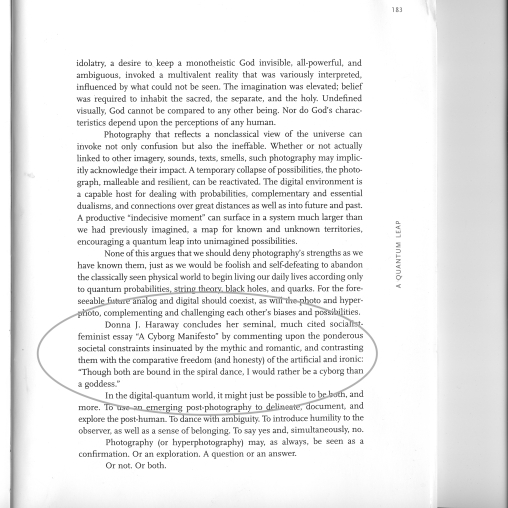
    • I like the ‘Another Life’ example but can’t see the link to the Haraway and Lupton in the last couple of paragraphs. Condensing this section will, again, focus your ideas. Hopefully, this will be more obvious once I’ve spelled things out but just to reiterate, William is a Cyborg. He is also the future of a photograph. He is also an obvious human Other – see many, many, many texts relating to Cyborgs to Otherness. See page 183 – Fred Ritchin quotes Harrawaycyborhharrowayritchin007.jpg
    • You mention Elkins saying that photography is boring but don’t actually reference this in your main section on him (p6). Useful point
    • The last paragraph feels very much what the focus of the review should be and I kept looking at your extended essay question which I think is much more precise.
    • Suggestions for examples section:
      • Noriko Yamaguchi – performance artist http://www.mem-inc.jp/keitaigirl/artist.htm
      • Juno Calypso ‘The Salon’ https://theculturetrip.com/europe/united-kingdom/england/london/articles/see-this-fantasy-beauty-salon-by-juno-calypso/
        I know this work is very popular – I am not convinced by it despite the fact it is striking and obviously very effective. 
      • Armin Linke – for photography as intra-related
      • Sohrab Hura ‘The lost head & the bird’ – for contemporary reality – ThinkI will be including this artist but not this work and came across it via 
      • Vincent Morisset – for game / interactive / installation / performance – merging of media & technology
      • Possibly (I couldn’t get them to download onto my v old iPad) see BJP April 2016 ‘Weird Science’ & April 2017 ‘Scratching the surface’. Should be in the UCA library.
  • I found this mostly engaging, but found the Examples in Popular Culture and Art section problematic for two reasons:
      • A lot of words per example – feels like two much detail for this length of essay Agreed. -it’s the section that isn;t working for me tight now. 
      • That the examples are all moving image See previous blogthis also tell to I need to spell things out more – I know you address this in the essay but your question (about whether still photography is embedded in a dying ideology) risks undermining the premise that this subject is worthy of an extended written project on a *photography* degree


There is some useful feedback here. Mainly because it shows me where I need to make things much more explicit – since I use the process of writing to think, to inquire, to figure things out, it is through reading and re-reading what I write, and then seeing how others receive it that I begin to understand the complex ideas I’m exploring in others’ writing and how that fits with my overall inquiry. However, the conservatism mentioned by Daniel C Blight (see below) on Twitter or the ‘Cartesian habit of mind’ Karen Barad discusses is strong in photography – and in academic photography training – and I feel like (even if I were the clearest simplest writer in the world) one is constantly working against that trend.

It is also very important for me to see that others have not been on my journey – my inquiry is long and expansive. My inquiry ‘explores debates beyond a simple education course forum’ (DI&C feedback 2019). It dates back to my time as a child watching grownups behave weirdly and noticing moments getting lost forever, people copying each other. To when I first began reading child/baby anthropology books because the usual baby fodder was boring, reductive, ideologically-informed and at times, quite, quite mad. i.e. ‘Don’t look your baby in the eyes’ !!!!!!

I also think when sharing these ideas with other photography students I will need to tread carefully – I am not saying their work is ‘boring’ (it isn’t). I am saying still photography is limited and limiting and ‘such and such’ may be the structural reasons why.

https://twitter.com/DanielCBlight/status/1199286943533731840?s=20


CS: A2 Tutor Feedback

Scroll to the bottom for PDF link or read additional notes first:

I had an extremely useful and relatively long tutorial with a new CS tutor after my previous tutor resigned from the OCA. As is usual with me, I submitted knowing there was still much to do but I reach a point where it’s helpful to get it the work off my hands and receive constructive, meaningful feedback even though I know things are still quite murky.

I have read significantly more since finishing the draft I handed in and am continuing to do so, refining and zoning in on the one hand, but also delving further into such a rich and fantastically difficult/confusing vein of knowledge on the other – that I am still in a thinking place.

I think I mentioned elsewhere that Matt advised me to write my plan/research question (A3) then return to A2 to strip out the unnecessary stuff and focus more on the key topic, not that I know yet what that is, but I am getting a clearer idea. For a while, I thought it was performativity which I have been busy investigating and how that relates to representation and ultimately photography/moving image. I still think that is the case but I keep thinking about boundaries and the collapse of them – also representation,  – a lot of the creative writing I am doing over on Sketchbook is tackling the issues I’m thinking about but in a more instinctive way than one might do so academically. I think that is a better way of working for me. I write, then read what I have and out of that I begin to see what my concerns are.

As far as performativity goes, it seems to have two paths leading to it (Lloyd, 2015) – one theatrical and the other sociological (Austin). One is about acting – playing the role of being a person in the scheme of things, and one is about reaching potential or expectations (or not) i.e. this hoover is not performing as well as advertised; to be a female non-subject one must live up to certain expectations – the  performativity of being a ‘girl’ / ‘women’ = e.g. taking care of one’s looks/physique, acquiescing (don’t be too bolshy or difficult  – that is underperforming  – think Kate in The Taming of the Shrew), having a certain a maternal aura, kind, gentle, quiet when necessary etc. Some women perform ‘well’ (like a hoover – they match up to requirements) others, myself included, ‘fail’ to. I think that is the very basic difference between the two versions of performativity and that needs to go into my Lit Review. Then there is theatricality – dismissed by the modernists and many more besides (Fried, 2008/1967) – especially nowadays when it’s de rigueur to be slapdash or else anti-commodified, or to give the impression of being so even when not.

I need to figure out how to tie (or if I must) this in with photography being ‘boring’ (Elkins, 2011 – and many more, including me.) Incidentally, I don’t necessarily dislike any of those anti -things, and really like them at times. However, I have noticed I can be far more ‘mundane and every day -ish in my writing than I can be in my photography.

I have yet to really get anywhere near to grips with Barad’s use of performativity at the quantum level but I have just ordered her Meeting the Universe Half Way, and I think there will be plenty of direct passages that can help me with my research there.

I am also wondering if I should have a glossary – is that allowed? There are some tricky words that I don’t want to spend too long explaining  – or waste too many words explaining unless it is necessary – I need to find out if this is considered acceptable or not.

Here is the feedback which I wrote up following the tutorial. A2 CS Feedback Form


CS: Assignment 2 – Literature review

Write a 2,000-word literature review that identifies, summarises and critically discusses the most relevant texts that currently explore the subject area of your practice (i.e. the subject area you are exploring in Body of Work). Try to contrast differing points of view and indicate how you will expand your research into your extended written project.

Your essay should include a bibliography, be fully illustrated and reference citations appropriately throughout. See the extended written project submission requirements at the end of Part Three for more information about how to format your literature review.


I have sent the following draft to my new tutor Matt White. This PDF does not include (c) images. The offline version does. Web CS Assignment 2 Can you be dead and alive at the same time_ Draft 4

He sent the following link a couple of weeks ago which I found useful.

The structure of a literature review

Here is my reflection:

Demonstration of subject-based knowledge and understanding:

I didn’t set out to write about Brecht but once I realised that Fried had relied on his theory to prop up his own writing I was able to draw on previous knowledge. As an A level student in 1989 or so I was barely literate but I managed to get top marks for my Brecht essay. I just loved learning about his plays and methods. I am also interested in reality so pulling these strands together was enjoyable although I feel I have only scratched the surface. I will need to read Fried more carefully as I’m pretty sure I’ve made some mistakes based on assumptions.

Demonstration of research skills:

As I say above I need to dig deeper and make sure I’m not assuming things. Having written this, I feel I can now go on to do the real research. I have just about finished the Lupton book and once that’s done I can get to grips with Fried and Object Ontology.

Demonstration of critical and evaluation skills:

I have shown that I am able to question established views and even if others don’t agree with me, I hope I have given reasons which go some way towards supporting my arguments.

Communication:

It’s always tricky getting the balance tight – overly academic writing isn’t fun to write or read. Before she left, Ruth suggested experimenting with the form and I would enjoy that – not sure the OCA assessors would agree though. I love Chris Kraus’s ability to intertwine critical theory and autobiography and novel into one.

Writing a literature review was new to me – should we include our thoughts? Some fo the advice I got from fellow students was contradictory and confusing to say the least!

Please note: I will need to go through it with a very fine-tooth comb before printing for assessment, and there will be typos and repetitiveness, however, I am likely to revisit it and hone it in the run-up to sending it in.