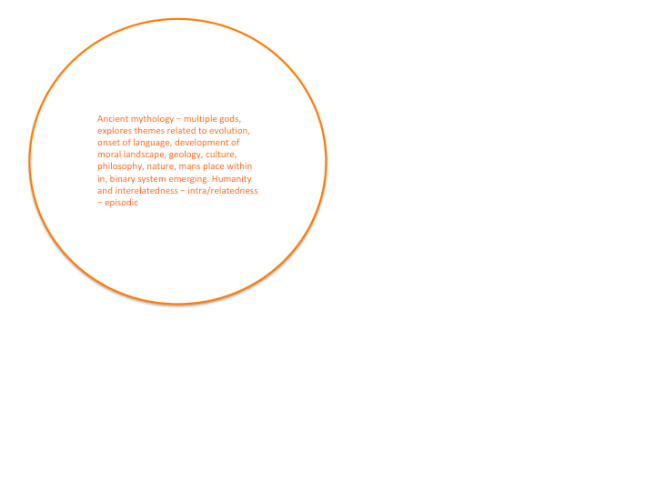
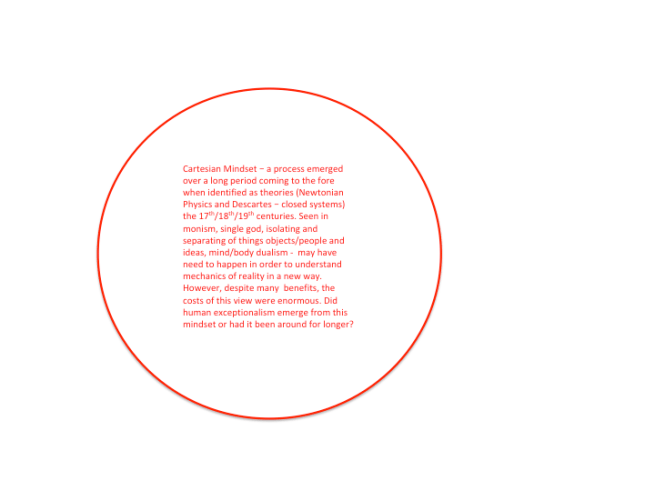
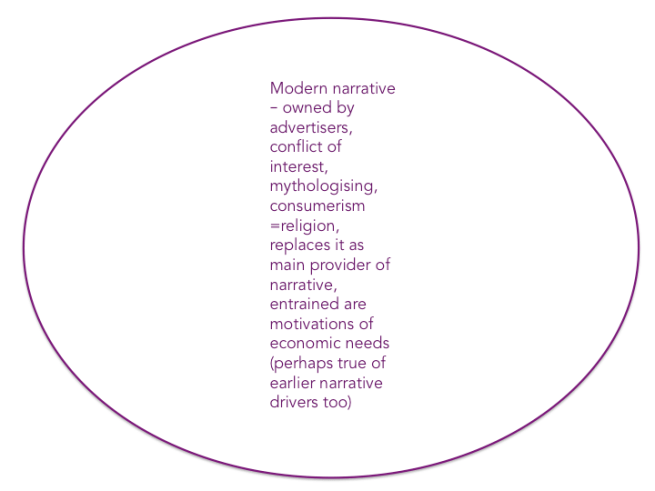
BOW/CS: Research , Delueze ‘difference’ & Barad ‘diffraction

Barad quotes Deleuze once in her first chapter at the top of a section, referencing language (words) and the problem of representationalism, and later, he is relegated to a sentence in her notes which mentions how his view on entities interacting – which are so similar to Barad’s ‘intra-action’ is irrelevant (2007, 437, n80). She writes ‘possibilities are reconfigured and reconfiguring’ (177) For Deleuze, there is folding and refolding and unfolding and refolding (May, 2005). I find Barad’s neglect of Deleuze surprising and wonder what it’s about. She tells us she is a Derridian – maybe it’s just about preference, but I suspect there is more to it. Can’t believe it’s related to views’ like Scruton’s dismissal of Deleuze.

Regardless, there are lots of correlations, and in any case, neither’s views are entirely new (suggested by Professor Paul Fry, Harvard) since the overemphasis by humans on their separability  – rejected by both Barad and Deleuze – is explored by Walter Pater in his 1873 book The Renaissance: Studies in Art and Poetry. The difference with Barad is she has the language of science backing up her arguments (although even then, they are contentious in some circles). Fry says Deleuze’s writing style is excitable – maybe it’s that which puts Barad off.

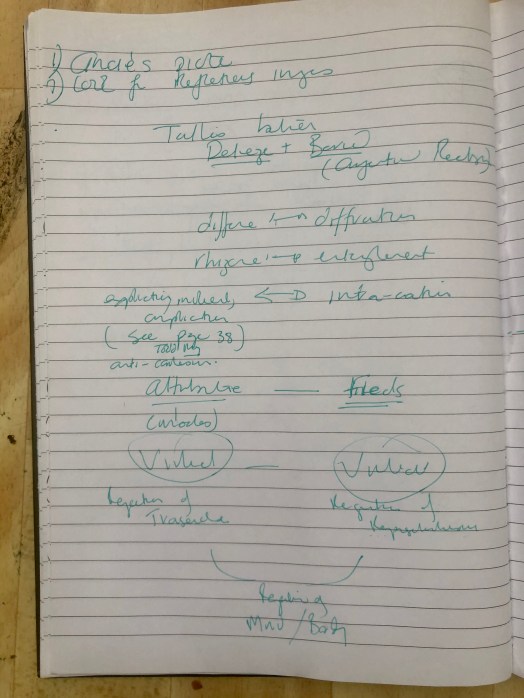
I have recently been reading Todd May who is recommended by different people as being good on Deleuze – and was thrilled to see morphology discussed in one of his videos as that links directly to my DI&C work. In the meantime, some notes taken while istening to Professor Fry’s lecture (see below):

IMG_2171IMG_2172IMG_2173IMG_2175IMG_2174


Barad, K. M. (2007) Meeting the universe halfway: quantum physics and the entanglement of matter and meaning. Durham: Duke University Press.

May, T. (2005) Gilles Deleuze: An Introduction. (s.l.): Cambridge University Press.

The Postmodern Psyche Explained (s.d.) At: https://www.sam-network.org/video/the-postmodern-psyche-explained(Accessed 16/02/2020).

CS A3: Tutor Feedback

Full document: Sarah-Jane Field CS A3 Feedback Form

 Key points

  • What do I mean by photography? A perennial problem and one which I spent many words trying to address in DI&C drafts before abandoning. Will discuss below.
  • I am asked; without being patronising, will there be a type of glossary for some of the more unfamiliar words/phrases/concepts? (I have wondered about including a glossary for the tricky concepts in the indices as well as inc. Chapter 1 as planned – would this be acceptable?)
  • Choose the right examples, this is imperative – I agree.

Summary of written feedback:

You are beginning to bring together these complicated ideas into a coherent piece of writing that asks questions about the way that we perceive photography. Your sample text section is well written and is an indicator of a highly polished, informative and interesting piece of critical writing. Good, I’m pleased to read that.

  • Need to be clearer about what I am critiquing – formal traditional photography (inc. moving image)/ or am I including or omitting practice that moves beyond the frame? My big challenge is our language system – I am critiquing the habit of a Cartesian mind which seeks to separate these things in a world still dominated by it – which I think is particularly *exemplified in photography – the recording and fixing of photons (there is much more to say about this but not here). How I overcome the challenge in the essay is yet to be seen and I may not succeed. It may not even be possible because the language we use today, and how, may not allow for it. A friend studying at a much higher level than me recently said, we desperately need consciousness to evolve away from the Cartesian urge to isolate and separate. But it’s not going to happen overnight or even this century – however, lots of people seem to think it is taking place, beneath the surface all the time without our awareness, due to digital culture for good and bad – and having an impact on how we perceive everything, from photography to far beyond. (*See John Tagg’s Filing Cabinet talk 2011, Vimeo, which though hard to follow has useful references)
  • I agree with Matt’s point, the artist examples should clarify things. I was glad to be pointed towards Christian Boltanski and Alfredo Jarr. I have identified that Edgar Martins is exploring the relationship between photography and perception, and his work is heavily influenced by quantum-informed concepts. Lewis Bush’s Ways Of Seeing project may also be an excellent source.
  • Since submitting A2 I have identified further written work which will help to support the discussion – essays in Martins’ book on death and suicide and by Daniel Palmer, Associate Dean of Research and Innovation in the School of Art at RMIT University, Melbourne. I have also continued to read Barad’s work making sure I understand the ideas as best I can and can apply them to photographic theory.
  • ‘Is the quantum world view that you suggest closer to certain modes of photographic expression than others?’ I suspect traditional photography can and does express the emerging view I’m exploring but it presents challenges. I think our understanding of how meaning comes about through intra-action, relation, and context – between all elements including the presence of a conscious mind is what matters most. As Palmer writes and I agree, ‘Cartier-Bresson’s style of photography is still possible, still practised and celebrated, but its importance is marginal. [Because it represents the mechanistic world in which it came to the fore.] With the digital universe, other types of photography have become more culturally significant, ones which often involve a shift from the single moment of capture to the expanded moments of post-production.’ (2015) Expanded moments of post-production make us think of a continued, phenomenological process. A Cartier-Bresson ‘capture’ aims to kill the moment and stick it up on the wall. He did tell us he was a hunter. For Barad, and Bohr, reality is all phenomena. Others don’t buy this, I’m aware. But from a structural point of view – in a world underpinned by continuously lively data – the notion of phenomena is critically important.  Algorithms, code, intra-active materials express today’s process of making meaning. It’s important to state I do not think all things digital are the Holy Grail – far from it.  
    (Ref: Palmer, D. et al.(2014) ‘‘Lights, Camera, Algorithm: Digital Photography’s Algorithmic Conditions’ in Sean Cubitt, Daniel Palmer &; Nate Tkacz (eds.),’ In: Digital Light. Fibreculture Books. pp.144–62. At: https://www.academia.edu/30168558/_Lights_Camera_Algorithm_Digital_Photography_s_Algorithmic_Conditions_in_Sean_Cubitt_Daniel_Palmer_and_Nate_Tkacz_eds._Digital_Light_London_Fibreculture_Book_Series_Open_Humanities_Press_2015_144_62(Accessed 08/01/2020).)
     
  • I am very interested in Matt’s inclusion of Jaar’s The Sound of Silence, not least of all because I lived in SA until I was 16, my mother was a journalist there in the 80s, her late husband knew Carter and his group of fellow photojournalists and the Bang Bang Club(2000) made me homesick and heartbroken for the people and country I knew – I read it a good while before studying with the OCA. In my own practice, text and its relationship to the image, our response to both forms, has been crucial since S&O when I exhibited a series of images and writings on the wall – giving both the same value. Since then, text has always played a role and at the moment my BOW includes just a single image and about ten pieces of writing – although I do currently plan to add more pictures. But the relationship between both forms is absolutely key. I will need to look at the work in more detail and think about your question – but it could be an excellent example. (This bullet point is sheer entanglement – but we might also call it serendipity or even an inevitable happy culmination of events/things/people/information.) https://sjflevel3.photo.blog/2020/01/07/bow-a3-texts-rewritten-and-placed-in-a-suggested-format/
  • ‘I am not that familiar with Muholi’s work but can you be specific about how she manages to move away from the Cartesian view beyond questions around Colonialism (how important is colonialism to your argument?)’ Colonialism is crucial. Barad never stops mentioning it. Azoulay’s thesis in Unlearning the Origins of Photography (2019) is clearly influenced by similar ideas to Barad’s – the entangled activities of taking, extracting and destroying – in which photography’s history and practice are firmly ensconced (See my DI&C essay). In an article about her earlier book, The Civil Contract of Photography (2014) she discusses how the meaning of a colonial image of an African man, originally intended to show how ‘savage’ the man was, today expresses the savagery of the photographer and the dignity of the subject – context and relation are key to quantum concepts/philosophy as well as photography. (‘relata-within-phenomena emerge through specific intra-actions’ (Barad, 2017: 334)) I will need to make this clear in the introduction, and I suspect quotes from Azoulay will help. Muholi’s work might provide evidence of a non-Cartesian, transformative, lively, relational view of the world – at the very least her work rips apart the Colonial habit of white European men cataloguing black skin (and women).

Finally, after submitting A3, I came across a useful paragraph in Barad’s book which settled something for me, where she discusses how the quantum world is not a different world to the Newtonian one (of course). Newtonian physics describes the parochial space we inhabit. Quantum ideas go beyond that and describe the world we have not evolved to ‘see’. But our growing knowledge of it affects our understanding. The maths (according to every documentary you watch) is the most accurate description of reality we have today and that there has ever been. I will need to include this, I think. Plus, why I think this is all so very important for photographers/artists.

(See original tutor text at end of document)


CS Research: (97) (PDF) ‘Lights, Camera, Algorithm: Digital Photography’s Algorithmic Conditions’ in Sean Cubitt, Daniel Palmer & Nate Tkacz (eds.), Digital Light (London: Fibreculture Book Series, Open Humanities Press, 2015), 144–62. | Daniel Palmer – Academia.edu

This has some useful references included and the phrase ‘marginal’ referring to decisive moment photography which may be useful alongside ‘boring’ (Elkins) ‘conservative’ (Blight) and ‘tautological’ (me).

(97) (PDF) ‘Lights, Camera, Algorithm: Digital Photography’s Algorithmic Conditions’ in Sean Cubitt, Daniel Palmer & Nate Tkacz (eds.), Digital Light (London: Fibreculture Book Series, Open Humanities Press, 2015), 144–62. | Daniel Palmer – Academia.edu
— Read on www.academia.edu/30168558/_Lights_Camera_Algorithm_Digital_Photography_s_Algorithmic_Conditions_in_Sean_Cubitt_Daniel_Palmer_and_Nate_Tkacz_eds._Digital_Light_London_Fibreculture_Book_Series_Open_Humanities_Press_2015_144_62


CS A3: Plan, sample text, schedule

Full document – inlcudes Sample, plan, schedule, bibliography and reflection:

CS A3 Entanglement Draft 5 – sample only .edited

Cut section (focuses on systems but think this muddies the water in an essay that needs to retain focus, despite the rhizome nature of the methodology – the cut section provides a background, so might need to insert some nuggets of information into the main body, however.)

Section cut from plan CS A3


CA A3: Plan and sample almost ready to share and submit

I have been really so ill the last week which has meant lots of plans cancelled. The good thing is I have been stuck indoors watching YouTube videos of Karen Barad and reading her book and making notes and writing and rewriting and preparing A3. I’ve sort of been at it the whole time (maybe that’s why it’s taking so long to get better).

Today I sent the sample to a physicist I have stumbled across who has kindly agreed to take a look at the theory and make sure I’m not making wildly inaccurate claims about quantum mechanics. I think it may be a strange thing for him to do though because Barad whose work my whole hypothesis bounces around is this peculiar hybrid of humanities and science which is unusual. But I am grateful to have the opportunity to have an actual scientist glance over my ideas – even though I suspect it might read to him like a 5-year-old’s version of the ideas he explores.

I asked him to look at the research question and pick holes in it – it is currently looking like this:


Diffraction

Entanglement 

&

Photography


According to contemporary science-philosophies, the notion of isolated, unrelated objects in a void universe expresses an out-dated and unhelpful view of reality. Rather than seeing ‘things’ which have their own place in space and time, many academics have been exploring a universe which is emergent, and where everything is interconnected, relational, dynamic, non-linear and lively. 


Within this evolving view of the universe, how – or can – photography successfully communicate the contemporary model described above? Or is it fatally challenged by its ontology? 


I will upload his response (unless he tells me it’s all crap – in which case I’ll cry and start again) and the rest of the sample before long, hopefully.


Lastly, because of the Hollins paper I recorded here recently, I am tempted to rethink the very top heading. I will wait and see.


CS/BOW Reflection: Long

I felt it would be useful for me to pause and consider where I am at this juncture, and where I came from in order to arrive here. The OCA has been an immensely useful container but the journey I’m on, the desire to understand something fundamental but hard to pinpoint began long before 2014. Perhaps as long ago as when I was a child watching how strangely the grown-ups behaved and wondering why. Or noticing how we (I) emulated others; accents, behaviours, tropes, and then absorbing these actions and making them ours (mine).

This will be a long post and is for my benefit rather than anyone else’s – it feels necessary and important to get these thoughts outside my head as a part of a process in relation to CS and BOW.  And also, that it should be more conversational as opposed to confined by the rigours of academia although the habit to identify quotes is strong nowadays. Ruth (previous CS tutor) had suggested experimenting with form for CS and so I won’t rule out including sections of this, or developing it, if down the line that seems like a route I would like to take.

I started making notes for this blog yesterday as I marched along the street, sweaty because it was very mild and I was dressed for the artic, muttering to myself about what exactly it is I am exploring here in this work; I began to formulate a narrative that linked my life with the theories and ideas I am looking at.

Right now, I think it always starts with digitisation. I am fascinated by the revolution we are currently living through, by the assumptions people make about it. About where it comes from, what it’s doing, why we’ve contrived to arrive at this point (without volition – is that possible? Or is contrived the wrong word?)

Groups used to be smaller. For most of our evolutionary history, we lived in manageable extended families. Across cultures, there were some basic similarities. Nikolas Christakis covers these in his book Blueprint (2019). He talks about a social suite, which ‘includes individuality, love, friendship, co-operation, learning and so on’.

He also talks about the dyadic nature of humans. I really like this. It’s a word I came across when I was reading about babies and their primary carers. In the baby literature, it implies living in this secondary invisible placenta; it contains mother and child. Both are deeply connected within and even shielded from something outside the dyad. Not all mothers experience this. And modern culture seems to makes it challenging for genuinely dyadic relationships. Some people suggest the high numbers of post-natal depression are related to this failure to connect – and I suspect there is some truth to that although it can also be down to a lack of support, which is of course, another connection with other mothers/parents/helpers – or allo-parents, a term used by Sarah Blaffer Hrdy, a socio-anthropologist who writes about mothers.

I was lucky. I did experience a deep connection with all of my children. During my divorce, I seemed to be able to protect my youngest in this little bubble from all the toxicity outside of it. It also taught me that symbolic language isn’t always necessary  (I should have been far more consciously and intellectually aware of this given my acting training)- that we can communicate without it, even while we are asleep. And that has been very important throughout this course. I’ve learned that symbolic language is a distancer. It helps us to distance ourselves from ourselves, never mind anyone or anything else. “Use your words” is a constant refrain to toddlers who prefer to lash out when angry. We ‘otherise’ ourselves, remove something and in the process de-intensify it – be it rage or love – through the use of symbolic language whether it’s written down or simply spoken. We send our thoughts out into the world with language; a little bit of ourselves leaves our bodies and lands elsewhere. It can land as a caress or a weapon and it has an effect but, while wounding with words can be devastating and the cause a chain of fatal events, it removes us from direct violence. Again, Christakis discusses this, as does Richard Wrangham in his book The Goodness Paradox (2019)

A little bit of us – a thought that gets heard is something that can affect others.

In a dyad between a mother and child, something else is going on. Physical reactions take place that don’t need words, not even as thoughts. A baby wakes in one room and your breasts start leaking in another. The prickly sensation of your milk ducts filling up is what alerts you and you check in to see your infant’s beaming face  – and they seem to have known you were on your way. I’m painting an idyllic picture  – it’s not always like this, obviously. And some women and babies have a really terrible time. There is so much in modern culture which gets in the way of the connecting behaviours that evolved to help us survive. But somehow most mothers (although not all) and also fathers overcome the many, many obstacles. When your child falls over, a jolting sensation takes place in your own body as if you too have fallen. The theory suggests mirror neurons are responsible, which apparently exist in all primates (and beyond no doubt). It happens with other relationships too but it’s very noticeable in parent/child pairs.

Christakis discusses the hyperdyadic nature of the human species. In other words, we are all connected, that is how we operate. Hegel talked about collective consciousness.  Edward O’ Wilson has spent a lifetime investigating the hive and applying it to human behaviour. Social contagion or mimetics are other words to describe this phenomenon. Despite sounding so modern, it seems plain as day to me that we are networked creatures and always have been. Christakis’s earlier book is indeed titled Connected (2009). These connections mean that ideas spread around cultures and groups even when there has been no physical contact. Wilson discusses this strange ability seen throughout history when inventions take place in more than one place at the same time.

The Internet is a response to a lack of connection, perhaps in particular relation to population growth. As groups got larger, we stopped being connected. Social fragmentation, evident in the artwork of the early 20th century is one expression of this loss of connection between people and in relation to how reality felt. We humans then ingeniously came up with a way to address that. We dug down into reality and found a way to emulate it. Despite its relative technological advancement our code is still a crude copy. And there is a problem. The code we use to make these connections is a language. It underpins all the forms and media that we see on our screens, which is also another layer of language. So inherent and embedded in the anatomy of the Internet is a process of distancing. What’s even more difficult, as my lovely and intelligent friend rages about often, the people writing the code are very frequently a certain type. “They are the nerds!” she states angrily. “The people who aren’t naturally social, who don’t understand relationships, who are on the spectrum and can’t communicate. The ones who don’t have any empathy!” This is blatant stereotyping but the people writing the code are aware there is a problem. They know they need to write empathy into the code. They know this. However, for now, empathy is missing and the fact the whole thing is structured on language which is itself a distancing process means there is a structural problem which we may never be able to overcome, although I have faith in humanity

We can be optimistic because while we have collectively tried to re-connect using digital technology, which emulates natural linkages, today we’ve not even begun to see just how powerful our technology will be. This is both frightening and exhilarating. Once quantum computing moves out of its infancy we will not only emulate ‘hyperdyadicness’ (not a real word, I know), we will reach a point where simulation and nature are interchangeable. There are many, many foreseeable and unforeseeable problems but we will go on an incredible journey as our clever people look for the solutions.

We have begun the process though. So far it has wrought terrible consequences in the form of nuclear war. But what we’ve lost over time as language developed and civilisation grew is currently being rediscovered through quantum science and systems theory (which is interdisciplinary – don’t underestimate how crucial that is). People often see similarities between Eastern philosophies and the newer sciences. But I am wary of spouting racist claptrap. However, it is well documented that the Dalai Lama is interested in quantum mechanics and Luisi and Capra (2007) devote a carefully written chapter to the relationship between spirituality and science.

Karen Barad’s book Meeting the Universe Halfway (2007) deals with the philosophy of quantum science. She cannot stress the importance of entanglement enough. She explains how ideology and world-views are embedded in the apparatus’ and the framing of our experiments and subsequent related objects and behaviours. This embedding is also explored in Vilém Flusser’s Towards a Philosophy of Photography (2012).  The ideology is in the apparatus and photographers (all except experimental ones) are flunkies or to use his word, functionaries  – they ‘are inside their apparatus and bound up with it’ (loc 2086).

What stops us from seeing this is our ‘Cartesian habit of mind’ (Barad, 2007). Both Systems Theory and quantum science urge us to move away from the strictures of a Newtonian/Cartesian worldview where isolated objects exist in a void universe and nothing is connected or relational. Entanglement has been lost in our understanding of reality and we are working our way back to incorporating it now. But there is a long way to go and it’s on the fringes of society – although arguments to suggest it is becoming embodied through our interactions with digital data.

The problem with arbitrary lines around isolated objects is that it too often engenders a simplistic, black and white of view of the world. (And that is being kind.) This can be seen across disciplines and in photography it is endemic. Photography which claims so loudly to be a ‘caller out of injustices’ seems in fact to reinforces unhelpful mentalities, undermines any attempts to move away from hierarchical thinking, narrows down meaning, oversimplifies complex issues, attracts monism, flattens nuances, strips away context and relationships. Still photography in particular entrenches all of that. It isolates and insists on objects in a void. It suggests the opposite of a ‘dynamic and shifting entangling of relationships’ (Barad, 2007: 35) no matter how hard people point out – and writers such as Ariella Azoulay have done -– that history and the objects we construct are forever subject to re-examination, are alive with possibility and liveliness.

There is something inherently unavoidable and entrenched, in particular in still and analogue photography. I look at the ontology of a photograph and see that at its core, still and moving image are one and the same thing. We may intervene and add lots of frames together or else we isolate a single frame but they are both an agential cut (a Baradian term which I will explain more fully in my extended essay and in BOW). It’s the isolating that causes problems.

I find it hard that people fail to appreciate intra-relatedness. My interactions with a secondary school shocked and enraged me too as my child was being so badly affected by their entrenched position in an out-dated reality, in a constructed and ludicrous simulation of the past that is no longer relevant and entirely inappropriate to its surroundings, and that they seemed utterly oblivious to emergent changes to the world or else angrily against them. This is especially unhelpful for young people who have grown up with the problematised Internet which, despite its many issues engenders a networked view of reality. It is frustrating beyond belief that so many want to drill down into detail so tiny, they leave no room and can only focus on single issues, which they hope will somehow communicate something greater, rather than simply isolating themselves and their ideas in the void. It astounds me how this habit of monism fails us but is still so prevalent and is taught in schools and colleges and universities; but then I recall the citation which I begin CS A2 (draft) with by Capra and Luigi: ‘It [this habit I’ve described] derives from the fact most people in our modern society, and especially large institutions, subscribe to the concepts of an outdated worldview, a perception of reality inadequate for dealing with our overpopulated, globally interconnected world.’ (2014) Inadequate is the key term here. Inadequate. This old way of seeing and being will not serve us going forward. That is not to say we should forget history. We can’t. Because in an intra-related world the past is enmeshed with the future and the present. We must, as Azoulay (2019) recommends, re-evaluate our Cartesian linear view of time.

In my work I am, like the child who watched and noticed the adults and my friends all copying each other, performing roles, connecting. We have always done this. The Internet makes it visible. It somehow speeds the process up (See Virilio (2008) on speed and technology). The breaks are no longer in place. But we will write them into the code again. In the meantime, I do believe we need to find ways to communicate and explore intra-relatedness. We must challenge linear understanding, flat thinking, monism. Not everyone I value or follow agrees that there are no objects, that process supersedes things. However, we have lived with that myopic view for so long in the West and it has taken us to a very dangerous place. And so it behooves anyone who has the capability of addressing and deconstructing it to do so.
CS: A3 Research direction/question

I’ve been thinking … and beginning to reach an idea/draft research question

Entanglement

At a time in our history where a Cartesian [isolated, discrete unrelated objects in a void universe] view of life is increasingly being left behind, can still/straight photography ever be capable of expressing an entangled view of reality? Or does photography’s history and ontology condemn it forever to being a reinforcer of fixed (and many would argue – outdated) realities?

Peer responses here and in comments below blog:

1. First thought – ‘Entangled’.
Wow, quite a complex idea, but then I suspect I am of the ‘Cartesian’ way of thinking.  Maybe as a counter I would posit that everything is made up of discrete elements but that today there are more links and they are easier to make.  As a result still/straight photography is still quite capable of providing a view of reality.
I think that you have formulated a very interesting topic and although the title may alter the concept of still images still being relevant in presenting a view of reality is an interesting one.  I look forward to this.
2.  It’s a fascinating question, concisely but comprehensibly worded. Go for it.The key will be making your response to the question understandable to the ‘average academic reader’. It’s potentially such a complex (and to many people, abstract) subject that you’ll need to keep checking that what you’re writing doesn’t only make sense to you 🙂

But as a starting point, as a research question – this is great.

3. So it’s an exploration of the Cartesian model (which I would personally find very interesting) and then of straight photography and it’s relevance to, I assume, new models of realising reality (again really interesting)

There are some really important questions in this! It’s a great starting point and I thing it’s a very coherent thought process. 👍🏻 [Coherent! – that’s a first for me!]

CS & BOW: Research Critique of Barad


Looking for a critique of Barad’s work I have come across this which confirms some of my concerns and questions, although rather more acerbically than I might have done. It begins with the following which made me laugh – humour in an academic paper, good! I do wonder if there is an element of peevishness in the article – will wait and see:

‘In Artful, her collection of critical essays, Smith (2013: 41) reminds us of a childhood game designed to break the boredom of long car journeys – ‘Ten points to the person who can see the Forth Road bridge’ – and points to its direct suitability to the situation of the academic conference: ‘Ten points to the first person who hears someone say the words Walter Benjamin.’ In recent years, it has been possible to play a version of this game substituting ‘Karen Barad’ for ‘Walter Benjamin’. If we add in bonus points for a cluster of terms taken from her book Meeting the Universe Halfway: Quantum Physics and the Entanglement of Matter and Meaning (2007) – especially ‘entanglement’, ‘diffraction’, ‘intra-action’ and ‘agential realism’ – then a fine game of ‘Barad Bingo’ can be had far and wide across the humanities and social sciences: from conferences on ruins, animal ethics and informational infrastructures to journal articles on lifelong learning (Edwards, 2010), bullying in schools (S ̄ndergaarda, 2012) and feminist theories of fashion (Parkins, 2008).’ (Hollins, et al, 2017)


Hollin, G, Forysth, I, Giraud, G et al. (1 more author) (2017) (Dis)entangling Barad: Materialisms and ethics. Social Studies of Science, 47 (6). pp. 918-941. ISSN 0306-3127

Click to access Disentangling%20Barad%20-%20version%20for%20repositories.pdf

Will report back with further notes – but good to see some counterpoints

  • What is it about Barad’s work that appeals to ‘now’ – which the authors admit is pressing today. “What is more, and as evidenced below (Figure 1), the influence of Barad’s work continues to grow, with the above outputs receiving significant year-on-year increases in citation counts. And this brings us to an important point: While Barad’s project spans twenty years, it is evidently of this moment.” (3)
  • ‘Questions are raised, however, about the applicability of concepts originating in the quantum realm and what is lost when they ‘jump scales’ and are used in order to grasp macro-sociological concerns.’ Barad herself actually warns against this kind of simplistic scaling up and claims to avoid analogy (5)Re second-mentioned concern is scaleability  – again dealt with by Barad – rather than scaling up, it seems to me she is suggesting implications at micro-level affect out thinking and even though the macro world is govenred by different rules, knowledge about more flexibity and possibility can nevertheless affect us, so not sure about this but I have only read first two chapters so will wait and see: “It does, however, mean that the issue of scale is particularly pertinent for those seeking to draw upon Barad’s work, and worth dwelling on.” (8)
  • Making matter matter, or, in search of lost realness‘ compare section heading to Foster Return fo the Real (6)
  • ‘We conclude the article by arguing that in much of the literature drawing upon Barad there is a focus upon diffraction and entanglement and that this has come at the expense of considerations of complementarity and necessary exclusion. We suggest, however, that it is the radical potential of an ethics of exclusion which is perhaps most vital to those continuing to use Barad’s work.’ (5)

  • ‘Re my own comments on peevishness: ‘Does the process by which ‘matter comes to matter’ in Barad’s thesis matter? When we call upon Barad to help secure an argument, how can we be sure that we are not suffering from a new case of physics envy – of the quantum variety?” (6)
  • ‘There are two entirely concordant consequences to this continuity between physics and social theory. First, Barad’s realism promises to firm up the ‘beneath’, to put it in Foucauldian terms, of knowledge (Lather, 2010) by offering ‘the weight of realism’ as ‘ballast’ against too much postmodernism (Barad, 2007: 43).”Objects, entities and phenomena are demonstrably instantiated in and by material practices, produced performatively in concrete situations and thus – crucially – can anchor political actions. This approach carries distinct ethical implications, on which we focus shortly.’ (8)
  • ‘Despite the obvious utility of diffraction, the section concludes with some thoughts on the possible merits of rescuing reflection.’ (11) see rest of section
  • I like this criticism:
    ‘In a recent article, Paxson and Helmreich (2013: 169) argued that:
    ‘[New materialism] is productive because it can shake thinking away from the certainties of social determinism, as exampled, canonically, in the Strong Programme in the Sociology of Knowledge – and because it can show that phenomena emerge in practice. But it is also risky, because new materialist tactics often veer towards universalizing metaphysical claims about the nature of ‘matter’ as such and also, at times, take scientific truth claims about the world at face value – a move that we consider a step backwards for STS.’ (13)
  • ‘The key terms within this passage – intra-action, agential separability, exteriority-within – all indicate that for Barad the separations between words, things, and knowers are real enough but these separations are effects of particular engagements with the world (p. 138). This is the crux of Barad’s agential realism.’ (16) Key for me too  – and can be applied to cameras and visual recording systems (some of which do not rely on sight or emulation of sight)
  • Barad’s understanding of the apparatus, then, is more expansive than in a ‘typical’ methods section, more-than-human in its composition, and emergent through practice. There are clear affinities here with actor-network theory (e.g. Latour, 1987: 162) Something for me to investigate further (17)
  • ‘Perhaps, we might speculate, for theorists whose bread and butter it is to consider the nonhuman and their relations with humans and other nonhumans, Barad’s considerations are neither seismic nor entirely novel.’ (17)
  • re tools – and thinking about cameras/visualising tools: ‘The stick cannot usefully serve as an instrument of observation if one is intent on observing it. The line between subject and object is not fixed, but once a cut is made (i.e., a particular practice is being enacted), the identification is not arbitrary but in fact materially specified and determined (Barad, 2007: 154-155). (18)
  • NBNBNB: Not only is cutting a boundary-making practice (p. 148), it is a process over which there is a degree of control. Thus, for Barad, boundaries are not only real but there is a degree of responsibility for their creation, the worlds that are made, and those that are excluded (p. 243). (18)
  • This emphasis on separability, exteriority and constitutive exclusion is a significant part of what makes Barad’s work distinct and important. It is also the part of Barad’s scholarship that is most frequently lost in the re-telling. (18)
  • ‘The concept of complementarity makes clear that, for Barad, when one apparatus instantiates a particular world another is necessarily excluded.’ (18) (At the risk of sounding slightly belittling and not meaning to, in popular culture, this is explored by Phillip Pullman  – pulverized and aneathetised by the BBC)
  • ‘We argue that the ways with which Barad’s approach has been engaged have resulted in an over-emphasis on questions of entanglement. In contrast, we suggest that the ‘radical potential’ of agential realism is in drawing attention to what is excluded from particular entanglements.’ (19)
  • A useful list of more-than-human writers: ‘Barad’s intra-active conception of the world offers a specific understanding of relationality that goes beyond earlier conceptualizations of hybridity (Haraway, 1992; Latour, 1993), a term which suggests relations shape pre-existing entities (Lorimer, 2015: 24). Yet, aside from offering a neat neologism that makes its difference from interaction explicit, on a superficial level, intra-active conceptions of the world do not appear to be wholly novel. Approaches that have considered the ‘mangle of practice’ (Pickering, 2010) such as posthumanism (Castree and Nash, 2004; Hayles, 1999; Wolfe, 2010), actor-network theory (Latour, 2005; Mol, 2003), non- representational theory (Anderson and Harrison, 2010), vital-materialist approaches (Bennett, 2009), engagements with cosmopolitics (Stengers, 1997, 2010, 2011; also Hinchcliffe et al., 2003), or object-oriented ontology (Bogost, 2011; Harman, 2012), all stress the agency of more-than- human entities and make clear that the human is shaped through encounters with other agencies.’ And add Deborah Lupton to this re Data Selves (2019)
  • The clearest description of performative for me yet – ‘Barad’s understanding of reality as enacted rather than pre-given similarly troubles pre-defined ethical hierarchies such as human/animal, subject/object, and nature/culture, as a way of thinking about the world.’ (19)
  • ‘Barad could thus be situated as part of a longer lineage of work that has collapsed the ontological and epistemological and turned attention to the performative composition of reality (e.g. Mol, 2002; Star, 1992).’ (I thinkI still need to figure out why this is not constructivist  – see the sentence about performative being not entirely or much at all re volition-) (20)
  • ‘We question the ease with which Barad’s work has ‘jumped’ between diverse scales and urged that attention be paid to frictions between scales, and what may be lost precisely because it is not scalable’ (23) Hayles (1999) seems to answer this when she describes the way we instantiate our movements and actions while we use computers – the technology for these computers often emerge from a range of inte-related sciences and technologies where quantum mechanics plays a significant part – See loc 698 and then Chapter 3 on how information became so important to theorists and scientists via the Macy conferences – how this conversation which informed military and computer sciences and ‘infected’ reality
  • Hard not to disagree with the following or any other form of information which becomes a holy grail and therefore dogma spouted by dogmatic, excluding followers. ‘Despite seeing a number of potentials in agential realism, however, it is important to caution against uncritically extolling the value of this approach. As Willey (2016: 993) powerfully argues, it is dangerous to position new materialism as a radical break from feminist, postcolonial STS (see also Sundberg, 2014), and uncritically valorizing agential realism can lend strength to this trap.’


BOW & CS Notes: Meeting the Universe Halfway, K.Barad, 2007 (Intro & Chpt. 1)

This book is vast and complex so I think I might try to make notes as I go. Although there is a risk in reading it that I will be carried away in unhelpful albeit exciting directions, I think it is worth taking because as I move through it I am beginning to have specific ideas about what I’m aiming to explore – and it’s very much linked to ‘seeing’. In DI&C A3 (2019) I began to explore the tendency for photography (both academic and more popular forms) to engage in hierarchical thinking, despite the fact that individuals within it often make great claims about using photography to interrogate society. This results in photography reinforcing rather than dismantling segregation of various forms.

Equipment and output are (perhaps catastrophically?) ‘entangled’ with the history and uses that engendered photography’s invention. I quoted Ariella Azoulay’s blog posts Unlearning the Origins of Photography (2018) which I now see are influenced by the same undoing of a Cartesian mindset that exists in Barad’s writing. I will also need to revisit Flusser’s Towards a Philosophy of Photography (2012) as the ‘apparatus’ – i.e. the social and economic machine in which the camera exists seems relevant.

So here are some bullet points notes for now:

  • Begins with an analysis of Frayn’s play Copenhagen (first performance 1998) (rave reviews and repeated runs across the globe) which she says is beautifully written but flawed – then goes on to say why, effectively lumping it alongside a ‘plethora of popular accounts that have sacrificed rigor (sic) for the sake of accessibility, entertainment, and if one is honest, the chance to garner the authority of science to underwrite one’s favourite view’ (6) I can imagine Frayne taking umbrage with this as it potentially says films such as Marvel’s Into the Spiderverse (2018) for instance which also uses a backdrop of multiple universes and fluid realities for its well-worn but nevertheless entertaining narrative structure are no different to his intellectual production. (I’ve not seen the play but really love Into the Spiderverse, incidentally…)
  • re the play, ‘we are left wandering aimlessly […with] only an empty feeling that quantum theory is somehow at once a manifestation of the mystery that keeps us alive and a cruel joke that deprives us of life’s meaning’ (17)
  • However, Neils Bohr, in particular, has called into question ‘an entire tradition in the history of Western metaphysics: the belief that the world is populated with individual things with their own set of determinate properties. The lesson that Bohr takes from quantum physics  is very deep and profound: there aren’t little things wandering aimlessly in the void that possess the complete set of properties Newtonian physics assumes’ […] “Which properties become determinate is not governed by the desires or the will of the experimenter but rather by the specificity of the experimental apparatus.”
  • ‘the very nature of intentionality needs to be rethought’ (22) i.e. we can assume nothing in isolation and the network/schema/surrounding landscape in which an intention emerges is always intra-dependent. (I will get to the use of intra-rather than inter shortly)
  • ‘intentions are not pre-existing determinate mental states of individual human beings’ & intentionality “might better be understood as attributable to a complex network of human and nonhuman [cameras for instance and the companies that make them] agents, including historically specific sets of material conditions that exceed the traditional notion of the individual’. (23)
  • ‘an entangled state of agencies’ (23)
  • She avoids analogies  – especially between people and particles and I will do well to heed her warning against doing so – reductive and simplistic
  • is interested in ‘conditions for the possibility of objectivity, the nature of measurement, the nature of nature and meaning making, and the relationship between discursive practices and the material world’  (24) This is where I am having some issues. First of all, because I had to get my head around ‘discursive practices’ as opposed to discursive writing – the latter is a description of a type of writing that flits from one subject to another and is a pejorative term (my writing!)  The former is a complex Foucaldian term which is very difficult to comprehend… discourse-related performative actions in human behaviour in which power-relations are played out. The most useful description is as follows: 

‘The discursive practice approach is grounded in four insights concerning discourse. One is the affirmation that social realities are linguistically/discursively constructed. The second is the appreciation of the context-bound nature of discourse. The third is the idea of discourse as social action. The fourth is the understanding that meaning is negotiated in interaction, rather than being present once-and-for-all in our utterances.’ From http://voidnetwork.gr/wp-content/uploads/2016/09/Discursive-practice.pdf

My problem – and this runs throughout the Barad and New Materialism material I’ve read (still reading, still trying to understand and a way to go) is that, while I appreciate that language has been given more attention than material/matter as Barad argues in debates about power – language and verbal action are in my understanding material and that distinction between the two is what prevents people up from valuing digital language (code, digital photography) which they see as non-material and therefore less worthy (in art especially). (See Lupton, 2019, How data came to matter (79)) The other thing is, assemblages and intra-actions which include discursive practices, as well as matter, don’t exist in isolation which is the base of her world view (which also tallies with systemic theories as far as I can see – again, based on very basic knowledge). I am aware I have not yet got the gist of Barad’s arguments about matter so – watch this space  – I might get it eventually.

  • diffractive approach  – this suits my way of thinking and I wholeheartedly agree. One of the issues with photography writing in some instances is that it seems to have tunnel vision and excludes all else at times leading to phrases such as ‘photography changes everything’ which I briefly dismantled in DI&CA3. Photography then ends up being seen as a holy grail in some people’s minds when in fact it is one mechanism amongst many that contribute to meaning – and the flat, still, decisive moment kind might just be the most irrelevant and in Elkin’s terms ‘boring’ example of reality out there nowadays. (2011) Again, Lupton’s explanation of a diffractive approach, which refers to Barad, is useful. (29)
  • ‘a diffractive methodology is respectful of the entanglement of ideas and other materials [ideas = materials] in ways that reflexive methodologies are not (29)
  • agential realism – recognises agents both human and non-human that exists in and acknowledge the real but eschew both anti-realism/constructivism as well as realist insisters “a philosophical framework that […] entails a rethinking of fundamental concepts that support such binary thinking, including the notions of matter, discourse, causality, agency, power, identity, embodiment, objectivity, space, and time’ (26) – See page 48 for more inc. ‘representationalism is so deeply entrenched in Western culture that has taken on a common-sense appeal’ (48) What’s the alternative? Describe/how does photography reinforce this and can it help to critique it, if so how? – performative approaches
  • central – ‘matter as a dynamic and shifting entanglement of relations rather than a property of things’ (35)
  • Bohr: ‘we are part of that nature that we seek to understand’. ‘part of the phenomena we describe’ (26)
  • NBNBNBNB ‘Performative approaches call into question the basic premises of representationalism’ (28)
    ‘representationalism in the belief in the ontological distinction between representation and that which they purport to represent’ (46) [I think revisit Rubenstein’s crit of Freid – Failure to Engage for more on this]
    ‘ther are assumed to be two distinct and independent kinds of entities – representations and entities to be represented’ (46)
    ‘Performative approaches call into question representationalism’s claim that there are representations, on the one hand, and ontologically separate entities awaiting representation on the other, and focus inquiry on the practices or performances of representing’ (49) Knowledge comes from ‘direct material engagement’ (49)
    See page 50 for Realism without Representation – where does all this tally with Hoffman’s theory in which our only access to the world is via representation alone. His representation is wholly constructed, it does not accurately describe the real but fulfills our needs for existing within it – therefore it is our real because its the only one we have.
    ‘Theorists who adopt a performative approach are often quick to point out performativity is not the same as performance, and to merely talk of performance does not make an approach performative’ (60)
  • Intraction – 33. ‘The neologism signifies the mutual constitution of entangled agencies’ – a good deal of photography-related critical theory seems not to recognise this mutuality. ‘the primary ontological unit is not independent objects with independently determinate boundaries and properties but rather what Bohr terms phenomena. ‘The shift from the metaphysics of things to phenomena makes an enormous difference in understanding the nature of science and ontological, epistemological and ethical issues more generally’. (33)
  • ‘realism is often saddled with essentialism’ (55)
  • ‘theorising and experimenting are not about intervening (from outside) but about intra-acting from within, and as part of the phenomena produced’ (56)
  • builds on ‘Foucault’s critique of representationalism and Bulter’s gender performativity’  – ‘gender is not an attribute of individuals’ (57) This would apply to poverty, class distinction, ‘race’, sexuality  – all emerge as ‘a doing’ – performing
  • ‘what is at stake in this dynamic conception of matter is an unsettling of natures presumed fixity and hence an opening up of the possibilities for change’ (64)

See Fred Ritchin’s final chapter After Photography (2010) as a possible intro into finding ways to use digital photography to bring these quantum influenced ideas into the discourse beyond scientific circles.

Think Zizek has critiqued Barad and will need to find it and see what he has to say… :-/ Been comparing what I recall of A Systemic View of Life 

Azoulay, A. (2018) Ariella Azoulay – Unlearning Decisive Moments of Photography. [online blog/forum] At: http://www.fotomuseum.ch/en/explore/still-searching/authors/10605_ariella_azoulay (Accessed 15/11/2019).

Capra, F. and Luisi, P. L. (2014) The Systems View of Life: A Unifying Vision. (1 edition) Cambridge: Cambridge University Press.

Flusser, V. (2012) Towards a philosophy of photography. London: Reaktion Books.

Field, S. (2019) The Democratisation of Form, OCA Digital Image and Culture A3. [Essay]: WordPress. At: https://sjfdiculture.files.wordpress.com/2019/03/assignment-3-democratisation-of-form-submission-1.pdf (Accessed 15/11/2019).

Spider-Man: Into the Spider-Verse (2018) Directed by Persichetti, B. et al. Sony.
Frayn, M. (1998) Copenhagen. London: Methuen Drama.
Ritchin, F. (2010) After Photography. New York, NY: W. W. Norton & Company.