One of things about studying this way (as opposed to in a classroom) is there’s plenty of freedom to go off and explore – which I do a-plenty. But because I tend to stray quite far (which is a good thing, I think, despite unavoidable pitfalls) I am prone to missing out on some basics which would make things simpler for me if I’d visited them before approaching certain topics, or at the start of doing so. I probably should have read the following and along with notes on philosopher John Austin before tackling Karen Barad’s paper. Having done a bit of digging, I get a much clearer picture about her rejection of language in favour of matter although I probably stand by my arguments for seeing language as a form of matter. I am also certain my experience of ‘actioning’ a script is going to inform my understanding and will be invaluable. I will add to this post once I’ve read Moya Lloyd’s chapter below.
To read and makes notes:
Metaphore widely used – perform
Derives from performance studies – dramatic terms OR sociology to perform a function in everyday life
Connote different things – 1 to act out or 2 to achieve an acceptable level of proficiency – a 50s man reached pique performance if he went to work and provided for the wife who achieved hers if she provided supper and slippers, etc. (no matter the cost to either) – etymologically different:
“late a5c., “accomplishment” (of something), from perform + -ance. Meaning “a thing performed” is from 1590s; that of “action of performing a play, etc.” is from 1610s; that of “a public entertainment” is from 1709. Performance art is attested from 1971.”
Difference between performance – performance studies and performativity from linguistic studies – (verbal acts which have an effect on the world)
Bulter in Gender trouble suggests both gender and sex are performative (3)
Austin JL – originates from
Beauvoir (Second Sex) body is not a ‘natural fact’ but an ‘historical idea’ (4)
An identity through a ‘stylized repetition of acts’ (Beauvior, 1988-519) (5)
Butler – Turner, life as a ritual social drama – depends on repetition of social performances – (see Chater) page 6
repeated social performances (6)
replication of corporeal repertoire (7)
a gendered subject is produced (little autonomy or volition) NBNBNB
Collective rules around acting out gender and sexuality
Page 11/12/13 Erving Goffman – “frames”
Sociological sorting 1977:302-3
Doing gender is unavoidable page 14/15 west and Zimmerman 1987:137
Differences in gender performance between Goffman and Butler page 17
(Remember entanglement – Barrie who wants value non-linguistic elements of an assembly that results in)
How to do things with words
MacKinnon 1987: 171 page 18 pornography see example in S&O – nail polish NB page
Write a 2,000-word literature review that identifies, summarises and critically discusses the most relevant texts that currently explore the subject area of your practice (i.e. the subject area you are exploring in Body of Work). Try to contrast differing points of view and indicate how you will expand your research into your extended written project.
Your essay should include a bibliography, be fully illustrated and reference citations appropriately throughout. See the extended written project submission requirements at the end of Part Three for more information about how to format your literature review.
Demonstration of subject-based knowledge and understanding:
I didn’t set out to write about Brecht but once I realised that Fried had relied on his theory to prop up his own writing I was able to draw on previous knowledge. As an A level student in 1989 or so I was barely literate but I managed to get top marks for my Brecht essay. I just loved learning about his plays and methods. I am also interested in reality so pulling these strands together was enjoyable although I feel I have only scratched the surface. I will need to read Fried more carefully as I’m pretty sure I’ve made some mistakes based on assumptions.
Demonstration of research skills:
As I say above I need to dig deeper and make sure I’m not assuming things. Having written this, I feel I can now go on to do the real research. I have just about finished the Lupton book and once that’s done I can get to grips with Fried and Object Ontology.
Demonstration of critical and evaluation skills:
I have shown that I am able to question established views and even if others don’t agree with me, I hope I have given reasons which go some way towards supporting my arguments.
Communication:
It’s always tricky getting the balance tight – overly academic writing isn’t fun to write or read. Before she left, Ruth suggested experimenting with the form and I would enjoy that – not sure the OCA assessors would agree though. I love Chris Kraus’s ability to intertwine critical theory and autobiography and novel into one.
Writing a literature review was new to me – should we include our thoughts? Some fo the advice I got from fellow students was contradictory and confusing to say the least!
Please note: I will need to go through it with a very fine-tooth comb before printing for assessment, and there will be typos and repetitiveness, however, I am likely to revisit it and hone it in the run-up to sending it in.
After sharing the previous blog where I reflect on topics and subjects I aim to explore in my extended essay, and looking at the references I will discuss in A2: Literature Review, I have had some useful comments from other students which include helpful sites as well as suggestions of writers and practitioners. I will add to this page as more arrive.
A guide to writing a critical review (as opposed to a literature review):
Another note that fellow students have reminded me of: The literature review is not an essay. (Yet, it should still be written as well it can be.)
Work I might find useful
I mention in my blog that I want to begin to tackle Deleuze. A Thousand Plateaus by Deleuze and Guattari has been recommended as a good start. I have looked at a couple of videos in the meantime. And immediately thought, Oh! this is related to Systems; and to how a linear Cartesian understanding of existence is being usurped by a picture of a networked reality, and the end of the Triangle of Being, replaced by a less hierarchical system. Therefore it will inform knowledge already embedded most notably from a System’s View of Life, Fritjof Capra and Pier Luigi Luisi, 2014 (Kindle)
Charlotte Cotton’s Photography is Magic 2015/16 Exhibtion and essays, which I have downloaded. There is an optimism in this show and, I believe the essays, which might act as a counter to Elkins’ darkness. Cotton also talks about ‘post-disciplinary art’ which sounds very much like ‘multidisciplinary’ as discussed by Capra.
Comments via email:
A few thoughts in response to a quick read …
I wonder whether Michael Fried’s “Why Photography Matters as Art as Never Before” might be a work worth looking at for a ‘counter view’. He’s a good old modernist (though you yourself say, in passing, that “intention is key” ).
You also say …
So the poor old still photograph has a great deal to compete with.
I might, if being contrary, argue that we still get an enormous amount of our information (and, perhaps, unconsciously, our perception of reality) from still visual images – even if they’re sometimes flashing by us momentarily. I’m not sure – are you looking to argue that the moving image has a closer relationship with reality; or that we humans regard it as more ‘real’; or that there’s more of it so it’s more influential on our perception of ‘reality’; or possibly something else or a combination ()? Are you, maybe, looking to understand (justify ) your own focus on the moving image?
Maybe (just ‘maybe’, not definitely) you will need to focus your attention somewhere? Be it still or moving image, the contextual scope – selfie/holiday video/online newsreel/archive photo/celebrity publicity/Jeff Wall artwork/feature film/indie documentary/magazine ad shot – is huge, and that list could go on and on and on.
Hope that’s useful – fascinating stuff, as always.
I replied (edited):
…. really useful. These discussions help me to see what holes I’m leaving and there are as usual many! Fried has been suggested to me before although I think in … 50 key writers on Photography. I shall take another look.
Do be contrary – it helps. I like how you have differentiated what I might be arguing (I must be honest, I do not know yet!)
I agree – I may need to focus my attention – it is such a very big topic and thank you for your suggestions. Super useful.
Here I add:
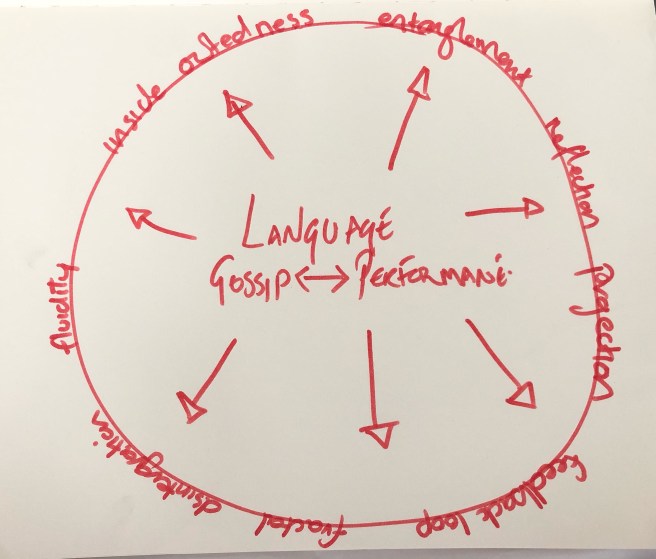
Am I looking to justify my own focus is a very good question and if so, I think I need to avoid doing so – I don’t need to justify it, do I? But I am more interested in using whatever form works to make the point – whatever the point might be. At the moment, I think I am trying to suggest that the momentous revolution we are living through now, moving from analogue to digital, is part of and exists in a feedback loop that is about something far more fundamental, a complete overthrow of logocentrism which dates back really far; and is probably well-served by fewer fixed boundaries between forms because the boundaries across reality are currently disintegrating while at the same time being redrawn. This view of mine is taken from far away and is not about the current decade or generation although this is a pivotal moment.
Some great feedback which includes potentially relevant quotes for me to look up and consider:
Something pops out at me which is that photography has been seen as this special medium, better and more real than what came before. And we have since realised that it has its limitations to capturing reality which has released an explosion of creativity that undermines its original intent. Does a loss of faith in the mediums initially perceived presentation of truth ultimately liberate it or condemn it?
Similarly the accessibility of photography through smartphones etc has democratised the medium which creates new causalities. Photography may become artisan again (analogue already is) when it is replaced by another medium. Is it a familiar cycle in all mediums? (Yes, so agree with this which is why the current obsession with alternative processes irritates me. It’s so predictable.)
Quotes (google the bits below)
Richard Serra – “Art is not democratic”
John Tagg – “More significantly, perhaps, if a piece of equipment was made available, then the necessary knowledges were not.” (Tagg, 1988, p.17).
Nicholas Bourriaud – “An artwork is a dot on a line.” (Bourriaud, 2002, p.21). In reference to linear art history. Do we repeat history
“Otherwise put, the role of artworks is no longer to form imaginary and utopian realities. but to actually be ways of living and models of action within the existing real, whatever the scale chosen by the artist.” (Bourriaud, 2002, p.13). Have we chosen to live in a constructed reality?
Overall I think you have a lot of interesting enquiries. Try to narrow down a central idea or interest, not too many because I know the word count fills up fast. It doesn’t have to be a direct relation to your BoW. My tutor said you can’t resolve everything in 5,000 words. (Good point!) So you want to leave room to enquire in other tangents potentially in the future.
To be clear; here I discuss the topic I am aiming for as I plan for the extended essay. I mention several key texts that I think will be helpful and which I will include in my A2 Literature Review. A previous blog also links to several important texts but there is minimal reflection in that one:
I need to get on with writing the literature review element of my extended essay. I am still thinking and gathering – but wanted to just put something down in writing to help me clarify where I’m at at the moment.
I’ve identified a key problem so far – how do I relate my inquiry which I think is about ‘the loss/destruction of reality (as it has been construed)’ to photography? After all, the degree has photography in its title and I need to link the central theme to that discussion. Photography has played its part in that destruction – although there are plenty of other factors/actors.
NB Destruction might also be seen astransformation. I believe this is what my BOW A1.2 is expressing.
Photography’s role in mythmaking
As I said in parenthesis in A1, “photography may have been a very brief interlude in the journey that begun with cave drawing, developed to become printing, followed by the invention of mechanisation, and moving towards a total simulated reality” (2019; 6) In response, Roberta suggested, “Although this has not diminished the demand for those other media – indeed it has given them a new lease of life.”
Printing is in trouble – we do still buy books but it is in a terrible competition with digital text. Painting, not mentioned above, which played such a big role in expressing religious propaganda existed in a feedback loop of development for that purpose. Although people still paint, I wonder if it is fair to say it is no longer used for what it was originally developed for – and that is a relic like still photography is perhaps becoming. People will continue to revel in it but they are making ghosts – sorry to all painters and still photographers. I do not intend to be dismissive – I understand lots of people still gain pleasure from these media.
2. I am also aware that my first essay could be read as a justification for moving away from photography ‘proper’ and focusing instead on moving image.
3. It seems like a key question in that essay and previous ones, along with the way my work is going is: Why is it more useful/fun/relevant/interesting to look at how images are used rather than the making of them? This is where Postmodernism is relevant.
But I’m not sure that’s really what I believe or what I want to ask.
If the construction of reality is a continuous re-invention of the moment we’re in (which I think is a simplistic way of describing current scientific understanding), the conscious self relies on…
i. memory – an intangible remnant of consciousness which we sometimes exteriorise using various forms/materials;
ii. our hyperdyadic* existence – perhaps represented by collage made with appropriated material;
iii. and mechanical construction (which includes language as a technology – see Andy Clark) – perhaps represented by the output of machinery we have invented, and which to greater or lesser extent becomes prosthetic – i.e. phones.
*dyadic – interconnection between two things. Hyerdyadic – interconnection between many – lots of people but also the environment
4. Whatever route I take, James Elkins book What Photography Is (2011)is an entire book which isn’t really about photography, even though its title suggests that’s all it is about. It’s a response to Barthes’ Camera Lucida (1980), another book which suggests photography is its main topic but it might also be read as an elderly man coming to terms with his mother’s – and so his own impending – death. I need to learn from them.
How do I keep this related to photography?
I think I need to state early on – that I am looking at the moving image as well as still and come up with a generic term to encompass both. I might use ‘image’ and then qualify that. Image, therefore, might refer to drawing /painting/film. In which case, is there space or a need to address the arguments made about differences between each of these forms and attempt to lay them to rest for the sake of the discussion? (See Barthes – indexicality of photography and also Elkins’).
Perhaps I need to also talk about why moving image is key nowadays, and perhaps more so than still – as the masses embrace technology which makes video recording so easy, and advertisers use it more and more as it can potentially grab our attention with its movements and flickers more successfully than still. Or at least suggest we can make that assumption with some certainty. This feels a bit like a justification again and might take up too many words, but it feels crucial.
Although it may seem like I am dismissing still photography, I am not. In amongst the plethora of photographic projects and bodies of work which all seem very similar and flaccid, there are a number of photographers making potent and striking work, such as (but not exclusively) Thomas Ruff and Zanele Muholi.
(Intention is key)
Elkin says, “beyond that, talking about the surround as I did for the photograph of the greyhound reveals that the surround is boring, and possibly also that photography as a whole is, in the end, also a bit boring.” (loc 1706) Perhaps, I will suggest that if this is true it is because we as a society are desensitised to photography, now that its initial magic qualities have faded. Seeing a photograph in 1845 must have been incredible and exciting and perhaps awe-inspiring. To capture a person and then have them rendered as delicately as those older processes were capable of would have seemed extraordinary. But now it is mundane and every day. Now our representations move, can be built by anyone – even children as young as two, and offer adventure and flexible narratives. They are engrossing and enticing and overstimulating. So the poor old still photograph has a great deal to compete with. While some, perhaps people with time on their hands, may revel in the luxury of contemplating an image of a leaf or a fragment of a person or people, or the emptiness of a blank page, others are fed a diet of shiny, fast-paced, noisy and enticing media. Most of us have this latter fodder in our lives and perhaps that is where the mythology I am interested in exists. If still photography (academic art) is to remain relevant, then perhaps it can a useful tool for deconstructing the myth I’m exploring.
Art photography is often inherently elitist. Not always, but so much of it can’t help being so – refs from Elkins:
“It is easy to agree that photography’s apparent realism has been formed by the middle-class hope that the photographs give us reality itself (as Bourdieu says).” (loc 762)“‘photography is most frequently nothing but the reproduction of the image that a group produces of its own integration’. (Bordieu, Un Art moyen, 48)” (loc 707)“For Bourdieu, photography is bourgeois to its bones, and it even includes its own futile anti-bourgeois gestures, like my own attraction to things that aren’t family photographs.” (loc 716)
Still photography is one fragment of a re-enactment of our biological processes – by focusing on it alone we persist with a Cartesian construction/understanding of reality. But it might be more relevant nowadays to explore these topics more holistically. Intro/preface?
Mythmaking
Hoffman’s book below references advertising and images extensively. Held within these images are myths.
I have become really interested in mythology – and the relationship between science and religion. It seems to me that both do the same things, i.e. put difficult concepts into narratives we can try to manage.
The following is from the author, Jonathan Raban’s biography A Passage to Juneau.
“Within the last 9,000 to 12,000 years, when people were present to witness such events, they would have seen the sea close over islands as earthquakes rearranged topography. You couldn’t look at the delicate compromise made here between land and sea without imagining the Flood: and you couldn’t imagine the flood without inventing a Noah or a Gilgamesh” (1999) (Perhaps this quote will be on the cover page or at the top of the essay).
Books
Return of the Real Hal Foster 1996
The Case Against Reality Donald D Hoffman 2019 (see below) (He mentions Plato’s Cave his description may be useful to quote.)
How we Became Posthuman Kathryn Hayles 1999 (in particular Chapter 7, Turning Reality Inside Out and Right Side Out: Boundary Work in the Mid Sixties of Philip K. Dick)
I need to look at Deleuze but I do not know his work and have no idea where to start.
Popular Culture, films, TV
The AO (Netflix) 2016-19 TV – Series One explores a kind of inverted Plato’s Cave which becomes a metaphor for digital culture. As part of my research, I have been watching plenty of reality-bending films and TV, this being one of them.
Total Recall, 1990 and 2012 Film
Inception, 2010 Film (this leads to Memento – also directed by Christopher Nolan but I am trying to avoid clinging to memory as a key theme, even though that is an important topic.)
(In the link above, I talk about several influencing works which had fed into my own practice but which may also be useful for the essay.
I will need to revisit this at Tate Britain as there is much to link to, moving image, youth culture, myth, everydayness.
2. Katinka Schuett, Cosmic Drive – I have only just come across this work and will look at it as a possible example of still photography looking at similar themes. ““Cosmic Drive primarily explores the way humans handle ignorance,” says Katinka Schuett of her Female in Focus winning series, which examines the contradictory spheres of fantasy and hard science. “I am interested in our perceptions of space, and the question of whether or not life can be found in the universe.” Schuett is as concerned with fantasy as she is with facts, merging the two to consider the illusions we create when there is a void of information. ” (Roberts, 2019)
I probably need to have a few more references here.
Blog Conclusion (not essay) – is there a question/title here yet?
I’m not sure … perhaps:
Should we re-evaluate our relationship to myth/humanity’s need to create myth? (And what role does the image play?)
I feel it will be necessary to use the word image in the extended essay rather than photography – because photography is such a nebulous term and describes a range of activities – and perhaps I need to explain in a preface. Does a preface count towards word count? Something to ask when submitting the review.
Something I’ve not addressed here which I think fits but which may be too far outside the inquiry – the body/blood/softness/boundaries/flesh. Hayle’s looks at this and references Donna Harraway several times – I don’t think I fully comprehend what’s going on here yet and need to read these sections again, as well as Haraway’s Cyborg essay which I’ve only read once so far (and found it a little bewildering – perhaps I was tired/distracted).
I know I am interested in the fractal nature of reality and our conscious understanding of it. So, we function (construct reality) in a certain way and the patterns of that construction are evident in our expressions (media – films/adverts.any narratives, the way we produce them.)
I still think I’m focusing too much on why photography is becoming irrelevant and need to look more at boundaries/flesh/death – life/self-other; I suppose these things to tie into myth and the breaking down of self as a definitive object as technology and science evolve. Therefore perhaps we might say, “it is a myth that you and I exist at all” – however, this myth is all we have and so we need to take it seriously even though we understand it is a myth.”
“Sometime in the not-too-distant future, anyone will be able to take a picture without a camera. Instead, we will be able to generate photographs, indistinguishable from those made by a camera, using artificial intelligence (AI) software. You will be able to create an image by simply typing out a description of the scene, or describing it to (presumably) Siri. “Siri,” you’ll say. “I’d like an image of a red-haired woman walking through a park in autumn, the breeze blowing red, orange, and yellow leaves around her.” And—though it may require more detail than that—presto! Your phone will provide various options on the screen to choose from.” (Palumbo 2018)
Other refs:
Raban, J. 1999 A Passage to Juneau, Picador, Basingstoke and Oxford
This is a good and ambitious essay. I can see what you are trying to achieve in your writing – and practice. Tease out your idea a little more so that you give yourself space to explore structuralism/post-structuralism in relation to photography and to film – and to why both have become so central within art discourse – esp. as it make no sense to talk about the original photo or film. My suggestion would be to begin to look at montage/bricolage in relation to Modernism and structuralism/post-structuralism in relation to Postmodernism. The question of ‘the author’, sole and sovereign is also interesting in relation to your interest in collaborative work. (Theories of authorship are also put under strain by technological developments).
It was also clear in our tutorial that you want to look at anthropology and visual anthropology has in recent years contributed considerably to the understanding of both photography and film, so this may prove fruitful for further research.
Lastly, set a date for the next assignment submission as it will help keep you on track. There is nothing like a deadline…
Look at key concepts contained within essay such structuralism and/or poststructuralism, montage, death of the author in greater depth.
Explore why structuralism and/or poststructuralism have become so important to photography/film
Explore montage/bricolage in relation to Modernism
Summary of tutorial discussion
This is an edited version of notes on my blog (see Tutor Feedback in menu system under relevant Assignment section for more detail.).
Written feedback
Tease out terms such as simulation and simulacra, structuralism and/or poststructuralism, Modernism/Post Modernism and keep relating to your practice. Give more space to these, aiming eventually to focus in. Having looked at early chapters of David Harvey, The Condition of Postmodernity – today the concern is with fluidity and malleability within language, underpinning reality and construction of it, compared to the Industrial resolution where, it seems, existence manifested itself in a more articulated manner.
Bring alternative thoughts into writing, i.e. “technology continues to penetrate or dissolve barriers” – or “builds walls… access to cheap technology but bombarded with advertising – penetrating the mind while depriving viewers of an education…”
Clarify use of the word ‘real’
Aim for greater depth of analysis
Make bold claims but back up with examples of work and wider context
Tutorial learning points
Investigate and try to make sense of a new type of hyperreality alongside what seems like a the loss of reality. Explore the erosion of critical thought and of education which leads to it. Look at Screen and Screen Education from 70s and 80s re linguistics and language. NB Language is arbitrary. Meaning never is (can’t see this came from.) I think this is from Chris Weedon, Feminist Practice and Poststructuralist Theory, Blackwell 1987. Look at the area of Visual Anthropology. In relation to first person in academic writing, ensure the knowledge is situated, i.e. I think this because and due to that in relation to… etc. – not, black is red because I say so. (See A Cyborg Manifesto by Donna J. Haraway (1985) – discussed in Kathryn Hayles)
Reading suggestions
Francois Lyotard The Postmodern Condition, 1979
Terry Eagleton, Literary Theory, Blackwell, 1983
Toril Moi Sexual Textual Politics, Routledge, 1985
Amelia Jones (Ed.), The Feminism and Visual Culture Reader, Routledge, 2003
Elizabeth Wright (Ed.), Feminism and Psychoanalysis, Routledge, 1998
Summary of Research Proposal (amended in the light of the tutorial)
Research proposal still to be developed… (discuss with newly appointed tutor)
Come up with focus for second essay – currently thinking about loss of reality/hyperreality as a focus.
Strengths
Areas for development
Committed writing
Needs greater detailed in-depth analysis
Relevant topics
Thoughtful research closely aligned to practice
Deeper research
Breadth of approach
Ambitious topic
Further exploration of theories presented, particularly Modernism/Postmodernism and the importance of film and photography in these theories
“Late twentieth-century machines have made thoroughly ambiguous the difference between natural and artificial, mind and body, self-developing and externally designed, and many other distinctions that used to apply to organisms and machines. Our machines are disturbingly lively, and we ourselves frighteningly inert.” (p.11)
“Modern machinery is an irreverent upstart god, mocking the Father’s ubiquity and spirituality.” (p.13)
“They [cyborgs] are about consciousness—or its simulation. 7” (p13)
“Ironically, it might be the unnatural cyborg women making chips in Asia and spiral dancing in Santa Rita Jail8 whose constructed unities will guide effective oppositional strategies.” (p.13)
Quotes from Archive Notes, Pandora’s Camera, Joan Fontcuberta, 2014
“…the first critical duty of the historian is to de-institutionalise history, to deconsecrate it – in short, to strip it of authoritarian discourse. This is the work of the historian, but also the work of the parallel awareness that often expresses itself as art.
“All of Schmid’s work is informed by a concern with visual ecology: […] Far from satisfying our need for information, the ungraspable abundances of indiscriminate data leaves us just as ignorant but much more confused. By reviving the Duchampian gesture, Schmid cancels the value of production (taking pictures) and shifts to selection, to the act of pointing and choosing.
“Schmid writes: “I’ve been working with found/appropriated imagery because I think that basically everything in the world has now been photographed in every possible way. We have an incredible amount of pictures after a hundred years of industrialised image-making, so making more pictures is no longer a creative challenge. Nevertheless, the production of photographs, of images goes on: photographs will be always be produced. It’s not so much the production of photographs which needs to concern is the use of them” (p.192)
Fontcuberta, J. (2016). Pandora’s camera, Photogr@phy after Photography. 1st ed. Mack, p.172.
Quotes from The Condition of Postmodernity David Harvey 1997 Blackwell
“… a loss of faith in the ineluctability of progress, and the growing unease with the categorical fixity of Enlightenment thought”. (p.29)
”
Harvey, D. (1997). The condition of postmodernity. Oxford: Blackwell, p.29.
what photography is, James Elkins, 2011
Elkins, J. (2011). What photography is. New York: Routledge.
Loc 1311 – quotes Benjiman, “…film he said, creates a percussive shock to the consciousness by continuously changing scenes, “I can no longer think what I want to think.” he writes. “My thoughts have been replaced by moving images.” (The Work of Art, in Illuminations, 238) – See Baudrillard
“I am unaware of the masses of things, the on and one of things, that I am permitting myself not to see”. (loc 1326)
Quotes Baudelaire – (loc 1561) When he said: “photography made the ‘whole squalid society …rush to gaze at its trivial image’ he was being sour and splenetic …but he wasn’t wrong”.
“There is no way to staunch the floods of false nostalgia for people and faces” (loc 1425)
“It is easy to agree that photography’s apparent realism has been formed by the middle-class hope that the photographs give us reality itself (as Bourdieu says).” (loc 762)
“‘photography is most frequently nothing but the reproduction of the image that a group produces of its own integration’. (Bordieu, Un Art moyen, 48)” (loc 707)
“For Bourdieu, photography is bourgeois to its bones, and it even includes its own futile anti-bourgeois gestures, like my own attraction to things that aren’t family photographs.” (loc 716). Perhaps such gestures are at risk of being the most middle-class, and elitist. (Think of explanation.)
Baudrillard – Disneyfication
A re-evaluation of psychiatric terms in relation to women and trauma:
I’m not doing this in the order I would usually do things. I was away from home for 4/5 weeks and didn’t want to fall too far behind, so I packed up a selection of books I thought would be useful and planned to write my essay once I’d arrived in Italy. I hoped this would be a good place to write. After all, I was away from London and my paid work demands, plus able to live in a kind of denial about the stresses and financial difficulties of life for a little while. However, family, lack of WIFI and other tech issues made it challenging. So research was a bit tricky… Although I loved being away, I really longed for a quiet, properly resourced space. I mention all of this because while there an article about women not having time or space to think, to create and make work went viral.
Brigid Shults wrote in The Guardian, “Women’s time has been interrupted and fragmented throughout history, the rhythms of their days circumscribed by the sisyphean tasks of housework, childcare and kin work – keeping family and community ties strong. If what it takes to create are long stretches of uninterrupted, concentrated time, time you can choose to do with as you will, time that you can control, that’s something women have never had the luxury to expect, at least not without getting slammed for unseemly selfishness.” (2019)
I think there is probably something to retain for possible future developments about this fragmentation of time and focus, the stop/start way of working and ceaseless interruptions women live with and that successful creative men have been able to live without. I suspect at some point I may want/be able to weave something of this into some work. And of course, not forgetting the shame. Even as I write this I feel tremendously guilty for sounding unappreciative of the time I took, and how I was able to catch up with so much reading. I feel compelled to express my gratitude for all that was given. (And a great deal, not only in terms of time, was gratefully received by me.
Essay
I wrote the essay which I sent to Roberta and warned her that I would look at it again after a few weeks and see where I could make better connections. Predictably, the minute I sent it off I noticed that I had relied on quotes I’d used in previous essays and I was sort of repeating myself. I don’t think there is too much wrong with this as I refine ideas and rely on really important concepts that are at the core of my developing work. However, I felt I was beginning to limit myself.
Therefore, I will take the comments that Roberta made plus a few I made myself and respond, sometimes based on reading I did following submission. Then I hope to have a short online meeting with her and following that I will fill in the formative feedback form taking edited highlights from this document and anything vital form our talk.
Comments
Essay text in green, Roberta’s comments in orang
“However, rather than, or perhaps in addition to lamenting time past, these signs also make reference to Baudrillard’s writing on simulation and simulacra – the constructed non-reality of the reality of modern life via modern media, where everything is lived on the surface, removed from the real but therefore rendered so.” (p3)
You might want to tease this out a little more in order and make a stab at defining these terms and their historical emergence.Also, see David Harvey, The Condition of Postmodernity.This may be reminiscent of techniques used by Adam Curtis in documentaries such as Bitter Lake (2015) or Hypernormalisation (2017) where vintage footage is also used to investigate our current reality. (p3/4)
again, as above can you push this a little further. Curtis is a good example
I ordered a cheap second-hand copy of the Harvey book which was waiting for me when I arrived home and read Chapter 1 where Modernism is discussed yesterday. I am really grateful for this suggestion as it’s a great book; lively, fascinating, and no verbosity (yay!) My favourite line so far – and be warned I will be repeating this several times – refers to what Benjamin calls ‘auratic art’ – Once reproduction and mechanisation arrived, in order to add value to work, “the artist had to assume an aura of creativity… to produce a cultural object” of value. “The result was often highly individualistic, aristocratic, disdainful (particularly of popular culture), and even arrogant in perspective on the part of the cultural producers, but it also indicated how our reality might be constructed through aesthetically informed activity.” (p22, 1990)The disdainful attitude has not gone away, or if it ever did, it seems to have returned with alacrity. I am often appalled by the supercilious, superior and condemnatory way in which some people/artists/photographers look down their noses at practically everything, including forms they don’t themselves use, the general population who don’t have the luxury of an expensive education at their disposal, nor decades of reading interminable circular texts about the ethics of photography behind them, nor the time, space or money to wallow in historical processes. All of this is made worse when artists, as echoed by Harvey, on one hand, “mythologise(d) the proletariat” (p33) while also behaving like the “elite-international avant-garde”. (p25) The following may still be an accurate description in some circles: “Artists, for all their predilection for anti-establishment and anti-bourgeois rhetoric, spent much more energy struggling with each other and against their own traditions in order to sell their products than they did in any real political action.” (p22)
The other critical element in this first chapter is how the articulated machinery on which Industrialisation relied affected perception and therefore artistic practice. The difference today is how digital machinery produces a far less articulated reality – and instead, there is a perceived flow as information travels and morphs and transforms. I was struck by the many references to machinery, “houses and cities could be openly conceived of as ‘machines for living in” (p32). Nowadays, existence is often written about in computer-related metaphor. Donald Hoffman’s recently published The Case Against Reality (2019) (which I will write about elsewhere) contains a hypothesis which describes reality as a series of desktop icons on a computer interface – and so, if one is wary of the current tendency to think of the brain as a computer, you have to tread quite carefully through his arguments in order to avoid being reductive. However, this loss of a fixed stable reality that is always around even when we’re not, which according to Harvey could be felt and was being expressed towards the end of the Modernist period, seems now in full swing.
I realise I digressed slightly with my rant about the irony of snobbish artists who peer down their noses at so much while at the same time claim to be something other than and often better (more valuable) than the ‘bourgeoisie or petit-bourgeoisie’ – however, my desire to embrace popular culture as I did in Self & Other when I made work using Snapchat, and when I use proprietary filters is related to this aspect. Recently I have focused on vintage material downloaded from the internet, i.e. rendered digital, and where signs of age are fetishised, but it may be that at some point I need to be really brave and grab material that has none of that safety-net.
But perhaps more importantly, the changes happening to our understanding of reality, the theories of which then go on to help design our technology are having the most seismic and profound impact on who we are and how we see ourselves. And I think that is probably at the core of what I’m aiming to explore.
“In Sirens and Origin of the Common-Place the medium, its source, and transformative journey are as critical as the content. Marshall McLuhan’s mantra “the medium is the message” is relevant.” (p4)
Why and how is McLuhan’s statement relevant? Can you explain in a little more detail
As a practitioner, currently and internally there is a tension in me, an argument between the value of process and representation. I feel I am trapped in representation while the art world values process more highly and wish I could find a way out of representation, which is what I know and where I come from – what I feel most comfortable with. I will say something more about this at the end of this section. However, the making of these films, the downloading of digital data on my computer at home and then the reconstitution of them, again at home on my computer or even my phone is critical to the work. Today I can take films – which were once the preserve of institutions – and transform them and make them my own. I have some element of autonomy over the message which is (was) fed to me. I can take the slop that was served up and do what I want with it, as long as I can master the easy to use technology and retain access to it. This is a big change in the way we interact with media and certainly very different from the fixed frescos on church walls that people bowed down before in the middle-ages.
McLuhan, and later others such as Kathryn Hayles in How We Became Post Human (1999) (a very important book for me) discuss how we instantiate technology; i.e. how the media we use becomes an extension of our nervous systems and how we internalise it. McLuhan’s ideas inform systems theory; not only does the type of media rather than the message have an impact on us – there is a feedback loop, both language (whatever media is used) and we exist in a living, dynamic symbiotic relationship. Andy Clarke is another philosopher who suggests that language itself – the process of speaking – is a prosthetic extension, a technological tool which has changed (through feedback loops) the way we evolved.As perception of fixed Cartesian concepts dissolve, replaced or added to by dynamic atomic units, and as relationship and context become more and more valued, perhaps it might be appropriate to say, you cannot view one without the other – the chosen medium and the content together are the message and to try and separate them risks being reductive.
In reference to representation – perhaps I am worrying too much about this. Hoffman’s book about reality suggests that the way in which we construct our so-called ‘real’ representation is absolutely critical to how we animals experience existence – and so maybe how I make things that end up looking and sounding and feeling a certain way is key. But what appears is also key and one cannot separate the two – or else it risks being reductive. Of course, lots of art seems to deliberately aim for reductiveness as perhaps it strives to make sense or unpick tiny aspects of living.
As the barriers between exterior and interior, or between physical and metaphysical break down
Again as above – see Harvey
I think this could become a very important subject for me. As well as Harvey, the later chapters in Hayles’ book explore this a great deal. I also posted some work by Albarado Morell recently which looks at it and further comments here. But perhaps Hayles in more relevant. Chapter 7 – Turning Reality Inside Out and Ride Side Out: Boundary Work in the Mid Sixties Novels of Philip K. Dick is absolutely teeming with relevant information and I have touched on this previously. Before the summer, on my Sketchbook blog, I was recording Random Notes for Short Story. I do not know where it is going or what I will do with these but I suppose I will continue and they may inform or become part of any BOW work. #12 in particular references this change in human experience and links back to media.
(And before that, drawings, which suggests still photography may have been a very brief interlude in the journey that began with cave drawing, developed to become printing, followed by the invention of mechanization, and moving towards a total simulated reality) (sp. corrected, p6) Although this has not diminished the demand for those other media – indeed it has given them a new lease of life.
Exactly, so why is Photography at times so neurotic and defensive? Why can’t it get over itself and stop trying to prove it really is in Art.
Barthes’ death of authorship may be easier to accept than the suggestion that all meaning is negated leaving us with a zero sign. In Sirens and other appropriated work, it might be argued, signification is transformed rather than nullified, even if the reader doesn’t particularly agree with or ‘like’ the altered content. death of the author – which gave birth to the reader’s primary role in creating meaning – hence one of the biggest problems is in visual literacy in particular – and literacy more generally. Increasingly it becomes more difficult to distinguish fact from fiction, truth from lies – for many it does not even matter (your Cambridge Analytica is one extreme example). See Francois Lyotard.
For the time being, I would always argue that photography, like all language, exists within a rich, complex, dynamic interplay – (recognised in the death of the author which might also be understood as the birth of the collaborative producer who understands that their work doesn’t emerge until there is a receptor, even if that consists of only one person) one of many nebulous elements that emerge and feedback in the process of reality construction. I don’t believe there is a zero sign, only that some ‘actors’ say things which bear little relation to their pretended intentions; there is still meaning, it is simply more difficult to unpick. Advertisers, fascists, narcissists are all excellent examples of those who employ such tactics. As an actor who studied Stanislavskian uniting of text – it is very difficult to accept that the sign could actually be empty. And I think that metaphor comes from a world in which discrete objects exist in the universe rather than one which emerges through relationship.
I also wonder when in our history the human population was ever able to determine fact from fiction. Our species is riddled with false assumptions about what and who we are, the majority of us left in the dark while those in power play merry havoc with our world while living off our efforts. It may be true that groups such CA have been able to flourish in these early pioneering days of a new epoch but there has to be hope – And I hope I am not overly optimistic, referencing Hayles as she says “Only if one thinks of the subject as an autonomous self, independent of the environment is one likely to experience the panic performed by Norbert Weiners Cybernetics and Bernard Wolf’s Limbo. This view of the self authorizes that fear that is boundaries are breached at all, there will be nothing left to stop the self’s complete dissolution. By contrast, when the human is seen as part of a distributed system, the full expression of human capability can be seen precisely to depend on n the splice rather than be imperiled but it.” (p290)
The collaborative nature of Sirens can be seen as another example of dissolving walls, modern-day fluidity, not only, as mentioned earlier between inner and outer worlds but also between individuals; systems which were perhaps previously considered closed but which might become viewed as open, as technology continues to penetrate or dissolve barriers.
Although, in other ways, it builds walls eg above re literacy. sure you can have access to cheap technology but you’ll be so bombarded with advertising – penetrating the mind while depriving most viewers/readers of an education that will provide them of the means to engage critically.
I do believe these walls have always existed. We see them more nowadays because that’s what digital technology does. It makes the structures visible. That’s not to say that digital technology hasn’t made it worse. See my response about the complex, dynamic interrelated process of reality below.Saying all that, I find collaboration incredibly challenging at the moment – and although there are many diverse reasons for this, I think it is interesting psychologically speaking that my reference to relationship below, although meant broadly, might also be suggestive of something more personal. I disagreed with Will Self’s comment about ‘there being no other’ in this new Millenial world of ours (how perfect that a man called Self should say this) but as I interact with people from a younger generation I am beginning to find it harder and harder to stray true to my conviction that he must be wrong. I mention this as it seems important to the whole issue of supposed ‘post-humanism’ and Hayle’s references literature that deals with the isolated individual.
Repetition flirts with tautology, but perhaps, in the case of my own work, various video-editing techniques help to transform rather than mirror.
and perhaps thwart the definition of photography as a ‘mirror with a memory’, so that you want to argue that photography, like language, constructs reality rather than reflecting reality,
For the time being, I would always argue that photography, like all language – it is, after all, a language itself, exists as part of a rich, complex, dynamic interplay – one of many nebulous elements that emerge and feedback in the process of reality construction.
Comments from the reflection section: Yes, it is good to read more widely but state your case for doing so too. – the world is changing so much – I think it’s incredibly important to place what we read about photography in broader context otherwise it becomes insular, circular and drier and drier, and irrelevant. I can’t see the point in simply re-stating what has already been said when the world we live in today is informed by new ideas. Saying that I love reading perspicacious texts which could describe the digital world long before the internet was conceived of, such as Guy Debord’s’ Society of the Spectacle. It reminds me not to be parochial about time which can lead to us thinking that the issues we are facing are all about us and us alone now, rather than stemming from historical processes. I think it will be more a question of greater depth of analysis of the avenues you touch on here: montage, structuralism, post-structuralism and its impact on film art. I totally understand that I will need to find a way to discuss things in more depth – this I think is the challenging (exhausting!) thing that I need to overcome. Making a bold ‘claim’ is good. You then want to then back that up and place your own work within a wider context (historical theoretical etc). I re-read James Elkins who has given me much fodder for suggesting that photography is at high risk of being tautological, if not damn boring. There is no problem at all using first person now in academic writing. The argument is that knowledge is not neutral and that all knowledge should be situated. I’m not convinced the OCA is up to speed with this and will discuss when we meet.
Overall, I could do with going back and fleshing out one of two topics while dropping others for now. Roberta wrote in an email “ease out your idea a little more so that you give yourself space to explore structuralism/post-structuralism in relation to photography and to film – and to why both have become so central within art discourse – esp. as it makes no sense to talk about the original photo or film. My suggestion would be to begin to look at theories you use in more depth. Montage/bricolage in relation to Modernism and structuralism/post-structuralism in relation to Postmodernism…also of course ideas of sole sovereign authorship: ‘The Author’ or ‘The Artist’ are put under strain by those theories – collaboration is, of course, interesting here” (2019)
Hayles, K. (1999). How we became posthuman: virtual bodies in cybernetics, literature, and informatics. KINDLE Edition Chicago, Ill, University of Chicago Press.
Harvey, D. (1990) The Condition of Postmodernity, London Blackwell
I had reason to return to the above text recently. I referred to it in S&O A5 as it mentions writer/artist Alain Fleischer and his work made in Ferentillo which is where I am now. He links photography with mummification as I quoted in S&O. One of my partners highlighted a different quote when I shared it with them.
“In the darkness of the catacombs … mummies are like
photographic images that have been developed but not fixed,saved from a fatal and definitive exposure to the light of the living, rescued from an ultimate oxidation by death’s
corrosives, thanks to a red, inactinic light, a laboratory light.
Like photographs yet to be printed, cadavers … to become
mummies, were initially material supports, emulsions, conserved in the dark, subsequently treated with acids, then exposed to light before being brought back underground.”
I visit the village regularly as my mother moved here in 2000 with her husband. He died suddenly in 2005. I made work for TAOPA5 and S&OA5 as well as a smaller project in between modules.
This summer, after my mother broke her ankle badly and ended up remaining here for far longer than she might have done, the boys and I decided to spend most of the break in Ferentillo with her, for a variety of reasons, not least of which was a desire to escape the U.K. and it’s interminable internal wrangling over Brexit.
As the collaborative project I’m involved with (Pic London) is based around the idea of a village it is perhaps fortuitous to be in this particular village with its references to death, mummification and previous work for an extended period.
I have also been re-reading James Elkin’s and struck by the discussion he has with himself about a realisation we are at times little more than hungry, violent critters despite all the symbolism with which we prop up our illusions of reality.
In addition, I sent in an essay for CS1 and have had some extremely helpful feedback from Roberta, my CS tutor which has prompted further thoughts and responses. I’ll revisit this on my return to London – however, some of my thoughts will likely end up in some writing I’m doing in preparation for the pic london work. (Not sure yet, how this writing will inform or be part of any work yet).
The writing centres around a man called Fiore who lived “both inside and outside” the village (Field, 2019 – draft foundation text for Pic London project). I don’t want to repeat myself but briefly, Fiore befriended my mother and her husband Roger. He built an illegal pool which we swam in and which was never blue, as Fiore couldn’t quite get to grips with the filter or chlorine. He had lost his wife to cancer and his daughter killed herself in grief soon afterwards. Later he got together with his housekeeper, Dora. He was a good friend to my mother’s after Roger died. Fiore owned a goat called Berlusconi who was strangled to death when his chain got caught on a tractor wheel. All Fiore’s neighbours were invited to a feast of Berlusconi but Fiori refused to eat him.
The writing is, like my previous writing, like a plait made up of different strands that will incorporate Fiore’s story, my reasons for being here – austerity, middle-class angst around failure, and a discussion about photography in relation to bacteria, citing Elkins’ book, and death.
At first I thought I’d be making a film like the previous two projects I’ve done – Origin of the Common-Place and Sirens. But the more I work on it the more it feels like it might be a photo-text like the ones discussed in the paper above:
The interphototextual dimension of Annie Ernaux and Marc Marie’s L’usage de la photo by Ari J. Blatt
There is not very much time but we’ll see.
Things to do;
Look at Robert Mapplethorpe’s work. I keep coming across his stuff which feels odd, like the universe is asking to to look at it. Then I suddenly clicked – flowers/Fiore. (Not to mention death).
In Format’s Talent there is a series called Flowers for Donald. I plan to take another look at that in more depth.
Try to find a vintage film/old book about flower arranging for possible use
Themes other than the subject of flowers which has emerged in the highly flashed night images I’ve been taking; water, stars, shooting stars, hear, climate, death.
Not sure how this work relates to BOW yet but some of the research Roberta talked about re. Modernism and appropriation should be relevant at the very least.
(NB: Quotes about photographs being mute and the closed circular arguments that arise out of only reading photography books in Blatt’s paper)
I’m retreading What Photography Is by James Elkin and have come across Abalardo Morell’s camera obscura images. I particularly like the ones with very modern city scapes . These may something to refer to in an essay if I continue to explore the inverted way we seem to have been heading, which I think probably will.

 ).
). )? Are you, maybe, looking to understand (justify
  SJField - OCA Level Three Study Blog