CS & BOW A4: Notes re. connecting Bow to CS A5

Some notes made on my phone last night:

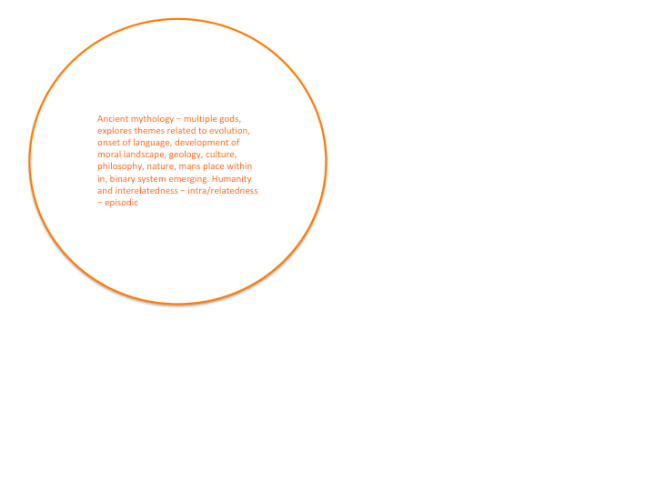
Structuralism = entanglement and intra-action of

  1. Language materials + architecture (code, print, architecture, web, tv, film, etc…)
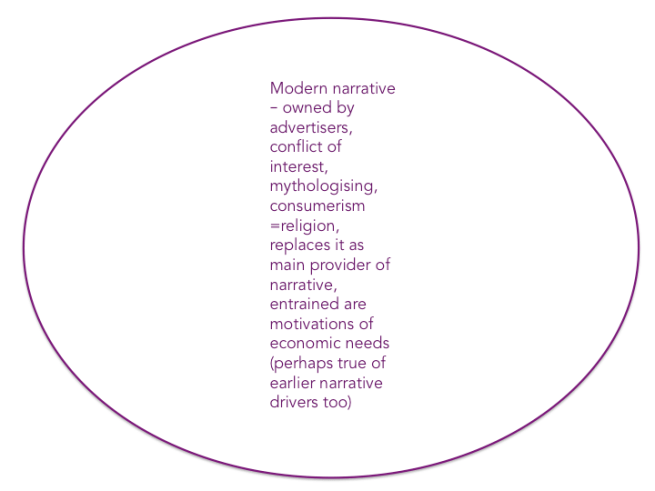
  2. Mythology (which includes consumerism, politics, and religion)
  3. Media (institutions and organisations that use no.1)


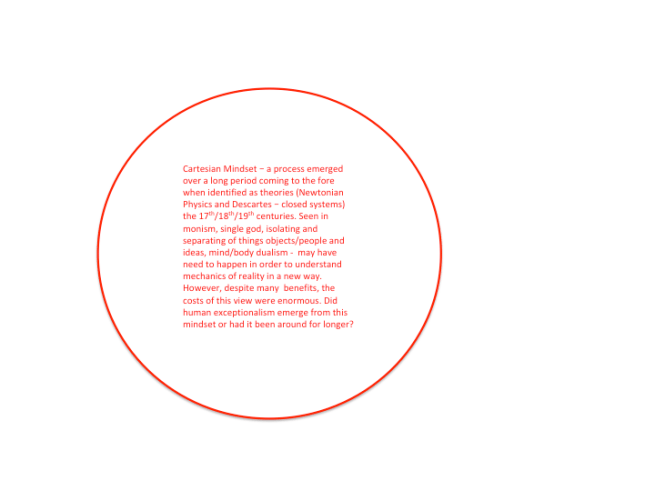
  • Bow explores ‘the cut’ – essay’s main aim is to explore suggestions that Cartesian world view has become unhelpful. We’ve outgrown it. Barad’s work introduces concepts from quantum understanding that challenge Cartesian lens including the concept of the cut. It is arguable that photography often inadvertently propagates Cartesian view even when it claims to be addressing salient issues, for a variety of probable reasons – then look at ways this can be addressed.
  • Semantic analysis – page 83 Zuboff – ‘squeeze meaning’ out of users movements
  • ‘Brew’
  • Include in – Indeterminism section
    Page 85 Zuboff – surveillance capitalism “not an inherent result of tech or expression of information capitalism”
  • Have lost the word ad (advert) from a comment made by Ai and need to reintroduce it – important to include
  • Must include Barad’s explanation of how micro (quantum) and macro describe the same world – through a different lens – not two sperate worlds

A useful and extremely relevant article worth referring to:

https://witness.worldpressphoto.org/photojournalisms-first-century-79645873e363
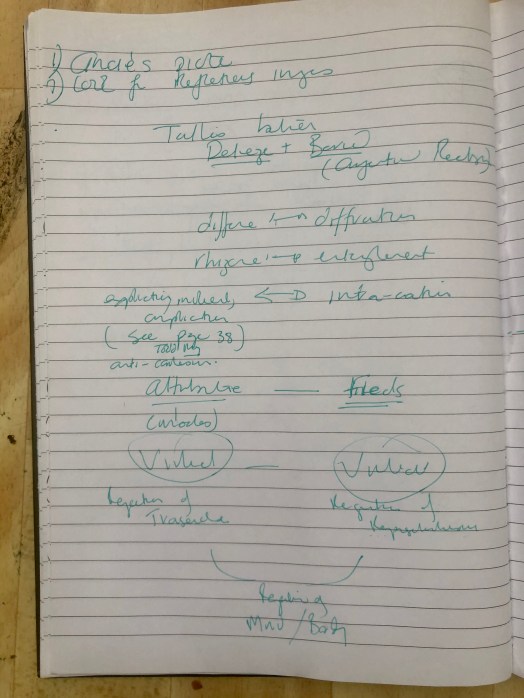
BOW/CS: Research , Delueze ‘difference’ & Barad ‘diffraction

Barad quotes Deleuze once in her first chapter at the top of a section, referencing language (words) and the problem of representationalism, and later, he is relegated to a sentence in her notes which mentions how his view on entities interacting – which are so similar to Barad’s ‘intra-action’ is irrelevant (2007, 437, n80). She writes ‘possibilities are reconfigured and reconfiguring’ (177) For Deleuze, there is folding and refolding and unfolding and refolding (May, 2005). I find Barad’s neglect of Deleuze surprising and wonder what it’s about. She tells us she is a Derridian – maybe it’s just about preference, but I suspect there is more to it. Can’t believe it’s related to views’ like Scruton’s dismissal of Deleuze.

Regardless, there are lots of correlations, and in any case, neither’s views are entirely new (suggested by Professor Paul Fry, Harvard) since the overemphasis by humans on their separability  – rejected by both Barad and Deleuze – is explored by Walter Pater in his 1873 book The Renaissance: Studies in Art and Poetry. The difference with Barad is she has the language of science backing up her arguments (although even then, they are contentious in some circles). Fry says Deleuze’s writing style is excitable – maybe it’s that which puts Barad off.

I have recently been reading Todd May who is recommended by different people as being good on Deleuze – and was thrilled to see morphology discussed in one of his videos as that links directly to my DI&C work. In the meantime, some notes taken while istening to Professor Fry’s lecture (see below):

IMG_2171IMG_2172IMG_2173IMG_2175IMG_2174


Barad, K. M. (2007) Meeting the universe halfway: quantum physics and the entanglement of matter and meaning. Durham: Duke University Press.

May, T. (2005) Gilles Deleuze: An Introduction. (s.l.): Cambridge University Press.

The Postmodern Psyche Explained (s.d.) At: https://www.sam-network.org/video/the-postmodern-psyche-explained(Accessed 16/02/2020).

CS A4: research Deleuze

In order to concentrate on BOW I had to remove myself temporarily from the CS module – still keeping one foot in obviously as both are informing each other – but now climbing back into it is taking a bit of time/space. I’ve just started reading Baggini’s How the World Thinks (2018) but I need to head back to Barad and also start delving into Deleuze esp. Difference and Repetition (1968). The video below is an excellent introduction. Interesting to compare with Barad.


Difference / diffraction

Rhizome / entanglement

The virtual by Deleuze is described in the same terms as Barad and other quantum people.

https://images.app.goo.gl/uYqeqcZdYqw92LkT6

Several useful YouTube vids and podcasts – weird that Barad doesn’t refer to Deleuze more


https://www.youtube.com/watch?v=R8DTBWaUqYo

https://podcasts.apple.com/gb/podcast/the-partially-examined-life/id318345767?i=1000159329268 (English guy’s comments useful – if (Life Not School Digest 23 Jan 2013))

Medium post with several podcasts, Philosophize This, John David Ebert, Todd May

CS: Alan Sekula’s The Body and the Archive part 1

Sekula, A. (1986) ‘The Body and the Archive’ In: October 39 p.3064. At: http://chnm.gmu.edu/courses/magic/sekula.pdf (Accessed 23/11/2019).

Field, S. (2017) Notes: The Body and the Archive Allan Sekula. WordPress [Blog] At: https://ocasjf.wordpress.com/2017/06/12/notes-the-body-and-the-archive-allan-sekula/ (Accessed 05/01/2020).
Heimans, J. and Timms, H. (2018) New power: how it’s changing the 21st century – and why you need to know. (Kindle) London: Macmillan.
Blatt, Ari J. 2009 ‘The interphototextual dimension of Annie Ernaux and Marc Marie’s L’usage de la photo‘, Word & Image, 25: 1, 46 — 55, 27 – Alain Fleischer, Mummy, mummies (Lagrasse: E ́ ditions Verdier, 2002), pp. 15–16. Translations mine. (Blatt) Available at: https://www.tcd.ie/French/assets/doc/BlattOnErnauxMarie.pdf [Accessed: 24/04/2018]
Quantum Fields: The Real Building Blocks of the Universe – with David Tong (2017) In: The Royal Institution. Royal Institute. At: https://www.youtube.com/watch?v=zNVQfWC_evg (Accessed 05/01/2020).

I looked at this essay during S&O and will look at it again here – Sekula’s essay along with John Tagg’s talk on the filing cabinet both provide plenty of useful references, which, combined with Barad, Lupton and Rubenstein’s thoughts/thesis’, are probably the key sources of information through which I’ll explore at the topic I’ve chosen.

  • The essay opens with the paradoxical status of photography in bourgeois culture (3)
  • He quotes a song which ‘plays on the possibility of a technological outpacing of already expanding cultural institutions’. (4) This rings true today (see New Power, (Heimans and Timms, 2018))
  • You could replace the work photography with digital for the first two pages and it would all sound relevant and fair.
  • However, by page 6, the veracity of the photography is being discussed, as seen by contemporaries – ‘Only the photograph could begin to claim the legal status of a visual document of ownership’
  • ‘a silence that silences’ (See muteness and photography – ‘Ernaux reminds us, initially ‘all photos are mute’’ (p.73).) Blatt, Ari J.(2009))
  • (6) ‘the criminal body’ and therefore the ‘social body’ invented
  • ‘a system of representation capable of functioning honorifically and repressively’ (6) how does this work with representationalism and the unpicking of that? There are no entities waiting somewhere to be represented, rather there are emergent intra-active phenomena (Barad, 2007) (criminal and social bodies are made/formed)
  • again photography can be replaced with digitisation when discussing how portraits are degraded and extended at the same time – see selfies, phone pics
  • (7) ‘Photography came to establish and delimit the terrain of the other, to define both the generalised look – the typology – and the contingent instance of deviance and social pathology.’ So much to say here – See Azoulay (2019) and photography’s intra-active position/role within a much wider non-linear narrative. See Tagg and ‘fixity’ of the photography and Victorian culture – the desire to catalogue everything according to ordered and identifiable rules, (2011) i.e. the periodic table of elements  – a Victorian System compared to today’s quantum fields, a modern system/model of reality which we are informed in most accurate to date and is far more nebulous and difficult to comprehend, no doubt in part due to our Cartesian ‘habit of mind’ which is desperate to label and file everything neatly and ordered (Barad, 2007) as well as being counter-intuitive, shrouded in academic mystery and just really impossibly hard. The Victorian system and hence our dominant one (although this is changing hence the entrenched reaction of a conservative mindset), seems desperately naive in comparison.
  • (7) See quote about ‘possessive individualism’ which I’ve already inserted into CSA2
  • (7) Relate photography ‘a means of cultural enlightenment’ and ‘sustained sentimental ties in a nation of migrants’  – compare this to digital tech/culture in today’s culture. Beneath both Carlyle and Aurelias Root’s comments is a dreadful patronising tone however which is surely avoidable. See images ‘of the great’ = ‘moral exemplars’ ??? (Imagine a photograph of any of our current crop of erstwhile leaders providing such?)
  • Sekula writes of the utilitarian social machine, the Panopticon – think today of social media/ Surveillance Capitalism (Zuboff, 2016) (9)
  • The archived body – ‘begins’ here see page (10) begins is not the right word, becomes visible perhaps.
  • 911) physiognomy and phrenology  – ‘surface of the body’ ‘bore the outward signs of the inner character’  – Compare this to Professor Plomins deterministic genetic code thesis which Cummings et al relied upon to justify changes they made to the Education system. Cummings claims that people misunderstood the work and have since retracted their negative comments. However, I think Christakis’ comments on genetic coding is probably more honest  – both I suspect, however, show how deep and far-reaching social construction and their associated embedded epigenetic markers can be. Whereas some can see the need for more positive and profound structural changes to take place, there is a mindset which believes we should further entrench these realities which Sekula is talking about that continue today. I was also struck while reading this by the similarities in an article I read today some on FB (I think) which claimed the more bitter and cynical you are, the more likely you are to age quickly and get sick. Lots of scientific data support the thesis – the way it’s been framed, but I am quite cynical indeed and look about fifteen years younger than some of my friends  – so I felt a little doubtful  – we people seem to enjoy deterministic narratives even today.
  • (11) borne of ‘attempts to construct a materialist science’  – compare to Barad’s performative/discursive/material emergence of meaning, far more complex and lively but nebulous so hard for people to engage with
  • Maybe time to revisit Szondi who I discussed in my first reflection about this essay – an early psychometric tester, he defined people by their reactions to faces rather than by the shape of their own faces/heads. Many companies today use much more robust psychometric tests which are extremely powerful but one wonders about the wonderful aspect of chance being eliminated. And so we enter the discussion of AI and how it can be so much more accurate than human power but how much agency do we give it? Currently watching Travelers (Netflix) which explores this in typical pop-culture fashion – first series better than then the rest and lots of references to .
  • Sekula identified ‘idealist secret lurking a the heart of the putatively materialist sciences’ – how is the AI screening of CVs and psychometric testing any different? And you should see the John Lewis video that you must watch before taking thier tests   – madly idealist in quite a scary way, reminded me of Logan’s Run (In HR terms, humans do still get involved: I know this as AI testing identified me as potentially suitable for a well-paid relatively high-status job but my lack of experience ensured I was rejected once a human looked at my CV in one particular application process!) Perhaps I will include some of the resulting descriptions of me, having taken part in this process in my BOW… 
  • TBC

CS A3: Tutor Feedback

Full document: Sarah-Jane Field CS A3 Feedback Form

 Key points

  • What do I mean by photography? A perennial problem and one which I spent many words trying to address in DI&C drafts before abandoning. Will discuss below.
  • I am asked; without being patronising, will there be a type of glossary for some of the more unfamiliar words/phrases/concepts? (I have wondered about including a glossary for the tricky concepts in the indices as well as inc. Chapter 1 as planned – would this be acceptable?)
  • Choose the right examples, this is imperative – I agree.

Summary of written feedback:

You are beginning to bring together these complicated ideas into a coherent piece of writing that asks questions about the way that we perceive photography. Your sample text section is well written and is an indicator of a highly polished, informative and interesting piece of critical writing. Good, I’m pleased to read that.

  • Need to be clearer about what I am critiquing – formal traditional photography (inc. moving image)/ or am I including or omitting practice that moves beyond the frame? My big challenge is our language system – I am critiquing the habit of a Cartesian mind which seeks to separate these things in a world still dominated by it – which I think is particularly *exemplified in photography – the recording and fixing of photons (there is much more to say about this but not here). How I overcome the challenge in the essay is yet to be seen and I may not succeed. It may not even be possible because the language we use today, and how, may not allow for it. A friend studying at a much higher level than me recently said, we desperately need consciousness to evolve away from the Cartesian urge to isolate and separate. But it’s not going to happen overnight or even this century – however, lots of people seem to think it is taking place, beneath the surface all the time without our awareness, due to digital culture for good and bad – and having an impact on how we perceive everything, from photography to far beyond. (*See John Tagg’s Filing Cabinet talk 2011, Vimeo, which though hard to follow has useful references)
  • I agree with Matt’s point, the artist examples should clarify things. I was glad to be pointed towards Christian Boltanski and Alfredo Jarr. I have identified that Edgar Martins is exploring the relationship between photography and perception, and his work is heavily influenced by quantum-informed concepts. Lewis Bush’s Ways Of Seeing project may also be an excellent source.
  • Since submitting A2 I have identified further written work which will help to support the discussion – essays in Martins’ book on death and suicide and by Daniel Palmer, Associate Dean of Research and Innovation in the School of Art at RMIT University, Melbourne. I have also continued to read Barad’s work making sure I understand the ideas as best I can and can apply them to photographic theory.
  • ‘Is the quantum world view that you suggest closer to certain modes of photographic expression than others?’ I suspect traditional photography can and does express the emerging view I’m exploring but it presents challenges. I think our understanding of how meaning comes about through intra-action, relation, and context – between all elements including the presence of a conscious mind is what matters most. As Palmer writes and I agree, ‘Cartier-Bresson’s style of photography is still possible, still practised and celebrated, but its importance is marginal. [Because it represents the mechanistic world in which it came to the fore.] With the digital universe, other types of photography have become more culturally significant, ones which often involve a shift from the single moment of capture to the expanded moments of post-production.’ (2015) Expanded moments of post-production make us think of a continued, phenomenological process. A Cartier-Bresson ‘capture’ aims to kill the moment and stick it up on the wall. He did tell us he was a hunter. For Barad, and Bohr, reality is all phenomena. Others don’t buy this, I’m aware. But from a structural point of view – in a world underpinned by continuously lively data – the notion of phenomena is critically important.  Algorithms, code, intra-active materials express today’s process of making meaning. It’s important to state I do not think all things digital are the Holy Grail – far from it.  
    (Ref: Palmer, D. et al.(2014) ‘‘Lights, Camera, Algorithm: Digital Photography’s Algorithmic Conditions’ in Sean Cubitt, Daniel Palmer &; Nate Tkacz (eds.),’ In: Digital Light. Fibreculture Books. pp.144–62. At: https://www.academia.edu/30168558/_Lights_Camera_Algorithm_Digital_Photography_s_Algorithmic_Conditions_in_Sean_Cubitt_Daniel_Palmer_and_Nate_Tkacz_eds._Digital_Light_London_Fibreculture_Book_Series_Open_Humanities_Press_2015_144_62(Accessed 08/01/2020).)
     
  • I am very interested in Matt’s inclusion of Jaar’s The Sound of Silence, not least of all because I lived in SA until I was 16, my mother was a journalist there in the 80s, her late husband knew Carter and his group of fellow photojournalists and the Bang Bang Club(2000) made me homesick and heartbroken for the people and country I knew – I read it a good while before studying with the OCA. In my own practice, text and its relationship to the image, our response to both forms, has been crucial since S&O when I exhibited a series of images and writings on the wall – giving both the same value. Since then, text has always played a role and at the moment my BOW includes just a single image and about ten pieces of writing – although I do currently plan to add more pictures. But the relationship between both forms is absolutely key. I will need to look at the work in more detail and think about your question – but it could be an excellent example. (This bullet point is sheer entanglement – but we might also call it serendipity or even an inevitable happy culmination of events/things/people/information.) https://sjflevel3.photo.blog/2020/01/07/bow-a3-texts-rewritten-and-placed-in-a-suggested-format/
  • ‘I am not that familiar with Muholi’s work but can you be specific about how she manages to move away from the Cartesian view beyond questions around Colonialism (how important is colonialism to your argument?)’ Colonialism is crucial. Barad never stops mentioning it. Azoulay’s thesis in Unlearning the Origins of Photography (2019) is clearly influenced by similar ideas to Barad’s – the entangled activities of taking, extracting and destroying – in which photography’s history and practice are firmly ensconced (See my DI&C essay). In an article about her earlier book, The Civil Contract of Photography (2014) she discusses how the meaning of a colonial image of an African man, originally intended to show how ‘savage’ the man was, today expresses the savagery of the photographer and the dignity of the subject – context and relation are key to quantum concepts/philosophy as well as photography. (‘relata-within-phenomena emerge through specific intra-actions’ (Barad, 2017: 334)) I will need to make this clear in the introduction, and I suspect quotes from Azoulay will help. Muholi’s work might provide evidence of a non-Cartesian, transformative, lively, relational view of the world – at the very least her work rips apart the Colonial habit of white European men cataloguing black skin (and women).

Finally, after submitting A3, I came across a useful paragraph in Barad’s book which settled something for me, where she discusses how the quantum world is not a different world to the Newtonian one (of course). Newtonian physics describes the parochial space we inhabit. Quantum ideas go beyond that and describe the world we have not evolved to ‘see’. But our growing knowledge of it affects our understanding. The maths (according to every documentary you watch) is the most accurate description of reality we have today and that there has ever been. I will need to include this, I think. Plus, why I think this is all so very important for photographers/artists.

(See original tutor text at end of document)


Artists: Orpheus Standing Alone, Camille L. and Anna L

I recalled seeing this work in a Foam magazine #51 (the previous post is also from that edition) and being really struck by the way it was put together, and incorporated a range of images, styles, as well as text. On the website there are still images, text, a bit of processing and a freedom that one doesn’t see in more ‘conservative’ examples of photographic work. I did not recall the name of the work and had to flick through old copies, and now see a similarity to one of my own texts – Orpheus in Homebase. The linking again of old myth to today’s world. What I take mostly from this work is freedom to play. (Which is interesting given my sense that there is an ever decreasing sense of play related to online forums where the conservatism of Flusser’s apparatus appears to dominate and rule.)

Self Published Art Books
— Read on www.orpheusstandingalone.com/about

Artist: Filip Berendt

Berendt’s ephemeral process equates well to Barad’s agenitial cut which I’ve been exploring in my own work (ideas for so far). There is also the mix of medium and ownership (like Martins and Clark) which rejects the purity espoused by Bate. Additionally, he manages to focus his work on myth and archetypical patterns cross culturally and across linear time. Worth exploring and thinking about, possibly including as an example in CS.

Monomyth project combines authorial photography with abstract painting – photographed objects are spatial collages created on the walls of Berendt’s studio and destroyed once they have been captured on film. Berendt has used that method previously in a couple of cycles (Every Single Crash, Pandemia) in which the only physical trace of the pieces he created – and thus the final effect of the creative act – was a photograph. His latest works refer to the idea of monomyth, introduced by the American mythologist Joseph Campbell (the term was originally coined by James Joyce). Monomyth stands for the archetypal pattern typical of fictional narratives, described by Campbell, shared by all mythical stories, manifesting itself as the hero’s journey, conveying universal truths about self-discovery and self-transcendence, about social and interpersonal roles. According to Campbell – and Berendt – the hero is an individual setting out on a journey leading them to the final destination: profound spiritual transformation. The journey is tantamount to making life meaningful, to searching for and discovering its meaning at consecutive stages of the trip.

text; Agnieszka Rayzacher

— Read on www.filipberendt.pl/

CS Research: (97) (PDF) ‘Lights, Camera, Algorithm: Digital Photography’s Algorithmic Conditions’ in Sean Cubitt, Daniel Palmer & Nate Tkacz (eds.), Digital Light (London: Fibreculture Book Series, Open Humanities Press, 2015), 144–62. | Daniel Palmer – Academia.edu

This has some useful references included and the phrase ‘marginal’ referring to decisive moment photography which may be useful alongside ‘boring’ (Elkins) ‘conservative’ (Blight) and ‘tautological’ (me).

(97) (PDF) ‘Lights, Camera, Algorithm: Digital Photography’s Algorithmic Conditions’ in Sean Cubitt, Daniel Palmer & Nate Tkacz (eds.), Digital Light (London: Fibreculture Book Series, Open Humanities Press, 2015), 144–62. | Daniel Palmer – Academia.edu
— Read on www.academia.edu/30168558/_Lights_Camera_Algorithm_Digital_Photography_s_Algorithmic_Conditions_in_Sean_Cubitt_Daniel_Palmer_and_Nate_Tkacz_eds._Digital_Light_London_Fibreculture_Book_Series_Open_Humanities_Press_2015_144_62


CA A3: Plan and sample almost ready to share and submit

I have been really so ill the last week which has meant lots of plans cancelled. The good thing is I have been stuck indoors watching YouTube videos of Karen Barad and reading her book and making notes and writing and rewriting and preparing A3. I’ve sort of been at it the whole time (maybe that’s why it’s taking so long to get better).

Today I sent the sample to a physicist I have stumbled across who has kindly agreed to take a look at the theory and make sure I’m not making wildly inaccurate claims about quantum mechanics. I think it may be a strange thing for him to do though because Barad whose work my whole hypothesis bounces around is this peculiar hybrid of humanities and science which is unusual. But I am grateful to have the opportunity to have an actual scientist glance over my ideas – even though I suspect it might read to him like a 5-year-old’s version of the ideas he explores.

I asked him to look at the research question and pick holes in it – it is currently looking like this:


Diffraction

Entanglement 

&

Photography


According to contemporary science-philosophies, the notion of isolated, unrelated objects in a void universe expresses an out-dated and unhelpful view of reality. Rather than seeing ‘things’ which have their own place in space and time, many academics have been exploring a universe which is emergent, and where everything is interconnected, relational, dynamic, non-linear and lively. 


Within this evolving view of the universe, how – or can – photography successfully communicate the contemporary model described above? Or is it fatally challenged by its ontology? 


I will upload his response (unless he tells me it’s all crap – in which case I’ll cry and start again) and the rest of the sample before long, hopefully.


Lastly, because of the Hollins paper I recorded here recently, I am tempted to rethink the very top heading. I will wait and see.