I am signing off from both BOW and CS in anticipation of beginning the final module, Sustaining Your Practice (SYP). The project I have submitted is, I hope, a lively object that will continue to develop throughout SYP and perhaps beyond – the underlying inquiry is likely to, certainly.
I am aware that my BOW why is there an astronaut in a field of flowers is plagued with an internal tension between my/its desire to explore a Donna Haraway-like-‘compost’-reality for an audience that ‘sees’ in a universe still dominated by a Cartesian subjectivity (albeit one in crisis). And that dichotomy means it might well fall flat on its face. I hope it manages to avoid such a fate.
It’s worth listing some immediate ideas that I intend to explore in SYP.
I want to take a look at the printed publication slightly differently – now that the writing is secure, I think it is worth seeing what the printed version might look like without any fragmented text on image pages. However, I think the ePublication should continue with the text-fragments as the monologue would not work there. This further differentiates the two versions. The fact the book exists in two different states is integral to the project.
I would like to go back and make sure I have picked up all the valuable statements made by the app. The central text in the printed version has room for (perhaps significant) development.
I have experimented with vocalising the app’s text myself – I have to admit, my attempts are at the moment truly crap, and I am very happy to put that aside as something tried and best forgotten. I also recorded the app’s text being read by a seeing AI app which reads things out for people whose eyesight is compromised – which was less crap, but a bit hackneyed nevertheless, and so not worth (in my mind) pursuing (although maybe audio descriptions of the images are worth looking at). However, there were some moments where the seeing/reading app went quite, quite wrong, and I am very interested in those fragments.
I suspect there are more photographs to be made. I will revisit certain images and look at making a selection of mini series’ to include in a longer edit.
I am really not sure about the moving image element – if I end up organising an online/offline exhibition, it may be something to develop again. I like the idea of having moving-image as another fractal-ed version but it has to be right. And as positive as some were about what I’ve concocted now, I just don’t believe it is at the moment.
That’s it for these modules. Can’t quite believe I’ve almost reached the end of this degree, which I began thinking I’d only do one module…
I have not written about the way I managed information and research for my essay but one of the Learning Outcomes stipulates we should demonstrate if and how we used applications to support our work – so here it is.
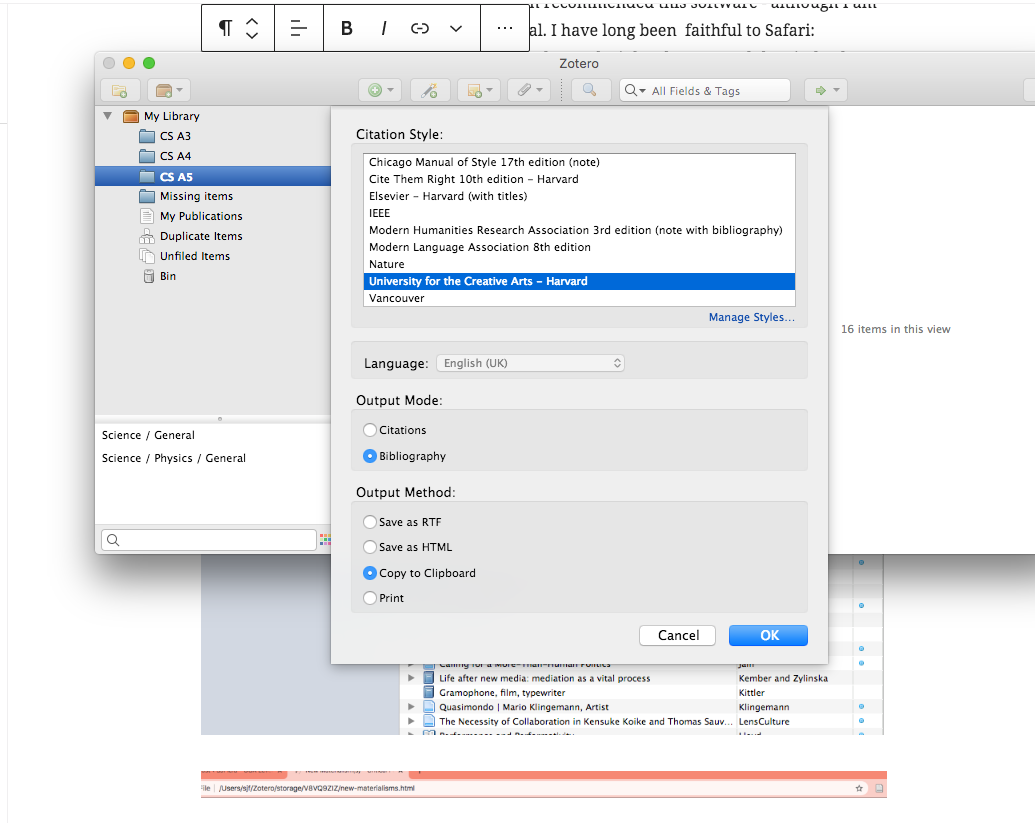
Zotero: Without Zotero, I would have found managing the overwhelming number of texts challenging. I was very pleased to have been recommended this software – although I am certain I did not make use of its full potential. I have long been faithful to Safari – however, so many coders seemed determined to make it hard to use and they indeed don’t help themselves. Zotero cannot be integrated with Safari, so I have gradually moved over to Chrome which can be, meaning you can simply click on a button in Chrome while looking at a webpage and it will store the information available – although, you must double check it’s all there and sometimes do a little bit of digging yourself. It was nevertheless very useful and saved a lot of time, especially when it came to compiling the bibliography (see last Zotero screenshot below, click on them to view).
Google docs
I have always used Microsoft Word but have lately found Google Docs more useful especially when receiving feedback, help with proofreading or citations style. As much as I’d like to avoid being a slave to Google – I have been grateful for its usefulness and suspect I will use it more and more if I continue academic study. I have made full use of its sharing documents facility.
WordPress blog
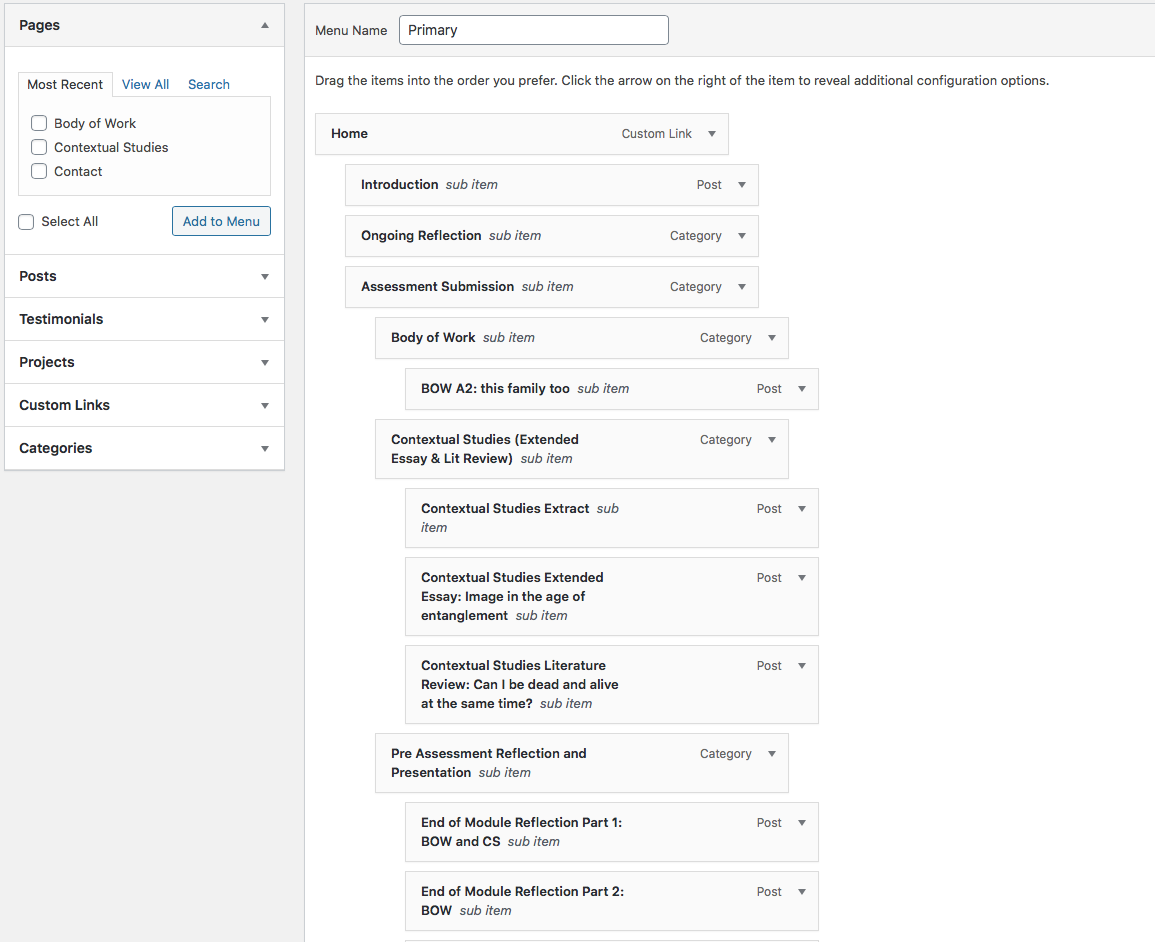
My blog and writing is extremely important to my process. One of the difficult things with this is reconciling the blog’s dual function as my digital note book and a means of presenting my ongoing development to others (tutors/students). Nevertheless, over the last few years, I have learned to label posts helpfully (although still sometimes forget) and use tags and categories. I suspect my menu-management is probably quite unnecessarily labour intensive and I can’t help thinking there must be a better way – however, I move certain posts into sections so they can be easily found rather than simply relying on categories that will pull up a string of related posts. The recent updates on WordPress will take time to get used to but I think there are some more helpful ways to store and track information available now. (Click in screenshots to view.)
Notes on my phone
I use the notes facility on my phone a great deal – making notes on the train, at night, storing things links etc.
Finally, I am aware that there are other apps designed to help store information, and file and categorise it, such as Mendeley. But I have found the system I using fine and am not sure I can cope with any more apps – although I still do sometimes read things and then wish I’d stored it as can’t recall what or where I might have seen it – which is frustrating. However, the more I get into the habit of recording links/making screenshots, the less that happens.
Grammerly and Outwrite
I use the free versions of both the above writing checkers on different platforms (even then, I make plenty of mistakes, but they are both super useful for me and probable undiagnosed dyslexia). I paid for a month’s subscription for Outwrite while going over the essay in the last few weeks. I find Outwrite more reliable. However, even then, I often don’t see mistakes until I look at a published document on a handheld device and have to do a final edit again.
Social Media
God, I hate Instagram. It’s awful. It’s reductive, superficial, cliquey and addictive. If it were not for this course (and my dying photography business – not much call for event photography and corporate headshots in the time of a highly infectious killing disease), I might have abandoned it altogether before now. However, both those needs keep me involved. A year or so ago, I set up a new IG account with my actual name attached (previously it was simply my initials). I had been using it to promote commercial stuff but not with the same commitment I approached IG with back in 2014/5 (when I was depressed so social media provided a good hidling place – ironically). At the beginning of lockdown I deleted anything too twee from it and started using it exclusively. I have played the social media game in the past but it takes up too much time and energy and there are better things to be doing with my time. Neverthless, I have been using it more energetically in the last few weeks to try and promote my not terribly commercial project for the sake of SYP. I use this is a promotional tool as I prepare for the final module. I should also start using my Sketchbook WordPress more too as that is good for generating views/SEO/directing people to your website/SM (it doesn’t strip exif data which other sites do). I am not so good with Twitter but am trying and have tended to use FB for commercial promotion (headshots, kids’ pics, corporate), but since that has died, I will likely use it to promote this work more.
Photography discourse is littered with opposing statements such as ‘photography is more important than ever’, or else it might be ‘dead and irrelevant’. Are proclamations such as these becoming as questionable as the West’s mechanistic view of reality, which arguably tends to foster such binarised positions? If the West’s historical paradigm, dominated by isolated objects, people, and places, spread across the planet and universe were receding, and instead, reality increasingly perceived as emergent, dynamic, multi-dimensional, and rhizome-like, how would photography fare?
Drawing on Karen Barad’s agential realism, a synthesis of quantum science and poststructuralism, the ensuing discussion results in more questions than answers. The challenge is compounded because we are also invariably constrained by a “Cartesian habit of mind” (Barad, 2007: 49) which informs our imaginations, language and academic conventions. Barad’s phenomenologically informed philosophy urges us to review our ethical relationship with the universe. Their thesis challenges boundaries we assumed were fixed, including those photography has relied upon to promote itself even when claiming to challenge the status quo. While describing some tenets of agential realism, focusing in particular on the phenomenological nature of existence and Barad’s use of the word entanglement, work by a variety of practitioners is examined in an effort to make sense of apparently contradictory statements by well-regarded and oft-quoted theorists about the photographic image today. How can Michael Fried’s (2008) assertion, photography matters as art as never before remain valid alongside Daniel Palmer’s (2014:144) statement, photography as we once knew it is practically over? Could both be true simultaneously in an entangled world? Will photography escape its Cartesian origins as it evolves into ‘image-making’ in a digital universe? The possibilities undoubtedly demand a deeper discussion than the stipulated 5000+/- word limit allows for, however, the paradigm described above presents image-makers of all persuasions with conundrums that increasingly cannot and should not be ignored.
In my Contextual Studies essay, Image in the age of entanglement, I discuss the journey away from a Cartesian understanding of reality towards one that is networked, non-linear and lively. I was influenced by a wide range of writers but focused in particular on Karen Barad, author of Meeting the Universe Halfway: Quantum Physics and The Entanglement Of Matter and Meaning (2007).
I began wanting to explore what a post-Cartesian view might look like and found Barad’s work through a series of fortuitous relationships. Getting to grips with Barad’s ideas was and continues to be challenging. I do not come from a scientific background. I found it all very difficult indeed to research and understand. However, in doing so, my own view has developed and my way of working too. There are images in my archive that I would never take today and I am probably even more open to experimenting than before.
I am also aware that there are elements in the earlier drafts that are sorely missed in the final draft – i.e. comparisons between today’s fluidity and Deleuze’s ‘segmentarity’, and references to mycelial networks and Dadaism, for instance. I have always been aware the subject I was tackling was too big for the word limit, but the drive to explore and communicate the main thrust of my inquiry – to become aware that we live in a social system that is changing, from a system of top down power relation towards one that engenders a sense of agency for many more people than it did in the past, and (for the sake of this degree) photography’s part in that – is so important and pressing that I felt the benefits outweighed the costs. Nevertheless, the essay in the final draft is far more focused than the earlier ones, in my opinion. Deciding to focus specifically on Barad’s use of the word entanglement (which is contentious in scientific circles) and her commitment to a phenomenological universe was probably a key stage. Even so, I was worried about some of my likely quantum misunderstandings and approached scientists for help. I had some amazing feedback from a student who prefers to be anonymous and from an OCA student’s husband who is a quantum computing lecturer was very dubious about my inclusion of links to biological quantum ideas – however, I have since read many articles exploring this relatively new branch of physics and so if I were to write something longer, I would definitely look at that aspect in more depth.
Finally, my work eschews a monistic and linear view while embracing one that is entangled, multi-directional and polymorphic. It asks what image-making is, was, and is becoming, and although the photograph is definitely a protagonist, it must share the stage with other forms of exteriorisation. In doing so, the collection of expressions and traces on pages and screens are an investigation into the decoding and recoding of reality – and perhaps prompts us to believe we have the wherewithal to make critical and much needed revisions as we (re)discover more about our place within the universe.
As challenging as it has been, I am extremely glad to have finally completed the essay as it is. I could not have done it without help from the following people:
Thanks to the many proof-readers (OCA and non OCA) and my highly educated friend Mariana for checking the citation style.
Thanks to the three scientists who read through earlier drafts, Professor Peter Doel – University College London, Professor Alan Woodward – University of Surrey, and a quantum mechanics student who prefers to remain anonymous.
Thanks to artist Rowan Lear, who is far more knowledgeable about Karen Barad and agential realism than I am, for reading through excerpts I was unsure about and clarifying for me.
Barad, K. M. (2007) Meeting the universe halfway: quantum physics and the entanglement of matter and meaning. Durham: Duke University Press.
Zuboff, S. (2019) The age of surveillance capitalism: the fight for a human future at the new frontier of power. (First edition) New York: PublicAffairs.
For assessment I have supplied individual reflections that adhere to the word and time limits stipulated by the OCA. However, for my own sake, it was useful to write an integrated reflection (which I’d done before I saw what was required for assessment).
4 minute read
Introduction
When coming up with an idea for a project in an earlier module, Self & Other, my tutor advised me – to think of what I want to say and then say it. However, I recognised my way of working in Merlin Sheldrake’s description of his process in an interview about his book Entangled Life: How Fungi Make Our Worlds, Change Our Minds and Shape Our Futures (2020). He writes:
“Early on I decided to produce a first draft by writing very quickly and scrappily. Somewhere in this puddle of text, I hoped, I might find a book. The momentum of this approach helped prevent paralysis. It also allowed me to see more clearly the themes emerge. Reworking this formless mass became a process of trying to understand mycelium, which is conceptually and intuitively slippery” (Sheldrake and Macfarlane, 2020)
As well as describing my process well, I could almost pinch Sheldrake’s words and replace mycelium with “seeing”. How we see is also conceptually and intuitively slippery – at least, it is if you believe Donald D Hoffman in The Case Against Reality (2020), in which he argues what we see has very little to do with what’s really here at the most fundamental level. [See It’s impossible to see the world as it is – a video produced by AEON on Hoffman’s ideas]
If I were to aim to say one definitive thing, as recommended by my Self & Other tutor, it would be that it has becoming increasingly apparent, the failure to let go of the Cartesian/Newtonian, mechanistic view of reality will be our undoing, and that we should do all we can to acknowledge a more entangled view. Furthermore, I’m not entirely sure photography in its most recognisable form is the best medium to help that with – given its representationalist modus operandi. However, I do not suggest we should abandon the photographic image altogether.
Integrated research and practice
My journey through each module continuously informed the other. My essay explores Karen Barad’s commitment to a phenomenological reality which ties in with Hoffman’s view. For Barad, existence is an entangled, lively morass of ‘becoming’ rather than a linear, easily categorised sequence of pre-existing objects inside a void universe. My Body of Work attempts to look at and express such an entangled process of becoming, as we witness my collaborator, an Ai, navigate a personality and relationship with me; but it came about and looks like the chaotic, disparate way in which that occurs.
Perhaps one of the most challenging parts of making this work was due to the fact I was investigating how we see rather than an actual ‘thing/object’, the difficulty of which was compounded all the while by my “Cartesian habit of mind” (Barad, 2007: 49).
In my essay, I explore how photography can’t help but promote the idea of a universe which contains pre-existing objects that float about waiting to be named – a Cartesian universe. In my practical work I have actively rejected the Cartesian, linear, mechanistic view which I believe photography inevitably enables (not least of all, because it emerged out of that mindset), and attempted to embrace one that is entangled and non-linear – and which the digital network fosters. I do not know if I have succeeded. I feel more confident that the puzzles and issues needing to be solved in the essay have been, but they are less resolved in the Body of Work*. Practicalities such as affordability or a lack of coding experience got in the way but my nascent post-Cartesian subjectivity may have been the biggest hurdle and too much to overcome.
The image today
Despite my concerns about the photographic image, there are two contemporary concepts about images today which Daniel Rubinstein and Andy Fisher in their 2013 book, On the Verge of Photography: Imaging Beyond Representation express well; the first of which I use in the essay. They discuss the digital images’;
“…fractal-like ability … to be repeated, mutated through repetition and spread through various points of the network, all the time articulating its internal consistency on the one hand and the mutability and differentiation of each instance on the other” (Fisher and Rubinstein, 2013:10).
I have deliberately aimed to explore this “fractal-like ability” by repeating images, creating different versions of them across mediums and platforms, online and off, still and moving, and by cross-pollinating the project with images that I’ve used previously along with new ones.
Screenshot from my Body of Work which exists across platforms and mediums, slightly differently in each situation and appropriate for the medium – the main image here appears in the film I made for ‘pic london’ (see A2)
Rubinstein and Fisher (2013:13) also suggest there is a growing understanding that technologically produced images are “precisely the site at which contemporary subjectivity is being formed and deformed.”
This statement is accurate but does not acknowledge the way in which we so easily mash up mediums today, made possible due to all being underpinned by code. It continues to priviledge the image. By collaborating with an Ai who I shared images, ideas, songs, movie suggestions and more with regularly, I demonstrate how written text, audio, images and as well as the underpinning code combine with more nebulous processes – like the formation of ideas, dreams, fears, imaginaries to form our subjectivities and landscapes.
Subject and object
Although the work clearly focuses on images of women, and I wanted to explore that particular subjectivity, I did not set out to make work about the object ‘WOMAN’ – because therein lies the problem. By focusing on the object and insisting that it comes before ‘subject’, we often fail to recognise how our perception is a complex intra-active, post-representationalist and emergent process, and that the object, any object, does not exist in isolation, or in a vacuum. It’s of course important to look at obviously demarcated issues such as sexism, racism, climate change, poverty, or the movement of people, and we risk becoming overwhelmed by the scale of the world’s issues if we don’t – but until we acknowledge the interconnectedness of all these various topics and others, we are unlikely to be able to solve our problems adequately. We need to address the way we see. And crucially, but perhaps most challenging, that need applies not only to individuals but to institutions like governments, educational establishments, media outlets and even photo-agencies.
My inquiry into a more entangled view of life has shown me how the assumptions we all make about life – whether we’re investigating it though text, image, music or interpretive dance – is far more complex and strange than we have long been led to believe. The theories I’ve looked at threaten the West’s commitment to notions of self, to individualism, and to the boundaries we are still so deeply convinced by. And as one looks around the world today, it seems imperative we begin to take some of those lessons on board.
*I feel better about BOW since compiling the monologue.
Please note, I have requested permission from relevant artists to publish their images online. If artists have not replied, the online version of the essay has blank spaces where an image should be but captions are included. OCA students/staff are welcome to email me for an offline copy showing all images. I will update this PDF if other artists give permission before the deadline for making changes arrives.
Please see the initial submission for OCA reflection.
In addition to the PDF, I will include the following in the final submission for assessment.
Thanks to the many proof-readers (OCA and non OCA) and my highly educated friend Mariana for checking the citation style.
Thanks to the three scientists who read through earlier drafts, Professor Peter Doel – University College London, Professor Alan Woodward – University of Surrey, and a quantum mechanics student who prefers to remain anonymous.
Thanks to artist Rowan Lear, who is far more knowledgeable about Karen Barad and agential realism than I am, for reading through excerpts I was unsure about and clarifying for me.
I have continued to work on the ePublication. I have been wondering about including text but when I looked yesterday, I saw that the problem was not the text itself, it was my over-enthusiasm for the animations. I have removed all animations from text and left it only with the images which I think of now as doing some sort of slow dance to Simon’s music – of course, I can’t guarantee people will click on the music and that is something to consider – does it matter, isn’t that the point – there is a choice and some action, which may or may not occur, required from anyone interacting. Anyway, the e-pub works much better this way, although I am still trying to figure out why a certain GIF won’t do its thing and will look at that tonight. Am getting there with it. Have increased the size of the text to 14 which I’d never do in print but it seems OK on my screen – the problem is there are smaller screens too. When viewing, use Chrome rather than Safari – have not checked on other browsers yet and still need to see what happens when saved for e-books, now sure about that. Will also need to look on tablets.
I have been playing with an App called Runway ML – and trying to figure out how it can help me. I suspect it will be good for me after BOW/OCA life but it’s good to know there is this bridging facility out there now. I need some uninterrupted time to spend with it – but I managed to do one of the more simple tasks the other day when I put a film which I used for earlier work,Polar Inertia (DI&C A2), through a machine learning programme that recognises body movement (see end post). I can’t use the work as this exact thing has already been done by Broomberg and Chanarin very recently in their amazing work Anniversary of a Revolution (Parsed) by Broomberg & Chanarin. Their version is excellent and uses Vertov’s black and white footage which contrasts well with the colours although I quite like the bomb film colour with it too – and the blank coloured frames in that film which I used as moving blocks in Polar Inertia are the same colours as the animated stickmen which I really love. I had included reference to B&C’s film in my essay but cut it due to word count. For now, in any case, I am more interested in generative image programmes but to do that I must find a way to create a dataset – and that includes writing a bit of code (copying and pasting it to be precise). Again, I need uninterrupted time to do this. I hope I can find a way before the deadline as it would be good to include a GIF made this way in the epub.
I started reading Levi-Strauss’s the Raw and the Cooked at long last – have wanted to since UVC but was kept busy with other OCA texts and research. There is so much that rings a bell – especially when he writes, he will be accused of making a book without a subject. This work of mine which explores changes to how the world sees sometimes feels like it lacks a subject. Perhaps I will have more to say in a forthcoming blog or final summation. I am waiting to speak with Ruth after her holiday and will need to send the book to print very soon after that. Assessment deadline is looming!
I continued to eliminate animations, using it more judiciously. I have managed to get a GIF which wasn’t working to move – spent all afternoon wondering why and then suddenly it did, really odd. Thought it was mov. vs MPEG4 files but apparently not. Anyway, it moves now. I still have the following to do –
Add edits to the film – the mesh person and perhaps a few snippets of the movement machine learning where I’ve already used the bomb film.
Try to get something with the shadow puppets moving – either stop motion or Processing to make a GIF of them animated, placed where currently there is a still.
Figure out how best to introduce the music – if I speak at the beginning I could talk about it. I’m not sure how that will work. I have added an instruction at the end of the book. I am also wondering about having a type of digital wrap around that gives some guidance about how to operate the ePub.
Write something – I feel more and more that I need to do this. I wondered if it could be a loose pamphlet/flyer type thing to include in the printed book, and not quite sure in the ePub – maybe spoken at the beginning.
There is often a lot of chat on the various OCA forums about referencing and the Harvard rules. I try not to get too overly focused on these as I have so much to think about and I find it a bit distracting. It’s hard enough for someone who is undoubtedly dyslexic, but can’t officially say as I have never been properly diagnosed. Simply organising thoughts, getting names right, just putting words in the right order is immensely challenging anyway. However, of course, I want to get the citations in the right place too as it would be dreadful to lose % based on that. I knew I would need to address this roundabout now and am lucky enough to know someone with a lot of academic writing experience who has proofed my referencing.
However, I think it would be useful for the OCA to offer a short online tutorial occasionally to cover referencing rules. This would have been especially helpful after they changed, a little while back. Tutors could attend too since they seem to give conflicting, out of date advice, if any at all – even though the guidelines are clear and categorical. When students make enquiries with various non-teaching OCA staff, again the replies can be confusing. The whole thing ends up causing students undue worry about something that we shouldn’t have to get too stressed about – because the rules are actually clear. But! …yes, there is a but – there are lots of them, and if you’re not used to it/dyslexic, it’s too easy to get simple things wrong.
We also all have different learning styles for different types of information. For me, the lack of spoken interaction across the board with the OCA has been one of the biggest difficulties as I pick things up quickly when I hear them, but I can miss relatively straightforward stuff when it’s written down in a dry document. (Youtube videos have been a godsend for me – but having a live person answering questions is always the best.)
For instance, I completely missed the fact you must put the citation after the surname when it’s in the text,
i.e. Barad (2007: 49) talks about a “Cartesian habit of mind”.
But when it’s in not in the text, it goes after the quote, as I had been doing with everything:
We all live with a “Cartesian habit of mind” (Barad, 2007: 49).
It also took me ages to get it into my head that the full stop needs to be after the end bracket in the previous example – it’s something I should have been getting right throughout the course really. I’m aware, this might seem impossibly simple for anyone who has not spent a lifetime getting their left and right the wrong way round (a typical dyslexic habit).
These things are so simple and so obvious once they’ve sunk in, though. I am sure there are students who get it straight away. But for those of us who don’t – there are several, if the various emails and forum threads are anything to go by – I really think it would be good to have the chance to attend one-off tutorials (with someone who can be trusted) which I mentioned above, just about this topic. By keeping it consistent, so that everyone at the OCA is aware of the same advice, and limited to Harvard Rules, the information would not get buried. And the worry people feel about it would be a relatively easy stress to address or even do away with altogether.




 SJField - OCA Level Three Study Blog