Yesterday as I travelled to the Optical Science Laboratory at UCL (thanks to the generosity of one of my son’s friend’s dad who works there) I was reading about Brittlestars in Barad’s book, Meeting the Universe Halfway (2007) which is over ten years old so slightly out of date – but she was very excited about then new research which stated that the Brittlestar is one giant eye. By 2018, what was being reported was subtly different but still entailed an alternative way of ‘seeing’ ( to ours – or else ascertaining what and how the surrounding environment is understood by other beings). The following was reported more recently in Nature
“There’s a growing understanding that the ability to see without eyes or eye-like structures, called extraocular photoreception, is more widespread than we thought,” says Julia Sigwart, an evolutionary biologist at Queen’s University Belfast, UK, and a study co-author. Many animals, including sea urchins and some small crustaceans, use this mechanism to sense their surroundings3. Brittlestars are just the latest addition to the list.
“Sensing the environment and responding to a stimulus without having to wait for that signal to go all the way to the brain can save a lot of time,” Sigwart says. And the idea could inspire the development of robots and image-recognition technology that don’t rely on a central control system, she adds.
As for the crystal structures that researchers thought acted as microlenses, “they’re just part of the skeleton,” Sigwart says. Their transparency and ability to focus light is “completely coincidental”, she adds. [This is what Barad was describing in her book]
But Hendler disagrees. “They could still conduct light into the skeleton,” he says. “I’m not ruling out the possibility that they have some optical function.” (Gugleimi, 2018)
Gugleimi, G. 2018, How brittlestars ‘see’ without eyes, Nature, [online] Available at: https://www.nature.com/articles/d41586-018-01065-7 Accessed 19/02/2019
I have been thinking about Hoffman’s book, The Case Against Reality (2019) a lot and how its hypothesis needs to be included in the CS essay – and can’t help but wonder, what if we humans could live as a brittlestar for a few moments – and then return to this human life to compare notes.
At UCL I and got to spend the day trying to figure out how to use an SEM machine (there is an SEM image in the Brittlestar article above – it’s MUCH better than anything I achieved). As Barad explains when describing STM, the bigger more powerful microscope out of the two – the way the machines ‘see’ is almost like a blind person might with their white stick. It feels, or in the case of the SEM reads the electric field at the end of its probe, sensing the terrain and sends the information back to the computer which then renders it to an image our brains recognise.
I learned that the hardest thing, working at this level, is to get the probe cut correctly. We had to cut it ourselves and unless you do it well enough it simply won’t work. Or it will render the image poorly. The tip of the probe needs to be one atom wide. And it can be easily damaged which is why you have to cut it yourself with plyers.
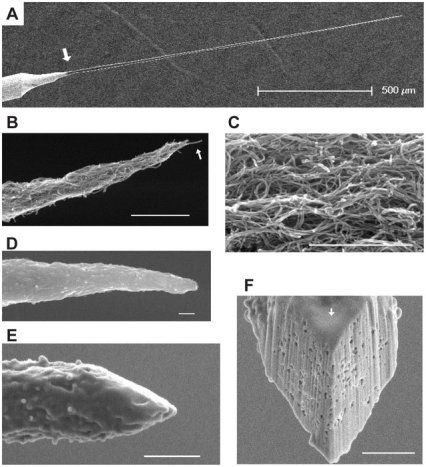
The example I was shown was more like a mountaintop, but here are some other probe points from https://www.researchgate.net/publication/248385439_Intracellular_Neural_Recording_with_Pure_Carbon_Nanotube_Probes/figures?lo=1
We spent hours trying and failing to get anything at all. Apparently, the students get marked quite highly or not for this experiment.
The other SEM images on the computer were all far better than my own one and I don’t think I will use mine in the book – but I was fascinated by the process and it will definitely feed into the book/work/essay. However, I will I hope return to do a still life of the tools we used as the colour of the handles is rather strangely the very same blue as the cows’ eyes (which I’ve not posted here yet – planning to do a contact sheet at some point soon). I think this may make a worthwhile juxtaposition.
Here are some of my efforts. Huge thanks to Peter Doel and his colleague for allowing me to explore this different way of seeing.


We did get an image of a range of atoms (I think) although it is not even, which is the ideal aim.
 SJField - OCA Level Three Study Blog