BOW: A3 dummy booklet

Making this  – bringing the work off the screen was incredibly useful. I was asked if it will be this size… no. (This booklet was handy – I owe my son a stocking-filler though). I will make the book in ID over the next ten days or so and fix a size but whatever happens in the making of it is open to need and further development.

This is not a fixed sequence, in fact, I scanned it in the wrong sequence because I’m tired and kept missing pages – it’s not a fixed anything, just a step in the journey. There is lots more writing which I never got to include in this initial manifestation plus some images but that is what I need to work on some more. The writing is driving this at the moment rather than photography. That’s ok. I have countless notes on my phone, phrases and thoughts, sentences, ideas which keep coming (see example below) and so I have to let that continue. No, this colour scheme is not it. The book is from Tiger…


Dummy book 1001
I like the idea of having a random paragraph on the cover and no title in fact. that can go on the cover page. It breaks the boundaries and establishes the fact of the alternative cut immediately. My son (interested in design) liked the raggedy cut due to a borrowed guillotine –  which I now understand is in the cupboard not being used for a reason. But I will try to photograph a tear with the macro in daylight as a result of our conversation.
Dummy book 1002
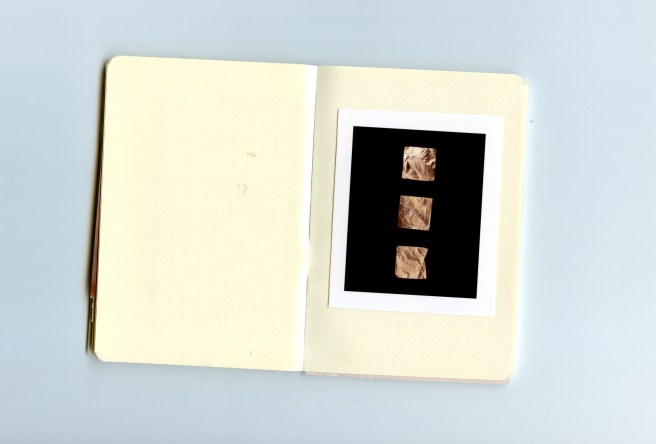
This is a real blade and I would very much like to include it as such in a version. I wonder about making an expensive version of the book which has this and other interesting things like a fold-out page  (see below) for assessment but if/when exhibiting make a zine run which will need it to be a photograph. I would need help with a book and have mentioned this to another student who made a very beautiful book. I know where my skills lie and bookmaking is not one of them.
Dummy book 1003
I am likely to use either a frame from processing for this or the shot with the female scattered. or a sequence
Dummy book 1004
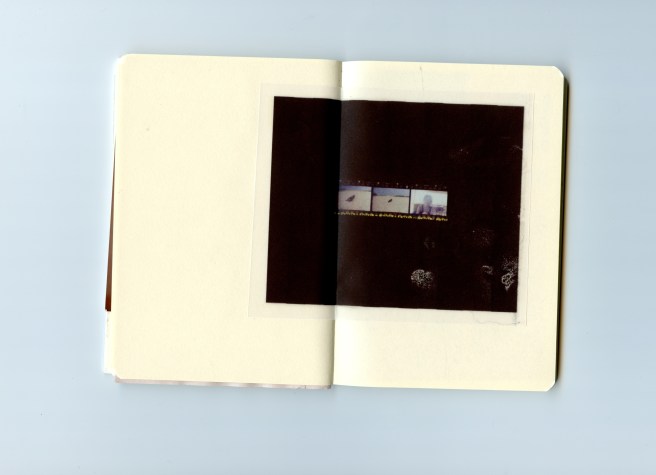
Folds out because of the size but in a finished product would not.


Dummy book 1006
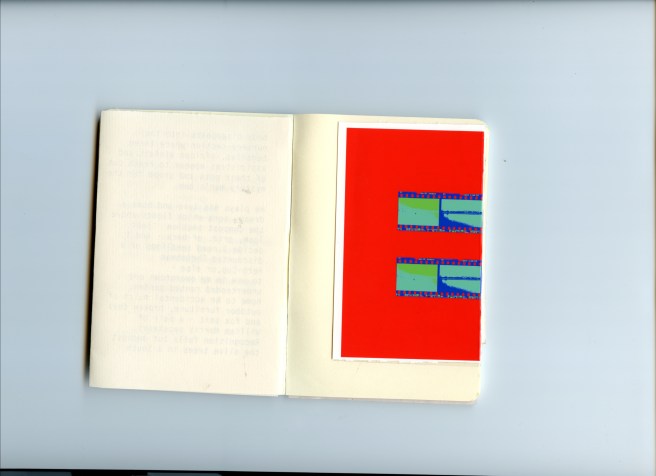
Mistake with printer which I liked split over two pages in fact, then didn’t like all the yellow on this and next page, so tried the red. My son loves this colour mix, I don’t, and will remake using specific negs I have identified. Scanned.

Dummy book 1005

Dummy book 1007
Will use something from Three Sisters or Uncle Vanya. Wasn’t sure but then realised the unconscious entanglement meant something – this book is about meaning emerging out of entangled interactions so will keep but not sure what passage.
Dummy book 1008
Like this combo but will play with other versions of selfies

Dummy book 1009

Dummy book 1010
Mistake covered up with something lying around  – like it. but need to find another or make sure I can take this out and scan it well enough. I do like these colours and wall paper.

Dummy book 1011Dummy book 1012


As mentioned, some notes from my phone with ideas, writing, things I’ve heard etc. I actually like the randomness and unstructuredness of some of this as-is, there is a freedom to it that isn’ in the earlier stuff:

The traumatised grown up

Sons hand me their hatred to carry around 

To the academics who fail to recognise their privileged booty 

Manifesto for the digitised self/age 

/ Alexa I’d like a wife

Sure, it’s fine for Philip Larkin to peer out of his train window and scoff at cheap fabric and gaudy hats 

Behind the shopfront, beneath the surface  everyday consumer 

Transactions – film world 

Trapped inside these words which cannot entertain a different world  

Split atom

Colonialism 

Sum

Of

The

Time 

&

Other 

Entanglements 

Reality is fucking with you 

Void realm 

Simpering 

Deity, divine, godhood, diabolical, decapitation, apotheosis, Ex rain god, enchantment  / Zeus sat down with Greta Garbo  – they don’t know how to create gods anymore, they worship objects. Laughter/ Zeus, my children don’t listen to me, I might as well not exist, I despaired then you and your friends came along, but then it was like the old days, not like that guy who wanted sole charge. He got it all wrong, 

There are no photographic records of my Czechoslovakian relatives, brewers who perished under the Nazi’s, in camps and ghettoes – missing images 

Mushroom, beige, magnolia 

Cut advert, cutting room floor, shiny nose, cut hair, terrible ‘boyfriend’ jerk, more money than any other job, least money with the BBC – most recognizable.

Floor, my entanglement with Tom 
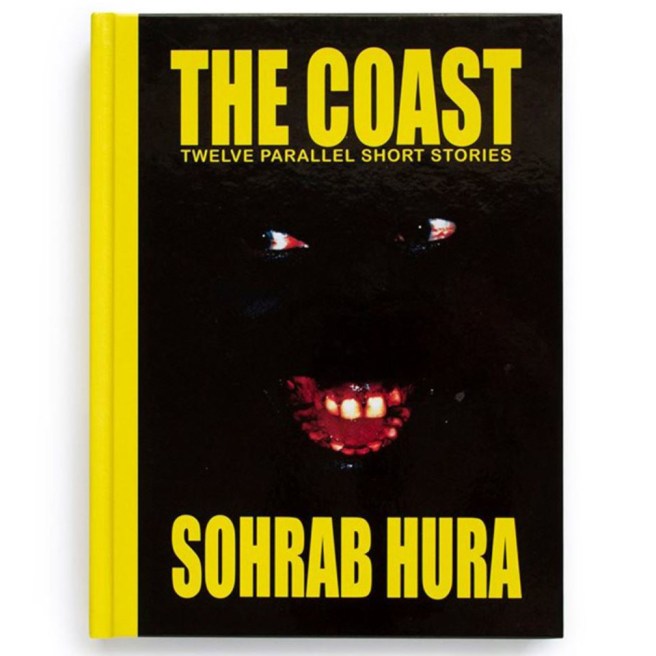
Artist (photobook): Sohrab Hura, The Coast


Absolutely love the look of this book, reviewed by Gerhard Clausing, and it seems inordinately relevant for me and my direction for BOW/CS. The mix of stories, images, the multiple states, not to mention the fantastically bold colours and content all appeal. Some of the images remind me of a clip from one of the films I’ve identified as a possible source a narrative in my own BOW, which will also be a collection of short stories alongside images – some very short indeed. Click on the link for the full review:

https://wordpress.com/read/blogs/4927285/posts/14353


00-coast
Image from the review – see link


“The carefully edited sequence of images and the surrounding mysterious short story versions go hand in hand. Sohrab Hura demonstrates that meanings can be altered by ever-so-slight changes in visual and verbal juxtapositions. This mirrors the current social media frenzy of believing imagined or constructed contexts or rumors more than facts that can be documented in incontrovertible detail. Is the person shown really injured?” (2019)

https://www.sohrabhura.com


CS & BOW Book Notes & Quotations: Data Selves, Deborah Lupton 201C

Lupton, D. (2019) Data selves: more-than-human perspectives. Cambridge, UK ; Medford, MA: Polity.

I am not sure when I started following Deborah Lupton’s blog or how I came across it but as we were preparing the installation for Pic London, I read her post about the forthcoming publication of her book Data Selves in my WordPress app. The word ‘assemblage’ stood out as one of the other artists, Josh Phillips had mentioned it several times. I wrote about it here and mentioned a discomfort with the word as it felt like an adjective that was being used as a noun. I have become used to the word now and it no longer jars every time I hear it. (I am not sure why I felt annoyed by the word – irrational irritation perhaps.)

Whatever the reasons, the work our group constructed, A rumour reached the village (2019) might be described as an assemblage of many smaller assemblages. There is something fractal about the ‘village’ of things we constructed. And so after reading Lupton’s blog, I ordered her book and am glad to have read it now, not only because it seems so relevant to my overall inquiry in which I am attempting to make sense of the way in which digital culture is changing the structural nature of existence, but because it led me to Karen Barad’s work. Actually, Barad had been mentioned to me before by another of my Pic London collaborators, Rowan Lear. But her name only sunk in while reading Data Selves.  

I expect I will need to investigate Barad further for CS and BOW but in the meantime here are some quotations from Lipton’s book with page numbers that could come in handy.

  • “Popular representations of these personal data and their futures often lean towards polar extremes.” (4)
  • “lively data” and “these data can continue to be lively even once the human they refer to is dead” (6)
  • “function creep”  – tech used in ways that go beyond their original purpose. (8)
  • Surveillance Capitalism (8)  – see https://www.theguardian.com/technology/2019/jan/20/shoshana-zuboff-age-of-surveillance-capitalism-google-facebook
  • “predictions that are made by data analytics can result in predictive privacy harms, in which people can be categorized against within certain social groups” (8) (See end of book where she talks about the limitations of data analytics – how our paranoia that too much is known about us prevents us from seeing how basic and limiting the categorisations can be (124)
  • (13 – NB pa) Personal data blur and challenge many of the binary oppositions and cultural boundaries that dominate in contemporary Western societies.
  • Rather than user – exister Amanda Lagerkvist (2017)
  • “In new materialism, the poststructuralist emphasis on language, discourse, and symbolic representation is enhanced by a turn torwards the material: particularly human embodied practices and interactions with objects, space and place.” (15)
  • “Braidotti (2018) terms ‘critical posthumanities’, in which the concept of human exceptionalism is done away with. This more-than-human approach sees human bodies as extending beyond their fleshy envelopes into the physicalenvironmentt, while the environment likewise colonised human bodies” (15)
  • “If we view personal digital data as manifestations of vitality, as recording, monitoring and influencing human lives, generating biolvalue and indeed as essentially part of humans, then they become part fo the domain of biopolitics.” (15)
  • “Feminist new materialists celebrate the renewal and liveliness of the capacities that human-nonhuman assemblages generate at the same time as identifying the ways in which these capacities can be closed off or limit the freedoms and potentials of some people or social groups or generate harm for the more-than-human world, as in environmental degradation, global warming, species extinction, pollution and climate change.” (17)
  • “While digital data assemblages are often conceptualised as immaterial, invisible and intangible, I contend that they are things that are generated in and through material devices (smartphones, computers, sensors), stored in material archives (data repositories), materialised in a range of formats that invite human sensory responses and have material effects on human bodies (documenting and having recursive effects on human flesh (19)
  • See quote by Koro-Ljungber et al. 2017; Taylor et al. 2018) NB
  • Diffractive methodology  – making entanglements visible. Barad suggests a diffractive approach is “good to think with”. (21) I agree. (Also 29)
  • More-than-human rather than posthuman (22) good para over to 23 – “interconnected and trans-agential.” Life, or vitality is not seen as possessed by any individual actor, but rather as constantly generated” (24)
  • Line about Caterisan dualism between mind and body (but see Alan Jasanoff (2018) for this too)
  • Animism – (25) quotes Haraway ” human ontologies must be understood as multiple and dynamic rather than fixed and essential (Bhavnani and Haraway, 1994)
  • Haraway’s ‘composite’ theory (26) See my own comments in BOW A2. (tentacular thinking)
  • Barad – “humans don’t know about the world because they are observing from outside it. They know about the world because they are inseparably part of it” (27)
  • Re agential cuts (29) And “Photographs make agential cuts that produce life forms rather than simply documenting them. “It is a way of giving form to matter” (Kember and Sylinska 2012:84) See 45 Years in lit review. more about agential cuts here: https://newmaterialism.eu/almanac/a/agential-cut.html – “Any attempt to impose meaning and order” […] “inevitably part of the matter it seeks to preserve or document” . Link this to Flusser and apparatus  – what he says about photographers (funny!)
  • Thing power and enchantment (30) “strange ability of ordinary, man-made items to exceed their status as objects and to manifest traces of independence and aliveness, constituting the outside of our own experience” Quoting Jane Bennett (2001 and 2009) – compare this to OOO Graham Harmen
  • Page 31 – assemblage “function of grouping of different things in an assemblage, each operating in conjunction with the others (including humans)” (Bennett 2004: 354)
  • 32 – Bennett recognises “mass-produced commodities as possible sites of enchantment” NB para
  • 33 – others working in technological design …recognise “humans invest digital devices with animistic or magical properties” See Marx and use-value.
  • 39 “death is more of a continuum” see page 40 too (Re mummies text)
  • 42/43 Summary about human and non-human entanglement inc. data and machine.
  • Liquid metaphor “data sweat” (Melissa Gregg 2015) ; data leaking, emerging from within the body to outside  – reveal ambivalence to data as it moves between “high value and useless – or even disgusting – waste product” (Abjection) 46
  • 53 uncanny valley, not quite right, see Mario Klingman – my blog S&O
  • 57 – Good Kristeva quote re creepiness, abjection.
  • 59 – Dirty data, “What matter is considered dirty or clean?” – attitudes can be related to underlying fears and anxieties about loss of control. Rowan Lear suggested the following after I posted a picture of the mould produced by her yeast started in the collective work and a picture of this section of the book – https://www.upress.umn.edu/book-division/books/against-purity?fbclid=IwAR1W0EQEaOOzd4jWd1Knp2iBmyse8bB22tN6sM0GayAg7o33KF1KyVo-Yj0
  • 63 – emphasis on all senses, not just visual “data physicalisations” See http://dataphys.org. Plenty of artists listed who are making alternative to visual art drawn from data
  • 68 NB – bias/visual data materialisations  – instead list artists making “multisensory, unconventional and surprising” materialisations
  • Doing Data chapter – less than critical of some of the neoliberal ways in which data is enmeshed with people’s lives, potentially making them more rather less neurotic. Little critical analysis, more reporting of her data about how this affects people who use the data.
  • Sharing and exploiting data  – caring/intimate surveillance concerns 103

The first section of the book is probably the most useful to me as it expresses ideas that I have found while reading about systems, a move away from mind-body dualism and digitisation’s impact on our perception of a less fragmented world. It is one of many books and articles which follow on from Kathryn Hayle’s posthuman book which has been so influential for me. I am inundated by such essays on Academia since reading a number of them. I like the sensible and pragmatic relationship Lupton has with data and technology even though she doesn’t seem all that critical of some aspects of data monitoring which strike me as nuts/unhealthy/hellish such as the constant surveillance of babies breathing – this kind of thing is very telling about our society and I could probably write a thesis on it alone.


Artist: Christiano​ Volk, Sinking Stone

I do wish I had some money to spare right now. This is the second photobook I’ve seen this week which I’d love to be able to buy.

Cristiano Volk’s Sinking Stone, a meditation on Venice, looks great. The reviewer writes:

“…rather than showing us a seemingly satisfying totality of Venice in the form that is viewed and reproduced by tourists, Volk confronts us with many jarring fragments that often flash by as in a short but powerful dream.”

and

“On the artistic side, I am very pleased that in his depiction of a city Volk has gone way beyond the traditional methodology of such genres as street photography. This project is an excellent example of making a statement by presenting ambiguities; this kind of fine art requires the participation of the viewer to reflect on issues that affect us all.”Clausing, 2019

You can see more here – worth the click!

Cristiano Volk – Sinking Stone

00-volk