BOW 3: Coursework, part ii

  1. I wrote about Joachim Schmid in DI&C and have been very influenced by his practice ever since. I love his notion of ecologically and pictures – and wholeheartedly agree with Berger’s statement that once everything is being photographed, photographs will become meaningless. This seems, in my mind, to have happened in this stage of late-Capitalism. But that’s another story/blog post – or indeed my essay! As you can see in this scan, I have found this particular passage on Schmid from Fontcuberta’s book incredibly helpful and influential.
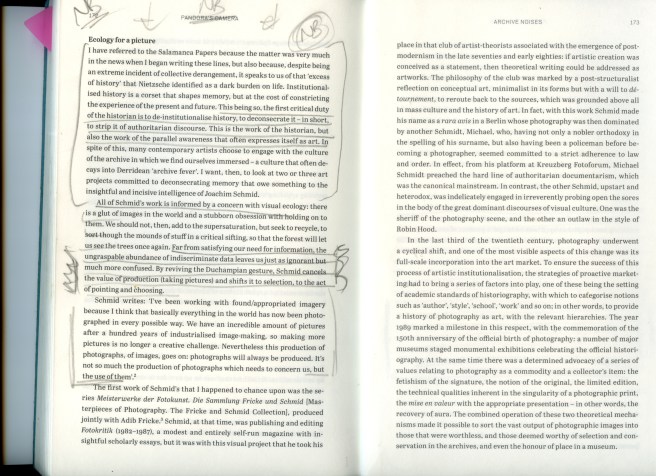
Various008

2. Frank, Alex Soth – before reading about this, I had already purchased a short video from eBay, a stranger’s first film which I will/may work with. We are asked in the file what we think about the ethical issues  – there is a question about privacy. Artists should be exploring the boundaries between private and public and there are far more boundary-breaking works out there. There is an interesting article in this month’s Tate mag which I will find later exploring the question of art/ethics/respect for others, the earth, etc. A major issue today in society is that everything is atomised into economic units, nothing is sacred, one’s own trauma, deviance, intimate states and feelings. And so that needs to feature in the work, even when it intrudes on privacy. But there are lines each artist and audience member must find for themselves.

3. This is about chance and David Bates accidents discussed. A more up to date example might be Collin Pantell’s broken camera images which I enjoy far more than the All Quiet on the Home Front images, which frighten me a bit. But the broken camera ones are really interesting and somehow unzip what I sense in the others. There’s a horror in the lack of cohesion which I’d rather face so I like these. I also used unwound film and flaws in an exercise I did for DI&C.  and am far more interested in this type of image than the perfect toothpaste advert ones others enjoy.

4. We are asked if these projects are a case of the Emperors New Clothes  – I know there are plenty who think so. I am more comfortable with such things and always looking for the kind of sensation of strangeness I enjoyed when watching silhouette cartoons as a child, or looking through my Viewmaster (I LOVED that toy so much).

Answers to some questions we are asked:

  • Is the work taking a direction of its own? I think so – I feel like I started with a very wide net and caught nothing for a long time, but little bumps of growth are appearing (excuse the mixed metaphors) – although some die quickly and disappear.
  • Strategy working? I am making things now, I really needed to do that. I must stick to this. I could lose it if not.
  • Am I resisting a certain direction – I am surprised to be focused on making a book rather than a film but I think that will come. It feels right to be focused in this direction.
  • Yes, the material in this section is very much my sort of thing
  • How has chance played a role? I ordered the film from eBay and had no idea what was on it, was a bit lost when I looked at it, but have decided to include it for now as one aspect rather than the containing element. Making the little dummy booklet was good because things I’d planned went wrong and I ended up using those wrong things – printing one page on two by accident – will use that. Finding a cut-out paragraph that works on the front cover. Making a mistake and covering it up with something I had lying around actually is a good idea which fits. It was very useful indeed. Using Processing to make things randomly. etc.
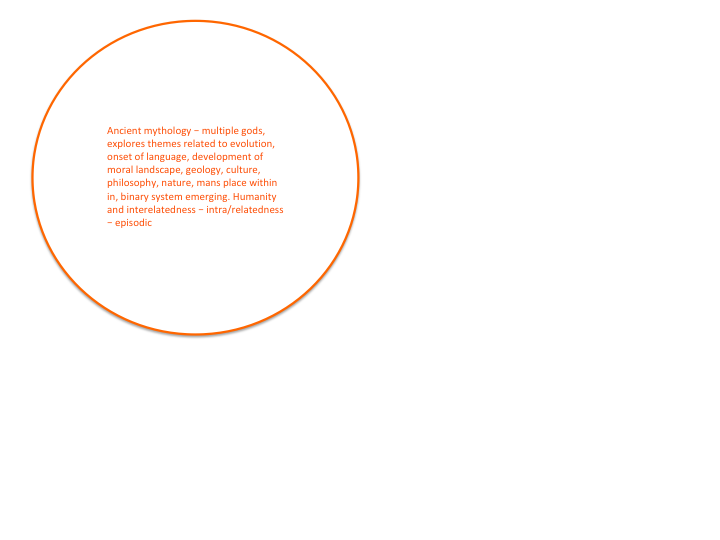
BOW: A3 ideas

  • Book
  • Website
  • Working towards installation consisting of moving image, still, text and objects

Main themes

  • Consumerism
  • Mythology (classical and modern) See below

https://vimeo.com/376661589


Click on slide below to see what each says – the animation above is meant o to indicate how all these are ‘entangled’ and part of the mesh life intra-active reality we live in today.

See more here: https://sjflevel3.photo.blog/2019/12/01/bow-ca-an-attempt-to-put-bubbling-concept-outside-of-me/

Current concepts to contain this:

Main Title – ‘????’  (Random notes for a short story?)

Subtitle – ‘ :a manifesto for the digitised self’

Will keep playing and thinking re the above – not there yet.

Need to focus on making work now – have been writing some of which is on Sketchbook blog – need to go back and re-look at quite a lot of the text, do rewrites etc. Feel The writing is the driver and the images playing second fiddle for now… need to change that. But in most cases, it was the writing which came first although Tom’s First Film (to be written) is inspired by the images in the film I bought to eBay. And having done that, I am returning to other films I’ve downloaded and looking for ‘kindling’ – i.e. frames that trigger texts. Below is a possibility for inclusion. Over the next several days (and beyond but in the immediate future, in order to submit A3), I hope to upload as many of these as possible and then will edit out much as one would with a sequence of images. using different materials to make ‘image’. This is an old image, incidentally, made while exploring S&O but not used.

Selfie-2  – A PDF to see what might look like in book form.

Selfie-1 –  Variation on a theme but prefer the above.

Many many more of these micro-stories to produce now….


CS A3: Plan, sample text, schedule

Full document – inlcudes Sample, plan, schedule, bibliography and reflection:

CS A3 Entanglement Draft 5 – sample only .edited

Cut section (focuses on systems but think this muddies the water in an essay that needs to retain focus, despite the rhizome nature of the methodology – the cut section provides a background, so might need to insert some nuggets of information into the main body, however.)

Section cut from plan CS A3


Research: CA A2 Daniel C Blight’s response to Charlotte Cotton’s Photography is Magic – Photography​ is Not Magic

I just discovered this as a draft – but never posted. The following passage is great.

“We might also beg questions of photography’s current relationship to non-representational theory here, a space in which we attempt to do away with the linguistic connotations of “reading photographs”. For as Piere Taminiaux notes in his The Paradox of Photography (2009) ‘Photography thus signifies both an end and a beginning to representation.’ Whichever theory of representation one might support, let’s remember John Harvey’s lines in his Photography and Spirit (2007), as both a criticism and a warning against such inconsistencies, which seem to forget that in the context of photography (and pertinently in the case of the algorithm), magic might not be made by the makers of photographs at all: ‘Pseudo-photographic relics and spirit photographs share not only the mystery and miracle of their manufacture but also the status of being representations of the spirit by the spirit’ [my italics].” (2015)

Update after finding post:

It seems that scientific theory is heading towards rendering representation key to our existence (Hoffman, 2019), I am not sure what to make of “Photography thus signifies both an end and a beginning to representation.’ It’s an odd sentence which I can’t make head nor tale of.

I do know Representation is under suspicion. On the one hand, science tells us we might only exist in a world of representation and reality is an illusion – on the other, science suggests phenomena rather than representation matters most. (Barad, 2003)  Barad’s critique/thesis “refuses the representationalist fixation on “words” and “things” and the problematic of their relationality, advocating instead a causal relationship between specific exclusionary practices embodied as specific material configurations of the world (i.e., discursive practices/(con)figurations rather than “words”) and specific material phenomena (i.e., relations rather than “things”).”

Daniel Rubenstein argues against Michael Freid’s negation of theatre as art, quoting Lyotard. ” In Libidinal Economy Lyotard proposed that the role of the artist is to lay bare the mechanisms of theatrical [perhaps here we don’t even need the word theatrical] representation, to show that if there is anything real about representation, it is because there also exists a fully real virtual domain constructed not from objects and things, but from intensities, desires and surfaces” (2017)

As I figure out what my A3 research question is – the word representation seems to be one of the key subjects along with performativity and the collapse of fixed and certain boundaries (which representation seems so reliant on).  I keep thinking about the conundrum of maths  – supposedly the least emotive language that exists. Is maths a language or is it a real thing. Apparently, the clever people can’t make up their minds. But what if it’s both?

Hoffman’s book on reality paints a picture (see the video on Aeon in references) that seems to suggest that our reality is *one giant representation – a user interface, the purpose of which is to ‘hide reality’ which allows us to ‘control [our] reality’. Our objects are icons that we recognise to work out our best fitness choices – otherwise, we would be distracted by reality. Not sure yet where the maths conundrum fits here  – but I do think if Hoffman’s theory has any credence then the illusion we create is the only reality we know and have, therefore it is real to us least, even though it is also representation. (“As an actor, I was not trying to fake it – I was trying to live it” – the most extreme example, the Method.)

*”When I see an apple it is a data structure  – I am rendering it when I look at it. This rendering happens in everyday life (a description of fitness payoffs.)

  • data structure
  • rendering
  • space-time itself is a data structure
  • conscious agents – passing experiences back and forth
  • reality is like a vast social network
  • Emergence
  • Entanglement


Barad, K. (2003) ‘Posthumanist Performativity: Toward an Understanding of How Matter Comes to Matter‘ In: Signs: Journal of Women in Culture and Society 28 (3) pp.801–831. At: https://www.journals.uchicago.edu/doi/abs/10.1086/345321 (Accessed 30/10/2019).

Blight, D. C. (2015) Photography Is Not Magic: Photographic Images and their Digital Spirit.  (AXA Online] At: https://americansuburbx.com/2015/10/photography-is-not-magic-photographic-images-and-their-digital-spirit.html (Accessed 06/11/2019).

Aeon (2019) It’s impossible to see the world as it is, argues a cognitive neuroscientist | Aeon Videos  At: https://aeon.co/videos/its-impossible-to-see-the-world-as-it-is-argues-a-cognitive-neuroscientist (Accessed 06/11/2019).

Rubinstein, D. (2017) ‘Failure to Engage: Art Criticism in the Age of Simulacrum‘ In: Journal of Visual Culture 16 (1) pp.43–55. At: http://journals.sagepub.com/doi/10.1177/1470412917690970 (Accessed 06/11/2019).