CS A1: Feedback

Normally to be written by the student, and endorsed by the tutor with additions/amendments in red.

Full report here: Field CS 1 Tutorial Report

Key points

This is a good and ambitious essay. I can see what you are trying to achieve in your writing – and practice. Tease out your idea a little more so that you give yourself space to explore structuralism/post-structuralism in relation to photography and to film – and to why both have become so central within art discourse – esp. as it make no sense to talk about the original photo or film. My suggestion would be to begin to look at montage/bricolage in relation to Modernism and structuralism/post-structuralism in relation to Postmodernism. The question of ‘the author’, sole and sovereign is also interesting in relation to your interest in collaborative work. (Theories of authorship are also put under strain by technological developments).

It was also clear in our tutorial that you want to look at anthropology and visual anthropology has in recent years contributed considerably to the understanding of both photography and film, so this may prove fruitful for further research.

Lastly, set a date for the next assignment submission as it will help keep you on track. There is nothing like a deadline…

  • Look at key concepts contained within essay such structuralism and/or poststructuralism, montage, death of the author in greater depth.
  • Explore why structuralism and/or poststructuralism have become so important to photography/film
  • Explore montage/bricolage in relation to Modernism

Summary of tutorial discussion

This is an edited version of notes on my blog (see Tutor Feedback in menu system under relevant Assignment section for more detail.).

Written feedback

Tease out terms such as simulation and simulacra, structuralism and/or poststructuralism, Modernism/Post Modernism and keep relating to your practice. Give more space to these, aiming eventually to focus in. Having looked at early chapters of David Harvey, The Condition of Postmodernity – today the concern is with fluidity and malleability within language, underpinning reality and construction of it, compared to the Industrial resolution where, it seems, existence manifested itself in a more articulated manner.

Bring alternative thoughts into writing, i.e. “technology continues to penetrate or dissolve barriers” – or “builds walls… access to cheap technology but bombarded with advertising – penetrating the mind while depriving viewers of an education…”

Clarify use of the word ‘real’

Aim for greater depth of analysis

Make bold claims but back up with examples of work and wider context

Tutorial learning points

Investigate and try to make sense of a new type of hyperreality alongside what seems like a the loss of reality. Explore the erosion of critical thought and of education which leads to it. Look at Screen and Screen Education from 70s and 80s re linguistics and language. NB Language is arbitrary. Meaning never is (can’t see this came from.) I think this is from Chris Weedon, Feminist Practice and Poststructuralist Theory, Blackwell 1987. Look at the area of Visual Anthropology. In relation to first person in academic writing, ensure the knowledge is situated, i.e. I think this because and due to that in relation to… etc.  – not, black is red because I say so. (See A Cyborg Manifesto by Donna J. Haraway (1985) – discussed in Kathryn Hayles)

Reading suggestions

Francois Lyotard The Postmodern Condition, 1979

Terry Eagleton, Literary Theory, Blackwell, 1983

Toril Moi Sexual Textual Politics, Routledge, 1985

Amelia Jones (Ed.), The Feminism and Visual Culture Reader, Routledge, 2003

Elizabeth Wright (Ed.), Feminism and Psychoanalysis, Routledge, 1998

Summary of Research Proposal (amended in the light of the tutorial)

Research proposal still to be developed… (discuss with newly appointed tutor)

Come up with focus for second essay – currently thinking about loss of reality/hyperreality as a focus.


Strengths Areas for development
Committed writing  Needs greater detailed in-depth analysis
 Relevant topics

Thoughtful research closely aligned to practice

 Deeper research
Breadth of approach

Ambitious topic

Further exploration of theories presented, particularly Modernism/Postmodernism and the importance of film and photography in these theories


Any other notes


Roberta McGrath
Next assignment due End October


Feedback: The real

There was a comment in Roberta’s feedback about the real which I didn’t write about in my previous reflection, and which deserves a slightly more in-depth response.

“The real, reality – and the genre of realism (from which and on which photography is predicated) are complex terms. The Lacanian Real is particularly so. This section may be something to explore further – although I wonder here if you are talking about the Freudian return of the repressed – and the compulsion to repeat.” (2019)

  1. Realism

The Tate website defines realism as:

“In its specific sense realism refers to a mid nineteenth century artistic movement characterised by subjects painted from everyday life in a naturalistic manner; however the term is also generally used to describe artworks painted in a realistic almost photographic way”

and

“The term generally implies a certain grittiness in choice of subject. Such subject matter combined with the new naturalism of treatment caused shock among the predominantly upper and middle class audiences for art.”

https://www.tate.org.uk/art/art-terms/r/realism

My experience with realism began when I learned about a style of theatre from a similar era, albeit perhaps a bit later, which tends to be seen as a reaction against melodrama, comedy, vaudeville.  A quick search leads to a long list of pages but the following is helpful and suggests realism emerged from and aimed to promote these ideas:

  • “truth resides in material objects we perceived to all five senses; truth is verified through science
  • the scientific method—observation—would solve everything
  • human problems were the highest” (Trumbull, 2009)

https://novaonline.nvcc.edu/eli/spd130et/realism.htm

Like many, I was always a bit cloudy over the difference between naturalism and realism.

Again a search leads to a summary of the main differences as follows:
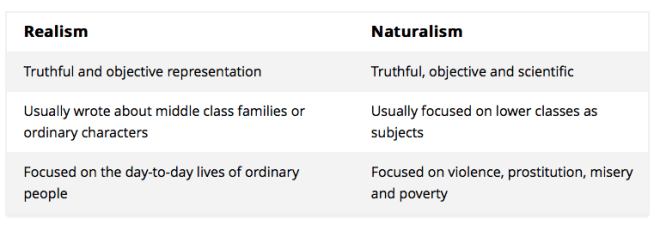
Screen Shot 2019-09-05 at 10.37.04

Screenshot from: https://difference.guru/difference-between-realism-and-naturalism-in-literature/

Either way, there is a focus on everyday people and mundane life, rather than gods and myths, then romanticism which is new.

2. Photography and realism

Photography grew out of the scientific harnessing of light and deeper understanding of chemicals and material. There has long been a tension between photography which aims to emulate painting, Pictorialism, and ‘straight photography,” which rejects what might be interpreted as any form of additional artistic flourish, insisting instead on sharp-focused ‘reality’. The eye of the photographer and not their ability to manipulate the picture in pre-or post-production became most important. This tension between the two continues today. Many practitioners working on the latter end of the spectrum seem to be rather sniffy about those who dally with potentially seductive, artistic traits.

However, equally today, there is a strong sense that what we see is constructed, and so whether an artist introduces flourishes or not, those embedded and working in a photographic tradition should be aware that however they are making work, they are nevertheless playing with various forms of human perception. Some philosophers such as Vilém Flusser will argue that even the most straight photography cannot help but contain within in it the voice of the central apparatus, which he describes as bigger than and disinterested in the individual except as a potential economic unit and disseminator of its aims.

“Apparatuses now function as an end in themselves, ‘automatically’ as it were, with the single aim of maintaining and improving themselves.” (1983, loc 850)

He does not seem to hold the photographer in high regard unless they are experimental and aware “the image, apparatus, program, and information are the basic problems that they have to come to terms with” and they must aim to “create unpredictable information, i.e. to release themselves from the camera, and the place within”. (loc 939) (What he means by experimental might be different to other peoples’ understanding, however).

http://www.flusserstudies.net/flusser-studies

At this point in time, I feel, perhaps due to the plethora of photography available to look at, that there are an awful lot very beautiful images which despite their loveliness do very little for me. Perhaps I am a Neanderthal heathen (Neandertals incidentally seemed to have been far more advanced than they were once given credit for) but I am a little tired of what I see as ‘visual masturbation’ over light and shadow or the photographer’s excitement about being able to control their exposure. I am aware this may be a projection as I spent some time enjoying creating just this sort of image but I eventually grew very bored of emulating Paul Strand type pictures. If a photograph is little more than a study in exposure control, it doesn’t do much for me. This is a bit of shame as far as my deep-seated need for external validation goes – that type of photography does appear to be the preferred option amongst many people who have the power to validate. But I am far more interested in inspecting and exploring the loss of reality we currently seem to be faced with.

3. Before I address the loss of realism, I will briefly mention the Lacanian Real and Freud’s repression as they were referenced in the feedback.

In my essay regarding Roberta’s comment, I believe I was referring to the Lacanian Real, which I shall simply call ‘the real’ in this section, or least my comprehension of that. When I first read about the real, like anyone, it was hard to know exactly what he meant. I watched as Zizek describe it in a Youtube Video – he suggests the real is the object minus any symbolism, i.e. an iPhone is simply a hunk of metal. It is only the symbolism endowed upon the object which makes it the valuable thing we believe it to be – constructed with sophisticated marketing within a structural world where the actual value is hard to separate from conscious commodification aimed at selling things. While I appreciate the object sans symbolism is indeed a bit of what we might call cold, hard ‘reality’, that has not been my understanding of the Lacanian real, even though it may be related.

I also watched another video (perhaps a School of Life production, simple but effective short introductions) which described Lacan’s real as the unformed, indefinable maelstrom that exists prior to symbolism. This is much harder to describe or understand.  I wonder if we need Lacanian imaginary to find ways in which symbols might attempt to describe the real, even though it is pre-linguistic and therefore indescribable. It might come in the form of a visceral feeling that hits us in the solar plexus or makes the hair stand out on the back of our necks, or accompanies a letdown reflex when our baby cries – but is always quickly usurped with symbols, i.e. “My baby needs feeding”. Perhaps this real is also something to do with Barthes ‘punctum’ although James Elkins warns us not to “immerse the punctum in the Freudian unconscious”. (loc 678)

According to Hal Foster, Lacan wanted to define the real in terms of trauma, and from a personal point of view, I can see why. When traumatic things have happened it can feel like the fabric of reality is so disturbed or torn apart that I am left having to cope without any protective illusions which are suggestive of ‘normality’. Things become ‘surreal’ and Foster suggests that Lacan was influenced by the Dadaists and Surrealists as he attempted to explore what the real might be. I think it’s probably important to think about how trauma doesn’t necessarily have to be dire – such as a death, accident, or divorce but may also refer to events which are considered more positive such as births and marriages. These breaches in our lives which cause significant shifts have such an impact and also operate at levels which we aren’t always conscious of or able to contain within everyday activities – which is why customs and rituals become important. It’s this kind of real which I always understand as ‘the real’ rather than an iPhone minus its commodity value.

4. The undoing of reality

There is really is so much to say about this and I can’t begin to cover it – it will only ever be too brief and utterly inadequate.

I’m not entirely sure when the undoing of reality can be said to have started. Perhaps its a pendulum action as different types of reality swing into favour. But even that is too simplistic as various bits of debris seem to hang on for the journey back and forth, round and round.

It does seem as if quantum mechanics which has been unfolding for roughly 100 to 120 years has had an unquantifiable impact on the way we perceive reality. But even before that, from the most basic inventions such as the wheel, or if you take Andy Clark’s thesis that language is a technology seriously, earlier, onwards  – the things we invent disrupt and change our relationship with perception. (And then there is the feedback loop too.)

There is a radical shift happening in relation to our understanding of space and time. In The Case Against Reality (2019), Donald D Hoffman writes that spacetime is doomed. He writes it 17 times! That’s not to say we are all heading for oblivion (we probably are) but that the calculations which Einstein gave us and which situated gravity inside a universe affecting the discrete objects inside it, no longer offer an accurate description – all of that is, according to Hoffman and other scientists, in the process of being replaced with new more accurate theories. These theories contain words like emergence, relationship, context, networks and illusion. Hoffman asks, if spacetime if doomed, what will replace it and then suggests “a data-compressing and error-correcting code for fitness” (page 114) There is so much out there at the moment about life not seeming real, about the possibility or probability of life being a hologram, about the fact that what we see and feel isn’t really real and all constructed in our heads. Kathryn Hayles (1999) mentions a frog study where it was discovered frogs’ eyes and brains perceive the world differently to us and so grab flies with their tongues having evolved to perceive time in a way that worked for that creature; thereby proving reality is constructed.

Hoffman talks about a screen (using computer metaphor and narrative throughout). He asks is we can ever pierce this screen and see objective reality although one suspects he thinks not. Rather than us existing in a universe, his theory says, “consciousness is fundamental and then has the task of showing how spacetime, matter, and neurobiology emerge as components of the perceptual interface of certain conscious agents.” (190)

If one were to give Hoffman’s description any credence, the real in Lacanian terms might be interpreted as the undefined pre-interface ‘stuff’ that has not yet been shaped into the things we perceive to be reality – a kind of half-baked cake mixture, not raw, not cooked yet (excuse the inadequate analogy).

What’s important here is the changing relationship we have with what makes the ‘real’. And as Hoffman admits, there is no fixed answer, science is always changing and evolving. Its aim is often to disprove itself in order say, this is not the way life works, let’s look in that direction instead. For several decades there has been a “loss of faith” and a “growing unease with the categorical fixity of Enlightenment thought” (Harvey, 1990; p29). But today, in science, at any rate, there seems to an acceptance that things are way more complex than we ever imagined. However, there is also a sense at the moment in the wider world that nothing is real and that may be deeply related to the political chaos we live with.

5. Slippage

I read the ‘real’ often but the trouble with the word is that it seems to be understood in so many different ways by people.  And everyone seems to think their way is the best way. I might think carefully about using it in the future and always try to see if there is a synonym which explains what I mean more definitively.

Elkins, J. (2011) What Photography Is, Kindle Edition, New York, Routledge

Hayles, K. (1999). How we became posthuman: virtual bodies in cybernetics, literature, and informatics. KINDLE Edition Chicago, Ill, University of Chicago Press.

Harvey, D. (1990) The Condition of Postmodernity, London Blackwell

CA A1 – Research & Reflection (written after draft 1 submitted, inc. some comments re. tutor feedback)

Time and shame

I’m not doing this in the order I would usually do things. I was away from home for 4/5 weeks and didn’t want to fall too far behind, so I packed up a selection of books I thought would be useful and planned to write my essay once I’d arrived in Italy. I hoped this would be a good place to write. After all, I was away from London and my paid work demands, plus able to live in a kind of denial about the stresses and financial difficulties of life for a little while. However, family, lack of WIFI and other tech issues made it challenging. So research was a bit tricky… Although I loved being away, I really longed for a quiet, properly resourced space. I mention all of this because while there an article about women not having time or space to think, to create and make work went viral.

Brigid Shults wrote in The Guardian, “Women’s time has been interrupted and fragmented throughout history, the rhythms of their days circumscribed by the sisyphean tasks of housework, childcare and kin work – keeping family and community ties strong. If what it takes to create are long stretches of uninterrupted, concentrated time, time you can choose to do with as you will, time that you can control, that’s something women have never had the luxury to expect, at least not without getting slammed for unseemly selfishness.” (2019)

I think there is probably something to retain for possible future developments about this fragmentation of time and focus, the stop/start way of working and ceaseless interruptions women live with and that successful creative men have been able to live without. I suspect at some point I may want/be able to weave something of this into some work. And of course, not forgetting the shame. Even as I write this I feel tremendously guilty for sounding unappreciative of the time I took, and how I was able to catch up with so much reading. I feel compelled to express my gratitude for all that was given. (And a great deal, not only in terms of time, was gratefully received by me.

Essay

I wrote the essay which I sent to Roberta and warned her that I would look at it again after a few weeks and see where I could make better connections. Predictably, the minute I sent it off I noticed that I had relied on quotes I’d used in previous essays and I was sort of repeating myself. I don’t think there is too much wrong with this as I refine ideas and rely on really important concepts that are at the core of my developing work. However, I felt I was beginning to limit myself.

Therefore, I will take the comments that Roberta made plus a few I made myself and respond, sometimes based on reading I did following submission. Then I hope to have a short online meeting with her and following that I will fill in the formative feedback form taking edited highlights from this document and anything vital form our talk.

Comments

Essay text in green, Roberta’s comments in orang

  1. “However, rather than, or perhaps in addition to lamenting time past, these signs also make reference to Baudrillard’s writing on simulation and simulacra – the constructed non-reality of the reality of modern life via modern media, where everything is lived on the surface, removed from the real but therefore rendered so.” (p3)

    You might want to tease this out a little more in order and make a stab at defining these terms and their historical emergence.
    Also, see David Harvey, The Condition of Postmodernity.This may be reminiscent of techniques used by Adam Curtis in documentaries such as Bitter Lake (2015) or Hypernormalisation (2017) where vintage footage is also used to investigate our current reality. (p3/4)
    again, as above can you push this a little further. Curtis is a good example


    I ordered a cheap second-hand copy of the Harvey book which was waiting for me when I arrived home and read Chapter 1 where Modernism is discussed yesterday. I am really grateful for this suggestion as it’s a great book; lively, fascinating, and no verbosity (yay!) My favourite line so far – and be warned I will be repeating this several times – refers to what Benjamin calls ‘auratic art’ – Once reproduction and mechanisation arrived, in order to add value to work, “the artist had to assume an aura of creativity… to produce a cultural object” of value. “The result was often highly individualistic, aristocratic, disdainful (particularly of popular culture), and even arrogant in perspective on the part of the cultural producers, but it also indicated how our reality might be constructed through aesthetically informed activity.” (p22, 1990)
    The disdainful attitude has not gone away, or if it ever did, it seems to have returned with alacrity. I am often appalled by the supercilious, superior and condemnatory way in which some people/artists/photographers look down their noses at practically everything, including forms they don’t themselves use, the general population who don’t have the luxury of an expensive education at their disposal, nor decades of reading interminable circular texts about the ethics of photography behind them, nor the time, space or money to wallow in historical processes. All of this is made worse when artists, as echoed by Harvey, on one hand, “mythologise(d) the proletariat” (p33) while also behaving like the “elite-international avant-garde”. (p25) The following may still be an accurate description in some circles: “Artists, for all their predilection for anti-establishment and anti-bourgeois rhetoric, spent much more energy struggling with each other and against their own traditions in order to sell their products than they did in any real political action.” (p22)

    The other critical element in this first chapter is how the articulated machinery on which Industrialisation relied affected perception and therefore artistic practice. The difference today is how digital machinery produces a far less articulated reality – and instead, there is a perceived flow as information travels and morphs and transforms. I was struck by the many references to machinery, “houses and cities could be openly conceived of as ‘machines for living in” (p32). Nowadays, existence is often written about in computer-related metaphor. Donald Hoffman’s recently published The Case Against Reality (2019) (which I will write about elsewhere) contains a hypothesis which describes reality as a series of desktop icons on a computer interface – and so, if one is wary of the current tendency to think of the brain as a computer, you have to tread quite carefully through his arguments in order to avoid being reductive. However, this loss of a fixed stable reality that is always around even when we’re not, which according to Harvey could be felt and was being expressed towards the end of the Modernist period, seems now in full swing.

    I realise I digressed slightly with my rant about the irony of snobbish artists who peer down their noses at so much while at the same time claim to be something other than and often better (more valuable) than the ‘bourgeoisie or petit-bourgeoisie’ – however, my desire to embrace popular culture as I did in Self & Other when I made work using Snapchat, and when I use proprietary filters is related to this aspect. Recently I have focused on vintage material downloaded from the internet, i.e. rendered digital, and where signs of age are fetishised, but it may be that at some point I need to be really brave and grab material that has none of that safety-net.

    But perhaps more importantly, the changes happening to our understanding of reality, the theories of which then go on to help design our technology are having the most seismic and profound impact on who we are and how we see ourselves. And I think that is probably at the core of what I’m aiming to explore.

  2. “In Sirens and Origin of the Common-Place the medium, its source, and transformative journey are as critical as the content. Marshall McLuhan’s mantra “the medium is the message” is relevant.” (p4)

    Why and how is McLuhan’s statement relevant? Can you explain in a little more detail

    As a practitioner, currently and internally there is a tension in me, an argument between the value of process and representation. I feel I am trapped in representation while the art world values process more highly and wish I could find a way out of representation, which is what I know and where I come from – what I feel most comfortable with. I will say something more about this at the end of this section. However, the making of these films, the downloading of digital data on my computer at home and then the reconstitution of them, again at home on my computer or even my phone is critical to the work. Today I can take films – which were once the preserve of institutions – and transform them and make them my own. I have some element of autonomy over the message which is (was) fed to me. I can take the slop that was served up and do what I want with it, as long as I can master the easy to use technology and retain access to it. This is a big change in the way we interact with media and certainly very different from the fixed frescos on church walls that people bowed down before in the middle-ages.
     

    McLuhan, and later others such as Kathryn Hayles in How We Became Post Human (1999) (a very important book for me) discuss how we instantiate technology; i.e. how the media we use becomes an extension of our nervous systems and how we internalise it. McLuhan’s ideas inform systems theory; not only does the type of media rather than the message have an impact on us – there is a feedback loop, both language (whatever media is used) and we exist in a living, dynamic symbiotic relationship. Andy Clarke is another philosopher who suggests that language itself – the process of speaking – is a prosthetic extension, a technological tool which has changed (through feedback loops) the way we evolved.As perception of fixed Cartesian concepts dissolve, replaced or added to by dynamic atomic units, and as relationship and context become more and more valued, perhaps it might be appropriate to say, you cannot view one without the other – the chosen medium and the content together are the message and to try and separate them risks being reductive.

    In reference to representation – perhaps I am worrying too much about this. Hoffman’s book about reality suggests that the way in which we construct our so-called ‘real’ representation is absolutely critical to how we animals experience existence – and so maybe how I make things that end up looking and sounding and feeling a certain way is key. But what appears is also key and one cannot separate the two – or else it risks being reductive. Of course, lots of art seems to deliberately aim for reductiveness as perhaps it strives to make sense or unpick tiny aspects of living.

  3. As the barriers between exterior and interior, or between physical and metaphysical break down

    Again as above – see Harvey

    I think this could become a very important subject for me. As well as Harvey, the later chapters in Hayles’ book explore this a great deal. I also posted some work by Albarado Morell recently which looks at it and further comments here. But perhaps Hayles in more relevant. Chapter 7 – Turning Reality Inside Out and Ride Side Out: Boundary Work in the Mid Sixties Novels of Philip K. Dick is absolutely teeming with relevant information and I have touched on this previously. Before the summer, on my Sketchbook blog, I was recording Random Notes for Short Story. I do not know where it is going or what I will do with these but I suppose I will continue and they may inform or become part of any BOW work. #12 in particular references this change in human experience and links back to media.
     
  4. (And before that, drawings, which suggests still photography may have been a very brief interlude in the journey that began with cave drawing, developed to become printing, followed by the invention of mechanization, and moving towards a total simulated reality) (sp. corrected, p6)
    Although this has not diminished the demand for those other media – indeed it has given them a new lease of life.

    Exactly, so why is Photography at times so neurotic and defensive? Why can’t it get over itself and stop trying to prove it really is in Art.
     
  5. Barthes’ death of authorship may be easier to accept than the suggestion that all meaning is negated leaving us with a zero sign. In Sirens and other appropriated work, it might be argued, signification is transformed rather than nullified, even if the reader doesn’t particularly agree with or ‘like’ the altered content.
    death of the author – which gave birth to the reader’s primary role in creating meaning – hence one of the biggest problems is in visual literacy in particular – and literacy more generally. Increasingly it becomes more difficult to distinguish fact from fiction, truth from lies – for many it does not even matter (your Cambridge Analytica is one extreme example). See Francois Lyotard.

    For the time being, I would always argue that photography, like all language, exists within a rich, complex, dynamic interplay – (recognised in the death of the author which might also be understood as the birth of the collaborative producer who understands that their work doesn’t emerge until there is a receptor, even if that consists of only one person) one of many nebulous elements that emerge and feedback in the process of reality construction. I don’t believe there is a zero sign, only that some ‘actors’ say things which bear little relation to their pretended intentions; there is still meaning, it is simply more difficult to unpick. Advertisers, fascists, narcissists are all excellent examples of those who employ such tactics. As an actor who studied Stanislavskian uniting of text – it is very difficult to accept that the sign could actually be empty. And I think that metaphor comes from a world in which discrete objects exist in the universe rather than one which emerges through relationship.

    I also wonder when in our history the human population was ever able to determine fact from fiction. Our species is riddled with false assumptions about what and who we are, the majority of us left in the dark while those in power play merry havoc with our world while living off our efforts. It may be true that groups such CA have been able to flourish in these early pioneering days of a new epoch but there has to be hope – And I hope I am not overly optimistic, referencing Hayles as she says “Only if one thinks of the subject as an autonomous self, independent of the environment is one likely to experience the panic performed by Norbert Weiners Cybernetics and Bernard Wolf’s Limbo. This view of the self authorizes that fear that is boundaries are breached at all, there will be nothing left to stop the self’s complete dissolution. By contrast, when the human is seen as part of a distributed system, the full expression of human capability can be seen precisely to depend on n the splice rather than be imperiled but it.” (p290) 
  6. The collaborative nature of Sirens can be seen as another example of dissolving walls, modern-day fluidity, not only, as mentioned earlier between inner and outer worlds but also between individuals; systems which were perhaps previously considered closed but which might become viewed as open, as technology continues to penetrate or dissolve barriers.

    Although, in other ways, it builds walls eg above re literacy. sure you can have access to cheap technology but you’ll be so bombarded with advertising – penetrating the mind while depriving most viewers/readers of an education that will provide them of the means to engage critically.
     

    I do believe these walls have always existed. We see them more nowadays because that’s what digital technology does. It makes the structures visible. That’s not to say that digital technology hasn’t made it worse. See my response about the complex, dynamic interrelated process of reality below.Saying all that, I find collaboration incredibly challenging at the moment – and although there are many diverse reasons for this, I think it is interesting psychologically speaking that my reference to relationship below, although meant broadly, might also be suggestive of something more personal. I disagreed with Will Self’s comment about ‘there being no other’ in this new Millenial world of ours (how perfect that a man called Self should say this) but as I interact with people from a younger generation I am beginning to find it harder and harder to stray true to my conviction that he must be wrong. I mention this as it seems important to the whole issue of supposed ‘post-humanism’ and Hayle’s references literature that deals with the isolated individual.

  7. Repetition flirts with tautology, but perhaps, in the case of my own work, various video-editing techniques help to transform rather than mirror.

    and perhaps thwart the definition of photography as a ‘mirror with a memory’, so that you want to argue that photography, like language, constructs reality rather than reflecting reality, 

    For the time being, I would always argue that photography, like all language – it is, after all, a language itself, exists as part of a rich, complex, dynamic interplay – one of many nebulous elements that emerge and feedback in the process of reality construction.

Comments from the reflection section:
Yes, it is good to read more widely but state your case for doing so too. – the world is changing so much – I think it’s incredibly important to place what we read about photography in broader context otherwise it becomes insular, circular and drier and drier, and irrelevant. I can’t see the point in simply re-stating what has already been said when the world we live in today is informed by new ideas. Saying that I love reading perspicacious texts which could describe the digital world long before the internet was conceived of, such as Guy Debord’s’ Society of the Spectacle. It reminds me not to be parochial about time which can lead to us thinking that the issues we are facing are all about us and us alone now, rather than stemming from historical processes.
I think it will be more a question of greater depth of analysis of the avenues you touch on here: montage, structuralism, post-structuralism and its impact on film art. I totally understand that I will need to find a way to discuss things in more depth – this I think is the challenging (exhausting!) thing that I need to overcome.
Making a bold ‘claim’ is good. You then want to then back that up and place your own work within a wider context (historical theoretical etc). I re-read James Elkins who has given me much fodder for suggesting that photography is at high risk of being tautological, if not damn boring.
There is no problem at all using first person now in academic writing. The argument is that knowledge is not neutral and that all knowledge should be situated. I’m not convinced the OCA is up to speed with this and will discuss when we meet.

Overall, I could do with going back and fleshing out one of two topics while dropping others for now. Roberta wrote in an email “ease out your idea a little more so that you give yourself space to explore structuralism/post-structuralism in relation to photography and to film – and to why both have become so central within art discourse – esp. as it makes no sense to talk about the original photo or film. My suggestion would be to begin to look at theories you use in more depth. Montage/bricolage in relation to Modernism and structuralism/post-structuralism in relation to Postmodernism…also of course ideas of sole sovereign authorship: ‘The Author’ or ‘The Artist’ are put under strain by those theories – collaboration is, of course, interesting here” (2019)

Links

https://www.theguardian.com/commentisfree/2019/jul/21/woman-greatest-enemy-lack-of-time-themselves?

CMP=fb_gu&utm_medium=Social&utm_source=Facebook&fbclid=IwAR18oNQakkE_TGTiI8ED__wkMIXGQ42I71tui9CZIor9faiPsLDAcc_hKtg#Echobox=1564153102

https://www.theguardian.com/books/2016/nov/25/will-self-humans-evolving-need-stories

Hayles, K. (1999). How we became posthuman: virtual bodies in cybernetics, literature, and informatics. KINDLE Edition Chicago, Ill, University of Chicago Press.

Harvey, D. (1990) The Condition of Postmodernity, London Blackwell

Inside out confusion

I’ve been alluding to what I understand as a relatively new phenomena recently in my CS1 essay and in one of the short story fragments; others’ exteriorisation emerging internally in individuals due to technology’s ability to do away with traditional boundaries between individuals. (How interesting this should have come about in an era when individualism has been so highly valued.) I think is something I should look into more and am re-reading (and reading some chapters for the first time) Hayles’ How We Became Posthuman. Chapter 7 Turning Reality Inside Out: boundary work in the mid-sixties Novels of Philip K Dick is probably going to be useful and clearly demonstrates how these issues arose prior to the internet – although made far far tangible and evident by its now overwhelming presence.

“When system boundaries are defined by information flows and feedback loops rather than epidermal surfaces, the subject becomes a system to be assembled and disassembled rather than an entity whose organic wholeness can be assumed” (160)

… “the weaker system is made to serve the goals of the stronger rather than pursuing its own system unity” (ibid)

“… a persistent suspicion that the objects surrounding us – and indeed reality itself – are fakes” (161)

And finally for now …

“The interpellation of the individual into market relations so thoroughly defines the characters of these novels that it is impossible to think of the characters apart from the economic institutions into which they are incorporated” (162)

Notes: for CS A1 Essay

Write a 1,000–1,500-word essay that relates your current work (the work that you made or are making in Body of Work) to an aspect of visual culture discussed in Part One.

Your text should be fully referenced and illustrated with your own photographs plus supporting figures where appropriate. Submit your essay to your tutor by whatever means agreed, either a hard copy in the post or a Microsoft Word or PDF document in an email.

You may find it difficult initially to identify which of the five concepts discussed in Part One (i.e. modernism, postmodernism, poststructuralism, photography and reality, globalisation) are relevant to your practice. However, this challenge is part of the objective of the exercise. Consult your tutor if you are experiencing difficulties.

Modernism

  • It becomes increasingly obvious to me that separating photography and its invention from the world in which it exists is risky.  Recalling Ariella Azoulay’s comments which I included in DI&C A3, ““To take this excursion to 1492 as the origin of photography—exploring this with and through photography—requires one to abandon the imperial linear temporality and the way it separates tenses: past, present, and future. One has to engage with the imperial world from a non-imperial perspective and be committed to the idea of revoking rather than ignoring or denying imperial rights manufactured and distributed as part of the destruction of diverse worlds” (2018) This is reminiscent of some of the theories about time which emerge from Quantum science – theories that are desperately difficult to comprehend.
  • Nevertheless, Modernism appears to be a very specific awakening. We humans can breakdown and dissect reality. However, the first stirrings did not begin then, and Leanoardo’s much earlier famous drawings are an obvious testament to a growing understanding of what human consciousness is capable of.
  • Perhaps Modernism is a moment we can pinpoint where a gradual turning inwards, or an increasingly inverted look, can be charted as having sped up.
  • If the Greeks looked upwards towards the stars and saw how big everything was culminating in the Rennaissance and Newtonian physics, then the Modernists were really getting humans busy with looking inwards and at the very small which continues apace with quantum exploration  – and this tussle with the arrow of time.
  • Pages 392 – 397 in Blue Print summation of history’s journey as the understanding of human relationship with self and nature evolves

Post-Modernism

  • ‘a rejection of meta-narratives’ (Lyotard, 1979) (OCA CS folder, page 17) – due perhaps to the underlying scientific narrative which posits context and relationship “The theory [quantum gravity] does not describe how things are; it describes how things occur and how they interact with each other.” or “relations between physical systems” – particle A meets particle B and something occurs but without that interaction particle A and B are meaningless. Particle A’s interaction with Particle C may be entirely different from the previous interaction. What’s more A, B and C never operate in a vacuum are entirely affected by environment. They are not discrete objects in a universe but part of the fabric of the universe
  • pluralism (ibid)
  • Tagg – “photography evolves by a process of internal self-criticism towards the ever-sharper definition of what the medium uniquely is” (page 18)  – in my, but not the photography purist’s opinion –  the ability to harness light using chemicals (at that time) and make a naive copy of reality which has since become increasingly more sophisticated, leading to the inevitable; photography is part of a journey whereby reality will having turned inwards be able to give birth to itself. And therefore photography cannot be uniquely anything as it is one element of many within a much larger human project
  • See above, inwards and small – this happens in tandem with the development of science and computing which relies increasingly heavily on quantum sciences as well as multi-disciplinary endeavors such as the Macy conferences.
  • Photography cannot go it alone despite many wishing or thinking it were so
  • “a hybrid construction of the self emerging from cultural theory and technology” Brown, 2008
  • Again, Tagg is critical of feminist or socialist histories for similar reasons – they overlook context.
  • NB – “Good people can do bad things (and visa versa) simply as a result of the structure of the network in which they are embedded, regardless of the convictions they hold or that the group espouses. It is not just a matter of being connected to ‘bad’ people; the number and pattern of social connections is also crucial” (Christakis, 2019. 106) Context, the shape and nature of the connections made seem, at every level of reality, to be all-important. Therefore, attempting to draw photography out and see it in isolation renders any conversation about it potentially meaningless.

Post-Structuralism and the language of photography

I have been convinced that this is where my work is situated. I am just fascinated by semiotics and how our reality is contained in the language we use. For me, this is the most interesting work to be persuing. But it seems very much tied up with the next section. The language we use, which emerges from us and also feeds back is the material out of which reality is built so both this section and the next section are important to me.

Early seeds for BOW, which I have started recording on my Sketchbook pertain to the performance of identity and experience, how we perform our roles and accept scripts handed to us by the narratives we watch/read/hear. We learn these scenes, responses, actions from the films and TV, now games, we engage with – and therefore the Bate quote on page 21 of the course folder may be worth delving into further.

My work on the previous course looked at this – the language of film and music which I grew up with and experienced in early adulthood.

Photography and reality

  • There seems to be a catastrophic breakdown of trust in reality itself, within the West, at any rate, as a collective loss of trust in what was once certain emerges. Truth is not reliable and in its place exists an overriding sense of skepticism. If nothing’s real, then why should anything matter? At least, that appears to be the mentality. Or perhaps, this dissolution I describe brings about abject terror and so certain groups feel compelled to retreat to a place where they imagine the rules of life were more tangible, less confusing. Men were men, women women – and everyone knew their place.
  • See notes in S&O and DI&C on cybernetics and the development on self and communal reality.
  • Digital photography and it’s potential and possibility are both immensely exciting and terrifying as nothing is certain – see Modernism notes.
  • See Lars Von Triers Nymphomaniac and the separate photo book by Casper Sejerson Belongs to Joe as a template  – photography and text used to convey, as well as being linked to and explored, various universal themes – all of which feed into developing ideas about reality, learning, human knowledge and ability to understand him/herself, such as fishing, the Fibonacci Sequence, trees, and music theory. The book and films (regardless of whether we like them) are multi-layered and complex
  • As is reality
  • Reality cannot, in my view, be explored purely via photography critique but the form and technique need to be looked at systemically, as elements of form all of which feed into our relationship with reality

Photography and the global age

This heading is the least interesting for me – simply because of all of the above links directly to it anyway – and so feel I can’t fulfill a separate heading. However, I am interested in briefly discussing comments about art and finance. It becomes increasingly clear to me that art, and photography in my experience, is so much about money, snobbery, elitism, and privilege. A person can buy oneself a career if they have the funds and time to do so. Of course, any endeavor whether in the arts or not is often reliant on networking and ‘playing a certain game’  – and it’s impossible to escape that kind of thing.  It’s probably always horrible and I’m very uncomfortable with it – it feels grotesque and very ugly indeed to me. It means some artists are at an advantage before they’ve even made anything at all. I also notice how art is used in the City or people’s homes to demonstrate wealth and status. The information contained in certain pieces of work is less about the artists’ claimed original intention and more about money and showing off. Perhaps it’s not Salgado’s fault but his work does this for me and recent experiences of this type of thing as I’ve met people in the industry have made me feel really awful and like running away into the hills never to be seen again.


Refs and possible research links

Brown, A . 2008 Demonic Fictions, Cybernetics and PostModernism

https://www.academia.edu/2020158/Demonic_fictions_cybernetics_and_postmodernism

Christakis, N. 2019 Blueprint, New York, Little Brown Spark

Lotringer, S. 2007 Over Exposed, Los Angeles, Semiotext(e)

Rovelli, C. 2016 Reality is Not What it Seems, London, Penguin


CS: Chapter 2 ‘Photography’ Howell’s (2011) Visual Culture

We are asked to look at Chapter 2 “Photography” by Richard Howells (2011). To begin with, the chapter sums up the very short history of photography. Although not Areilla Azoulay’s non-Cartesian version, which I talked about in my DI&C essay, and which posits that we cannot separate the invention of photography from its related activities, that of empire building which began in the 14th century when Columbus sailed across the Atlantic and began the process of taking people and land on behalf of European conquerors. I’ll touch on this briefly later. However, the author does take us back to cave-drawing (as far back as 25 000 years rather than 40 000 which is where academics have placed the earliest discoveries; coded symbols that can found over eons of space and time). This is important because photography is simply one more way for us to exteriorise our inner selves, to other the self, to store consciousness. That it’s mechanical is important but doesn’t render it less than.

It was interesting to touch base with the received story again, having read about it in various books while studying but specifically, in a wonderfully entertaining book called Capturing the Light by Helen Rappaport and Roger Watson (2013) which goes into much greater detail, although with less critical depth.

However, I found it difficult after reading the chapter to get beyond the inclusion of Roger Scruton’s essay, Photography and Representation‘ in “The Aesthetic Understanding‘, Essays in the Philosophy of Art and Culture‘ (1983). Scruton isn’t only a Conservative, he is a reactionary extremist who promotes the most appalling ideas and is a friend of the Spiked bunch, who, quite frankly, seem completely nuts. (And I used to quite like some of what Frank Ferudi said about parenting.) Scruton was recently sacked from his position at the head of the Government funded Building Better, Building Beautiful Commission (what he was doing there, is anybody’s guess – a mate of a mate, no doubt) for making comments that aren’t even worth repeating. He has spent his whole life offending people and seems to feel hard done by, having ostracised himself from various British academic institutions. His own father was, by all accounts, chaotic and damaged and very anti-establishment. Read into that what you will.

I appreciate that the original chapter was written some time ago (2003) and Scruton may, in keeping with the times and contemporary discourse, have virulently amplified his conservative message in recent years. But I find his argument sort of ridiculous – and Howell talks about it being flawed. I also know difference of opinion is important and having both sides of any argument is thought to bring about some form of synthesis, leading to a balanced idea of reality. However, modern science and philosophy are rendering the arguments included in Howell’s chapter and in particular Scruton’s, not only flawed but almost irrelevant. Before introducing Scruton, Howell tells us how some people felt that photography cannot be art because it merely records the natural world, reality,  as it is, which is where Scruton we are told, positions himself.

For a moment, I’ll deviate here and talk a bit about ‘reality’.

Two years or so ago I got off a train at a station beyond my intended stop. I realised my mistake but wasn’t sure how long I’d been distracted by my book, and looked at the map on the platform to see where I was and where I needed to get to. For a short moment, but long enough to cause a sense of panic and alarm, my memory stopped working. I recognised the signs on the maps as signs but had no recollection of what any of them meant, no access to their meaning. It was like looking at a map in a foreign language at the same time as not even knowing what a language might be. It may have been an early sign of something sinister healthwise to come, however, it has not happened since and I hope and suspect it was simply a brain glitch brought about by stress, tiredness, and distraction. It felt like it lasted about a minute. The experience, however, demonstrated what my consciousness and its integral function, memory, does for me. It enables me to get from A to B so I can survive. Without that ability I would not be able to move about in the world, feeding myself, interacting with people, finding a mate – doing all the things that keep the genes alive and reproducing. This is what our consciousness is – an evolved survival mechanism. And as hard as it is to accept, we have evolved to see only what we need to see in order to exist. We have a limited, locally based view of reality that is myopic but highly specialised. Some criticise this materialist view suggesting it leads to emptiness, an existence that lacks meaning, but the illusion of reality is literally all we have and to belittle or undervalue it isn’t automatic or necessary. One hopes we can afford to be honest with ourselves, although as we look about today, it does at times seem perilous and perhaps terrifying for people.

I am looking forward to receiving my delayed copy of “The Case Against Reality” by Donald D Hoffman. But since 2015 I have been reading as much as I can to understand this illusion of reality including Reality is Not What is Seems Rovelli (2016), The Ego Trick Baggini (2015), and The Biological Mind Jasonoff (2018) amongst many others which look at life systemically. I think the science contained in these books potentially nullifies any arguments about photography being simply a recording of reality – because our reality is SO subjective and particularly nowadays when digital technology is fundamentally changing what we expect from reality  – and because any language form, photography included, is an emergent property which is what is so fascinating about mark making – however we choose to do it. And that’s before we even touch on individual subjectivity (as opposed to species subjectivity), technical ability, and choice, or processing whether in the darkroom or your desktop.

And in any case, the arguments against photography of any description being an art form because it is  a copy, where photographers simply record rather than dictate what’s included, were made redundant the moment a urinal was placed in an art gallery. If you think photographs merely copy reality, then they are the ultimate readymade. Although I do see some conservatives are likely to dismiss appropriation as a viable art form too, missing the point of it entirely. But like the evolving nature of gods and God as civilisation develops, what we need from art changes too. And conceptualism rather than dogmatic religious iconography is clearly more relevant today as the nature of reality is unpicked and newly understood. Photography, being an emergent property that came along with the evolution of technology over several centuries alongside its sibling, or perhaps its close cousin, Capitalism, is not only interesting as a concept but crucial to the way we see and understand life today, and therefore an integral form in any artistic exploration regardless of whether it ‘ideal or real’ (Scruton’s distinctions). Even if all the artist is doing is making something pretty, which is of course just as valid as documenting society, or commenting on language.  These distinctions are as silly as the ones about digital technology not being ‘lovely’ enough to produce art.

I am looking forward to receiving my book by Hoffman so I can keep investigating this subject and bringing it into my own work. In the meantime, I used to think that all the technological advances we relied on were changing our evolutionary path whereas now I see that they are part and parcel of our evolutionary path. They are expressions which lead to feedback loops. I think that’s why distinguishing between forms and saying one is art and one isn’t is a limited and limiting view.

CS Part 1: Rhetoric of the Image, Barthes, 1964

While doing UVC in 2016, I was asked to look at Rhetoric of the Image and talk about a couple of advertisements, relating them to Barthes’ ideas. It’s really interesting to look back, as the examples I explored were to do with the yet-to-be-held referendum. Barthes’ style is so opaque at times, I am still not sure if I was making the right sort of connections, but I don’t think I’d change much of what I said as I view my blog in retrospect, with three years of history between the time I wrote it and today.

  1. A slight diversion from Barthes’ essay but relevant and perhaps linked to another of his well-known essays: It’s interesting I picked up on the tautology in the advert  – it seems to me (in my personal and most likely biased view) that Brexit and tautology are very closely related. “A vote is a vote” in the advert seems like a forerunner to “Brexit is Brexit”. Do we really need to be told a word means a word? Why must political ideas all be reduced to meaningless empty circular straplines? Does this negate meaning or invert it? Is the advertising industry guilty of dumbing us all down to such an extent, that we really are only capable of hearing and taking on board – ‘Apple means Apple’. See my Notes on Myth Today (1957) “Tautology – An ugly thing. One takes refuge in tautology as one does in fear, or anger, or sadness. Tautology creates a dead motionless world. See my blog post for Project 1 – Operation Black Vote advert” (Field, 2016)

    3543
    From: https://www.theguardian.com/media/2016/may/25/eu-referendum-poster-minority-ethnic-voters (24/06/19)
  2. Looking at the advert I originally, critiqued, I am also struck by the dreadful stereotypes it perpetuates. This is hardly surprising, given the advertising industry tends to be populated by people who might never have met anyone who exists outside their quite narrow circles. We must all fit into neat little boxes and woe-betide anyone who can’t. There is no space for anyone ill-fitting in the post-post-modern digital archive of consumers out of which our current reality is forced.
  3. I have been stuck these last few years by how ignorant of others less fortunate than them, even the most well-meaning people can be. Friends who work in or near Whitehall might have the best ‘liberally’ minded intentions but simply have no idea of the suffering that is actually taking place in this country, of what drove people to vote against the ruling classes in 2016. The UK still seems shackled to a ruling class, many of whom are the great-grandchildren of those who ruled in centuries gone by. That British people aren’t more shocked by this is incredible. That people don’t see it or question it is extraordinary. However, I think and hope more and more people will be less satisfied and more incredulous by that reality, as social media reveals the extraordinary levels of incompetence amongst our rulers. Myths are being upended by social media, but sadly at the same time, new myths are being constructed. We are in a state of chaos and flux.
  4. Yesterday, I saw Andy Holden’s Laws of Motion in a Cartoon Landscape (2011-2016). In it, Holden compares Capitalism to a cartoon character who runs off the cliff but has no idea of the danger until it becomes conscious and then collapses. He likens this to the banking collapse but that might be seen as one wave in a succession of waves, to come. Perhaps society is becoming conscious of the myths we have lived with – what will it take to up-end them, or are they in the most horrific way upending themselves? The hivemind is far more complex than we understand – as a group, we do not seem able to take control of events until they have run their course, no matter how horrific or vile we understand them to be. 

Some notes of my most recent reading of Rhetoric of the Image:

The Linguistic message

  • Linguists, we are told, were suspicious of the linguistic nature of the image. Surely, this can’t the case anymore as people use images and emoticons to communicate more and more, perhaps even usurping text. (33) See page 11 of Derrida’s Grammatology (tr. Spivak, 2016)… “[the] nonfortuitous conjunction of cybernetics and the ‘human sciences’ of writing leads to a more profound reversal”.)
  • Images and text, he states, are ‘antipathetic’ to lived experience. (33) Douglas Crimp also touches on this in The Photographic Activity of Postmodernism, which I looked at previously. Again, Derrida writes “In this play of representation, the point of origin becomes ungraspable. There are things, reflecting pools and images, an infinite reflection, from one to the other, but no longer a source, a spring.” I wonder if this is why we’ve reached this place where tautology rules. We are just so far removed from the origin through layers and layers of representation – we cannot find it anymore.
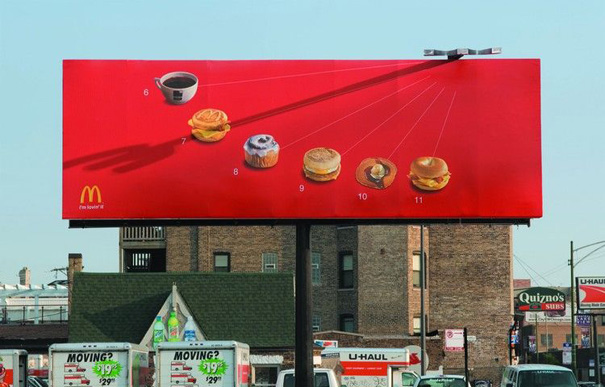
  • Barthes then begins by staying he will use adverts to explain himself as meaning is intentional and frank. The signifiers are “full, formed, with a view to the optimum reading” (34) Barthes’ might have been interested to see the following adverts...

These adverts (regardless of one’s thoughts about the content) are tapping into society’s mistrust of advertising and consequently meaning. As the meaning of advertising signification is now suspected of being false, (and so much more besides) we might question Barthes statement in retrospect. Although unusual, these adverts do not subscribe to Barthes analysis so easily. Meaninglessness is a big issue today – also referred to as ‘fake news’. A century of being manipulated by advertisers might be responsible for this sense of society having been gas-lit, leaving us all in an unstable landscape (like the cartoon landscape of Holden’s film). Images, which can and do invite multiple readings, even with the tyranny of advertising slogans, but which ultimately lie to us have contributed to this.

(Below – my comments are in orange, otherwise quoted from Barthes)

  • Panzini – French and ‘Italianicity’ Denotational and connotational  – in a single sign therefore seen as one message.
  • Image – not linear, order therefore not important
  • A return from the market =  freshness (despite the dried and tinned aspects) and domesticity
  • Half open bag = shopping around for oneself as opposed to the hasty filling up of a more ‘mechanical’ civilisation.
  • Colour (which we don’t see in the reader) implies Italianicity. Stereotypes (based on the fact this is a French advert selling a product that is supposedly Italian. Is this another example of Tautology or reinforcing a message which has already been stated in the pastiche of a name, again underscoring stereotype of otherness – a different group)
  • The sign of the still life (nature-morte) – heavily cultural and reflects history of art in the advert (sales, mechanical, mass produced)
  • “A message without a code”? see below
  • The Panzini photograph/advert offers three messages – The linguistic message and two iconoc messages which Barthes’s suggest  – we might have the right to separate: the perceptual message, and the cultural message. (Confusion comes about from function of the mass image).
  • Linguistic message – “today at the level of mass communications, title captain, accompanying press ect… we are still civilisation of writing”. Some suggest we are becoming less and less so – as iconic signs are used to advertise very well known brands more often than ever. (However, for now, at any rate, these images emerge from written code (the computer translates to another code which we don’t understand and cannot read and that too is a sequence of symbols))
  • gisele-chanel-no-5

apple-commercial-piece-640x640.jpg

billboard-ads-part2-25-1

  • Linguistic sign acts as anchorage and relaythe above images have very little or no writing (which Barthes’ says doesn’t matter, any presence acts as anchorage and relay) I wonder if the power contained within certain corporate non-linguistic signs are so great that it is able to operate as an anchor itself while being read by today’s consumers. If anchorage is control, and certain of its sign then this type of sign is possibly the most self-assured. 
  • All images are polysemous – underlying their signifiers, a floating chain of signifieds, the reader able to choose some and ignore others. Polysemy poses a question of meaning and this question always comes through as dysfunction (note the language of Freud). 
  • Societies ‘fix’ the floating signifieds to counter the terror of uncertain signs. Today, it might seem there are too many unfixed signs as we transition from one epoch to whatever is coming next, digital technology perhaps destabilises, the reaction against this (culture war, as it has been termed) is to head backward, to fix things down, to make things certain again. You see this is the rhetoric of Make America Great Again. A giant, global attempt to fix unstable, ‘flickering signifiers’  (Hayles, 1999).  Additionally, all advertising then taps into this terror. Buy this thing and feel safe is the underlying connotated message. Powerful, beautiful, one of the crowd, above the crowd – all of these are second level messages which sit above the initial one – about keeping the ‘terror of uncertain signs’ at bay. 
  • Linguistic signs have the power to suggest, “What goes without saying …” & “What is conspicuous by its absence” (Chandler, loc 1622) Anchorage banishes one possible signified…it acts a counter taboo. Anchorage can be ideological (and Barthes Myth plays a critical part in this), it remote controls, subtle dispatching, certain of its sign. anchorage is control 
  • With respect to the liberty of the signifieds of the image, the text has thus a repressive value and we can see that it is at this level that the morality and ideology of a society are above all invested. 

The Denoted Image

  • Barthes tells us – only the photograph is able to transmit the (literal) information without forming it by means of discontinuous signs and rules of transformation. Drawing is coded he says, i.e. the style of drawing transmits information. But he insists the photograph does not. Again, unless I’m really misinterpreting something, I find this difficult to accept. Photographic decisions, especially today, seem to contain all sorts of social and structural information – but then today’s photographs are more like drawing than ever as various levels of digital manipulation (or decisions to avoid it) impute information about the society  – in the same way, perspective in drawing does in the West – and therefore, potentially say a great deal.  The expertise and practiced execution of any drawing carry connotation and denote messages too. I cannot see why lighting, sets, film stock (or the digital re-enactment of it) don’t also carry such connotations. I don’t believe that just because something is mechanical, it doesn’t carry a code. In fact, it might carry a very specific code informed by ‘the apparatus’, which is very difficult to shrug off except by experimental photographers who are deliberately finding ways to debate with the code directly, as argued by Vilém Flusser (2000)
  • I wonder if today, our suspicions of photography negate this argument of Barthes of a photograph being without a code, and especially amongst tech-savvy sophisticated younger readers of images who have grown up with Snapchat and Instagram filters. 
  • If I were to use a Snapchat style image of a woman with animated sparkly bunny rabbit ears in an advert – there are several possible readings (perhaps anchored by an ironic strapline for more sophisticated consumers or else reinforced by one aimed at teens who love that kind of thing) but the structural code is inescapable and only a Martian would find it difficult to read. There are quite specific codes in all of the examples I have included here – the overzealous processing in the Vote is. Vote advert speaks volumes, for instance. 

Refs: All accessed 23/24 June 2019

Project 3.1 (b): Rhetoric of the Image

https://stylecaster.com/beauty/vintage-chanel-no-5-ads/#slide-11

http://www.cinemamuseum.org.uk/2019/andy-holden-laws-of-motion-in-a-cartoon-landscape/

https://www.boredpanda.com/creative-billboard-ads-2/?utm_source=google&utm_medium=organic&utm_campaign=organic

https://www.theguardian.com/media/2016/may/25/eu-referendum-poster-minority-ethnic-voters

Barthes. R (2013) Rhetoric of the Image in Visual Culture: A Reader, London, Open University, Sage Publications; 33-40

Flusser, V. (2000) Towards a Philosophy of PhotographyTrans. Mathews A. (Kindle Edition) London: Reacktion Books

N. K. Hayles. (1999) How We Became Posthuman: Virtual Bodies in Cybernetics, Literature and Informatics. Chicago: University of Chicago Press