One of my Pic London collaborators told me about James Richards:
From the Tate site:
“Richards generates meaning through abundance, by way of allusion, ellipsis and unity of tone, the lack of legibility counterbalanced by a strong sense of mood. The White Review”
Richard’s work will be really useful for me as he’s doing the same sort of thing – improvising, mixing, creating audio-visual collages. Here are some of the key phrases which stuck out for me from his Tate SHots interview:
The material… none of it is abstract… it is all stuff from the world… continuously gather and experiment
In the film below the time-lapsed Lillies are filmed in front of a painting that has a slight cartoon quality to it – of a wolf and bloody sheep, creating a ‘moving image still life‘ with death and gore in the Lillies as we watch them open and wilt, and in the painting that surrounds them. Death, dying, life, living, beauty, terror, sex all in this tightly compacted text. Content becomes abstracted by the close-up crop. Good for me to see how he relies on others to edit and animate. This later work has more of a polished feel and although I’m beginning to feel that the Brechtian/Deren habit of opting for less polished settings is not fashionable at the moment – I think my heart still resides more with a raw and under-commodified aesthetic.
As discussed I attended three workshops organised by Pic London at LCC, led by Una Hamilton Helle and Joshua Bilton who were original members of a group called Hal Silver.
Pic London’s site told us:
The workshops will be experimental in nature and the focus of each session will be on collective forms of making, improvisation and group dynamics. This could take the form of games, role-play, unskilled mask and costume making, photography, video and sound recording. These process-led activities can be gathered into a final exhibition display, the form of which will be established throughout the workshop sessions. (2019)
Improvising in the dark at LCC with Hal Silver Courtesy of Pic London
We played a number of improvisation games including some vocal games devised by Pauline Oliveros called Sonic Meditations. (See below) These games reminded me of the kind of thing I did at drama school (1991-94). I introduced this exercise to the OCA Music Collective when Emma and I shared Sirens.
We also played an imaginary game where each of us had to come up with a character and then imagine ourselves in a village. Someone, it was rumoured, might have done something untoward and the rest of us had to make a decision about whether it was true or not. People were ejected from the game/executed/banished if individuals believed the story others told about them. We played it several times and invented many strange and bizarre tragedies which we blamed on eachother.
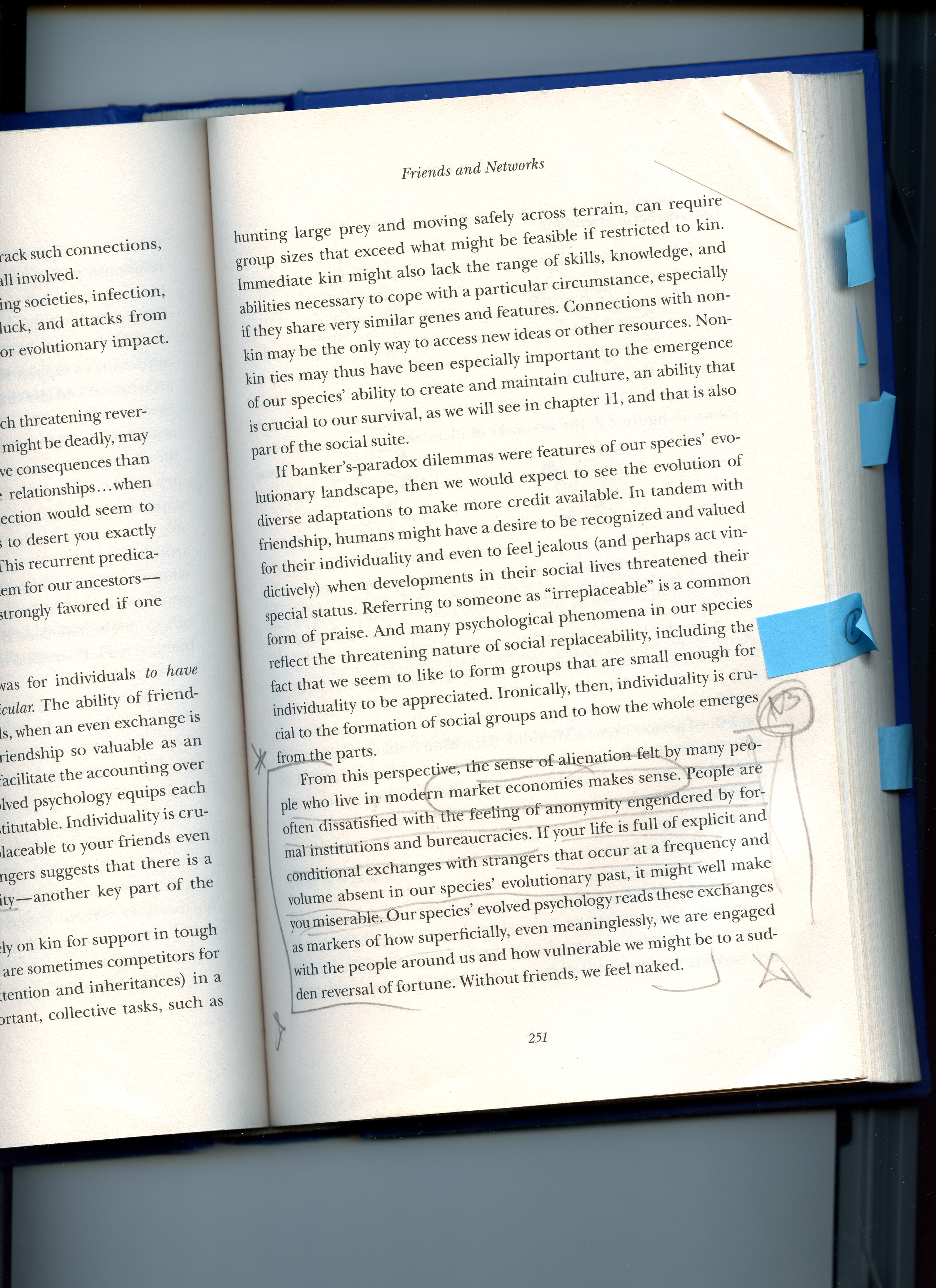
The Goodness Paradox: How Evolution Made Us Both More and Less Violent Kindle Edition, Richard Wrangham, 2019 and Blueprint: The Evolutionary Origins of a Good Society, Nicholas A Christakis 2019
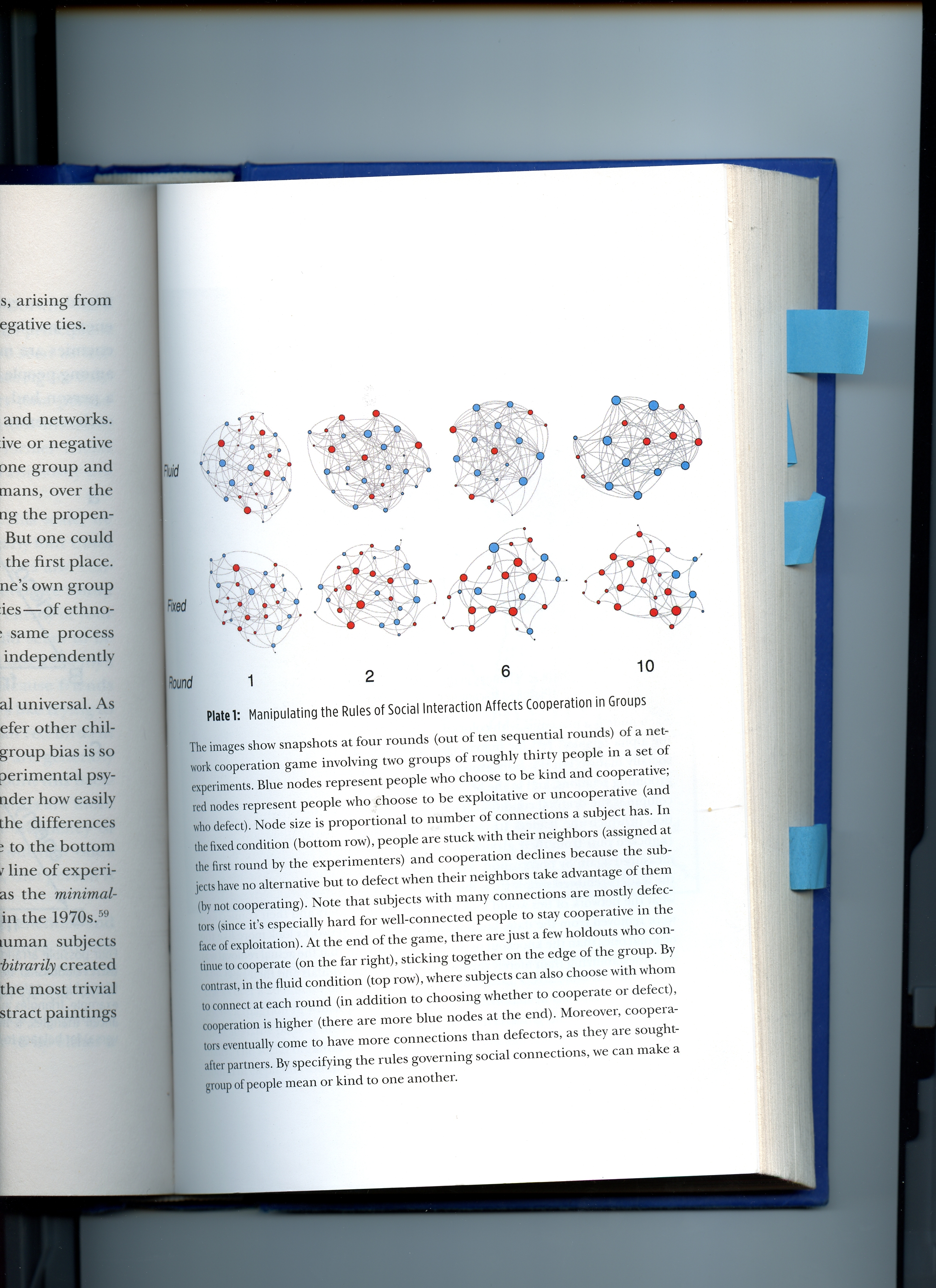
I had just finished reading the above books both of which deal with the way in which societies keep themselves in order (or not). Wrangham’s central thesis is that humans are the most violent and the most passive of primates at the same time and that it is language which enables this paradox. Language gives us the opportunity to gossip. Once we have that capacity we can lie, protect oursleves and send blame in a different direction. Cliques form which protects the group – the most cost-effective way to ensure survival for the individual and the group. Outsiders are seen as a threat to the group. To deviate from the norm is to invite extreme danger, ultimately execution. Through language, violence is planned and carried out over time, thereby distancing oneself from spontaneous aggression, but often finding ways to be far more aggressive in the long term. This distancing is contained in the law.
A photo I found on Twitter showing executions during the Spanish Civil War (will need to do a bit of digging to make sure that’s right and find the link)
The second book covers some of the same ground but also looks at networks and co-operation. It is a more expansive thesis than Wrangham’s.
However, the two main themes emerged from the games and which I had just read about in these books; the role of language in establishing and maintaining groups and the networked nature of human existence.
A group discussion also led the circular nature of existence, history, culture and relationships.
Bringing objects, books, and games to the group.
We were all asked to bring some items to the second workshop – these could be objects, photos, text or games for instance.
I provided a range of things but the following have stuck.
Text from Christakis’ book
Books by the Situationists which focus on circles
A stick game I used to play at drama school which demonstrates to the players where your connection is strong and where it breaks down. At university, we might have used this as a warm-up game or as rehearsal support with lines.
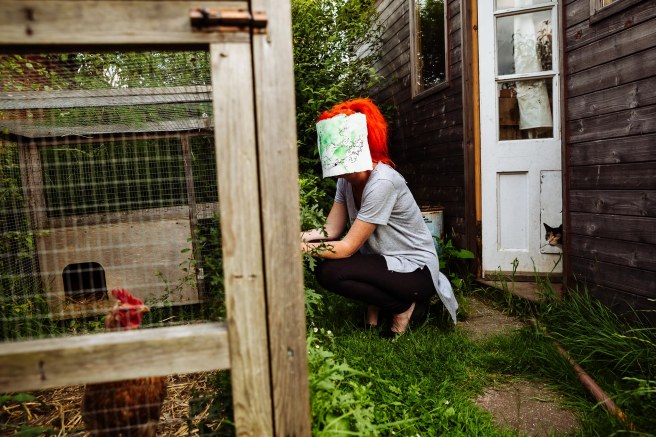
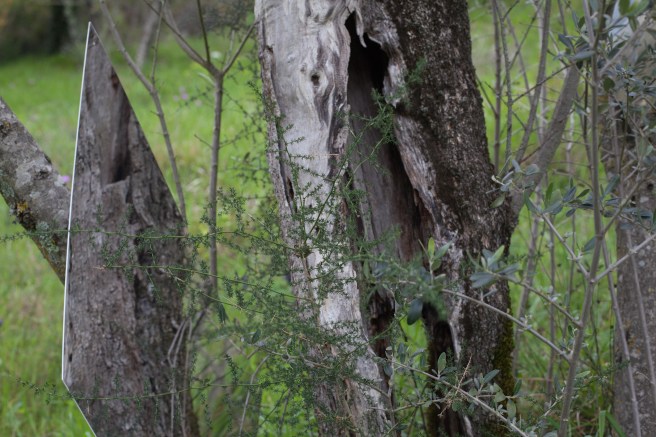
In the spirit of collaboration here are some cropped images on one of the member’s of our group – Eva Louisa’s – Instagram feed which I took during a meeting at the end of the summer while playing the stick game. I should share it with my old head of school Niamh Dowling, now head of Rose Bruford – I suspect she would be pleased to see it. I think this image is being used by Pic London so I will wait and see and share that with her if so.
For me, the most interesting aspect of all of this is the language.
I am the oldest in the group and therefore immediately the outsider. There is one other person who is probably slightly older than the majority but everyone else is early-to-mid-twenties.
I grew up the 80s and the early to mid-90s were my heyday.
However, that is the least of it, I am sure. As another collaborator said to me when we worked together at the beginning of Self & Other while discussing the meaning and implications of other, “But what about your otherness, Sarah-Jane?”
Image from Self & Other A1 (2017)
And then how did we maintain satisfactory communications across social media? This was the only route open to us since we would all be scattered across the globe for the duration of the summer. Of course, prior to social media’s existence, we would have had letters and the telephone to use. We now have more opportunity than ever. However, it felt to me that we struggled to genuinely connect despite digital access – which was often unreliable, frustrating and fragmented. Or so it felt to me.
Most of the time I sensed I was talking into a void. I felt isolated and alone, often paranoid and like an outsider, a freak. Of course, some of that must be me – I do sometimes feel that way but it’s been a while since I’ve felt it with such force. Perhaps while I was married and in relation to some other mothers in the playground (but I know lots of other mothers feel this way in the playground too), certainly while I quite insanely joined the PTA after my dad died in 2010 (a short-lived experiment!), and when I was in a play at the Library Theatre shortly after graduating. Everyone else in the cast lived in London. I lived in Manchester and got the job at the last minute after someone dropped out. I felt horribly inadequate and was suffering the most awful acne at the time too. When I was a child I had this same feeling when I was sent to boarding school. A few months after being there I told all the boys about the girls wearing bras which was a desperately self-defeating thing to have done – I was the outsider and felt so wretched about it I made it worse by making sure I had to remain an outsider for even longer.
This sense is, I am well aware, partly self-generated but then some sort of transference and counter-transference starts taking place. I mention all of this as the poem I will likely include in some way is very much informed these feelings and my personal history with my own mother.
Continuing the improvisation across social media
Perhaps my history with impro or the fact that I meet OCA people regularly online meant I was flummoxed when attempts to get this going failed. I felt like a disappointed child realising that all the other children were really very grown-up and somewhat irritated by my enthusiasm.
Instagram
At our first online meeting (where it was very difficult to hear and see what people were saying) we agreed we would set up an IG account and post collectively there, responding to each other and attempting to continue playing improvisations games. One member suggested each taking it in turns to give another a task – out of which a resulting photo or text should be posted on the IG. We said we would start with some thought experiments. Then each of us should pass the baton on. Of course, if no-one started or passed it on the game would die.
Well, the game barely lived at all. And I got bored of waiting so set someone a task. They did it, posted an image prompted by the task and then stopped I think.
Nevertheless, we began to post images. I suspect some more than others. I posted images promoted by discussions online and in the workshops and in response to images by others.
Thought experiments provided by another group member as prompts/ideas for tasks being set. No-one had to use these but it was hoped they would prove useful.
I played quite a lot although did not share everything I made. My phone then stopped working altogether! And I was stuck in Italy. this was probably, in the long run, a good thing. I had a much-needed break from social media and had already posted quite a few pictures and videos anyway.
Click in individual images.
I don’t have all my images anymore after the phone broke and there was no wifi in Italy. So sadly I lost some originals but they are still on the IG account.
This account has led to a book which will act as a research footnote to the exhibition. I will add a low res PDF of the book after it opens. Massive thanks to Rowan Lear for organising this.
Research and Ideas
All the time I was in Italy I kept thinking about the village I was staying in, Ferentillo. I wrote about it here. It is a village I have stayed in and made work about several times as can be evidenced in my Sketch Book blog and in Self & Other A5.
Image from Self & Other A5 i will have call you (2018) made in Ferentillo, exploring the boundaries between life and death via mirrors in the landscape, phone apps and filters, and moving image.
This Family Too (2017) (A project which I never resolved and should return to – take some of these out and look again at the images and sequence. I recall wanting to make sure the sequence was random and could ask a fellow OCA person I know about setting this up in Processing.
And I submitted a book for TAOP A5 which was made in Ferentillo and included written work as well as images.
Notes which I shared about some of this work with the group:
Alain Fleischer, Mummy, mummies – a photography book with text in which Fleisher photographs the mummies for which Ferentillo is famous.
As discussed in several blogs above this work is mentioned in The interphototextual dimension of Annie Ernaux and Marc Marie’s L’usage de la photo‘ by Ari J. Blatt.
What caught my eye was the following:
“If Bazin offers a compelling theorization of the photograph as mummified presence, in his wistful recent book Mummy, mummies Alain Fleischer plays with that paradigm and examines the mummy itself as evocative of the photographic process. In this combination of essay and fiction that focuses upon a group of mummified bodies housed for eternity in the museum crypts at Ferentillo and Palermo in Italy, Fleischer conceptualizes the relationship between mummified and photographic traces: ‘Mummification and photography are united against the disappearance of appearances: they are alike in their materiality, their techniques, and their codes of resemblance.’”
Blatt, Ari J.(2009) ‘The interphototextual dimension of Annie Ernaux and Marc Marie’s L’usage de la photo‘, Word & Image, 25: 1, 46 — 55, 27 – Alain Fleischer, Mummy, mummies (Lagrasse: E ́ditions Verdier, 2002), pp. 15–16. Translations mine. (Blatt) Available at: https://www.tcd.ie/French/assets/doc/BlattOnErnauxMarie.pdf [Accessed: 24.May.2017]
I sent this document to the group and one of them picked up on another sentence where the darkness in the tombs is stressed.
Fiore
I thought about Fiore (mentioned in the poem) and all the other tragic stories – suicide, cancer, airplane crashes and wondered why there so many of them. I suspect it is the fact everyone knows each other. Death is also everywhere in the village – a Catholic community with a cemetery on the edge and posters announcing death all over the town as is the Italian habit.
And I thought about darkness and the work isolating. Before we got going with the IG, I had suggested a task – a self-portrait based on the character we had constructed in the game. This was blocked and portraits referred to as ‘isolating’. I felt this was unhelpful as self-portrait could be interpreted in many ways. I also wanted to say, that is what language is – isolating. All these happenings led to the flash images:
The film is made by adding all these fragments together. Although it may seem incomprehensible, I think perhaps that is what I am after as that is how I felt – as if life and language and being in the group were incomprehensible. I am not a Millenial. I grew up in the 80s as everything was changing and being set for the digital bubble to come in the 90s. (See Adam Curtis’s Hypernormalisation 2016).
However, now that I have worked on it this morning and added the Game Boy music as the only audio (which will be available online only so people can hold their devices and listen through headphones in the gallery is they want to – but a bit like holding a Nintendo Gameboy). Version 24th September 2019, Password Village3
Some further thoughts
Thinking back to the books I mentioned above – Wrangham and Christakis’, I have, throughout this process and while in Ferentillo, been thinking about the way societies evolve. Umbria is a perfect landscape/example for Virilio’s thesis whereby war is the main motivator of all technology stating that is what has driven civilisation’s development (1985). Throughout Umbria there are hilltop towns and castles demonstrating this aspect of human nature; villages maintaining boundaries between themselves and the outsiders. And yet their history is filled with outsiders – Chinese tourists in the crypts which were photographed by Fleisher, Assyrian refugees painted in local abbey’s. And how art has such a huge history here – the purpose of it – in chapels and churches for instance; and the very long history. Below the Twitter link, there are some images from books on Umbria and I’ve focused in particular on the faces of the people from that other time.
Blatt, Ari J.(2009) ‘The interphototextual dimension of Annie Ernaux and Marc Marie’s L’usage de la photo‘, Word & Image, 25: 1, 46 — 55, 27 – Alain Fleischer, Mummy, mummies (Lagrasse: E ́ditions Verdier, 2002), pp. 15–16. Translations mine. (Blatt) Available at: https://www.tcd.ie/French/assets/doc/BlattOnErnauxMarie.pdf [Accessed: 24.May.2017]
A short film to be shown in a group show on a platform or in a circle which functions as a village of work made by the collective.
Latest iteration following feedback: Password Village3
Following some constructive (and helpful) feedback from the regular OCA online hangout I attend, plus some comments from Ruth in my last tutorial, I have continued to develop this film (See earlier versions below). It is half the length than it was and has a less fragmented audio track. I am thinking I will only provide the audio online and visitors must use their phones to hear it in the gallery or on a computer at home, not least of all because it will drive the invigilators completely insane if it is on the whole time. There are further reasons to do this but I will discuss that on my blog. I need to match some clips up with obvious bits in the music still, but I think this is a much more accessible idea – although still incomprehensible I’m sure to some. In an accompanying brief statement, I need to say something like the following:
An audiovisual moving image collage, which contains themes and fragments that emerged out of a conversation with 5 other artists, and took place over several months as we were researching and developing the overall inquiry into what a village might be. Images, mostly found but some original, are combined with music from a well-known computer game from the 80s which was usually played on a portable handheld device, a precursor to today’s ubiquitous mobile phone. (When I played it, aged 11 or so, my three brothers were horribly annoyed that I reached the high score and saw the prize before any of them did.)
Since I am now going to submit some work I am doing in conjunction with a group called Pic London, or at least part of it for BOW 1.2, I need to record development and research in more detail than I have done to date.
I will be submitting work that is part of a group show titled A rumour reached the village. The project is the result of a collaborative process which took place over the summer and continues still, and is one for four groups showing work under the Pic London After School Collective strategies name at Lewisham Art House in October.
There are roughly six people in each group. Ours includes Michaela Lahat, Rowan Lear, Eva Louisa Jonas, Joshua Phillips, Christel Pilkaer Thomsen and me.
Why I submitted my work to Pic London in the first place
Before submitting for DI&C assessment I shared a newspaper element, which I eventually sent to the OCA, with OCA friends and a couple of external people for feedback. Sometimes when I share my work with people there are embarrassed silences as people don’t know what to do, where to look, or what to say. This can make it quite hard to feel OK with the work or get the sort of constructive feedback I am after. I have discussed this before and I am aware that quite often my work is hard to make sense of especially when it’s still in the early stages of being developed. Although I had received some useful feedback from my cohort about the way the paper might be construed by assessors (and a warning that I must stress the films were the main element in the submission while the paper a supporting document) I was searching for a conversation about what worked and what didn’t come across as I hoped. A good friend who is a photographer said she did not feel qualified to give me the sort of feedback that would be helpful but she felt the work was strong and urged me to submit it a call out by Pic London. (My fifteen-year-old son was in fact extremely helpful in the end.)
As an aside, my friend and I have spoken several times about where my work is heading and I have said I feel like the usual photography competitions are just not suitable places for me. And not do I want to be limited to straight photographs. I am in a constant state of flux at the moment about where my energies should be directed and what sort of work I should spending my time on. I am confused in my head and split, but not split in a clear and defined way. More a fragmented mess of a crisis way. This is probably apparent in the choices and mis-choices I am making with each discipline and how I choose to express it; commercial work photography and this other work I do for which I don’t yet have a name. I am also beginning to wonder if the commercial photography is the same as the non-commercial photography, so long as it is just photography; and the other unnamed stuff I do is not photography at all although at times it may contain images. That might sound terribly confusing – and if it does, that’s an accurate reflection of where I am.
For Pic London, I submitted the final DI&C project, Origin of the Common-Place and Assignment 2 – Polar Interia along with the newspaper and was thrilled when it was accepted. However, having submitted that moving image work – having so little experience in all of this – I felt that some form of video work in the same vein would be what was expected of me. Perhaps I was wrong – I am still figuring this all out.
Workshops
I actually had no idea what the resulting work would be. It took me a while to be really clear that whatever we had submitted wasn’t being shown but some new collaborative project which would emerge out of the workshops.
We were put into groups – these were listed in the application where we had to state a preference. I went for Hal Silver who I had never heard about but that group seemed to suggest performance would be involved which sounded right for me and I was glad to be assigned to the group I wanted.
Hal Silver was made up from a group of RA photography students who wanted to explore practices beyond their narrowly photo-focused studies. I think they got together in 2010. The workshop leaders, Una Hamilton Helle, and Joshua Bilton have pages about Hal Silver on their websites but it was quite hard to pin down who or what Hal Silver was online prior to meeting them. I quite liked this slightly incognito and enigmatic air that Hal Silver projected when I tried to look him/her/it up. We were told he/she/it might not even turn up at all! So a form of performance seemed to begin before we even met or started playing together. (I do now wonder if the original members had hidden the relevant pages from their websites as none of us were able to find out much about Hal Silver by doing searches prior to the workshops beginning.)
Pic London’s description of Hal Silver’s plans:
The workshops will be experimental in nature and the focus of each session will be on collective forms of making, improvisation and group dynamics. This could take the form of games, role-play, unskilled mask and costume making, photography, video and sound recording. These process-led activities can be gathered into a final exhibition display, the form of which will be established throughout the workshop sessions. (2019)
We were given three talks from each of the leaders/groups over a period of several weeks on Saturday mornings, which were followed by workshops where the seeds of some ideas were introduced to us.
As the work has not yet opened and is still in progress, I will either need to wait to publish any further information or publish privately (more likely the latter as I need to ensure there is enough material available for Ruth/assessors to see my process.)







 SJField - OCA Level Three Study Blog