CS Research: (97) (PDF) ‘Lights, Camera, Algorithm: Digital Photography’s Algorithmic Conditions’ in Sean Cubitt, Daniel Palmer & Nate Tkacz (eds.), Digital Light (London: Fibreculture Book Series, Open Humanities Press, 2015), 144–62. | Daniel Palmer – Academia.edu

This has some useful references included and the phrase ‘marginal’ referring to decisive moment photography which may be useful alongside ‘boring’ (Elkins) ‘conservative’ (Blight) and ‘tautological’ (me).

(97) (PDF) ‘Lights, Camera, Algorithm: Digital Photography’s Algorithmic Conditions’ in Sean Cubitt, Daniel Palmer & Nate Tkacz (eds.), Digital Light (London: Fibreculture Book Series, Open Humanities Press, 2015), 144–62. | Daniel Palmer – Academia.edu
— Read on www.academia.edu/30168558/_Lights_Camera_Algorithm_Digital_Photography_s_Algorithmic_Conditions_in_Sean_Cubitt_Daniel_Palmer_and_Nate_Tkacz_eds._Digital_Light_London_Fibreculture_Book_Series_Open_Humanities_Press_2015_144_62


Research: Art Schools of the Future Need to Teach Students to Understand Technology. How Will That Change the Future of Art? | artnet News

As software, algorithms, non-conscious cognitive agents and cybernetic thinking increasingly shape the world around us, artists need to have a strong grasp of the practical and philosophical implications of this transformation,” Kaganskiy says. “I’m not saying that every artist needs to learn to code, but they should probably read some media theory and software studies texts, maybe even some posthumanist philosophy.”
— Read on news.artnet.com/art-world/art-school-tech-adapt-1742802

I can’t help thinking this reluctance is all about snobbery. It reminds me of the Blight comment re photography and conservatism which I mentioned in a previous post and which might go into my introduction- if not elsewhere in the essay.

CS & BOW: research – Cultural Capital / Capital Culture text Sunil Shah

Re: the entangled implications of art, culture, business and ethics

‘How can artists and their work stand up to critical scrutiny if the conditions which foreground them are complicit in the creation of the subject matter they represent? What does that mean for the integrity of the artist and the ethics of the photo- journalist, documentarian or creative producer who seeks to address our world’s problems?’ (Shah, 2019)

https://www.mathieuasselin.com/cultural-capital-capital-culture

Currently looking through a book on Baudrillard so good timing to stumble across the above

Artist: Edgar Martins Siloquies and Soliloquies

Am trying to find out more about this work. I am particularly interested in Martins’ ability to mix archival and original photography as well as text. Looking for as much exposure to this work as possible – if anyone has the book, I’d love to take a look at it.

Having only seen the work online so far, I am so impressed by its power and focus. I am also interested in the range of forms – still gallery prints, videos, book, interviews, talks – utilising every way possible to convey information.

Noted Virilio’s comments on death and reminded of Wegee https://www.icp.org/browse/archive/constituents/weegee

Will keep investigating.

http://www.edgarmartins.com/video/siloquies-soliloquies-death-life-interludes-compilation-video/

http://www.edgarmartins.com/video/siloquies-and-soliloquies-on-death-life-and-other-interludes-open-eye-gallery-liverpool/

Some useful links from Doug  – Martins talks about relevant ideas (uncertainty principle – although important to recall Barad opts for indeterminacy over uncertainty as interpreted by Bohr)

Colberg reprints Martins’ response to NYT withdrawing his images – ‘As fraught and as contradictory as much of the information being portrayed often is, it reveals a polymorphic and multiform reality, a world of flux and flow that is in a perpetual state of uncertain transformation and where the constant search for answers only leads to more questions.’ (Colberg, 2009) Martins alludes to entanglement as the housing crisis and the issue of ‘reality’ in photography intersect in this episode.

http://jmcolberg.com/weblog/2009/07/edgar_martins_how_can_i_see_what_i_see_until_i_know_what_i_know/

Truthy lies: photographers speak out on Edgar Martins

This is not a House @ The New Art Gallery Walsall (UK)
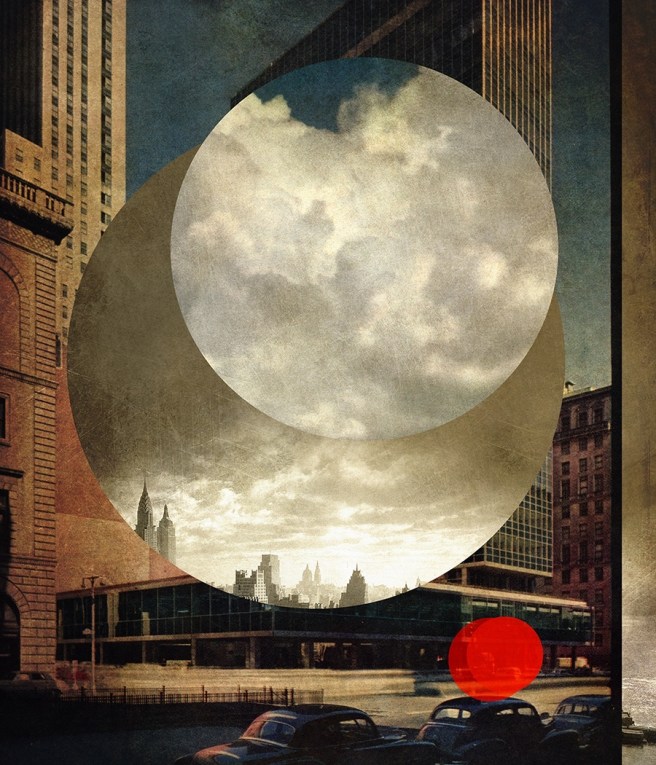
Artist: Peter Horvath

https://www.riseart.com/article/2019-12-17-artists-interviews-peeling-back-contemporary-collage-with-peter-horvath

Peter Hovarth New York State of Mind 2018

Using mainly images from early 20th Century advertising and Hollywood, these pieces explore early consumer culture. However, by taking these images out of their usual context, Horvath repurposes them and completely redefines their meaning in fresh and interesting ways. We caught up with Peter to find out a little more about his artistic journey, process and some of his plans for the future.‘ Couldn’t be more relevant!

Useful example of someone making work about consumerism. Will keep as someone to refer to possibly when writing up BOW notes. And although I’ve sort of rejected or not developed what I was playing with earlier this quarter, some of his images are reminiscent of these experiments.

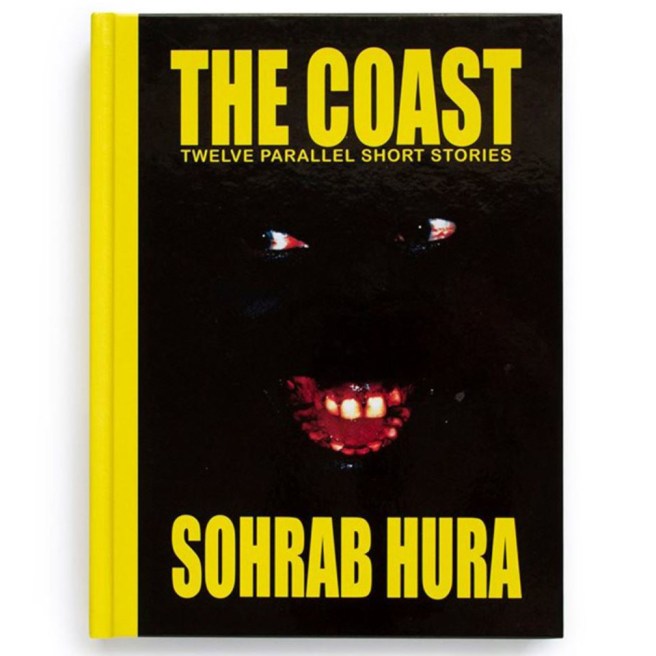
Artist (photobook): Sohrab Hura, The Coast


Absolutely love the look of this book, reviewed by Gerhard Clausing, and it seems inordinately relevant for me and my direction for BOW/CS. The mix of stories, images, the multiple states, not to mention the fantastically bold colours and content all appeal. Some of the images remind me of a clip from one of the films I’ve identified as a possible source a narrative in my own BOW, which will also be a collection of short stories alongside images – some very short indeed. Click on the link for the full review:

https://wordpress.com/read/blogs/4927285/posts/14353


00-coast
Image from the review – see link


“The carefully edited sequence of images and the surrounding mysterious short story versions go hand in hand. Sohrab Hura demonstrates that meanings can be altered by ever-so-slight changes in visual and verbal juxtapositions. This mirrors the current social media frenzy of believing imagined or constructed contexts or rumors more than facts that can be documented in incontrovertible detail. Is the person shown really injured?” (2019)

https://www.sohrabhura.com


CS & Bow: research Myth and Science Fiction

Like anyone on Academia.edu I’m bombarded and overwhelmed with potentially relevant titles from them and have had to put a mental block in front of any response to them for fear of information overload. But this title is immensely relevant for me.

https://www.academia.edu/7515758/Science_Fiction_as_the_Mythology_of_the Future.

Haven’t read it yet but feel it’s worth exploring even if only for references in the end. So storing here

CS / BOW Research: Actor-Network Theory


From Hollin’s paper (2017) – actor-network theory. For me what is so interesting is the taking up of theatrical terms in social sciences. I don’t think this is just a weird happenstance but a specific relation to the fact that theatre has long been a laboratory; if we put these people in this situation and make these things happen what would happen? I don’t think it is worth arguing against Michael Freid – his dualistic thesis is tied up in a way of seeing that we have moved away from – something can be worthy/valuable/appealing whether they are theatrical or anti-theatrical and something can be an object in this decade but a piece of art in the next or visa Versa – context and what this speaker refers to as messy networks are what makes meaning, not the style. Am thinking about the above – which also explores power,  as ‘an aesthetic allusion’. Not what an individual is exerting, but token moving through a network. Sees actors as non-human and human. The ‘study of relationships’. 

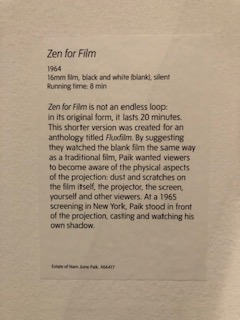
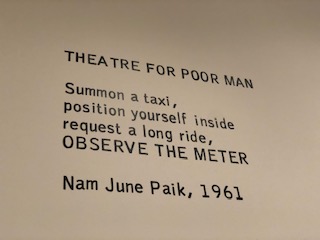
Artist: Nam June Paik, Tate November, 2019

I really enjoyed this exhibition and will do doubt return when I will spend more time there, and maybe even make proper notes. In the meantime, I felt the following was important to record and ingest.

The statement for TV Garden describes how Paik “imagines a future landscape where technology is an integral part of the natural world”. And “His approach follows a Buddist philosophy that everything is interdependent. It also suggests that technology not in conflict with nature but an extension of the human realm. ” (Tate, 2019) I would say more than an extension and using Barad’s word, intra-related. I think that word is one of the most useful things (amongst a lot of useful things) to come out of my study of her ideas.

(c)SJFIeld2019-9810
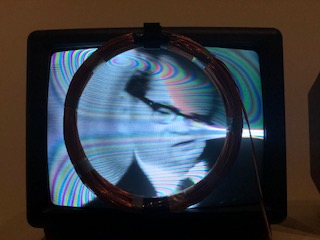
An earlier version of interactive light art as seen in Olafur Eliasson’s exhibition


(c)SJFIeld2019-9809
Really loved this magnet making the picture of Nixon wobble. 

IMG_0434IMG_0439IMG_0449IMG_0456IMG_0464