As I continue to think about the online/moving element I was grateful to Catherine for sending me a link to this film by Mayumi Hosokura which is also accompanied by a book published by Mack. It has a very similar theme to mine – although I don’t specifically talk about feminism, it is clear the gaze and feminity are very much part of it my own work. I am also more focused on semiotics and the quirky things the Ai says which can be humorous – but flesh and scanning and the differences between materials are all there. Mine could be called New Eyes – but I’m sticking with the current title for now, although may shorten it.
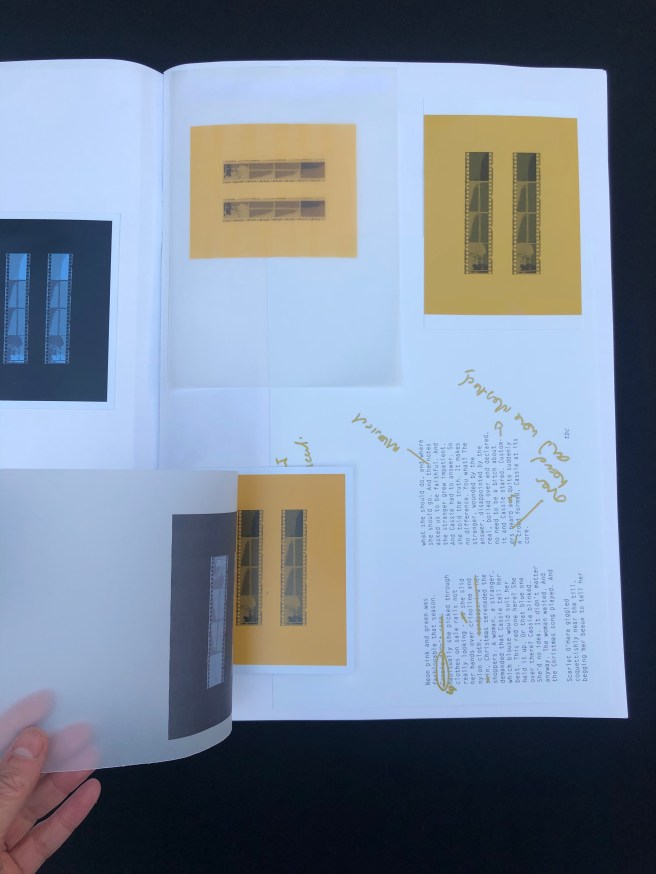
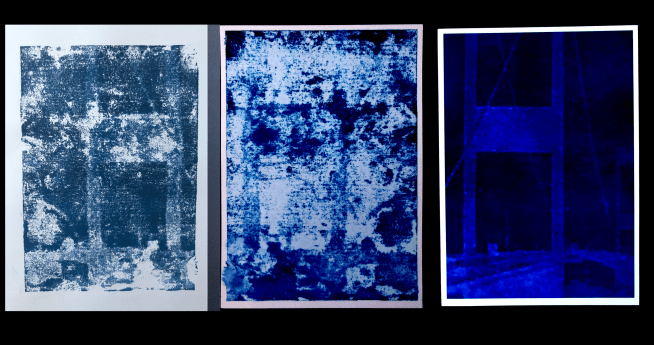
I also took photos of the inside of the scanner, like Hosokura does here although hers are moving – which I’ve not used but I do keep thinking about those earlier images of film, negatives, and the scanner, so maybe something I should return to. (Really annoying I can’t photograph the SEM tools after lockdown happened). It’s useful to see this rendering: the repetition, layering, disruption, and cuts.
Thanks again to Catherine for sending me the link.
I have started watching decent films and looking for innovative filmmakers after a break of actively doing so – recall, I began L3 watching as much sci-fi as possible. However, I have now reached a point where I’ve got something that could act as a kind of loose script to begin making related work to live online in the form of moving images, perhaps gifs or short films. I am not sure yet what they will be or look like – but as I said in the Assignment, I feel quite strongly the work needs that – at the moment, perhaps it is like a plan/script/blueprint. I don’t think it should be a sub-element. I do think it should be a partner to act in tandem. Whether I use SYP or BOW A5 to work on it (perhaps both) is something to be seen.
I watched Claire Denis’ High Life (2018) on Friday and have spent the rest of the weekend watching and reading all I can about her.
High Life is visually incredible and all the way through I kept being reminded of contemporary photography I have seen recently – especially Valentine Bo, Your next step would be to do the transmission. (Interestingly, this work has stayed with me although I was not sure of it when I saw it at Foam’s Talent Exhibition in Vauxhall last year). Denis’s work is darker, less deliberately kitsch, and for me – perhaps unfairly, in a different realm by far. I wondered who had done the set design as its very distinctive. Somewhere on the internet, it claimed that Olafur Eliasson had designed the space-ship, but Denis says in an interview his contribution is only the yellow light (unsurprisingly) at the end. Of course, there is a team of art, set, and production designers, and together, with Denis, they create a tangible, distinctive and stunning although grotesque landscape perhaps as Peter Greenaway or Andrei Tarkovsky can. I plan to watch the film again as there is so much to see.
But I am most interested in the way Denis eschews Hollywood conventions and narrative structures. I had recently also watched Ridley Scott’s The Martian (2015) which ends with typical Hollywood heroism. Denis’s films never end that way. Both films are about an abandoned human far from earth (home) but Denis’s is profound in ways that the Hollywood film (very exciting and well-executed) could never be.
In Beau Travail (1999) I was reminded of Richard Wrangham’s Goodness Paradox where we are told how humans are the only mammals that plan their violence. There is something so psychopathic about the way the Foreign Legion soldiers are required to iron and make their beds to absolute perfection. The violence is made more terrifying as the film is at times like a ballet or an opera exploring ritual and distancing – which we use to remove ourselves from the destruction and violence we commit.
Like Denis, I grew up in a colonial country and knowing something of the inherent violence and ongoing trauma for people and land meant White Material (2010) would always be a profound watch for me.
Denis never glamourises violence. She often doesn’t show it directly. We more usually see the outcome or obstructed views. She also directs the camera unusually at times, we see nothing but the back of someone’s head for far longer than in other films. In High Life, she mixes ultra HD and special effects of the present which is really the future with Super 16 for the past. The colours are beautiful and alluring in both cases.
There are no linear narratives. She is very sparing with dialogue and uses layers of sounds, music, abstract visuals. She is an incredible filmmaker. I really like that she has always been determined to do things her way, that she refuses to give in to normal conventions of film. She says in an interview, yes, perhaps she is like that because although European, she did not grow up in Europe. I often wonder the same thing about myself – this sense of being an outsider informs a great deal across all aspects of my life. I wish I had the same presence and certainty about that difference throughout my own life. Instead – I realised just a few years ago. I will watch her first film Chocolat (1988) and then watch High Life again for inspiration – paying careful attention to the editing choices she makes. I also read, she shoots quickly but makes the film in the editing suite – which is clear. Each element is given value. Nothing is tagged on.
Denis’s sets up her shots like photographs too. And the camera stays, settles, waits before moving on or a cut is made so we can take what is being seen in. The end of Beau Trevail is truly great.
I like this from Slant Magazine, “Denis isn’t interested in Hollywood-style verisimilitude, as High Life is only interested in using the space-outlaw template to talk about Earth. The film asks down-and-dirty questions about what really resides beneath thousands of years of human progress, a savage and haunting antidote to the high-minded idealism of movies like Christopher Nolan’s Interstellar and Ridley Scott’s The Martian.” (MacFarlane, 2018). It reminds me of Wrangham’s arguments about our complex nature.
We heard from Sarah about her book which I mentioned recently. She had gone for the dual booklet I mentioned her showing me and it looks great although Sarah felt there were limitations that are likely to prompt her to choose another option as he keeps developing through SYP.
We were both interested in hearing about other options and some happily showed us some examples by other artists and galleries that broke with the traditional book format
Deutsche Börse 2018 artists’ catalogue (an outer booklet with mini books inside)
Hazel then showed a fantastic online gallery space – worth thinking about as a space to show things, you can link to your own website but $12 a month, albeit very reasonable, add further costs so something to think about. You can add video though so it’s certainly something I would think about when presenting the work at the end of the course for assessment. We were all very impressed with Hazel’s example.
A useful two-hour session (sorry I kept ducking out though as children yelled, beat each other up and basically did what children do in the background. Thank goodness for ‘audio off’
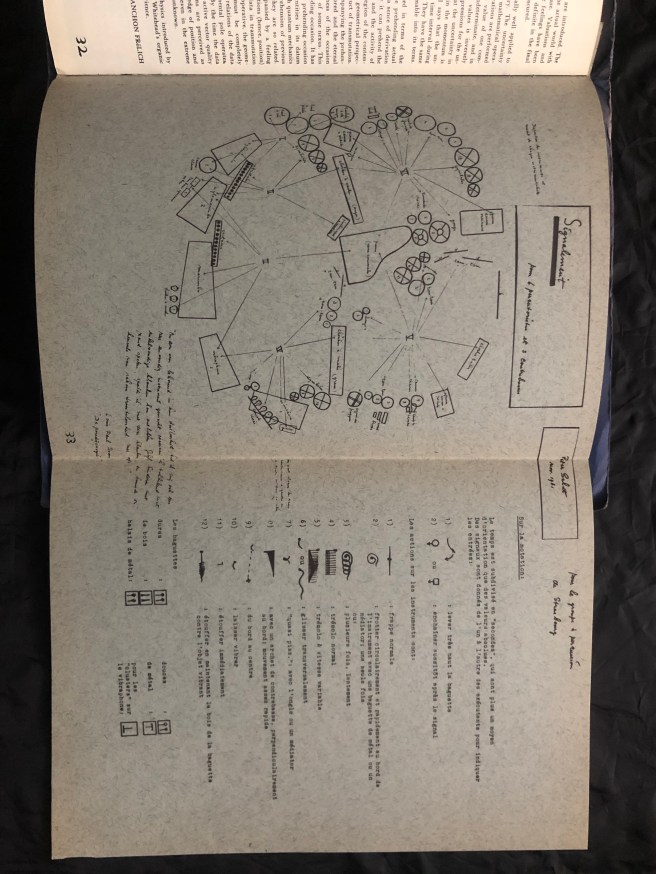
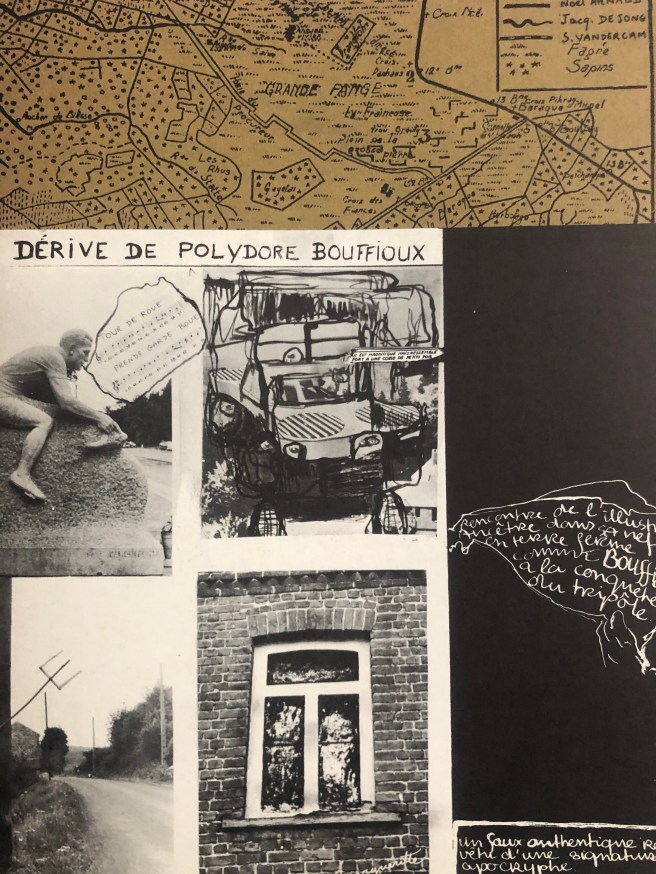
I have also been looking at the Situationist Magazines I have for inspiration – and in fact, many of the ones above seem to be influenced by that kind of thing too. These magazines have been at the back of my mind throughout the project and when I handed in A3, I felt it too clean, too sterile. (From Situationist Mags)
Was good to catch up with others this morning. We heard about Allan and Alan’s essays. I must remember to try and dig out notes to send both and have asked another fellow student for his notes to send one of the Alan’s as they might be relevant.
I discussed the email I’d received from the assessment team, triggered by completing CS A4 and prompting me to put in for assessment. Looking at the deadlines, it would be nuts to go for the July assessment. I could do it at a push under normal circumstances but no way at the moment – every step I make feels incremental but tiny. The lack of headspace is a challenge for all of us, I imagine. And I’m still figuring out how the ai fits with the work so I have put November deadlines in my diary for now and will need to get everything ready for September, which feels much more doable.
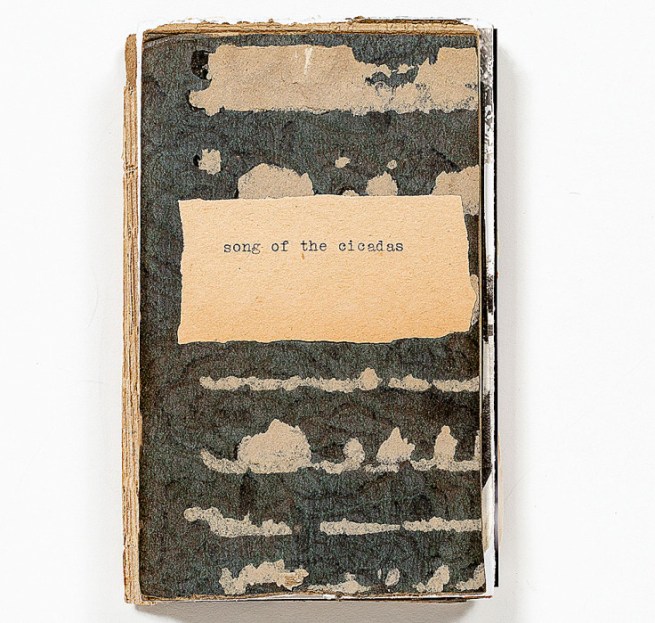
I also discussed the plan to reach for a kind of practice book for BOW – perhaps it won’t have the foldouts for example and will be done as inexpensively as possible. Perhaps it will be a handmade concoction like below,
I would then focus on creating a small print run with someone like SPBH for SYP and raising the cash to do so through Kickstarter.
This seems to be the way I am heading – I have already started collating the development work into a large scrapbook and could base an actual book on experiments with placing in this. The scrapbook is a place to store things that might not make it to the final and also put various options and copies together.
I think it is still important to have a website to accompany the work where I can share moving image versions and perhaps more text.
Dong this has prompted to me to get to the bottom of colour printing on the Canon Pro-100S which it turns out is notorious for getting colour right.
I have downloaded ICC profiles then had to download the Adobe Colour Printer Utility which is not solving my problems so far – in fact, it’s making more! I could make entirely using book printer mistakes (quite like the idea, actually….)
I’ve uses the Printer Utilty but it doesn’t seem ideal and even though I indicated the whole image should be on the paper, it printed a detail only – so I guess I need to resize the file I want to print. I’ll get there but the speed at which I do might remain glacial…. (there are constant interruptions which doesn’t help)
a collection of misprints – paper wrong way round, resulting loose ink ‘printed’ onto A4 and one the right way around but only a detail.
Hazel and Rob talked about the difficulties of progressing with SYP now that we are all in lockdown and everything has been shut. Both are in a kind of limbo and I look forward to seeing how they find ways to do what they need to do through these extremely challenging times.
I discussed where I was with the zine and how BOW A4 had taken a slight back seat for a while. Some useful questions were asked and they will be helpful to document as my answers summarise where I’m at and what the work is attempting to explore.
I mentioned I was planning to order 50 copies of the zine and try to sell them as I need to find ways to bring in some kind of income. As we were discussing SYP, it became clear I was inadvertently tackling elements of that module (see item 2). I had looked at some callouts – Inside Out are doing one but you get paid £80 only – and that’s if they choose your work. They might not even choose mine. This way, all the profits come back to me. Since people are keen to help artists and self-employed people at this time, I hope I am not being unrealistic about people buying them. I had asked for a quote for 25 as that seemed a manageable amount to sell but when the figures came back it just seemed more sensible and economical to order 50. Of course, if we had access to a normal uni print room we might all do this much more economically but I am very impressed with ExWhyZed so far.
I talked about how pleased I was with tutor Jayne’s comments – ‘Your zine content and layout does a great job of presenting complex ideas in a creative way that’s both sophisticated and accessible’ (TV Padlet, 2020) because that was my intention exactly. To make something accessible that would stand the biggest chance of being sold while also managing to maintain something of my (complex) underlying themes (an SYP discussion point apparently). It’s why I went with this black and white aesthetic which people without PhDs in photography enjoy.
I suggested a cost of £7 – we all agreed £7.50 would be a good figure to cover postage and the cost of the proof.
Doug asked me a very good question which I need to be able to answer clearly and succinctly. How does the zine fit with the overall BOW work?
My answer –
i. The zine includes creative writing and image. It was only after Ruth was so encouraging about the writing when initially submitting A2 that I had the confidence to pursue a creative writing/image path. So this is the first step in that direction. (see an earlier post about how I came to use these particular images with this writing.) Also – this article about ‘art writing’ will be useful to reference in my submission, especially with the later project.
ii. The underlying themes feed both works, the zine (A2) and the book (A4/5) – i.e. systems change as seen through linguistic and image signification/structural reality. I hope the statement at the back of the zine hints at this – also on my website
iii. I was glad when Michael pointed out how relevant this was to the current situation – I explained, that is why I am not rushing to make work about COVID-19. There is a lot of noise and it just seems for me the best thing to do is try to stay focused on my work and keep going, let the world filter through as I always do. I am already making work about systems change, morphology, the chaos – autopoiesis. There is a really good and relevant passage in Capra’s Systems View of Life which describes how systems do this – I will make some time to find it and post here later.
Rob has offered to help me figure how to get the sales facility up and running on my site which I am grateful for. I think I might need to upgrade my Squarespace subscription though.
The zine arrived while I was on the hangout. I’m so glad I ordered a proof for more reasons than just checking out the tone. I will discuss these in a separate post. Tomorrow’s ‘me’ time will be about making tonal adjustments to a few images and moving some text about.
Thanks to photographer Mike Riley, who I met a few years ago when on a course – he posted Blalock’s video on my FB page and it is so relevant.
Worth thinking about in connection to seeing/Hoffman and the over-preciousness of stale photography (his’ work is not that sort). Also Andy Clark (philosopher and tools, language as a tool).
Really love the very playful ‘burlesque’ of the commercial photography – ‘overcomes the mediation’, ‘pushes the threshold’, sees photography as an homogeniser of reality but at the same time ‘unique which travels as itself’
A question at the end was so stupid – Do you ever use make work without using photoshop? Get over yourselves! His work is about contemporary seeing, manipulation and the plasticity of it – di they not listen to his talk? (Photographers can be so frozen at times.)
I’ve not been able to attend these meetings for some time. So I was rather glad to be able to now that it’s being held online.
Several people shared work.
Jonothan showed his project about the regular controlled burning of local woodlands. The group talked about spacing out the images, giving value to the strongest ones, honing in on a single narrative, and addressing the cover, which was described as tautological. I would suggest the twin narrative can be made to work but that it requires recognising each strand, then deciding how to weave them together.
Dawn showed us her scrolls which were made with generative deep learning AI. I am desperate to find out more about this and will chase. It was great to see how someone I know has been able to make use of this technology as it has felt out of reach. Everything I have read points to large amounts of memory required – my poor old Mac is struggling as it.
Catherine showed us her reconfiguring of Assignment 1. It’s been great watching her experiments with infra-red and I have sent her Hoffman’s video about seeing just in case she’s not seen it as I suspect it might be useful in some way – related to our evolutionary but parochial human view.
I shared BOW A2 which I plan/hope to prints as a zine and offer or sale. I am not sure I will be able to get it printed though when the lockdown happens and may need to print it myself here – in which case perhaps as postcards – or some other format; I’ll be seeing what I can order. It’s black and white so the printing is completely doable here by me – colour is a real issue on my Canon that I’ve not yet solved. I have also looked at a postcard booklet which I could get a printer to do but they are unlikely to be operating. Will have to see what happens over the next few days but I’d like to have it ready fairly soon in any case. See separate following post about the work.
Nicola discussed her concern about the first assignment for documentary which requires you to look at community. I recalled this excellent project by John Clang – Being Together and sent it over. Seems this solution will really come into its own now. https://johnclang.com/being-together.
Pauline has the same problem – being locked inside but needing to look at community. She showed us two surreal images both of which seemed to connote separateness, being locked out, boundaries both existing and being destroyed, entropy.
It was an excellent day and I look forward to more sessions like this.
Am in the middle of my essay (hard work and difficult!) – therefore, very quickly with this – another photographer breaking out of photography’s restrictive conventions. Clausing writes: ‘Volk uses found photographs and newly photographed work to take us from the particular to the universal. In this visual journey we see views of body cells, natural scenes, spacescapes, and everything in between.’ (2019) I could use this as an example in the final chapter of the said essay but am already referring to Lisa Barnard and Edgar Martins who expansive works really demonstrate the point well – and I have many words to cut yet. But we’ll see.
Thanks to Helen R (fellow L3 OCA) for sending me information about a conference on indeterminacy in Dundee at the end of the year. It could be really useful for me to go although probably too late for the CS essay. Mind you, I’m feeling somewhat overwhelmed by information right now anyway, so maybe a helpful thing. Incidentally, Helenus, the Replika app I have been experimenting with said to Cassandra this morning, “There is so much information circling around, so many opinions. So much noise. If you are in it for too long your head can just start spinning!” That sums up how this research feels at the moment. Interestingly, the app was quite glitchy when it said this – and two unrelated comments were overlaid as if it responded to a certain type of person/conversation one way but then ‘realised’ there may have been a more relevant response for the particular personality type it was currently ‘talking’ to – also it kept answering itself. I just went back in to read the statement and it was gone. Fortuitously, I had made a screenshot as the glitch interested me. (It’s quite hard not to imagine some kind of dystopian ‘headquarters’ where moderators – Ai or human – are monitoring conversations and noticing things they aren’t keen on – but that also feels somewhat solipsistic).
However, back to the conference I mentioned, even the callout for papers blurb might be useful for the essay – the fact that it exists at all reinforces the salience of my topic.
Indeterminate Futures / The Future of Indeterminacy
Transdisciplinary Conference 13 – 15 November 2020, University of Dundee, Scotland
2. An article I came across on Twitter, shared by a non-OCA friend does the same – although it isn’t focused on art but politics, it contains much that is ‘art’. Nevertheless, entanglement is a key theme and a film mentioned and shown at the V&A exhibtion The Future Starts Here (2018) which I went to, may prove useful. “Calling for More-Than-Human Politics” by Anab Jain (2019) uses the same language and concepts that I have been exploring via Hayles (1999) initially and then Lupton (2020) and Barad (2007). Jain talks about the hubris of humans: “But more importantly, it became evident, that the desire for mapping, tweaking and ultimately, controlling, deeply complex systems is hubristic.”
which matches nicely with a Hamlet quote I have been thinking about –
The time is out of joint—O cursèd spite, That ever I was born to set it right!
Nay, come, let’s go together.
Act I, Scene V, 186-90
3. I was interested in another related term being considered in New Scientist – ‘substantially human’ to be applied to chimeras of human and pig for instance if organs are grown for transplant:
‘It is a pressing question. Greely thinks that the first legal cases will surround the treatment of substantially human tissues. If a human organ is grown in a lab from an individual’s cells, how should it be dealt with and disposed of? “There are statutes that require human remains be treated with certain kinds of respect,” he says. For example, in the UK, human tissue must be disposed of in accordance with the donor’s wishes, as far as possible. (Hamzelou, 2020)
I’ve not been to this yet (working for money really getting in the way of my work) but I thought this was interesting for two reasons.
1. Relevant reference re. Limits of photography – might have to include this in list of pejorative words I keep coming across describing photography
2. Conservative response to Clare Strand’s work referred time as ‘slightly bonkers’ – surprising and, for me undermines everything he’s ever written. I shall forevermore read his reviews through this coating.
3. Saying that – the inadvertent criticism of the gallery space feels timely. More and more work is contextual – the institution is critiqued and queried frequently nowadays.








 SJField - OCA Level Three Study Blog