I was fortunate enough to have an opportunity to chat with collaborative artists, Walter and Zoniel recently. They work together using alternative processes to create images which are both conceptual and representative.
Here, saltwater prints are made with the actual sea water in the image:
Here, photographs of chairs burning in the darkest forests are printed on material which is created by pulping down the burnt chairs and turning it into paper. The light of the fire which illuminated the darkest forests where the images were made is truly captured in the print.
The pair have been working together for several years and their collaboration seems to have emerged out of a genuine relationship with came about organically. Their work is therefore uncompromised by any form of ‘blind-date’, contrived or engineered collaboration, the likes of which I’m beginning to have my doubts about. Collaboration is fashionable nowadays, but perhaps only as we admit that this is probably how many people always worked. I wonder if the couple would have been described as Walter AND Zoniel had they been making work in the same way at the beginning of last century.
It was interesting to hear from both of them separately. Walter was so enthusiastic as he described his journey from physics-major to artist, as he became obsessed with alternative processes. Initially, he had to write to the Eastman Gallery and ask for the collodion recipes as it wasn’t possible to obtain it ready-made here in the UK. (I suspect he may have had to play around with them too as chemicals react differently in different environments.) Mark Osterman and France Scully Osterman, the resident Kodak Eastman alternative process experts, who I have done a course with, gladly helped them. I think I recall them telling us about Walter, and there were apparently a few disagreements about what might be possible. When Walter suggested making large prints, they said it couldn’t be done as there were no big enough cameras, so he made one! There was a portable replica of his original construction at the venue and I was able to walk around inside it. Quite the opposite to our phones!
It was a good opportunity for me to think about the relationship between physics, material, and the digital, quantum world. I am, for now, firmly invested in the digital and committed to it – for me exploring the tensions between these different points is far more interesting than any regressive, romanticising about old processes – but I didn’t get that sense from the couple at all. They just seemed to be having the most fun. Their work was very beautiful and worth seeing when the opportunity arises.
Berrada is concerned with some of the same things I seem to be focusing on – but his practice is completely different from where mine is heading for now. I can’t find my way out of representation and while I am inspired by the scientific theories I see, he actually uses the chemicals and scientific practice to make the work.
“The aim of science is to produce new knowledge, whereas I am trying to disorient our points of reference. My practice is artistic, but it uses the tools and methods introduced by science, and the protocols of scientific experiments. Science has provided us with excellent tools for apprehending the real world, as well as for manipulating and giving form to reality. I use these tools as a visual artist to produce forms and images that do not have a specific scientific purpose.” (From an interview on the Hayward Gallery website, 2019)
The film I made for DI&C A5 began with the word deviation which I noticed being used a lot in Turin’s essay about morphogenesis. I think what I end up doing is making connections with the language we use – leading to more opaque and less comprehensible results than Berrada’s. But I wonder if that somehow links to the way language operates; it contains information that isn’t always easy to unravel and see so clearly.
I have been looking this weekend with more depth at epigenetics (with frustratingly limited science knowledge). Our DNA is spooled around histone proteins (I think!) and that makes it impossible for all of the DNA information to be read. Epigenetics is the way a second level of information – highlights and blackouts and markers means some information to be accessed and triggered. I’m still figuring it out! … I’m wondering if this could be a good metaphor for how language works too – maybe, maybe not. Will see.
Berrada’s work will be at the Hayward Gallery from tomorrow and I intend to go along and see it as soon as possible.
“For this solo exhibition – his first in a UK institution – the artist brings together a number of new and existing works, including a series of illuminated tanks that feature delicate and ephemeral chemical landscapes, and a large-scale immersive video installation that explores morphogenesis, the biological process that causes an organism to change shape.” (Hayward Gallery website, 2019)
Thanks to Dawn Langly for remembering John Clang for me – I was certain I’d kept a record of this work but couldn’t find it. I wanted to send it on to a group of people I have been working with via Pic London, as technology will be integral to how we are able to keep in touch, in much the same way I do with various OCA people.
Clang writes on his site “In this series, ” webcam was used to do live recording of my family in Singapore. The recording was then transmitted via Skype to New York City and projected onto my living space. This is how families, dis(membered) through time and space, can be re(membered) and made whole again through the use of a third space, a site that is able to reassemble them together within the photographic space that we call a family portrait.” (2010)
I am reminded of Virilio’s comments/arguments about the perils of making it possible to put time and space on top of each other in this way.
“Speed is violence” (45)
“The obscenity of technology” (46)
Virilio also speaks of heading towards worldwide consciousness. “the fragmentation of historical reality is the dawn(were still being metaphorical) of an identity, a worldwide consciousness.” (50)
(I was minded to think about Santiago’s theory of cognition and what Virilio might have made it – however, the idea of worldwide conscious consciousness, as I think Virilio describes, is rather different from the idea of Santiago’s theory of cognition. COgnition and consciousness are not the same thing at all. Although they do appear to be related. We, humans, have a symbolic system into which we can pour our cognition – thereby construct ideas and express ourselves. it distances us from our basest cognitive activities (unconscious drives))
“Living systems are cognitive systems, and living as a process is a process of cognition. This statement is valid for all organisms, with or without a nervous system”. This can be applied to the smallest system to the largest – i.e. the entire universe.)
I have written NB next to the following in my copy of Virilio’s Pure War (2008)
“At the same time it’s the death of intimacy. All the reflection of these last years on an exploded ‘schizophrenic’ model of subjectivity corresponds to the great aesthetic of the collage. The ego is not continuous, it’s made up of a series of little deaths and partial identities which don’t come back together; or which only manage to come back to together by paying the price of anxiety” (51)
Ref:
Virillio P & Lotringer S, 2008 Pure War, Pasadena CA, Semiotext(e)
Later this month I am booked to attend a study visit led by Jayne Taylor to see the Sherman exhibition at NPG.
This is a sort of placeholder at the moment – a place to store some links. Although I have resisted Sherman’s work as an influence, I do feel it will be valuable to me here, and I do keep stumbling upon it in various places right now, including in OCA colleague, Selina Wallace’s CS A5.
She is quoted as saying, ““The work is what it is and hopefully it’s seen as feminist work, or feminist-advised work … []… But I’m not going to go around espousing theoretical bullshit about feminist stuff.” (Cain, 2016) The belittling of feminism theory makes me bristle, not to mention the elitist institutionalisation of the Sherman brand.
Last week, as discussed, said study visit took place. We began the day with a bit of a disappointing talk which seemed to be aimed at A level or lower rather than degree HE level. The speaker started by stating, “these are not selfies”, and it never really improved from there.
Following the talk, we had time to look at the work – and there is a lot of it – before gathering to discuss what we had seen.
Comments made by other students:
A female artist has made a career without getting her kit off during the vast majority of it. This is to be commended. I very much agree. If she ever does play with nudity, she opts for highlighting the grotesque, using prosthesis and puppets.
Her work nowadays seems quite distant from the everyday. When she was starting she emulated scenes we’d all seen on the cinema screen. Nowadays, she tends to play with the masks that the super-rich construct.
Her work parodies the world she lives within. They love her for it. So it can seem like an in-joke for her circle and possibly even irrelevant to “the average” person.
She is a very good actor
The Untitled trope (all her work is labeled such with #number) became tedious
The clowns were creepy (well, yes)
A student asked, “did anyone hate it?”
Sherman is a performance artist.
Perhaps, a bit unimaginatively, I was mostly drawn to the very well-known Untitled Stills (1977-1980). I also enjoyed seeing Sherman’s student work; she had already begun dressing up but in these early examples there is something quite Dada-esque or surreal about these images and it was interesting to see her early experiments with identity. The later work reminded me of characters from the Capitol in Suzanne Collins’ Hunger Games books (2008-2011) later adapted for the cinema, where citizens are spoilt, rich, culturally violent, wholly lacking in empathy, hedonistic, dressed in over-designed fashion, and complicit in the alienation of people who are kept away from the economic centre, while tortured and some murdered and forced to live in abject poverty.
Given her habit of drawing on popular culture to create her images, it isn’t surprising I make this connection with a Hollywood franchise (along with what the narrative represents) when I think about some of Sherman’s work. A couple of the fashion images which appeared in Vogue are very striking too. I noted there were no examples of the Instagram selfies where Sherman pushes some of the transformative technology available to create monstrous images of women (many of which have disappeared from her Instagram feed).
The Guardian review ends with, “Who is Cindy, what is she? It is almost impossible to fix upon her in this slippery image. As in life, so in art: Sherman makes herself up as she goes along; and her camera catches the truth, that we may all be strangers to ourselves.” (Cumming, 2019) I’m not sure trying to figure out who Sherman is, is the point – although it is difficult to avoid being drawn into that conundrum, which I address in the penultimate paragraph. Even Sherman, in a childhood document, seems overly concerned with stating the obvious to herself by repeating “thats me, thats me, thats me”, which might be read as an inverted insecurity about the truth of that statement. Of course, we should avoid imposing individual-focused pop-psychology on her work.
But it’s so tempting to (which makes me wonder about avoiding doing so) and perhaps it says something about the tensions at work in our society between female subjectivity and the gaze (male or otherwise). “Sherman remained unwilling to directly tie her work to feminist theory” and “own expressly non-theoretical, even anti-theoretical stance.” (Cain, 2016) For me, one the most interesting aspects of Sherman’s work might be the gaze and female representation. I don’t’ know enough to say whether her reported dismissals of feminist theory are genuine, over-reported or attention seeking-affectation.
Phone pic
Either way, when you look at her work, she’s either dedicated her whole career to exploring female representation, or she’s simply addicted to dressing up and taking pictures of herself on her own in a room while searching for a stable persona. Whatever the case, we end up thinking about and querying the way women are seen and see themselves when we look at her work.
But perhaps more crucially, we can’t help but look for a place to situate her, to place in context, to fulfill a recognition which often remains elusive. In a useful blog/article titled Subverting the Male Gaze for Curating the Contemporary (artists and curators platform blog), Sherman is quoted;
“When I prepare each character I have to consider what I’m working against; that people are going to look under the make-up and wigs for that common denominator, the recognizable. I’m trying to make other people recognize something of themselves rather than me.” (quoted in Schulz-Hoffman, 1991: 30).” (Sorrentino, 2014)
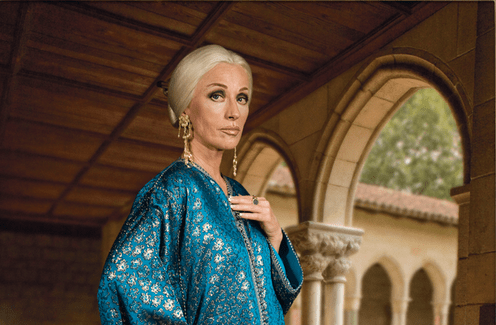
The very first image in the exhibition is large and shows us a groomed, polished, middle-aged woman with french manicured hands, highlights, straightened hair, heavily made-up, wearing expensive looking sports clothing. She appears rich, and like so many women on TV or the cinema, or who I might have met when doing corporate headshots – the bosses of companies, never the workers – or photographed at charity events or parties. I spent ages trying to place my recognition. She seemed so very, very familiar. It was like seeing someone in B&Q and thinking they’re your friend or a person you’ve met, only to eventually realise you’ve seen them somewhere on the ‘telly’.
Phone image
Whatever else it might be evoking, Sherman’s work is exploring celebrity, simulacra and simulation, the way modern culture gaslights us into thinking so much of what we experience is real, while it, in fact, often lacks ‘the real’. And how that is only ever linked to consumerism – a lifestyle which is being sold to us and is completely and utterly false and made up. And consumerism is without a doubt heavily invested in selling femininity to us. But I wonder if women and disenfranchised men are victims of this nowadays – leaving so many of us unsure of who we are, hence selfie culture which, like Sherman’s childhood diary are attempts to reassure ourselves – THIS IS ME!! It is, it is, it is, it is, I tell you!! So, while we should be wary of imposing pop-psychology on Sherman herself, it might point us towards clues which help us to understand how her work expresses something on behalf of all of us.
Perhaps a most memorable moment for me was listening to three women talk about the picture I just described. They turned to look at the image opposite, where Sherman is dressed as some sort of quirky media boss. Like all her later work, both are powerful caricatures. “Ooooh! said on the viewers, is it the same woman?” They discussed this possibility for a while by comparing features and decided, in the end, it was not the same person. They then proceeded onwards to look at the rest of the exhibition. I couldn’t help wondering if they ever twigged and what they might have gained from the exhibition if not!
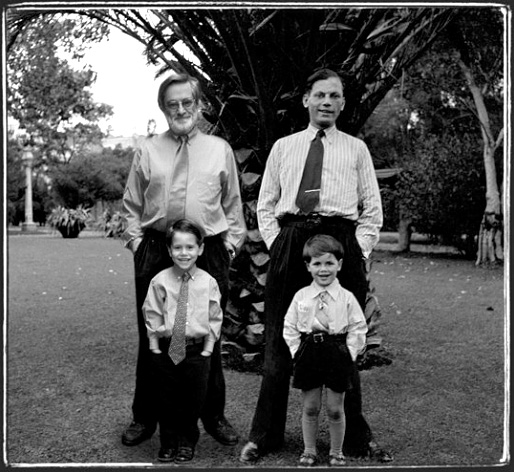
Her series Imagine Finding Me is described as, “a series of twelve unique ‘double self-portraits’ made between 2005 and 2009 which are created around a collection of childhood photographs taken from Otsuka’s family album. Here, the older Chino Otsuka uses a digital time machine to revisit her younger self in photographs of journeys she made with her parents as a child. ‘1977 and 2009, Jardin du Luxembourg, France’ runs the caption to one such photo; ‘1982 and 2006, Tokyo, Japan’ another.” (Lensculture, n.d)
Am reusing a quote I feel is incredibly relevant for discussions about a new reality: “Within a Newtonian worldview, the famed Cartier-Bresson photograph of a man jumping a puddle leaves the reader confident he will land on the other side; in a subatomic quantum universe it remains a matter of probabilities.” (Ritchin, 2009; 181)
Otsuka’s work is similar to Pedro Meyer’s composite image included in the Ritchin book. (176)


 SJField - OCA Level Three Study Blog