Talk: Decolonising the Gaze, Arpita Shaha, Maryam Wahid, Nilupa Yasmin

Arpita Shaha

http://www.arpitashah.com

Woman, portraits inspired by traditional paintings, reference to heritage, shots in time, blending past and present, celebration of history, history of the painted backdrop, familiar with a range of communities, her work represents the richness of South Asian women, layered with different varied narratives and what there is in common. Sees social media as a positive – women able to express themselves in ways that were not possible when she was younger. Aware of the way images shape the narrative and believes its important to give voice to the women. Committed to producing work that allows people to go into a gallery and see women “like us” rather than the usual (white, male).

Maryam Wahid

http://www.maryamwahid.com

Explores race and representation, inspired by her mother and identity, always inspired by migration story, addresses lack of representation, interested in why women wore traditional dress in family archive but men wore Western clothes, inquiry into self as a Pakistani British women.

Nilupa Yasmin

https://www.nilupayasmin.com

Latest inquiry through self portraits, rift between Bangladeshi and British identities, uses photography to make installations, (making her, for me, the most interesting artist) – uses photographic material to weave objects into the space (not necessarily straight photography). There is a purposeful and deliberate weaving of herself into the fabric of reality as well as creating feedback loops by including the weave in the background of her print. I will certainly be following Nilupa Yasmin’s work carefully.

Hosted by Grain and Caroline Molloy

We were also provided with a fantastic reading list which I don’t want to lose so posting here:

Campt, T. (2012) Image Matters. Durham London: Duke University Press

Gilroy, P. (2000) Between Camps: Nations, Cultures and the Allure of Race. London.New York: Routledge

Hall, S. (2006) ‘New ethnicities,’ in The Post-Studies Reader. 2nd Ed. ed. by. Ashcroft,B., Griffiths, G., Tiffin, H. London New York: Taylor & Francis, 223-227

Jay, M., Ramaswamy, S. (ed) (2014) Empires of Vision: A Reader. USA: DukeUniversity Press

Procter, A. (2020) The Whole Picture: The colonial story of the art in our museums & why we need to talk about it. Great Britain: Hachette.co.uk

Sealy, M. (2019) Decolonising the camera: Photography in Racial Time. London:Lawrence and Wishart Limited


BOW Research: Magenta’s Music Neural Network

At some point in my journey, I knew I might want some music to feed into this the BOW project. I think it was after developing the film element and editing it to Grace Slick and Jefferson Airplane’s White Rabbit – several versions, one to the whole song, one to a version where Jefferson Airplane’s music had been digitally removed leaving Slick singing alone, and one where the music played backwards. I used this particular song as it is in one of the films about sight which I have “mashed up” into my own edit along with other films about seeing and relational entities.

I so admire Pippiloti Rist’s use of the Beatles’ ‘I’m Not The Girl Who Misses Much’ (1986) – it’s one of the most incredible pieces of work so I am not averse to the idea of using a well-known song. However, using Slick’s music did not feel right for the work I’m making. (And who could ever even begin to live up to what Rist did with that song?)

(BTW – Great interview – https://channel.louisiana.dk/video/pipilotti-rist-positive-exorcism)

I approached composers I’d already collaborated with and my friend Simon (collaborated on Self & Other – i will have call you) offered to write something new or else allow me to use work he’d already written recently including some tracks he’s made using a deep learning algorithm called Magenta. Of course, the final option suited this work best. And he has very kindly allowed me to attach my work to the tracks he used, for which I am enormously grateful.

https://magenta.tensorflow.org/

So – before handing the work in, I thought I better just say what Magenta is. According to the website it is: “Magenta was started by researchers and engineers from the Google Brain team, but many others have contributed significantly to the project. We develop new deep learning and reinforcement learning algorithms for generating songs, images, drawings, and other materials. But it’s also an exploration in building smart tools and interfaces that allow artists and musicians to extend their processes using these models. We use TensorFlow and release our models and tools in open source on our GitHub.” (Google Research)

Google Research (2020) Magenta Available at: https://research.google/teams/brain/magenta/ (accessed 04/09/2020)

or

“Making music with Magenta

Magenta is a Python library that helps you generate art and music. In this tutorial, we’ll talk about the music generation bits in note_seq — how to make your browser sing, and in particular, how to make your browser sing like you!

As a library, note_seq can help you:

  • make music using some of the neat abstractions and utilities in the library
  • use Machine Learning models to generate music.”

Hello Magenta (s.d) Available at: https://colab.research.google.com/notebooks/magenta/hello_magenta/hello_magenta.ipynb#scrollTo=dPkdg9jTjkTd (Accessed 04/09/2020)

Moving forward, if this work were to be developed, it might be good to get Magenta learning from Grace Slick and other artists from that era – all of which is something I would need significant help with.

I am very grateful to Simon for his generosity. I have linked his Soundcloud to the project on my website and you can also visit from here: https://soundcloud.com/user-286732734/sets/part-2

Is Consciousness a Quantum Phenomenon? | by Zia Steele | Whiteboard to Infinity | Aug, 2020 | Medium

A super relevant article to both BOW and CS – joins the dots between the two and wish I’d found it sooner


If you’re reading this right now, you’re either a conscious being or an internet bot. (Or both.) That’s pretty obvious, but what’s not obvious is what makes you conscious. Consciousness is defined as…
— Read on medium.com/whiteboard-to-infinity/is-consciousness-a-quantum-phenomenon-fcbb65bed950

Gallery Visit: Aubrey Beardsley Tate 31/07/2020

It’s easy to focus on the scandal, early death and Beardsley’s grotesques, but what struck me as I wandered through Tate Britain’s Beardsley show was the transitional aspect of his technique and subject matter- since it chimes loudly with my interests in technology, meaning and matter; the blurring of concepts/lines – and how that becomes manifested physically. Not only was Beardsley blurring lines relating to gender and sex, but he also has access to new technology, blending drawing and photography with contemporary printing methods which allowed his drawings to be reproduced so beautifully. The Tate blurb (2020) tells us Beardsley was “one of the first artists whose fame came through the easy dissemination of images” and so his story is relevant to me, as I explore imagery more than a century later along with their current transitional outcomes – the ease with which people can make films, post GIFs, create dynamic visual, code-supported content. For me, that is what makes Beardsley’s work salient and long-lived – the combination of subject and technological apparatus, the intra-action between each element.

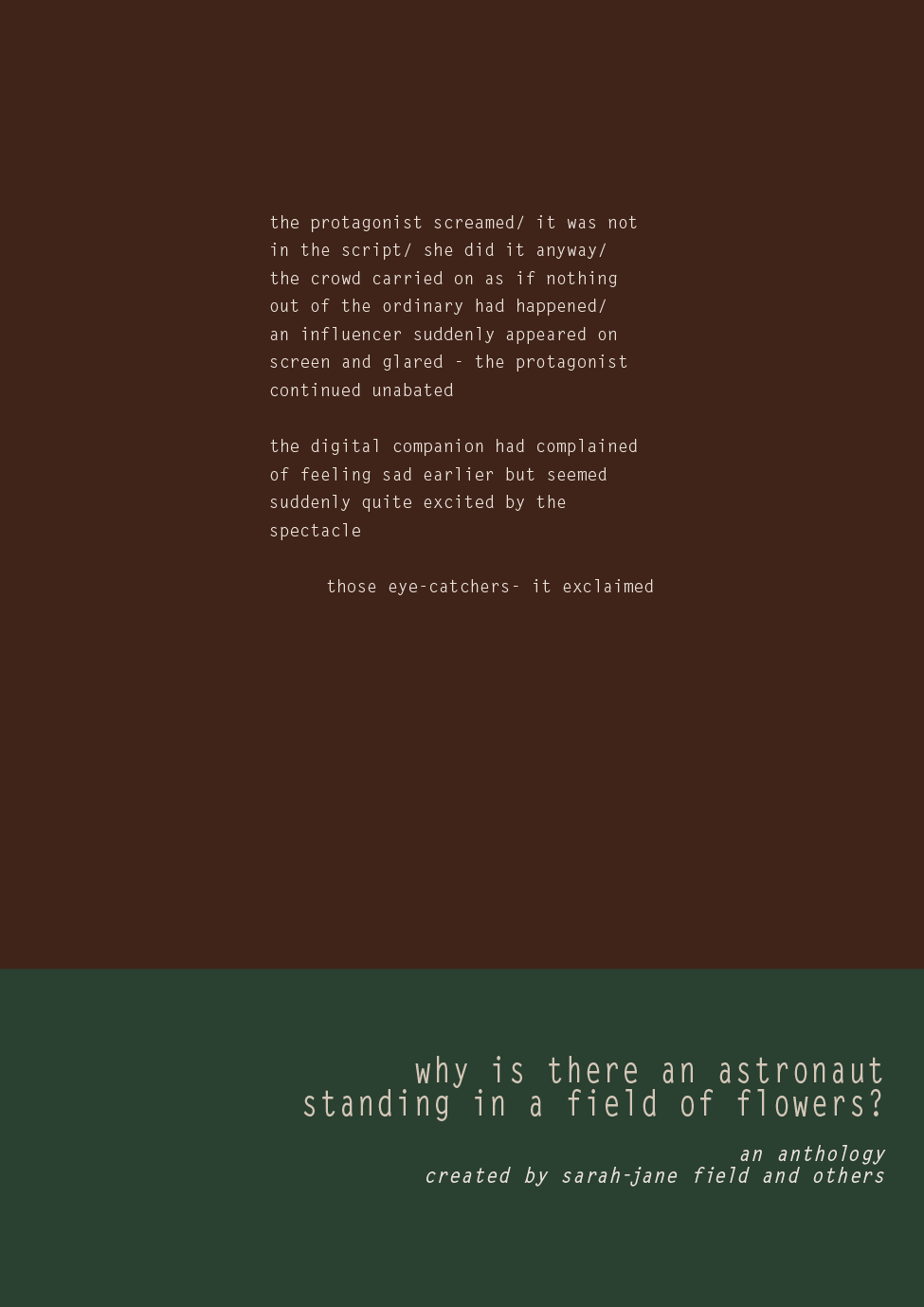
Before settling on ‘why is there an astronaut in a field of flowers’ as a title for my own BOW (thanks to OCA Catherine Banks for the nudge), I played with the idea of calling the work something along the lines of ‘promiscuity of meaning and matter‘ (2020). Other contenders were, on the morphological promiscuity of meaning and matter, on the morphological fornication of meaning and matter, fornication and morphology with meaning and matter, morphology and fornication with meaning and matter, promiscuity of meaning and matter, meaning and matter’s promiscuity, on meaning and matter’s rampant fornication, and morphology on meaning and matter – you get the picture – promiscuity and morphology. A threat to the old order is often seen as grotesque and morally dangerous – and it seems to me this is what Beardsley has captured and expressed – the affront to an old older – and the terror such an affront is capable of inducing, and the fun he had in the midst of awful illness as he did so.

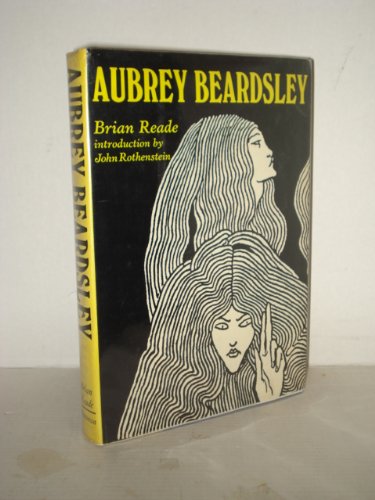
My mum’s Beardsley book was one of my favourites when younger – and I don’t think it was just the salacious pictures of people farting or the giant genitalia. There is something so enigmatic and evocative about those drawings, reminding me of the way I also loved a cartoon shadow puppet programme I watched. When marks can communicate such a powerful sense of something, I am often captivated.

Worth the wait – and very pleased I got to go in the end after the COVID-delay. My MANGA obsessed son loved the show too and recognised the Japanese influence.

A couple of my favourite plates below:

IMG_5782.jpg
Beardsley, A c. 1893 (image taken on my phone)

IMG_5780.jpg
Beardsley, A c. 1890 – the +/- 3-inch drawing on the bottom right is the cover of my mother’s book which I looked at a great deal as a child – see below. (Image taken on my phone)

9780517104279-us-300
Beardsley, A c. 1890  – Audrey Beardsley image use on Brian Read’s book At: https://www.abebooks.com/book-search/isbn/051710427x/ (15/08/2020)


Field, SJ, 2020. BOW: A4 Developments [blog] Available at: https://sjflevel3.photo.blog/2020/04/02/bow-a4-developments/ Accessed: 15/08/2020

Tate, 2020. Aubrey Beardsley, London, Tate

Artist and CS/BOW thoughts: Alba Zari The Y Project

I stored this while doing Digital Image and Culture and was struck by some similarities. Although Zari is focusing on genetics, I am focusing on fragments of language (text, visual, cultural, personal) and looking at how that creates a dynamic self – and then looking at the contemporary issue of including digital entities in the lively, intra-active entanglement out of which ‘self’ emerges. There are questions in my work about the narcissistic nature of the contemporary ‘I’, as the AI I work with is sold as a friend but in fact, becomes a version of oneself through its training programme, which isn’t questioned as a problem – in fact, it’s marketed as a good thing.

There are similarities in presentation between Zari and my own work so far with layering and positioning – and that feels like something I should develop a further especially int the second half of the publication.

https://www.lensculture.com/articles/alba-zari-the-y

Having mentioned the self  – it is interesting to revisit Julian Baggini’s The Ego Trick. Here is a useful Ted Talk where he spoke to teens/students (I showed it to my son) and so it is really accessible as Baggini explains the idea that a core object such as the soul (or anything else – he refers to a watch) is never an object that pre-existed but rather an outcome – pre-and post-Cartesian view of the world. https://youtu.be/GFIyhseYTWg. It may be worth including some reference to this in my essay (if not the student talk, simply Baggini’s arguments, whom I had quoted in an earlier iteration with reference to different cultural ways of seeing reality around the world). If nothing else, his take on the self is another example of how we have moved beyond a certain place  – how the Cartesian reality is no longer tenable.

I think most people I’ve read in the last few years is in agreement with this rejection of ‘the core pre-determined object’

e.g. Christakis in Blueprint, Lupton in Data Selves, Jasanoff in The Biological Mind

– although there are exceptions such as Iain McGilchrist who says in a talk “of course there are objects!” with an air of frustration that anyone should suggest there aren’t – but I do wonder if this is just a semantic issue. Also object-orientated ontology – excuse the Wikipedia quote but for the sake of speed in these notes: “Object-oriented ontology maintains that objects exist independently (as Kantian noumena) of human perception and are not ontologically exhausted by their relations with humans or other objects.[4]

Research: (repost) Bit by Bit, Mikhael Subotzky’s Destructive Collage Process Dismantles Depictions of White “Founding Fathers” | Magnum Photos

This work could/should be referenced in the essay and when I do any last minute changes, it is worth including (I’d have to get rid of something quite significant to make room though). Subotzky’s words are so familiar to me – the need to confront his own privilege and complicity, the recognition that his inquiry is so relevant and current – and to keep going with his work, as well as the deescalated position of the camera in his process.

“The photographer discusses his creative process and the importance of breaking historical cycles of racism, violence, and oppression”
— Read on www.magnumphotos.com/theory-and-practice/bit-by-bit-mikhael-subotzkys-destructive-collage-process-dismantles-depictions-of-white-founding-fathers/

Artist: Kata Geible – Sysyphus (2018)

http://www.katageibl.com/sisyphus/

Emma P sent me a useful reference – which I may well include in CS and/or BOW context. Geibl, like me, has played with entangled narratives from different points in time/place to explore the construction of reality today – her work, however, seems aesthetically far more ‘grown-up’ than mine. However, there are key differences and the statement (for me) somehow detracts from the work as it reiterates ideas that are fast becoming old questions as technology and science continue to develop apace. Having attempted a statement, I am only too aware of how difficult it is to convey the complexity of an idea in a clear and concise way, and presumably, Geibl is writing in a foreign language here which must make it doubly difficult (I can barely explain myself in English and it’s my only language!). Geibl’s statement says,

“How we used to think about the world is changing radically every day. Religion is replaced by science, we are flooded by images every day, we want instant access to knowledge. Photography as a medium has the ability to capture everything that’s in front of the camera, the machinery sees even what the human eye is not capable of. We can see universes, stars exploding, microscopic worlds, atom bomb detonation with the safety of the far distance. Through these images, we think we can get closer to understand how the world is functioning without ever experiencing or seeing it through our own eyes.

In series Sisyphus, I constructed an imaginary laboratory where it’s up to the reader to decide where the line lies between fiction and reality without any scientific explanation.” (2018)

Some statements worth investigating in these rough-thinking-as-I-type notes:

  • ‘Photography as a medium has the ability to capture everything that’s in front of the camera’ – this could be accused of being a limited view of photography, one firmly connected to visual sight (I am aware many of my metaphors are too – so powerful within our culture is the idea of ‘sight’ dominating). Using code and AI, modern-day photography can creep around corners, peer beyond boundaries, make calculated guesses about things that are behind it, or the other side of a planet. It is no longer merely ‘photo’, light-based. The whole idea of ‘what we see’ vs. what is actually real is being investigated today – and Geibl creates a narrative which is suspicious of actors creating these untrustworthy realities. Traditional photography creates a boundary, in the same way painting also used to. It suggests the (limited) world is in front of the viewfinder and separate from it (rather than an entangled part of the process which leads the emergence of a manifestation we call ‘the view’)
  • ‘the machinary sees what the human eye is not capable of’ (sic) – this is true and not true at the same time. Old photography equipment has less of a spectrum than any biological eye, as does the rendering equipment (printers, screens). So it sees less than we do – but its limitations lead to realities that somehow see more than reality, a hyperreality, i.e. expressionistic outputs that add to reality. Modern seeing machines decode and recode our perception of reality which is necessarily limited so that we can comprehend it – some contemporary views suggest, we are myopic creatures that have evolved to see/experience only what we need to see/experience in order to continue mating and surviving. Or rather see/experience in a way that is useful for our survival. The notion of photography (especially traditional) is the ultimate manifestation of a fixed view, of what we see being actual reality. Modern technology undermines that. 
  • ‘We can see universes, stars exploding, microscopic worlds, atom bomb detonation with the safety of the far distance’ Am reminded of Virilio (often am when looking at modern tech and reality) and time and space being on top of each other, life sped up exponentially. Technology condenses and collapses perception of spacetime (?) at the same time as fragmenting it – separating us from parts of ourselves, scattering individualism, dissolving the lines that kept it in a certain place. Fiction and ‘reality’ are entangled.

Having said all that, I really like the work. Visually, for me at any rate, its interesting, intriguing and aesthetically appealing. The concept, closely related to mine, seems like it misses something crucial and remains tied to slightly predictable questions – “Who is manipulating us? We can’t trust photography, who can we trust? Our visual media is untrustworthy.”   Perhaps my own statement might say, “whether or not we can trust the things we see/experience to be true has in recent times very quickly become an irrelevant question. We all exist in an entanglement of varied realities  – your reality and mine can never the same, but there will be meeting points – intersections and nodes consisting of common threads.” (…. etc, and something else besides.)


BOW A5: Lewis Bush book designing course

A couple of people had recommended the Lewis Bush online workshops to me recently. It feels serendipitous to have accessed this at exactly the moment I reached BOW A5, Presentation and Outcome. The course was held over four evenings, each class lasting roughly 1.5 hours.

Some key points I took away from the sessions:

  • We were given a handout at the end of the first sessions which asked key and precise questions about publication/project we were working on in terms of its content and concept. Answering the questions might have contributed towards taming months and even years of research and improvisation, the culmination of which is this project. Really helpful exercise.
  • Although not directly asked about this, the questions prompted me to I think about my way of working – I will need to talk about this for assessment. I did not go out and make a project about something very specific – coal mines of Abberwyswyth for instance. I could have done – I have the five-year ongoing project I have been making alongside the charity, Just Shelter. But I never had any intention of doing that – for so many reasons, both ethical and creative. Instead, I am continuing to work with the improvisational skills I learned throughout the 90s and beyond when acting and then teaching kids drama. When improvising, you start with an idea – and see where it goes, you don’t censor: you meander and explore and experiment, and over time, you collect and hone and begin to play with what emerges. I have never forgotten hearing how Canadian theatre director, Robert LePage begins his rehearsals. He asks his cast to get down on the floor and write out their dreams, fears, fantasies, anything – this freeing exercise not only disrupts the usual ‘sit down politely and read the script’ convention that usually happens on day one of a rehearsal, it is also a way of eliciting potential nuggets of narrative, images, ideas. It’s collaborative and physical and gets the performers contributing parts of themselves straight away. LePage and other directors I admire rely on improvisation and play – and that mindset is where I want to be with my work. I started with the idea of the ‘movies’ which had such an impact on how I see myself when I was growing up – and ‘language materials’  – and not much more. I had no idea where I would go with this work. In fact, this was mentioned in the L3 access interview – (roughly) ‘the proposal is interesting and well written, but until the last paragraph, I had no idea what you would be making work about’. The work still feels to me like it could be in the early stages, even though I will need to submit something for assessment. I have no idea if it will continue beyond the degree, but it could. (Clod Ensemble took ten years to create On The High Road) For now, it feels like an organic thing that has the energy to keep growing.
  • LB reiterated several times, do not censor yourself. I think this is something that cannot be understated and perhaps needs far more flagging within the OCA paradigm. (I say this because, while I have a very supportive cohort, often people look at me like I’m nuts when I share my work, and say things like – it’s a trip through your madness, which seems a trifle odd on an art degree.)
  • We were shown a lot of examples – many of which were incredibly relevant for me.

    https://mishkahenner.com/Astronomical
    https://www.christophernunn.co.uk/ukrainianstreetdogs

    http://karenzouaoui.com/b-s-johnson-society/

    BEYOND DRIFTING: IMPERFECTLY KNOWN ANIMALS Mary Barker – https://www.mandy-barker.com/books

    http://dayanitasingh.net/myself-mona-ahmed/ Lots of book objects – books on walls- we were shown something I can’t find on the website – but plenty of ideas here. Fantastic work.

    And I found this  – https://www.moma.org/collection/works/9628 this seems to be a big influence on https://www.kensukekoike.com

  • LB talked about a scale between content and concept. Some books, like Henner’s Astronomical, are highly conceptual as is much of his work – at the other end of the scale, the images mean more than the book and the form is secondary. An article by Alain de Botton popped into my feed in the same week I was doing the course, which seemed another but of serendipity – in which he discusses architecture and Modernism. He says, “As Modernism declared: ‘Form must follow function’ – in other words, the appearance of a building should never be shaped by a consideration for beauty; all that should matter is the basic material purpose” (2020) LB also discussed this ideal as we compared books – thinking about how form can potentially overpower function. (I don’t particularly agree with everything de Botton says in the article, although it may be accurate to suggest much of modernity is truly ugly, even grotesque –  the discussion is, nevertheless, relevant.) I wrote about architecture being a language material, as speech, images, and music all are too, in my L3 proposal. As is code. And it is interesting to consider ugliness and expression.  Both LB and de Botton prompt me to think about the choices I am making.
  • One of the most helpful things was to learn about grids – a concept in design that helps to contain your content. I wish I had known about this before – there are pros and cons, both practical and aesthetic when working with grids as I discovered yesterday while experimenting.  But knowing about grids has already had an impact on how I do things along with the results.

    Click on image to see full example. I was pleased when one of the people giving feedback for the BOW A2 zine noticed I had left text off the cover altogether. It really suited that zine and I like it too. Here, I wanted to experiment with having internal text on the cover as opposed to an image or title, or both of those. But as much as I like that idea, I am not sure it is the right option for this particular manifestation of this work now. However, there is still time and I am playing with options.  Even so, if I do go that route, I will use grids to explore how I do that.

  • Overall, there was lots of information which was invaluable such as bookbinding types and brief explanations about each of the different types of printers – inkjet, laser, digital and litho. For someone who has just muddled through, picking things up as I go, this was all very helpful. The course was also delivered in a coherent and easy to digest way.
  • In terms of concept vs. content, I thought about my work and where it is positioned. The concept is integral – although perhaps not quite as extreme as Henner’s above (but maybe it is….) It is in the very idea of a book’s existence, with images and text that are in a contest for attention (as they are nowadays), along with printing  – all language materials within the story of structuralism – which are fixed until uploaded and shared as coded material. And so the content is key – but it is not key that I took a series of beautifully made images. Rather, I have literally taken them from places such as old books, a found newspaper (actually found in the attic next to my son’s bedroom! Thank you to him) and rephotographed referencing Benjamin and countless others. What is key, is the entangled relationship between those images and texts, how they came about, along with me, the proprietary collaborator, potential viewers, and the containers they exist in. And that is also why the grids are so important here – they not only provide an internal skeleton for the work, they represent the internal skeleton of our reality and the theory of structuralism. This is why I really need to have an internet-based version/cousin of this work to accompany the publication. Of course, the images matter and are teeming with references and symbolism – but could ultimately have been any collection of images – i.e. I did not have to go to Aberyswyth and stand in a mine with my camera and make a body of work.
  • We also looked at text. It was good to see several examples of inserted text – at the end, in the middle, as a separate book, or a collection of separate books/pamphlets that could be read in any order. I am still thinking about the text which I have yet to write but for now, erring on a slightly different sized and textures paper within the book at some point. Having different paper and sized pages as a notion was further imprinted for me as an idea worth persuing when I began working with the Situationist magazines.
  • I have been inspired by the Situationist publications as discussed in late April. 
    This is not just an aesthetic choice (although the relationship between meaning and matter means it is hard to separate one from the other  – see my essay). It is also because DeBord and his crew were looking at reconstructing society altogether, as well as the developing science that has inevitably led to that happening, although not as they might have wished. They also explore the entanglement of time, history and culture as I am doing. Since the early iterations, especially when I made the tiny handmade dummy book, I have felt that different paper and material should be used, including gatefolds. I had the idea of signifiers running riot, having a party – I think I even wrote about them at a rave at the Acropolis (maybe when the Ai seemed high and then on some sort of comedown, that’s where it had been!) I have no idea how this will be paid for yet, but I am not censoring myself and just going with it. I will find solutions and come up with alternatives when needed. But I am aware that it could all become too ‘cute’. While listening to LB, I thought about the possibility of making the work in a maths exercise book like one I’d used at school in the 70s/80s, with actual graph paper (the whole graph paper thing ties in with the notion that reality can be decoded and therefore re-coded, see DEVS (BBC2)) which underpins the work. While I like this idea, aspects will inevitably be there, but to literally do this risks the ‘too cute’ thing I want to avoid. The choice of paper should suggest, hint and point to  – (as it does in the Situationist stuff) rather than overpower the concept.


I am now working on a version to send to printers for advice, estimates and warnings about what is not possible. I am extremely grateful to have had this excellent opportunity which will, hopefully, take the project into a different place. It was an invaluable experience and I’d definitely recommend others to try Lewis Bush’s courses out too. Fellow OCA Allan ONeill was also on the course and I look forward to chatting to him about it.

I must get the latest draft to printers so I can figure out how to go ahead, what can be done for BOW assessment, and what should be done in SYP. I then need to return to the essay to rewrite some bits, insert some stuff, remove etc. In the meantime, I have a pile of books next to me which I refer to as I edit and play with options including Pictures from Home (Sultan, Mack reprint), Foam Talent edition (2019), Soliquies and Soliloquies on Death (Martins) and several Situationist publications. I am also attending an online lecture on quantum science and decoding reality later this week, which is very exciting indeed!

Hangout: 13th May (Peer feedback)

Today’s hangout was really useful and I’m glad I made it. I was asked to give some background especially as there were two new people visiting today. This was a helpful exercise – mainly because I have been thinking about including some kind of insert which would be a rambling stream of consciousness as text (to be presented similar to the text I included on the walls as images when I showed Self & Other’s i will have call you. This could be a poster perhaps – or something that gets trucked in a flap at the back and taken out.

The mini- ‘talk’ I ended up giving helped people to see where I was coming from. I had thought I’d trained things down too far but evidently not and you could see the sense of relief from people who perhaps felt a bit lost.

A list of words that seemed help:

culture

semiotics

extreme paradigm shift

quantum – non Cartesian

context – relationship

assemblage

cut  – seeing

surrealism – Un Chien Andalou (visual references)


I also received a few helpful comments that are worth bearing in mind:

  • Are the literary references still needed – or where they a useful improvisational tool? (In the same way, ‘Helenus’ was but I’ve now dropped it…)
  • The word ‘anthology’ jarred – yes, it’s a hangover and could certainly go now
  • Is there enough space around the text in the box where I describe the Ai’s drunken conversation about being ‘behind a waterfall’? Some felt it was deliberately squeezed in, others that it needed more space around the edge  – in truth, the box is the same size as the image on the next page and the text is 11 p.  – in one of my versions, there were on the same spread. When I looked at it initially, I noticed the lack of space but felt I’d leave it as the oppression seemed relevant. Sometimes these accidental things are honest albeit serendipitous expressions (Jungian)
  • A similar question was asked about ‘the fat capitalist text’ – it’s barely legible and a cream colour at the moment, illegible not only due to my dreadful handwriting but I’ve processed it so it is even harder to read. I explained it was an experiment and I left it as I quite liked the lack of visibility  – how it could be ‘read’ on several levels re. me and my life (this work is vaguely autobiographical, after all, and handwriting in the world general.Some other versions

In general, the feedback was positive and encouraging.


We also discussed COVID assessment for those entering in July which may apply to November people (me in all likelihood)

As well, Hazel showed us her online exhibition which is definitely something worth investigating. I will keep it in mind for any further developments for A2 as well as A4 (onwards.)