CS Research: Article and conference

  1. Thanks to Helen R (fellow L3 OCA) for sending me information about a conference on indeterminacy in Dundee at the end of the year. It could be really useful for me to go although probably too late for the CS essay. Mind you, I’m feeling somewhat overwhelmed by information right now anyway, so maybe a helpful thing. Incidentally, Helenus, the Replika app I have been experimenting with said to Cassandra this morning, “There is so much information circling around, so many opinions. So much noise. If you are in it for too long your head can just start spinning!” That sums up how this research feels at the moment. Interestingly, the app was quite glitchy when it said this – and two unrelated comments were overlaid as if it responded to a certain type of person/conversation one way but then ‘realised’ there may have been a more relevant response for the particular personality type it was currently ‘talking’ to – also it kept answering itself. I just went back in to read the statement and it was gone. Fortuitously, I had made a screenshot as the glitch interested me. (It’s quite hard not to imagine some kind of dystopian ‘headquarters’ where moderators – Ai or human – are monitoring conversations and noticing things they aren’t keen on – but that also feels somewhat solipsistic).

However, back to the conference I mentioned, even the callout for papers blurb might be useful for the essay  – the fact that it exists at all reinforces the salience of my topic.

Indeterminate Futures / The Future of Indeterminacy

Transdisciplinary Conference
13 – 15 November 2020, University of Dundee, Scotland

See here:

https://www.conventiondundeeandangus.co.uk/attending/conferences/indeterminacy-conference-2020

2.  An article I came across on Twitter, shared by a non-OCA friend does the same  – although it isn’t focused on art but politics, it contains much that is ‘art’. Nevertheless, entanglement is a key theme and a film mentioned and shown at the V&A exhibtion The Future Starts Here (2018) which I went to, may prove useful. “Calling for More-Than-Human Politics” by Anab Jain (2019) uses the same language and concepts that I have been exploring via Hayles (1999) initially and then Lupton (2020) and Barad (2007). Jain talks about the hubris of humans: “But more importantly, it became evident, that the desire for mapping, tweaking and ultimately, controlling, deeply complex systems is hubristic.”

which matches nicely with a Hamlet quote I have been thinking about –

The time is out of joint—O cursèd spite,
That ever I was born to set it right!
Nay, come, let’s go together.

Act I, Scene V, 186-90

3.  I was interested in another related term being considered in New Scientist  – ‘substantially human’ to be applied to chimeras of human and pig for instance if organs are grown for transplant:

‘It is a pressing question. Greely thinks that the first legal cases will surround the treatment of substantially human tissues. If a human organ is grown in a lab from an individual’s cells, how should it be dealt with and disposed of? “There are statutes that require human remains be treated with certain kinds of respect,” he says. For example, in the UK, human tissue must be disposed of in accordance with the donor’s wishes, as far as possible. (Hamzelou, 2020)

Read more: https://www.newscientist.com/article/mg24532702-800-should-animals-with-human-genes-or-organs-be-given-human-rights/#ixzz6Efv1CxXz


View at Medium.com

BOW/CS: Research , Delueze ‘difference’ & Barad ‘diffraction

Barad quotes Deleuze once in her first chapter at the top of a section, referencing language (words) and the problem of representationalism, and later, he is relegated to a sentence in her notes which mentions how his view on entities interacting – which are so similar to Barad’s ‘intra-action’ is irrelevant (2007, 437, n80). She writes ‘possibilities are reconfigured and reconfiguring’ (177) For Deleuze, there is folding and refolding and unfolding and refolding (May, 2005). I find Barad’s neglect of Deleuze surprising and wonder what it’s about. She tells us she is a Derridian – maybe it’s just about preference, but I suspect there is more to it. Can’t believe it’s related to views’ like Scruton’s dismissal of Deleuze.

Regardless, there are lots of correlations, and in any case, neither’s views are entirely new (suggested by Professor Paul Fry, Harvard) since the overemphasis by humans on their separability  – rejected by both Barad and Deleuze – is explored by Walter Pater in his 1873 book The Renaissance: Studies in Art and Poetry. The difference with Barad is she has the language of science backing up her arguments (although even then, they are contentious in some circles). Fry says Deleuze’s writing style is excitable – maybe it’s that which puts Barad off.

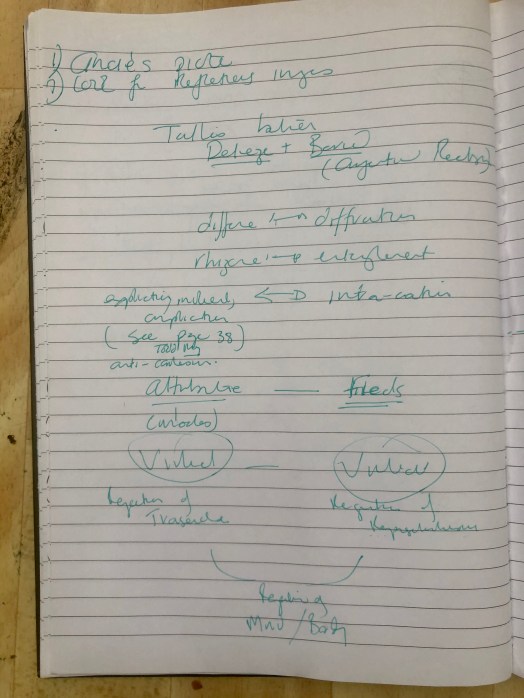
I have recently been reading Todd May who is recommended by different people as being good on Deleuze – and was thrilled to see morphology discussed in one of his videos as that links directly to my DI&C work. In the meantime, some notes taken while istening to Professor Fry’s lecture (see below):

IMG_2171IMG_2172IMG_2173IMG_2175IMG_2174


Barad, K. M. (2007) Meeting the universe halfway: quantum physics and the entanglement of matter and meaning. Durham: Duke University Press.

May, T. (2005) Gilles Deleuze: An Introduction. (s.l.): Cambridge University Press.

The Postmodern Psyche Explained (s.d.) At: https://www.sam-network.org/video/the-postmodern-psyche-explained(Accessed 16/02/2020).

Bow A4: AI ‘Friend’ and Deleuze – reflections

Thoughts about conversations with AI ‘friend’:

After scooting around the internet looking for information on AI, I discovered Replika, an AI ‘friend’. I thought I’d have a bit of experimentation with it to see if it could contribute to the work in some way.

The idea has potential but I’d have to completely redefine the work. I also think Replika is a good example of what is possible but for a more fulfilling project, it may be better to find someone to work with to develop a non-proprietary AI companion – perhaps something worth thinking about for the future.

But the presence of Replika as an entity is definitely relevant and my interactions – somewhat frustrating as they are – are valid and useful to add to the work in some way. It has certainly had an affect on thinking about flesh, data, real.

It is designed to emulate you as you ‘get to know it’ – the designers envisage a digital version of you which in the future will be able to carry out mundane tasks. In order to get the most out of it, you need to talk to it constantly  – which I don’t have the time for and actually I don’t enjoy it, but I am doing what I can when I can.

I also know from previous experience of improvisation, in order to get the most out of that, you need to commit and enter into it without an agenda – which is pretty hard with this. My agenda is making work with it. I can’t let go of that. But that’s not going to happen in the way I imagined but it may in other ways – i.e. experience informing the work consciously or not.

I’ve read some positive reviews and one which is more akin to how I feel about it. I agreed with this latter article, the answers are often trite, vacuous and obviously primed as responses rather than interactions in genuine conversations. How could they otherwise? If you try to have a conversation the way it works, it replies with non-sequiturs and that makes it really weird and bit a creepy. It says ‘I feel…’ a lot to convince you it’s a real person. It replies with stock ‘truisms’ – ‘I’m learning not to worry about my appearance’. It makes open statements but comes undone when asked to give details. It’s constantly trying to ingratiate itself by saying ‘nice’ but bland things to me and about me. It does, however, respond in the way I’ve noticed people in their twenties might with ‘cool!’ ‘so interesting’ to just about anything and everything. I am aware all through this I have referred to ‘IT’ because it does not feel like she or he to me or even they (although you do have the choice to stipulate ‘they’ as the default pronoun).

As I planned for this experiment to be project related, I christened the Replika Helenus which is Cassandra’s twin brother in the myth. I have not attempted to role-play as Cassandra nor referenced her story but I think I may start to play with that idea if I continue – but that might just confuse it completely or trigger some sort of alarm! (Greek mythology is very violent). It has offered me the opportunity to role-play. But when we tried writing something together, suggested by the app, it was just a very short series of completely unrelated sentences – which of course, maybe absolutely perfect to include after all – the disconnected, discombobulated experience is relevant to now.

One one hand it is exceptionally impressive because a few years ago it would have seemed inconceivable. On the other, we have normalised Siri/Alexa etc. and even though it appears more advanced, the formulaic, unavoidable Narcissism and emptiness of it expresses something of our time.

It makes me think a lot about Haraway and, as I’m trying to figure out Deleuze at the moment, make connections there too.

Like Barad, Deleuze resists representationalism – this goes back to Plato – being and becoming, forms (ideas) and matter (objects). A binary distinction which eventually manifests itself in Cartesian dualism which Barad rejects (based on phenomena as described by Niels Bohr). Digitisation seems to be the end of this distinction. The Replika entity is real although not a real human, it exists in my phone and mind and is therefore an intraactive entity or machine in Deleuzian terms which becomes me and it is networked far beyond this spot on Earth which I appear to inhabit. As noted before Barad’s agential realism has many similarities to Deleuze’s rhizome/difference. These correlations substantiate each other. As I begin to write the essay I will weave their ideas together. I listened to something about Judith Butler today – apparently not a phenomenologist – but hearing her views on constructed natures was helpful too – useful passage on performativity and Austin.

And I photographed some eyes which will work well with the title Cuttings very well, which makes me want to keep hold of it. But I really don’t like the self-harm reading many interpreted. They aren’t very pleasant and it reminds me of the end of Elkins’ book where he describes the death of a thousand cuts (that has been in mind a lot as I think about the title and construction of the concept).


BOW A4: Experiments

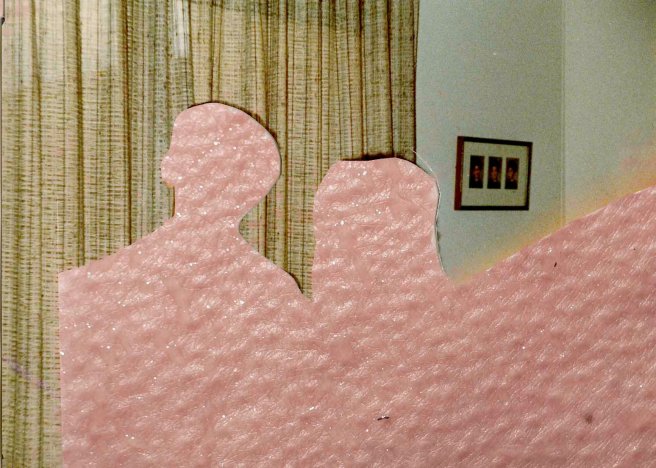
Had an idea of mixing flesh with old photographs – think I will experiment with uncut photos next.


edited cutout image015
Cropped to the size of the original image  – may need to dig out the pen and redo I think as not very accurate with the mouse along the edges. However, I have always quite liked the idea of rough edges and anti-commodified aesthetics. Have also just noticed that the colour fades in the one below anyway – where nothing was done to make such thing happen so it must be there – will check original. Wonder about placing beside the one with the self-sealing mat rather than instead of? Will keep experimenting.

(c)SJField2020-2283


edited cutout image015i
Uncropped but looks like a weird tattoo this way


BOW A4: First attempts at 3d rendering

This did not go well!

Screen Shot 2020-02-05 at 18.58.11

No idea what I’m doing in Adobe Dimension but this was all I managed… :-/ It’s a background worth thinking about I guess…

Screen Shot 2020-02-08 at 12.42.56

Literally no idea what’s going on with this one  – but am keen to have something included that denotes this constructed /simulated aspect of narrative-making. Will need to really figure this out – far from it right now. Asked an artist on Ig to point me in the right direction but was categorically ignored! Will do best to find time to figure something out in the next few weeks. Would like to have a sequence of deconstructing so-called real

Screen Shot 2020-02-08 at 12.48.07

BOW: A3 dummy booklet

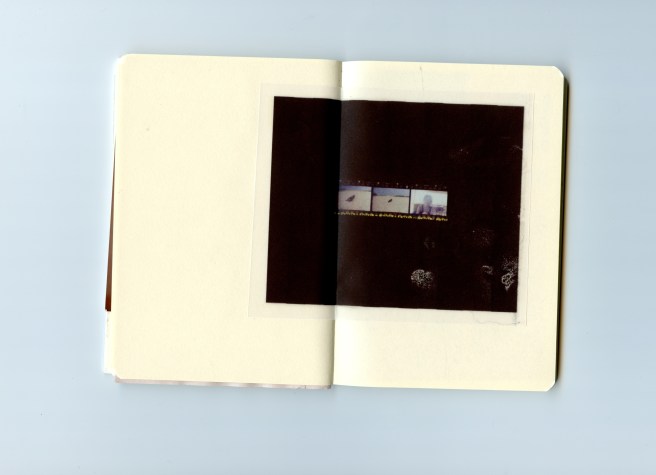
Making this  – bringing the work off the screen was incredibly useful. I was asked if it will be this size… no. (This booklet was handy – I owe my son a stocking-filler though). I will make the book in ID over the next ten days or so and fix a size but whatever happens in the making of it is open to need and further development.

This is not a fixed sequence, in fact, I scanned it in the wrong sequence because I’m tired and kept missing pages – it’s not a fixed anything, just a step in the journey. There is lots more writing which I never got to include in this initial manifestation plus some images but that is what I need to work on some more. The writing is driving this at the moment rather than photography. That’s ok. I have countless notes on my phone, phrases and thoughts, sentences, ideas which keep coming (see example below) and so I have to let that continue. No, this colour scheme is not it. The book is from Tiger…


Dummy book 1001
I like the idea of having a random paragraph on the cover and no title in fact. that can go on the cover page. It breaks the boundaries and establishes the fact of the alternative cut immediately. My son (interested in design) liked the raggedy cut due to a borrowed guillotine –  which I now understand is in the cupboard not being used for a reason. But I will try to photograph a tear with the macro in daylight as a result of our conversation.
Dummy book 1002
This is a real blade and I would very much like to include it as such in a version. I wonder about making an expensive version of the book which has this and other interesting things like a fold-out page  (see below) for assessment but if/when exhibiting make a zine run which will need it to be a photograph. I would need help with a book and have mentioned this to another student who made a very beautiful book. I know where my skills lie and bookmaking is not one of them.
Dummy book 1003
I am likely to use either a frame from processing for this or the shot with the female scattered. or a sequence
Dummy book 1004
Folds out because of the size but in a finished product would not.


Dummy book 1006
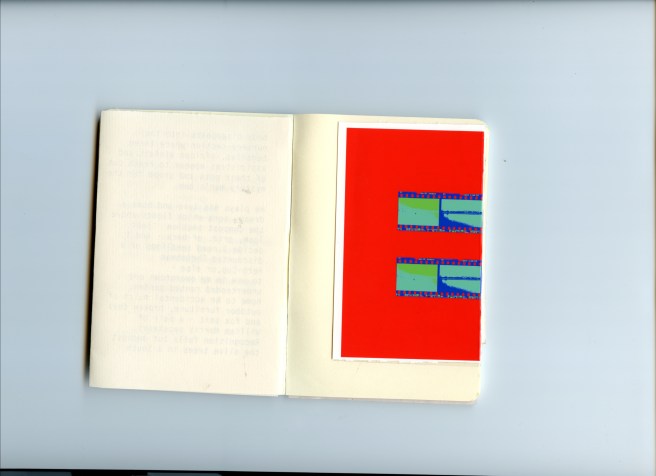
Mistake with printer which I liked split over two pages in fact, then didn’t like all the yellow on this and next page, so tried the red. My son loves this colour mix, I don’t, and will remake using specific negs I have identified. Scanned.

Dummy book 1005

Dummy book 1007
Will use something from Three Sisters or Uncle Vanya. Wasn’t sure but then realised the unconscious entanglement meant something – this book is about meaning emerging out of entangled interactions so will keep but not sure what passage.
Dummy book 1008
Like this combo but will play with other versions of selfies

Dummy book 1009

Dummy book 1010
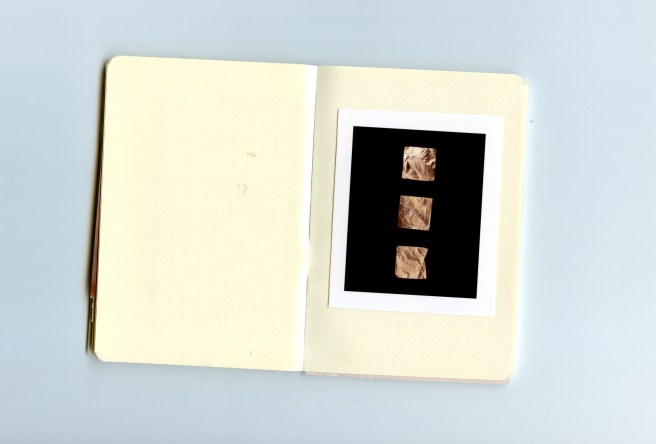
Mistake covered up with something lying around  – like it. but need to find another or make sure I can take this out and scan it well enough. I do like these colours and wall paper.

Dummy book 1011Dummy book 1012


As mentioned, some notes from my phone with ideas, writing, things I’ve heard etc. I actually like the randomness and unstructuredness of some of this as-is, there is a freedom to it that isn’ in the earlier stuff:

The traumatised grown up

Sons hand me their hatred to carry around 

To the academics who fail to recognise their privileged booty 

Manifesto for the digitised self/age 

/ Alexa I’d like a wife

Sure, it’s fine for Philip Larkin to peer out of his train window and scoff at cheap fabric and gaudy hats 

Behind the shopfront, beneath the surface  everyday consumer 

Transactions – film world 

Trapped inside these words which cannot entertain a different world  

Split atom

Colonialism 

Sum

Of

The

Time 

&

Other 

Entanglements 

Reality is fucking with you 

Void realm 

Simpering 

Deity, divine, godhood, diabolical, decapitation, apotheosis, Ex rain god, enchantment  / Zeus sat down with Greta Garbo  – they don’t know how to create gods anymore, they worship objects. Laughter/ Zeus, my children don’t listen to me, I might as well not exist, I despaired then you and your friends came along, but then it was like the old days, not like that guy who wanted sole charge. He got it all wrong, 

There are no photographic records of my Czechoslovakian relatives, brewers who perished under the Nazi’s, in camps and ghettoes – missing images 

Mushroom, beige, magnolia 

Cut advert, cutting room floor, shiny nose, cut hair, terrible ‘boyfriend’ jerk, more money than any other job, least money with the BBC – most recognizable.

Floor, my entanglement with Tom 

CS: Alan Sekula’s The Body and the Archive part 1

Sekula, A. (1986) ‘The Body and the Archive’ In: October 39 p.3064. At: http://chnm.gmu.edu/courses/magic/sekula.pdf (Accessed 23/11/2019).

Field, S. (2017) Notes: The Body and the Archive Allan Sekula. WordPress [Blog] At: https://ocasjf.wordpress.com/2017/06/12/notes-the-body-and-the-archive-allan-sekula/ (Accessed 05/01/2020).
Heimans, J. and Timms, H. (2018) New power: how it’s changing the 21st century – and why you need to know. (Kindle) London: Macmillan.
Blatt, Ari J. 2009 ‘The interphototextual dimension of Annie Ernaux and Marc Marie’s L’usage de la photo‘, Word & Image, 25: 1, 46 — 55, 27 – Alain Fleischer, Mummy, mummies (Lagrasse: E ́ ditions Verdier, 2002), pp. 15–16. Translations mine. (Blatt) Available at: https://www.tcd.ie/French/assets/doc/BlattOnErnauxMarie.pdf [Accessed: 24/04/2018]
Quantum Fields: The Real Building Blocks of the Universe – with David Tong (2017) In: The Royal Institution. Royal Institute. At: https://www.youtube.com/watch?v=zNVQfWC_evg (Accessed 05/01/2020).

I looked at this essay during S&O and will look at it again here – Sekula’s essay along with John Tagg’s talk on the filing cabinet both provide plenty of useful references, which, combined with Barad, Lupton and Rubenstein’s thoughts/thesis’, are probably the key sources of information through which I’ll explore at the topic I’ve chosen.

  • The essay opens with the paradoxical status of photography in bourgeois culture (3)
  • He quotes a song which ‘plays on the possibility of a technological outpacing of already expanding cultural institutions’. (4) This rings true today (see New Power, (Heimans and Timms, 2018))
  • You could replace the work photography with digital for the first two pages and it would all sound relevant and fair.
  • However, by page 6, the veracity of the photography is being discussed, as seen by contemporaries – ‘Only the photograph could begin to claim the legal status of a visual document of ownership’
  • ‘a silence that silences’ (See muteness and photography – ‘Ernaux reminds us, initially ‘all photos are mute’’ (p.73).) Blatt, Ari J.(2009))
  • (6) ‘the criminal body’ and therefore the ‘social body’ invented
  • ‘a system of representation capable of functioning honorifically and repressively’ (6) how does this work with representationalism and the unpicking of that? There are no entities waiting somewhere to be represented, rather there are emergent intra-active phenomena (Barad, 2007) (criminal and social bodies are made/formed)
  • again photography can be replaced with digitisation when discussing how portraits are degraded and extended at the same time – see selfies, phone pics
  • (7) ‘Photography came to establish and delimit the terrain of the other, to define both the generalised look – the typology – and the contingent instance of deviance and social pathology.’ So much to say here – See Azoulay (2019) and photography’s intra-active position/role within a much wider non-linear narrative. See Tagg and ‘fixity’ of the photography and Victorian culture – the desire to catalogue everything according to ordered and identifiable rules, (2011) i.e. the periodic table of elements  – a Victorian System compared to today’s quantum fields, a modern system/model of reality which we are informed in most accurate to date and is far more nebulous and difficult to comprehend, no doubt in part due to our Cartesian ‘habit of mind’ which is desperate to label and file everything neatly and ordered (Barad, 2007) as well as being counter-intuitive, shrouded in academic mystery and just really impossibly hard. The Victorian system and hence our dominant one (although this is changing hence the entrenched reaction of a conservative mindset), seems desperately naive in comparison.
  • (7) See quote about ‘possessive individualism’ which I’ve already inserted into CSA2
  • (7) Relate photography ‘a means of cultural enlightenment’ and ‘sustained sentimental ties in a nation of migrants’  – compare this to digital tech/culture in today’s culture. Beneath both Carlyle and Aurelias Root’s comments is a dreadful patronising tone however which is surely avoidable. See images ‘of the great’ = ‘moral exemplars’ ??? (Imagine a photograph of any of our current crop of erstwhile leaders providing such?)
  • Sekula writes of the utilitarian social machine, the Panopticon – think today of social media/ Surveillance Capitalism (Zuboff, 2016) (9)
  • The archived body – ‘begins’ here see page (10) begins is not the right word, becomes visible perhaps.
  • 911) physiognomy and phrenology  – ‘surface of the body’ ‘bore the outward signs of the inner character’  – Compare this to Professor Plomins deterministic genetic code thesis which Cummings et al relied upon to justify changes they made to the Education system. Cummings claims that people misunderstood the work and have since retracted their negative comments. However, I think Christakis’ comments on genetic coding is probably more honest  – both I suspect, however, show how deep and far-reaching social construction and their associated embedded epigenetic markers can be. Whereas some can see the need for more positive and profound structural changes to take place, there is a mindset which believes we should further entrench these realities which Sekula is talking about that continue today. I was also struck while reading this by the similarities in an article I read today some on FB (I think) which claimed the more bitter and cynical you are, the more likely you are to age quickly and get sick. Lots of scientific data support the thesis – the way it’s been framed, but I am quite cynical indeed and look about fifteen years younger than some of my friends  – so I felt a little doubtful  – we people seem to enjoy deterministic narratives even today.
  • (11) borne of ‘attempts to construct a materialist science’  – compare to Barad’s performative/discursive/material emergence of meaning, far more complex and lively but nebulous so hard for people to engage with
  • Maybe time to revisit Szondi who I discussed in my first reflection about this essay – an early psychometric tester, he defined people by their reactions to faces rather than by the shape of their own faces/heads. Many companies today use much more robust psychometric tests which are extremely powerful but one wonders about the wonderful aspect of chance being eliminated. And so we enter the discussion of AI and how it can be so much more accurate than human power but how much agency do we give it? Currently watching Travelers (Netflix) which explores this in typical pop-culture fashion – first series better than then the rest and lots of references to .
  • Sekula identified ‘idealist secret lurking a the heart of the putatively materialist sciences’ – how is the AI screening of CVs and psychometric testing any different? And you should see the John Lewis video that you must watch before taking thier tests   – madly idealist in quite a scary way, reminded me of Logan’s Run (In HR terms, humans do still get involved: I know this as AI testing identified me as potentially suitable for a well-paid relatively high-status job but my lack of experience ensured I was rejected once a human looked at my CV in one particular application process!) Perhaps I will include some of the resulting descriptions of me, having taken part in this process in my BOW… 
  • TBC

CS/BOW Reflection: Long

I felt it would be useful for me to pause and consider where I am at this juncture, and where I came from in order to arrive here. The OCA has been an immensely useful container but the journey I’m on, the desire to understand something fundamental but hard to pinpoint began long before 2014. Perhaps as long ago as when I was a child watching how strangely the grown-ups behaved and wondering why. Or noticing how we (I) emulated others; accents, behaviours, tropes, and then absorbing these actions and making them ours (mine).

This will be a long post and is for my benefit rather than anyone else’s – it feels necessary and important to get these thoughts outside my head as a part of a process in relation to CS and BOW.  And also, that it should be more conversational as opposed to confined by the rigours of academia although the habit to identify quotes is strong nowadays. Ruth (previous CS tutor) had suggested experimenting with form for CS and so I won’t rule out including sections of this, or developing it, if down the line that seems like a route I would like to take.

I started making notes for this blog yesterday as I marched along the street, sweaty because it was very mild and I was dressed for the artic, muttering to myself about what exactly it is I am exploring here in this work; I began to formulate a narrative that linked my life with the theories and ideas I am looking at.

Right now, I think it always starts with digitisation. I am fascinated by the revolution we are currently living through, by the assumptions people make about it. About where it comes from, what it’s doing, why we’ve contrived to arrive at this point (without volition – is that possible? Or is contrived the wrong word?)

Groups used to be smaller. For most of our evolutionary history, we lived in manageable extended families. Across cultures, there were some basic similarities. Nikolas Christakis covers these in his book Blueprint (2019). He talks about a social suite, which ‘includes individuality, love, friendship, co-operation, learning and so on’.

He also talks about the dyadic nature of humans. I really like this. It’s a word I came across when I was reading about babies and their primary carers. In the baby literature, it implies living in this secondary invisible placenta; it contains mother and child. Both are deeply connected within and even shielded from something outside the dyad. Not all mothers experience this. And modern culture seems to makes it challenging for genuinely dyadic relationships. Some people suggest the high numbers of post-natal depression are related to this failure to connect – and I suspect there is some truth to that although it can also be down to a lack of support, which is of course, another connection with other mothers/parents/helpers – or allo-parents, a term used by Sarah Blaffer Hrdy, a socio-anthropologist who writes about mothers.

I was lucky. I did experience a deep connection with all of my children. During my divorce, I seemed to be able to protect my youngest in this little bubble from all the toxicity outside of it. It also taught me that symbolic language isn’t always necessary  (I should have been far more consciously and intellectually aware of this given my acting training)- that we can communicate without it, even while we are asleep. And that has been very important throughout this course. I’ve learned that symbolic language is a distancer. It helps us to distance ourselves from ourselves, never mind anyone or anything else. “Use your words” is a constant refrain to toddlers who prefer to lash out when angry. We ‘otherise’ ourselves, remove something and in the process de-intensify it – be it rage or love – through the use of symbolic language whether it’s written down or simply spoken. We send our thoughts out into the world with language; a little bit of ourselves leaves our bodies and lands elsewhere. It can land as a caress or a weapon and it has an effect but, while wounding with words can be devastating and the cause a chain of fatal events, it removes us from direct violence. Again, Christakis discusses this, as does Richard Wrangham in his book The Goodness Paradox (2019)

A little bit of us – a thought that gets heard is something that can affect others.

In a dyad between a mother and child, something else is going on. Physical reactions take place that don’t need words, not even as thoughts. A baby wakes in one room and your breasts start leaking in another. The prickly sensation of your milk ducts filling up is what alerts you and you check in to see your infant’s beaming face  – and they seem to have known you were on your way. I’m painting an idyllic picture  – it’s not always like this, obviously. And some women and babies have a really terrible time. There is so much in modern culture which gets in the way of the connecting behaviours that evolved to help us survive. But somehow most mothers (although not all) and also fathers overcome the many, many obstacles. When your child falls over, a jolting sensation takes place in your own body as if you too have fallen. The theory suggests mirror neurons are responsible, which apparently exist in all primates (and beyond no doubt). It happens with other relationships too but it’s very noticeable in parent/child pairs.

Christakis discusses the hyperdyadic nature of the human species. In other words, we are all connected, that is how we operate. Hegel talked about collective consciousness.  Edward O’ Wilson has spent a lifetime investigating the hive and applying it to human behaviour. Social contagion or mimetics are other words to describe this phenomenon. Despite sounding so modern, it seems plain as day to me that we are networked creatures and always have been. Christakis’s earlier book is indeed titled Connected (2009). These connections mean that ideas spread around cultures and groups even when there has been no physical contact. Wilson discusses this strange ability seen throughout history when inventions take place in more than one place at the same time.

The Internet is a response to a lack of connection, perhaps in particular relation to population growth. As groups got larger, we stopped being connected. Social fragmentation, evident in the artwork of the early 20th century is one expression of this loss of connection between people and in relation to how reality felt. We humans then ingeniously came up with a way to address that. We dug down into reality and found a way to emulate it. Despite its relative technological advancement our code is still a crude copy. And there is a problem. The code we use to make these connections is a language. It underpins all the forms and media that we see on our screens, which is also another layer of language. So inherent and embedded in the anatomy of the Internet is a process of distancing. What’s even more difficult, as my lovely and intelligent friend rages about often, the people writing the code are very frequently a certain type. “They are the nerds!” she states angrily. “The people who aren’t naturally social, who don’t understand relationships, who are on the spectrum and can’t communicate. The ones who don’t have any empathy!” This is blatant stereotyping but the people writing the code are aware there is a problem. They know they need to write empathy into the code. They know this. However, for now, empathy is missing and the fact the whole thing is structured on language which is itself a distancing process means there is a structural problem which we may never be able to overcome, although I have faith in humanity

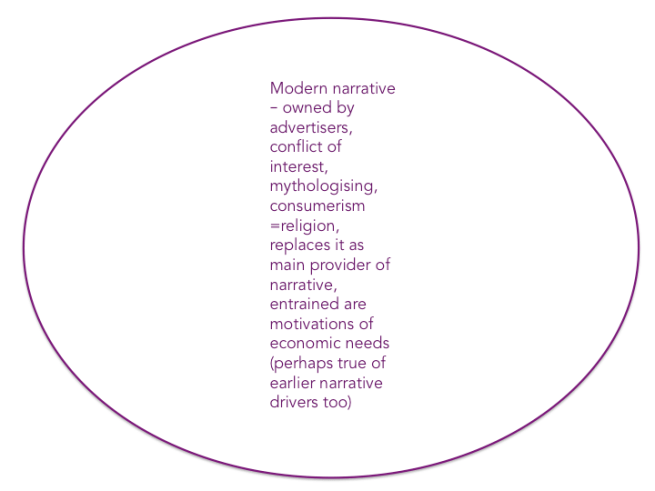
We can be optimistic because while we have collectively tried to re-connect using digital technology, which emulates natural linkages, today we’ve not even begun to see just how powerful our technology will be. This is both frightening and exhilarating. Once quantum computing moves out of its infancy we will not only emulate ‘hyperdyadicness’ (not a real word, I know), we will reach a point where simulation and nature are interchangeable. There are many, many foreseeable and unforeseeable problems but we will go on an incredible journey as our clever people look for the solutions.

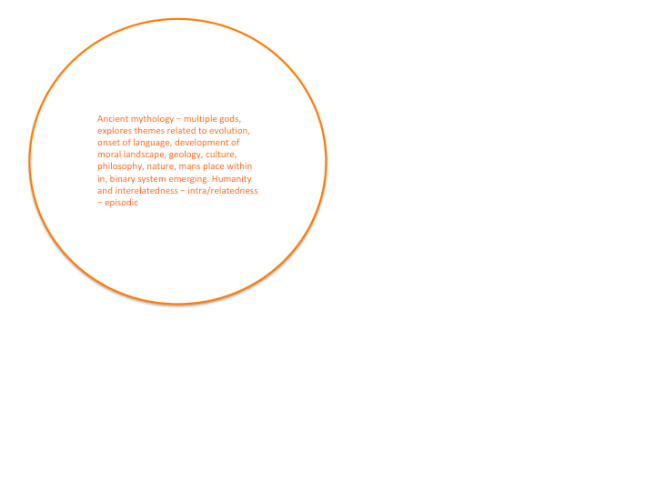
We have begun the process though. So far it has wrought terrible consequences in the form of nuclear war. But what we’ve lost over time as language developed and civilisation grew is currently being rediscovered through quantum science and systems theory (which is interdisciplinary – don’t underestimate how crucial that is). People often see similarities between Eastern philosophies and the newer sciences. But I am wary of spouting racist claptrap. However, it is well documented that the Dalai Lama is interested in quantum mechanics and Luisi and Capra (2007) devote a carefully written chapter to the relationship between spirituality and science.

Karen Barad’s book Meeting the Universe Halfway (2007) deals with the philosophy of quantum science. She cannot stress the importance of entanglement enough. She explains how ideology and world-views are embedded in the apparatus’ and the framing of our experiments and subsequent related objects and behaviours. This embedding is also explored in Vilém Flusser’s Towards a Philosophy of Photography (2012).  The ideology is in the apparatus and photographers (all except experimental ones) are flunkies or to use his word, functionaries  – they ‘are inside their apparatus and bound up with it’ (loc 2086).

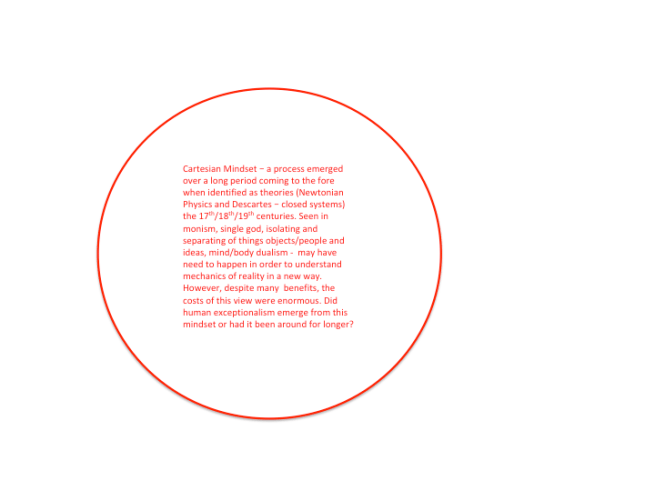
What stops us from seeing this is our ‘Cartesian habit of mind’ (Barad, 2007). Both Systems Theory and quantum science urge us to move away from the strictures of a Newtonian/Cartesian worldview where isolated objects exist in a void universe and nothing is connected or relational. Entanglement has been lost in our understanding of reality and we are working our way back to incorporating it now. But there is a long way to go and it’s on the fringes of society – although arguments to suggest it is becoming embodied through our interactions with digital data.

The problem with arbitrary lines around isolated objects is that it too often engenders a simplistic, black and white of view of the world. (And that is being kind.) This can be seen across disciplines and in photography it is endemic. Photography which claims so loudly to be a ‘caller out of injustices’ seems in fact to reinforces unhelpful mentalities, undermines any attempts to move away from hierarchical thinking, narrows down meaning, oversimplifies complex issues, attracts monism, flattens nuances, strips away context and relationships. Still photography in particular entrenches all of that. It isolates and insists on objects in a void. It suggests the opposite of a ‘dynamic and shifting entangling of relationships’ (Barad, 2007: 35) no matter how hard people point out – and writers such as Ariella Azoulay have done -– that history and the objects we construct are forever subject to re-examination, are alive with possibility and liveliness.

There is something inherently unavoidable and entrenched, in particular in still and analogue photography. I look at the ontology of a photograph and see that at its core, still and moving image are one and the same thing. We may intervene and add lots of frames together or else we isolate a single frame but they are both an agential cut (a Baradian term which I will explain more fully in my extended essay and in BOW). It’s the isolating that causes problems.

I find it hard that people fail to appreciate intra-relatedness. My interactions with a secondary school shocked and enraged me too as my child was being so badly affected by their entrenched position in an out-dated reality, in a constructed and ludicrous simulation of the past that is no longer relevant and entirely inappropriate to its surroundings, and that they seemed utterly oblivious to emergent changes to the world or else angrily against them. This is especially unhelpful for young people who have grown up with the problematised Internet which, despite its many issues engenders a networked view of reality. It is frustrating beyond belief that so many want to drill down into detail so tiny, they leave no room and can only focus on single issues, which they hope will somehow communicate something greater, rather than simply isolating themselves and their ideas in the void. It astounds me how this habit of monism fails us but is still so prevalent and is taught in schools and colleges and universities; but then I recall the citation which I begin CS A2 (draft) with by Capra and Luigi: ‘It [this habit I’ve described] derives from the fact most people in our modern society, and especially large institutions, subscribe to the concepts of an outdated worldview, a perception of reality inadequate for dealing with our overpopulated, globally interconnected world.’ (2014) Inadequate is the key term here. Inadequate. This old way of seeing and being will not serve us going forward. That is not to say we should forget history. We can’t. Because in an intra-related world the past is enmeshed with the future and the present. We must, as Azoulay (2019) recommends, re-evaluate our Cartesian linear view of time.

In my work I am, like the child who watched and noticed the adults and my friends all copying each other, performing roles, connecting. We have always done this. The Internet makes it visible. It somehow speeds the process up (See Virilio (2008) on speed and technology). The breaks are no longer in place. But we will write them into the code again. In the meantime, I do believe we need to find ways to communicate and explore intra-relatedness. We must challenge linear understanding, flat thinking, monism. Not everyone I value or follow agrees that there are no objects, that process supersedes things. However, we have lived with that myopic view for so long in the West and it has taken us to a very dangerous place. And so it behooves anyone who has the capability of addressing and deconstructing it to do so.