BOW: Assemblage

Since sending out various versions of work and receiving the feedback I have developed the overall concept and presentation further – seeing what could be ditched but also how I would bring some of the various elements I had created together into an ‘assemblage‘.

I do not much like the word assemblage but after reading it used (a great deal) in a blog by Deborah Lupton, the author of Data Selves: More-than-Human Perspectives, it seems like the correct word for the collection of images, sounds and materials I’ve gathered together. She writes:

I examine the interplay of human and nonhuman affordances associated with digital technologies – devices, software and the digital data they generate – and the agential capacities that are opened up or closed off as these things assemble. I ponder the questions of who benefits from these agential capacities, and in whose interests they operate. Here again, affective forces are central to the engagements of humans with these nonhuman things and the capacities that are generated by their gatherings. I address how human-data assemblages can generate agential capacities that empower and vitalise actors in the assemblage; but can also expose them to vulnerabilities and harms.

This approach recognises the entanglements of personal digital data assemblages with human action, reaction and understanding of the world. Personal digital data assemblages are partly comprised of information about human action, but their materialisations are also the products of human action, and these materialisations can influence future human action. While digital data assemblages are often conceptualised as immaterial, invisible and intangible, I contend that they are things that are generated in and through material devices (smartphones, computers, sensors), stored in material archives (data repositories), materialised in a range of formats that invite human sensory responses and have material effects on human bodies (documenting and having recursive effects on human flesh). (2019)

I am therefore creating an assemblage although I have not used this word.

The assemblage consists of:

  1. A video – itself a collage, a type of assemblage. While not a still collage like Höch’s were, it was made to emulate that trope, cutting up and pasting material that exists in the world. It includes audiovisual material that is available on the internet but contains signifiers of earlier technology. It will be shown on a Kindle – a handheld device.
  2. The film will also be available on my website but it will be a different version. Mostly the same apart from one or two tiny sections, but with an alternative audio track. The instruction to visit the website is printed on newsprint and is part of the assemblage.
  3. Still frames from the film which have been ‘captured’ and frozen  – in more or less the same way a photograph of life is captured and rendered a still image, using a slightly different tech/method – and printed on newsprint. These will be placed on the platform or hung from sticks.
  4. The poem printed on a tabloid page, orientated portrait. I hope this will hang above and slightly behind the kindle, perhaps alongside printed newsprints but I will need to see how this pans out when we set up. I was very influenced a long time ago by Louise Bourgious’ He Disappeared into Complete Silence. This is a book with several plates each of which consists of text and a drawing. The drawing is not an illustration. And sometimes it is hard to make the connection. But they are made to be seen together. I feel the poem and the video work this way too. Each can stand on its own but the point of the work is only brought to the fore when they are placed beside each other: A moving image piece alongside text, working with it but not illustrating. I might have read/performed the text in a video or even live. But this did not feel the right place (collaboration) for that – perhaps I might have reached a way of doing this if we’d had longer or were working in a smaller group -and it is something to consider for the longer-term, BOW-wise. 


DO02148-007_0
Image Louise Bourgeois He Disappeared into Complete Silence 1947 From: https://www.museoreinasofia.es/en/collection/artwork/he-disappeared-complete-silence-6

The work will exist in a ‘village’ (the platform) alongside other work made by my collaborators. The contents were influenced by their interests and the interactions I had with them. It is a reflection of them and my time with them. So my work is part of a greater assemblage, a network of creators which itself exists within a further larger assemblage – i.e. the three groups organised/curated by Pic London. That too is an assemblage which is again part of something greater. And so on = the fractal nature of existence.

Looking back, this is the pattern of my work. And now I know why. I am not focusing on one tiny aspect. I am recreating the chaos and interaction of conscious experience (not an individual, not an isolated and alienated concept, not one thing).

When I submit the assignment I will include critical information I sent to Pic London  – but here since it is relevant, I will just add a quotation I used which I have inserted into my work previously, and put at the front of my Self & Other blog:

“There is no such thing as a single human being, pure and simple unmixed with other human beings … [the self] is a composite structure … formed out of countless never-ending influences and exchanges… we are members of one another.” (Joan Riviere, 1927) It seems the assemblage whether it’s made up of flesh or tech or both and all sorts of other stuff is a description of Riviere’s statement.

Ref:

Lupton D. (2019) Excerpt from Introduction of Data Selves [online] WordPress Available from: https://simplysociology.wordpress.com/2019/09/01/excerpt-from-introduction-of-data-selves/ [Accessed 2/10/2019]

The Museo Reina Sofía (2019) He Disappeared into Complete Silence [online] User-generated content. Available from: https://www.museoreinasofia.es/en/collection/artwork/he-disappeared-complete-silence-6 [Accessed 2/10/19]
BOW 1.1: Feedback form and tutorial​

Yesterday I had a meeting with Ruth online and this morning I have added to the feedback form and sent it over to her.

An abbreviated version below: 

The film demonstrates technical and visual skills, and imaginative handling of the found footage to draw out its haptic qualities and communicate a critical re-reading of the material. The three sections ‘verses’ have distinct atmospheres. Overall sense of the film: it could be much shorter and thereby allow the viewer to be swept up in the whirl of the imagery and music but not start figuring out what is going on.  The length somewhat detracts from the open-endedness of the film, and suggests a potential narrative. Let’s discuss this, along with choice of film, precedents (similar/related work); rhythms (from sound and visual edits such as speed, image manipulation etc.)

Before meeting for an online tutorial, I sent Ruth a blog post (password protected, available on request or supplied for assessment) which explained why even though I agreed in the main with her about the film, I felt reworking Sirens was impractical and undesirable. I have been working on another collaborative project and suggested submitting the results (or a part of them) for the A1.2 and sent some work in progress. I can see that the course wants us to be prepared for reworking projects as part of an ongoing process. But I have often done this in any case during my time with the OCA and either do so or sometimes choose not to, moving on to something new instead or ditching previous ideas/work altogether and starting again from scratch. So accepting feedback and reworking is not unknown to me. We agreed in the end that Sirens had been a good stepping-stone but that my time would be better used moving forward with the next project.

Extra information which I’ve not talked about on the feedback form

Ruth and I agreed that submitting the Pic London work will be the best use of my time. I had shared some Work in Progress.

  • A film
  • A set of stills taken in the village I was in Italy (some of which are in the film at the moment – WIP – so who knows if they’ll stay)
  • A poem I wrote while making and thinking about this work. The poem will be in a booklet accompanying the installation made by the Pic London group and is a research document rather than a catalogue.

Ruth said as the film stood now she couldn’t make sense of it. But that she thought the poem was strong. I ended the session ready to ditch the film altogether but that feeling had dissipated by the end of the day. The film is important but needs more work. I try to remind myself of Adam Curtis’s comment about showing unfinished work. “I just think it’s incredibly risky to show stuff early on when you’re trying to combine, say, two or three different narratives together to make a bigger point. It’s so easy to get it wrong. Because you can see it in your brain, but they don’t know your brain.” (2018)

https://www.theguardian.com/film/2019/jan/18/adam-curtis-and-vice-director-adam-mckay-on-how-dick-cheney-masterminded-a-rightwing-revolution

However, it was great to have such positive feedback about the writing and I have been thinking about how I might show it outside the book, if at all. Ruth suggested submitting that part for A1.2.

I think the best thing to do is forge ahead thinking in terms of the exhibition and then think about which elements I submit to the OCA, if not all of it. One thing Ruth said which struck a chord was that there will be a lot of work at the venue, and it will be like a graduate show which I have thought before too. How do I make sure my work doesn’t get drowned out? Maybe I can’t ensure it doesn’t but presenting something striking but simple is one possible way of addressing this. The writing could potentially work, as it’s full of visual imagery but isn’t an image.


CS A1: Feedback

Normally to be written by the student, and endorsed by the tutor with additions/amendments in red.

Full report here: Field CS 1 Tutorial Report

Key points

This is a good and ambitious essay. I can see what you are trying to achieve in your writing – and practice. Tease out your idea a little more so that you give yourself space to explore structuralism/post-structuralism in relation to photography and to film – and to why both have become so central within art discourse – esp. as it make no sense to talk about the original photo or film. My suggestion would be to begin to look at montage/bricolage in relation to Modernism and structuralism/post-structuralism in relation to Postmodernism. The question of ‘the author’, sole and sovereign is also interesting in relation to your interest in collaborative work. (Theories of authorship are also put under strain by technological developments).

It was also clear in our tutorial that you want to look at anthropology and visual anthropology has in recent years contributed considerably to the understanding of both photography and film, so this may prove fruitful for further research.

Lastly, set a date for the next assignment submission as it will help keep you on track. There is nothing like a deadline…

  • Look at key concepts contained within essay such structuralism and/or poststructuralism, montage, death of the author in greater depth.
  • Explore why structuralism and/or poststructuralism have become so important to photography/film
  • Explore montage/bricolage in relation to Modernism

Summary of tutorial discussion

This is an edited version of notes on my blog (see Tutor Feedback in menu system under relevant Assignment section for more detail.).

Written feedback

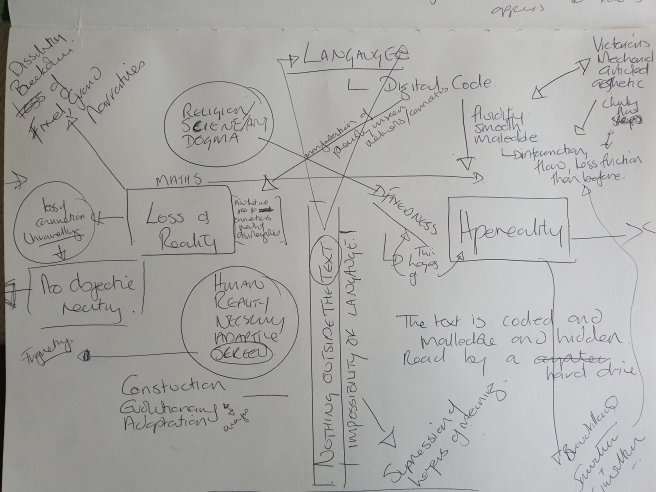
Tease out terms such as simulation and simulacra, structuralism and/or poststructuralism, Modernism/Post Modernism and keep relating to your practice. Give more space to these, aiming eventually to focus in. Having looked at early chapters of David Harvey, The Condition of Postmodernity – today the concern is with fluidity and malleability within language, underpinning reality and construction of it, compared to the Industrial resolution where, it seems, existence manifested itself in a more articulated manner.

Bring alternative thoughts into writing, i.e. “technology continues to penetrate or dissolve barriers” – or “builds walls… access to cheap technology but bombarded with advertising – penetrating the mind while depriving viewers of an education…”

Clarify use of the word ‘real’

Aim for greater depth of analysis

Make bold claims but back up with examples of work and wider context

Tutorial learning points

Investigate and try to make sense of a new type of hyperreality alongside what seems like a the loss of reality. Explore the erosion of critical thought and of education which leads to it. Look at Screen and Screen Education from 70s and 80s re linguistics and language. NB Language is arbitrary. Meaning never is (can’t see this came from.) I think this is from Chris Weedon, Feminist Practice and Poststructuralist Theory, Blackwell 1987. Look at the area of Visual Anthropology. In relation to first person in academic writing, ensure the knowledge is situated, i.e. I think this because and due to that in relation to… etc.  – not, black is red because I say so. (See A Cyborg Manifesto by Donna J. Haraway (1985) – discussed in Kathryn Hayles)

Reading suggestions

Francois Lyotard The Postmodern Condition, 1979

Terry Eagleton, Literary Theory, Blackwell, 1983

Toril Moi Sexual Textual Politics, Routledge, 1985

Amelia Jones (Ed.), The Feminism and Visual Culture Reader, Routledge, 2003

Elizabeth Wright (Ed.), Feminism and Psychoanalysis, Routledge, 1998

Summary of Research Proposal (amended in the light of the tutorial)

Research proposal still to be developed… (discuss with newly appointed tutor)

Come up with focus for second essay – currently thinking about loss of reality/hyperreality as a focus.


Strengths Areas for development
Committed writing  Needs greater detailed in-depth analysis
 Relevant topics

Thoughtful research closely aligned to practice

 Deeper research
Breadth of approach

Ambitious topic

Further exploration of theories presented, particularly Modernism/Postmodernism and the importance of film and photography in these theories


Any other notes


Roberta McGrath
Next assignment due End October