CS: Information management and technology LO4

I have not written about the way I managed information and research for my essay but one of the Learning Outcomes stipulates we should demonstrate if and how we used applications to support our work – so here it is.

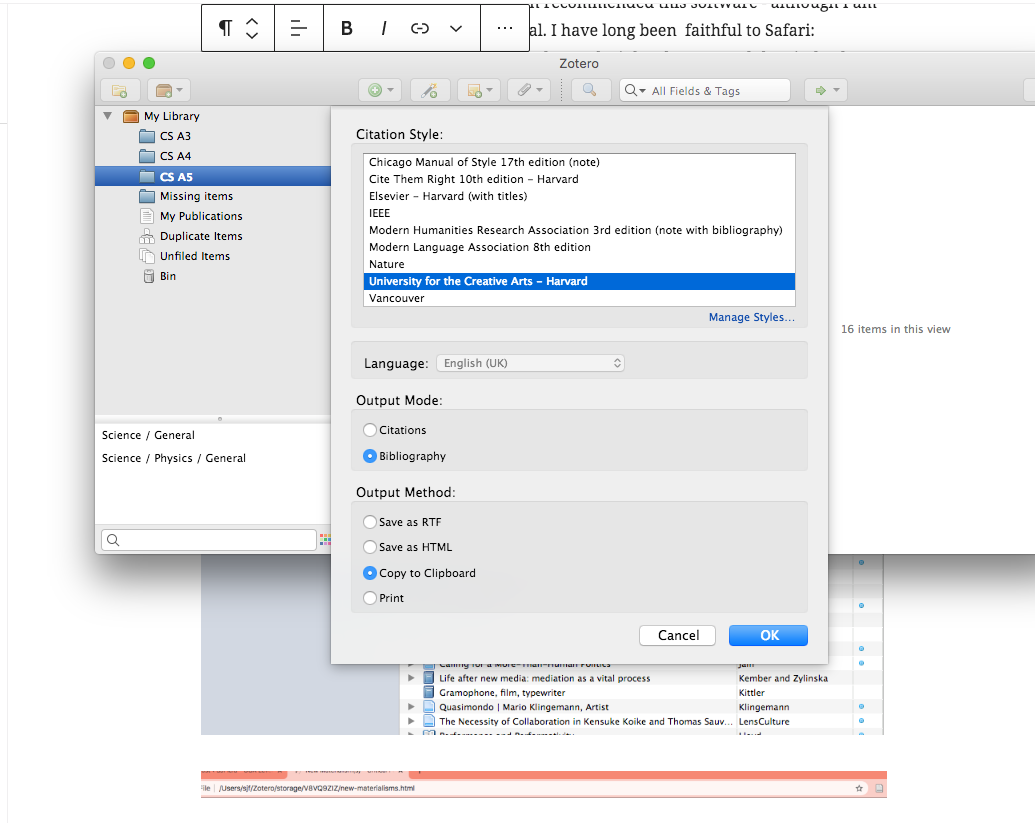
Zotero: Without Zotero, I would have found managing the overwhelming number of texts challenging. I was very pleased to have been recommended this software – although I am certain I did not make use of its full potential. I have long been faithful to Safari – however, so many coders seemed determined to make it hard to use and they indeed don’t help themselves. Zotero cannot be integrated with Safari, so I have gradually moved over to Chrome which can be, meaning you can simply click on a button in Chrome while looking at a webpage and it will store the information available – although, you must double check it’s all there and sometimes do a little bit of digging yourself. It was nevertheless very useful and saved a lot of time, especially when it came to compiling the bibliography (see last Zotero screenshot below, click on them to view).

Google docs

I have always used Microsoft Word but have lately found Google Docs more useful especially when receiving feedback, help with proofreading or citations style. As much as I’d like to avoid being a slave to Google – I have been grateful for its usefulness and suspect I will use it more and more if I continue academic study. I have made full use of its sharing documents facility.

WordPress blog

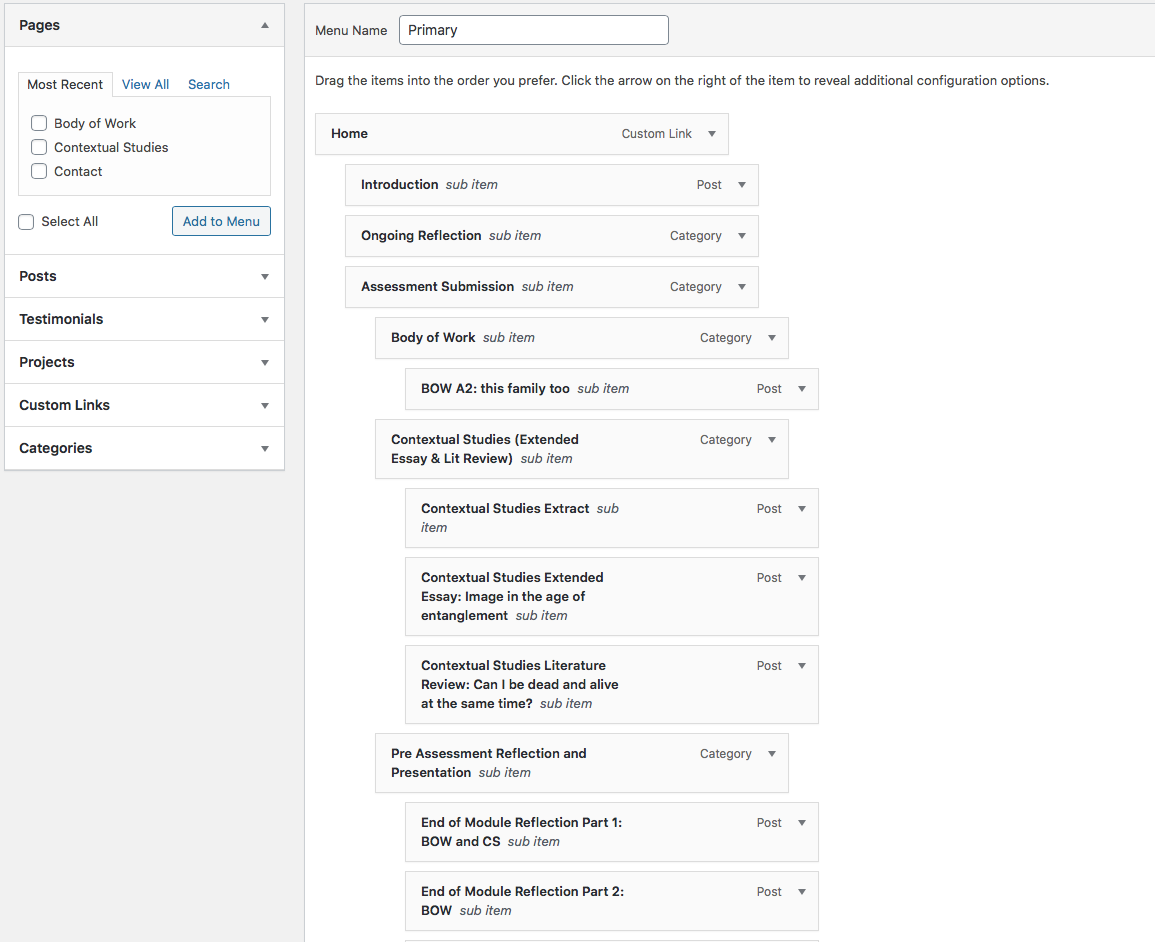
My blog and writing is extremely important to my process. One of the difficult things with this is reconciling the blog’s dual function as my digital note book and a means of presenting my ongoing development to others (tutors/students). Nevertheless, over the last few years, I have learned to label posts helpfully (although still sometimes forget) and use tags and categories. I suspect my menu-management is probably quite unnecessarily labour intensive and I can’t help thinking there must be a better way – however, I move certain posts into sections so they can be easily found rather than simply relying on categories that will pull up a string of related posts. The recent updates on WordPress will take time to get used to but I think there are some more helpful ways to store and track information available now. (Click in screenshots to view.)
Notes on my phone

I use the notes facility on my phone a great deal – making notes on the train, at night, storing things links etc.

Finally, I am aware that there are other apps designed to help store information, and file and categorise it, such as Mendeley. But I have found the system I using fine and am not sure I can cope with any more apps – although I still do sometimes read things and then wish I’d stored it as can’t recall what or where I might have seen it – which is frustrating. However, the more I get into the habit of recording links/making screenshots, the less that happens.

Grammerly and Outwrite

I use the free versions of both the above writing checkers on different platforms (even then, I make plenty of mistakes, but they are both super useful for me and probable undiagnosed dyslexia). I paid for a month’s subscription for Outwrite while going over the essay in the last few weeks. I find Outwrite more reliable. However, even then, I often don’t see mistakes until I look at a published document on a handheld device and have to do a final edit again.

Social Media

God, I hate Instagram. It’s awful. It’s reductive, superficial, cliquey and addictive. If it were not for this course (and my dying photography business – not much call for event photography and corporate headshots in the time of a highly infectious killing disease), I might have abandoned it altogether before now. However, both those needs keep me involved. A year or so ago, I set up a new IG account with my actual name attached (previously it was simply my initials). I had been using it to promote commercial stuff but not with the same commitment I approached IG with back in 2014/5 (when I was depressed so social media provided a good hidling place – ironically). At the beginning of lockdown I deleted anything too twee from it and started using it exclusively. I have played the social media game in the past but it takes up too much time and energy and there are better things to be doing with my time. Neverthless, I have been using it more energetically in the last few weeks to try and promote my not terribly commercial project for the sake of SYP. I use this is a promotional tool as I prepare for the final module. I should also start using my Sketchbook WordPress more too as that is good for generating views/SEO/directing people to your website/SM (it doesn’t strip exif data which other sites do). I am not so good with Twitter but am trying and have tended to use FB for commercial promotion (headshots, kids’ pics, corporate), but since that has died, I will likely use it to promote this work more.

https://www.instagram.com/sarahjane.field/
CS A2: Can I be dead and alive at the same time?

Literature review

After initially submitting the literature review last year, I rewrote a few sections to clarify. In the lead up to assessment, I have made very few adjustments other than updating and correcting the citation positions and rewriting a handful of sentences.

Contextual Studies Extended Essay

This is an offline version of the extended essay and does not show images which I do not have permission to show. A copy of the essay with all images is included in the GDrive for assessors. [Added December 2020 – there are some typos in this online version, please contact me for the submission copy supplied for assessment if required.]

CS: Extract

In the age of entanglement

Photography discourse is littered with opposing statements such as ‘photography is more important than ever’, or else it might be ‘dead and irrelevant’. Are proclamations such as these becoming as questionable as the West’s mechanistic view of reality, which arguably tends to foster such binarised positions? If the West’s historical paradigm, dominated by isolated objects, people, and places, spread across the planet and universe were receding, and instead, reality increasingly perceived as emergent, dynamic, multi-dimensional, and rhizome-like, how would photography fare?

Drawing on Karen Barad’s agential realism, a synthesis of quantum science and poststructuralism, the ensuing discussion results in more questions than answers. The challenge is compounded because we are also invariably constrained by a “Cartesian habit of mind” (Barad, 2007: 49) which informs our imaginations, language and academic conventions. Barad’s phenomenologically informed philosophy urges us to review our ethical relationship with the universe. Their thesis challenges boundaries we assumed were fixed, including those photography has relied upon to promote itself even when claiming to challenge the status quo. While describing some tenets of agential realism, focusing in particular on the phenomenological nature of existence and Barad’s use of the word entanglement, work by a variety of practitioners is examined in an effort to make sense of apparently contradictory statements by well-regarded and oft-quoted theorists about the photographic image today. How can Michael Fried’s (2008) assertion, photography matters as art as never before remain valid alongside Daniel Palmer’s (2014:144) statement, photography as we once knew it is practically over? Could both be true simultaneously in an entangled world? Will photography escape its Cartesian origins as it evolves into ‘image-making’ in a digital universe? The possibilities undoubtedly demand a deeper discussion than the stipulated 5000+/- word limit allows for, however, the paradigm described above presents image-makers of all persuasions with conundrums that increasingly cannot and should not be ignored.

SJField 2020

End of Module Reflection: CS

Three-minute read

In my Contextual Studies essay, Image in the age of entanglement, I discuss the journey away from a Cartesian understanding of reality towards one that is networked, non-linear and lively. I was influenced by a wide range of writers but focused in particular on Karen Barad, author of Meeting the Universe Halfway: Quantum Physics and The Entanglement Of Matter and Meaning (2007). 

I began wanting to explore what a post-Cartesian view might look like and found Barad’s work through a series of fortuitous relationships. Getting to grips with Barad’s ideas was and continues to be challenging. I do not come from a scientific background. I found it all very difficult indeed to research and understand.  However, in doing so, my own view has developed and my way of working too. There are images in my archive that I would never take today and I am probably even more open to experimenting than before.

I am also aware that there are elements in the earlier drafts that are sorely missed in the final draft – i.e. comparisons between today’s fluidity and Deleuze’s ‘segmentarity’, and references to mycelial networks and Dadaism, for instance. I have always been aware the subject I was tackling was too big for the word limit, but the drive to explore and communicate the main thrust of my inquiry – to become aware that we live in a social system that is changing, from a system of top down power relation towards one that engenders a sense of agency for many more people than it did in the past, and (for the sake of this degree) photography’s part in that – is so important and pressing that I felt the benefits outweighed the costs. Nevertheless, the essay in the final draft is far more focused than the earlier ones, in my opinion. Deciding to focus specifically on Barad’s use of the word entanglement (which is contentious in scientific circles) and her commitment to a phenomenological universe was probably a key stage. Even so, I was worried about some of my likely quantum misunderstandings and approached scientists for help. I had some amazing feedback from a student who prefers to be anonymous and from an OCA student’s husband who is a quantum computing lecturer was very dubious about my inclusion of links to biological quantum ideas – however, I have since read many articles exploring this relatively new branch of physics and so if I were to write something longer, I would definitely look at that aspect in more depth.

Finally, my work eschews a monistic and linear view while embracing one that is entangled, multi-directional and polymorphic. It asks what image-making is, was, and is becoming, and although the photograph is definitely a protagonist, it must share the stage with other forms of exteriorisation. In doing so, the collection of expressions and traces on pages and screens are an investigation into the decoding and recoding of reality – and perhaps prompts us to believe we have the wherewithal to make critical and much needed revisions as we (re)discover more about our place within the universe.

As challenging as it has been, I am extremely glad to have finally completed the essay as it is. I could not have done it without help from the following people:

  • Thanks to the many proof-readers (OCA and non OCA) and my highly educated friend Mariana for checking the citation style.
  • Thanks to the three scientists who read through earlier drafts, Professor Peter Doel – University College London, Professor Alan Woodward – University of Surrey, and a quantum mechanics student who prefers to remain anonymous.
  • Thanks to artist Rowan Lear, who is far more knowledgeable about Karen Barad and agential realism than I am, for reading through excerpts I was unsure about and clarifying for me.

Barad, K. M. (2007) Meeting the universe halfway: quantum physics and the entanglement of matter and meaning. Durham: Duke University Press.

Rubinstein, D. and Fisher. A. (ed.) (2013) On the verge of photography: imaging beyond representation. [PDF] Birmingham: Article Press. Available at: https://www.academia.edu/25121246/On_the_Verge_of_Photography_Non-representational_Imaging (Accessed 14/06/2020)

Zuboff, S. (2019) The age of surveillance capitalism: the fight for a human future at the new frontier of power. (First edition) New York: PublicAffairs.

CS A5: Referencing and Harvard Rules

There is often a lot of chat on the various OCA forums about referencing and the Harvard rules. I try not to get too overly focused on these as I have so much to think about and I find it a bit distracting. It’s hard enough for someone who is undoubtedly dyslexic, but can’t officially say as I have never been properly diagnosed. Simply organising thoughts, getting names right, just putting words in the right order is immensely challenging anyway. However, of course, I want to get the citations in the right place too as it would be dreadful to lose % based on that.  I knew I would need to address this roundabout now and am lucky enough to know someone with a lot of academic writing experience who has proofed my referencing.

However, I think it would be useful for the OCA to offer a short online tutorial occasionally to cover referencing rules. This would have been especially helpful after they changed, a little while back. Tutors could attend too since they seem to give conflicting, out of date advice, if any at all – even though the guidelines are clear and categorical. When students make enquiries with various non-teaching OCA staff, again the replies can be confusing. The whole thing ends up causing students undue worry about something that we shouldn’t have to get too stressed about  – because the rules are actually clear. But! …yes, there is a but – there are lots of them, and if you’re not used to it/dyslexic, it’s too easy to get simple things wrong.

We also all have different learning styles for different types of information. For me, the lack of spoken interaction across the board with the OCA has been one of the biggest difficulties as I pick things up quickly when I hear them, but I can miss relatively straightforward stuff when it’s written down in a dry document. (Youtube videos have been a godsend for me – but having a live person answering questions is always the best.)

  • For instance, I completely missed the fact you must put the citation after the surname when it’s in the text,
  • i.e. Barad (2007: 49) talks about a “Cartesian habit of mind”.
  • But when it’s in not in the text, it goes after the quote, as I had been doing with everything:
  • We all live with a “Cartesian habit of mind” (Barad, 2007: 49).

It also took me ages to get it into my head that the full stop needs to be after the end bracket in the previous example – it’s something I should have been getting right throughout the course really. I’m aware, this might seem impossibly simple for anyone who has not spent a lifetime getting their left and right the wrong way round (a typical dyslexic habit).

These things are so simple and so obvious once they’ve sunk in, though. I am sure there are students who get it straight away. But for those of us who don’t – there are several, if the various emails and forum threads are anything to go by – I really think it would be good to have the chance to attend one-off tutorials (with someone who can be trusted) which I mentioned above, just about this topic. By keeping it consistent, so that everyone at the OCA is aware of the same advice, and limited to Harvard Rules, the information would not get buried. And the worry people feel about it would be a relatively easy stress to address or even do away with altogether.


CS: A5 Edits following tutor feedback

Following the chat I had with Matt a couple of week’s ago and his feedback, I have finally managed to get the word count down – I suspect it is a bit less than stated on the cover now and will recount before assessment (I counted over the weekend but cut more this morning.)

I have emphasised the link between poststructuralism and the science philosophy/science using Barad’s interpretation far more than before, not so much due to Matt’s response – in fact, he told me not to undermine my argument after I attempted to accommodate notes made by two quantum scientists, both of whom said, but you can’t feel quantum fluctuations. It was that which made me grit my teeth (yes, I am aware!) and look through Barad’s work again and then to underscore the links between PS and the science.

Despite my frustrations, I am grateful to the scientists as their comments resulted in a more focused essay, I think, and I need to add thanks to them on the document.

I need to write to artists included and request permission to show their images on the blog version of the essay.

Introduction still isn’t quite right and I need to look at it again.

Appendix One could probably do with being heavily edited or even cut altogether now as I address the topic in the essay more.

At this point, finally, if any peers do read this yet again, I am now ready to address proofing/corrections if you notice them. It will be proofed by someone external in any case before the assessment deadline and has been through Grammarly. I do hope to God I have picked up the really daft mistakes/typos now and that everyone’s name is right.

CS A5 Image in the age of entanglement – July27th


CS A5: NB NB – some additional notes after sending the essay to tutor (my own feedback)

  • I have focused on two things in Barad’s interpretation – entanglement and phenomenology = reality, fixed photograph’s role within. Since submitting I have gone back and rewritten a couple of sentences in the intro and conclusion to underline this point. (Already adjusted)
  • I have re-written the first sentence – it was a bit sloppy and I have tightened it up and changed the word ‘evolving’ to ‘shifting’ to avoid the idea of a linear journey for civilisation from bad to good. (Adjusted on Matt’s copy in Gdrive)
  • I am concerned Appendix i – the second half of it – should really be in the essay but can’t see the space for it.
  • I miss Deleuze’s segmentarity, which I wrote about in the first draft (A3) recognisable in Talmor’s work – and as an example of difference to the fluidity seen in Klingemann’s images – again cannot see the space for it.
  • There is a comment in Superposition about it not being a mixture  – I feel like this is too flippant and needs explaining but can’t (it’s too complex for me! and there is no space) Should I take it out? I think so – maybe the whole bit about superposition. Perhaps I can just use it elsewhere and rely on the glossary?
  • Objects – I probably should have acknowledged something like OTT but don’t have space. It may be worth simply acknowledging that not everyone agrees with a purely phenomenological reality – although Bohr’s interpretation makes it hard to argue with. (Not to mention Hoffman’s theories about seeing and the brain)
  • I would have liked to discussed Diffractive Practice (an agential realist notion) but took it out after A3 – again, I am not clear enough about it in my own head and there is no space. I have tried to write diffractively and one of Rowan’s comment was that I was a bit inconsistent which feels accurate. (see feedback)
  • Another thing Rowan mentioned was how the AI was trained – “it is programmed through existing patterns (can you please explicate what the ai was, how it was trained etc – this is important).” I think I do need to find a way to include this – but it may be that the information is included in supporting text for my BOW and rather than expand on it in the essay, I link to it. If the writing were a longer piece it would definitely warrant a whole section. For the sake of the BOW – it’s really important the AI is a proprietary app that costs me £6 a month – an artificial friend I subscribe to. That relates to the anatomisation of relations – which I really wanted to cover in the essay – and Zuboff’s book The Age of Surveillance Capitalism where she discusses behavioural surplus.  This is something I really need to think about because I will need to do quite a big edit at this stage if include it and it will be a very different essay.
  • In a longer piece, there would be a good argument to include references to King Lear – it seems it is a play about shifting paradigms but instead of like our time – moving from Cartesian towards post – it was pre-Cartesian to Cartesian. There is also so much symbolism about seeing and nothing being something which ties in with a section I recently cut about the void not being empty space.
  • The work by Mikhael Subotzky I saw this morning is so relevant. I really feel I ought to mention it in Part II – maybe even use one of his images for the cover
  • It was interesting to note that the first UVC assignment I wrote came under the course heading of The Interaction of Media.
  • Although the concepts I look at come from quantum mechanics, they’re not brand new or novel – Julian Baggini’s recent book on cultures around the world seems motivated by the desire to show how western ‘common sense’ looks to those not influenced by a Cartesian history – I removed a quotation and might need to underline this point again in intro and conclusion.
  • I may find a way to add one of two possible examples to Part 2 – both counter the documentary tradition by using the style or equipment of those ‘hero’ photographers – but if I do this I need to give space and word count over which is going to be very challenging

Or

  • And what a terrible shame not to have found space for this guy! (His book isn’t out in time in the U.K. – but there are interviews aplenty and I might even have a sneaky way of getting an early copy)

https://www.penguin.co.uk/books/1115381/entangled-life/9781847925190

Overall – The essay feels a bit slim in parts right now. I have been through it, removed bits where I was a bit apologetic or seemed to be excusing things I’d included. I will wait until I have spoken with Matt before making any of the above adjustments and then upload another draft for assessment.

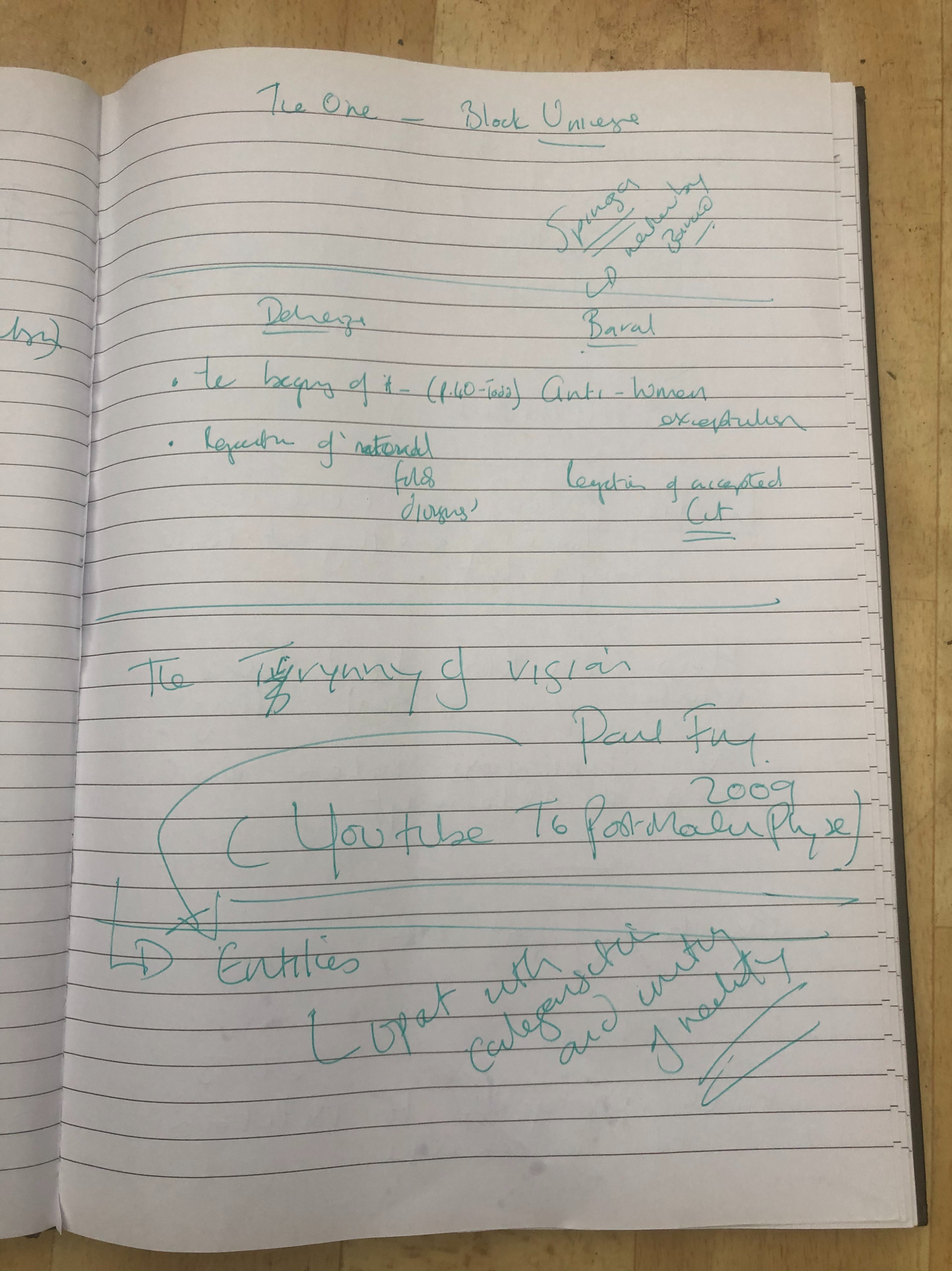
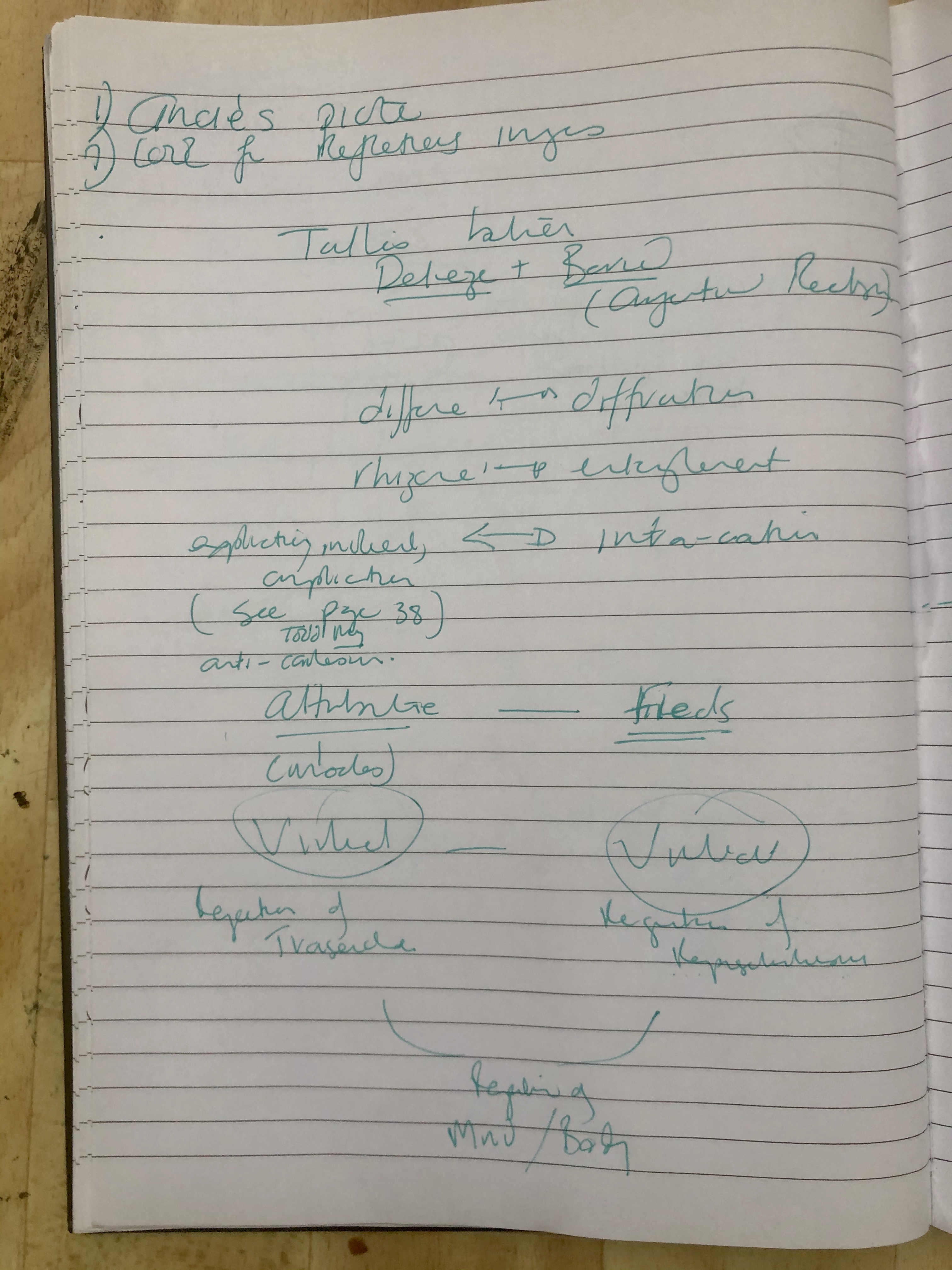
BOW/CS: Research , Delueze ‘difference’ & Barad ‘diffraction

Barad quotes Deleuze once in her first chapter at the top of a section, referencing language (words) and the problem of representationalism, and later, he is relegated to a sentence in her notes which mentions how his view on entities interacting – which are so similar to Barad’s ‘intra-action’ is irrelevant (2007, 437, n80). She writes ‘possibilities are reconfigured and reconfiguring’ (177) For Deleuze, there is folding and refolding and unfolding and refolding (May, 2005). I find Barad’s neglect of Deleuze surprising and wonder what it’s about. She tells us she is a Derridian – maybe it’s just about preference, but I suspect there is more to it. Can’t believe it’s related to views’ like Scruton’s dismissal of Deleuze.

Regardless, there are lots of correlations, and in any case, neither’s views are entirely new (suggested by Professor Paul Fry, Harvard) since the overemphasis by humans on their separability  – rejected by both Barad and Deleuze – is explored by Walter Pater in his 1873 book The Renaissance: Studies in Art and Poetry. The difference with Barad is she has the language of science backing up her arguments (although even then, they are contentious in some circles). Fry says Deleuze’s writing style is excitable – maybe it’s that which puts Barad off.

I have recently been reading Todd May who is recommended by different people as being good on Deleuze – and was thrilled to see morphology discussed in one of his videos as that links directly to my DI&C work. In the meantime, some notes taken while istening to Professor Fry’s lecture (see below):

IMG_2171IMG_2172IMG_2173IMG_2175IMG_2174


Barad, K. M. (2007) Meeting the universe halfway: quantum physics and the entanglement of matter and meaning. Durham: Duke University Press.

May, T. (2005) Gilles Deleuze: An Introduction. (s.l.): Cambridge University Press.

The Postmodern Psyche Explained (s.d.) At: https://www.sam-network.org/video/the-postmodern-psyche-explained(Accessed 16/02/2020).

CS: Alan Sekula’s The Body and the Archive part 1

Sekula, A. (1986) ‘The Body and the Archive’ In: October 39 p.3064. At: http://chnm.gmu.edu/courses/magic/sekula.pdf (Accessed 23/11/2019).

Field, S. (2017) Notes: The Body and the Archive Allan Sekula. WordPress [Blog] At: https://ocasjf.wordpress.com/2017/06/12/notes-the-body-and-the-archive-allan-sekula/ (Accessed 05/01/2020).
Heimans, J. and Timms, H. (2018) New power: how it’s changing the 21st century – and why you need to know. (Kindle) London: Macmillan.
Blatt, Ari J. 2009 ‘The interphototextual dimension of Annie Ernaux and Marc Marie’s L’usage de la photo‘, Word & Image, 25: 1, 46 — 55, 27 – Alain Fleischer, Mummy, mummies (Lagrasse: E ́ ditions Verdier, 2002), pp. 15–16. Translations mine. (Blatt) Available at: https://www.tcd.ie/French/assets/doc/BlattOnErnauxMarie.pdf [Accessed: 24/04/2018]
Quantum Fields: The Real Building Blocks of the Universe – with David Tong (2017) In: The Royal Institution. Royal Institute. At: https://www.youtube.com/watch?v=zNVQfWC_evg (Accessed 05/01/2020).

I looked at this essay during S&O and will look at it again here – Sekula’s essay along with John Tagg’s talk on the filing cabinet both provide plenty of useful references, which, combined with Barad, Lupton and Rubenstein’s thoughts/thesis’, are probably the key sources of information through which I’ll explore at the topic I’ve chosen.

  • The essay opens with the paradoxical status of photography in bourgeois culture (3)
  • He quotes a song which ‘plays on the possibility of a technological outpacing of already expanding cultural institutions’. (4) This rings true today (see New Power, (Heimans and Timms, 2018))
  • You could replace the work photography with digital for the first two pages and it would all sound relevant and fair.
  • However, by page 6, the veracity of the photography is being discussed, as seen by contemporaries – ‘Only the photograph could begin to claim the legal status of a visual document of ownership’
  • ‘a silence that silences’ (See muteness and photography – ‘Ernaux reminds us, initially ‘all photos are mute’’ (p.73).) Blatt, Ari J.(2009))
  • (6) ‘the criminal body’ and therefore the ‘social body’ invented
  • ‘a system of representation capable of functioning honorifically and repressively’ (6) how does this work with representationalism and the unpicking of that? There are no entities waiting somewhere to be represented, rather there are emergent intra-active phenomena (Barad, 2007) (criminal and social bodies are made/formed)
  • again photography can be replaced with digitisation when discussing how portraits are degraded and extended at the same time – see selfies, phone pics
  • (7) ‘Photography came to establish and delimit the terrain of the other, to define both the generalised look – the typology – and the contingent instance of deviance and social pathology.’ So much to say here – See Azoulay (2019) and photography’s intra-active position/role within a much wider non-linear narrative. See Tagg and ‘fixity’ of the photography and Victorian culture – the desire to catalogue everything according to ordered and identifiable rules, (2011) i.e. the periodic table of elements  – a Victorian System compared to today’s quantum fields, a modern system/model of reality which we are informed in most accurate to date and is far more nebulous and difficult to comprehend, no doubt in part due to our Cartesian ‘habit of mind’ which is desperate to label and file everything neatly and ordered (Barad, 2007) as well as being counter-intuitive, shrouded in academic mystery and just really impossibly hard. The Victorian system and hence our dominant one (although this is changing hence the entrenched reaction of a conservative mindset), seems desperately naive in comparison.
  • (7) See quote about ‘possessive individualism’ which I’ve already inserted into CSA2
  • (7) Relate photography ‘a means of cultural enlightenment’ and ‘sustained sentimental ties in a nation of migrants’  – compare this to digital tech/culture in today’s culture. Beneath both Carlyle and Aurelias Root’s comments is a dreadful patronising tone however which is surely avoidable. See images ‘of the great’ = ‘moral exemplars’ ??? (Imagine a photograph of any of our current crop of erstwhile leaders providing such?)
  • Sekula writes of the utilitarian social machine, the Panopticon – think today of social media/ Surveillance Capitalism (Zuboff, 2016) (9)
  • The archived body – ‘begins’ here see page (10) begins is not the right word, becomes visible perhaps.
  • 911) physiognomy and phrenology  – ‘surface of the body’ ‘bore the outward signs of the inner character’  – Compare this to Professor Plomins deterministic genetic code thesis which Cummings et al relied upon to justify changes they made to the Education system. Cummings claims that people misunderstood the work and have since retracted their negative comments. However, I think Christakis’ comments on genetic coding is probably more honest  – both I suspect, however, show how deep and far-reaching social construction and their associated embedded epigenetic markers can be. Whereas some can see the need for more positive and profound structural changes to take place, there is a mindset which believes we should further entrench these realities which Sekula is talking about that continue today. I was also struck while reading this by the similarities in an article I read today some on FB (I think) which claimed the more bitter and cynical you are, the more likely you are to age quickly and get sick. Lots of scientific data support the thesis – the way it’s been framed, but I am quite cynical indeed and look about fifteen years younger than some of my friends  – so I felt a little doubtful  – we people seem to enjoy deterministic narratives even today.
  • (11) borne of ‘attempts to construct a materialist science’  – compare to Barad’s performative/discursive/material emergence of meaning, far more complex and lively but nebulous so hard for people to engage with
  • Maybe time to revisit Szondi who I discussed in my first reflection about this essay – an early psychometric tester, he defined people by their reactions to faces rather than by the shape of their own faces/heads. Many companies today use much more robust psychometric tests which are extremely powerful but one wonders about the wonderful aspect of chance being eliminated. And so we enter the discussion of AI and how it can be so much more accurate than human power but how much agency do we give it? Currently watching Travelers (Netflix) which explores this in typical pop-culture fashion – first series better than then the rest and lots of references to .
  • Sekula identified ‘idealist secret lurking a the heart of the putatively materialist sciences’ – how is the AI screening of CVs and psychometric testing any different? And you should see the John Lewis video that you must watch before taking thier tests   – madly idealist in quite a scary way, reminded me of Logan’s Run (In HR terms, humans do still get involved: I know this as AI testing identified me as potentially suitable for a well-paid relatively high-status job but my lack of experience ensured I was rejected once a human looked at my CV in one particular application process!) Perhaps I will include some of the resulting descriptions of me, having taken part in this process in my BOW… 
  • TBC