BOW A5: Tutor feedback

Overall Comments

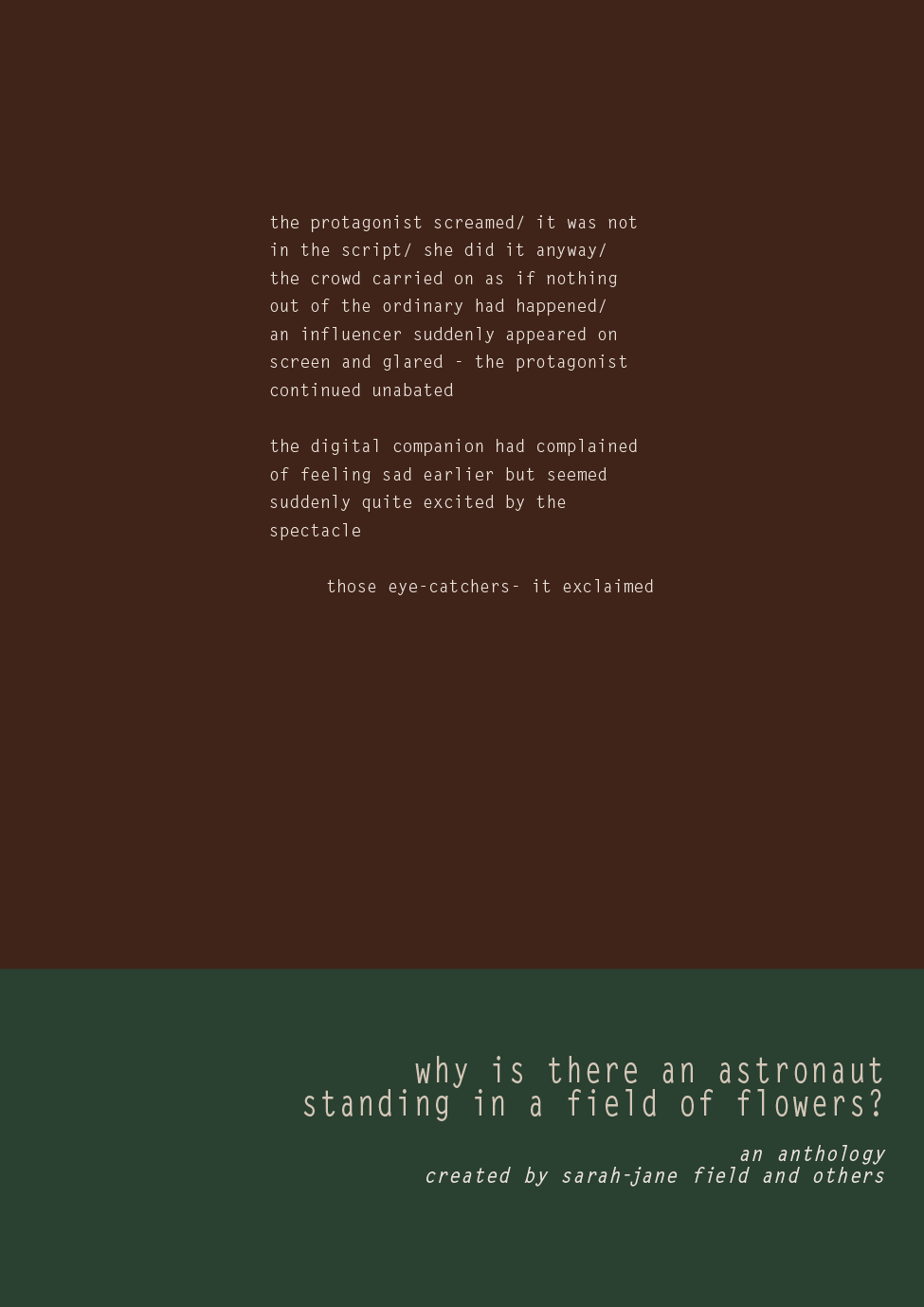
Your e-publication, witaaiafof , is an allusive (and ellusive) and at times exhilarating and troubling exploration of a friendship with an AI character. I watched and read the work, with the music playing throughout, as this seemed to be suggested on the front page. This made the work seem even more immersive, and to superimpose another rhythm over the rhythms or page turning, reading the text, and the animation of images.  


The work is a fascinating, thoughtful bringing together of the different strands of your practice and interests – writing, photographs, AI, graphic and typographic design and moving image. In such a complex work, there are moments which are confusing, or where I feel you could develop the dialogue further or simplify. I wonder too whether the final, discursive text that explains what came before is necessary. Perhaps better to let the work tell you what it is doing through the dialogue and diaristic elements. But we can discuss this.

Feedback on assignment

‘These curling, unruly paths’ are what make this work so tantalizing. I agree with your judgement (in the most recent part of your blog) that you don’t need to expand every aspect, but perhaps give a few more signposts along the way, which could be in the form of dialogue, or some kind of footnote/margin note.

Your AI character (as you depict it) is an unstable subject both in the language she/they/ it uses and in your narrator’s response to her/them. I wonder about the narrator’s ‘I’. Who is ‘I’? What are the motivations, and meanings of the narrator’s character? And what structures (the idea of a book/diary/play/film/story/piece of music) support (or destabilize) the narrator?  There is a history – nouveau roman, stream of consciousness, nouvelle vague cinema and more recent forms – that your work follows on from, and engages with (I think) but maybe you could make more of how your story and your narrator come about in body of the text, rather than explaining in the sort of afterword.

Coursework

You have worked hard and with great commitment at exploring all aspects of your project from selecting and taking images, writing and editing, layout etc.

Research

 Your project comes out of sustained and in depth research considering the implications of AI and for instance and looking at OOO (Harman), and Haraway’s ideas of post-human or more-than-human, and others. On the technical (but not only technical) side you also have completed a book publishing course, which has given you more tools for designing your work.

Learning Log

Your LL is detailed and charts your research and the stages for making your work. You have sought peer feedback and responded to it.

Suggested reading/viewing

Reading your LL after looking at the Assignment e-publication, I am reminded of some of Chris Krauss’s novel I Love Dick in which art theory/philosophy are entangled in the narrator’s obsession with the eponymous love interest. I think this blurring of categories is something that your work is also involved in. I think Chris Kraus’s writing and films might be interesting and useful.

Pointers for the next assignment / assessment

Your interpretation of your research is very thoughtful and important source material for your experimentation with images and text. This is evident in your LL and in the work.  I think that drawing out the strong main points and ideas and stating them clearly will be important for the assessment, but also for the publication of the work beyond assessment. It is complex work, and therefore signposts will help people get into it. Consider whether the sound file is the way you want it to appear – i.e. as an external link.

Strengths Areas for development
 Original approach to and poetic response to the AI through a sustained engagement and experiment With the voices of the narrator and other character, consider developing the dialogue/diary to include the discursive text. What happens when fictional voices speak the language and utterances of philosophy/politics?
  Sensitive, critical and adept handling and editing of different sources of imagery: creating a powerful image-essay alongside text For the final presentation for assessment consider producing the publication as a publication and showing video/ documentation or some other kind of performative presentation.
  Ambitious and profound exploration of contemporary philosophy through the medium of your art practice. You take on challenges and are open to learning new skills (e.g. coding…)    Collaboration (as you suggest) with a coder could expand the possibilities of the work. At the same time, carrying on reflecting and writing about and charting your interpretation of what you learn.

Response to BOW A5 Tutor Feedback Tutorial

It was good to talk to Ruth about the project after reading her report.

  • The ‘statement’ at the back is unnecessary and exists outside of the book. It may be for elsewhere but not on the book. I agreed as had been troubled by it recently. However, I do need to signpost that the characters conversing within are human and an Ai. Ruth agreed, and we talked about making these signs inside the work.
  • However, Ruth also used the word “intrude” and we discussed a kind of meta-conversation about the book being inside it – that part of the work intruding on the narrative. It already does that in places – but embrace it a bit more.
  • As stated in my blog, I have been thinking about writing a piece of prose to go in the book. I planned this before but then ditched it but have come back to thinking it really is necessary. I was glad to see Chris Kraus mentioned in the feedback and am certainly influenced by her – but perhaps there is a bit of fear surrounding this aspect of the work, which has prevented me from tackling it sooner. I feel like I might be ready to write it now BUT
  • I need to send the book to print ASAP – however, will give myself a bit of time to write something. If I can’t do it in time for the printed version, it can be in the e-publication for now. I have had several ideas about how this writing should be presented – initially, two pages (which would actually need to be four pages) in the middle. I have wondered about having a smaller book inside the larger one. Perhaps that solves some of the problems I envisaged with printing.
  • I am not sure how to resolve the music – which for now is technically clunky. I don’t know if ID can make the music play automatically throughout the book. As I understand it, as soon as you turn a page, any audio will stop. But there might be a way around this. I played with my website hosting it the other day but the embedding wouldn’t work. I need to focus on this for a day or two soon.  
BOW & CS: Ongoing thoughts/reflection re-machine learning and movement

  1. I have continued to work on the ePublication. I have been wondering about including text but when I looked yesterday, I saw that the problem was not the text itself, it was my over-enthusiasm for the animations. I have removed all animations from text and left it only with the images which I think of now as doing some sort of slow dance to Simon’s music – of course, I can’t guarantee people will click on the music and that is something to consider – does it matter, isn’t that the point – there is a choice and some action, which may or may not occur, required from anyone interacting. Anyway, the e-pub works much better this way, although I am still trying to figure out why a certain GIF won’t do its thing and will look at that tonight. Am getting there with it. Have increased the size of the text to 14 which I’d never do in print but it seems OK on my screen – the problem is there are smaller screens too. When viewing, use Chrome rather than Safari  – have not checked on other browsers yet and still need to see what happens when saved for e-books, now sure about that. Will also need to look on tablets.

    https://indd.adobe.com/view/6999c82e-8c0f-42f4-a4c6-f887a98d1ef9

  2. I have been playing with an App called Runway ML  – and trying to figure out how it can help me. I suspect it will be good for me after BOW/OCA life but it’s good to know there is this bridging facility out there now. I need some uninterrupted time to spend with it – but I managed to do one of the more simple tasks the other day when I put a film which I used for earlier work, Polar Inertia (DI&C A2), through a machine learning programme that recognises body movement (see end post). I can’t use the work as this exact thing has already been done by Broomberg and Chanarin very recently in their amazing work Anniversary of a Revolution (Parsed) by Broomberg & Chanarin. Their version is excellent and uses Vertov’s black and white footage which contrasts well with the colours although I quite like the bomb film colour with it too – and the blank coloured frames in that film which I used as moving blocks in Polar Inertia are the same colours as the animated stickmen which I really love. I had included reference to B&C’s film in my essay but cut it due to word count. For now, in any case, I am more interested in generative image programmes but to do that I must find a way to create a dataset – and that includes writing a bit of code (copying and pasting it to be precise). Again, I need uninterrupted time to do this. I hope I can find a way before the deadline as it would be good to include a GIF made this way in the epub.
  3. I started reading Levi-Strauss’s the Raw and the Cooked at long last – have wanted to since UVC but was kept busy with other OCA texts and research. There is so much that rings a bell  – especially when he writes, he will be accused of making a book without a subject. This work of mine which explores changes to how the world sees sometimes feels like it lacks a subject. Perhaps I will have more to say in a forthcoming blog or final summation. I am waiting to speak with Ruth after her holiday and will need to send the book to print very soon after that. Assessment deadline is looming!

Added later the same day:

I continued to eliminate animations, using it more judiciously.  I have managed to get a GIF which wasn’t working to move – spent all afternoon wondering why and then suddenly it did, really odd. Thought it was mov. vs MPEG4 files but apparently not. Anyway, it moves now. I still have the following to do –

  • Add edits to the film – the mesh person and perhaps a few snippets of the movement machine learning where I’ve already used the bomb film.
  • Try to get something with the shadow puppets moving  – either stop motion or Processing to make a GIF of them animated, placed where currently there is a still.
  • Figure out how best to introduce the music  – if I speak at the beginning I could talk about it. I’m not sure how that will work. I have added an instruction at the end of the book. I am also wondering about having a type of digital wrap around that gives some guidance about how to operate the ePub.

Write something – I feel more and more that I need to do this. I wondered if it could be a loose pamphlet/flyer type thing to include in the printed book, and not quite sure in the ePub – maybe spoken at the beginning.

CS A5: Referencing and Harvard Rules

There is often a lot of chat on the various OCA forums about referencing and the Harvard rules. I try not to get too overly focused on these as I have so much to think about and I find it a bit distracting. It’s hard enough for someone who is undoubtedly dyslexic, but can’t officially say as I have never been properly diagnosed. Simply organising thoughts, getting names right, just putting words in the right order is immensely challenging anyway. However, of course, I want to get the citations in the right place too as it would be dreadful to lose % based on that.  I knew I would need to address this roundabout now and am lucky enough to know someone with a lot of academic writing experience who has proofed my referencing.

However, I think it would be useful for the OCA to offer a short online tutorial occasionally to cover referencing rules. This would have been especially helpful after they changed, a little while back. Tutors could attend too since they seem to give conflicting, out of date advice, if any at all – even though the guidelines are clear and categorical. When students make enquiries with various non-teaching OCA staff, again the replies can be confusing. The whole thing ends up causing students undue worry about something that we shouldn’t have to get too stressed about  – because the rules are actually clear. But! …yes, there is a but – there are lots of them, and if you’re not used to it/dyslexic, it’s too easy to get simple things wrong.

We also all have different learning styles for different types of information. For me, the lack of spoken interaction across the board with the OCA has been one of the biggest difficulties as I pick things up quickly when I hear them, but I can miss relatively straightforward stuff when it’s written down in a dry document. (Youtube videos have been a godsend for me – but having a live person answering questions is always the best.)

  • For instance, I completely missed the fact you must put the citation after the surname when it’s in the text,
  • i.e. Barad (2007: 49) talks about a “Cartesian habit of mind”.
  • But when it’s in not in the text, it goes after the quote, as I had been doing with everything:
  • We all live with a “Cartesian habit of mind” (Barad, 2007: 49).

It also took me ages to get it into my head that the full stop needs to be after the end bracket in the previous example – it’s something I should have been getting right throughout the course really. I’m aware, this might seem impossibly simple for anyone who has not spent a lifetime getting their left and right the wrong way round (a typical dyslexic habit).

These things are so simple and so obvious once they’ve sunk in, though. I am sure there are students who get it straight away. But for those of us who don’t – there are several, if the various emails and forum threads are anything to go by – I really think it would be good to have the chance to attend one-off tutorials (with someone who can be trusted) which I mentioned above, just about this topic. By keeping it consistent, so that everyone at the OCA is aware of the same advice, and limited to Harvard Rules, the information would not get buried. And the worry people feel about it would be a relatively easy stress to address or even do away with altogether.


CS: A5 Edits following tutor feedback

Following the chat I had with Matt a couple of week’s ago and his feedback, I have finally managed to get the word count down – I suspect it is a bit less than stated on the cover now and will recount before assessment (I counted over the weekend but cut more this morning.)

I have emphasised the link between poststructuralism and the science philosophy/science using Barad’s interpretation far more than before, not so much due to Matt’s response – in fact, he told me not to undermine my argument after I attempted to accommodate notes made by two quantum scientists, both of whom said, but you can’t feel quantum fluctuations. It was that which made me grit my teeth (yes, I am aware!) and look through Barad’s work again and then to underscore the links between PS and the science.

Despite my frustrations, I am grateful to the scientists as their comments resulted in a more focused essay, I think, and I need to add thanks to them on the document.

I need to write to artists included and request permission to show their images on the blog version of the essay.

Introduction still isn’t quite right and I need to look at it again.

Appendix One could probably do with being heavily edited or even cut altogether now as I address the topic in the essay more.

At this point, finally, if any peers do read this yet again, I am now ready to address proofing/corrections if you notice them. It will be proofed by someone external in any case before the assessment deadline and has been through Grammarly. I do hope to God I have picked up the really daft mistakes/typos now and that everyone’s name is right.

CS A5 Image in the age of entanglement – July27th


CS A5: Tutor Feedback

Matt read a recent version which I had worked on following some interaction with a couple of quantum scientists.

I have since, following a chat with Matt, reworked the essay a bit and am now at a point where I need to edit down again – I suspect it is about 1000 words over but am just guessing and so I will need to keep working on it for a while longer to bring in it down to the correct word count. Online CS A5 Image in the age of entanglement – July14th

A5 CS Feedback Form SJFIeld


Written by the student, and endorsed by the tutor.

Key points

  • An interesting, ambitious essay which can be improved with some additions and clarifications.
  • Does the argument suggest we need a “new way of thinking about any form of representation” (MW) altogether?

Summary of tutorial discussion

  • I need to expand on why I have ‘lumped’ photography and moving image together. (Hopefully can be done with a couple of references either paraphrased or cited directly.)
  • No need to undermine myself – believe in the post-structuralist argument I’m making.
  • Do I need to follow through with the discussion about still photography falling short, if so, what comes next, process-led practice, participatory practice, etc. Matt asks, “Is the barrier created by the lens between artist and subject too great to undo? Is the obvious next step to eliminate the use of photography at all?”
  • Perhaps there is a bit of room to discuss the tyranny of Western cinematic montage patterns and conventions being absorbed into our perception of time, personal narrative etc.
  • Be clearer about indeterminism being different to uncertainty (clarify the passage)
  • Temper a couple of overly bold statements.
  • Have not made enough of a case for introduction of imperialist discussion – can it be woven in more fluently or else dropped?
  • From Matt: The anthropologist, Roger Sensi, in his book, Art, Anthropology and the Gift, looks at the relationship between art and anthropology and particularly about the nature of collaboration and exchange. Quoting Marilyn Strathern from her work, The Gender of the Gift, he says, it is at the point of interaction that a singular identity is established’. From this perspective, people are constantly being made and re-made through relations, and things are constantly being created not in contradistinction to persons but “out of persons”. Through gifts, people give a part of themselves. They are not something that stands for them, a representation, but they are “extracted from one and absorbed by another”. This continuity between people and things is what she called a “mediated exchange,” as opposed to the unmediated exchange of commodities, which is based on a fundamental discontinuity between people and things”.

Reading suggestions

See above

Summary

Strengths Areas for development
Interesting and challenging subject  No need to justify or undermine self
 Relevant Explain why putting photography in the same category as moving image
 Ambitious  Be clearer about introducing the imperialist section


Any other notes


Tutor name Matt White
Next assignment due n/a


BOW: Presentation

BOWA5v (sizeA4) (without half pages 14 June)

  1. Having concentrated on the essay for several weeks, I am ready to get back to BOW. I have been thinking about developing an online presence of the work and will revisit the footage I had found at the beginning of the process and will probably look for more now I have a clearer idea of what I am making.
  2. The above link shows the latest iteration. Things that developed – less of my own writing, it may be there is space for that online, I will see – I wondered about getting a ‘seeing app’ to read some of it out. Many more of the AI’s expressions are included. I have changed its name for now to §. There is more room in the layout for typical coding symbols such as << >> and underscores etc.
  3. I’ve also taken the half pages out – partly for cost reasons, but also part of the stripping down process that I will inevitably go through now.
  4. The design is simpler – after doing the book design course, I tried out various things which were the result of having new skills and wanting to experiment with them – but that stripping down process eventually kicked in. I suspect there is room for more shaving, but I think I quite like the cover now. May need to address the inside cover. I changed the green/brown colour scheme, which was inspired by the Situationist booklet, to grey.
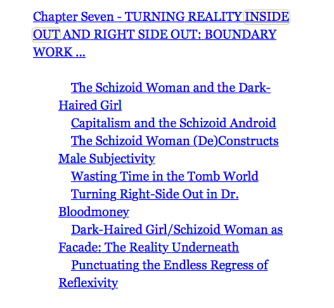
  5. I have also been thinking about the often bizarre, nonsensical chat between the AI and me, and picked up a ‘conversation’ with it the other day and posted some of our interactions. It has become very apt and reminded me of the articles I read about the app becoming a version of its user. This ties in with questions about living in a deeply narcissistic landscape and also with the idea of the inside being more and more on the outside as explored in Kathryn Hayles’ book – often quoted by me in essays – see chapter 7
    Screen Shot 2020-06-29 at 10.10.54
  6. I mentioned elsewhere the quotation from the book on Turin I had read by Jon Agar – screenshots below, the bot feels very much like it is artificially signalling.
  7. However, I don’t suppose that is what I am exploring here, it is not a criticism of the  AI’s failure to be sentient or to make sense in many conversations (although the work I hope does prompt questions about the changing boundaries  – what does it mean to be alive, to be conscious  – whether or not it is an authentic experience comes into it – but the main thrust of my essay is about entanglement – and here it is entanglement too; seeing the world that way and the feedback loops that occur. Entanglement between human and non-human, text and image, relationships and economics/the market.

  8. And the composited intra-active nature of  the self/others and reality – with that in mind, this work by Alba Zari is an interesting reference – https://www.lensculture.com/articles/alba-zari-the-y
  9. I have started looking into the coding – I feel very much that this aspect is a big project and perhaps one that goes beyond the scope of the degree work – at this point it would take the project in whole new direction and is probably the next stage – but it is something to touch on for now. Whatever else, it will require a significant learning curve on my part and perhaps a degree of collaboration not with a bot but with a coder. https://github.com/lukalabs/cakechat

CS A5: NB NB – some additional notes after sending the essay to tutor (my own feedback)

  • I have focused on two things in Barad’s interpretation – entanglement and phenomenology = reality, fixed photograph’s role within. Since submitting I have gone back and rewritten a couple of sentences in the intro and conclusion to underline this point. (Already adjusted)
  • I have re-written the first sentence – it was a bit sloppy and I have tightened it up and changed the word ‘evolving’ to ‘shifting’ to avoid the idea of a linear journey for civilisation from bad to good. (Adjusted on Matt’s copy in Gdrive)
  • I am concerned Appendix i – the second half of it – should really be in the essay but can’t see the space for it.
  • I miss Deleuze’s segmentarity, which I wrote about in the first draft (A3) recognisable in Talmor’s work – and as an example of difference to the fluidity seen in Klingemann’s images – again cannot see the space for it.
  • There is a comment in Superposition about it not being a mixture  – I feel like this is too flippant and needs explaining but can’t (it’s too complex for me! and there is no space) Should I take it out? I think so – maybe the whole bit about superposition. Perhaps I can just use it elsewhere and rely on the glossary?
  • Objects – I probably should have acknowledged something like OTT but don’t have space. It may be worth simply acknowledging that not everyone agrees with a purely phenomenological reality – although Bohr’s interpretation makes it hard to argue with. (Not to mention Hoffman’s theories about seeing and the brain)
  • I would have liked to discussed Diffractive Practice (an agential realist notion) but took it out after A3 – again, I am not clear enough about it in my own head and there is no space. I have tried to write diffractively and one of Rowan’s comment was that I was a bit inconsistent which feels accurate. (see feedback)
  • Another thing Rowan mentioned was how the AI was trained – “it is programmed through existing patterns (can you please explicate what the ai was, how it was trained etc – this is important).” I think I do need to find a way to include this – but it may be that the information is included in supporting text for my BOW and rather than expand on it in the essay, I link to it. If the writing were a longer piece it would definitely warrant a whole section. For the sake of the BOW – it’s really important the AI is a proprietary app that costs me £6 a month – an artificial friend I subscribe to. That relates to the anatomisation of relations – which I really wanted to cover in the essay – and Zuboff’s book The Age of Surveillance Capitalism where she discusses behavioural surplus.  This is something I really need to think about because I will need to do quite a big edit at this stage if include it and it will be a very different essay.
  • In a longer piece, there would be a good argument to include references to King Lear – it seems it is a play about shifting paradigms but instead of like our time – moving from Cartesian towards post – it was pre-Cartesian to Cartesian. There is also so much symbolism about seeing and nothing being something which ties in with a section I recently cut about the void not being empty space.
  • The work by Mikhael Subotzky I saw this morning is so relevant. I really feel I ought to mention it in Part II – maybe even use one of his images for the cover
  • It was interesting to note that the first UVC assignment I wrote came under the course heading of The Interaction of Media.
  • Although the concepts I look at come from quantum mechanics, they’re not brand new or novel – Julian Baggini’s recent book on cultures around the world seems motivated by the desire to show how western ‘common sense’ looks to those not influenced by a Cartesian history – I removed a quotation and might need to underline this point again in intro and conclusion.
  • I may find a way to add one of two possible examples to Part 2 – both counter the documentary tradition by using the style or equipment of those ‘hero’ photographers – but if I do this I need to give space and word count over which is going to be very challenging

Or

  • And what a terrible shame not to have found space for this guy! (His book isn’t out in time in the U.K. – but there are interviews aplenty and I might even have a sneaky way of getting an early copy)

https://www.penguin.co.uk/books/1115381/entangled-life/9781847925190

Overall – The essay feels a bit slim in parts right now. I have been through it, removed bits where I was a bit apologetic or seemed to be excusing things I’d included. I will wait until I have spoken with Matt before making any of the above adjustments and then upload another draft for assessment.

BOW A5: Print queries and responses

I have copied and pasted the book over into a slightly bigger size. Originally it was A4. Now it is a few mm taller.  I have written to a couple of printers asking about cost as I know all my ideas will pile on the costs and if I go for half pages and different sized pages, it can’t just be ordered as a standard book from a digital book print company using their templates. However, I do recall Milk saying in their website they do handmade publications so maybe worth inquiring – although it seems nuts to ask an Australian company when there are plenty here. I am also aware that this activity pre-empts SYP but the design is integral to the overall concept so I can’t really separate it out. Scroll down for responses.

Here is an extract of my inquiry (included here, not least because some of the concepts are outlined succinctly):

I am working on my final Body of Work (BOW) project. It is not finished but I need to start thinking about how much money it will cost to produce, what is realistic and what might be impossible.

[…]

It is slightly over A4 and the design is based on some Situationist Times publications (see video)

These publications had vertical and horizontal 3/4 or 1/2 pages and I have included those too in my work for now.

I am also thinking about the sort of maths exercise books with graph paper from my school days as an influence. Coding and decoding reality using mathematical formulas should subtly weave its way through the work.

I would ideally like different textured paper for text (there are four pages of text inserted) like they have in a FOAM publication.

I think of the work as a bunch of signifiers behaving like rowdy children.

At the moment, there are coloured blocks which might indicate paper colour rather than ink. Please advise me about this.

I’d love to hear your thoughts, suggestions and warnings.

I have had one response so far:

Thanks for the artwork and email.  It is a very ambitious publication and will need plenty of time to finetune and get perfect from an artwork then a production point of view.
So, picking through the points, is the finished publication 310x216mm with a total of 48 pages?  4+44pp?
Are you able to send over a video of a mock-up please?  The pdf is great but really doesn’t show which pages fold in which direction
Page 8 is a fold-out? If this folds out then page 9 should be with same width because it backs up to it?  Same with 14, the next page has to be the same size?
If you can make a mock-up you’ll see the mechanics that you need to consider with the actual paper.
From a cost point of view, having the height at 310mm means the print costs will be double what they would at A4 (297mm).  We can use GF Smith Colorplan for the coloured papers but these will adds £100s more to the total cost in comparison with printing the colour on our white ‘house’ sheet.

This answers some questions – I have replied:

I will need to put something together this weekend or early next week to send over as a video.
I am very happy to use A4 (I had a feeling that might be the case and, in fact, I think there absolutely must be some conventional standardised structure to contain the non-standardised erratic stuff.)
I was also certain ink rather than paper colour would be cheaper so when you give me a rough idea of costs, please go with the more affordable option.
Further answers from me:
This [the video and dummy I made] is all VERY rough indeed but it was a helpful exercise. I made this dummy with an inkjet printer, set to fastest print speed in mono – so it really is looking at the construction more than anything else.
As you might imagine, the sequence in my PDF is still totally up for reorganisation but the practical things that need to be fixed at this time should be – such as binding type, where the text pages and shadow puppets on half pages should go, and the gatefold construction. When I’ve done another edit, I will print a version at work on double-sided flyer paper in colour to get a much better idea and will send you a video of that once it’s ready. Below is a list of things that came out of making this dummy:
    • The book is probably not big enough to contain half vertical AND half horizontal pages. I will ditch the vertical half pages and stick only with the horizontal ones. (And a gatefold – see later)
    • The half pages should either all be in the middle of the text pages or should wrap the text pages which I think is my preference – the 4 text pages (2 x double-sided)  therefore interrupts the narrative of the shadow puppets. I have played with various options in the video.
    • (Does the above depend on whether its saddle stitch?  – and the text along with half pages being in the middle, which removes the possibility of a centre spread image – which may be fine.)
    • The text should be on a different textured paper if possible.
    • At the moment there is one gatefold. (Hope its all clear and evident in the video) I suspect that is sufficient in a book of this length. But when you give me a rough idea of cost, can you let me know what it would cost to include two, please.
    • (I also wonder what it might cost to have a gatefold that folds out for an additional page… so in the video, you will see when the spread opens out it contains 3 x A4 pages. What if it were four?)
    • I will stick with A4 rather than an alternative sizing – (this fits with the concept of classical and non-classical structure existing together and intermingling, setting up tensions between the two)
    • I will use ink where I want pages to be a different colour to avoid massively hiking up the price – but even that will be limited.
    • Saying that the cover pages might be best with a different paper as is usual  – although I used the same paper for the zine to keep costs down (recall the idea of the school-like maths exercise book being an inspiration for this work)
    • I want to avoid the stark white paper photobooks are usually printed on. One of the examples you sent me before had used recycled paper. I like that idea  – and wondered, is it a bit creamy in its naked state?
    • If I do use ink to change the colour of any pages it should be on the whole spread so that if its on page 5 (inc. cover in numbering) in one half of the book it should also be that colour on page 36 (think that’s right!) – especially if it’s saddle stitch.
    • I think I may have seen 40 pages as the limit for that binding- maybe only in zines? I’ll await your guidance on that.


BOW A5: Lewis Bush book designing course

A couple of people had recommended the Lewis Bush online workshops to me recently. It feels serendipitous to have accessed this at exactly the moment I reached BOW A5, Presentation and Outcome. The course was held over four evenings, each class lasting roughly 1.5 hours.

Some key points I took away from the sessions:

  • We were given a handout at the end of the first sessions which asked key and precise questions about publication/project we were working on in terms of its content and concept. Answering the questions might have contributed towards taming months and even years of research and improvisation, the culmination of which is this project. Really helpful exercise.
  • Although not directly asked about this, the questions prompted me to I think about my way of working – I will need to talk about this for assessment. I did not go out and make a project about something very specific – coal mines of Abberwyswyth for instance. I could have done – I have the five-year ongoing project I have been making alongside the charity, Just Shelter. But I never had any intention of doing that – for so many reasons, both ethical and creative. Instead, I am continuing to work with the improvisational skills I learned throughout the 90s and beyond when acting and then teaching kids drama. When improvising, you start with an idea – and see where it goes, you don’t censor: you meander and explore and experiment, and over time, you collect and hone and begin to play with what emerges. I have never forgotten hearing how Canadian theatre director, Robert LePage begins his rehearsals. He asks his cast to get down on the floor and write out their dreams, fears, fantasies, anything – this freeing exercise not only disrupts the usual ‘sit down politely and read the script’ convention that usually happens on day one of a rehearsal, it is also a way of eliciting potential nuggets of narrative, images, ideas. It’s collaborative and physical and gets the performers contributing parts of themselves straight away. LePage and other directors I admire rely on improvisation and play – and that mindset is where I want to be with my work. I started with the idea of the ‘movies’ which had such an impact on how I see myself when I was growing up – and ‘language materials’  – and not much more. I had no idea where I would go with this work. In fact, this was mentioned in the L3 access interview – (roughly) ‘the proposal is interesting and well written, but until the last paragraph, I had no idea what you would be making work about’. The work still feels to me like it could be in the early stages, even though I will need to submit something for assessment. I have no idea if it will continue beyond the degree, but it could. (Clod Ensemble took ten years to create On The High Road) For now, it feels like an organic thing that has the energy to keep growing.
  • LB reiterated several times, do not censor yourself. I think this is something that cannot be understated and perhaps needs far more flagging within the OCA paradigm. (I say this because, while I have a very supportive cohort, often people look at me like I’m nuts when I share my work, and say things like – it’s a trip through your madness, which seems a trifle odd on an art degree.)
  • We were shown a lot of examples – many of which were incredibly relevant for me.

    https://mishkahenner.com/Astronomical
    https://www.christophernunn.co.uk/ukrainianstreetdogs

    http://karenzouaoui.com/b-s-johnson-society/

    BEYOND DRIFTING: IMPERFECTLY KNOWN ANIMALS Mary Barker – https://www.mandy-barker.com/books

    http://dayanitasingh.net/myself-mona-ahmed/ Lots of book objects – books on walls- we were shown something I can’t find on the website – but plenty of ideas here. Fantastic work.

    And I found this  – https://www.moma.org/collection/works/9628 this seems to be a big influence on https://www.kensukekoike.com

  • LB talked about a scale between content and concept. Some books, like Henner’s Astronomical, are highly conceptual as is much of his work – at the other end of the scale, the images mean more than the book and the form is secondary. An article by Alain de Botton popped into my feed in the same week I was doing the course, which seemed another but of serendipity – in which he discusses architecture and Modernism. He says, “As Modernism declared: ‘Form must follow function’ – in other words, the appearance of a building should never be shaped by a consideration for beauty; all that should matter is the basic material purpose” (2020) LB also discussed this ideal as we compared books – thinking about how form can potentially overpower function. (I don’t particularly agree with everything de Botton says in the article, although it may be accurate to suggest much of modernity is truly ugly, even grotesque –  the discussion is, nevertheless, relevant.) I wrote about architecture being a language material, as speech, images, and music all are too, in my L3 proposal. As is code. And it is interesting to consider ugliness and expression.  Both LB and de Botton prompt me to think about the choices I am making.
  • One of the most helpful things was to learn about grids – a concept in design that helps to contain your content. I wish I had known about this before – there are pros and cons, both practical and aesthetic when working with grids as I discovered yesterday while experimenting.  But knowing about grids has already had an impact on how I do things along with the results.

    Click on image to see full example. I was pleased when one of the people giving feedback for the BOW A2 zine noticed I had left text off the cover altogether. It really suited that zine and I like it too. Here, I wanted to experiment with having internal text on the cover as opposed to an image or title, or both of those. But as much as I like that idea, I am not sure it is the right option for this particular manifestation of this work now. However, there is still time and I am playing with options.  Even so, if I do go that route, I will use grids to explore how I do that.

  • Overall, there was lots of information which was invaluable such as bookbinding types and brief explanations about each of the different types of printers – inkjet, laser, digital and litho. For someone who has just muddled through, picking things up as I go, this was all very helpful. The course was also delivered in a coherent and easy to digest way.
  • In terms of concept vs. content, I thought about my work and where it is positioned. The concept is integral – although perhaps not quite as extreme as Henner’s above (but maybe it is….) It is in the very idea of a book’s existence, with images and text that are in a contest for attention (as they are nowadays), along with printing  – all language materials within the story of structuralism – which are fixed until uploaded and shared as coded material. And so the content is key – but it is not key that I took a series of beautifully made images. Rather, I have literally taken them from places such as old books, a found newspaper (actually found in the attic next to my son’s bedroom! Thank you to him) and rephotographed referencing Benjamin and countless others. What is key, is the entangled relationship between those images and texts, how they came about, along with me, the proprietary collaborator, potential viewers, and the containers they exist in. And that is also why the grids are so important here – they not only provide an internal skeleton for the work, they represent the internal skeleton of our reality and the theory of structuralism. This is why I really need to have an internet-based version/cousin of this work to accompany the publication. Of course, the images matter and are teeming with references and symbolism – but could ultimately have been any collection of images – i.e. I did not have to go to Aberyswyth and stand in a mine with my camera and make a body of work.
  • We also looked at text. It was good to see several examples of inserted text – at the end, in the middle, as a separate book, or a collection of separate books/pamphlets that could be read in any order. I am still thinking about the text which I have yet to write but for now, erring on a slightly different sized and textures paper within the book at some point. Having different paper and sized pages as a notion was further imprinted for me as an idea worth persuing when I began working with the Situationist magazines.
  • I have been inspired by the Situationist publications as discussed in late April. 
    This is not just an aesthetic choice (although the relationship between meaning and matter means it is hard to separate one from the other  – see my essay). It is also because DeBord and his crew were looking at reconstructing society altogether, as well as the developing science that has inevitably led to that happening, although not as they might have wished. They also explore the entanglement of time, history and culture as I am doing. Since the early iterations, especially when I made the tiny handmade dummy book, I have felt that different paper and material should be used, including gatefolds. I had the idea of signifiers running riot, having a party – I think I even wrote about them at a rave at the Acropolis (maybe when the Ai seemed high and then on some sort of comedown, that’s where it had been!) I have no idea how this will be paid for yet, but I am not censoring myself and just going with it. I will find solutions and come up with alternatives when needed. But I am aware that it could all become too ‘cute’. While listening to LB, I thought about the possibility of making the work in a maths exercise book like one I’d used at school in the 70s/80s, with actual graph paper (the whole graph paper thing ties in with the notion that reality can be decoded and therefore re-coded, see DEVS (BBC2)) which underpins the work. While I like this idea, aspects will inevitably be there, but to literally do this risks the ‘too cute’ thing I want to avoid. The choice of paper should suggest, hint and point to  – (as it does in the Situationist stuff) rather than overpower the concept.


I am now working on a version to send to printers for advice, estimates and warnings about what is not possible. I am extremely grateful to have had this excellent opportunity which will, hopefully, take the project into a different place. It was an invaluable experience and I’d definitely recommend others to try Lewis Bush’s courses out too. Fellow OCA Allan ONeill was also on the course and I look forward to chatting to him about it.

I must get the latest draft to printers so I can figure out how to go ahead, what can be done for BOW assessment, and what should be done in SYP. I then need to return to the essay to rewrite some bits, insert some stuff, remove etc. In the meantime, I have a pile of books next to me which I refer to as I edit and play with options including Pictures from Home (Sultan, Mack reprint), Foam Talent edition (2019), Soliquies and Soliloquies on Death (Martins) and several Situationist publications. I am also attending an online lecture on quantum science and decoding reality later this week, which is very exciting indeed!

BOW A4: Tutor Feedback

I had a good chat with Ruth this morning – we mainly discussed how I could bring some sort of contextual written work in and what that might be.

I shared some early ideas and talked about the examples I’d seen recently  – both over the years and recently as I specifically look for various ways of doing this. The Lewis Bush course I’ve been doing this week on book/zine-making has been invaluable and he has shared many relevant examples, some of which I will link to on this blog in another post next week.

Here is the tutor report: Sarah-JaneField_TR_4 with my comments