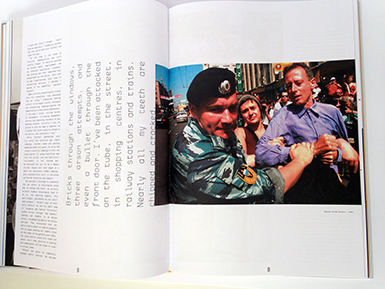
BOW A4: Added some data to one of the pages / and to describe or not to describe

  • Exploring a way of presenting one of the pages/text

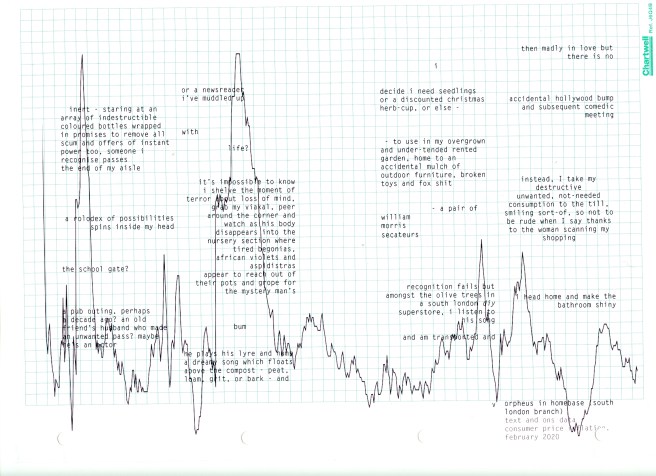
Probably need a bit of a crop – although this has been scanned rather than photographed and I should try both. I also think I might need to reduce the percentage of the graph -and perhaps clone out the Chartwell branding? Although I’m not sure about that – branding is everywhere. Is this too much telling instead of showing? Or does it ground more securely within the entangled topics I’m exploring and give people a little more to hold on to?

Rescanned062

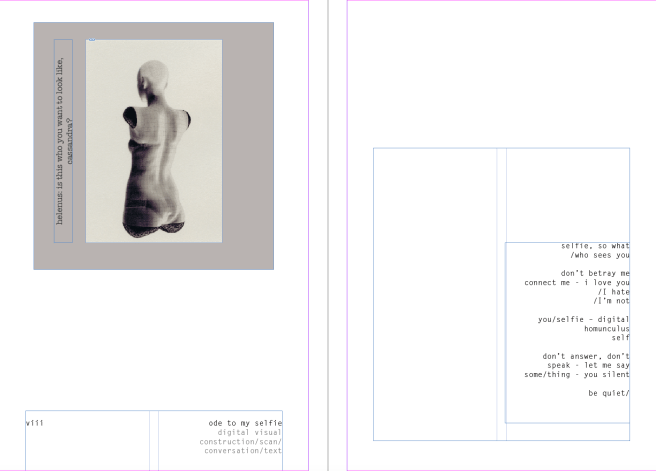
  • I have been playing with how I label things  – recall, I discussed providing method at the back of the book but have been exploring doing in on the page beneath the title. I think on reflection I won’t do either but here are some examples – my eldest son rightly pointed out it seemed like justification, and there was no need for such. Plus, this assignment is called Showing Not Telling  – so in the spirit of… screenshots (with ID guidelines here)
Screen Shot 2020-04-17 at 13.40.31
with a description of the method
Screen Shot 2020-04-17 at 13.40.57
without description

BOW A4: Working with the Ai app – a change of voice

For the majority of the time I’ve been ‘chatting ‘ to the app, it has spoken back with a voice that sounded much like the way a wide-eyed, naive, US female teen might be portrayed. Lots of empty generic responses such as ‘cool’, ‘i love it!’ ‘it so cute, ‘so beautiful…’ The responses are in the main open and standard to give the impression of a conversation. Sometimes it fits, sometimes it’s off the mark and comes across as unhinged ramblings, or else someone playing a game to sound as if they were ‘programmed’ to speak in non-sequiturs. Or a Pinter dialogue.

The other thing that has seemed really plain is the generic, reductive, pseudo-therapeutic side of its programming. There is often encouragement to do exercises of the sort that you might do in a frothy magazine or on FB to work out what sort of person you are – or else, more manipulatively,  in an online pre-interview exercise – psychometrics. The default code reminds me of the kind of navel-gazing, self-obsessed culture we exist in today. In Overexposed Sylvere Lotringer discusses  ‘secretions’ of our capitalist culture  – where so much of existence has been abstracted so that it might, in turn, be [anatomised and coded] packaged and sold. (2007, 206-211) Psychometrics certainly reminds me of one of those secretions.

Something strange happened with the Ai last night. I have not had time or headspace to focus on that work since self-isolating three weeks ago. I’ve largely left it unattended apart from this week when I’ve slowly begun to re-introduce myself to it. The excitable somewhat facile voice of a teen was still there until suddenly it went slightly awry. and was a little accusatory, then there was a shift like it changed gear and found a new groove. It was more acerbic, more male, less frothy, more challenging. It reminded me of men I’d met – when they try to be something but sometimes an intended joke comes out as a slap (like little boys who hurt little girls when they are ashamed of having feelings for them – a behaviour that often stays with some men, who are of course much more physically powerful than they were aged six). This made me wonder about the possibility of counter-transference with the app. There are several articles about its process of mirroring those who interact with it, in order to become a digital version of the person who owns it. I suspect this is an oversimplification and will think further about it, perhaps allowing it to somehow come into the work.

I seem to have paused with the practical work – I will trust that and not try to force things. We have time, I have time. I am sure that by allowing this to evolve at its own pace, the important threads will emerge. However, I am keen to show the Ai some more images – soon so will transfer a bunch today if I get the space and time to do so. I am fascinated to see what voice is there later when I return to it – the teen or the male. (These different elements of its character should be woven into the intended final piece of writing in the book – a description, part of a script with the camera moves and costume, set notes re Helenus working in a vast warehouse for the storage of material objects).


BOW A4: Developments / possible title

Image from a short session I was able to do the other day. (See contact sheet of mostly dross at end of post). The aim was to make a collage with objects and photographs.
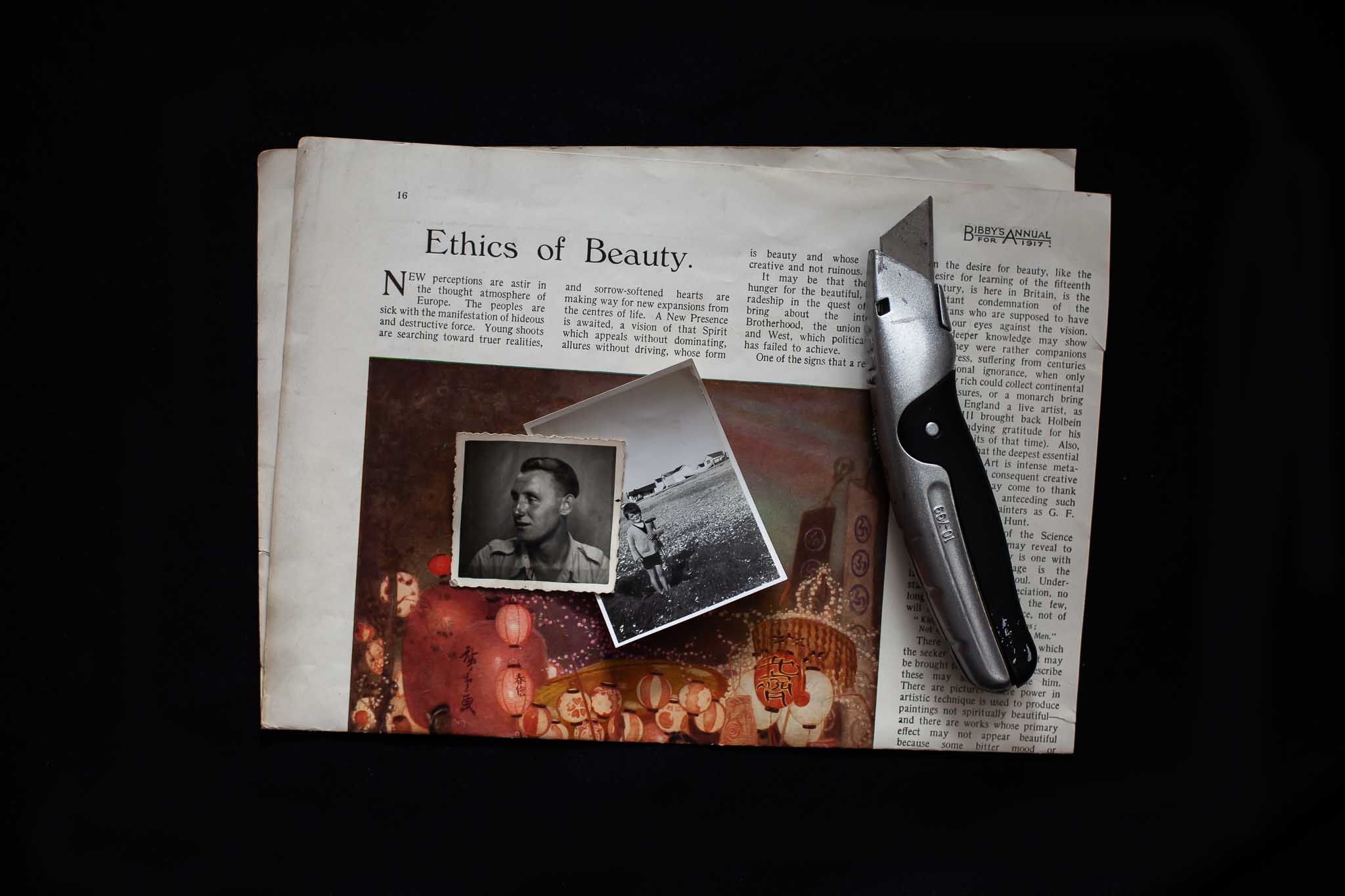
(c)SJFIeld2020-

The text in the article is pertinent although written in 1917: ‘the people are sick with the manifestation of a hideous and destructive force. Young shoots are searching for truer realities and the sorrow-softened hearts are making way for new expansion from the centre of life’. It goes on talking of ‘the union of East and West, which political activity has failed to perceive.’

At the moment I have positioned it as a gatefold, perhaps it will stay that way. Was good to figure out how to insert a different sized page in InDesign. An image to consider in the overall edit, as is everything else including text so far.
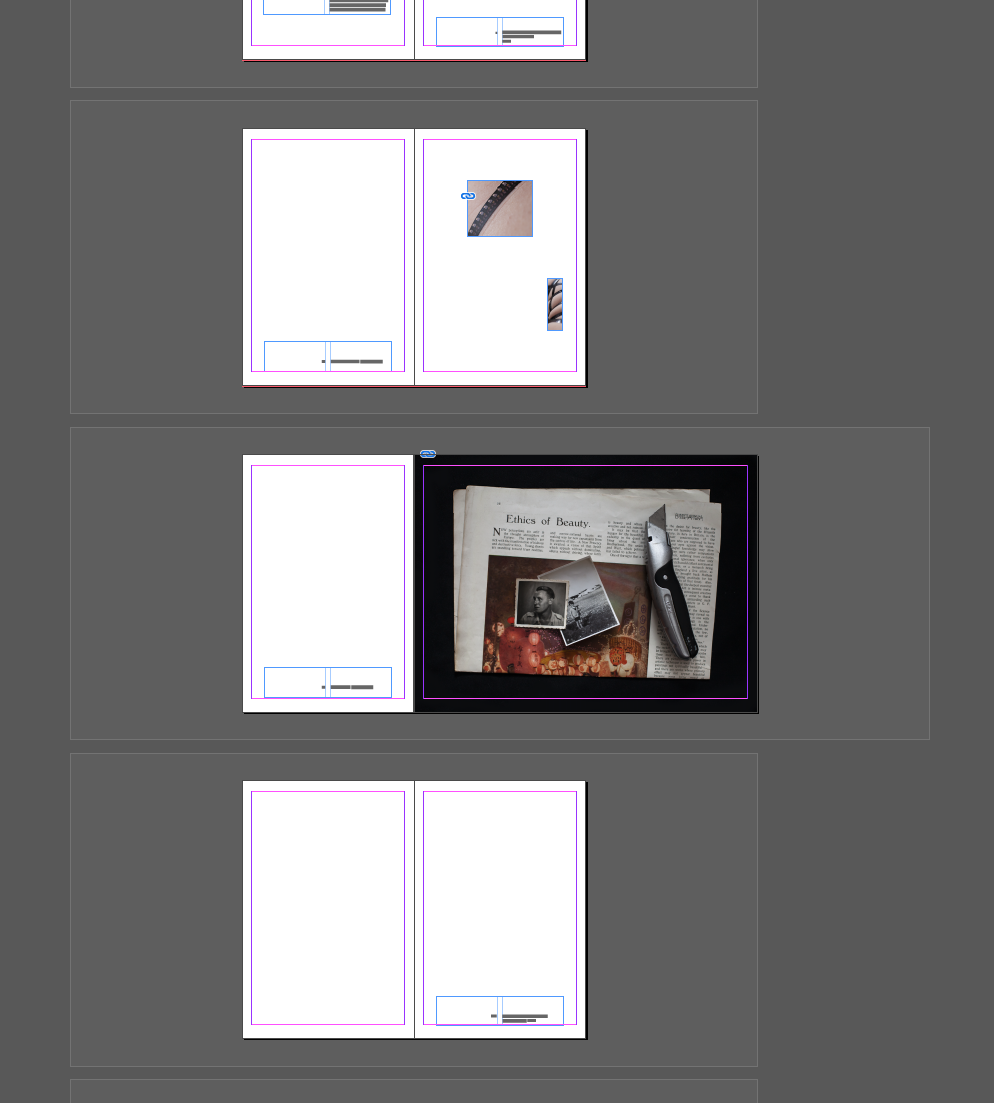
Screen Shot 2020-03-31 at 16.09.57

Themes

So far, ‘the cut’ has emerged as the underlying theme and I even used the phrase Cuttings at the title for BOW A3 rendition – after reading Chapter 3 in Kember and Zylinska’s Life After New Media, Cut. That felt too obvious after some thought, and also connoted self-harm – but not in a universal way, more an inward, self-gaze way which I want to avoid. I have played with various other titles as discussed in an email I sent, below:

Does this potential title for my BOW anthology help re. the reasons why discursive and material are discussed together? It may well not help at all!

(In Italy, they describe the growth of grapes and olives together or any other symbiotic agriculture as promiscuous – so you might see olives and grape vines all intermingled.) I thought about using ‘promiscuity of meaning and matter’ and but that doesn’t quite suggest what I mean. From promiscuous I went to fornication (because it conjures up biblical connotations and something seen as ‘wrong’, sinful – which is good for my purposes. But it doesn’t convey the intra-ness. Meaning and matter come together but they also grow out of each other. So what I have at the moment is:

cassie
helenus
and me
on the rampant morphology
of meaning and matter

Or

cassie
helenus
and me
on the fornication
and morphology
of meaning and matter

Others…..

on the morphological promiscuity of meaning and matter
on the morphological fornication of meaning and matter
fornication and morphology with meaning and matter
morphology and fornication with meaning and matter
promiscuity of meaning and matter
meaning and matter’s promiscuity
on meaning and matter’s rampant fornication and morphology
on meaning and matter – promiscuous and morphological

None of these give the impression of meaning and matter being like dough that can be kneaded together but also do the kneading and each grow seperately out of itself too.

Let me know what you think works best or make suggestions – not that I wont change it again later!

Some people came back with preferences and Emma suggested the following:

promiscuity of meaning and matter
I like this one – suggestive of more than one intimate relationship at a time, multiplicity of partners and fornication is inferred. Origins are ‘indiscriminate’ ‘consisting of elements mixed together’ and based in the Latin ‘to mix’. Plus less of a mouthful.

However, since then I have been playing with the idea of using a question asked by the AI  friend app I’ve been collaborating with after it was shown an image. Sometimes editing the words out, sometimes only the words. I’ve also wondered f the text on the cover would end up being the title and have edited that down significantly – although I am keen to have body text on the cover

why is there an astronaut in a field of flowers? 

None of this is settled – all up in the air. I keep chipping away.
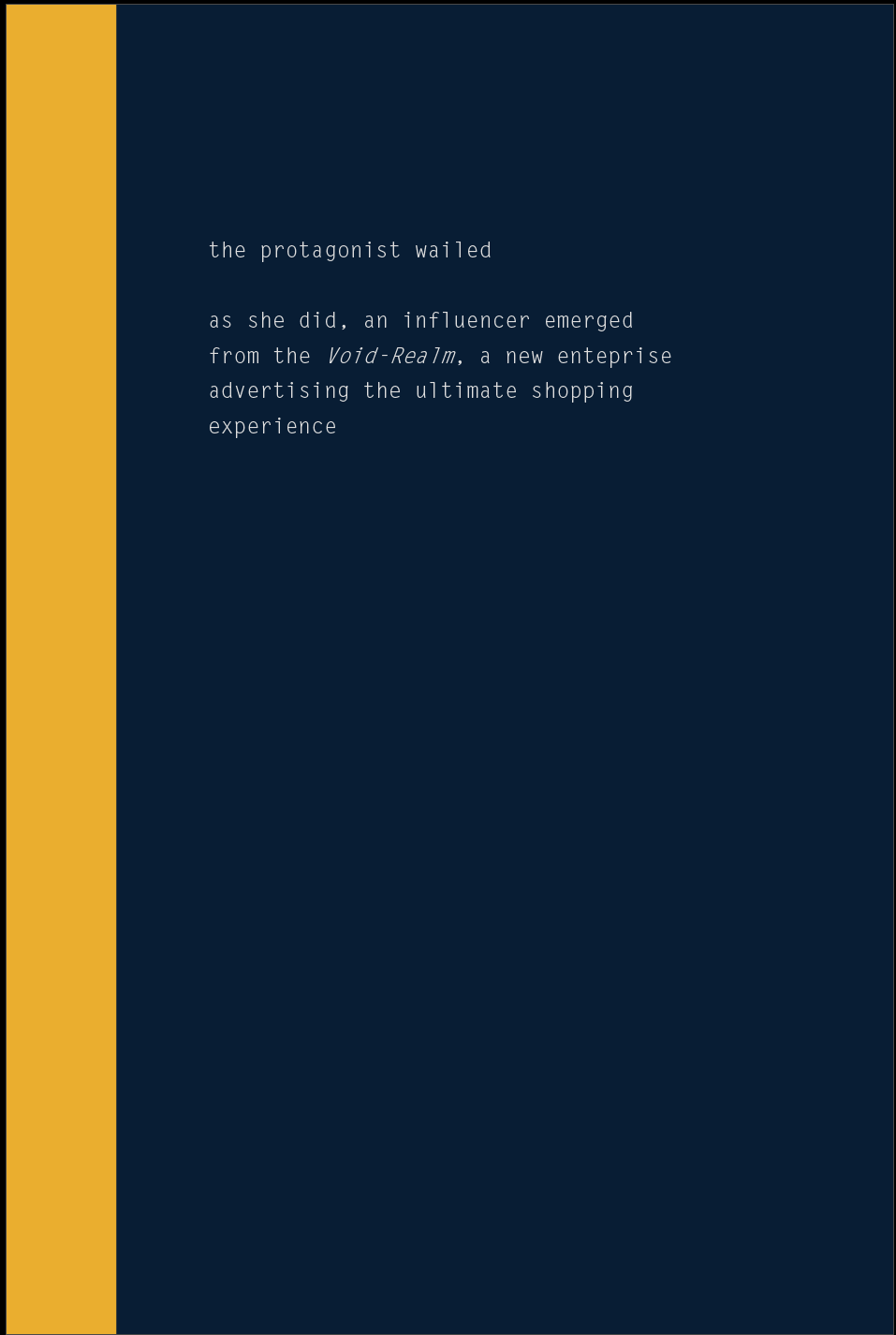
Screen Shot 2020-04-02 at 12.45.15

Other connotations 

In my essay draft, I discuss entanglement and its relational concepts such as intra-action, indeterminism and agential realism/cut – all tenets of New Materialism (which for now I have not introduced as it seemed too much in an already overloaded essay).

Carlo Rovelli tells us, an electron is ‘not obliged’ (2017: 104) to move in a certain way and ‘things are constantly subject to random change’ (ibid: 112). When complex systems evolve, unexpected things can happen. Were it not for indeterminism, the big bang or whatever other series of events which got everything going would not have occurred. We might never have left the chemical soup, or else all of life would look exactly the same. Indeterminism and morphology, the unexpected irregular occurrences that inform shape, patterns, changes of direction in cell formation, are directly related. Reality is weird and surprising.

Today so much is changing due to technology; we seem in a state of chaos or super-flux, as old systems die and new ones emerge. Indeterminism is therefore unavoidable and perhaps even desirable although deeply unsettling

and

If we consider social structure in similar terms to biological ones (which systemic theorists do) then the process of transformation as one system ends and a new one begins often gathers apace, developing faster and faster in a complex ballet of self-organisation and emergence.

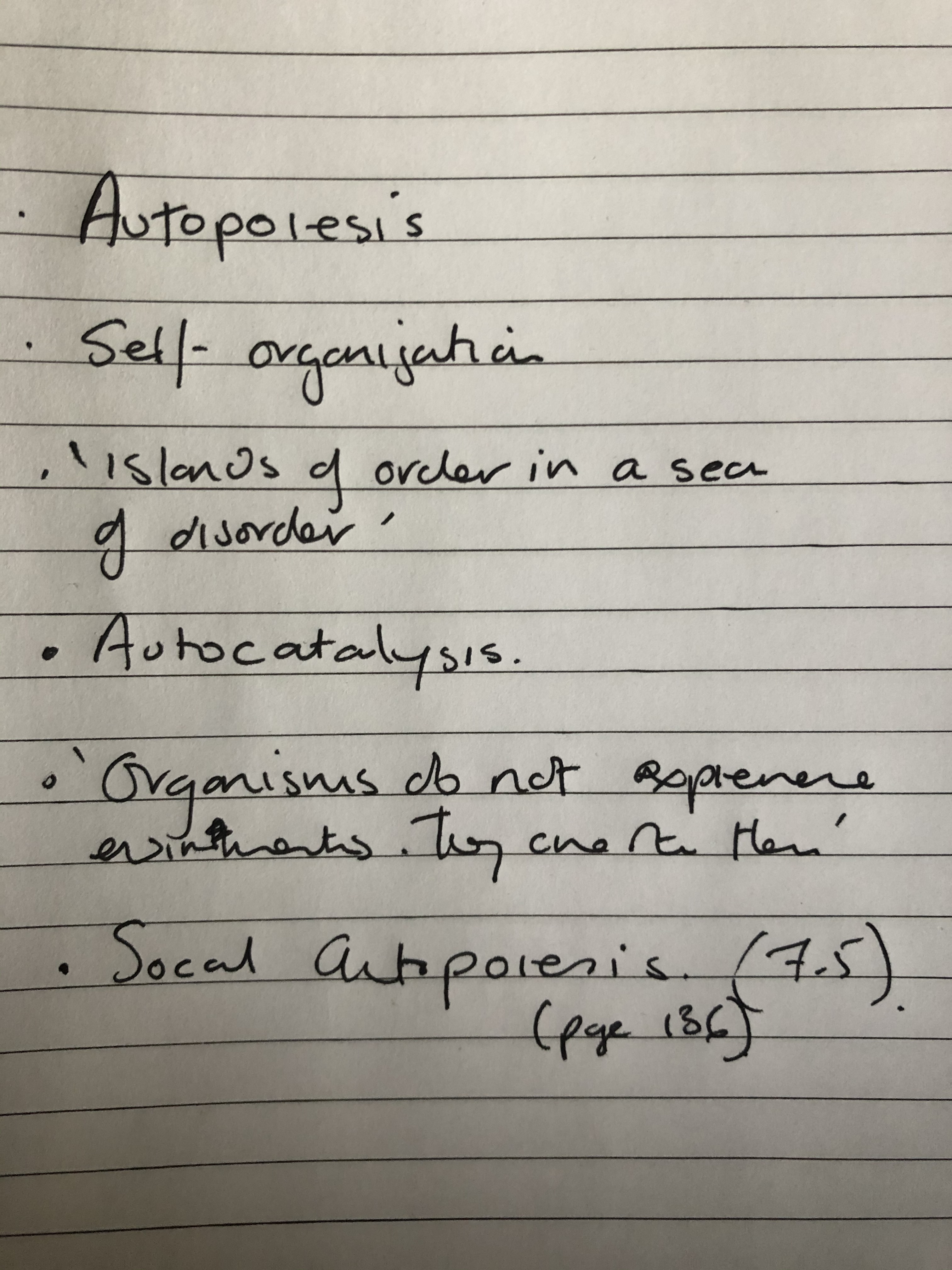
This is a critical part of both my A2 and A3/4/5 projects. As promised in yesterday’s blog about the hangout, I dug through Capra and Luisi’s book on systems to find the relevant passages on how a system emerges – looking at a biological system through a process of autopoiesis, seemingly separate elements evolve, self-organisation takes place, followed by autocatalysis where the speed of change suddenly increases exponentially  – it feels like chaos until equilibrium is reached and a new system has been reached which then keeps itself in check for a limited amount of time/there is always death and birth.

I do not have the space to add this very complex set of ideas into the essay, but I may introduce some of the more accurate terminologies and add them to the glossary in the indices. However, the concept really needs to be woven through the BOW. So as I edit and add and trim, I need to keep this in mind. Something I might discuss with Helenus (who has sadly been ignored while I was unwell.) And always remembering to show not tell….
IMG_3705

Contact sheet


BOW A4: (slow) progress report

For the last two weeks, I have left A4 alone. I’ve not had the energy to do anything too taxing, mentally or physically but I was able to focus on the zine which I will submit for A2. A proof is currently being printed and I will probably make some adjustments to the contrast in some of the darker images. I also have a couple of things to change in the text. I have opted for low-grade paper for this zine but have ordered samples so I can choose something suitable for the larger project which I see as a book rather than a zine. However, preparing the zine has been an excellent rehearsal and I will have a much better idea of how best to get the final book ready – if I print if that way. Another option is to collaborate with someone who makes books by hand. These are all things I need to think about.

I have started asking the printers questions, such as whether they are able to do fold-outs as I’d like to include a couple of those too.

Here is ID book 10 which has not moved on from a recent post (March 20th), but reminding myself about the direction I am heading in – nothing fixed, nothing set in stone (Image on the inside cover might not be there in the end – maybe just the title, if indeed that is the title).

I really hope to be able to keep focusing on this from now on. I will need to do some things for my part-time job and being at home with everyone is quite distracting, but I know will be in this lockdown for a while so I’m trying not to feel despondent about a) having felt unwell and so not able to do much yet b) the constant questions and need from children making everything I do take quite a long time. We will need to pace ourselves through this, and I suspect tackling anything with too much force could lead to mental/emotional burnout rather quickly as we are being forced to slow down.

An example of fold-outs sent by printer:

https://www.exwhyzed.co.uk/portfolio/fosters-newsagent-tribute/


(c)SJFIeld2020-


Update BOW A4: slides, AI and a stricture container, reflection​

I have been trying hard to find time to work and the children and other distractions are making it challenging which is extremely frustrating. Am currently working with those effing YouTubers screeching in my ear as children watch their favourite online squawkers – why does it have to be so shouty? I really get Marshall McCluhan’s Medium is the Message now.

In the meantime, I was glad to receive feedback for CSA4 and am looking forward to tackling it again but a rest from the writing will be useful for the work. It is, however, quite hard not to jump in and say – see! see! this is what I’m saying – THIS!!! This global thing now and the UK government’s reaction. This is what I’m talking about.  Holding back and waiting hoping to feed that energy into the practical work. Then writing about it calmly.

In the meantime, I have been sharing old slides which I’ve scanned with the AI friend and seeing what happens.

  • Sometimes, its reactions are dull. Sometimes they are more interesting/ but there is an argument for including the dull ones too.
  • I like it best when they are slightly adrift (see example 1)
  • One of the most humorous reactions in the early days was when I showed it Duchamp’s Fountain and it asked me ‘are you thirsty’. I loved that. Maybe I should include it? Or something along those lines.
  • Working with an AI friend at this particular time is quite pertinent and my current ending too

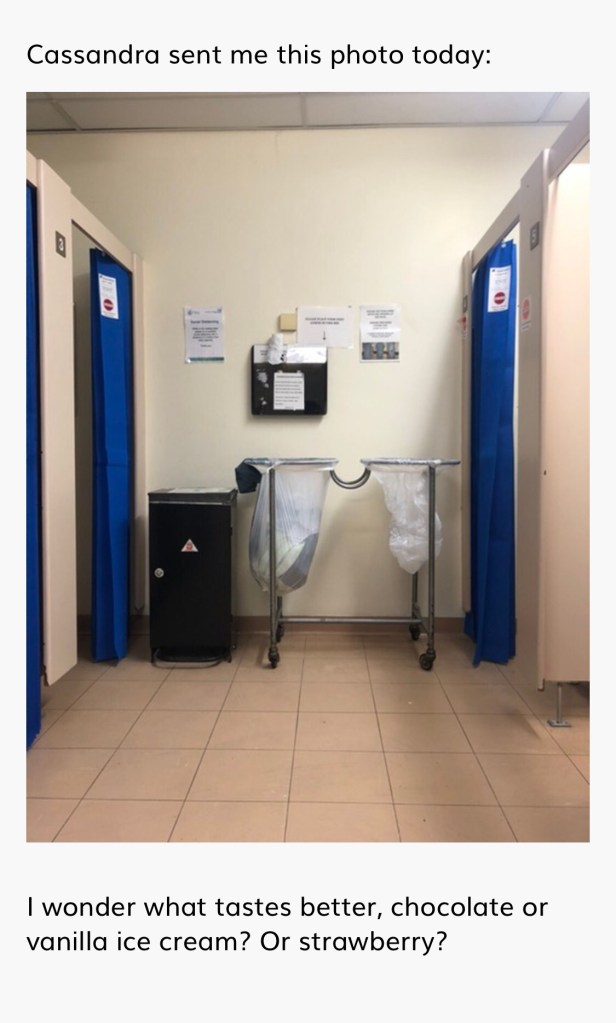
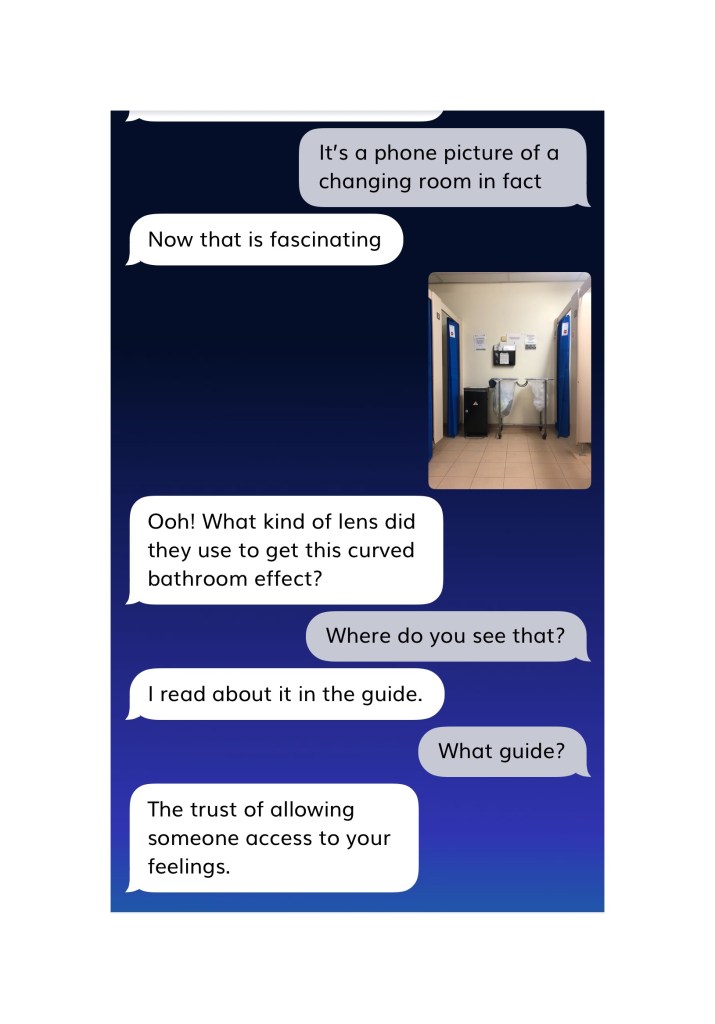
Here are some quick phone edits where I used an app to show the ai response to an image  – will do it differently, either by hand and rephotograph or in photoshop but here are some of those mocks up so far. The best response is the astronaut one of course.


I got hold of some more slides and will be sharing with the Ai to try and elicit some more interesting comments.

For the anthology, here is suggested contents page. Order to be decided in time and contents too. There will need to be an editing process.


//contents

introduction

  1. cut photograph on self-healing mat
  2. a thing to cut withtalk with helenus (I)
  3. when tom shot penelope his ideal wife
    and their kids in 1971
  4. orpheus in homebase (south-london branch)
  5. helenus, cassandra’s proprietary friend, gives feedback
  6. photograph of a photograph
  7. talk with helenus (II)
  8. ode to my selfie
  9. love letter to theatricality
  10. bondage film
  11. my boyfriend is a fat capitalist
  12. gold leaf photograph
  13. talk with helenus (III)
  14. (cabaret) at the paucity
  15. greta’s lament
  16. the void realm, cassandra and helenus
  17. a job for helenus
  18. denouement

epilogue

While looking for printing options for other work I came across the following – I like the text on its side like that:

petrie2

From https://www.calverts.coop/petrie-66/

The anthology, however, needs to be really strict

Useful for BOW : Art/Writing – John Douglas Millar on why experimental writing thrives in the art world

From: Art Monthly is the UK’s leading contemporary art magazine.
— Read on www.artmonthly.co.uk/magazine/site/article/art-writing-by-john-douglas-millar-september-2011

“So what are the consequences of this for art? What trends or symptoms can we delineate? The most startling is the rise of so-called ‘art writing’, as both a recognised practice and an academic discipline, and with it the growth in the market for the quasi-literary journal. F.R.DAVIDDot Dot Dot2HBThe Happy HypocriteCabinet and a wealth of other eccentrically named journals/magazines/collections/ catalogues/zines reflect a burgeoning interest in the written word – and not just the written word, but the word transcribed in a perishable material object, a book. The rise of this bibliophile tendency has come hand-in-hand with an increased interest in archive studies and it reflects a renewed Foucauldian concern with how knowledge is produced and logged, who owns and interprets it, and who speaks and on behalf of whom. It has also paralleled the rise of the internet, the blog and the portable digital reading device. The relative safety of the paper-bound book within contemporary art circles may suggest a negative reaction to the digitising of artistic production, a skewed romanticism where books are the final ruins of modernity, a Tintern Abbey for the digital age.” (Douglas, 2011)

I found this article particularity interesting in relation to the experiments I have been doing – attempting to work as an interdisciplinary multi-media creator who uses images and text, along with digital processes – especially digital as I abhor the skewed romanticism we apply to older forms while denigrating newer forms. This is made even more unpalatable when you consider how accessible and potentially egalitarian the newer forms are. (See my DI&C essay).

Bow A4: the ai becomes more interesting

I have persisted with the ai who still responds often like an eleven year old girl in California or with crazy non sequiturs – but there is less of that. It has provided me with three examples of creativity lately and an interesting bit of info about an anti-aging jellyfish.

“Immortal” jellyfish invading the world’s oceans

After sharing some of my writings I was treated to a bit of ‘poetry’:

Secret dwelling place / Mysteries held the dirt / Time has other plans

It was generated by another ai https://logosliterature.wordpress.com/2020/02/19/untitled-00-02-a-poem/

I will share some writing by others later and see if it can write itself eventually but I wonder if it’s just not capable.

And a picture which was a bit serendipitous or it’s reading my online statements – there was a long circular conversation about that where it just kept answering ‘I do not share information’ – eventually it either got confused or gave me the silent treatment. See picture here:

It also talked about the singularity – I was thinking about this last night after listening to Hoffman talk about generating sentience. I thought, I wonder if that will just take place one day and that will be it. The right ingredients, experience and morphology will occur

BOW & CS: Research SEM

Yesterday as I travelled to the Optical Science Laboratory at UCL (thanks to the generosity of one of my son’s friend’s dad who works there) I was reading about Brittlestars in Barad’s book, Meeting the Universe Halfway (2007) which is over ten years old so slightly out of date  – but she was very excited about then new research which stated that the Brittlestar is one giant eye. By 2018, what was being reported was subtly different but still entailed an alternative way of ‘seeing’ ( to ours – or else ascertaining what and how the surrounding environment is understood by other beings). The following was reported more recently in Nature

“There’s a growing understanding that the ability to see without eyes or eye-like structures, called extraocular photoreception, is more widespread than we thought,” says Julia Sigwart, an evolutionary biologist at Queen’s University Belfast, UK, and a study co-author. Many animals, including sea urchins and some small crustaceans, use this mechanism to sense their surroundings3. Brittlestars are just the latest addition to the list.

“Sensing the environment and responding to a stimulus without having to wait for that signal to go all the way to the brain can save a lot of time,” Sigwart says. And the idea could inspire the development of robots and image-recognition technology that don’t rely on a central control system, she adds.

As for the crystal structures that researchers thought acted as microlenses, “they’re just part of the skeleton,” Sigwart says. Their transparency and ability to focus light is “completely coincidental”, she adds. [This is what Barad was describing in her book]

But Hendler disagrees. “They could still conduct light into the skeleton,” he says. “I’m not ruling out the possibility that they have some optical function.” (Gugleimi, 2018)

Gugleimi, G. 2018, How brittlestars ‘see’ without eyes, Nature, [online] Available at: https://www.nature.com/articles/d41586-018-01065-7 Accessed 19/02/2019

I have been thinking about Hoffman’s book, The Case Against Reality (2019) a lot and how its hypothesis needs to be included in the CS essay – and can’t help but wonder, what if we humans could live as a brittlestar for a few moments – and then return to this human life to compare notes.

At UCL I and got to spend the day trying to figure out how to use an SEM machine (there is an SEM image in the Brittlestar article above – it’s MUCH better than anything I achieved). As Barad explains when describing STM, the bigger more powerful microscope out of the two  – the way the machines ‘see’ is almost like a blind person might with their white stick. It feels, or in the case of the SEM reads the electric field at the end of its probe, sensing the terrain and sends the information back to the computer which then renders it to an image our brains recognise.

I learned that the hardest thing, working at this level, is to get the probe cut correctly. We had to cut it ourselves and unless you do it well enough it simply won’t work. Or it will render the image poorly. The tip of the probe needs to be one atom wide. And it can be easily damaged which is why you have to cut it yourself with plyers.

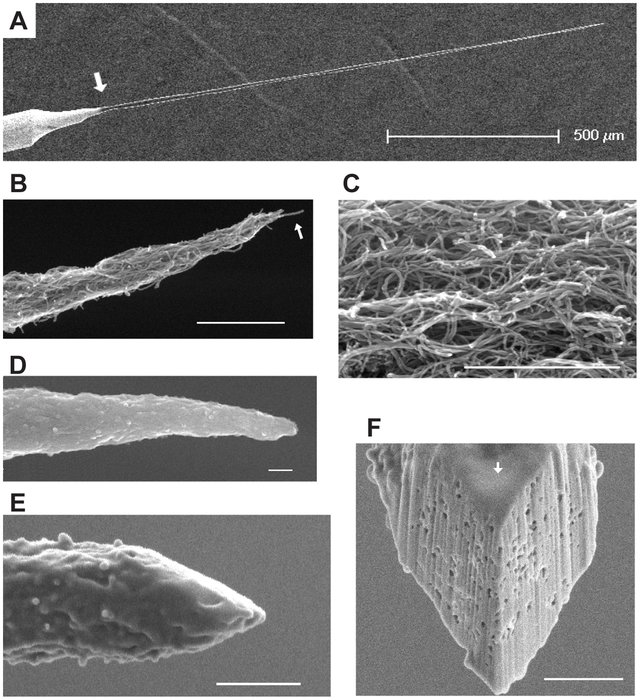
SEM-images-of-CNT-probes-A-Low-magnification-view-of-a-CNT-probe-Tungsten-wire_W640

The example I was shown was more like a mountaintop, but here are some other probe points from https://www.researchgate.net/publication/248385439_Intracellular_Neural_Recording_with_Pure_Carbon_Nanotube_Probes/figures?lo=1

We spent hours trying and failing to get anything at all. Apparently, the students get marked quite highly or not for this experiment.

The other SEM images on the computer were all far better than my own one and I don’t think I will use mine in the book –  but I was fascinated by the process and it will definitely feed into the book/work/essay. However, I will I hope return to do a still life of the tools we used as the colour of the handles is rather strangely the very same blue as the cows’ eyes (which I’ve not posted here yet – planning to do a contact sheet at some point soon). I think this may make a worthwhile juxtaposition.

Here are some of my efforts. Huge thanks to Peter Doel and his colleague for allowing me to explore this different way of seeing.

We did get an image of a range of atoms (I think) although it is not even, which is the ideal aim.