There was a comment in Roberta’s feedback about the real which I didn’t write about in my previous reflection, and which deserves a slightly more in-depth response.
“The real, reality – and the genre of realism (from which and on which photography is predicated) are complex terms. The Lacanian Real is particularly so. This section may be something to explore further – although I wonder here if you are talking about the Freudian return of the repressed – and the compulsion to repeat.” (2019)
- Realism
The Tate website defines realism as:
“In its specific sense realism refers to a mid nineteenth century artistic movement characterised by subjects painted from everyday life in a naturalistic manner; however the term is also generally used to describe artworks painted in a realistic almost photographic way”
and
“The term generally implies a certain grittiness in choice of subject. Such subject matter combined with the new naturalism of treatment caused shock among the predominantly upper and middle class audiences for art.”
https://www.tate.org.uk/art/art-terms/r/realism
My experience with realism began when I learned about a style of theatre from a similar era, albeit perhaps a bit later, which tends to be seen as a reaction against melodrama, comedy, vaudeville. A quick search leads to a long list of pages but the following is helpful and suggests realism emerged from and aimed to promote these ideas:
- “truth resides in material objects we perceived to all five senses; truth is verified through science
- the scientific method—observation—would solve everything
- human problems were the highest” (Trumbull, 2009)
https://novaonline.nvcc.edu/eli/spd130et/realism.htm
Like many, I was always a bit cloudy over the difference between naturalism and realism.
Again a search leads to a summary of the main differences as follows:
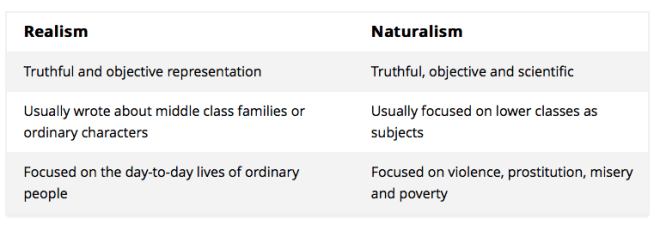
Screenshot from: https://difference.guru/difference-between-realism-and-naturalism-in-literature/
Either way, there is a focus on everyday people and mundane life, rather than gods and myths, then romanticism which is new.
2. Photography and realism
Photography grew out of the scientific harnessing of light and deeper understanding of chemicals and material. There has long been a tension between photography which aims to emulate painting, Pictorialism, and ‘straight photography,” which rejects what might be interpreted as any form of additional artistic flourish, insisting instead on sharp-focused ‘reality’. The eye of the photographer and not their ability to manipulate the picture in pre-or post-production became most important. This tension between the two continues today. Many practitioners working on the latter end of the spectrum seem to be rather sniffy about those who dally with potentially seductive, artistic traits.
However, equally today, there is a strong sense that what we see is constructed, and so whether an artist introduces flourishes or not, those embedded and working in a photographic tradition should be aware that however they are making work, they are nevertheless playing with various forms of human perception. Some philosophers such as Vilém Flusser will argue that even the most straight photography cannot help but contain within in it the voice of the central apparatus, which he describes as bigger than and disinterested in the individual except as a potential economic unit and disseminator of its aims.
“Apparatuses now function as an end in themselves, ‘automatically’ as it were, with the single aim of maintaining and improving themselves.” (1983, loc 850)
He does not seem to hold the photographer in high regard unless they are experimental and aware “the image, apparatus, program, and information are the basic problems that they have to come to terms with” and they must aim to “create unpredictable information, i.e. to release themselves from the camera, and the place within”. (loc 939) (What he means by experimental might be different to other peoples’ understanding, however).
http://www.flusserstudies.net/flusser-studies
At this point in time, I feel, perhaps due to the plethora of photography available to look at, that there are an awful lot very beautiful images which despite their loveliness do very little for me. Perhaps I am a Neanderthal heathen (Neandertals incidentally seemed to have been far more advanced than they were once given credit for) but I am a little tired of what I see as ‘visual masturbation’ over light and shadow or the photographer’s excitement about being able to control their exposure. I am aware this may be a projection as I spent some time enjoying creating just this sort of image but I eventually grew very bored of emulating Paul Strand type pictures. If a photograph is little more than a study in exposure control, it doesn’t do much for me. This is a bit of shame as far as my deep-seated need for external validation goes – that type of photography does appear to be the preferred option amongst many people who have the power to validate. But I am far more interested in inspecting and exploring the loss of reality we currently seem to be faced with.
3. Before I address the loss of realism, I will briefly mention the Lacanian Real and Freud’s repression as they were referenced in the feedback.
In my essay regarding Roberta’s comment, I believe I was referring to the Lacanian Real, which I shall simply call ‘the real’ in this section, or least my comprehension of that. When I first read about the real, like anyone, it was hard to know exactly what he meant. I watched as Zizek describe it in a Youtube Video – he suggests the real is the object minus any symbolism, i.e. an iPhone is simply a hunk of metal. It is only the symbolism endowed upon the object which makes it the valuable thing we believe it to be – constructed with sophisticated marketing within a structural world where the actual value is hard to separate from conscious commodification aimed at selling things. While I appreciate the object sans symbolism is indeed a bit of what we might call cold, hard ‘reality’, that has not been my understanding of the Lacanian real, even though it may be related.
I also watched another video (perhaps a School of Life production, simple but effective short introductions) which described Lacan’s real as the unformed, indefinable maelstrom that exists prior to symbolism. This is much harder to describe or understand. I wonder if we need Lacanian imaginary to find ways in which symbols might attempt to describe the real, even though it is pre-linguistic and therefore indescribable. It might come in the form of a visceral feeling that hits us in the solar plexus or makes the hair stand out on the back of our necks, or accompanies a letdown reflex when our baby cries – but is always quickly usurped with symbols, i.e. “My baby needs feeding”. Perhaps this real is also something to do with Barthes ‘punctum’ although James Elkins warns us not to “immerse the punctum in the Freudian unconscious”. (loc 678)
According to Hal Foster, Lacan wanted to define the real in terms of trauma, and from a personal point of view, I can see why. When traumatic things have happened it can feel like the fabric of reality is so disturbed or torn apart that I am left having to cope without any protective illusions which are suggestive of ‘normality’. Things become ‘surreal’ and Foster suggests that Lacan was influenced by the Dadaists and Surrealists as he attempted to explore what the real might be. I think it’s probably important to think about how trauma doesn’t necessarily have to be dire – such as a death, accident, or divorce but may also refer to events which are considered more positive such as births and marriages. These breaches in our lives which cause significant shifts have such an impact and also operate at levels which we aren’t always conscious of or able to contain within everyday activities – which is why customs and rituals become important. It’s this kind of real which I always understand as ‘the real’ rather than an iPhone minus its commodity value.
4. The undoing of reality
There is really is so much to say about this and I can’t begin to cover it – it will only ever be too brief and utterly inadequate.
I’m not entirely sure when the undoing of reality can be said to have started. Perhaps its a pendulum action as different types of reality swing into favour. But even that is too simplistic as various bits of debris seem to hang on for the journey back and forth, round and round.
It does seem as if quantum mechanics which has been unfolding for roughly 100 to 120 years has had an unquantifiable impact on the way we perceive reality. But even before that, from the most basic inventions such as the wheel, or if you take Andy Clark’s thesis that language is a technology seriously, earlier, onwards – the things we invent disrupt and change our relationship with perception. (And then there is the feedback loop too.)
There is a radical shift happening in relation to our understanding of space and time. In The Case Against Reality (2019), Donald D Hoffman writes that spacetime is doomed. He writes it 17 times! That’s not to say we are all heading for oblivion (we probably are) but that the calculations which Einstein gave us and which situated gravity inside a universe affecting the discrete objects inside it, no longer offer an accurate description – all of that is, according to Hoffman and other scientists, in the process of being replaced with new more accurate theories. These theories contain words like emergence, relationship, context, networks and illusion. Hoffman asks, if spacetime if doomed, what will replace it and then suggests “a data-compressing and error-correcting code for fitness” (page 114) There is so much out there at the moment about life not seeming real, about the possibility or probability of life being a hologram, about the fact that what we see and feel isn’t really real and all constructed in our heads. Kathryn Hayles (1999) mentions a frog study where it was discovered frogs’ eyes and brains perceive the world differently to us and so grab flies with their tongues having evolved to perceive time in a way that worked for that creature; thereby proving reality is constructed.
Hoffman talks about a screen (using computer metaphor and narrative throughout). He asks is we can ever pierce this screen and see objective reality although one suspects he thinks not. Rather than us existing in a universe, his theory says, “consciousness is fundamental and then has the task of showing how spacetime, matter, and neurobiology emerge as components of the perceptual interface of certain conscious agents.” (190)
If one were to give Hoffman’s description any credence, the real in Lacanian terms might be interpreted as the undefined pre-interface ‘stuff’ that has not yet been shaped into the things we perceive to be reality – a kind of half-baked cake mixture, not raw, not cooked yet (excuse the inadequate analogy).
What’s important here is the changing relationship we have with what makes the ‘real’. And as Hoffman admits, there is no fixed answer, science is always changing and evolving. Its aim is often to disprove itself in order say, this is not the way life works, let’s look in that direction instead. For several decades there has been a “loss of faith” and a “growing unease with the categorical fixity of Enlightenment thought” (Harvey, 1990; p29). But today, in science, at any rate, there seems to an acceptance that things are way more complex than we ever imagined. However, there is also a sense at the moment in the wider world that nothing is real and that may be deeply related to the political chaos we live with.
5. Slippage
I read the ‘real’ often but the trouble with the word is that it seems to be understood in so many different ways by people. And everyone seems to think their way is the best way. I might think carefully about using it in the future and always try to see if there is a synonym which explains what I mean more definitively.
Elkins, J. (2011) What Photography Is, Kindle Edition, New York, Routledge
Hayles, K. (1999). How we became posthuman: virtual bodies in cybernetics, literature, and informatics. KINDLE Edition Chicago, Ill, University of Chicago Press.
Harvey, D. (1990) The Condition of Postmodernity, London Blackwell
 SJField - OCA Level Three Study Blog