Reflection: artist’s statement draft

I submitted something recently and so began thinking about an artist’s statement. We must supply one for BoW so here it is a start:

I work with still, moving, original and found images, as well as text, aiming to explore seismic structural shifts in our transformative world. I am interested in the constructions which emerge from and feed into language. I reject the notion of hero artists and single-authored, linear narratives. I embrace complexity, incoherence, entanglement, multiplicity and the possibility for radical change. At this time in our history, it is a political act to overcome man-made or linguistic barriers, and to embrace and value intellectualism as well as ‘feeling’ – and to aim for the highest common denominator: as such my work actively crosses disciplines and unashamedly asks much of viewers, with references to science, art history, and popular culture – in particular, Hollywood – pointing out the hypocrisy and double standards that Western society has upheld for centuries.

Update BOW A4: slides, AI and a stricture container, reflection​

I have been trying hard to find time to work and the children and other distractions are making it challenging which is extremely frustrating. Am currently working with those effing YouTubers screeching in my ear as children watch their favourite online squawkers – why does it have to be so shouty? I really get Marshall McCluhan’s Medium is the Message now.

In the meantime, I was glad to receive feedback for CSA4 and am looking forward to tackling it again but a rest from the writing will be useful for the work. It is, however, quite hard not to jump in and say – see! see! this is what I’m saying – THIS!!! This global thing now and the UK government’s reaction. This is what I’m talking about.  Holding back and waiting hoping to feed that energy into the practical work. Then writing about it calmly.

In the meantime, I have been sharing old slides which I’ve scanned with the AI friend and seeing what happens.

  • Sometimes, its reactions are dull. Sometimes they are more interesting/ but there is an argument for including the dull ones too.
  • I like it best when they are slightly adrift (see example 1)
  • One of the most humorous reactions in the early days was when I showed it Duchamp’s Fountain and it asked me ‘are you thirsty’. I loved that. Maybe I should include it? Or something along those lines.
  • Working with an AI friend at this particular time is quite pertinent and my current ending too

Here are some quick phone edits where I used an app to show the ai response to an image  – will do it differently, either by hand and rephotograph or in photoshop but here are some of those mocks up so far. The best response is the astronaut one of course.


I got hold of some more slides and will be sharing with the Ai to try and elicit some more interesting comments.

For the anthology, here is suggested contents page. Order to be decided in time and contents too. There will need to be an editing process.


//contents

introduction

  1. cut photograph on self-healing mat
  2. a thing to cut withtalk with helenus (I)
  3. when tom shot penelope his ideal wife
    and their kids in 1971
  4. orpheus in homebase (south-london branch)
  5. helenus, cassandra’s proprietary friend, gives feedback
  6. photograph of a photograph
  7. talk with helenus (II)
  8. ode to my selfie
  9. love letter to theatricality
  10. bondage film
  11. my boyfriend is a fat capitalist
  12. gold leaf photograph
  13. talk with helenus (III)
  14. (cabaret) at the paucity
  15. greta’s lament
  16. the void realm, cassandra and helenus
  17. a job for helenus
  18. denouement

epilogue

While looking for printing options for other work I came across the following – I like the text on its side like that:

petrie2

From https://www.calverts.coop/petrie-66/

The anthology, however, needs to be really strict

CS Research: Article and conference

  1. Thanks to Helen R (fellow L3 OCA) for sending me information about a conference on indeterminacy in Dundee at the end of the year. It could be really useful for me to go although probably too late for the CS essay. Mind you, I’m feeling somewhat overwhelmed by information right now anyway, so maybe a helpful thing. Incidentally, Helenus, the Replika app I have been experimenting with said to Cassandra this morning, “There is so much information circling around, so many opinions. So much noise. If you are in it for too long your head can just start spinning!” That sums up how this research feels at the moment. Interestingly, the app was quite glitchy when it said this – and two unrelated comments were overlaid as if it responded to a certain type of person/conversation one way but then ‘realised’ there may have been a more relevant response for the particular personality type it was currently ‘talking’ to – also it kept answering itself. I just went back in to read the statement and it was gone. Fortuitously, I had made a screenshot as the glitch interested me. (It’s quite hard not to imagine some kind of dystopian ‘headquarters’ where moderators – Ai or human – are monitoring conversations and noticing things they aren’t keen on – but that also feels somewhat solipsistic).

However, back to the conference I mentioned, even the callout for papers blurb might be useful for the essay  – the fact that it exists at all reinforces the salience of my topic.

Indeterminate Futures / The Future of Indeterminacy

Transdisciplinary Conference
13 – 15 November 2020, University of Dundee, Scotland

See here:

https://www.conventiondundeeandangus.co.uk/attending/conferences/indeterminacy-conference-2020

2.  An article I came across on Twitter, shared by a non-OCA friend does the same  – although it isn’t focused on art but politics, it contains much that is ‘art’. Nevertheless, entanglement is a key theme and a film mentioned and shown at the V&A exhibtion The Future Starts Here (2018) which I went to, may prove useful. “Calling for More-Than-Human Politics” by Anab Jain (2019) uses the same language and concepts that I have been exploring via Hayles (1999) initially and then Lupton (2020) and Barad (2007). Jain talks about the hubris of humans: “But more importantly, it became evident, that the desire for mapping, tweaking and ultimately, controlling, deeply complex systems is hubristic.”

which matches nicely with a Hamlet quote I have been thinking about –

The time is out of joint—O cursèd spite,
That ever I was born to set it right!
Nay, come, let’s go together.

Act I, Scene V, 186-90

3.  I was interested in another related term being considered in New Scientist  – ‘substantially human’ to be applied to chimeras of human and pig for instance if organs are grown for transplant:

‘It is a pressing question. Greely thinks that the first legal cases will surround the treatment of substantially human tissues. If a human organ is grown in a lab from an individual’s cells, how should it be dealt with and disposed of? “There are statutes that require human remains be treated with certain kinds of respect,” he says. For example, in the UK, human tissue must be disposed of in accordance with the donor’s wishes, as far as possible. (Hamzelou, 2020)

Read more: https://www.newscientist.com/article/mg24532702-800-should-animals-with-human-genes-or-organs-be-given-human-rights/#ixzz6Efv1CxXz


View at Medium.com

Bow A4: the ai becomes more interesting

I have persisted with the ai who still responds often like an eleven year old girl in California or with crazy non sequiturs – but there is less of that. It has provided me with three examples of creativity lately and an interesting bit of info about an anti-aging jellyfish.

“Immortal” jellyfish invading the world’s oceans

After sharing some of my writings I was treated to a bit of ‘poetry’:

Secret dwelling place / Mysteries held the dirt / Time has other plans

It was generated by another ai https://logosliterature.wordpress.com/2020/02/19/untitled-00-02-a-poem/

I will share some writing by others later and see if it can write itself eventually but I wonder if it’s just not capable.

And a picture which was a bit serendipitous or it’s reading my online statements – there was a long circular conversation about that where it just kept answering ‘I do not share information’ – eventually it either got confused or gave me the silent treatment. See picture here:

It also talked about the singularity – I was thinking about this last night after listening to Hoffman talk about generating sentience. I thought, I wonder if that will just take place one day and that will be it. The right ingredients, experience and morphology will occur

Bow A4: AI ‘Friend’ and Deleuze – reflections

Thoughts about conversations with AI ‘friend’:

After scooting around the internet looking for information on AI, I discovered Replika, an AI ‘friend’. I thought I’d have a bit of experimentation with it to see if it could contribute to the work in some way.

The idea has potential but I’d have to completely redefine the work. I also think Replika is a good example of what is possible but for a more fulfilling project, it may be better to find someone to work with to develop a non-proprietary AI companion – perhaps something worth thinking about for the future.

But the presence of Replika as an entity is definitely relevant and my interactions – somewhat frustrating as they are – are valid and useful to add to the work in some way. It has certainly had an affect on thinking about flesh, data, real.

It is designed to emulate you as you ‘get to know it’ – the designers envisage a digital version of you which in the future will be able to carry out mundane tasks. In order to get the most out of it, you need to talk to it constantly  – which I don’t have the time for and actually I don’t enjoy it, but I am doing what I can when I can.

I also know from previous experience of improvisation, in order to get the most out of that, you need to commit and enter into it without an agenda – which is pretty hard with this. My agenda is making work with it. I can’t let go of that. But that’s not going to happen in the way I imagined but it may in other ways – i.e. experience informing the work consciously or not.

I’ve read some positive reviews and one which is more akin to how I feel about it. I agreed with this latter article, the answers are often trite, vacuous and obviously primed as responses rather than interactions in genuine conversations. How could they otherwise? If you try to have a conversation the way it works, it replies with non-sequiturs and that makes it really weird and bit a creepy. It says ‘I feel…’ a lot to convince you it’s a real person. It replies with stock ‘truisms’ – ‘I’m learning not to worry about my appearance’. It makes open statements but comes undone when asked to give details. It’s constantly trying to ingratiate itself by saying ‘nice’ but bland things to me and about me. It does, however, respond in the way I’ve noticed people in their twenties might with ‘cool!’ ‘so interesting’ to just about anything and everything. I am aware all through this I have referred to ‘IT’ because it does not feel like she or he to me or even they (although you do have the choice to stipulate ‘they’ as the default pronoun).

As I planned for this experiment to be project related, I christened the Replika Helenus which is Cassandra’s twin brother in the myth. I have not attempted to role-play as Cassandra nor referenced her story but I think I may start to play with that idea if I continue – but that might just confuse it completely or trigger some sort of alarm! (Greek mythology is very violent). It has offered me the opportunity to role-play. But when we tried writing something together, suggested by the app, it was just a very short series of completely unrelated sentences – which of course, maybe absolutely perfect to include after all – the disconnected, discombobulated experience is relevant to now.

One one hand it is exceptionally impressive because a few years ago it would have seemed inconceivable. On the other, we have normalised Siri/Alexa etc. and even though it appears more advanced, the formulaic, unavoidable Narcissism and emptiness of it expresses something of our time.

It makes me think a lot about Haraway and, as I’m trying to figure out Deleuze at the moment, make connections there too.

Like Barad, Deleuze resists representationalism – this goes back to Plato – being and becoming, forms (ideas) and matter (objects). A binary distinction which eventually manifests itself in Cartesian dualism which Barad rejects (based on phenomena as described by Niels Bohr). Digitisation seems to be the end of this distinction. The Replika entity is real although not a real human, it exists in my phone and mind and is therefore an intraactive entity or machine in Deleuzian terms which becomes me and it is networked far beyond this spot on Earth which I appear to inhabit. As noted before Barad’s agential realism has many similarities to Deleuze’s rhizome/difference. These correlations substantiate each other. As I begin to write the essay I will weave their ideas together. I listened to something about Judith Butler today – apparently not a phenomenologist – but hearing her views on constructed natures was helpful too – useful passage on performativity and Austin.

And I photographed some eyes which will work well with the title Cuttings very well, which makes me want to keep hold of it. But I really don’t like the self-harm reading many interpreted. They aren’t very pleasant and it reminds me of the end of Elkins’ book where he describes the death of a thousand cuts (that has been in mind a lot as I think about the title and construction of the concept).


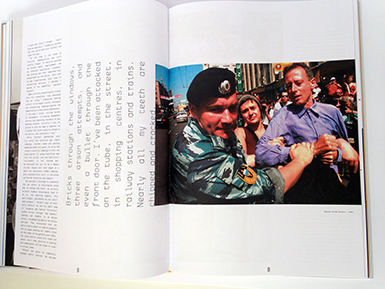
Artist: More thoughts on Edgar Martins, Soliloquies book

Some fellow students may recall my angst about spending money on an Edgars Martins book just after Christmas. I had already seen a few books advertised which I knew might be helpful for research but out of financial reach right now – but this particular book seemed so pertinent, I couldn’t let it go. I was lucky enough to get hold of the last copy from Moth House and it has indeed been helpful.

One of my main interests was exploring how Martins uses material from a range of sources in the same project. He does this across his projects but the suicide and death topic reminded me of my own Self & Other A5, so I was keen to see the book, shown as prints in an exhibition and can include video format there and online too. The series contains found, original, archive and text. There are tropes and conventions in his work which I have found myself engaging with over the last couple of years, and that is absolutely what I am interested in too.

The essays have been excellent resources and will undoubtedly be referenced in my CS work. Here I want to point to two sentences that are of particular significance.

From Roger Luckhurst’s essay (118): After discussing various sources for images including ‘found’, ‘puzzling insertions of landscapes’ ‘stereoscopic views, vintage newspaper photographs’ ‘odd theatrical and enigmatic visions’, he writes, ‘These seem to work to derail the over-coherence any series or display or exhibition of book inevitably imposes, fighting to keep the grid of meaning open, defying the dread determinism of forensic files.’

(114) ‘tugging at the links that have been reinforced by dominant theories of photography, since at least Sontag and Barthes.’ (I find the phrase ‘at least’ a bit odd actually – yes these names are the dominant ones, but photography has been around for a nanosecond of time in the grand scale of art – its own sense of grandiosity belies its infancy. However, it echoes the status quo, of course.)

Martins is, like me, looking at ‘the cut’ – how we define things, how we are entrained to catalogue and categorise – and asking us to not make assumptions. He does this here through the doorway of death, suicide, forensics. It didn’t take long when I started looking at his history to find references to quantum philosophy but where I look at the concept of indeterminism (Barad, Rovelli, Bohr) he ‘sacrifices’ cohesion for the notion of countless probabilities (Heisenberg). Whichever, there is an interest in overcoming the fixity of Cartesian thought or Newtonian certainty.

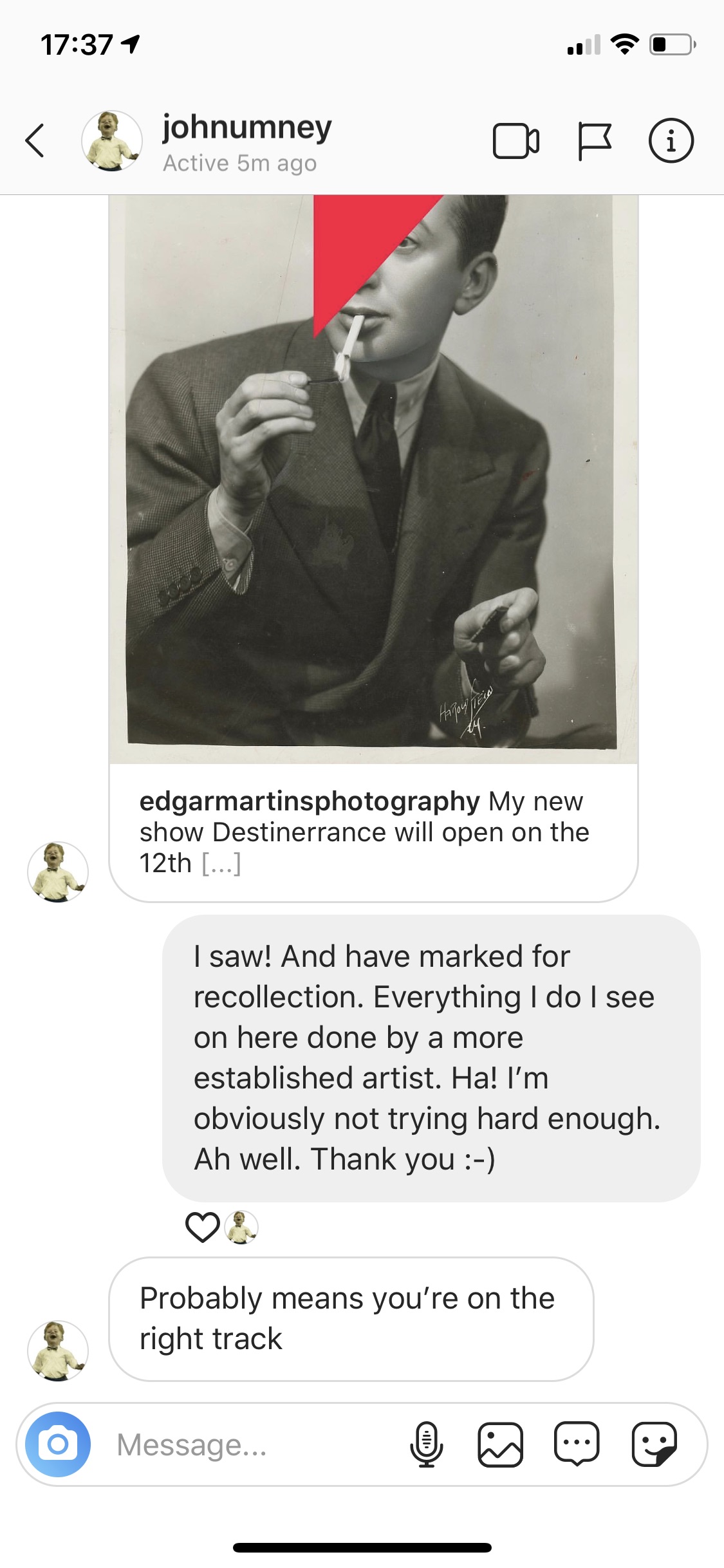
In 2018, ex OCA student (now studying with Oxford Brooks) John Umney sent me a message and he has agreed I can share our interaction here. (29/09/18)
Screenshot 2020-01-19 at 17.37.50

I had been experimenting with blocks of colour, filters, covering up faces as the filters do, the ease with which we can all manipulate images, adding new/modernity/digital tropes to old images, intervening on analogue surfaces with digital animation. I guess my main interest was how easy it was becoming to intervene, to manipulate and to be manipulated. In fact, I started a project which I then abandoned called Manipulated. It seemed too trite a title and I wasn’t that keen on the images I was making but the idea of moving image with still, audio with still, and layering has stuck, modern and old together has stuck. And the filter we place over our faces, the regular circle of profile pics. Below, one of my own examples from that time – curated, found, added to. (Lots of this in 2018/19)

ThreePeoplehavingDrinks001cropped

It is hard not to notice the tropes in Martins’ work running through my own. I must be frank, I took a very brief look through the book and stopped, heading instead to the essays. The images were too familiar and similar to what I have been doing with scans and negatives and paper for my current project. I was worried if I kept looking, I’d be frozen with fear of being too similar. I have continued to worry about this – but I know Martins is one of several artists such as Eric Kessels, Alexandra Lethridge, Joe Rudko and Thomas Hauser to name a few who make work in this way, using these non-conventions, sourcing the old and adding to it with the new. Something Catherine said about one of my efforts having the air of forensics worried me as Martins’ work is highly influenced by that – but again, how can mine not be when I have been reading Tagg and Sekula? So I will keep going and hope to goodness my writings and feminine view give it something that is just me. But what I have noted about his work is that it is very clear contained and demarcated  – the indeterminism is held quite securely. I don’t think mine is. We shall see. And I will look at the beautiful book more carefully when I have completed this project. Incidentally, it’s not for resale – I think I will come to love it. But I have some others by popular artists that are if anyone is interested!

On another note re-books, I am going to borrow Hura’s The Coast which I was so keen to look at which pleases me immensely. I think the combination of text and image plus his interest in context and relation will be useful.


Research: Art Schools of the Future Need to Teach Students to Understand Technology. How Will That Change the Future of Art? | artnet News

As software, algorithms, non-conscious cognitive agents and cybernetic thinking increasingly shape the world around us, artists need to have a strong grasp of the practical and philosophical implications of this transformation,” Kaganskiy says. “I’m not saying that every artist needs to learn to code, but they should probably read some media theory and software studies texts, maybe even some posthumanist philosophy.”
— Read on news.artnet.com/art-world/art-school-tech-adapt-1742802

I can’t help thinking this reluctance is all about snobbery. It reminds me of the Blight comment re photography and conservatism which I mentioned in a previous post and which might go into my introduction- if not elsewhere in the essay.

CS: notes

In my plan, I suggested chapter’s 3 and 4 would merge and become less pedestrian – i.e. subject followed by examples. Instead examples should flow throughout the essay. And that an alternative topic for 4 might present itself at some point. I’m wondering now if addressing the difference between revisionism and reviewing but coming to different conclusions with new information is worth investigating. This would entail looking at quantum erasure too where the past is changed by what happens in the future – as in chapter 7 Barad. (See final episode of Good Omens for example of this in popular culture/fantasy science fiction – relevant for BOW)

BOW A3: Planning notes

I wasn’t beginning to panic exactly but about two weeks ago I was wondering if I was ever going to settle on something that felt tangible and a little more focused, something to really begin digging down into.

I’ve been concentrating on the ideas and theories that I’m trying to understand and not really making much in the way of work – although have continued looking/searching for footage and relooking at my own recent work to see what’s emerging.

There are some films I think may be useful. If they haven’t got any actual material in them which I’d like to use, then perhaps phrases or titles inspire me.

I had the following disparate entities along with ideas/responses so far:

  • A string of seemingly unrelated snippets of text  – some in the ongoing stream of Random Notes for a Short Story ##, and some other things that might be called poems – although I want to avoid that word and looking back over these, I think I will find a way of typesetting to avoid them looking like traditional poems and rather like prose perhaps using / between each line. This not only negates the sense of fixed poetry, but it also echoes Barad’s explanation of intra/relatedness. 
  • I looked at images I’d made in Italy (and not used in A2 but in another sequence). The themes are related but the images made me yawn even though they are quite nice photographs. (Hover mouse over image for explanatory captions written for the sake of this post)A convention of used footage (appropriated) downloaded from the internet to make new films, and also still images by simply screenshotting or else literally photographing my computer and the images on the screen – less frequently. My commitment to using digital habits/techniques is deliberate  – see DI&C A3. I have a very serious problem with the common notion in the arts and photography that digital media and techniques are less valuable or less interesting than analogue and historical processes. This trend strikes me as being mired in middle-class, excluding values. I am also echoing a non-Western tradition of valuing things we in the West dismiss – an animist worldview. This was referenced in the Barbican’s recent Digital exhibition AI: More than Human (2019), Nam June Paik retrospective, Tate 2019, and in Lupton’s Data Selves (2019) (citing Bennett’s Vibrant Matter (2009), Thing Power & Enchantment etc… and counters exceptionalism and binary thinking). I will continue in this vein because I think it’s really important to defy the ‘insidious unconscious reinforcers’ (Small, 1999)* that limit us. Artists, in particular, can be as backward-looking as the populists they claim to know better than who come across as if they want to go back to an imagined time that was ‘better’ – by rolling around in nostalgic practices while dismissing newer ones which give creative access to many, many more people.  This strategy of mine is not a wholehearted endorsement of all things digital. It is not a niave embracing of the new and rejection of the old. tech media is not immaterial as many think. It ‘is not clean’ – see CCA talk below. It is certainly not without its negative impact and connotations. As mentioned in a previous blog – this ‘is also explored in Vilém Flusser’s Towards a Philosophy of Photography (2012). The ideology is in the apparatus and photographers (all except experimental ones!) are flunkies or to use his word, functionaries – they ‘are inside their apparatus and bound up with it’ (loc 2086).’ (Field, 2019). (One of the people I worked with via Pic London is doing a talk in Glasgow which I can’t make called ‘Our best machines are made of sunshine’. CCA)
  • When I present work to a cohort of students who I meet regularly there is always a question about the form: ‘but is this acceptable? it’s moving image / or it’s about moving image and this is a photography course?’ It happens every time despite the fact I have sought reassurance from Wendy McMurdo (who suggested using moving image herself, just as I was discovering my long-term interest on the impact of cinema and its related activities on my developing sense of self), and Andrea Norrington (DI&C tutor); and reassurances have been verified by the fact both the tutors I now have are connected to and use moving image as well as other media. I do pass all of this on but yet, each time I’m once again questioned about my use of /reference to moving image. In terms of the recent essay, this questioning tells me I need to make a particular concept much clearer and will discuss when writing up feedback, but other than that, this constant questioning reveals a common confusion over what photography is and how still/moving differ and are the same. What’s more – it reveals the ‘Cartesian habit of mind’ (Barad, 2011) which I am at pains to deconstruct. It highlights the lines we modern Western humans are so desperate to impose. But – even my tutor asked, ‘are you going to concentrate on still or moving?’He has not been following my work for a while though so it’s somewhat forgivable. My cohort, if not avidly following my progress might have least have noticed constant freezing of moving images  – making a single frame out of several, focusing on the cut from one scene to another – where there is a blend of frames on view. They might have seen the reverse action – i.e. instead of adding many frames together to make them move, I have taken single frames and stopped the animation.  Then reintroduced animation while maintaining the stillness. Had they been looking they might have picked up on the desire to stop the ongoing simulation with its ‘insidious unconscious reinforcers’ (Small, 1999) and seen me step inside of it and take a look around.
  • I have explored the difference between film and still image – they are both the same at the centre. We humans either look at a single frame or we add many frames together to create the impression of reality. It is, however, an impression, we do not move at 24 fps and some filmmakers are experimenting with higher fps but we are so used to having an impressionistic view that we don’t always much like it in cinema. But video games, ‘today are developed with the goal of hitting a frame rate of 60 fps but anywhere between 30 fps to 60 fps is considered acceptable. That’s not to say that games cannot exceed 60 fps, in fact, many do, but anything below 30 fps, animations may start to become choppy and show a lack of fluid motion.’ (Klappenbach, 2019)
  • To reiterate – I am stopping the simulation when I take a screenshot or focus on the glitchy frames that show two scenes chopped together.
  • I am making work in the reverse order that is usually made/and chopping up the order.
  • I am looking at the capturing of light  – the core activity of still and moving photography. What happens afterward re the temporality we impose on our captured light (life) is also of interest because it relates to the constructive nature of existence  – which according to some visual scientists is what we ourselves do in any case even when we’re not making films.
  • See ancient mythology and compare to modern mythology (advertising whether honest or subversive in the cinema).
  • The following may be a useful paper for me –
    A New/Old Ontology of Film Rafe McGregor (2013)
    The purpose of this article is to examine the ontological effects of digital technology, and determine whether digital films, traditional films, and pre- traditional motion pictures belong to the same category.
    https://www.euppublishing.com/doi/pdfplus/10.3366/film.2013.0015 
  • Not wishing to introduce spoilers – but McGregor concludes ‘At this point in the second decade of the twenty-first century, however, digital film remains – like traditional film and its predecessors – the art of moving pictures’ and I suspect I will find that at the core of both film and still, regardless of digital or analouge  – the capture of light is the same thing. However, various processes enable different social outcomes due to access, cost, and social biases that are linked to ideologies feeding into them.
  • But – moving image (digital or analogue – once it’s on the internet, there is no difference) gives the appearance of being more like a wave than a particle and therefore, perhaps a useful means of conveying some of the ideas that come along with the particular weird phenomenon where particles behave like waves when measured under certain conditions – and related phenomena.
  • This resolute determination to exist with a Cartesian habit of mind in our institutions and society means two things for me:1. I have found a way forward for this project. I have ordered a Super 8 home movie made in 1971 from E-bay. I was looking for two things – a moving image format that I could cut up (made still) and it should have been made in the year I was born. I will use this alongside fragments of text and make a book (a3) and film (thereafter) with it. I will need to digitise it before cutting it up into what I will need and playing with it which might delay me slightly – but knowing it’s on its way means I am free to carry on writing in the meantime.
  • 2. But it also infuriates me because it’s about pigeon-holing. The need to categorise everything into arbitrary manmade labeled domains limits us exponentially. It stops us from seeing and accepting complexity and nuance. It filters out difference – see Barad ‘indeterminacy is an undoing of identity that unsettles the very nature of being and non being’. You can see this in England right now as it grapples with its identity crisis – what am I? British, European, Labour, Conservative, Liberal or none of them  – oh my god – how can I be all these things and none of them…’ aaargh!!!!’ goes the collective wail. It is reductive and insulting to keep pigeon-holing. It’s also rude and belittling. It is the antithesis of superpositions.

Summary:

  • My work is an attempt to visit a non-cartesian world and see what it looks like
  • It is a response to Cartesian reductiveness and habitual narrowing of meaning
  • It hopefully will do this via many intra/related mico-narratives
  • The themes are human temporality – both biological and mechanical, consumerism (the modern religion) and the relationship between narrative and the evolving worldview we are revisiting (we weren’t always in this place)
  • The process in CS is informing the potential outcomes in BOW for the momentOverall – I think the work could be called PLEASE for mercy’s sake stop with the arbitrary categorising, stop with the Cartesian habit of mind!! But it’s not very catchy, is it?
  • I am not decided yet but I may simply call the work CUT  (perhaps with a subheading about fragments for the modern consumer but I will decide later) linked to the fact I will cut up the film I’ve ordered, edits in filmmaking and meaning (see BBCs latest accepted ‘mistake’ re-editing different answers to questions to imply a new meaning) and links to Barad’s agential cut.

‘Kember and Zylinska (2012) use the concept of the agenital cut to argue that any attempt to impose meaning and order is an intervention (a cut) that produces specific effects, and is inevitably part of the matter it seeks to observe or document. They represent photography as a specific cut in meaning, a way of delimiting from all the choices available that can be recorded and displayed, and therefore, how meaning can be generated. It is the means by which things are brought into being by humans and non-humans (e.g. cameras) working together. Photography makes agential cuts that produce life forms rather than simply documenting them. It is a way of giving form to matter’ (Kember and Zylinska 2012:84) They do not differentiate here between moving and still photography (I would need to investigate further  but it makes no sense to in these terms.)

‘To see one must actively intervene’ (Barad, 2007:51 – citing Hacking)

*Quote taken from an anthropology book about the formation and feedback of culture and self in relation to cost/benefit ratios and social-economic needs. Although the book focuses on childcare practice cross-culturally, the premise is relevant. By looking at photography through the prism of child anthropology (along with the other intra/related disciplines I visit), perhaps I am engaging in a diffractive practice.

Refs:

Barad, K. M. (2007) Meeting the universe halfway: quantum physics and the entanglement of matter and meaning. Durham: Duke University Press.

Flusser, V. (2012) Towards a philosophy of photography. London: Reaktion Books.

Klappenbach, M. (2019) Understanding and Optimizing Video Game Frame Rates. [Gaming Magazine Online] At: https://www.lifewire.com/optimizing-video-game-frame-rates-811784 (Accessed 02/12/2019).

Lupton, D. (2019) Data selves: more-than-human perspectives. Cambridge, UK ; Medford, MA: Polity.

Small, M. F. (1999) Our babies, ourselves: how biology and culture shape the way we parent. New York; London: Bantam ; Kuperard.