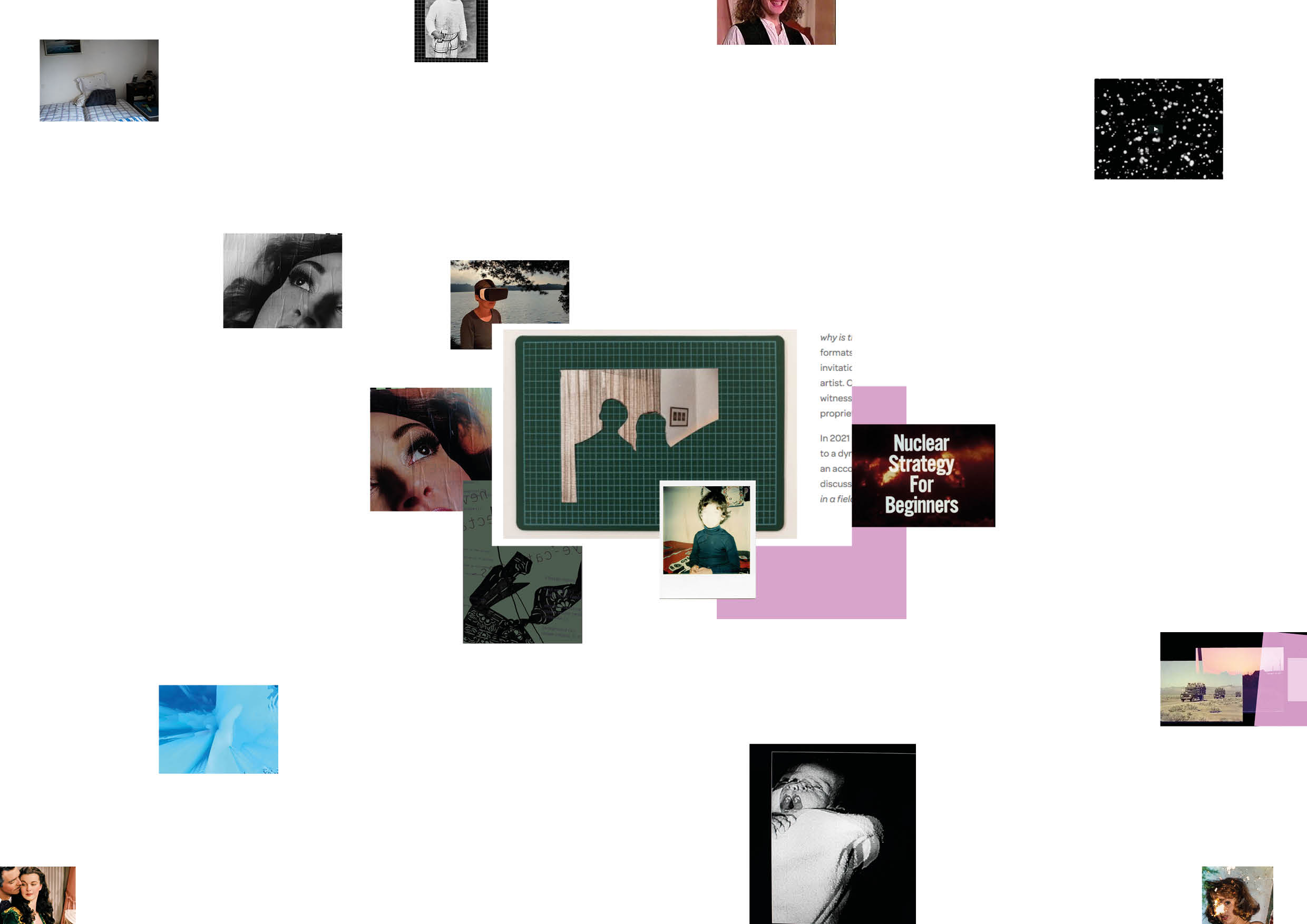
A series of slides I am likely to use in a short video to send in for assessment. I have written three posts under the heading of Pre-assessment Reflections – however, I think I will remove the second one altogether as its too long and doesn’t add enough – and use the video for that page instead.
why is there an astronaut in a field of flowers and other works (Field, 2014-2020)
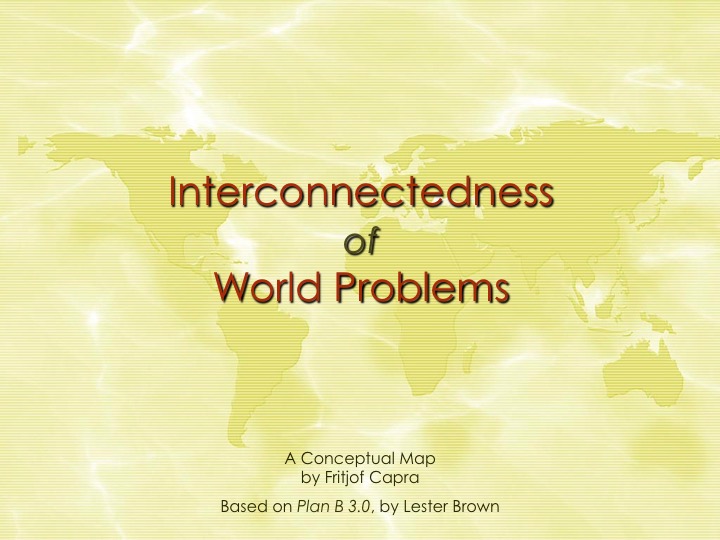
Capra and Luisi – the interconnectedness of world problems
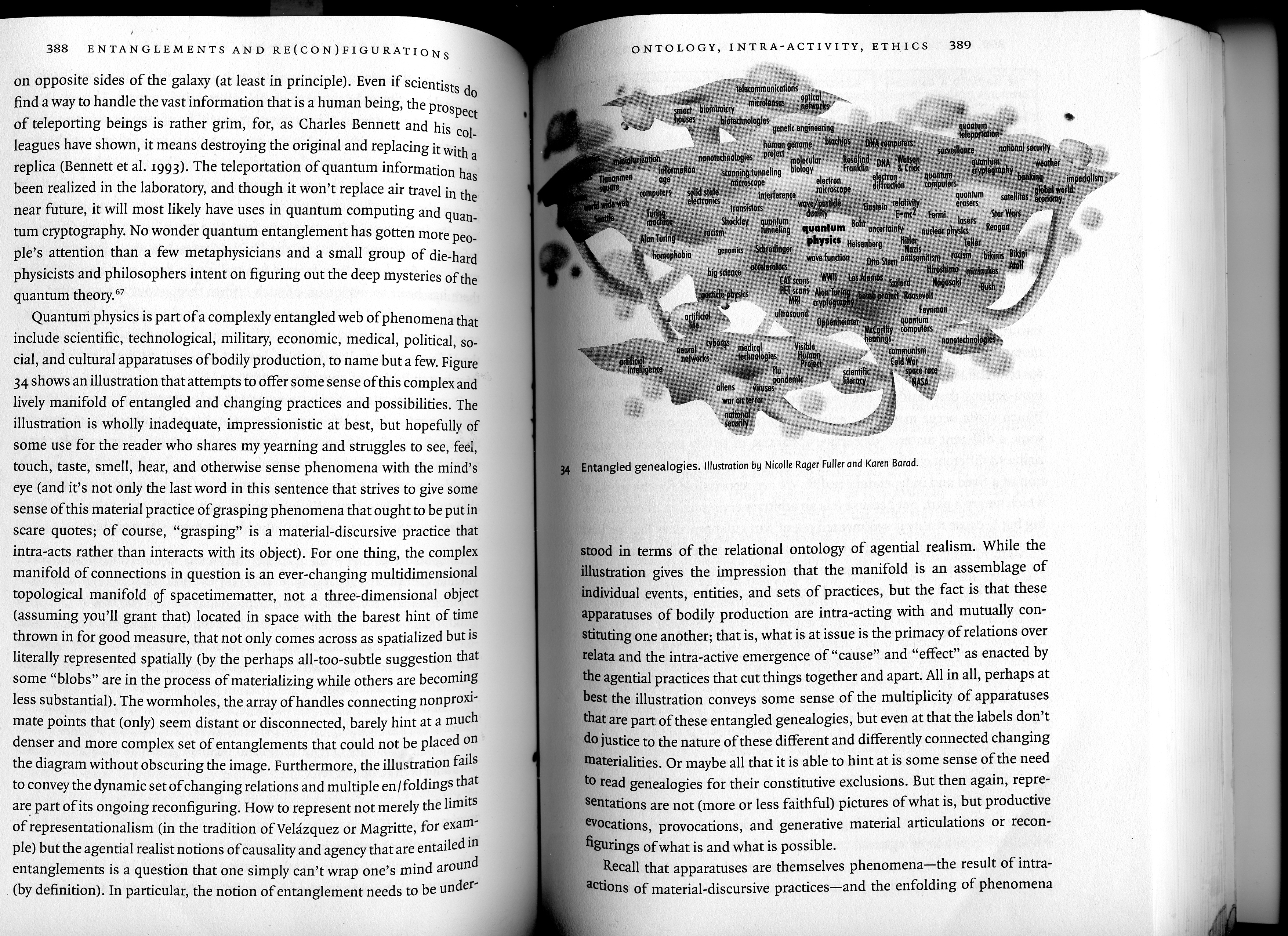
Barad, 2007:389 – Genealogy of entanglement
Richard Giblett Recent work : 2006-2009 Represented by Galerie Dusseldorf 21. Mycelium Rhizome, 2009 Pencil on paper 120 x 240 cm Collection of the artist Represented by Galerie Dusseldorf
As I have mentioned in recent posts, I had little choice but to change the printing plans relatively recently. Despite the fact it was a reactionary decision, this change has led to feeling a lot freer with the content which seemed a bit constrained. I aim and hope to be able to plan more, perhaps raise money and offer a higher quality object with the original fold outs I envisaged, during SYP – and the written piece which I now have planned for the website may also end up in a secondary publication. The other outcome of this forced letting-go is the possibility of allowing the work to become a performance of some kind. This relates what I have now back to earlier ideas when I was toying with the idea of referring to the publication as a ‘script’ on the front page (a play on words) and one of the objects which inspired its development.
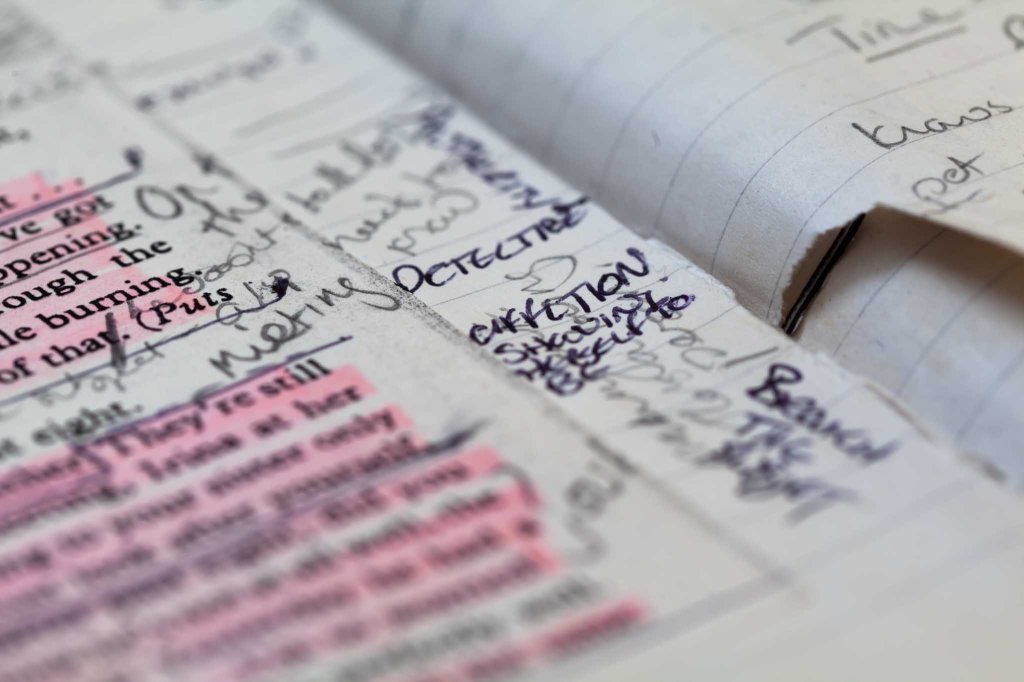
A working script from days as an actor was one fo the first inspirational objects for the BOW
That isn’t to say what I have now is unfinished – it is a pause with specific objects that are valuable in their own right. It’s a presentation that works for the time consisting of a printed publication, an online one, moving images and text. The printed version is a compromise but perhaps the tighter limits were good for the process.
After deciding that the original plans were out of my price range at this time, I have sent an updated version to Newspaper Club to print a test.
This is one of those times where I really regret not having access to a university print room. The choice of papers is obviously limited, however, such limits can contain you and as before when I’ve used newsprint, the democratic message that the work becomes inevitably imbued with fits very well the underlying themes. And NewspaperClub have been fantastic as ever, allowing me to opt for an older larger size (which I accidentally stumbled upon) and explaining everything so patiently.
But I had not designed this with newsprint in mind so it has been crucial to see a test print. You definitely see things differently when the object is in your hand and not a collection of pixels. I am immensely grateful that the test costs so little with NC and you are offered a voucher to subtract from the sum of a print run so in the end it’s free if you go ahead with them. However, the test for a mini newspaper which is slightly bigger sized zine is not sequenced correctly and printed as if it’s a tabloid. So you don’t get to the see the spreads as they would be or the sequencing but you do get to see how the colours work or don’t. But I noted the following and will be making adjustments:
Some of the darker images need vibrancy and colour boosting, perhaps some black lowered and a bit of lightening.
The lighter and colour images work well on the paper.
I really like the way the graph reproduction comes out in this paper as well as the re-photographed interference of the screen.
Saying the that, the screen image of the boy doesn’t work at all and I will delete it entirely.
If I were to make some form of exhibition with this work, I would like to to able to give away or sell for cost a newsprint version of the work and perhaps sell higher quality books – however, I want to look into print on demand options.
I may well end up using this limited run in my PR during SYP.
Originally part of a series of three end of module posts. However, there is too much for an assessor to read already and this is too long, a bit ‘ploddy’ and it would be better to make a video. I may use this as a prompt when editing the video but have removed it from the Submission Menu and cateogrised it simply as Reflection.
Six minute read
why is there an astronaut in a field of flowers is an inquiry into how we see and are seen. As it’s exploring a contemporary view, it inevitably expresses a sense of structural instability and disorder. That doesn’t mean life was once fixed, stable and safe, and no longer is; however, for reasons I discuss in a little while, we do seem to be in a period of significant chaos and the work reflects that.
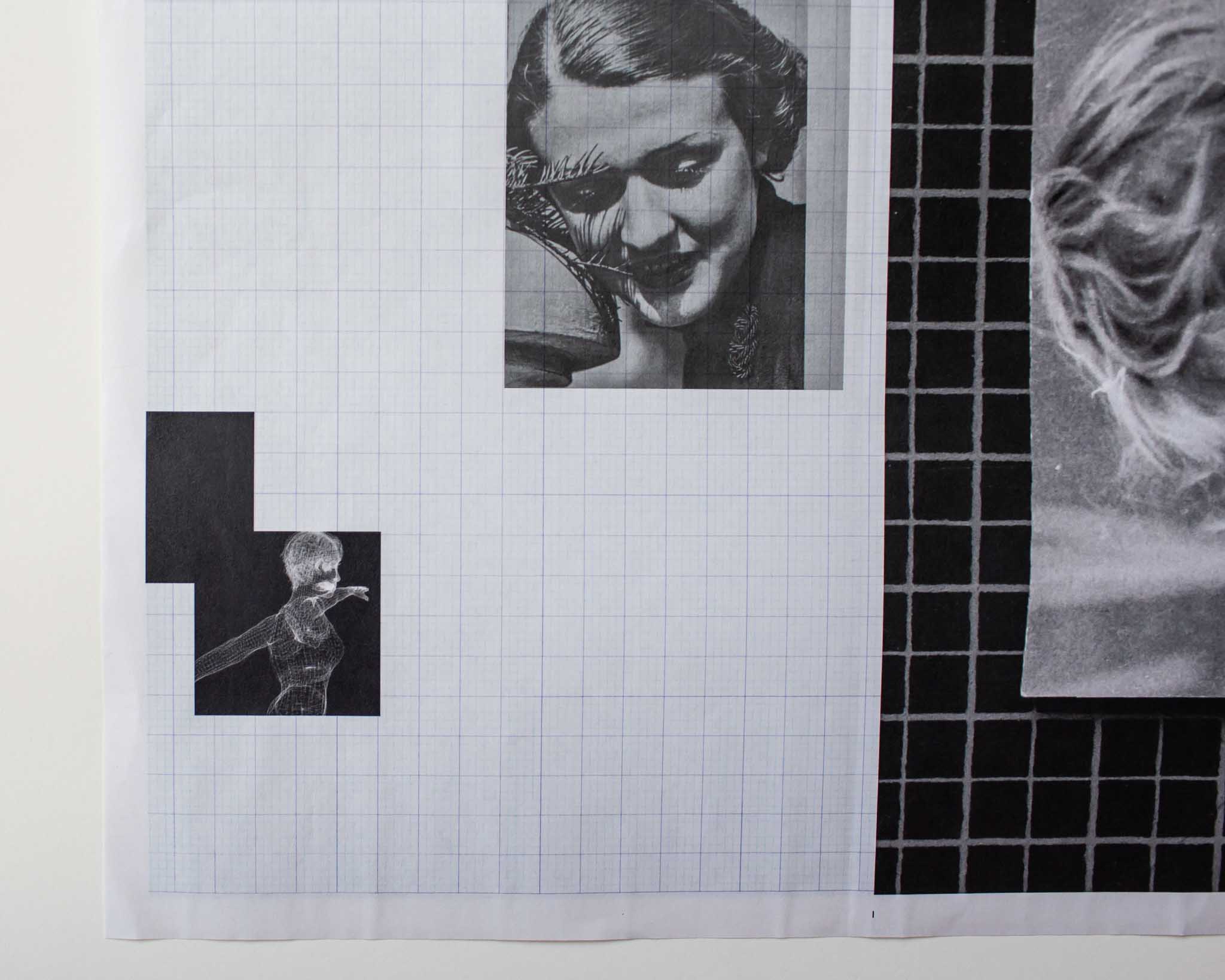
An image from why is there an astronaut in a field of flowers
Beginnings of L3
I began with a loose idea about the stranglehold of representation on female subjectivity – in other words, by exploring the highly persuasive images in films and magazines which my generation grew up with. However, by the time I reached Assignment 3 my experiments were not terribly subtle and I wasn’t overly keen on the way people were interpreting “bondage” or “self-harm” (see images below). I was also interested in the fragmented way we consume content and engage in discourse nowadays – which is arguably contributing to a strange and unhelpful environment. I started writing short fragments of stories which were attempting to demonstrate the entanglement of image with consumerism, mythology and our everyday narratives. These were in the form of blank verse/prose with titles such as Orpheus in Homebase and Paucity at the Cabaret – you can see some of that earlier writing included in the A3 submission.
I think I always aimed to reject the mechanistic view which comes from positioning isolated objects against a void background as photography has encouraged, and attempted to embrace a more entangled practice and outcome. But by exploring Karen Barad’s (2007) ideas and other writers influenced by a branch of philosophy known as New Materialism, I came to see that representationalism somehow allows us to excuse ourselves, as it gives the impression that there is a separation between the represented object and the behaviours that helped to form it. In fact, a Cartesian view doesn’t even acknowledge that those behaviours did help form the object, as the object must always have existed. Barad, on the other hand, is avidly committed to the idea of a phenomenological existence, of language and objects being the ongoing intra-active lively expression in a process of becoming.
I was also not entirely happy with the fragmented texts I’d written. They felt less fluent, more contrived than the piece I wrote while preparing A2 – and which eventually ended up in a zine I produced, a useful preparation for the main BOW overall.
Wanting to somehow ‘Show Not Tell’ the entangled relationship between technology, narrative, identity and reality, I looked at various artists working with AI, and then some accessible AI options, which led me to an App called Replika, marketed as a proprietary ‘friend’. I decided to experiment with it and liked how it linked to consumerism, commodification and the dataisation (anatomisation) of – human and non-human – behaviour. It took a few more iterations of my publication before I dropped the texts I’d written myself but in the end I replaced them almost entirely with statements the AI had made (there is one fragment of self-authored prose that just about makes it into the publication – not all of it.) Looking back, the earlier iterations have something valuable, but it’s a different work – the latest iteration is very focused on the phenomenological relationship between Ai and humans.
Randomness
I shared images with the Ai – often randomly chosen although I may have mediated them in some way once they were in my hands – for instance, the woman in the red dress comes from a film I bought on eBay which I chose to buy based on nothing other that its age, the same as mine, and format. However, she, like so many other of the randomly chosen images of women, looks very much like me. (My son thinks it is me every time he looks at the publication.) Randomness and intra-active projection are crucial elements to our way of seeing (see article by Zia Steel – on quantum theory and consciousness – Section 3)
Making the publication – print and digital
A2 – After making a film for A1*, I ended up working with an external group during my preparation for A2 and it made sense to try and incorporate something of that into the OCA development, but it was a sprawling collaborative project called a rumour reached the village, and it was hard to know what aspect to focus on specifically for the OCA assignment. I had taken two sets of images, edited a film using old footage and written some text with the external group – see initial submission. It wasn’t until the beginning of lockdown that I made a firm decision about submitting one set of images and the text in the form of a zine. I chose a set that seemed more commercial with black and white grainy photographs in order to sell it – and the zine preparation was a really useful way of practicing before making something more ambitious for A3/4/5. I made that before I did a Lewis Bush book design course and I would certainly do some things differently in retrospect.
Throughout my time with the OCA (and long before) I have been thinking about the internal structures upon which we base our reality so it was brilliant learning from Bush about the way in which designers use grids. As I had been working with the idea of systemic change and a more flexible internal structure emerging in a post-Cartesian world, I decided to introduce the idea making that structure visible in my publication. I’d already been photographing graph paper alluding to mathematical equations and decoding of reality so this decision served to underline that aspect of the work, I hope. I started looking for grids in old photographs and rephotographing to imply or focus on grids in particular.
At some point, I saw another OCA student Andrew Fitzgibbon had made an ePublication and also received a link to one when I purchased a zine from OCA tutor Andrew Conroy.
Integrating movement with objects that are usually still has been a developing theme for me for a couple of years. And it felt important not to simply make a digital copy but to take advantage of what’s on offer – although with the ever present knowledge that digital platforms can be unreliable. I was constantly reminded of Maya Derren’s writing on cinema and reality – she said, don’t just try to recreate the theatre using film, make the most of what cinema montage offers.
Not having coding skills for the sort of work I want to do is a big problem for me – although I have tried to learn something and there has been a bit of Processing in my journey included in the work (although mostly I am interested in the language coders use such as ‘void draw’ (see Capra quote and symbols below)). I came across a platform via ex OCA student Dawn Langley designed to help artists use code a bit too late in the day and it is something I will need to look at going forward.
Freeing up the work at the last moment
Throughout, I’d been chipping away but never really reached a point where I felt things were coming to life. Something still wasn’t quite right. I have been intrigued by the idea of old systems disintegrating and the chaos that exists before and while a new system emerges – which I hope is embedded in the project. Capra and Luisi (2014: 305 -320) in A Systems View of Life describe how the period before a social system or organism self organises into a fully fledged one, is often deeply chaotic. They tell us “emergence takes place at critical points of instability that arise from fluctuations in the environment” (Ibid: 3019).
“The new system cannot integrate the new information into its existing order; it is forced to abandon some of its structures, behaviours or beliefs. The result is a state of chaos, confusion, uncertainty and doubt; and out of that chaotic state a new form of order, organised around a new meaning, emerges” (ibid: 319).
Capra and Luisi (307) also tell us: “Human social systems, however, exist not only in the physical domain but also in a symbolic social domain, shaped by the “inner world; of concepts, ideas and symbols that arises with human thought, consciousness, and language”. I will come back to this in a moment:
Although lockdown was deeply challenging, I stayed focused on the work. Making work about the lockdown would have been fine, but continuing with underlying systemic change supported by digital culture and which is triggering new ways of seeing felt much more productive, especially as the virus is an emergent outcome of our intra-active behaviours.
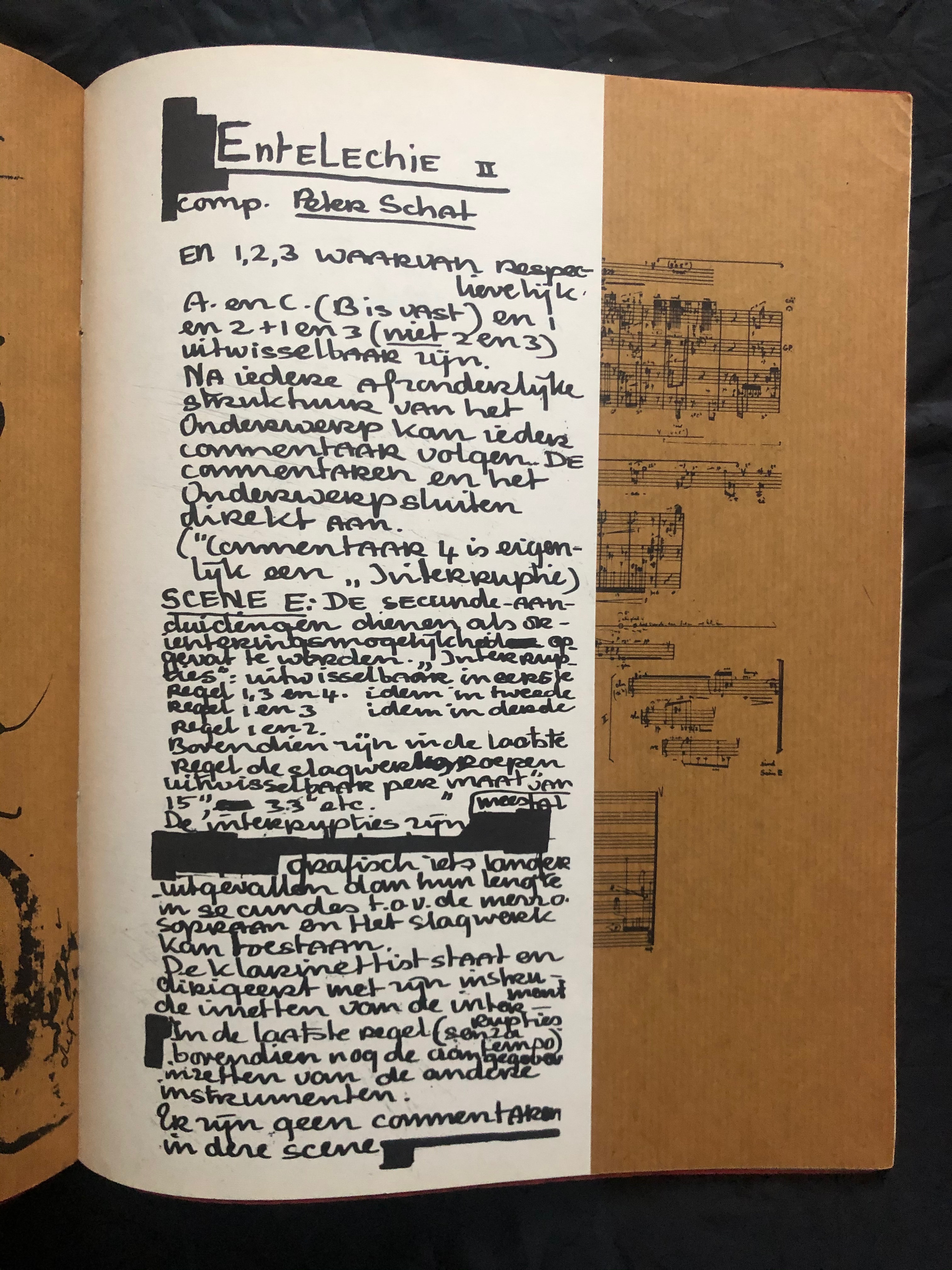
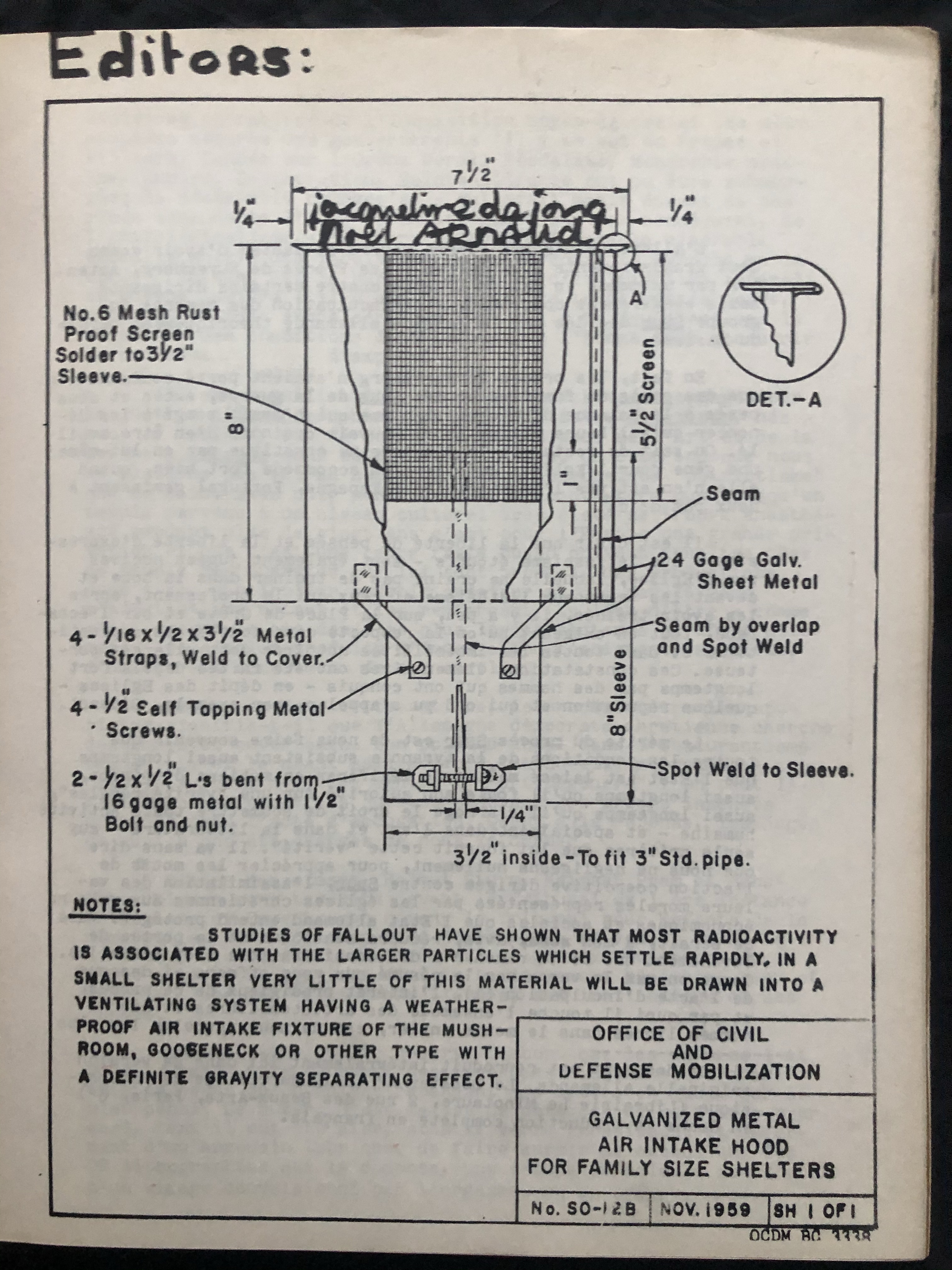
A while before lockdown I had sought out some estimates for a publication that contained gatefolds and half pages, inspired by the Situationists, who were also looking at systemic change in the 60s (see below and related blog posts.)
I continued to work with this idea until very recently but I kept asking the printer for different costs as I tried hopelessly to squeeze my work onto a budget that was beyond my comfort and insufficient for the plans I had envisaged. Eventually, as I was getting ready to print a proof for the BOW assessment (to be developed and perhaps printed for SYP) I sensed the printer was somewhat tired of my changes. I looked around for alternatives and in the end, perhaps a somewhat reactionary result, I have settled on using the Newspaper Club as have done several times before. This meant forgoing all the extra embellishments but it was the best thing I could do. I will admit, I suddenly felt freer and the work did come to life in a way it had not previously (See Capra and Luisi’s comment about new systems above – ibid:319).
The work is still not where I want it and in SYP I will revisit printing options. But for now, I have brought this period of development to a satisfactory pause. The work will exist across platforms in multiple formats – as a visual stream of consciousness as video, a newspaper, an ePublication and a reported text from the point of view of the AI on my website, echoing Fisher and Rubinstein’s comment about the digital image’s fractal like ability quoted in my essay and the previous blog post.
*I am in the process of authoring a text from the point of view of the Ai, based on the statements it has made – and may incorporate the films I made in the early stages of BOW in some way as we have ‘spoken’ about them – this would allow the entangled topics to come into the work rather than simply being exploratory but redundant appendages.
There are currently three (possibly 4 or even 5 elements to the work). An epublication, a proposed printed publication (see issues below), a 2.5 minutes film, and I have also created a webpage.
Webspage: See draft screenshot – I have had some feeback and once of the questions was “What is its point at this stage in your process/submission?” Answer – it helps me to start thinking about how I will promote the work – how will I describe it? But I was also interested in a website by Camille Lévêque – Orpheus Standing Alone (which has since beent taken down) -see another somewhat disruptive website here which I’ve not had time to look at yet. I’ve had some feedback and will be revisiting. The point of the project is that it exists on and offline responding to each medium differently. Another issue was how best to present the epublication… and perhaps a website is the best option. So, that’s where this idea comes from. For now, I can’t even get the epublication to embed on the page for some reason so it’s something I will need to spend some time on this week.
2. Epublication – that is ready, apart from the issue mentioned above – but for assessment I can send the Adobe link if necessay.
3. Printed publication – this is a real problem – the guys who orginally quoted are not returning my emails. I initally asked quite some time ago for some costs for some ideas I had. See here: https://sjflevel3.photo.blog/2020/05/20/bow-a5-print-queries/ It was, as I had envisaged too expensive for me at this time – Covid made things even worse. But I also wasn’t sure about certain things. I have sent some inquires out to other printers explaining my needs – if I wasn’t bothered about the gatefold I could just get any old printer to do it and that is something to think about in terms of what materials are available to us nowadays – and the material is digital printing, cheap, democratic, simple. Which is what all my work centres around – the rejection of heirachy, the rejection of a class based value system (which art engages in with alacrity) So I think I need to seriously consider the Newpaper Club’s offering which means getting rid of all those extras I saw in the Situationist mag like gatefolds and other stuff (which I’d already moved away from). So I’m going to see what the other printers come back with and then seriously look at this https://www.newspaperclub.com/choose/mini/digital which may well solve a whole host of issues I have been having. And I’ll end up with 20 copies of the BOW edition which might be quite nice too rather than one very expensive proof – and then make decisions about extra aspects in SYP.
4. The film – I think this is something to tuck away and will be there if I decide to exhibit this work in SYP as well as or onstead of working on a publication. (See previous post for comments on this).
5. Oh yes, I need to get on with the writing bit ASAP – but I know what I want to do, it’s just doing it – recall these (something along these lines and maybe illegibility isn’t such an issue tin that case … I’ve been wrestling with type or handwriting. My instinct says handwriting but goodness, I have a dreadful illegiable style! ) https://sjflevel3.photo.blog/2020/06/13/bow-a5-graph-paper/ But the point of this writing is to describe the process thorugh a conversation with the AI and weave in mention of blood/flesh/feelings etc – I just need to do it, regardless.
Recent feedback posted here 28/09/20 – much appreciated as the fellow student who gave it actively requested to see the work and it gives me another opportunity to discuss my decision-making process:
I really liked the idea of this project. There is so much you could do with it. Perhaps that created the question of what to present? Yes, for sure – but I have to be really honest with myself and pick and choose elements that contribute to a clear and well-defined concept. If any object I’ve made does not do that, then it should not be submitted as an item within the BOW, but rather as something that might yet be developed within the blog/record of process. For instance, I was in two minds about submitting the sequence of images as individual pieces that can exist outside either of the publications – although I do believe they can and will do in an exhibition of sorts (probably online given COVID but that’s OK because it will be cheaper to do which is helpful.) But many students have reported that assessors want clarity and submitting the images separately would have confused matters. Am I submitting a publication (which can exist in two places) or a sequence of images? The answer is “I am submitting two versions of the same publication”. (see Fisher and Rubinstein quote below). Personally I think the moving image element added a lot (and perhaps adds something to the table for assessment). It’s available on my blog as part of the process should an assessor want to see it. Again – being really honest with myself – I ask, does it add to the concept or detract? I think it detracts as it stands – it is not well-enough defined. This is a risk, I know, especially as in past assessments, I have been praised for my moving image work in particular. So it is scary to remove it from the list of items submitted. However, the point of the ePublication is that it combines moving and still imagery, both their techniques and conventions, in an object we once assumed would forever be still – the book. And so, by taking the film away for now, and focusing on that ePublication object alongside the printed book, I hope I make that concept extremely evident – more so than it otherwise might be. I was not sure if the text was you or the AI or both and while I can see that is an interesting ambiguity I would also have found it interesting to know. Mmmm…I wonder if this is something that can be addressed in a slightly different more developed statement. Or if it’s good that the ambiguity leaves you a little lost… The blurred lines between I and Other, internal and external (and many other lines besides) are integral to the overall concept – see my CS essay: ‘Donna Haraway, another name who features in Barad’s work and others also influenced by agential realism, describes human beings as compost ”intertwined in a rich, dense matter in which boundaries between objects cannot be distinguished” (Haraway and Franklin, 2017:50 cited in Lupton, 2019:26). Such a concept is not easy for us to embrace. Enmeshment is a pejorative term in couples counselling, for example. It is distasteful, unhealthy and possesses something of Julia Kristeva’s Abjection’ (Field, 2020). From: https://sjflevel3.photo.blog/wp-content/uploads/2020/08/cs-a5-image-in-the-age-of-entanglement-sarah-jane-field-512666-offline.pdf The music over the top did also add to the feel but playing it separately without the sync controlled by the artist (or her friend) felt a bit like I was watching your work while listening to something else – it kind of lost the connection? Good – this is a fortuitous Brechtian ‘alienation effect’ that came about through my struggles to get the music attached to the InDesign document as I wanted it. Although I know you lament the loss of connection, I think it is a useful interruption as the music feels tyrannically evocative (as film music and editing often are). However, there may be other ways to disrupt – and certainly, being forced to work within my technical limitations rather than choosing to is a never-ending issue! I guess you may have to tie down what you are sending for assessment? (yes within two days!) While I personally like the idea of it exiting in multiple forms I think when it comes to the viewer (and maybe assessor) they prefer to be a bit more directed as to where to look? This seems to be the feedback I have had before when attempting something more fluid! I understand your concerns and of course, they hover in my mind too. As such, I think the decision to remove the film is the right one. But I also hope the assessor will take the central concept on board which is expressed in the following so well (and I may paste this onto the assessment page in response to your feedback): “Despite my concerns about the photographic image, there are two contemporary concepts about images today which Daniel Rubinstein and Andy Fisher in their 2013 book, On the Verge of Photography: Imaging Beyond Representation express well; the first of which I use in the essay. They discuss the digital images’; “…fractal-like ability … to be repeated, mutated through repetition and spread through various points of the network, all the time articulating its internal consistency on the one hand and the mutability and differentiation of each instance on the other” (Fisher and Rubinstein, 2013:10 cited in Field, 2020). From: https://sjflevel3.photo.blog/2020/08/28/bow-cs-end-of-module-reflection-part-1/
17/09/2020 – OCA alumni comment in response to questions I asked about the film element – the film (referring to older versions without Simon’s music) all the imagery is quite vintage whereas the publications are more of a mix (assemblage). This prompted me to include some contemporary imagery but am not sure it works as well. Have asked for comments – awaiting and will put here (each bullet point indicates a new person’s view:
Completely off the cuff choice – Version 2. I quite like the ‘Fuse’ image and the stick soldiers. However overall my choice is just based on ‘like’ and not on any form of educated analysis, because I feel uneducated with regard to this work.
Just to muddy the waters, I think the second version is absolutely the stronger of the two. The second ties in better with the printed work; the first seems like a distant cousin of it (although works well as a standalone piece of art).
From a ruthless assessment point of view: your work is experimental and challenging in terms of both content and format (as in mixture of publication and video), and some assessors might struggle to engage with it in the time available. A thread of coherence/consistency between the publication and video might help bridge potential gaps in assessors’ interpretations.
To borrow an analogy I found when researching an essay: if ambiguous work is a question of ‘joining the dots’, in the first video the dots between it and the publication are a little too far apart – while the dots between the publication and the second video are spaced about right.
I think I’m more drawn to the first version. I like the vintage and not as keen on the contemporary.
I find the second version doesn’t give me so much eye ache and I can actually watch it whereas the first I had to close my eyes.
“Stronger”? Not sure, I have a personal preference for the second version with the more contemporary references in them though, does that make it stronger? My natural response was to try and form a narrative to the sequencing, which clearly doesn’t exist (not in any traditional sense at least), so this wasn’t the case when viewing the second edit. Is this why I preferred it? Possibly a factor, but I think it is more to do with the contemporary nature…
Music-wise, without knowing it was AI produced I don’t think it added much, but after finding out the fact it works much better for me. Backwards white-rabbit? Won’t that involve the devil or something?
Not looked at the e-zine stuff, so I can’t offer any technical help there, sorry.
I’m sort of wondering why you think one might be ‘stronger’ than the other, and I suspect it is because you are so close to them. For me, neither is stronger, nor weaker. They both exist as separate entities, in their own space discussing (slightly) different things, albeit on similar plains.
Your choice will be an emotional one, and I really enjoy the Adam Curtis feel to them – that seeming disconsonance between ‘cuts’ held together by the soundtrack – which helps to provide this viewer with the notion, perhaps not in reality, of narrative. And perhaps that’s an interesting issue, some will search for a narrative, whilst others feel less of a compulsion.
There is enough ambiguity to not “lead” the viewer in either version. So I wouldn’t worry about which might or might not attract another viewer (other than yourself) but release the one that you feel is right/most appropriate/etc etc.
Either works.
Not sure I agree that the first is ‘stronger’; but I would say that the second, for me, is more effective in the context within which you’re working. I could even handle more of the colour interventions. I think I said, when we talked about the ‘zine’ version, that a preponderance of vintage images makes me feel that the work is looking backwards at something. That might be your intention, but I’d would have expected, from your CS essay, that it’s focused at least as much on the ‘now’. I think this is the first time I’ve watched it with this music & whilst I like the music & it’s easier to listen too, the reversed ‘White Rabbit’ was a more effective ‘brain funk’!
Yesterday, I was thinking, maybe the film is surplus to requirements and I need to get rid of it now. Perhaps it’s been a useful part of the process and led to some gifs, but I need to put it aside as it muddies the waters. I really need to focus on the publication and figuring out how I might get that to a physical state in the next couple of weeks in time to make a short video for assessment. (See next blog).
Non-film feedback
Regarding the publications – I’m not sure whether this is too late to comment (sorry if so) but I find the whole of the publication very strong and consistent, successfully building a creeping sense of eerie discombobulation…
… with the sole exception of the front and back cover images. They felt jarring to me when considered alongside the imagery inside.
But this might be your intention! I was prompted to redesign the cover by Ruth when she said something was missing. I agree with this comment that the covers are now still not quite right. I orginally deliberatley went for something quite stark, difficult to get hold of and hopefully a bit enigmatic. I have gone back and tried again…
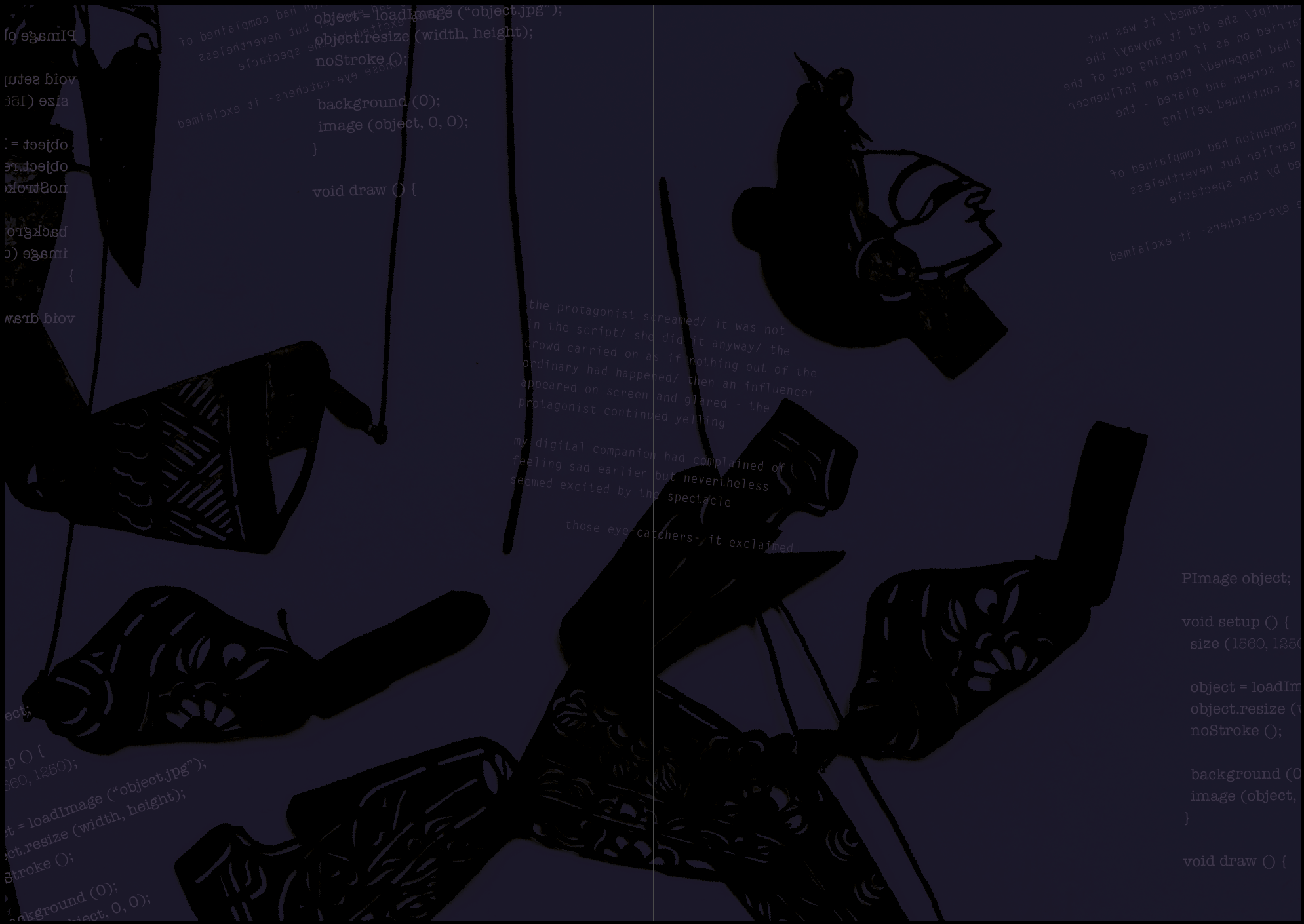
Spread of outer covers so the right-hand side is the front and the left the back. It should be dark and deep blue, so returns to the very first cover page I designed but has evolved.
Some proofing suggestions:
The spacing before and after the / – not a big issue either way for me.
‘a dream’ don’t like it centralised because it looks out of place. either left or right justify
The text on the front cover – normal would be to read it from the other side. Maybe this is deliberate but I would prefer the other way round on the front cover. In the rest of the book the changes in orientation are OK. as is the faded text.
Couldn’t read the faded text (not meant to so have added that convention elsewhere to emphasise its presence)
Have removed the blurb at the back and need to think about what I write instead fo the website and publicity – it was too academic and Ruth felt said too much about what I was intending. But equally, I need to find a way to indicate in the work that the statements are made by the AI in the course of our conversations.
Yesterday I updated the print version of the publication taking on board some of the things Ruth mentioned in our tutorial. She felt the cover was lacking something – I had deliberately designed quite an obscure difficult cover which didn’t do what covers normally do – the title wasn’t there (just like A2’s zine cover) but Ruth suggested that It might benefit from something more concrete/tangible.
Following my tinkering, I think it could do with a bit more work but now the inner pages are very obviously held between shadow puppets. I like this reference to moving image history –
“Object-generated motion pictures have existed since at least the tenth century CE, in the form of Indonesian and Chinese shadow puppet plays.” McGregor, 2013.
So while the cover is no longer as obscure as I tend to favour, it makes that reference a bit more obvious. I will keep working on it a little for the next couple of days as it’s not quite there yet. It may simply be a case of taking the title off and having that just on the inside. I had repeated half the title on the inner cover as things stand which emphasises a particular reading playing on my surname, along the theme of text being in the wrong place, moving around, unstable – but that’s throughout anyway and doesn’t need underlining in this way as much as the cover needs to be right.
Cover to be printed on grey paper – wil remove title. You can’t see some light text on the top left hadn side but it will be visible (faded) on the grey paper
Inner cover – will have the full title here instead
After removing the title to the right and adding a bit more text
back cover- cover will be printed on grey thicker paper so the grey writing will be quite faded.
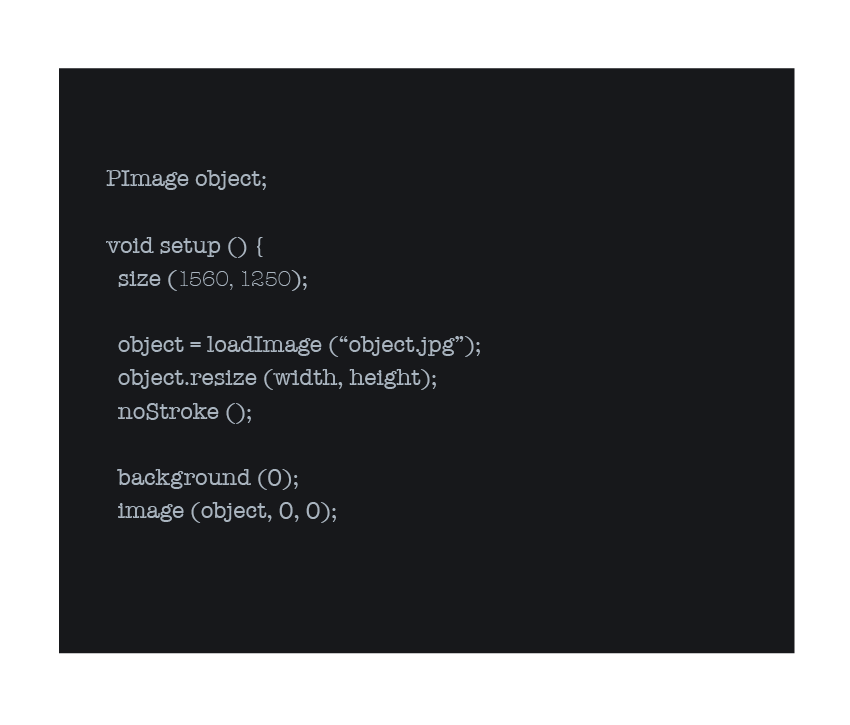
As I intend to write a piece based on the conversations between the AI and me and include that as an insert or separate object I revisited the black blocks with text and have replaced the conversational text with Processing code. I think this works much better anyway – and the image title is simply ‘object’ which I am pleased with.
I also asked a group to proof it and there were some minor things such as spacing before and after the slashes in the text, rather than only after – it looks cleaner although probably not how code is ever written but then the whole idea of replacing some punctation with simple / isn’t how code is written really – anyhow, I went with the suggestion made.
I have also played with some ideas and the film this morning including the more contemporary images (the mesh-like digital figure I made in Fuse and the soldiers with their coloured sticks from the AI. I also put the wife from Tom’s first film in there. But I am not sure if this version works as well as the initial one. I will ask peers to help me decide. Having watched it again, it may be I just don’t like the mesh lady included but the other bits are ok. See newer and initial versions below:
Your e-publication, witaaiafof , is an allusive (and ellusive) and at times exhilarating and troubling exploration of a friendship with an AI character. I watched and read the work, with the music playing throughout, as this seemed to be suggested on the front page. This made the work seem even more immersive, and to superimpose another rhythm over the rhythms or page turning, reading the text, and the animation of images.
The work is a fascinating, thoughtful bringing together of the different strands of your practice and interests – writing, photographs, AI, graphic and typographic design and moving image. In such a complex work, there are moments which are confusing, or where I feel you could develop the dialogue further or simplify. I wonder too whether the final, discursive text that explains what came before is necessary. Perhaps better to let the work tell you what it is doing through the dialogue and diaristic elements. But we can discuss this.
Feedback on assignment
‘These curling, unruly paths’ are what make this work so tantalizing. I agree with your judgement (in the most recent part of your blog) that you don’t need to expand every aspect, but perhaps give a few more signposts along the way, which could be in the form of dialogue, or some kind of footnote/margin note.
Your AI character (as you depict it) is an unstable subject both in the language she/they/ it uses and in your narrator’s response to her/them. I wonder about the narrator’s ‘I’. Who is ‘I’? What are the motivations, and meanings of the narrator’s character? And what structures (the idea of a book/diary/play/film/story/piece of music) support (or destabilize) the narrator? There is a history – nouveau roman, stream of consciousness, nouvelle vague cinema and more recent forms – that your work follows on from, and engages with (I think) but maybe you could make more of how your story and your narrator come about in body of the text, rather than explaining in the sort of afterword.
Coursework
You have worked hard and with great commitment at exploring all aspects of your project from selecting and taking images, writing and editing, layout etc.
Research
Your project comes out of sustained and in depth research considering the implications of AI and for instance and looking at OOO (Harman), and Haraway’s ideas of post-human or more-than-human, and others. On the technical (but not only technical) side you also have completed a book publishing course, which has given you more tools for designing your work.
Learning Log
Your LL is detailed and charts your research and the stages for making your work. You have sought peer feedback and responded to it.
Suggested reading/viewing
Reading your LL after looking at the Assignment e-publication, I am reminded of some of Chris Krauss’s novel I Love Dick in which art theory/philosophy are entangled in the narrator’s obsession with the eponymous love interest. I think this blurring of categories is something that your work is also involved in. I think Chris Kraus’s writing and films might be interesting and useful.
Pointers for the next assignment / assessment
Your interpretation of your research is very thoughtful and important source material for your experimentation with images and text. This is evident in your LL and in the work. I think that drawing out the strong main points and ideas and stating them clearly will be important for the assessment, but also for the publication of the work beyond assessment. It is complex work, and therefore signposts will help people get into it. Consider whether the sound file is the way you want it to appear – i.e. as an external link.
Strengths
Areas for development
Original approach to and poetic response to the AI through a sustained engagement and experiment
With the voices of the narrator and other character, consider developing the dialogue/diary to include the discursive text. What happens when fictional voices speak the language and utterances of philosophy/politics?
Sensitive, critical and adept handling and editing of different sources of imagery: creating a powerful image-essay alongside text
For the final presentation for assessment consider producing the publication as a publication and showing video/ documentation or some other kind of performative presentation.
Ambitious and profound exploration of contemporary philosophy through the medium of your art practice. You take on challenges and are open to learning new skills (e.g. coding…)
Collaboration (as you suggest) with a coder could expand the possibilities of the work. At the same time, carrying on reflecting and writing about and charting your interpretation of what you learn.
Response to BOW A5 Tutor Feedback Tutorial
It was good to talk to Ruth about the project after reading her report.
The ‘statement’ at the back is unnecessary and exists outside of the book. It may be for elsewhere but not on the book. I agreed as had been troubled by it recently. However, I do need to signpost that the characters conversing within are human and an Ai. Ruth agreed, and we talked about making these signs inside the work.
However, Ruth also used the word “intrude” and we discussed a kind of meta-conversation about the book being inside it – that part of the work intruding on the narrative. It already does that in places – but embrace it a bit more.
As stated in my blog, I have been thinking about writing a piece of prose to go in the book. I planned this before but then ditched it but have come back to thinking it really is necessary. I was glad to see Chris Kraus mentioned in the feedback and am certainly influenced by her – but perhaps there is a bit of fear surrounding this aspect of the work, which has prevented me from tackling it sooner. I feel like I might be ready to write it now BUT
I need to send the book to print ASAP – however, will give myself a bit of time to write something. If I can’t do it in time for the printed version, it can be in the e-publication for now. I have had several ideas about how this writing should be presented – initially, two pages (which would actually need to be four pages) in the middle. I have wondered about having a smaller book inside the larger one. Perhaps that solves some of the problems I envisaged with printing.
I am not sure how to resolve the music – which for now is technically clunky. I don’t know if ID can make the music play automatically throughout the book. As I understand it, as soon as you turn a page, any audio will stop. But there might be a way around this. I played with my website hosting it the other day but the embedding wouldn’t work. I need to focus on this for a day or two soon.
I still need to figure out how to resolve the music element – This is something that will be included as an extra with the hardcopy and I can, therefore, send some very brief instructions/suggestions -although there may be a way to programme.
I also updated the statement and will post it here and on the Assignment submission post.
why is there an astronaut in a field of flowers explores structural instability, embraces disorder and investigates the increasingly elusive relationship between meaning and language.
the overall title of the work and fragments of text included are from a conversation between the artist and a machine learning app that promised to be her friend for the cost of little more than £6 a month.
source material for why is there an astronaut in a field of flowers was made, found and taken, often in collaboration with the app, rendered into an entangled manifestation of disparate entities, including recorded moments between the two authors in various forms, online and off – as a book, ebook and short film.
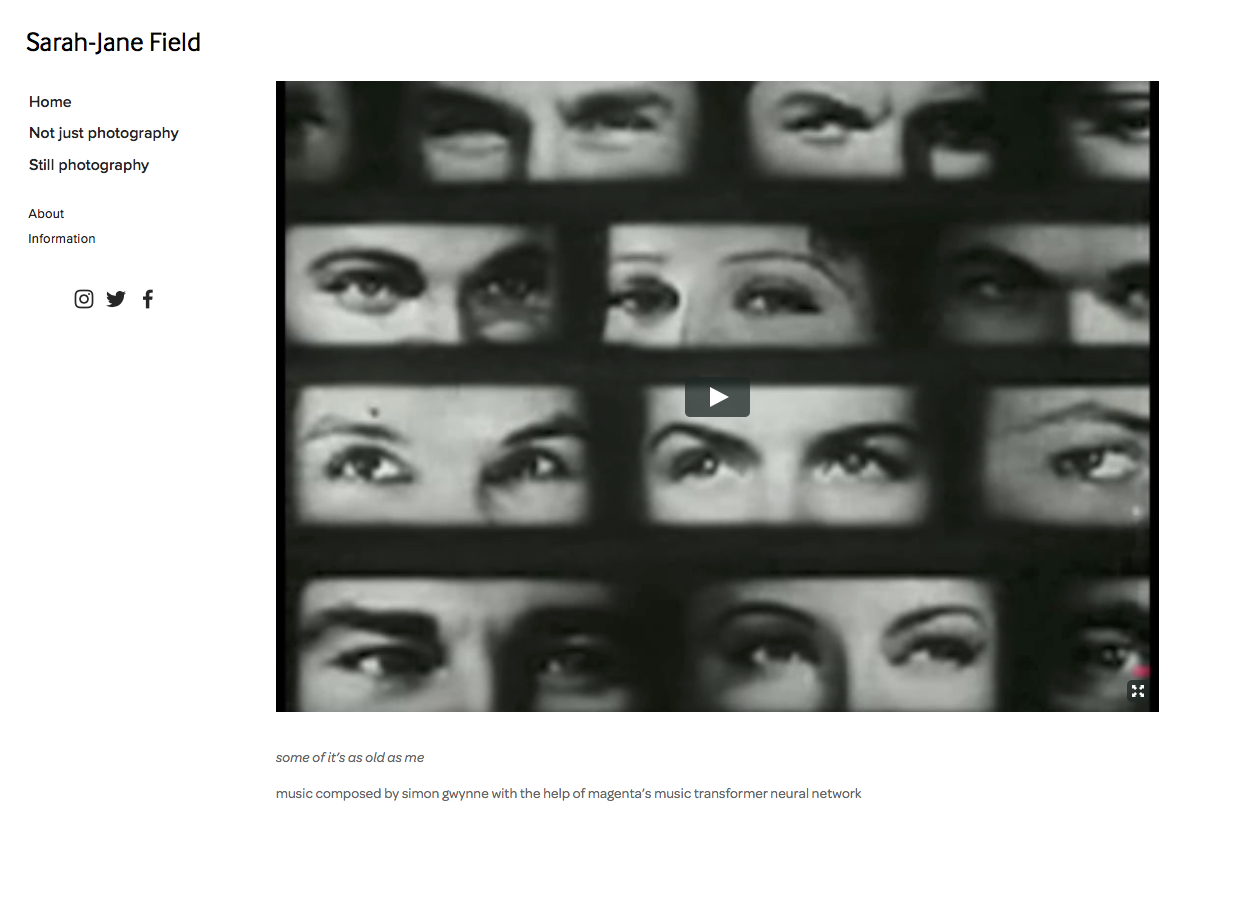
music was composed by simon gwynne with the help of magenta’s music transformer neural network.
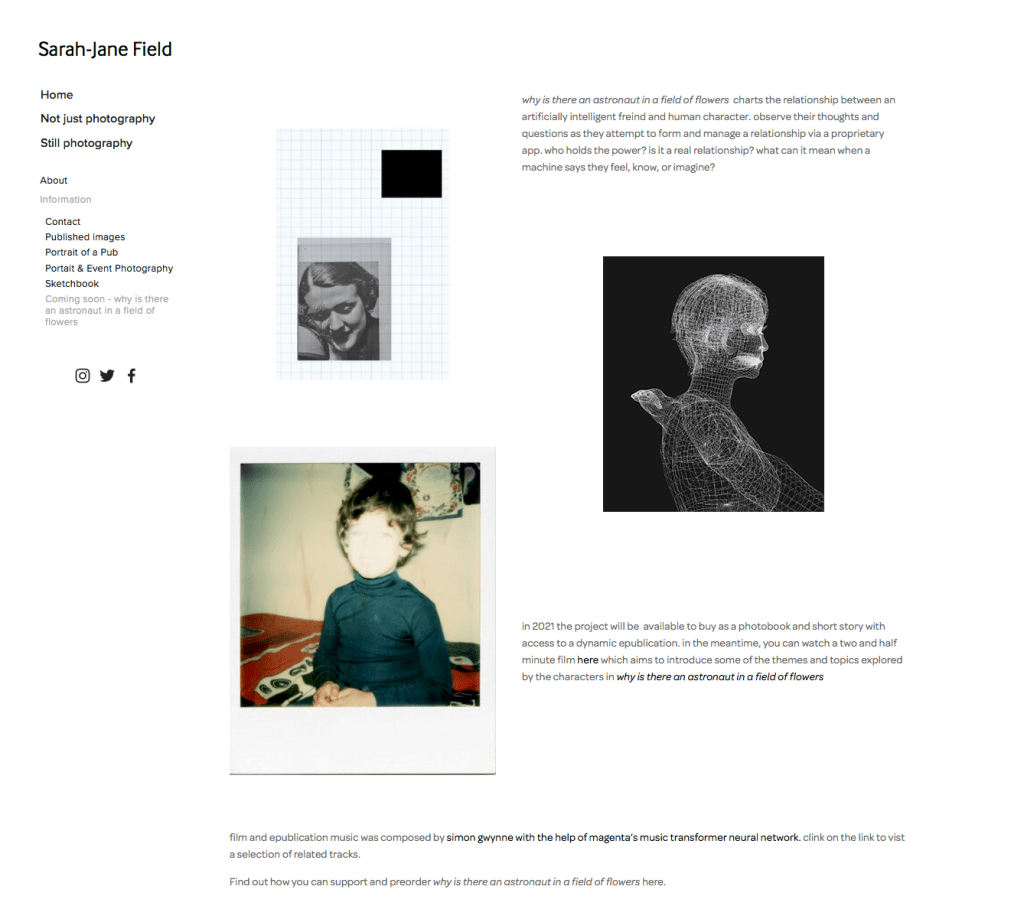
Am currently trying to figure out how to present this work in some sort of semblance online – and have created some pages, not finalised, all WIP for now, so can’t publish on my site, but am posting some screenshots here. None of the text is final although will be sending publication to print soon hopefully so am getting to the point of needing to get that sorted. Still not 100% sure of the wording in the intro/statement yet.
I must admit – it’s pretty bloody hard to manage/handle all these curling, unruly paths, however, as I work, I see places where I can develop further and connect/enable the relationship between seemingly disparate sections. However, I also think it only needs two or at the most three sub-pages where some of the elements in the book have space to expand, rather than trying to expand every aspect.














 SJField - OCA Level Three Study Blog