I have copied and pasted the book over into a slightly bigger size. Originally it was A4. Now it is a few mm taller. I have written to a couple of printers asking about cost as I know all my ideas will pile on the costs and if I go for half pages and different sized pages, it can’t just be ordered as a standard book from a digital book print company using their templates. However, I do recall Milk saying in their website they do handmade publications so maybe worth inquiring – although it seems nuts to ask an Australian company when there are plenty here. I am also aware that this activity pre-empts SYP but the design is integral to the overall concept so I can’t really separate it out. Scroll down for responses.
Here is an extract of my inquiry (included here, not least because some of the concepts are outlined succinctly):
I am working on my final Body of Work (BOW) project. It is not finished but I need to start thinking about how much money it will cost to produce, what is realistic and what might be impossible.
[…]
It is slightly over A4 and the design is based on some Situationist Times publications (see video)
These publications had vertical and horizontal 3/4 or 1/2 pages and I have included those too in my work for now.
I am also thinking about the sort of maths exercise books with graph paper from my school days as an influence. Coding and decoding reality using mathematical formulas should subtly weave its way through the work.
I would ideally like different textured paper for text (there are four pages of text inserted) like they have in a FOAM publication.
I think of the work as a bunch of signifiers behaving like rowdy children.
At the moment, there are coloured blocks which might indicate paper colour rather than ink. Please advise me about this.
I’d love to hear your thoughts, suggestions and warnings.
I have had one response so far:
Thanks for the artwork and email. It is a very ambitious publication and will need plenty of time to finetune and get perfect from an artwork then a production point of view.
So, picking through the points, is the finished publication 310x216mm with a total of 48 pages? 4+44pp?
Are you able to send over a video of a mock-up please? The pdf is great but really doesn’t show which pages fold in which direction
Page 8 is a fold-out? If this folds out then page 9 should be with same width because it backs up to it? Same with 14, the next page has to be the same size?
If you can make a mock-up you’ll see the mechanics that you need to consider with the actual paper.
From a cost point of view, having the height at 310mm means the print costs will be double what they would at A4 (297mm). We can use GF Smith Colorplan for the coloured papers but these will adds £100s more to the total cost in comparison with printing the colour on our white ‘house’ sheet.
This answers some questions – I have replied:
I will need to put something together this weekend or early next week to send over as a video.
I am very happy to use A4 (I had a feeling that might be the case and, in fact, I think there absolutely must be some conventional standardised structure to contain the non-standardised erratic stuff.)
I was also certain ink rather than paper colour would be cheaper so when you give me a rough idea of costs, please go with the more affordable option.
Further answers from me:
This [the video and dummy I made] is all VERY rough indeed but it was a helpful exercise. I made this dummy with an inkjet printer, set to fastest print speed in mono – so it really is looking at the construction more than anything else.
As you might imagine, the sequence in my PDF is still totally up for reorganisation but the practical things that need to be fixed at this time should be – such as binding type, where the text pages and shadow puppets on half pages should go, and the gatefold construction. When I’ve done another edit, I will print a version at work on double-sided flyer paper in colour to get a much better idea and will send you a video of that once it’s ready. Below is a list of things that came out of making this dummy:
The book is probably not big enough to contain half vertical AND half horizontal pages. I will ditch the vertical half pages and stick only with the horizontal ones. (And a gatefold – see later)
The half pages should either all be in the middle of the text pages or should wrap the text pages which I think is my preference – the 4 text pages (2 x double-sided) therefore interrupts the narrative of the shadow puppets. I have played with various options in the video.
(Does the above depend on whether its saddle stitch? – and the text along with half pages being in the middle, which removes the possibility of a centre spread image – which may be fine.)
The text should be on a different textured paper if possible.
At the moment there is one gatefold. (Hope its all clear and evident in the video) I suspect that is sufficient in a book of this length. But when you give me a rough idea of cost, can you let me know what it would cost to include two, please.
(I also wonder what it might cost to have a gatefold that folds out for an additional page… so in the video, you will see when the spread opens out it contains 3 x A4 pages. What if it were four?)
I will stick with A4 rather than an alternative sizing – (this fits with the concept of classical and non-classical structure existing together and intermingling, setting up tensions between the two)
I will use ink where I want pages to be a different colour to avoid massively hiking up the price – but even that will be limited.
Saying that the cover pages might be best with a different paper as is usual – although I used the same paper for the zine to keep costs down (recall the idea of the school-like maths exercise book being an inspiration for this work)
I want to avoid the stark white paper photobooks are usually printed on. One of the examples you sent me before had used recycled paper. I like that idea – and wondered, is it a bit creamy in its naked state?
If I do use ink to change the colour of any pages it should be on the whole spread so that if its on page 5 (inc. cover in numbering) in one half of the book it should also be that colour on page 36 (think that’s right!) – especially if it’s saddle stitch.
I think I may have seen 40 pages as the limit for that binding- maybe only in zines? I’ll await your guidance on that.
This is now much more focused on a specific line of inquiry. I feel like this has put me in a better place to begin putting words down for A3. (I hope!)
Adding 5/12/2019 (although they arrived prior to that nad presented here in the order they arrived – my responses in Orange)
Read your Lit Review and have the following comments: Firstly – an excellent review of the position you are taking.
In some ways it feels like being close to a completed essay, much like John did, and could see you fleshing it out to provide a final essay. I feel the shape is just about where it needs to be too and I can use the progression/layout here as a starting point for A3/4 etc.
Maybe needs a link to your work, but that could come in the final essay,
To be really picky, there is some inconsistency in your citations in the text. (I did not check the bibliography)
The use of italics for emphasis is maybe superfluous – I did not highlight all of them, – thank you
UCA Harvard refers to Figures not Images, so OK in body but should have List of Figures , not ‘Images’ OK
Something I picked up from the UCA (site links below) was that the list of illustrations goes before the bibliography. I’ve followed these for mine. I wasn’t sure about the sentences under the images. Should they be in the text? (yes, I am really pushing boundaries here – something to look into. – I wrote in an email discussion
I expect if it repeats what’s in the body it’s fine, if it echoes what’s in the body one is flirting with danger, if it adds info – it’s probably not such a good idea. )
The intimates using text examples e.g (see fig 1).
Like Doug, I thought you had to refer it back to your BOW. (God there are so many opposing suggestions re. this point from students and staff. My BOW and CS work is clearly very much connected but BOW is as it should be right now, an unfolding emergent thing – at the moment the CS work is informing the BOW ideas but there is nothing to see except for experiments of A1 and A2 which might feel completely unrelated, an email from eBay confirming a purchase of some Super 8 film shot in the US in 1971 (my year of birth) and a bunch of disparate bits of text. I suspect for any students reading this – that in each case it will be different. It will depend on your work and your process. I suspect there are no hard and fast rules, rather tendencies. The tendency would be to include some reference to one’s own work but it is not necessary especially if not relevant (although how one makes work and then writes about something that isn’t related is puzzling) – or if it doesn’t further your argument.
The formatting is obviously something one wants to get right – good habits are great to get into and I will revisit. I am confused (as I think many others are too) about what is expected of us if we have already mentioned citation info in the body – which we might do if relevant – then thereafter we need only put the page number or ibid if continuing. I am not sure if this convention is acceptable or if it is what my peer is referring too but I have been looking at and taking on board what academic writers do and noticing when they seem to be following Harvard guidelines (as far as I understand them). If one need only put (date) or (pagenumber) after a quote or reference rather than (name, date, page number) because the information has already been established, that should suffice – surely. Even if that is not what we do every time. Is this comment is referring to, I wonder. I will need to clarify in case it is about something else which I’ve not cottoned on to.
I’m going to put these here & have included an annotated doc with more suggestions.
There are two main topics of conversation in the introduction: Why is the narrative of quantum theory relevant to representing our sense of reality today? & Is digital or analogue more suited to this type of representation? I am not sure I see this as a problem – but will re-look at my phrasing. The main issue I have and which I am working against all the time is how entanglement functions, is seen by modern Westerners and effects academic practice, and how the separation of related topics is discussed. I am also coming round to the idea that the issue is not about the difference between analogue and/or digital although that is a relevant issue – but rather than the difference between fixedness and dynamism. Still analogue speaks to a world in which things are fixed. Moving image, regardless of media conveys less fixedness. Digital media has dynamic movement and possibility built into it – regardless of what happens thereafter, i.e. whether we focus on a single frame or many (giving the illusion of movement) and speaks to and conveys a world that is not fixed but dynamic. Fluidity is not some kind of Nirvana for me – it has its problems as we see, but it is what we are dealing with in the world today.
See Self & Other A5 text – “Photography (still and moving) attracts plenty of attention as the possible culprit for “destabilising truth and reality. The bombardment of images makes valuing them a challenge. In an article querying their reliability LA Times journalists, Carolina Miranda and Jeffery Fleishman, tell us “…in our social media-frenetic world, images careen at hyper-speed across a politically divisive and dangerous landscape, where they are celebrated, manipulated and often degraded. A picture can be altered and a video edited with such alarming swiftness and precision that it is difficult to scroll back to its unadulterated original…Alternate realities have become hobgoblins of our time.” (2018) Just under two decades ago, Andy Grundy for the New York Times wrote, “In the future, it seems almost certain, photographs will appear less like facts and more like factoids – as a kind of unsettled and unsettling hybrid imagery based not so much on observable reality and actual events as on the imagination”. He continues, “This shift, which to a large extent has already occurred within the rarefied precincts of the art world, will fundamentally alter not only conventional ideas about the nature of photography but also many cherished conceptions about reality itself.” (1990) One might justifiably argue conceptions of reality are changing dramatically in light of digitisation. However, they’ve done so frequently in the past, throughout our relatively brief history and often due to previous technological advances. They will undoubtedly continue to evolve. To borrow Mr Peachum’s excellent words: ‘that is all there is to it’. And beyond that, humanity may indeed be ‘shit’. However important and destructive and godlike we think we are as individuals, however collectively critical we might be about NOW, we have long been full of it.” (Field 2018 – extract)
See: “I think it’s an oversimplification [social media being to blame for a distrust of science]. We know from history that you don’t need social media to spread disinformation, you can do it with old-fashioned media. However, I do think social media has made it worse because it’s now possible to get disinformation out to incredibly large audiences rapidly at very low cost. A bunch of guys in a basement can now do a lot of damage and do it pretty quickly” (Lawton/Oreskes 2019)Read more: https://www.newscientist.com/article/mg24432580-600-naomi-oreskes-turn-your-anger-at-science-denial-into-political-action/#ixzz67EaekWF6Analogue is limiting. Although women and non-male, non-white people, non-dominant ideology subjects, of course, have made work with older tech, the space, money, time one needs to use analogue materials prevents many from doing so. This impacts heavily on the perception of reality – so much media made privileged and arguably quote myopic people who have limited experience of life, literally never had to think about being black or poor or uneducated – and my DI&C essay is all about that issue. Within an entangled discussion about an entangled subject – this is key.
The ‘Flexible Unlearning’ section is too dense and summarising the ideas in the quotations will also focus your thoughts. I am looking for places to cut words but I am not sure this is the place – although I will relook. I was encouraged by Andrea (previous tutor) about comments regarding my ‘sophisticated use of quotes’ used to ‘drive arguments forward’. Something to speak with Matt about
The two bits on moving image and consciousness don’t seem to fit here (p7-8)
I agree that the examples are too long and that there are examples within Photography that might be worth looking at (see below). Have noted that this section is where I can make cuts but I very clear that the first two examples are absolutely right – although I need to set up a dialectic in the second example which I can do, having seen tutor feedback to other student’s work which clarified things a little for me about images being a phenomenon and or object/memori mento. Another peer’s comments made me realise I need to really underline and heavily signpost why I have used these two examples – this comment underlines that need. The final example can be replaced by another – and I think I may have found one I’m happier with.
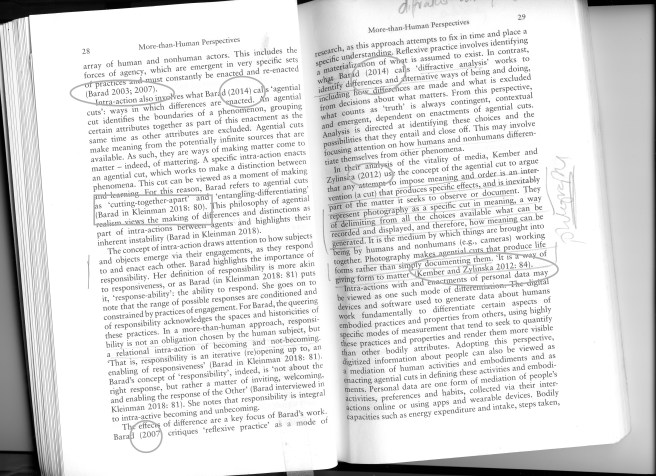
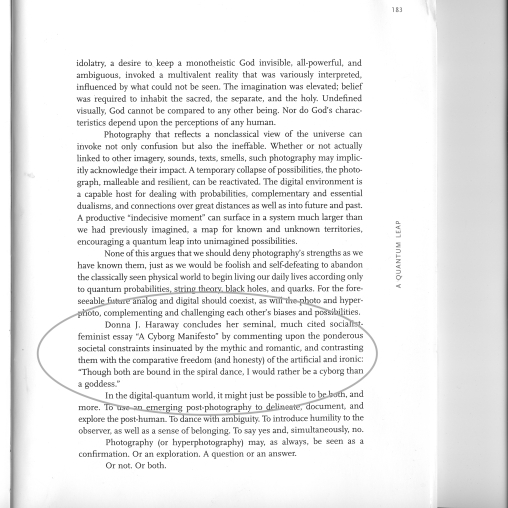
I like the ‘Another Life’ example but can’t see the link to the Haraway and Lupton in the last couple of paragraphs. Condensing this section will, again, focus your ideas. Hopefully, this will be more obvious once I’ve spelled things out but just to reiterate, William is a Cyborg. He is also the future of a photograph. He is also an obvious human Other – see many, many, many texts relating to Cyborgs to Otherness. See page 183 – Fred Ritchin quotes Harraway–
You mention Elkins saying that photography is boring but don’t actually reference this in your main section on him (p6). Useful point
The last paragraph feels very much what the focus of the review should be and I kept looking at your extended essay question which I think is much more precise.
Sohrab Hura ‘The lost head & the bird’ – for contemporary reality – ThinkI will be including this artist but not this work and came across it via
Vincent Morisset – for game / interactive / installation / performance – merging of media & technology
Possibly (I couldn’t get them to download onto my v old iPad) see BJP April 2016 ‘Weird Science’ & April 2017 ‘Scratching the surface’. Should be in the UCA library.
I found this mostly engaging, but found the Examples in Popular Culture and Art section problematic for two reasons:
A lot of words per example – feels like two much detail for this length of essay Agreed. -it’s the section that isn;t working for me tight now.
That the examples are all moving imageSee previous blog – this also tell to I need to spell things out more – I know you address this in the essay but your question (about whether still photography is embedded in a dying ideology) risks undermining the premise that this subject is worthy of an extended written project on a *photography* degree
There is some useful feedback here. Mainly because it shows me where I need to make things much more explicit – since I use the process of writing to think, to inquire, to figure things out, it is through reading and re-reading what I write, and then seeing how others receive it that I begin to understand the complex ideas I’m exploring in others’ writing and how that fits with my overall inquiry. However, the conservatism mentioned by Daniel C Blight (see below) on Twitter or the ‘Cartesian habit of mind’ Karen Barad discusses is strong in photography – and in academic photography training – and I feel like (even if I were the clearest simplest writer in the world) one is constantly working against that trend.
It is also very important for me to see that others have not been on my journey – my inquiry is long and expansive. My inquiry ‘explores debates beyond a simple education course forum’ (DI&C feedback 2019). It dates back to my time as a child watching grownups behave weirdly and noticing moments getting lost forever, people copying each other. To when I first began reading child/baby anthropology books because the usual baby fodder was boring, reductive, ideologically-informed and at times, quite, quite mad. i.e. ‘Don’t look your baby in the eyes’ !!!!!!
I also think when sharing these ideas with other photography students I will need to tread carefully – I am not saying their work is ‘boring’ (it isn’t). I am saying still photography is limited and limiting and ‘such and such’ may be the structural reasons why.
Fellow OCA student Holly suggested looking at Graham Harmen
A useful counter-argument to the overwhelming direction in science to reduce everything to process/event (naive realism)
Two kinds of knowledge – 1 what it’s made of (physics), 2 what it does (Some modern philosophy) But problem with these – they are related. Duomining (over and undermining but never really getting the true essence of the thing) PDF of paper – http://dar.aucegypt.edu/bitstream/handle/10526/3466/Duomining.pdf?sequence=1
Relate to New Materialism
Relate to Michael Fried’s writing about photography
See assemblages (Feminist New Realism) (Lupton 2019 – very relevant, will need to record notes/bullet points soon for CS)
Rhizome
Relate to Thing-Power (Bennet, 2010, Lupton 2019)
Harmen – a phenomenologist
Relate to Klein object relations
Objects relate to each other, there is some causal power – this is also key in new materialism although much else is opposing. Harmen is not a materialist. But link this to Santiago theory of cognition.
like new materialism humans are not better than other objects (compare this to animism)
Doesn’t believe in matter – the world is made of substantial forms, there is no such thing as shapeless forms
You can’t describe the world, the best you can do is hint at what the real is
Does not believe in absolute knowledge, likes art because it alludes which is a better way of trying to describe the world than spelled out scientific language, believes metaphor is a better way to access the real (i.e. Zizek’s real rather than Lacan’s version)
Harmen’s philosophy is directly opposed to Donald D Hoffman’s theory about reality.
One of the people who was recommended to counter James Elkin’s final sentences in What Photography Is that photography might actually be ‘boring’, was Michael Fried. I’d not read his work at length before, although had read the passage about him in Fifty Key Photography writers, and so have spent some time trying to introduce myself to a few of his key ideas. (Of no genuine importance unless you’re an avid Freudian, he has the same family name as my dad before he changed it when he was a young man.)
Objecthood – I suspect this is probably a subject quite close to my heart, but reading further will help talk about it using language that people writing about art tend to use. And certainly, there is a lot more to it that my constant referrals to Rovelli’s statement about relationship rather than objects. “[Quantum mechanics] does not describe things as they are: it describes how things occur and how they interact with each other… [] Reality is reduced to a relation.” (2014)
From a handy summary by the ever-reliable Chicago School of Art. “Maurice Merleau-Ponty breaks down Descartes system of binaries and conceptualizes the self and bodies as thoroughly intermeshed and indistinguishable, especially with respect to the body. With no clear distinction between subject and object, objects can be part of the subject’s being.” (See Klein’s object-relations).
This ties in with the quote I’d identified in Hayle’s work and which is discussed at length in various essays about cyborgs and the way we other-ise cyborgs/AI in fiction. “Only if one thinks of the subject as an autonomous self independent of the environment is one likely to experience the panic performed by Norbert Wiener’s Cybernetics and Bernard Wolf’s Limbo. This view of the self authorizes the fear that if the boundaries are breached at all, there will be nothing to stop the self’s complete dissolution. By contrast, when the human is seen as part of a distributed system, the full expression of human capability can be seen precisely to dependent on the splice rather than being imperilled by it.” (1999)
Maurice Merleau-Ponty seems to go onto say that paintings are above and beyond that – they have a special place in the world. “The special category of objects, paintings, especially eludes this process, and returns the spectator for a moment to a time when the dichotomy, between subject and object, was not yet formed. The view of a painting does not move to perceive and define the object before them.” This seems rather like Benjamin’s aura. As if some objects carry something of ‘god’ or the ‘spirit’ in them.
According to Fried, “During the experience of art subject and object, space and time become collapsed, negating the possibility of objects [see time, space].” [See Hoffman’s dissolution of space-time and therefore of objects within space-time. Also Rovelli, System’s theory and a number of other books I’ve read recently]
Apparently, “Descartes relegates color to a secondary property of reality. This allows him to construct a unitary and undifferentiated model of objects, by making shape, a spatial property, the defining characteristic” which seems a bit nuts nowadays.
“The essential norms or conventions of painting are at the same time the limiting conditions with which a picture must comply in order to be experienced as a picture. Modernism has found that these limits can be pushed back infinitely before a picture stops being a picture and turns into an arbitrary object. [11]” Modernism in these terms is the start of expressions which refute the existence of God, even though they still continue to refer to a kind of divine experience.
“By virtue of its opposition to the banality, worldliness, and gracelessness of objecthood, art takes on transcendental significance.”
Ah – here is what is at the core of my own thinking – Other writers do not distinguish art from objects by way of arguments about perception or phenomenology, but examine the way art objects behave socially to gain their status. Walter Benjamin’s concept of the “aura” depends on art as an object residing in specific spaces. The fact that forms of art such as painting and sculpture must exist in one spatial location corresponds to their social and class function. But Benjamin is still thinking in Cartesian terms because this aura relating to social class and function is tied to religion too as these institutions cannot really exist as they do without each other.
“This art, unlike art with an aura, has no specific spatial location, and is unable to be located as an object. It would be difficult to term the art of film as an object in the sense that has been discussed above.” Well, I am not so sure about this. A film can be seen as an object if we think about the screen on which it is shown and we begin to imagine that we might function in a similar way which is what theory likes to point to nowadays – we have a desktop (reality) and we draw on information to construct objects [icons] in our world (Hoffman, 2019) This assertion that non-aura art has no spacial location remind me of the mentality that just because something is digital its not material. If I am looking at the letter on my screen (underlined in red due to all the typos – I know exactly where it is. It is here, in my construction of space and time which my many ancestors evolved to ‘exist’ within in order to recognise what will help my system continue for long enough to procreate and take care of the little systems that emerged from me. (ibid)
“Rather it is a set of social practices that define and declare the object art.” Re Raymond Williams. This makes the most sense to me – art seems to be mostly about money and status and daft games. I say mostly because I am sure there is valuable work being made which has nothing to do with all of that. What is probably quite a good question is what if all of that nonsense is eschewed and just a few people see the work, perhaps in someone’s back garden in Croydon (honestly hypothetically as I know no-one there), is it art? Does something only become art when a middle-class art-history graduate deems it so? If it’s not got any fiscal value because no-one wants to buy it, is it art? Is Art just about something being a commodity? If yes, then art is a load of tosh that deserves the reputation it has amongst some people. I don’t think it is just that – but wading through it can be challenging.
After sharing the previous blog where I reflect on topics and subjects I aim to explore in my extended essay, and looking at the references I will discuss in A2: Literature Review, I have had some useful comments from other students which include helpful sites as well as suggestions of writers and practitioners. I will add to this page as more arrive.
A guide to writing a critical review (as opposed to a literature review):
Another note that fellow students have reminded me of: The literature review is not an essay. (Yet, it should still be written as well it can be.)
Work I might find useful
I mention in my blog that I want to begin to tackle Deleuze. A Thousand Plateaus by Deleuze and Guattari has been recommended as a good start. I have looked at a couple of videos in the meantime. And immediately thought, Oh! this is related to Systems; and to how a linear Cartesian understanding of existence is being usurped by a picture of a networked reality, and the end of the Triangle of Being, replaced by a less hierarchical system. Therefore it will inform knowledge already embedded most notably from a System’s View of Life, Fritjof Capra and Pier Luigi Luisi, 2014 (Kindle)
Charlotte Cotton’s Photography is Magic 2015/16 Exhibtion and essays, which I have downloaded. There is an optimism in this show and, I believe the essays, which might act as a counter to Elkins’ darkness. Cotton also talks about ‘post-disciplinary art’ which sounds very much like ‘multidisciplinary’ as discussed by Capra.
Comments via email:
A few thoughts in response to a quick read …
I wonder whether Michael Fried’s “Why Photography Matters as Art as Never Before” might be a work worth looking at for a ‘counter view’. He’s a good old modernist (though you yourself say, in passing, that “intention is key” ).
You also say …
So the poor old still photograph has a great deal to compete with.
I might, if being contrary, argue that we still get an enormous amount of our information (and, perhaps, unconsciously, our perception of reality) from still visual images – even if they’re sometimes flashing by us momentarily. I’m not sure – are you looking to argue that the moving image has a closer relationship with reality; or that we humans regard it as more ‘real’; or that there’s more of it so it’s more influential on our perception of ‘reality’; or possibly something else or a combination ()? Are you, maybe, looking to understand (justify ) your own focus on the moving image?
Maybe (just ‘maybe’, not definitely) you will need to focus your attention somewhere? Be it still or moving image, the contextual scope – selfie/holiday video/online newsreel/archive photo/celebrity publicity/Jeff Wall artwork/feature film/indie documentary/magazine ad shot – is huge, and that list could go on and on and on.
Hope that’s useful – fascinating stuff, as always.
I replied (edited):
…. really useful. These discussions help me to see what holes I’m leaving and there are as usual many! Fried has been suggested to me before although I think in … 50 key writers on Photography. I shall take another look.
Do be contrary – it helps. I like how you have differentiated what I might be arguing (I must be honest, I do not know yet!)
I agree – I may need to focus my attention – it is such a very big topic and thank you for your suggestions. Super useful.
Here I add:
Am I looking to justify my own focus is a very good question and if so, I think I need to avoid doing so – I don’t need to justify it, do I? But I am more interested in using whatever form works to make the point – whatever the point might be. At the moment, I think I am trying to suggest that the momentous revolution we are living through now, moving from analogue to digital, is part of and exists in a feedback loop that is about something far more fundamental, a complete overthrow of logocentrism which dates back really far; and is probably well-served by fewer fixed boundaries between forms because the boundaries across reality are currently disintegrating while at the same time being redrawn. This view of mine is taken from far away and is not about the current decade or generation although this is a pivotal moment.
Some great feedback which includes potentially relevant quotes for me to look up and consider:
Something pops out at me which is that photography has been seen as this special medium, better and more real than what came before. And we have since realised that it has its limitations to capturing reality which has released an explosion of creativity that undermines its original intent. Does a loss of faith in the mediums initially perceived presentation of truth ultimately liberate it or condemn it?
Similarly the accessibility of photography through smartphones etc has democratised the medium which creates new causalities. Photography may become artisan again (analogue already is) when it is replaced by another medium. Is it a familiar cycle in all mediums? (Yes, so agree with this which is why the current obsession with alternative processes irritates me. It’s so predictable.)
Quotes (google the bits below)
Richard Serra – “Art is not democratic”
John Tagg – “More significantly, perhaps, if a piece of equipment was made available, then the necessary knowledges were not.” (Tagg, 1988, p.17).
Nicholas Bourriaud – “An artwork is a dot on a line.” (Bourriaud, 2002, p.21). In reference to linear art history. Do we repeat history
“Otherwise put, the role of artworks is no longer to form imaginary and utopian realities. but to actually be ways of living and models of action within the existing real, whatever the scale chosen by the artist.” (Bourriaud, 2002, p.13). Have we chosen to live in a constructed reality?
Overall I think you have a lot of interesting enquiries. Try to narrow down a central idea or interest, not too many because I know the word count fills up fast. It doesn’t have to be a direct relation to your BoW. My tutor said you can’t resolve everything in 5,000 words. (Good point!) So you want to leave room to enquire in other tangents potentially in the future.
To be clear; here I discuss the topic I am aiming for as I plan for the extended essay. I mention several key texts that I think will be helpful and which I will include in my A2 Literature Review. A previous blog also links to several important texts but there is minimal reflection in that one:
I need to get on with writing the literature review element of my extended essay. I am still thinking and gathering – but wanted to just put something down in writing to help me clarify where I’m at at the moment.
I’ve identified a key problem so far – how do I relate my inquiry which I think is about ‘the loss/destruction of reality (as it has been construed)’ to photography? After all, the degree has photography in its title and I need to link the central theme to that discussion. Photography has played its part in that destruction – although there are plenty of other factors/actors.
NB Destruction might also be seen astransformation. I believe this is what my BOW A1.2 is expressing.
Photography’s role in mythmaking
As I said in parenthesis in A1, “photography may have been a very brief interlude in the journey that begun with cave drawing, developed to become printing, followed by the invention of mechanisation, and moving towards a total simulated reality” (2019; 6) In response, Roberta suggested, “Although this has not diminished the demand for those other media – indeed it has given them a new lease of life.”
Printing is in trouble – we do still buy books but it is in a terrible competition with digital text. Painting, not mentioned above, which played such a big role in expressing religious propaganda existed in a feedback loop of development for that purpose. Although people still paint, I wonder if it is fair to say it is no longer used for what it was originally developed for – and that is a relic like still photography is perhaps becoming. People will continue to revel in it but they are making ghosts – sorry to all painters and still photographers. I do not intend to be dismissive – I understand lots of people still gain pleasure from these media.
2. I am also aware that my first essay could be read as a justification for moving away from photography ‘proper’ and focusing instead on moving image.
3. It seems like a key question in that essay and previous ones, along with the way my work is going is: Why is it more useful/fun/relevant/interesting to look at how images are used rather than the making of them? This is where Postmodernism is relevant.
But I’m not sure that’s really what I believe or what I want to ask.
If the construction of reality is a continuous re-invention of the moment we’re in (which I think is a simplistic way of describing current scientific understanding), the conscious self relies on…
i. memory – an intangible remnant of consciousness which we sometimes exteriorise using various forms/materials;
ii. our hyperdyadic* existence – perhaps represented by collage made with appropriated material;
iii. and mechanical construction (which includes language as a technology – see Andy Clark) – perhaps represented by the output of machinery we have invented, and which to greater or lesser extent becomes prosthetic – i.e. phones.
*dyadic – interconnection between two things. Hyerdyadic – interconnection between many – lots of people but also the environment
4. Whatever route I take, James Elkins book What Photography Is (2011)is an entire book which isn’t really about photography, even though its title suggests that’s all it is about. It’s a response to Barthes’ Camera Lucida (1980), another book which suggests photography is its main topic but it might also be read as an elderly man coming to terms with his mother’s – and so his own impending – death. I need to learn from them.
How do I keep this related to photography?
I think I need to state early on – that I am looking at the moving image as well as still and come up with a generic term to encompass both. I might use ‘image’ and then qualify that. Image, therefore, might refer to drawing /painting/film. In which case, is there space or a need to address the arguments made about differences between each of these forms and attempt to lay them to rest for the sake of the discussion? (See Barthes – indexicality of photography and also Elkins’).
Perhaps I need to also talk about why moving image is key nowadays, and perhaps more so than still – as the masses embrace technology which makes video recording so easy, and advertisers use it more and more as it can potentially grab our attention with its movements and flickers more successfully than still. Or at least suggest we can make that assumption with some certainty. This feels a bit like a justification again and might take up too many words, but it feels crucial.
Although it may seem like I am dismissing still photography, I am not. In amongst the plethora of photographic projects and bodies of work which all seem very similar and flaccid, there are a number of photographers making potent and striking work, such as (but not exclusively) Thomas Ruff and Zanele Muholi.
(Intention is key)
Elkin says, “beyond that, talking about the surround as I did for the photograph of the greyhound reveals that the surround is boring, and possibly also that photography as a whole is, in the end, also a bit boring.” (loc 1706) Perhaps, I will suggest that if this is true it is because we as a society are desensitised to photography, now that its initial magic qualities have faded. Seeing a photograph in 1845 must have been incredible and exciting and perhaps awe-inspiring. To capture a person and then have them rendered as delicately as those older processes were capable of would have seemed extraordinary. But now it is mundane and every day. Now our representations move, can be built by anyone – even children as young as two, and offer adventure and flexible narratives. They are engrossing and enticing and overstimulating. So the poor old still photograph has a great deal to compete with. While some, perhaps people with time on their hands, may revel in the luxury of contemplating an image of a leaf or a fragment of a person or people, or the emptiness of a blank page, others are fed a diet of shiny, fast-paced, noisy and enticing media. Most of us have this latter fodder in our lives and perhaps that is where the mythology I am interested in exists. If still photography (academic art) is to remain relevant, then perhaps it can a useful tool for deconstructing the myth I’m exploring.
Art photography is often inherently elitist. Not always, but so much of it can’t help being so – refs from Elkins:
“It is easy to agree that photography’s apparent realism has been formed by the middle-class hope that the photographs give us reality itself (as Bourdieu says).” (loc 762)“‘photography is most frequently nothing but the reproduction of the image that a group produces of its own integration’. (Bordieu, Un Art moyen, 48)” (loc 707)“For Bourdieu, photography is bourgeois to its bones, and it even includes its own futile anti-bourgeois gestures, like my own attraction to things that aren’t family photographs.” (loc 716)
Still photography is one fragment of a re-enactment of our biological processes – by focusing on it alone we persist with a Cartesian construction/understanding of reality. But it might be more relevant nowadays to explore these topics more holistically. Intro/preface?
Mythmaking
Hoffman’s book below references advertising and images extensively. Held within these images are myths.
I have become really interested in mythology – and the relationship between science and religion. It seems to me that both do the same things, i.e. put difficult concepts into narratives we can try to manage.
The following is from the author, Jonathan Raban’s biography A Passage to Juneau.
“Within the last 9,000 to 12,000 years, when people were present to witness such events, they would have seen the sea close over islands as earthquakes rearranged topography. You couldn’t look at the delicate compromise made here between land and sea without imagining the Flood: and you couldn’t imagine the flood without inventing a Noah or a Gilgamesh” (1999) (Perhaps this quote will be on the cover page or at the top of the essay).
Books
Return of the Real Hal Foster 1996
The Case Against Reality Donald D Hoffman 2019 (see below) (He mentions Plato’s Cave his description may be useful to quote.)
How we Became Posthuman Kathryn Hayles 1999 (in particular Chapter 7, Turning Reality Inside Out and Right Side Out: Boundary Work in the Mid Sixties of Philip K. Dick)
I need to look at Deleuze but I do not know his work and have no idea where to start.
Popular Culture, films, TV
The AO (Netflix) 2016-19 TV – Series One explores a kind of inverted Plato’s Cave which becomes a metaphor for digital culture. As part of my research, I have been watching plenty of reality-bending films and TV, this being one of them.
Total Recall, 1990 and 2012 Film
Inception, 2010 Film (this leads to Memento – also directed by Christopher Nolan but I am trying to avoid clinging to memory as a key theme, even though that is an important topic.)
(In the link above, I talk about several influencing works which had fed into my own practice but which may also be useful for the essay.
I will need to revisit this at Tate Britain as there is much to link to, moving image, youth culture, myth, everydayness.
2. Katinka Schuett, Cosmic Drive – I have only just come across this work and will look at it as a possible example of still photography looking at similar themes. ““Cosmic Drive primarily explores the way humans handle ignorance,” says Katinka Schuett of her Female in Focus winning series, which examines the contradictory spheres of fantasy and hard science. “I am interested in our perceptions of space, and the question of whether or not life can be found in the universe.” Schuett is as concerned with fantasy as she is with facts, merging the two to consider the illusions we create when there is a void of information. ” (Roberts, 2019)
I probably need to have a few more references here.
Blog Conclusion (not essay) – is there a question/title here yet?
I’m not sure … perhaps:
Should we re-evaluate our relationship to myth/humanity’s need to create myth? (And what role does the image play?)
I feel it will be necessary to use the word image in the extended essay rather than photography – because photography is such a nebulous term and describes a range of activities – and perhaps I need to explain in a preface. Does a preface count towards word count? Something to ask when submitting the review.
Something I’ve not addressed here which I think fits but which may be too far outside the inquiry – the body/blood/softness/boundaries/flesh. Hayle’s looks at this and references Donna Harraway several times – I don’t think I fully comprehend what’s going on here yet and need to read these sections again, as well as Haraway’s Cyborg essay which I’ve only read once so far (and found it a little bewildering – perhaps I was tired/distracted).
I know I am interested in the fractal nature of reality and our conscious understanding of it. So, we function (construct reality) in a certain way and the patterns of that construction are evident in our expressions (media – films/adverts.any narratives, the way we produce them.)
I still think I’m focusing too much on why photography is becoming irrelevant and need to look more at boundaries/flesh/death – life/self-other; I suppose these things to tie into myth and the breaking down of self as a definitive object as technology and science evolve. Therefore perhaps we might say, “it is a myth that you and I exist at all” – however, this myth is all we have and so we need to take it seriously even though we understand it is a myth.”
“Sometime in the not-too-distant future, anyone will be able to take a picture without a camera. Instead, we will be able to generate photographs, indistinguishable from those made by a camera, using artificial intelligence (AI) software. You will be able to create an image by simply typing out a description of the scene, or describing it to (presumably) Siri. “Siri,” you’ll say. “I’d like an image of a red-haired woman walking through a park in autumn, the breeze blowing red, orange, and yellow leaves around her.” And—though it may require more detail than that—presto! Your phone will provide various options on the screen to choose from.” (Palumbo 2018)
Other refs:
Raban, J. 1999 A Passage to Juneau, Picador, Basingstoke and Oxford
“Late twentieth-century machines have made thoroughly ambiguous the difference between natural and artificial, mind and body, self-developing and externally designed, and many other distinctions that used to apply to organisms and machines. Our machines are disturbingly lively, and we ourselves frighteningly inert.” (p.11)
“Modern machinery is an irreverent upstart god, mocking the Father’s ubiquity and spirituality.” (p.13)
“They [cyborgs] are about consciousness—or its simulation. 7” (p13)
“Ironically, it might be the unnatural cyborg women making chips in Asia and spiral dancing in Santa Rita Jail8 whose constructed unities will guide effective oppositional strategies.” (p.13)
Quotes from Archive Notes, Pandora’s Camera, Joan Fontcuberta, 2014
“…the first critical duty of the historian is to de-institutionalise history, to deconsecrate it – in short, to strip it of authoritarian discourse. This is the work of the historian, but also the work of the parallel awareness that often expresses itself as art.
“All of Schmid’s work is informed by a concern with visual ecology: […] Far from satisfying our need for information, the ungraspable abundances of indiscriminate data leaves us just as ignorant but much more confused. By reviving the Duchampian gesture, Schmid cancels the value of production (taking pictures) and shifts to selection, to the act of pointing and choosing.
“Schmid writes: “I’ve been working with found/appropriated imagery because I think that basically everything in the world has now been photographed in every possible way. We have an incredible amount of pictures after a hundred years of industrialised image-making, so making more pictures is no longer a creative challenge. Nevertheless, the production of photographs, of images goes on: photographs will be always be produced. It’s not so much the production of photographs which needs to concern is the use of them” (p.192)
Fontcuberta, J. (2016). Pandora’s camera, Photogr@phy after Photography. 1st ed. Mack, p.172.
Quotes from The Condition of Postmodernity David Harvey 1997 Blackwell
“… a loss of faith in the ineluctability of progress, and the growing unease with the categorical fixity of Enlightenment thought”. (p.29)
”
Harvey, D. (1997). The condition of postmodernity. Oxford: Blackwell, p.29.
what photography is, James Elkins, 2011
Elkins, J. (2011). What photography is. New York: Routledge.
Loc 1311 – quotes Benjiman, “…film he said, creates a percussive shock to the consciousness by continuously changing scenes, “I can no longer think what I want to think.” he writes. “My thoughts have been replaced by moving images.” (The Work of Art, in Illuminations, 238) – See Baudrillard
“I am unaware of the masses of things, the on and one of things, that I am permitting myself not to see”. (loc 1326)
Quotes Baudelaire – (loc 1561) When he said: “photography made the ‘whole squalid society …rush to gaze at its trivial image’ he was being sour and splenetic …but he wasn’t wrong”.
“There is no way to staunch the floods of false nostalgia for people and faces” (loc 1425)
“It is easy to agree that photography’s apparent realism has been formed by the middle-class hope that the photographs give us reality itself (as Bourdieu says).” (loc 762)
“‘photography is most frequently nothing but the reproduction of the image that a group produces of its own integration’. (Bordieu, Un Art moyen, 48)” (loc 707)
“For Bourdieu, photography is bourgeois to its bones, and it even includes its own futile anti-bourgeois gestures, like my own attraction to things that aren’t family photographs.” (loc 716). Perhaps such gestures are at risk of being the most middle-class, and elitist. (Think of explanation.)
Baudrillard – Disneyfication
A re-evaluation of psychiatric terms in relation to women and trauma:
 ).
). )? Are you, maybe, looking to understand (justify
 SJField - OCA Level Three Study Blog