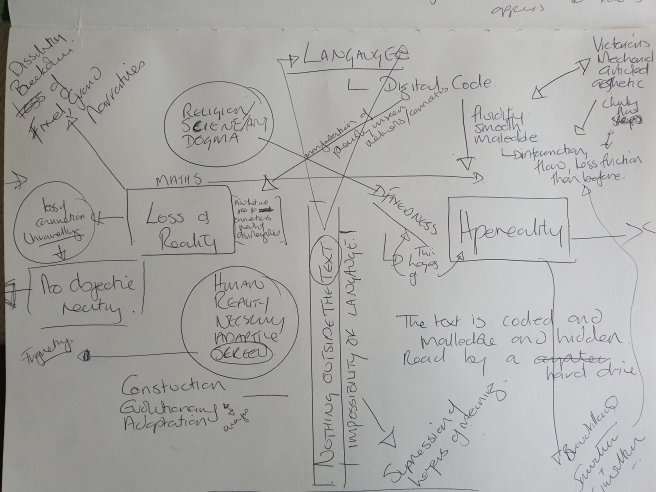
BOW/CS A3: Research/Sketches, Reality Evolution, perception

According to Donald Hoffman’s theory which I have discussed several times (Literature review ),  we did not evolve to see reality as it truly is, as has been argued. Rather, we evolved to see the sort of reality we need to see to for ‘optimal fitness’. We perceive far less than there actually is because to see it all would be unhelpful. What’s more, according to Hoffman, the objects we see, including space and time are like desktop icons – constructed objects that represent the goal we are either after or trying to avoid. As hard as this is to understand, and Hoffman admits he may very well be wrong but that his theory makes the ‘hard problem’ of consciousness approachable, his idea sits well with many of the other theories I have been reading about since I picked up The Ego Trip by Julian Baggini (2011) (when I began UVC) followed by a raft of other books exploring similar themes.

I have been trying to express and understand these subjects in my writing, and looking at and photographing objects and phenomena in the world. The photoshopped images below are attempts to explore these ways of thinking about the world.

Fred Ritchin’s After Photography (2009) has some good sentences which I will introduce into my Lit Review and no doubt take forward into the essay.


“…some quantum theorists, foremost amongst them, Neils Bhor and Heisenberg himself, argued that fundamental reality is essentially indeterminate, that there is no clear fixed, underlying ‘something’ to our daily existence that can ever be known. Everything about reality is and remains a matter of probabilities […] We have tried to use the photograph to concretize the probabilities (isn’t that what the “decisive moment” is all about?), reassuring us that reality is more solid than what our theories tell us.” (180)

In Data Selves (2019) Deborah Lupton quotes Kember and Zylinska (2012) to describe how photography is an “agential cut” aimed at imposing “meaning and order” and “delimiting choices” (29). As Ritchin says an alternative “may be too disconcerting, if not terrifying.” (ibid)  As he describes, digital technology and photography in particular “can begin to be receptive to the oddities described by newer theories” [quantum and consciousness related]. (177) Superpositions, endless possibilities, entanglement, for instance, can all be alluded to using malleable data either as a process or a representation (which if one takes Hoffman’s idea on board are completely intra-related in any case).

Some sketches – I wonder if these would benefit from more contemporary mixes (a bit like Flowers for Donald). Still a bit Guardian headline pics for my liking :


IMG_9765iiilow-
Isle of White – windswept hilltop
Landscape with Bridge - The Metropolitan Museum of Art
Similar to above but layered with an anonymous 17th-century pencil landscape downloaded from Google Art and supplied by the Metropolitan Museum of Art


Windswept tree  – shaped by the elements – differentiation reduced by processing decisions.


(See Orpheus story – trees to this day in shape of dance to his music)


Hoffman, D. D. (2019) The case against reality: how evolution hid the truth from our eyes. London: Allen Lane.

Lupton, D. (2019) Data selves: more-than-human perspectives. Cambridge, UK ; Medford, MA: Polity.
Landscape with Bridge – Anonymous, Italian, 17th century (s.d.) At: https://artsandculture.google.com/asset/landscape-with-bridge-anonymous-italian-17th-century/EwHp9J9QWhanmw (Accessed 10/11/2019).

Baggini, J. (2011) The Ego Trick. [Kindle edition] London: Granta Books.

CS & Bow: Research notes, Daniel Rubinstein, Failure to Engage 2017

www.danielrubinstein.net/wp-content/uploads/2013/04/Failure-to-Engage.pdf

This article by Daniel Rubinstein confirms my recognition of Freid’s conservativism and does a super job of helping me to more fully comprehend some of the ideas in Barad’s essay. Beneath the argument about theatricality and anti-theatricality, it explores the changing nature of being and knowledge – or ontology and epistemology, as expressed via quantum sciences and philosophies, namely Barad (2003), Lupton (2019), Rovelli (2017), Capra (2014) – leading to what Barad terms “Onto-epistem-ology”[which is] —the study of practices of knowing in being—is probably a better way to think about the kind of understandings that are needed to come to terms with how specific intra-actions matter.” (2003: 829) (See Rovelli and Kant in the previous blog.)

However, Barad argues against what she calls representationalism, which is; “the belief in the ontological distinction between representations and that which they purport to represent; in particular, that which is represented is held to be independent of all practices of representing. That is, there are assumed to be two distinct and independent kinds of entities—representations and entities to be represented” (804) If you can overcome this and see “representationalism as a Cartesian by-product—a particularly inconspicuous consequence of the Cartesian division between “internal” and “external” that breaks along the line of the knowing subject.” (Rouse, 1996: 209, Barad, 2003:805) then the arguments made be Fried begin to disintegrate. As – “it is possible to develop coherent philosophical positions that deny that there are representations on the one hand and ontologically separate entities awaiting representation on the other” (807) relying instead on emergence. And ff you see theatre as a laboratory (not just Growtowski’s but the entire history of it) then perhaps Fried’s entire argument collapses – although I am not sure Rubinstein gets there with this.

Some quotes below and perhaps an occasional note:

  • by way of identifying the dualist oppositions and the ideological investments that establish the ontological significance of this text. (44)
  • Fried is not criticising the work of certain artists, but devising a universal method for distinguishing true art from ‘objecthood’, based on the assumption that (Fried’s) consciousness can distinguish physical reality from art (44) (religiosity)
  • this rejection leads him to adopt a conception of art that is hierarchical, analytical and traditionalist (45)
  • contemporary philosophical thought that studies theatricality as part of the logocentric apparatus inherited from the Renaissance (45)
  • The conception of ‘objecthood’ in contemporary art can be traced to Duchamp’s readymades which he created by selecting, modifying and rectifying mass-produced objects (46)
  • this opposition between the image and the real has its roots in Platonism, where the sensible world is produced as a copy of the world of ideas, and it is the task of reason to overcome the errors of the copy in order to arrive at the truth (46) Far more simply explained here than in Barad’s essay
  • The touchstone for this distinction is whether the image declares itself to be an image (the fable of the cave is told as a fable) or whether the image pretends not to be one, disguising itself as an object (47)
  • Plato’s demand for ‘primary distinction’ between images and models is motivated by the moral need to protect the idea of truth from the dangerous world of simulacra. (47) In CS A2, I argue the shadows on the wall of the attic are the actual real  – what looks like the simulacra is just as real as the flesh and blood version watching the slides – although more likely they exist together, both real, both valuable (see Jung – dream world equal to waking world) 
  • The artworks that Fried designates as ‘theatrical’ seem to have a common denominator: they strive to take over the real, to immerse and to overwhelm us by replacing the real with a readymade and truth with simulacrum until we are no longer able to distinguish the artwork from the real, the referent from the sign, and the subject from the object. (48)
  • Critical opposition to theatricality will not get one very far, as opposition itself is a theatrical requisite (49)
  • Quote Fried, “The Platonic division of the cave, which is effectively the theatrical division between a real outside and an inside simulating this outside … The thing stands for something else, and it is less than what it represents. In order that it be what it is, there has been a lack of being. What is given to us, insofar as it is not similitude itself, is deficient in force. The theatricality of representation implies this deficiency, this depression. (pp. 68, 71, emphases in original)” (49) See Barad and her refusal of representation being something that acts as a sign for something previous and original. (50)
  • Here the antinomy to the ‘theatrical cube’ is being revealed not as anti- theatricality, but as an infinite movement of surfaces that continuously self- replicate and morph into each other (50)
  • If the origin of theatre is in negation, and if its operation is representational, then the deeper reason Fried can speak of a ‘war’ between theatricality and real art becomes clear. (51)
  • Anti-theatricality, in other words, implies that in order to be meaningful, accessible and ‘true’, the artwork has to inhabit some form of transcendental negation, or excluded middle or some other form of metaphysical ground (51)
  • by arguing against the dualism of theatricality and for the monism of ‘real’ art, he is unable to move beyond the very dualism he is trying to unsettle as his thought is chained to the common-sense notion that representation is a natural, ordinary, everyday occurrence (52)
  • The deeper structure of Fried’s argument is that true knowledge can transcend mere appearances and grasp their underlying presence. As Luce Irigaray (1985[1974]) has shown, this framework is based on the notion of a stable subject that comprehends – like Rodin’s Thinker – a world that is also stable and unchanging. (53)
  • Freid’s description of Caro’s sculptures are ‘performative’ therefore theatrical (53) They are also elitist and come about due to a his privileged and educated position. 
  • according to Fried, the greatest danger: under the auspice of theatre, art loses its spiritual, sensual and theological dimension. When art is stripped of its mystical, spiritual powers, of its direct link with experience through the unmediated connection with life, all that remains is the theatre: a pale re-enactment of the mysteries of the sacrificial ritual. (53) This is a bizarre argument given theatre’s roots are deeply embedded in the spiritual and mystical, and was born out of attempts to commune with the gods (the universe).
  • Putting the object first will not work because the opposition between art and non-art is itself the product of an ideology that asserts that there is a real world that can be taken up and represented as an image (53) which Barad argues against using quantum knowledge. 

Edited 01/09/2009 to correct the spelling of Rubinstein’s name

Barad, K. (2003) ‘Posthumanist Performativity: Toward an Understanding of How Matter                    Comes to Matter’ In: Signs: Journal of Women in Culture and Society 28 (3) pp.801–831. At: https://www.journals.uchicago.edu/doi/abs/10.1086/345321 (Accessed 30/10/2019).
Capra, F. and Luisi, P. L. (2014) The Systems View of Life: A Unifying Vision. (1 edition) Cambridge: Cambridge University Press.
Rovelli, C. (2017) Reality is not what it seems: the journey to quantum gravity. London: Penguin
Rubinstein, D. (2017) ‘Failure to Engage: Art Criticism in the Age of Simulacrum’ In: Journal of Visual Culture 16 (1) pp.43–55. At: https://doi.org/10.1177/1470412917690970 (Accessed 30/10/2019).

CS & BOW: Notes following online presentation with Dr. Ariadne Xenou 24/10/19

It was good to hear someone say don’t separate CS & BOW. Students keep saying, you don’t need to connect CS to BOW and I can’t for the life of me understand why you wouldn’t connect them or why you’d want to disconnect them either. I have actually been thinking about these reflections which are are usually relevant for both and wondering how to rearrange the menu system as both modules become more and more interconnected.

It was also useful to think CS A3 as a research document setting out my plans and suggested research question – which I have yet to identify.

The other useful thing that came out of the session for me was thinking about overarching topics I’ve been investigating since the end of UVC, and how I can put those into some kind of tangible form. Here is an attempt to pin down some of these very big themes and links to relevant subtopics.

Inside Outedness

From my Sketchbook blog:

For millennia, language was on the outside. We could, in retrospect, usually see it. On walls, in caves, then tablets, scrolls and eventually in books. [Lately on advertising hoarding and signs telling us how fast we can drive, where we can park, if we play, enter, stay out, smoke, shop, make noise, and of course, what we can buy, how much better we will be if we buy whatever it is.]

Today, as many but not all are aware, it [language] somehow exists more and more on the inside [but not the inside of us as it did before emerging – although I think it is generally thought of as outside – rather the inside of machines and devices]. And in places it can’t be seen.

This means we often have no idea what’s being said. We are less able to read the signs [Or even see them]. Vast dynamic archives of language exist – somewhere – affecting everything. We know they are there. But they’re invisible. We see the flimsy surface only.

It’s true, in the past archives tended to be secreted, were often sacred, and contained as well as emanated power.

Very few would have had access.

It’s just that today the whole world is one big archive. And it’s hard to imagine how anyone escapes. [Could do with expanding the final thought.]

Random notes for a short story #12

Derrida’s Archive Fever, University of Chicago Press; Reprint edition (19 Sept. 2017)(The first chapter may be useful here)

Chapter 7, Turning Reality Inside Out and Right Side Out: Boundary Work in the Mid Sixties of Philip K. Dick, Hayles, K. (1999) How we became posthuman: virtual bodies in cybernetics, literature, and informatics. Chicago, Ill: University of Chicago Press.


When I was a child a boy in my class used to turn his eyelids out. It revolted me. The other boys found it hilarious. I hated seeing him do it. It hurt to look at and to think about, and still does. Seeing my reaction, he did it all the more to taunt me. 


Gossip & Performance

I believe these aspects of our existence are inter-related. From my BOW A2 assignment:

As part of my on-going research into language, culture and reality, I’d been reading Richard Wrangham’s The Goodness Paradox (2019) and books by Nicholas Christakis who wrote Connected (2009) which is about social networks (in general, not just digital ones.)

Wrangham’s book centres around the idea that human beings evolved with an ability to temper their immediate aggression, while simultaneously developing a propensity for calm, rationally-considered, pre-planned violence. Humans also became hyper-co-operative; today collaboration is part of our DNA. Wrangham suggests these trends are underwritten by our ability to talk to and about each other, and that we have an ever-present unconscious fear someone might be watching, gossiping, and planning to do away with us if we don’t conform. Gossip allows us to conjure up stories, deny and blame others, and plan punishment for anyone deemed a deviant. Wrangham’s theory along with Christakis’ ideas about connection sit at the centre of my contribution to the project. (2019a)

Performance grows out of the knowledge we will be seen and so we must ‘act’ the part in order to be accepted, to survive in the group. However, as Karen Barad tells us – entanglement is critical and without it perhaps nothing at all emerges. Her description changes my understanding of the conscious agent which I wrote about CS A2 – assuming a notion which I accepted in books about systems. However, Barad says something which fundamentally changes the underlying nature of performance and I’m still trying to get my ehad around it: ““A phenomenon is a specific intra-action of an ‘object’; and the ‘measuring agencies’; the object and the measuring agencies emerge from, rather than precede, the intra-action that produces them.” (Barad, 2007, p. 128). From Sauzet, 2018 – https://newmaterialism.eu/almanac/p/phenomena-agential-realism.html Accessed 21/10/2019 From https://sjflevel3.photo.blog/2019/10/21/bow-cs-notes-research-karen-barad/

Today we appear to perform for ourselves and the manifestation of such is available for all to see on social media. But there are also more private performances which people don’t necessarily share widely (although some do) which emerges from tracking devices. See Lupton’s Data Selves book.


Langauge

At the beginning of Self & Other I wrote about Léopold Szondi. After reading The Body & the Archive by Allan Sekula I was reminded about his thoughts on language. I said, “Szondi was also I believe interested in those ‘in-between spaces’ I’m so keen to find out more about. “language is a ‘social fact’. It is the glue that holds society together; through ‘language a child becomes integrated with a social community,’ and ‘it serves to maintain social interaction’. Since dialogue is the primary vehicle of interpersonal relations – what Szondi calls the sphere of the between -it lords it over traditional theatre” (Holmberg, 1996; 67).”

Notes: The Body and the Archive Allan Sekula

I am interested in the changing nature of language, the structural implications of a language which is coded and incomprehensible to most of us. Flusser’s thoughts on the ease with which we use devices compared to the complex nature of them which bypasses most of us may be useful to revisit.

Flusser, V. (2012) Towards a philosophy of photography. London: Reaktion Books.

Data Selves by Deborah Lupton also contains useful content about language and its relationship to new materialism. “In new materialism, the poststructuralist emphasis on language, discourse, and symbolic representation is enhanced by a turn towards the material: particularly human embodied practices and interactions with objects, space and place.” (2019: 15) However, she also writes a great deal about how data (language) manifests as those things – so although data seems immaterial, “things that are generated in and through material devices (smartphones, computers, sensors), stored in material archives (data repositories), materialised in a range of formats that invite human sensory responses and have material effects on human bodies (documenting and having recursive effects on human flesh” (19).

I need to revisit Barthes’ Myth Today (1957) https://uvcsjf.wordpress.com/2016/07/18/notes-project-3-3-myth-is-a-type-of-speech/


I suspect Karen Barad’s ideas are going to be important. And I suspect they will inform all three of these key themes. I need to investigate further before adding them here. However, I think I have identified three key topics: Inside Outedness, Gossip & Performance and Language. I wonder if the latter is the umbrella under which Inside Outedness, Gossip & Performance exist.  And the term assemblage which I’ve talked about quite a lot lately is not a theme but rather a structural reality, and our modern form of assemblages are what’s resulting in inside outedness. How I bring any of this into a semi-coherent work yet is anyone’s guess a this time! 


BOW: Assemblage

Since sending out various versions of work and receiving the feedback I have developed the overall concept and presentation further – seeing what could be ditched but also how I would bring some of the various elements I had created together into an ‘assemblage‘.

I do not much like the word assemblage but after reading it used (a great deal) in a blog by Deborah Lupton, the author of Data Selves: More-than-Human Perspectives, it seems like the correct word for the collection of images, sounds and materials I’ve gathered together. She writes:

I examine the interplay of human and nonhuman affordances associated with digital technologies – devices, software and the digital data they generate – and the agential capacities that are opened up or closed off as these things assemble. I ponder the questions of who benefits from these agential capacities, and in whose interests they operate. Here again, affective forces are central to the engagements of humans with these nonhuman things and the capacities that are generated by their gatherings. I address how human-data assemblages can generate agential capacities that empower and vitalise actors in the assemblage; but can also expose them to vulnerabilities and harms.

This approach recognises the entanglements of personal digital data assemblages with human action, reaction and understanding of the world. Personal digital data assemblages are partly comprised of information about human action, but their materialisations are also the products of human action, and these materialisations can influence future human action. While digital data assemblages are often conceptualised as immaterial, invisible and intangible, I contend that they are things that are generated in and through material devices (smartphones, computers, sensors), stored in material archives (data repositories), materialised in a range of formats that invite human sensory responses and have material effects on human bodies (documenting and having recursive effects on human flesh). (2019)

I am therefore creating an assemblage although I have not used this word.

The assemblage consists of:

  1. A video – itself a collage, a type of assemblage. While not a still collage like Höch’s were, it was made to emulate that trope, cutting up and pasting material that exists in the world. It includes audiovisual material that is available on the internet but contains signifiers of earlier technology. It will be shown on a Kindle – a handheld device.
  2. The film will also be available on my website but it will be a different version. Mostly the same apart from one or two tiny sections, but with an alternative audio track. The instruction to visit the website is printed on newsprint and is part of the assemblage.
  3. Still frames from the film which have been ‘captured’ and frozen  – in more or less the same way a photograph of life is captured and rendered a still image, using a slightly different tech/method – and printed on newsprint. These will be placed on the platform or hung from sticks.
  4. The poem printed on a tabloid page, orientated portrait. I hope this will hang above and slightly behind the kindle, perhaps alongside printed newsprints but I will need to see how this pans out when we set up. I was very influenced a long time ago by Louise Bourgious’ He Disappeared into Complete Silence. This is a book with several plates each of which consists of text and a drawing. The drawing is not an illustration. And sometimes it is hard to make the connection. But they are made to be seen together. I feel the poem and the video work this way too. Each can stand on its own but the point of the work is only brought to the fore when they are placed beside each other: A moving image piece alongside text, working with it but not illustrating. I might have read/performed the text in a video or even live. But this did not feel the right place (collaboration) for that – perhaps I might have reached a way of doing this if we’d had longer or were working in a smaller group -and it is something to consider for the longer-term, BOW-wise. 


DO02148-007_0
Image Louise Bourgeois He Disappeared into Complete Silence 1947 From: https://www.museoreinasofia.es/en/collection/artwork/he-disappeared-complete-silence-6

The work will exist in a ‘village’ (the platform) alongside other work made by my collaborators. The contents were influenced by their interests and the interactions I had with them. It is a reflection of them and my time with them. So my work is part of a greater assemblage, a network of creators which itself exists within a further larger assemblage – i.e. the three groups organised/curated by Pic London. That too is an assemblage which is again part of something greater. And so on = the fractal nature of existence.

Looking back, this is the pattern of my work. And now I know why. I am not focusing on one tiny aspect. I am recreating the chaos and interaction of conscious experience (not an individual, not an isolated and alienated concept, not one thing).

When I submit the assignment I will include critical information I sent to Pic London  – but here since it is relevant, I will just add a quotation I used which I have inserted into my work previously, and put at the front of my Self & Other blog:

“There is no such thing as a single human being, pure and simple unmixed with other human beings … [the self] is a composite structure … formed out of countless never-ending influences and exchanges… we are members of one another.” (Joan Riviere, 1927) It seems the assemblage whether it’s made up of flesh or tech or both and all sorts of other stuff is a description of Riviere’s statement.

Ref:

Lupton D. (2019) Excerpt from Introduction of Data Selves [online] WordPress Available from: https://simplysociology.wordpress.com/2019/09/01/excerpt-from-introduction-of-data-selves/ [Accessed 2/10/2019]

The Museo Reina Sofía (2019) He Disappeared into Complete Silence [online] User-generated content. Available from: https://www.museoreinasofia.es/en/collection/artwork/he-disappeared-complete-silence-6 [Accessed 2/10/19]

CS: Chapter 2 ‘Photography’ Howell’s (2011) Visual Culture

We are asked to look at Chapter 2 “Photography” by Richard Howells (2011). To begin with, the chapter sums up the very short history of photography. Although not Areilla Azoulay’s non-Cartesian version, which I talked about in my DI&C essay, and which posits that we cannot separate the invention of photography from its related activities, that of empire building which began in the 14th century when Columbus sailed across the Atlantic and began the process of taking people and land on behalf of European conquerors. I’ll touch on this briefly later. However, the author does take us back to cave-drawing (as far back as 25 000 years rather than 40 000 which is where academics have placed the earliest discoveries; coded symbols that can found over eons of space and time). This is important because photography is simply one more way for us to exteriorise our inner selves, to other the self, to store consciousness. That it’s mechanical is important but doesn’t render it less than.

It was interesting to touch base with the received story again, having read about it in various books while studying but specifically, in a wonderfully entertaining book called Capturing the Light by Helen Rappaport and Roger Watson (2013) which goes into much greater detail, although with less critical depth.

However, I found it difficult after reading the chapter to get beyond the inclusion of Roger Scruton’s essay, Photography and Representation‘ in “The Aesthetic Understanding‘, Essays in the Philosophy of Art and Culture‘ (1983). Scruton isn’t only a Conservative, he is a reactionary extremist who promotes the most appalling ideas and is a friend of the Spiked bunch, who, quite frankly, seem completely nuts. (And I used to quite like some of what Frank Ferudi said about parenting.) Scruton was recently sacked from his position at the head of the Government funded Building Better, Building Beautiful Commission (what he was doing there, is anybody’s guess – a mate of a mate, no doubt) for making comments that aren’t even worth repeating. He has spent his whole life offending people and seems to feel hard done by, having ostracised himself from various British academic institutions. His own father was, by all accounts, chaotic and damaged and very anti-establishment. Read into that what you will.

I appreciate that the original chapter was written some time ago (2003) and Scruton may, in keeping with the times and contemporary discourse, have virulently amplified his conservative message in recent years. But I find his argument sort of ridiculous – and Howell talks about it being flawed. I also know difference of opinion is important and having both sides of any argument is thought to bring about some form of synthesis, leading to a balanced idea of reality. However, modern science and philosophy are rendering the arguments included in Howell’s chapter and in particular Scruton’s, not only flawed but almost irrelevant. Before introducing Scruton, Howell tells us how some people felt that photography cannot be art because it merely records the natural world, reality,  as it is, which is where Scruton we are told, positions himself.

For a moment, I’ll deviate here and talk a bit about ‘reality’.

Two years or so ago I got off a train at a station beyond my intended stop. I realised my mistake but wasn’t sure how long I’d been distracted by my book, and looked at the map on the platform to see where I was and where I needed to get to. For a short moment, but long enough to cause a sense of panic and alarm, my memory stopped working. I recognised the signs on the maps as signs but had no recollection of what any of them meant, no access to their meaning. It was like looking at a map in a foreign language at the same time as not even knowing what a language might be. It may have been an early sign of something sinister healthwise to come, however, it has not happened since and I hope and suspect it was simply a brain glitch brought about by stress, tiredness, and distraction. It felt like it lasted about a minute. The experience, however, demonstrated what my consciousness and its integral function, memory, does for me. It enables me to get from A to B so I can survive. Without that ability I would not be able to move about in the world, feeding myself, interacting with people, finding a mate – doing all the things that keep the genes alive and reproducing. This is what our consciousness is – an evolved survival mechanism. And as hard as it is to accept, we have evolved to see only what we need to see in order to exist. We have a limited, locally based view of reality that is myopic but highly specialised. Some criticise this materialist view suggesting it leads to emptiness, an existence that lacks meaning, but the illusion of reality is literally all we have and to belittle or undervalue it isn’t automatic or necessary. One hopes we can afford to be honest with ourselves, although as we look about today, it does at times seem perilous and perhaps terrifying for people.

I am looking forward to receiving my delayed copy of “The Case Against Reality” by Donald D Hoffman. But since 2015 I have been reading as much as I can to understand this illusion of reality including Reality is Not What is Seems Rovelli (2016), The Ego Trick Baggini (2015), and The Biological Mind Jasonoff (2018) amongst many others which look at life systemically. I think the science contained in these books potentially nullifies any arguments about photography being simply a recording of reality – because our reality is SO subjective and particularly nowadays when digital technology is fundamentally changing what we expect from reality  – and because any language form, photography included, is an emergent property which is what is so fascinating about mark making – however we choose to do it. And that’s before we even touch on individual subjectivity (as opposed to species subjectivity), technical ability, and choice, or processing whether in the darkroom or your desktop.

And in any case, the arguments against photography of any description being an art form because it is  a copy, where photographers simply record rather than dictate what’s included, were made redundant the moment a urinal was placed in an art gallery. If you think photographs merely copy reality, then they are the ultimate readymade. Although I do see some conservatives are likely to dismiss appropriation as a viable art form too, missing the point of it entirely. But like the evolving nature of gods and God as civilisation develops, what we need from art changes too. And conceptualism rather than dogmatic religious iconography is clearly more relevant today as the nature of reality is unpicked and newly understood. Photography, being an emergent property that came along with the evolution of technology over several centuries alongside its sibling, or perhaps its close cousin, Capitalism, is not only interesting as a concept but crucial to the way we see and understand life today, and therefore an integral form in any artistic exploration regardless of whether it ‘ideal or real’ (Scruton’s distinctions). Even if all the artist is doing is making something pretty, which is of course just as valid as documenting society, or commenting on language.  These distinctions are as silly as the ones about digital technology not being ‘lovely’ enough to produce art.

I am looking forward to receiving my book by Hoffman so I can keep investigating this subject and bringing it into my own work. In the meantime, I used to think that all the technological advances we relied on were changing our evolutionary path whereas now I see that they are part and parcel of our evolutionary path. They are expressions which lead to feedback loops. I think that’s why distinguishing between forms and saying one is art and one isn’t is a limited and limiting view.