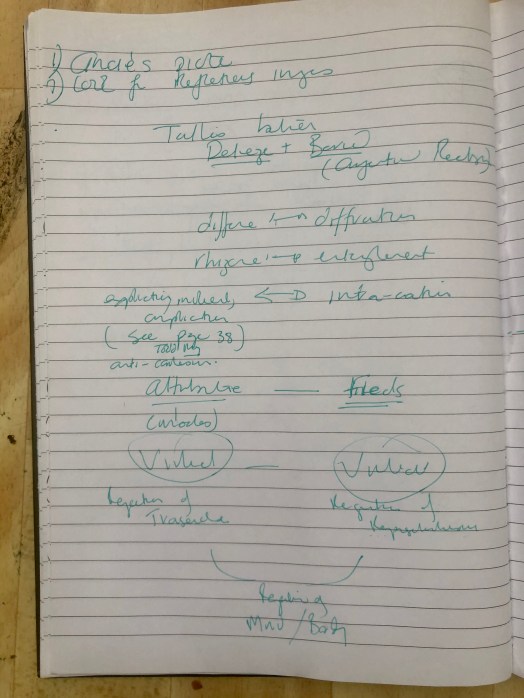
BOW/CS: Research , Delueze ‘difference’ & Barad ‘diffraction

Barad quotes Deleuze once in her first chapter at the top of a section, referencing language (words) and the problem of representationalism, and later, he is relegated to a sentence in her notes which mentions how his view on entities interacting – which are so similar to Barad’s ‘intra-action’ is irrelevant (2007, 437, n80). She writes ‘possibilities are reconfigured and reconfiguring’ (177) For Deleuze, there is folding and refolding and unfolding and refolding (May, 2005). I find Barad’s neglect of Deleuze surprising and wonder what it’s about. She tells us she is a Derridian – maybe it’s just about preference, but I suspect there is more to it. Can’t believe it’s related to views’ like Scruton’s dismissal of Deleuze.

Regardless, there are lots of correlations, and in any case, neither’s views are entirely new (suggested by Professor Paul Fry, Harvard) since the overemphasis by humans on their separability  – rejected by both Barad and Deleuze – is explored by Walter Pater in his 1873 book The Renaissance: Studies in Art and Poetry. The difference with Barad is she has the language of science backing up her arguments (although even then, they are contentious in some circles). Fry says Deleuze’s writing style is excitable – maybe it’s that which puts Barad off.

I have recently been reading Todd May who is recommended by different people as being good on Deleuze – and was thrilled to see morphology discussed in one of his videos as that links directly to my DI&C work. In the meantime, some notes taken while istening to Professor Fry’s lecture (see below):

IMG_2171IMG_2172IMG_2173IMG_2175IMG_2174


Barad, K. M. (2007) Meeting the universe halfway: quantum physics and the entanglement of matter and meaning. Durham: Duke University Press.

May, T. (2005) Gilles Deleuze: An Introduction. (s.l.): Cambridge University Press.

The Postmodern Psyche Explained (s.d.) At: https://www.sam-network.org/video/the-postmodern-psyche-explained(Accessed 16/02/2020).

Artist: More thoughts on Edgar Martins, Soliloquies book

Some fellow students may recall my angst about spending money on an Edgars Martins book just after Christmas. I had already seen a few books advertised which I knew might be helpful for research but out of financial reach right now – but this particular book seemed so pertinent, I couldn’t let it go. I was lucky enough to get hold of the last copy from Moth House and it has indeed been helpful.

One of my main interests was exploring how Martins uses material from a range of sources in the same project. He does this across his projects but the suicide and death topic reminded me of my own Self & Other A5, so I was keen to see the book, shown as prints in an exhibition and can include video format there and online too. The series contains found, original, archive and text. There are tropes and conventions in his work which I have found myself engaging with over the last couple of years, and that is absolutely what I am interested in too.

The essays have been excellent resources and will undoubtedly be referenced in my CS work. Here I want to point to two sentences that are of particular significance.

From Roger Luckhurst’s essay (118): After discussing various sources for images including ‘found’, ‘puzzling insertions of landscapes’ ‘stereoscopic views, vintage newspaper photographs’ ‘odd theatrical and enigmatic visions’, he writes, ‘These seem to work to derail the over-coherence any series or display or exhibition of book inevitably imposes, fighting to keep the grid of meaning open, defying the dread determinism of forensic files.’

(114) ‘tugging at the links that have been reinforced by dominant theories of photography, since at least Sontag and Barthes.’ (I find the phrase ‘at least’ a bit odd actually – yes these names are the dominant ones, but photography has been around for a nanosecond of time in the grand scale of art – its own sense of grandiosity belies its infancy. However, it echoes the status quo, of course.)

Martins is, like me, looking at ‘the cut’ – how we define things, how we are entrained to catalogue and categorise – and asking us to not make assumptions. He does this here through the doorway of death, suicide, forensics. It didn’t take long when I started looking at his history to find references to quantum philosophy but where I look at the concept of indeterminism (Barad, Rovelli, Bohr) he ‘sacrifices’ cohesion for the notion of countless probabilities (Heisenberg). Whichever, there is an interest in overcoming the fixity of Cartesian thought or Newtonian certainty.

In 2018, ex OCA student (now studying with Oxford Brooks) John Umney sent me a message and he has agreed I can share our interaction here. (29/09/18)

Screenshot 2020-01-19 at 17.37.50

I had been experimenting with blocks of colour, filters, covering up faces as the filters do, the ease with which we can all manipulate images, adding new/modernity/digital tropes to old images, intervening on analogue surfaces with digital animation. I guess my main interest was how easy it was becoming to intervene, to manipulate and to be manipulated. In fact, I started a project which I then abandoned called Manipulated. It seemed too trite a title and I wasn’t that keen on the images I was making but the idea of moving image with still, audio with still, and layering has stuck, modern and old together has stuck. And the filter we place over our faces, the regular circle of profile pics. Below, one of my own examples from that time – curated, found, added to. (Lots of this in 2018/19)

ThreePeoplehavingDrinks001cropped

It is hard not to notice the tropes in Martins’ work running through my own. I must be frank, I took a very brief look through the book and stopped, heading instead to the essays. The images were too familiar and similar to what I have been doing with scans and negatives and paper for my current project. I was worried if I kept looking, I’d be frozen with fear of being too similar. I have continued to worry about this – but I know Martins is one of several artists such as Eric Kessels, Alexandra Lethridge, Joe Rudko and Thomas Hauser to name a few who make work in this way, using these non-conventions, sourcing the old and adding to it with the new. Something Catherine said about one of my efforts having the air of forensics worried me as Martins’ work is highly influenced by that – but again, how can mine not be when I have been reading Tagg and Sekula? So I will keep going and hope to goodness my writings and feminine view give it something that is just me. But what I have noted about his work is that it is very clear contained and demarcated  – the indeterminism is held quite securely. I don’t think mine is. We shall see. And I will look at the beautiful book more carefully when I have completed this project. Incidentally, it’s not for resale – I think I will come to love it. But I have some others by popular artists that are if anyone is interested!

On another note re-books, I am going to borrow Hura’s The Coast which I was so keen to look at which pleases me immensely. I think the combination of text and image plus his interest in context and relation will be useful.


CS/BOW Reflection: Long

I felt it would be useful for me to pause and consider where I am at this juncture, and where I came from in order to arrive here. The OCA has been an immensely useful container but the journey I’m on, the desire to understand something fundamental but hard to pinpoint began long before 2014. Perhaps as long ago as when I was a child watching how strangely the grown-ups behaved and wondering why. Or noticing how we (I) emulated others; accents, behaviours, tropes, and then absorbing these actions and making them ours (mine).

This will be a long post and is for my benefit rather than anyone else’s – it feels necessary and important to get these thoughts outside my head as a part of a process in relation to CS and BOW.  And also, that it should be more conversational as opposed to confined by the rigours of academia although the habit to identify quotes is strong nowadays. Ruth (previous CS tutor) had suggested experimenting with form for CS and so I won’t rule out including sections of this, or developing it, if down the line that seems like a route I would like to take.

I started making notes for this blog yesterday as I marched along the street, sweaty because it was very mild and I was dressed for the artic, muttering to myself about what exactly it is I am exploring here in this work; I began to formulate a narrative that linked my life with the theories and ideas I am looking at.

Right now, I think it always starts with digitisation. I am fascinated by the revolution we are currently living through, by the assumptions people make about it. About where it comes from, what it’s doing, why we’ve contrived to arrive at this point (without volition – is that possible? Or is contrived the wrong word?)

Groups used to be smaller. For most of our evolutionary history, we lived in manageable extended families. Across cultures, there were some basic similarities. Nikolas Christakis covers these in his book Blueprint (2019). He talks about a social suite, which ‘includes individuality, love, friendship, co-operation, learning and so on’.

He also talks about the dyadic nature of humans. I really like this. It’s a word I came across when I was reading about babies and their primary carers. In the baby literature, it implies living in this secondary invisible placenta; it contains mother and child. Both are deeply connected within and even shielded from something outside the dyad. Not all mothers experience this. And modern culture seems to makes it challenging for genuinely dyadic relationships. Some people suggest the high numbers of post-natal depression are related to this failure to connect – and I suspect there is some truth to that although it can also be down to a lack of support, which is of course, another connection with other mothers/parents/helpers – or allo-parents, a term used by Sarah Blaffer Hrdy, a socio-anthropologist who writes about mothers.

I was lucky. I did experience a deep connection with all of my children. During my divorce, I seemed to be able to protect my youngest in this little bubble from all the toxicity outside of it. It also taught me that symbolic language isn’t always necessary  (I should have been far more consciously and intellectually aware of this given my acting training)- that we can communicate without it, even while we are asleep. And that has been very important throughout this course. I’ve learned that symbolic language is a distancer. It helps us to distance ourselves from ourselves, never mind anyone or anything else. “Use your words” is a constant refrain to toddlers who prefer to lash out when angry. We ‘otherise’ ourselves, remove something and in the process de-intensify it – be it rage or love – through the use of symbolic language whether it’s written down or simply spoken. We send our thoughts out into the world with language; a little bit of ourselves leaves our bodies and lands elsewhere. It can land as a caress or a weapon and it has an effect but, while wounding with words can be devastating and the cause a chain of fatal events, it removes us from direct violence. Again, Christakis discusses this, as does Richard Wrangham in his book The Goodness Paradox (2019)

A little bit of us – a thought that gets heard is something that can affect others.

In a dyad between a mother and child, something else is going on. Physical reactions take place that don’t need words, not even as thoughts. A baby wakes in one room and your breasts start leaking in another. The prickly sensation of your milk ducts filling up is what alerts you and you check in to see your infant’s beaming face  – and they seem to have known you were on your way. I’m painting an idyllic picture  – it’s not always like this, obviously. And some women and babies have a really terrible time. There is so much in modern culture which gets in the way of the connecting behaviours that evolved to help us survive. But somehow most mothers (although not all) and also fathers overcome the many, many obstacles. When your child falls over, a jolting sensation takes place in your own body as if you too have fallen. The theory suggests mirror neurons are responsible, which apparently exist in all primates (and beyond no doubt). It happens with other relationships too but it’s very noticeable in parent/child pairs.

Christakis discusses the hyperdyadic nature of the human species. In other words, we are all connected, that is how we operate. Hegel talked about collective consciousness.  Edward O’ Wilson has spent a lifetime investigating the hive and applying it to human behaviour. Social contagion or mimetics are other words to describe this phenomenon. Despite sounding so modern, it seems plain as day to me that we are networked creatures and always have been. Christakis’s earlier book is indeed titled Connected (2009). These connections mean that ideas spread around cultures and groups even when there has been no physical contact. Wilson discusses this strange ability seen throughout history when inventions take place in more than one place at the same time.

The Internet is a response to a lack of connection, perhaps in particular relation to population growth. As groups got larger, we stopped being connected. Social fragmentation, evident in the artwork of the early 20th century is one expression of this loss of connection between people and in relation to how reality felt. We humans then ingeniously came up with a way to address that. We dug down into reality and found a way to emulate it. Despite its relative technological advancement our code is still a crude copy. And there is a problem. The code we use to make these connections is a language. It underpins all the forms and media that we see on our screens, which is also another layer of language. So inherent and embedded in the anatomy of the Internet is a process of distancing. What’s even more difficult, as my lovely and intelligent friend rages about often, the people writing the code are very frequently a certain type. “They are the nerds!” she states angrily. “The people who aren’t naturally social, who don’t understand relationships, who are on the spectrum and can’t communicate. The ones who don’t have any empathy!” This is blatant stereotyping but the people writing the code are aware there is a problem. They know they need to write empathy into the code. They know this. However, for now, empathy is missing and the fact the whole thing is structured on language which is itself a distancing process means there is a structural problem which we may never be able to overcome, although I have faith in humanity

We can be optimistic because while we have collectively tried to re-connect using digital technology, which emulates natural linkages, today we’ve not even begun to see just how powerful our technology will be. This is both frightening and exhilarating. Once quantum computing moves out of its infancy we will not only emulate ‘hyperdyadicness’ (not a real word, I know), we will reach a point where simulation and nature are interchangeable. There are many, many foreseeable and unforeseeable problems but we will go on an incredible journey as our clever people look for the solutions.

We have begun the process though. So far it has wrought terrible consequences in the form of nuclear war. But what we’ve lost over time as language developed and civilisation grew is currently being rediscovered through quantum science and systems theory (which is interdisciplinary – don’t underestimate how crucial that is). People often see similarities between Eastern philosophies and the newer sciences. But I am wary of spouting racist claptrap. However, it is well documented that the Dalai Lama is interested in quantum mechanics and Luisi and Capra (2007) devote a carefully written chapter to the relationship between spirituality and science.

Karen Barad’s book Meeting the Universe Halfway (2007) deals with the philosophy of quantum science. She cannot stress the importance of entanglement enough. She explains how ideology and world-views are embedded in the apparatus’ and the framing of our experiments and subsequent related objects and behaviours. This embedding is also explored in Vilém Flusser’s Towards a Philosophy of Photography (2012).  The ideology is in the apparatus and photographers (all except experimental ones) are flunkies or to use his word, functionaries  – they ‘are inside their apparatus and bound up with it’ (loc 2086).

What stops us from seeing this is our ‘Cartesian habit of mind’ (Barad, 2007). Both Systems Theory and quantum science urge us to move away from the strictures of a Newtonian/Cartesian worldview where isolated objects exist in a void universe and nothing is connected or relational. Entanglement has been lost in our understanding of reality and we are working our way back to incorporating it now. But there is a long way to go and it’s on the fringes of society – although arguments to suggest it is becoming embodied through our interactions with digital data.

The problem with arbitrary lines around isolated objects is that it too often engenders a simplistic, black and white of view of the world. (And that is being kind.) This can be seen across disciplines and in photography it is endemic. Photography which claims so loudly to be a ‘caller out of injustices’ seems in fact to reinforces unhelpful mentalities, undermines any attempts to move away from hierarchical thinking, narrows down meaning, oversimplifies complex issues, attracts monism, flattens nuances, strips away context and relationships. Still photography in particular entrenches all of that. It isolates and insists on objects in a void. It suggests the opposite of a ‘dynamic and shifting entangling of relationships’ (Barad, 2007: 35) no matter how hard people point out – and writers such as Ariella Azoulay have done -– that history and the objects we construct are forever subject to re-examination, are alive with possibility and liveliness.

There is something inherently unavoidable and entrenched, in particular in still and analogue photography. I look at the ontology of a photograph and see that at its core, still and moving image are one and the same thing. We may intervene and add lots of frames together or else we isolate a single frame but they are both an agential cut (a Baradian term which I will explain more fully in my extended essay and in BOW). It’s the isolating that causes problems.

I find it hard that people fail to appreciate intra-relatedness. My interactions with a secondary school shocked and enraged me too as my child was being so badly affected by their entrenched position in an out-dated reality, in a constructed and ludicrous simulation of the past that is no longer relevant and entirely inappropriate to its surroundings, and that they seemed utterly oblivious to emergent changes to the world or else angrily against them. This is especially unhelpful for young people who have grown up with the problematised Internet which, despite its many issues engenders a networked view of reality. It is frustrating beyond belief that so many want to drill down into detail so tiny, they leave no room and can only focus on single issues, which they hope will somehow communicate something greater, rather than simply isolating themselves and their ideas in the void. It astounds me how this habit of monism fails us but is still so prevalent and is taught in schools and colleges and universities; but then I recall the citation which I begin CS A2 (draft) with by Capra and Luigi: ‘It [this habit I’ve described] derives from the fact most people in our modern society, and especially large institutions, subscribe to the concepts of an outdated worldview, a perception of reality inadequate for dealing with our overpopulated, globally interconnected world.’ (2014) Inadequate is the key term here. Inadequate. This old way of seeing and being will not serve us going forward. That is not to say we should forget history. We can’t. Because in an intra-related world the past is enmeshed with the future and the present. We must, as Azoulay (2019) recommends, re-evaluate our Cartesian linear view of time.

In my work I am, like the child who watched and noticed the adults and my friends all copying each other, performing roles, connecting. We have always done this. The Internet makes it visible. It somehow speeds the process up (See Virilio (2008) on speed and technology). The breaks are no longer in place. But we will write them into the code again. In the meantime, I do believe we need to find ways to communicate and explore intra-relatedness. We must challenge linear understanding, flat thinking, monism. Not everyone I value or follow agrees that there are no objects, that process supersedes things. However, we have lived with that myopic view for so long in the West and it has taken us to a very dangerous place. And so it behooves anyone who has the capability of addressing and deconstructing it to do so.
CS: Chapter 2 ‘Photography’ Howell’s (2011) Visual Culture

We are asked to look at Chapter 2 “Photography” by Richard Howells (2011). To begin with, the chapter sums up the very short history of photography. Although not Areilla Azoulay’s non-Cartesian version, which I talked about in my DI&C essay, and which posits that we cannot separate the invention of photography from its related activities, that of empire building which began in the 14th century when Columbus sailed across the Atlantic and began the process of taking people and land on behalf of European conquerors. I’ll touch on this briefly later. However, the author does take us back to cave-drawing (as far back as 25 000 years rather than 40 000 which is where academics have placed the earliest discoveries; coded symbols that can found over eons of space and time). This is important because photography is simply one more way for us to exteriorise our inner selves, to other the self, to store consciousness. That it’s mechanical is important but doesn’t render it less than.

It was interesting to touch base with the received story again, having read about it in various books while studying but specifically, in a wonderfully entertaining book called Capturing the Light by Helen Rappaport and Roger Watson (2013) which goes into much greater detail, although with less critical depth.

However, I found it difficult after reading the chapter to get beyond the inclusion of Roger Scruton’s essay, Photography and Representation‘ in “The Aesthetic Understanding‘, Essays in the Philosophy of Art and Culture‘ (1983). Scruton isn’t only a Conservative, he is a reactionary extremist who promotes the most appalling ideas and is a friend of the Spiked bunch, who, quite frankly, seem completely nuts. (And I used to quite like some of what Frank Ferudi said about parenting.) Scruton was recently sacked from his position at the head of the Government funded Building Better, Building Beautiful Commission (what he was doing there, is anybody’s guess – a mate of a mate, no doubt) for making comments that aren’t even worth repeating. He has spent his whole life offending people and seems to feel hard done by, having ostracised himself from various British academic institutions. His own father was, by all accounts, chaotic and damaged and very anti-establishment. Read into that what you will.

I appreciate that the original chapter was written some time ago (2003) and Scruton may, in keeping with the times and contemporary discourse, have virulently amplified his conservative message in recent years. But I find his argument sort of ridiculous – and Howell talks about it being flawed. I also know difference of opinion is important and having both sides of any argument is thought to bring about some form of synthesis, leading to a balanced idea of reality. However, modern science and philosophy are rendering the arguments included in Howell’s chapter and in particular Scruton’s, not only flawed but almost irrelevant. Before introducing Scruton, Howell tells us how some people felt that photography cannot be art because it merely records the natural world, reality,  as it is, which is where Scruton we are told, positions himself.

For a moment, I’ll deviate here and talk a bit about ‘reality’.

Two years or so ago I got off a train at a station beyond my intended stop. I realised my mistake but wasn’t sure how long I’d been distracted by my book, and looked at the map on the platform to see where I was and where I needed to get to. For a short moment, but long enough to cause a sense of panic and alarm, my memory stopped working. I recognised the signs on the maps as signs but had no recollection of what any of them meant, no access to their meaning. It was like looking at a map in a foreign language at the same time as not even knowing what a language might be. It may have been an early sign of something sinister healthwise to come, however, it has not happened since and I hope and suspect it was simply a brain glitch brought about by stress, tiredness, and distraction. It felt like it lasted about a minute. The experience, however, demonstrated what my consciousness and its integral function, memory, does for me. It enables me to get from A to B so I can survive. Without that ability I would not be able to move about in the world, feeding myself, interacting with people, finding a mate – doing all the things that keep the genes alive and reproducing. This is what our consciousness is – an evolved survival mechanism. And as hard as it is to accept, we have evolved to see only what we need to see in order to exist. We have a limited, locally based view of reality that is myopic but highly specialised. Some criticise this materialist view suggesting it leads to emptiness, an existence that lacks meaning, but the illusion of reality is literally all we have and to belittle or undervalue it isn’t automatic or necessary. One hopes we can afford to be honest with ourselves, although as we look about today, it does at times seem perilous and perhaps terrifying for people.

I am looking forward to receiving my delayed copy of “The Case Against Reality” by Donald D Hoffman. But since 2015 I have been reading as much as I can to understand this illusion of reality including Reality is Not What is Seems Rovelli (2016), The Ego Trick Baggini (2015), and The Biological Mind Jasonoff (2018) amongst many others which look at life systemically. I think the science contained in these books potentially nullifies any arguments about photography being simply a recording of reality – because our reality is SO subjective and particularly nowadays when digital technology is fundamentally changing what we expect from reality  – and because any language form, photography included, is an emergent property which is what is so fascinating about mark making – however we choose to do it. And that’s before we even touch on individual subjectivity (as opposed to species subjectivity), technical ability, and choice, or processing whether in the darkroom or your desktop.

And in any case, the arguments against photography of any description being an art form because it is  a copy, where photographers simply record rather than dictate what’s included, were made redundant the moment a urinal was placed in an art gallery. If you think photographs merely copy reality, then they are the ultimate readymade. Although I do see some conservatives are likely to dismiss appropriation as a viable art form too, missing the point of it entirely. But like the evolving nature of gods and God as civilisation develops, what we need from art changes too. And conceptualism rather than dogmatic religious iconography is clearly more relevant today as the nature of reality is unpicked and newly understood. Photography, being an emergent property that came along with the evolution of technology over several centuries alongside its sibling, or perhaps its close cousin, Capitalism, is not only interesting as a concept but crucial to the way we see and understand life today, and therefore an integral form in any artistic exploration regardless of whether it ‘ideal or real’ (Scruton’s distinctions). Even if all the artist is doing is making something pretty, which is of course just as valid as documenting society, or commenting on language.  These distinctions are as silly as the ones about digital technology not being ‘lovely’ enough to produce art.

I am looking forward to receiving my book by Hoffman so I can keep investigating this subject and bringing it into my own work. In the meantime, I used to think that all the technological advances we relied on were changing our evolutionary path whereas now I see that they are part and parcel of our evolutionary path. They are expressions which lead to feedback loops. I think that’s why distinguishing between forms and saying one is art and one isn’t is a limited and limiting view.