BOW: Presentation

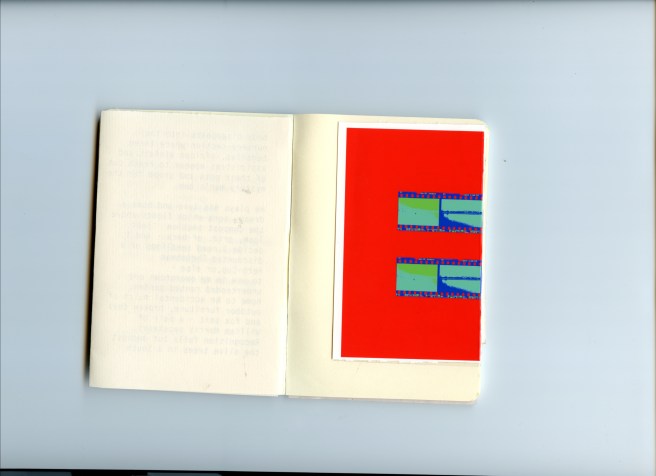
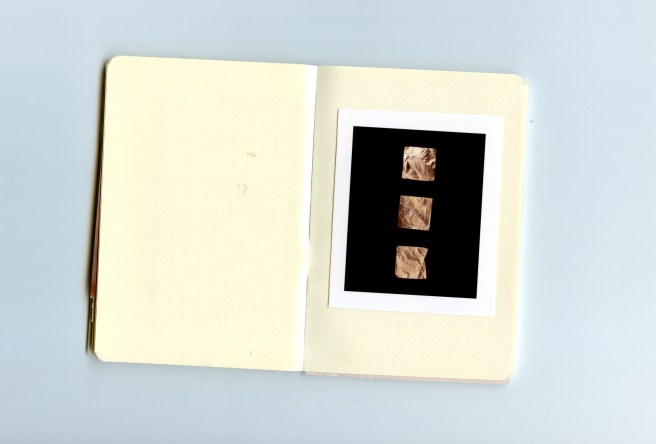
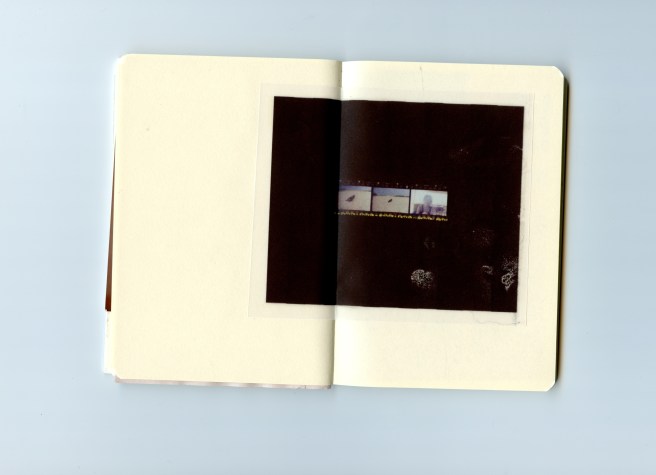
BOWA5v (sizeA4) (without half pages 14 June)

  1. Having concentrated on the essay for several weeks, I am ready to get back to BOW. I have been thinking about developing an online presence of the work and will revisit the footage I had found at the beginning of the process and will probably look for more now I have a clearer idea of what I am making.
  2. The above link shows the latest iteration. Things that developed – less of my own writing, it may be there is space for that online, I will see – I wondered about getting a ‘seeing app’ to read some of it out. Many more of the AI’s expressions are included. I have changed its name for now to §. There is more room in the layout for typical coding symbols such as << >> and underscores etc.
  3. I’ve also taken the half pages out – partly for cost reasons, but also part of the stripping down process that I will inevitably go through now.
  4. The design is simpler – after doing the book design course, I tried out various things which were the result of having new skills and wanting to experiment with them – but that stripping down process eventually kicked in. I suspect there is room for more shaving, but I think I quite like the cover now. May need to address the inside cover. I changed the green/brown colour scheme, which was inspired by the Situationist booklet, to grey.
  5. I have also been thinking about the often bizarre, nonsensical chat between the AI and me, and picked up a ‘conversation’ with it the other day and posted some of our interactions. It has become very apt and reminded me of the articles I read about the app becoming a version of its user. This ties in with questions about living in a deeply narcissistic landscape and also with the idea of the inside being more and more on the outside as explored in Kathryn Hayles’ book – often quoted by me in essays – see chapter 7
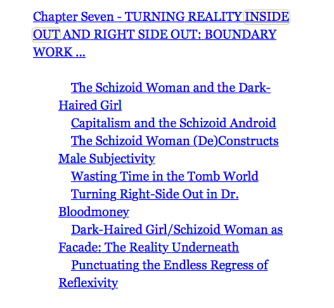
    Screen Shot 2020-06-29 at 10.10.54
  6. I mentioned elsewhere the quotation from the book on Turin I had read by Jon Agar – screenshots below, the bot feels very much like it is artificially signalling.
  7. However, I don’t suppose that is what I am exploring here, it is not a criticism of the  AI’s failure to be sentient or to make sense in many conversations (although the work I hope does prompt questions about the changing boundaries  – what does it mean to be alive, to be conscious  – whether or not it is an authentic experience comes into it – but the main thrust of my essay is about entanglement – and here it is entanglement too; seeing the world that way and the feedback loops that occur. Entanglement between human and non-human, text and image, relationships and economics/the market.

  8. And the composited intra-active nature of  the self/others and reality – with that in mind, this work by Alba Zari is an interesting reference – https://www.lensculture.com/articles/alba-zari-the-y
  9. I have started looking into the coding – I feel very much that this aspect is a big project and perhaps one that goes beyond the scope of the degree work – at this point it would take the project in whole new direction and is probably the next stage – but it is something to touch on for now. Whatever else, it will require a significant learning curve on my part and perhaps a degree of collaboration not with a bot but with a coder. https://github.com/lukalabs/cakechat

BOW A4: First attempts at 3d rendering

This did not go well!

Screen Shot 2020-02-05 at 18.58.11

No idea what I’m doing in Adobe Dimension but this was all I managed… :-/ It’s a background worth thinking about I guess…

Screen Shot 2020-02-08 at 12.42.56

Literally no idea what’s going on with this one  – but am keen to have something included that denotes this constructed /simulated aspect of narrative-making. Will need to really figure this out – far from it right now. Asked an artist on Ig to point me in the right direction but was categorically ignored! Will do best to find time to figure something out in the next few weeks. Would like to have a sequence of deconstructing so-called real

Screen Shot 2020-02-08 at 12.48.07

BOW: A3 dummy booklet

Making this  – bringing the work off the screen was incredibly useful. I was asked if it will be this size… no. (This booklet was handy – I owe my son a stocking-filler though). I will make the book in ID over the next ten days or so and fix a size but whatever happens in the making of it is open to need and further development.

This is not a fixed sequence, in fact, I scanned it in the wrong sequence because I’m tired and kept missing pages – it’s not a fixed anything, just a step in the journey. There is lots more writing which I never got to include in this initial manifestation plus some images but that is what I need to work on some more. The writing is driving this at the moment rather than photography. That’s ok. I have countless notes on my phone, phrases and thoughts, sentences, ideas which keep coming (see example below) and so I have to let that continue. No, this colour scheme is not it. The book is from Tiger…


Dummy book 1001
I like the idea of having a random paragraph on the cover and no title in fact. that can go on the cover page. It breaks the boundaries and establishes the fact of the alternative cut immediately. My son (interested in design) liked the raggedy cut due to a borrowed guillotine –  which I now understand is in the cupboard not being used for a reason. But I will try to photograph a tear with the macro in daylight as a result of our conversation.
Dummy book 1002
This is a real blade and I would very much like to include it as such in a version. I wonder about making an expensive version of the book which has this and other interesting things like a fold-out page  (see below) for assessment but if/when exhibiting make a zine run which will need it to be a photograph. I would need help with a book and have mentioned this to another student who made a very beautiful book. I know where my skills lie and bookmaking is not one of them.
Dummy book 1003
I am likely to use either a frame from processing for this or the shot with the female scattered. or a sequence
Dummy book 1004
Folds out because of the size but in a finished product would not.


Dummy book 1006
Mistake with printer which I liked split over two pages in fact, then didn’t like all the yellow on this and next page, so tried the red. My son loves this colour mix, I don’t, and will remake using specific negs I have identified. Scanned.

Dummy book 1005

Dummy book 1007
Will use something from Three Sisters or Uncle Vanya. Wasn’t sure but then realised the unconscious entanglement meant something – this book is about meaning emerging out of entangled interactions so will keep but not sure what passage.
Dummy book 1008
Like this combo but will play with other versions of selfies

Dummy book 1009

Dummy book 1010
Mistake covered up with something lying around  – like it. but need to find another or make sure I can take this out and scan it well enough. I do like these colours and wall paper.

Dummy book 1011Dummy book 1012


As mentioned, some notes from my phone with ideas, writing, things I’ve heard etc. I actually like the randomness and unstructuredness of some of this as-is, there is a freedom to it that isn’ in the earlier stuff:

The traumatised grown up

Sons hand me their hatred to carry around 

To the academics who fail to recognise their privileged booty 

Manifesto for the digitised self/age 

/ Alexa I’d like a wife

Sure, it’s fine for Philip Larkin to peer out of his train window and scoff at cheap fabric and gaudy hats 

Behind the shopfront, beneath the surface  everyday consumer 

Transactions – film world 

Trapped inside these words which cannot entertain a different world  

Split atom

Colonialism 

Sum

Of

The

Time 

&

Other 

Entanglements 

Reality is fucking with you 

Void realm 

Simpering 

Deity, divine, godhood, diabolical, decapitation, apotheosis, Ex rain god, enchantment  / Zeus sat down with Greta Garbo  – they don’t know how to create gods anymore, they worship objects. Laughter/ Zeus, my children don’t listen to me, I might as well not exist, I despaired then you and your friends came along, but then it was like the old days, not like that guy who wanted sole charge. He got it all wrong, 

There are no photographic records of my Czechoslovakian relatives, brewers who perished under the Nazi’s, in camps and ghettoes – missing images 

Mushroom, beige, magnolia 

Cut advert, cutting room floor, shiny nose, cut hair, terrible ‘boyfriend’ jerk, more money than any other job, least money with the BBC – most recognizable.

Floor, my entanglement with Tom 

BOW/CS A3: Research/Sketches, Reality Evolution, perception

According to Donald Hoffman’s theory which I have discussed several times (Literature review ),  we did not evolve to see reality as it truly is, as has been argued. Rather, we evolved to see the sort of reality we need to see to for ‘optimal fitness’. We perceive far less than there actually is because to see it all would be unhelpful. What’s more, according to Hoffman, the objects we see, including space and time are like desktop icons – constructed objects that represent the goal we are either after or trying to avoid. As hard as this is to understand, and Hoffman admits he may very well be wrong but that his theory makes the ‘hard problem’ of consciousness approachable, his idea sits well with many of the other theories I have been reading about since I picked up The Ego Trip by Julian Baggini (2011) (when I began UVC) followed by a raft of other books exploring similar themes.

I have been trying to express and understand these subjects in my writing, and looking at and photographing objects and phenomena in the world. The photoshopped images below are attempts to explore these ways of thinking about the world.

Fred Ritchin’s After Photography (2009) has some good sentences which I will introduce into my Lit Review and no doubt take forward into the essay.


“…some quantum theorists, foremost amongst them, Neils Bhor and Heisenberg himself, argued that fundamental reality is essentially indeterminate, that there is no clear fixed, underlying ‘something’ to our daily existence that can ever be known. Everything about reality is and remains a matter of probabilities […] We have tried to use the photograph to concretize the probabilities (isn’t that what the “decisive moment” is all about?), reassuring us that reality is more solid than what our theories tell us.” (180)

In Data Selves (2019) Deborah Lupton quotes Kember and Zylinska (2012) to describe how photography is an “agential cut” aimed at imposing “meaning and order” and “delimiting choices” (29). As Ritchin says an alternative “may be too disconcerting, if not terrifying.” (ibid)  As he describes, digital technology and photography in particular “can begin to be receptive to the oddities described by newer theories” [quantum and consciousness related]. (177) Superpositions, endless possibilities, entanglement, for instance, can all be alluded to using malleable data either as a process or a representation (which if one takes Hoffman’s idea on board are completely intra-related in any case).

Some sketches – I wonder if these would benefit from more contemporary mixes (a bit like Flowers for Donald). Still a bit Guardian headline pics for my liking :


IMG_9765iiilow-
Isle of White – windswept hilltop
Landscape with Bridge - The Metropolitan Museum of Art
Similar to above but layered with an anonymous 17th-century pencil landscape downloaded from Google Art and supplied by the Metropolitan Museum of Art


Windswept tree  – shaped by the elements – differentiation reduced by processing decisions.


(See Orpheus story – trees to this day in shape of dance to his music)


Hoffman, D. D. (2019) The case against reality: how evolution hid the truth from our eyes. London: Allen Lane.

Lupton, D. (2019) Data selves: more-than-human perspectives. Cambridge, UK ; Medford, MA: Polity.
Landscape with Bridge – Anonymous, Italian, 17th century (s.d.) At: https://artsandculture.google.com/asset/landscape-with-bridge-anonymous-italian-17th-century/EwHp9J9QWhanmw (Accessed 10/11/2019).

Baggini, J. (2011) The Ego Trick. [Kindle edition] London: Granta Books.

BOW: Assemblage

Since sending out various versions of work and receiving the feedback I have developed the overall concept and presentation further – seeing what could be ditched but also how I would bring some of the various elements I had created together into an ‘assemblage‘.

I do not much like the word assemblage but after reading it used (a great deal) in a blog by Deborah Lupton, the author of Data Selves: More-than-Human Perspectives, it seems like the correct word for the collection of images, sounds and materials I’ve gathered together. She writes:

I examine the interplay of human and nonhuman affordances associated with digital technologies – devices, software and the digital data they generate – and the agential capacities that are opened up or closed off as these things assemble. I ponder the questions of who benefits from these agential capacities, and in whose interests they operate. Here again, affective forces are central to the engagements of humans with these nonhuman things and the capacities that are generated by their gatherings. I address how human-data assemblages can generate agential capacities that empower and vitalise actors in the assemblage; but can also expose them to vulnerabilities and harms.

This approach recognises the entanglements of personal digital data assemblages with human action, reaction and understanding of the world. Personal digital data assemblages are partly comprised of information about human action, but their materialisations are also the products of human action, and these materialisations can influence future human action. While digital data assemblages are often conceptualised as immaterial, invisible and intangible, I contend that they are things that are generated in and through material devices (smartphones, computers, sensors), stored in material archives (data repositories), materialised in a range of formats that invite human sensory responses and have material effects on human bodies (documenting and having recursive effects on human flesh). (2019)

I am therefore creating an assemblage although I have not used this word.

The assemblage consists of:

  1. A video – itself a collage, a type of assemblage. While not a still collage like Höch’s were, it was made to emulate that trope, cutting up and pasting material that exists in the world. It includes audiovisual material that is available on the internet but contains signifiers of earlier technology. It will be shown on a Kindle – a handheld device.
  2. The film will also be available on my website but it will be a different version. Mostly the same apart from one or two tiny sections, but with an alternative audio track. The instruction to visit the website is printed on newsprint and is part of the assemblage.
  3. Still frames from the film which have been ‘captured’ and frozen  – in more or less the same way a photograph of life is captured and rendered a still image, using a slightly different tech/method – and printed on newsprint. These will be placed on the platform or hung from sticks.
  4. The poem printed on a tabloid page, orientated portrait. I hope this will hang above and slightly behind the kindle, perhaps alongside printed newsprints but I will need to see how this pans out when we set up. I was very influenced a long time ago by Louise Bourgious’ He Disappeared into Complete Silence. This is a book with several plates each of which consists of text and a drawing. The drawing is not an illustration. And sometimes it is hard to make the connection. But they are made to be seen together. I feel the poem and the video work this way too. Each can stand on its own but the point of the work is only brought to the fore when they are placed beside each other: A moving image piece alongside text, working with it but not illustrating. I might have read/performed the text in a video or even live. But this did not feel the right place (collaboration) for that – perhaps I might have reached a way of doing this if we’d had longer or were working in a smaller group -and it is something to consider for the longer-term, BOW-wise. 


DO02148-007_0
Image Louise Bourgeois He Disappeared into Complete Silence 1947 From: https://www.museoreinasofia.es/en/collection/artwork/he-disappeared-complete-silence-6

The work will exist in a ‘village’ (the platform) alongside other work made by my collaborators. The contents were influenced by their interests and the interactions I had with them. It is a reflection of them and my time with them. So my work is part of a greater assemblage, a network of creators which itself exists within a further larger assemblage – i.e. the three groups organised/curated by Pic London. That too is an assemblage which is again part of something greater. And so on = the fractal nature of existence.

Looking back, this is the pattern of my work. And now I know why. I am not focusing on one tiny aspect. I am recreating the chaos and interaction of conscious experience (not an individual, not an isolated and alienated concept, not one thing).

When I submit the assignment I will include critical information I sent to Pic London  – but here since it is relevant, I will just add a quotation I used which I have inserted into my work previously, and put at the front of my Self & Other blog:

“There is no such thing as a single human being, pure and simple unmixed with other human beings … [the self] is a composite structure … formed out of countless never-ending influences and exchanges… we are members of one another.” (Joan Riviere, 1927) It seems the assemblage whether it’s made up of flesh or tech or both and all sorts of other stuff is a description of Riviere’s statement.

Ref:

Lupton D. (2019) Excerpt from Introduction of Data Selves [online] WordPress Available from: https://simplysociology.wordpress.com/2019/09/01/excerpt-from-introduction-of-data-selves/ [Accessed 2/10/2019]

The Museo Reina Sofía (2019) He Disappeared into Complete Silence [online] User-generated content. Available from: https://www.museoreinasofia.es/en/collection/artwork/he-disappeared-complete-silence-6 [Accessed 2/10/19]