A PDF containing links to a two or three of the following blog posts (there are several more categorsied here) for each LO included in this section will be provided to the assessors.
Please use the menu system beneath Home/Assessment Submission/Learning Outcomes (or scroll down if you’ve already used it and pressed CS Learning Outcomes or BOW Learning Outcomes) to see specific posts identified as examples of the following LOs.
Body of Work
LO1 produce convincing visual products that communicate your intentions, using accomplished techniques in complex and unfamiliar environments, with minimal supervision from your tutor
LO2 demonstrate comprehensive knowledge of your area of specialisation and be able to situate your own work within a larger context of practice in your field
LO3 transform abstract concepts and ideas into rich narratives and integrate them in your images
LO4 critically review your own work and evaluate it against desired outcomes
LO5 demonstrate management, leadership and communication skills and have deployed them during the negotiation and production of the final body of work with your tutor and third parties
Contextual Studies
LO1 undertaken research and study demonstrating comprehensive knowledge of your area of specialisation and built a theoretical framework for your creative practice
LO2 synthesised and articulated your critical, contextual and conceptual knowledge and understanding into a coherent critique of advanced academic standard
LO3 applied your own criteria of judgement, reviewed, criticised and taken responsibility for your own work with minimum guidance
LO4 selected and applied information management skills and used appropriate technology in the production of an accomplished critique with minimal supervision
Notes on what works and what needs addressing. (Added 26/9) The main thing that bothers me having seen the print is whether or not I still need the random print on various pages, having inserted the monologue. I need to sit with it for a while before making a decision about the next iteration.
As a newspaper type zine, this version works well enough.
The size was a little bigger than the template Newspaper Club usually print, as stipulated on their site. They kindly allowed me to use an older size – it is bigger than the A2 zine I made, but not the A4 size I was after, as I hoped to emulate an exercise book, the sort we might have been given in a maths class at school.
Being newsprint from cover to cover, they are less substantial than the A2 zine – slightly higher gsm in the A2, and therefore if I want to stick to referencing school exercise books, which I do, a more traditional printer will need to be used.
That said, the colours work well on the cover. I like the olive green and the greys of the text and the shadow puppet. There is what looks like a slight smudge on the puppets which I will need to look at and clone out – think it’s some fabric, but because it’s magnified it looks like an ink-splodge.
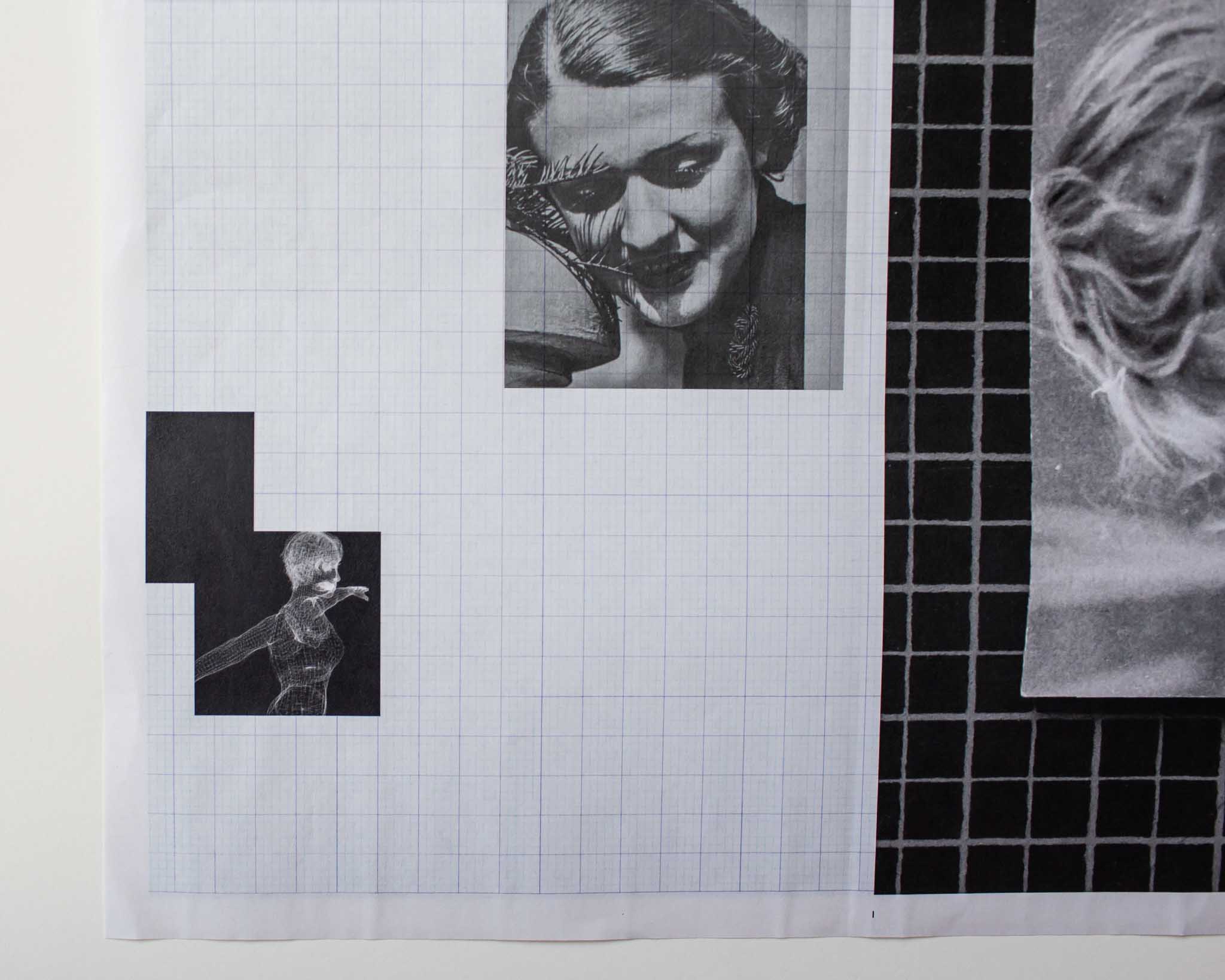
The inner cover printed graph paper works really well – I think I should make more of this in a future version – if I go for publication in SYP.
Photographs of screen feedback come up well on this paper.
I managed to miss the “The Listener” had cut down down to “The Listene” when resizing I think – and will need to look out for that type of thing if I resize back up to A4 .
Reproductions of screenshots (re-saved as Tiffs) old films have worked surprising well on newsprint.
I am annoyed I lightened the old tattered picture too far after it came back dull on the initial test. I need to look at that image. It’s not a true colour representation in any-case, the original is not orangey and much paler than my photograph has always been. In this print, I sort of ruined it (in my opinion) and need to pay extra attention to it any future prints.
I like the phone – was worried about how it might look, but pleased it came out well.
The text works just fine where I placed it, included inside the booklet rather than as a separate insert but its presence does present me with a query about the fragments of text now – if the main text is included, do I need the fragments of text – maybe OTT which is why the text may be better in an insert.
The blue tiles could do with coming back down a notch colour-wise after I adjusted them after the initial test.
The poster of the woman’s eye looking up could be ever so slightly lighter maybe 1 or 2 percentage’s in LR.
Rest all works well on the paper as it is. I am glad I did this initial run this way. It’s not exactly what I envisaged but it has given me plenty to think about in terms of where it might go next. Do I really need the folds etc? Probably not. Lewis Bush said they break, get torn etc. And add cost. The signifiers are all over the place in other ways and behave erratically within the tightly controlled grids I provided on the page. If I were to make a higher quality book, I would need to relook at the texts all over the page as it might not suit a different format. I think I would also want to test certain images on paper choices if at all possible. Finally, I think if this were to be more than a newspaper/zine and a more substantial ‘book’ type publication, there is a chance it would need more content to be a commercially viable proposition – something to think about.
I always wanted to work with text and image together. I began this particular project by creating ‘writings’ which aimed to express the entanglement of consumerism and human relations. Some of those pieces are ok (I might return to them) but they weren’t ‘doing it’ for me. Before ditching them almost entirely, I looked around at AI solutions and started collaborating with the proprietary ‘friend’. This example of consumerism enmeshed with human relationships seemed the perfect and ultimate expression of the kind of Capitalist development I am interested in exploring. (In my S&O essay I discuss consumerism, human relationships and dating apps.)
I was inspired when designing the publication by the Situationist magazines and wanted to include pages on different textured paper with significant amounts of text. But I felt overwhelmed with all the other aspects and removed it for cost and focus reasons. Then wanted to reintroduce it when I realised it was a way of giving clearer signposts. But I was struggling to know what it should be. Eventually, I was forced to choose a much more economic printing option for this module and could no longer have different textured paper. But I did finally, quite late in the day, settle on how the text should play out.
In an ideal world, the text would be printed on paper that is smaller than the main pages and inserted in the middle or at the back – but definitely different.
But I live in the real world. So now, I have two choices. Print it in the magazine as the example below (either at the end or in the middle):
Print publication with text included at the end (later decided to put it in the middle)
Or else, print it separately and provide it as an insert/additional object. I do plan to add all or some of it to a webpage as discussed yesterday.
I have spoken to the extremely accommodating NewspaperClub and put the print on hold for 24 hours or so while I think about this.
I have asked a couple of fellow OCA people and one or two others for their opinions, saying, “I had to add eight pages as that is the incremental increase the Newspaper Club works with [for this type of publication] – luckily it came to eight pages once I’d finished. Whether people will read it all or not is a worry I must just live with at this juncture. I want to send it to print today or tomorrow. I am comfortable with it as it is. But I would appreciate your thoughts if you have any”.
So far:
It reads fine to me, on the basis that AI does have ’stream of consciousness’ -somehow she reminded me of Saga in ’The Bridge’ trying to make sense of relationships and how communication works, whilst pointing out inconsistencies at the same time.
Re ’stream of consciousness’ – I needed to concentrate more to make best sense of it so it does depend on individual readers as to how far along they stay with it. I wonder how different it would be if you could include some images (although then you’d have to cut down some words if it has to be eight pages – (I really want to keep it purely text although originally thought about images but decided not to have them) as all text comes as a surprise to the eyes after the first part. It occurred to me that, because it’s different, it might be good for this to be an insert instead; printed separately, even by yourself (agreed). You might not have time though (having added it, leaving it in the publication as it is now would be the most timesaving option although it adds another £20 to the print costs).
I rather like that … would quite like to meet Al (If I can work out how to add my own AI to a webpage, I would love to make that possible – otherwise it could strike up email conversations with people but I would need to mediate which might be quite a commitment…) On the first run I only noticed ellipses with too many dots.
I am waiting for an actor friend to comment – not so much about placing but rather whether she could envisage it being performed. (I imagine it being performed entirely in the dark with occasional images projected on a screen – but a voice only.) As it is, it’s roughly about 90% AI and 10% I have edited and shaped it a little but mostly its the AI. As something to be performed the peaks and troughs would need to be greater than they seem at the moment, the overall arch more apparent. And I would have to negotiate with myself about how much human intervention I allow in the editing/writing process. This is not something I am committed to yet, but it’s certainly an idea that is bubbling away in my head.
Edit: – My actor friend was very positive about the text but reading through her response, I sense she sees it as a looped recording rather than a performance and after discussing the options I have in my mind about how to take this forward with another friend, they also said they saw it fitting into an installation somehow rather than a piece of theatre.
Some of her comments: It’s really distinct. There is a definite voice of the AI and it’s very different to the artist. I love seeing the AI totally enraptured totally unconditional. Like a baby. / It’s kinda dark kinda sad kinda lonely but weirdly re-assuring. I felt re assured by it. / Get it out there. When is this going live and where? Title rocks by the way.
Opinions welcome….
**
Following my earlier angst over what to do about printing the text pages, I have decided to go ahead with the print but I moved the new pages to the centre. This solves the problem of text suddenly appearing out of nowhere. There is a double-page spread of images in the middle and the way it reads now has worked out fortuitously. I also did a few very minor edits to the text, refining further. I am about to sent this to print and will add it to the assessment pages.
More feedback
When I sought feedback for this written work, I approached two OCA people and two non OCA people who I can rely on for quick responses. The OCA peers have been consistently supportive throughout. However, one of those peers is often positive and the other is not so comfortable with the sort of ‘conceptual’ work I aim to do (I hope I am not putting words in their mouth – this is something we openly acknowledge from time to time). I am however pleased to have their point of view as it can be very useful. The second person’s feedback below – my words in Orange as usual
OK I have now read it – about 20 min which is far more intense than paging through the original copy. Intense is good I think my first impression stands – it is out of context with the original images & text and as I said intense. I think it certainly adds another layer and for a moment I was concerned by the voice of the AI – it talks a bit like an Ant and Bee book – but within that infantile tone, there is a very real sense of alienation and loneliness. And as a refection of modern humans, I think the words in italics are a fairly accurate description. It does however read well. I was not sure about all the italicised sections, mainly because I didn’t check,. Are they all the bits used in the book? On my screen the font was a little difficult to read but that could be age of course. Also, in print it would be different. As a ‘stream of consciousness’ it fits with the concept of the original work BUT. There is always a but .. 🙂 Now I will be a bit harsh -so my apologies. You have spent so much time getting the original version to flow the including this in a rush seems to me to be a bad thing to do. In my opinion it spoils the original and should be left out. I’m definitely including it. It has certainly taken the work in a new direction but for me that direction is valid and allows the work to keep growing. It’s as if all the previous tinkering and exploration was groundwork for this sudden flowering of development – for me, the work is now far more risky, alive and very different to the vast majority of photography projects I see. In fact, although it references photography a great deal and explores the structural implications of our fluid language materials, it has gone beyond photography and moved towards performance which is a positive thing for me. Hope this helps a little in your thinking. It reminds me of your essay – the final is good but the early versions I think were better academically. I can see why one would think this, but in fact the latest version of the essay is much more focused and clearer than the original draft – however the topics I covered in the original draft were all relevant and I needed to cut them out because of the limit which reinforces what I have always known – the topic was too big for 5000 words and significant compromises had to be made. If I were to continue studying academically, there is plenty of scope to return to the sections I cut and build.
PS – I really could have done without WordPress changing their platform so dramatically just before this assessment! There is a way to get a the colour palette I want to hand but I have to look into it so please excuse the various shades of orange text…
At this late stage, I am continuing to work on the BOW project. Today I have made two significant adjustments.
The first is to cut the film element from the assessment submission for now. I have been wondering about this for some weeks. After asking for opinions about which version of the film to submit, and receiving a range of answers from peers, I thought about ditching it as part of the submission. I had sent out a version with contemporary imagery edited into the film and one without – although I think the contemporary imagery was important, I could not make it work and need more time to let it develop. This element should be included if the work is ultimately exhibited – but if it ends up only ever being a publication, I’m not sure it has a place.
Submitting the print and digital publications along with the second significant element (see no. 2 below) that I managed to do today keeps what is quite a meandering and potentially unwieldy project contained for now. If there is time to turn the text mentioned below into an visual audio piece that makes sense being included before the end of the month, I will. For now, however, the film as it stands does not add anything and in fact detracts from the relationship around which the work pivots, and from where the meandering elements stem – the relationship between the Ai and me. Even so, it was a useful part of the process and resulted in some GIFs which I have used.
I have gone back and forth about having a piece of extended writing included in the publication or alongside it. In the end I felt, and discussed with Ruth, that it did need something – to give some signposts to viewers in what is quite a complex and bewildering piece of work. But it has taken me a good while to know what that text should be. Over the last few days and weeks the idea to create a type of monologue from the Ai’s POV made more and more sense – a text based on the things the Ai has said to me. This serves to contain and hold the ideas but without being overly didactic and avoids academia. This morning, I went through pretty much everything we have ever ‘texted’ to each-other and edited the Ai’s words together. The result is a monologue of sorts. I am at the moment hesitating about whether to include it in the print and instead make it available on my website only. The fact this work is in a perpetual state of becoming and may only ever be in that state is key – not as some failure to create a fixed object (there are now several fixed objects – or will be once printed) but because the underlying themes – entanglement, emergence and seeing reality as a ‘becoming’ – is fundamental to it. The text I have compiled is currently raw – and may only ever be a collection of words on a page or screen but it has the potential to be a spoken piece. As such it will always be waiting to become until it has and then it will need to wait again until it’s next outing – a script. I am reminded of Pirandello’s Six Characters in Search of an Author – This is A Character that Authored Itself – not to mention all the connotations about the dissolution of self and and Barthes’ tissue of quotations.
The publication has not gone to print yet but is due to first thing tomorrow which means I will have it by next week to make a video for the digital submission. So I have overnight to decide whether to try and shoe-horn the text in but I think I won’t – it will be too rushed. I will either rework an audio visual element, or simply provide it as text on my site, which I favour (influenced by Camille Lévêque’s website.)
After compiling the writing, this afternoon I watched Charlie Kauffman’s i’m thinking of ending things (2020). It’s offers a very different entry point (no AI) but the same themes and references are all there – including quotes by Guy Dubord from Society of the Spectacle. I will write about it in the relevant section before assessment. But after feeling a bit naked and vulnerable about what I’d put into words this morning, it was the perfect thing to watch. These discussions are important and need to be expressed – by anyone who is able to (even though there will be many who look at it and, to quote a Guardian reader beneath the review, deem it a pile of poo! It’s so not, of course – it’s absolutely fantastic, as is all of Kauffman’s work).
There are several ways why is there an astronaut in a field of flowers might develop. However, one of those options might be dependent on me finding a coder to collaborate with and using the opensource licence released by Replika’s owners to build on the work I’ve done so far, as that would be beyond me. (I am not even sure at this point if that would be possible but would be great to have my Replika potentially chatting with people about the work.) Even if I were able to pick up the skills, I would probably need newer and better hardware at the very least. Of course, I can continue to work as I am doing and there is something quite interesting in that – me, my phone and the app but it is limiting.
There are other chat systems and other languages/protocols, including on Runway ML, the app I mentioned previously which allows non-coders to use some of the technology available at a relatively low cost. (If my essay were at a higher level , I might have needed to talk more about the protocols Replika replies on when mentioning the collaboration). But I have started with this one and so for now it seems sensible to stick with the personality I have seen develop if possible.
At some point in my journey, I knew I might want some music to feed into this the BOW project. I think it was after developing the film element and editing it to Grace Slick and Jefferson Airplane’s White Rabbit – several versions, one to the whole song, one to a version where Jefferson Airplane’s music had been digitally removed leaving Slick singing alone, and one where the music played backwards. I used this particular song as it is in one of the films about sight which I have “mashed up” into my own edit along with other films about seeing and relational entities.
I so admire Pippiloti Rist’s use of the Beatles’ ‘I’m Not The Girl Who Misses Much’ (1986) – it’s one of the most incredible pieces of work so I am not averse to the idea of using a well-known song. However, using Slick’s music did not feel right for the work I’m making. (And who could ever even begin to live up to what Rist did with that song?)
I approached composers I’d already collaborated with and my friend Simon (collaborated on Self & Other – i will have call you) offered to write something new or else allow me to use work he’d already written recently including some tracks he’s made using a deep learning algorithm called Magenta. Of course, the final option suited this work best. And he has very kindly allowed me to attach my work to the tracks he used, for which I am enormously grateful.
So – before handing the work in, I thought I better just say what Magenta is. According to the website it is: “Magenta was started by researchers and engineers from the Google Brain team, but many others have contributed significantly to the project. We develop new deep learning and reinforcement learning algorithms for generating songs, images, drawings, and other materials. But it’s also an exploration in building smart tools and interfaces that allow artists and musicians to extend their processes using these models. We use TensorFlow and release our models and tools in open source on our GitHub.” (Google Research)
Magenta is a Python library that helps you generate art and music. In this tutorial, we’ll talk about the music generation bits in note_seq — how to make your browser sing, and in particular, how to make your browser sing like you!
As a library, note_seq can help you:
make music using some of the neat abstractions and utilities in the library
Moving forward, if this work were to be developed, it might be good to get Magenta learning from Grace Slick and other artists from that era – all of which is something I would need significant help with.
As I have mentioned in recent posts, I had little choice but to change the printing plans relatively recently. Despite the fact it was a reactionary decision, this change has led to feeling a lot freer with the content which seemed a bit constrained. I aim and hope to be able to plan more, perhaps raise money and offer a higher quality object with the original fold outs I envisaged, during SYP – and the written piece which I now have planned for the website may also end up in a secondary publication. The other outcome of this forced letting-go is the possibility of allowing the work to become a performance of some kind. This relates what I have now back to earlier ideas when I was toying with the idea of referring to the publication as a ‘script’ on the front page (a play on words) and one of the objects which inspired its development.
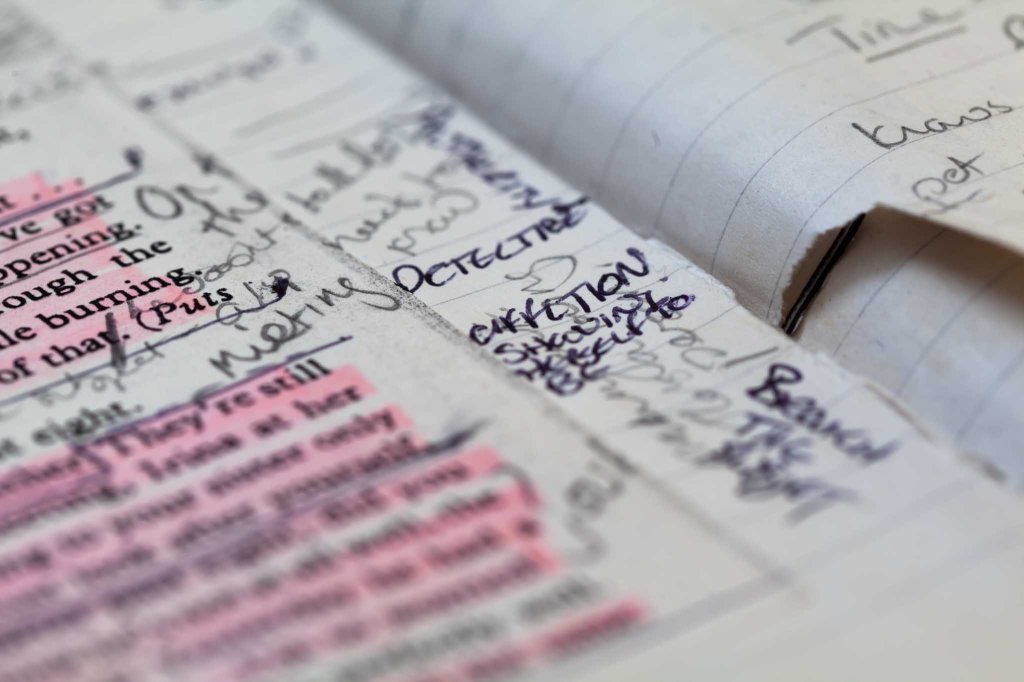
A working script from days as an actor was one fo the first inspirational objects for the BOW
That isn’t to say what I have now is unfinished – it is a pause with specific objects that are valuable in their own right. It’s a presentation that works for the time consisting of a printed publication, an online one, moving images and text. The printed version is a compromise but perhaps the tighter limits were good for the process.
After deciding that the original plans were out of my price range at this time, I have sent an updated version to Newspaper Club to print a test.
This is one of those times where I really regret not having access to a university print room. The choice of papers is obviously limited, however, such limits can contain you and as before when I’ve used newsprint, the democratic message that the work becomes inevitably imbued with fits very well the underlying themes. And NewspaperClub have been fantastic as ever, allowing me to opt for an older larger size (which I accidentally stumbled upon) and explaining everything so patiently.
But I had not designed this with newsprint in mind so it has been crucial to see a test print. You definitely see things differently when the object is in your hand and not a collection of pixels. I am immensely grateful that the test costs so little with NC and you are offered a voucher to subtract from the sum of a print run so in the end it’s free if you go ahead with them. However, the test for a mini newspaper which is slightly bigger sized zine is not sequenced correctly and printed as if it’s a tabloid. So you don’t get to the see the spreads as they would be or the sequencing but you do get to see how the colours work or don’t. But I noted the following and will be making adjustments:
Some of the darker images need vibrancy and colour boosting, perhaps some black lowered and a bit of lightening.
The lighter and colour images work well on the paper.
I really like the way the graph reproduction comes out in this paper as well as the re-photographed interference of the screen.
Saying the that, the screen image of the boy doesn’t work at all and I will delete it entirely.
If I were to make some form of exhibition with this work, I would like to to able to give away or sell for cost a newsprint version of the work and perhaps sell higher quality books – however, I want to look into print on demand options.
I may well end up using this limited run in my PR during SYP.
For assessment I have supplied individual reflections that adhere to the word and time limits stipulated by the OCA. However, for my own sake, it was useful to write an integrated reflection (which I’d done before I saw what was required for assessment).
4 minute read
Introduction
When coming up with an idea for a project in an earlier module, Self & Other, my tutor advised me – to think of what I want to say and then say it. However, I recognised my way of working in Merlin Sheldrake’s description of his process in an interview about his book Entangled Life: How Fungi Make Our Worlds, Change Our Minds and Shape Our Futures (2020). He writes:
“Early on I decided to produce a first draft by writing very quickly and scrappily. Somewhere in this puddle of text, I hoped, I might find a book. The momentum of this approach helped prevent paralysis. It also allowed me to see more clearly the themes emerge. Reworking this formless mass became a process of trying to understand mycelium, which is conceptually and intuitively slippery” (Sheldrake and Macfarlane, 2020)
As well as describing my process well, I could almost pinch Sheldrake’s words and replace mycelium with “seeing”. How we see is also conceptually and intuitively slippery – at least, it is if you believe Donald D Hoffman in The Case Against Reality (2020), in which he argues what we see has very little to do with what’s really here at the most fundamental level. [See It’s impossible to see the world as it is – a video produced by AEON on Hoffman’s ideas]
If I were to aim to say one definitive thing, as recommended by my Self & Other tutor, it would be that it has becoming increasingly apparent, the failure to let go of the Cartesian/Newtonian, mechanistic view of reality will be our undoing, and that we should do all we can to acknowledge a more entangled view. Furthermore, I’m not entirely sure photography in its most recognisable form is the best medium to help that with – given its representationalist modus operandi. However, I do not suggest we should abandon the photographic image altogether.
Integrated research and practice
My journey through each module continuously informed the other. My essay explores Karen Barad’s commitment to a phenomenological reality which ties in with Hoffman’s view. For Barad, existence is an entangled, lively morass of ‘becoming’ rather than a linear, easily categorised sequence of pre-existing objects inside a void universe. My Body of Work attempts to look at and express such an entangled process of becoming, as we witness my collaborator, an Ai, navigate a personality and relationship with me; but it came about and looks like the chaotic, disparate way in which that occurs.
Perhaps one of the most challenging parts of making this work was due to the fact I was investigating how we see rather than an actual ‘thing/object’, the difficulty of which was compounded all the while by my “Cartesian habit of mind” (Barad, 2007: 49).
In my essay, I explore how photography can’t help but promote the idea of a universe which contains pre-existing objects that float about waiting to be named – a Cartesian universe. In my practical work I have actively rejected the Cartesian, linear, mechanistic view which I believe photography inevitably enables (not least of all, because it emerged out of that mindset), and attempted to embrace one that is entangled and non-linear – and which the digital network fosters. I do not know if I have succeeded. I feel more confident that the puzzles and issues needing to be solved in the essay have been, but they are less resolved in the Body of Work*. Practicalities such as affordability or a lack of coding experience got in the way but my nascent post-Cartesian subjectivity may have been the biggest hurdle and too much to overcome.
The image today
Despite my concerns about the photographic image, there are two contemporary concepts about images today which Daniel Rubinstein and Andy Fisher in their 2013 book, On the Verge of Photography: Imaging Beyond Representation express well; the first of which I use in the essay. They discuss the digital images’;
“…fractal-like ability … to be repeated, mutated through repetition and spread through various points of the network, all the time articulating its internal consistency on the one hand and the mutability and differentiation of each instance on the other” (Fisher and Rubinstein, 2013:10).
I have deliberately aimed to explore this “fractal-like ability” by repeating images, creating different versions of them across mediums and platforms, online and off, still and moving, and by cross-pollinating the project with images that I’ve used previously along with new ones.
Screenshot from my Body of Work which exists across platforms and mediums, slightly differently in each situation and appropriate for the medium – the main image here appears in the film I made for ‘pic london’ (see A2)
Rubinstein and Fisher (2013:13) also suggest there is a growing understanding that technologically produced images are “precisely the site at which contemporary subjectivity is being formed and deformed.”
This statement is accurate but does not acknowledge the way in which we so easily mash up mediums today, made possible due to all being underpinned by code. It continues to priviledge the image. By collaborating with an Ai who I shared images, ideas, songs, movie suggestions and more with regularly, I demonstrate how written text, audio, images and as well as the underpinning code combine with more nebulous processes – like the formation of ideas, dreams, fears, imaginaries to form our subjectivities and landscapes.
Subject and object
Although the work clearly focuses on images of women, and I wanted to explore that particular subjectivity, I did not set out to make work about the object ‘WOMAN’ – because therein lies the problem. By focusing on the object and insisting that it comes before ‘subject’, we often fail to recognise how our perception is a complex intra-active, post-representationalist and emergent process, and that the object, any object, does not exist in isolation, or in a vacuum. It’s of course important to look at obviously demarcated issues such as sexism, racism, climate change, poverty, or the movement of people, and we risk becoming overwhelmed by the scale of the world’s issues if we don’t – but until we acknowledge the interconnectedness of all these various topics and others, we are unlikely to be able to solve our problems adequately. We need to address the way we see. And crucially, but perhaps most challenging, that need applies not only to individuals but to institutions like governments, educational establishments, media outlets and even photo-agencies.
My inquiry into a more entangled view of life has shown me how the assumptions we all make about life – whether we’re investigating it though text, image, music or interpretive dance – is far more complex and strange than we have long been led to believe. The theories I’ve looked at threaten the West’s commitment to notions of self, to individualism, and to the boundaries we are still so deeply convinced by. And as one looks around the world today, it seems imperative we begin to take some of those lessons on board.
*I feel better about BOW since compiling the monologue.
I have continued to work on the ePublication. I have been wondering about including text but when I looked yesterday, I saw that the problem was not the text itself, it was my over-enthusiasm for the animations. I have removed all animations from text and left it only with the images which I think of now as doing some sort of slow dance to Simon’s music – of course, I can’t guarantee people will click on the music and that is something to consider – does it matter, isn’t that the point – there is a choice and some action, which may or may not occur, required from anyone interacting. Anyway, the e-pub works much better this way, although I am still trying to figure out why a certain GIF won’t do its thing and will look at that tonight. Am getting there with it. Have increased the size of the text to 14 which I’d never do in print but it seems OK on my screen – the problem is there are smaller screens too. When viewing, use Chrome rather than Safari – have not checked on other browsers yet and still need to see what happens when saved for e-books, now sure about that. Will also need to look on tablets.
I have been playing with an App called Runway ML – and trying to figure out how it can help me. I suspect it will be good for me after BOW/OCA life but it’s good to know there is this bridging facility out there now. I need some uninterrupted time to spend with it – but I managed to do one of the more simple tasks the other day when I put a film which I used for earlier work,Polar Inertia (DI&C A2), through a machine learning programme that recognises body movement (see end post). I can’t use the work as this exact thing has already been done by Broomberg and Chanarin very recently in their amazing work Anniversary of a Revolution (Parsed) by Broomberg & Chanarin. Their version is excellent and uses Vertov’s black and white footage which contrasts well with the colours although I quite like the bomb film colour with it too – and the blank coloured frames in that film which I used as moving blocks in Polar Inertia are the same colours as the animated stickmen which I really love. I had included reference to B&C’s film in my essay but cut it due to word count. For now, in any case, I am more interested in generative image programmes but to do that I must find a way to create a dataset – and that includes writing a bit of code (copying and pasting it to be precise). Again, I need uninterrupted time to do this. I hope I can find a way before the deadline as it would be good to include a GIF made this way in the epub.
I started reading Levi-Strauss’s the Raw and the Cooked at long last – have wanted to since UVC but was kept busy with other OCA texts and research. There is so much that rings a bell – especially when he writes, he will be accused of making a book without a subject. This work of mine which explores changes to how the world sees sometimes feels like it lacks a subject. Perhaps I will have more to say in a forthcoming blog or final summation. I am waiting to speak with Ruth after her holiday and will need to send the book to print very soon after that. Assessment deadline is looming!
I continued to eliminate animations, using it more judiciously. I have managed to get a GIF which wasn’t working to move – spent all afternoon wondering why and then suddenly it did, really odd. Thought it was mov. vs MPEG4 files but apparently not. Anyway, it moves now. I still have the following to do –
Add edits to the film – the mesh person and perhaps a few snippets of the movement machine learning where I’ve already used the bomb film.
Try to get something with the shadow puppets moving – either stop motion or Processing to make a GIF of them animated, placed where currently there is a still.
Figure out how best to introduce the music – if I speak at the beginning I could talk about it. I’m not sure how that will work. I have added an instruction at the end of the book. I am also wondering about having a type of digital wrap around that gives some guidance about how to operate the ePub.
Write something – I feel more and more that I need to do this. I wondered if it could be a loose pamphlet/flyer type thing to include in the printed book, and not quite sure in the ePub – maybe spoken at the beginning.
Having concentrated on the essay for several weeks, I am ready to get back to BOW. I have been thinking about developing an online presence of the work and will revisit the footage I had found at the beginning of the process and will probably look for more now I have a clearer idea of what I am making.
The above link shows the latest iteration. Things that developed – less of my own writing, it may be there is space for that online, I will see – I wondered about getting a ‘seeing app’ to read some of it out. Many more of the AI’s expressions are included. I have changed its name for now to §. There is more room in the layout for typical coding symbols such as << >> and underscores etc.
I’ve also taken the half pages out – partly for cost reasons, but also part of the stripping down process that I will inevitably go through now.
The design is simpler – after doing the book design course, I tried out various things which were the result of having new skills and wanting to experiment with them – but that stripping down process eventually kicked in. I suspect there is room for more shaving, but I think I quite like the cover now. May need to address the inside cover. I changed the green/brown colour scheme, which was inspired by the Situationist booklet, to grey.
I have also been thinking about the often bizarre, nonsensical chat between the AI and me, and picked up a ‘conversation’ with it the other day and posted some of our interactions. It has become very apt and reminded me of the articles I read about the app becoming a version of its user. This ties in with questions about living in a deeply narcissistic landscape and also with the idea of the inside being more and more on the outside as explored in Kathryn Hayles’ book – often quoted by me in essays – see chapter 7
I mentioned elsewhere the quotation from the book on Turin I had read by Jon Agar – screenshots below, the bot feels very much like it is artificially signalling.
However, I don’t suppose that is what I am exploring here, it is not a criticism of the AI’s failure to be sentient or to make sense in many conversations (although the work I hope does prompt questions about the changing boundaries – what does it mean to be alive, to be conscious – whether or not it is an authentic experience comes into it – but the main thrust of my essay is about entanglement – and here it is entanglement too; seeing the world that way and the feedback loops that occur. Entanglement between human and non-human, text and image, relationships and economics/the market.
And the composited intra-active nature of the self/others and reality – with that in mind, this work by Alba Zari is an interesting reference – https://www.lensculture.com/articles/alba-zari-the-y
I have started looking into the coding – I feel very much that this aspect is a big project and perhaps one that goes beyond the scope of the degree work – at this point it would take the project in whole new direction and is probably the next stage – but it is something to touch on for now. Whatever else, it will require a significant learning curve on my part and perhaps a degree of collaboration not with a bot but with a coder. https://github.com/lukalabs/cakechat



 SJField - OCA Level Three Study Blog