Yesterday I had a meeting with Ruth online and this morning I have added to the feedback form and sent it over to her.
An abbreviated version below:
The film demonstrates technical and visual skills, and imaginative handling of the found footage to draw out its haptic qualities and communicate a critical re-reading of the material. The three sections ‘verses’ have distinct atmospheres. Overall sense of the film: it could be much shorter and thereby allow the viewer to be swept up in the whirl of the imagery and music but not start figuring out what is going on. The length somewhat detracts from the open-endedness of the film, and suggests a potential narrative. Let’s discuss this, along with choice of film, precedents (similar/related work); rhythms (from sound and visual edits such as speed, image manipulation etc.)
Before meeting for an online tutorial, I sent Ruth a blog post (password protected, available on request or supplied for assessment) which explained why even though I agreed in the main with her about the film, I felt reworking Sirens was impractical and undesirable. I have been working on another collaborative project and suggested submitting the results (or a part of them) for the A1.2 and sent some work in progress. I can see that the course wants us to be prepared for reworking projects as part of an ongoing process. But I have often done this in any case during my time with the OCA and either do so or sometimes choose not to, moving on to something new instead or ditching previous ideas/work altogether and starting again from scratch. So accepting feedback and reworking is not unknown to me. We agreed in the end that Sirens had been a good stepping-stone but that my time would be better used moving forward with the next project.
Extra information which I’ve not talked about on the feedback form
Ruth and I agreed that submitting the Pic London work will be the best use of my time. I had shared some Work in Progress.
A film
A set of stills taken in the village I was in Italy (some of which are in the film at the moment – WIP – so who knows if they’ll stay)
A poem I wrote while making and thinking about this work. The poem will be in a booklet accompanying the installation made by the Pic London group and is a research document rather than a catalogue.
Ruth said as the film stood now she couldn’t make sense of it. But that she thought the poem was strong. I ended the session ready to ditch the film altogether but that feeling had dissipated by the end of the day. The film is important but needs more work. I try to remind myself of Adam Curtis’s comment about showing unfinished work. “I just think it’s incredibly risky to show stuff early on when you’re trying to combine, say, two or three different narratives together to make a bigger point. It’s so easy to get it wrong. Because you can see it in your brain, but they don’t know your brain.” (2018)
However, it was great to have such positive feedback about the writing and I have been thinking about how I might show it outside the book, if at all. Ruth suggested submitting that part for A1.2.
I think the best thing to do is forge ahead thinking in terms of the exhibition and then think about which elements I submit to the OCA, if not all of it. One thing Ruth said which struck a chord was that there will be a lot of work at the venue, and it will be like a graduate show which I have thought before too. How do I make sure my work doesn’t get drowned out? Maybe I can’t ensure it doesn’t but presenting something striking but simple is one possible way of addressing this. The writing could potentially work, as it’s full of visual imagery but isn’t an image.
When I responded to the call out for collaborators to work on projects under the banner of the OCA New Music Collective, I had no intention of using any work made for BOW/CS or L3. Rather, I saw it as an opportunity to experiment with original music but I also wanted to continue my ongoing investigations into imagery and its affect on us. Additionally, as I’ve done in previous projects, I hoped to explore the transitional structural state I believe we are experiencing today, by comparing and investigating how we respond to various media, i.e. sound, imagery, text (if at all possible). I was assigned to a composing student who I will refer to on my blogs simply as Emma, at her request. We began our journey together about three or four months ago.
Lately, I have been working more and more with moving image, and with appropriated found footage influenced by work I looked at during Digital Image & Culture, so it felt natural to keep heading in the same direction. Unlike my DI&C film Origin of the Common-Place, however, the work I made for the NMC does not contain still images, so I was a little concerned it might not be appropriate for BOW A1. However, after liaising with my tutor, Ruth, I felt that the work demonstrates where ‘I’m at’ for now, better than a set of random still images might. It also deals with some of the themes I identified in my proposal – ‘the language of actresses and fairy tales’ although as I pointed out in my email to Ruth, in this case myth might be a better word.
Although I did not originally intend to submit this work, I did, however, keep a record of of development and reflection on my Sketchbook blog. (Once I’m back in London, if I’ve not had a chance to do so beforehand, I will transfer some of these notes to the correct menu on this blog.)
Film
The film was shown to a group of OCA students and tutors on 20 June 2019 at Toynbee Hall. An improvised live ‘choir’ (volunteers I cop-opted from the NMC) joined in during the final section. The following text was not shared with the group and I am not certain how much of it would be needed by an audience – or if some of it is merely a part of my own private background work. The indented paragraph is probably a draft statement and the following text a description for study purposes.
Voyage to the Planet of Prehistoric Women is a 1967 film about a journey to Venus where a group of intrepid male astronauts encounter a host of dangers in the form of a crash, a range of monsters and a band of sirens. Despite being about a world inhabited by women lasting nearly one and a half hours, the film contains roughly eleven minutes of footage where the women appear alone. That increases to just under twenty minutes if you include scenes where the women carry a dead fishy creature or appear alongside impending disasters or monsters.
This re-imagined film is a journey through time and a sample of the visual representation of sirens.
Sirens is a visual and audio poem which consists of three verses, and the entire length amounts to roughly the same time given to the women themselves in the original film.
Verse 1 contains the original film, sped up.
Verse 2 A version of the footage, containing the women, is reversed and blended with a negative copy of itself.
Verse 3 is a further representation of the women modified by a proprietary app and will be accompanied by a series of live vocal improvisations as we attempt to bring the sirens to life in the present.
I have discussed this film in my first Contextual Studies essay.
Live voice
When Emma and I showed the work we included a live improvised choir of the Sirens based on the sort of exercises devised by Pauline Oliveros which she calls Sonic Meditations. I wrote on my Sketchbook:
“While developing our film I had the thought that it would be great to introduce human voices in the final section but we did not have the time to write for and organise a choir. I had recently done some improvisation games with the Pic London group, which were very much like the ones I spent three years doing while at drama school (1991-94). Although I have not acted in some years now, the skills – I have recently learned – are still embedded within me; and improvisation and performance seem to be a language I am relatively fluent in. Revisiting has felt like a wonderful ‘awakening’ and these experiences are encouraging me to keep heading in this direction. I suggested to Emma we try out the improvised vocal games with volunteers, to see how that goes, and she was open to the idea.” (2019)
The improvisation went well and was effective as described in my post. What’s more, from a personal point of view, it feels like a significant step towards literally using my own voice in my work, and perhaps reflecting the more metaphorical meaning too, i.e. finding my voice.
Collaboration
The collaboration was not an immediate easy one, as Emma will no doubt also admit. We are quite different people with different backgrounds. I have talked about this a bit more on my other blog. I am very grateful to Emma for the extremely suitable and excellent music she wrote in the end. But I think will need to develop my communication skills and be more confident with my intentions – plus understand that I might be coming from a very different place to new collaborators initially. However, I approached the project with the expectation that we would really collaborate from scratch and I wouldn’t simply give instructions about the sort of music a finished project might require. We got there in the end but I think Emma was expecting me to work in a more traditional way.
Earlier versions – some of which are quite rough indeed:
Other slightly removed BOW work
As well as working on this project, I have been slowly writing very short fragments of short stories. I am not sure yet whether these will ultimately develop into something usable or not. But I felt they were worth recording as possible BOW work on my Sketchbook blog and I do intend to keep writing them as they keep popping into my mind.
Reflection
Demonstration of technical and visual skills
I always find it a bit tricky to write about this, as with this sort of work I am deliberately looking for the sort of artifacts in the found footage that modern photography does its best to avoid. I did manage to do some work in Premier Pro after fixing a long standing issue with my desktop and software, although in the end, for the sake of time, I edited it mostly on my phone and in iMovie. I suspect previous editing experiments have paid off as I become more fluid with the technology I do manage to use.
Quality of Outcome
The early experiments were a bit limited and it wasn’t until I felt slightly panicked as described in my notes that I found a way to make this project work visually. The middle section where I blended backward moving film with negative layer of itself went a long way towards bringing the film up a level.
Demonstration of creativity
This work is original and perhaps challenging for people who are looking for straight photographs, especially as I deliberately challenge notions of taste and simplicity, and by using proprietary apps – hopefully referencing apps such as Snapchat, filters, and the coded language used everyday by regular people. However, I hope to continue finding new ways to explore the subjects and themes I am interested in, and that may well lead me back to using my camera in a traditional way.
Context
The notes I have made in the coursework are probably at a good enough level for this stage in the course. This work does link to the concerns I discussed in both BOW and CS.
I just loved getting involved with old images during Digital Image & Culture. I am not sure I was doing it for the same reasons many other artists seem to – Nicky Bird is mentioned in the course folder and we are told she is concerned with social histories. OCA alumni and my friend John Umney is interrogating memory through family archive. Joachim Schmid is “concerned with the visual ecology’ in a world where we are inundated with new images by the second which according to him leaves us “ignorant but much more confused” (Fontcuberta, 172) He often uses images which have been left out of any archive, found, individuals he may have bought at market, or images discovered in job lots. He adds that the “production of images” should no longer concern us after 100 years of image-making, but rather the way they are used.
For DIAC A4/5 I used mainly moving images from a website called Archive.org – and see this as a response to the archive too. The internet is one giant archive – modern technology is based on archiving. Vast databases sit behind our screens and on the cloud, in huge computers which support the web, facilitating modernity. Archiving is a fundamentally human activity which supports civilisation and everything that stems from that practice. It becomes more and more adept, widespread and controlling as humanity develops. When I respond to the archive I am trying to figure out how meaning enters our language, and how power equates to the signified. Bringing that down to the most simple terms – why is it my words carry so little weight but a lying lunatic or a mega-company wield so much power? Why is the language we use so unstable right now?
Responding to the archive nearly always comes across as conceptual and I will address this under the relevant heading at the bottom of the page.
I gave a (slightly too grown-up – it was OK they loved it and made great pictures) workshop to some eleven-year-olds recently about the practice of re-using images. As I told them, the artists we looked at and the ones mentioned above are all doing something similar even if they individually state they are focused on a variety of different issues. Each of them is disrupting the usual value system. We live in a world where the production of stuff must continue. In order to sustain the economic system which upholds our world, things must be made and value must be apportioned where the advertisers dictate. When an artist rifles through a market or discovered an old archive in the attic or found an image on the street and turned it into ‘art’, they are saying no to the dominant system which insists the value of something emerges out of symbols it has established and owns – in Flusser’s terms – handed down from the all-governing apparatus, the capitalist system.
As I said in my blog about the workshop for eleven-year-olds, I enjoy sharing my developing knowledge with others regardless of their age as it helps me to consolidate my own learning and make connections. One of the things I talked about with the children was waste products and how we as a society view ‘waste’; not only commercial production waste but our own. Mention of ‘poo’ and ‘pee’ got them laughing and perhaps this is why they enjoyed it – but it is a serious point. Duchamp’s use of the porcelain urinal is not a random object. It is a powerful signifier that represents a new world, one where factories are available to mass-produce porcelain products which we humans will use to collect and manage (and sometimes store) the increased levels of waste products we produce*; increased as mass-production, along with other related factors such as a stable climate (now no more), and which enabled and exponentially increased population. Hence more human waste. What to do with it all? And with all our after-effects – pollution? There is an ongoing feedback loop between production, waste, and population growth which exists within a system that is related to a range of other greater and less dominant systems. I am not sure I would have seen this looping quite so patently had I not done the workshop. And so, I am grateful to the eleven-year-olds for indulging me. (I have had several very positive comments from teachers, parents, and children so despite the fact the work I shared may have been a little too sophisticated for such young children they loved it anyway.) And so, artists who disrupt our value system – and highlight their own individual concerns along the way – are helping us to challenge the advertisers, or those managing the apparatus. They are the experimental photographers Flusser tells us we need. (2000)
I really like the passage in the course folder about John Tagg included in CS1. The course author writes, “The other narrative Tagg refers to are exemplified by ‘feminist’ and ‘socialist’ histories of photography, which he sees as equally problematic insofar they continue to overlook various institutions and social contexts in which photographs are made.” (Alexander, 2013, p18) Critical thinkers, artists or scientists from a range of disciplines need to adopt a systemic view. It will become more and more important. We cannot continue to look at anything in isolation because the causes and effects we all live with are inter-related. It seems like this fact is one of the most pressing messages to get across because bizarrely there are still far too many people in charge (teachers, politicians, business people) who haven’t caught up. Working with old images, investigating archival material, is perhaps one way of making this point – regardless of what the ‘issue’ at the forefront of any work might seem to be.
Changing the way we perceive is happening regardless, and this is examined in various books about systems theory. However, the following passage from an article on systems and changed perceptions is useful; “Einstein’s widely quoted advice that “we cannot solve our problems with the same thinking we used when we created them” seems more appropriate than ever. We are dealing with the complexity of a profound societal change and the transition towards diverse regenerative cultures as manifestations of not only a different way of being in the world, but also a different way of seeing the world.” (Wahl, 2017)
Finally, on another note, as I was playing with old images in photoshop during DI&C, it amused me to revisit comments I’d made during UVC about tampering with older artworks. I felt it was ‘extreme arrogance’ for Clement Greenberg to have tampered with his late friend’s art. “However, a quick Google search on Greenberg reveals that he worked with several artists, two of whose work, after their deaths, he changed and adjusted,[2] altering lines and even removing paint from sculptor David Smith’s work claiming that he was not an important colourist, so it didn’t matter.” Looking back, it seems the reasoning is arrogant but the act might be more complex. Context is everything though and nowadays I suspect I’d look to this more closely before condemning him. Anyway, I have tampered with and adjusted plenty of old images – and often wonder if this is more palatable since the images are anonymous. What would happen if I did the same with a Berenice Abbot print I own? Is it less or more acceptable if I scan the image and don’t ‘damage’ the print? Does the gesture carry less weight if I scan it even though I am playing with scans (being one of several ‘after photography’ tools)?
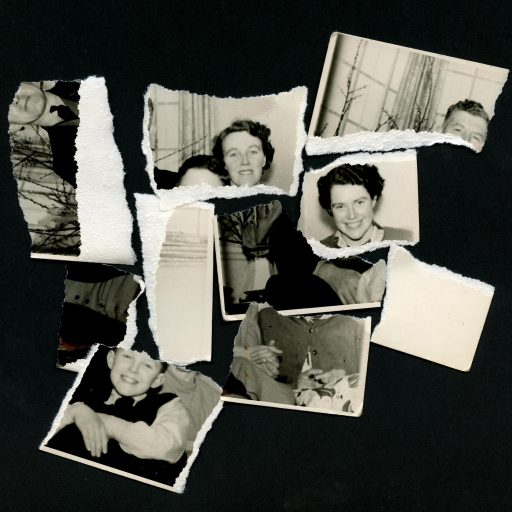
One of the many images I started playing with after scanning and taking through Photoshop during DI&C. The act of turning the analogue image into digital data that can be easily manipulated is more important to me here than the original signified content.Another scanning experiment’s
Psychogeography
I feel like this is the least accessible genre for me. It requires ample time and space (which is often accompanied with some form of private income) for a photographer to devote to wandering around observing the way our landscape is shaped in the way the original fläneurs will have done. (Do people, in fact, refer to this sort of work as urban landscape photography.) And my time is not my own. It’s hard enough fitting my photography in unless as it is and I know that the idea of the fläneur has attracted some feminist criticism. So, I do feel a sense of ambivalence about it really, given the original intention may have been a reaction against capitalism. I wrote about it during UVC and had quite a good conversation with other students too here.
I have also been really quite taken with the Situationists ideology, along with Guy Debord’s written work, and have referenced them constantly throughout the course. But here again, I must admit, while I don’t agree, I do have a smattering of sympathy for Scroton’s defensive reaction towards the ‘middle-class anarchists’ he thinks saw in the Paris ’68 riots. The people at the very bottom, the most down-trodden, (perhaps not in France but in England it does feel this way) those who struggle the most to stay alive in the world have no time for such outbursts. Simply being is too exhausting. Too challenging. There may be little or no time or energy for protests of any description be it via photography, thinking about using less plastic, worrying about middle-class mores in relation to child-rearing or anything else other than surviving and keeping one’s kids alive. Of course, many would argue that this is intentional on behalf of those in power, and all the more reason to find ways to fight it. Even so, wandering about the planet taking lovely photographs all the while claiming you’re querying capitalism’s horror can seem like quite an extraordinary privileged lack of awareness, as fellow photographer John Umney commented; “Interesting: You touched an many themes why I don’t care for the concept of Flaneurism. It was, and perhaps still is, a bourgeois pursuit – who else had the time or capacity for ambling? Certainly not the great unwashed who were busy being busy earning a crust – see later ideas from Benjamin.. And echoed again when you talk about not having access to education AND not being male. Women simply didn’t idly amble in the 19th century, and today psychogeographers are, in the vast majority, loaded with testosterone – absenting oestrogen from the discourse… I could go on…” (2016)
I’d say the street photography I used to do a lot of (despite the limits – having my phone camera certainly helped) sometimes fits in with this genre. Here’s one I took recently on my phone which I imagine fits the genre in some ways. I have stopped doing this type of photography for so many reasons, but perhaps I just ran out of energy as I focused on making other sorts of work
Given the UVC blog and the student comments below, I will move on now to conceptualism which I have combined with genre-hopping because for me conceptualism takes on many forms.
Conceptual photography and Genre Hopping
Although my work has been very much rooted in personal journeys and at times in fictional autobiography, it is also more and more, flirting with conceptualism. It’s true, the term is nebulous and means different things to people. For some, it’s simply about black and white documentary images of 70s performance art and that’s it. But in my mind, all photography should be conceptual, which is echoed in the folder. However, I don’t really see the necessity for the slight dig in the course folder, “that needn’t mean there’s no room for aesthetics.” (If one was going to say that, why not in the psychogeography section where so much photography is quite dry indeed and has specific (as John said testosterone-laden) narrow appeal?) If the black and white photography from the 70s shadow still has any value, then it might be because conceptual art has had such a profound impact across disciplines since, including photography. Art which is embedded first and foremost in ideas, and where then the medium is almost secondary to that, is everywhere. As the Conceptual Art in Britain (1964-79) exhibition book introduction tells us, it “changed the priorities of art”… “these moves took place within a wider landscape of art”. (2016) Idea art which queries our humanity, culture and institutions are more necessary for our society nowadays than painted religious scenes for instance. I wrote in the CS section, “.. like the evolving nature of gods and God as civilisation develops, what we need from art changes too. And conceptualism rather than dogmatic religious iconography is clearly more relevant today as the nature of reality is unpicked and newly understood.” (2019)
I’m not sure what the first Source video tells us, other than it might be a terrible faux-pax to describe one’s photography as conceptual. However, I would imagine the term tells people something about that sort of work they can expect. I also think that photography students who venture away from pure photography (like myself and others) are exploring other avenues of ‘art’ that are less defined, and in which ideas are often the initial medium – if not the form. That’s not to say the photography purists don’t have ideas too.
As I mentioned in yesterday’s post, I am not entirely comfortable relying on narratives which don’t belong to me for work. It feels a little like I would be commodifying other people’s issues and when it is my own children’s issues, in particular, that feels really wrong, although I do admit to skirting the boundaries of my moral compass.
During DI&C A4/5 I identified the word ‘deviance’. I did not consciously choose the word but came upon it as I delved further into a hotchpotch of ideas and sketches I was making. I eventually connected the word to one of my children who has always been slightly left of field and is currently causing me a good deal of worry. (Along with others in my life, perhaps including me.) There is a multitude of possible reasons for this and some of them might be neurological while others, the result of experiences he’s gone through. One way of coming to terms with this would be to make a documentary piece about him or my reaction to some of his unfolding behaviour. But that feels so completely out of order. I do not like the way reality TV and then social media have encouraged us to reveal every last detail about ourselves to strangers. Awful cheap TV which preys on troubled children’s’ behaviour and struggling families (often produced by Oxbridge educated television makers) for the nation to watch and judge have caused untold harm to individuals.
Sylvère Lotringer discusses this ‘overexposure’ and links it to a perversity in our culture which he also connects with capitalism. I tend to agree. An argument against my stance might be that it would be useful for other parents to hear about my struggles with my son. But I sense this is an excuse for social prurience which has been normalised in society. People ‘get off’ on others’ difficulties as it removes them from their own.
However, as someone who creates to make sense of the world, I still want to explore. Making work for which the term conceptual might make sense helps me to overcome the dilemma. It also stops the work from being overly inward-looking and self-referential. In other words, it has the potential to be more universal – as the work I made operated on several levels as it looked at growth, transformation, and language including structuralism. A risk of working this way is that it might hide the ‘me’ that is interesting in any project (as the truthful ‘me’ of anyone is always valuable and worth sharing – I use the word truthful with trepidation. It has such connotations in post-modern art circles and completely different to those in acting parlance.)
For DI&C I appropriated several films and made a new one by re-editing them in a way that told an abstract story relevant to me, referencing Barthes “tissue of quotations”. The refusal to be bound by strict narrative norms also leave meaning wide open, as favoured by the director, Robert Wilson and discussed here. ““I try to open up, not narrow down meaning“. And “The gaps between the fragments are larger than the fragments, giving the spectator who wants a story acres of empty space in which to construct one… Wilson privileges formal patterns; he foregrounds spacial and temporal not narrative, structure.” (1996 – my italics) I will continue to pursue this strategy.
Finally, projects which respond to the archive (any archive) often ‘look’ conceptual and I note that John Stezaker is listed as a reference on the Source page we are instructed to view. David Bate and Mark Powell seem like purist photographers. Gossip tells me that Bate does not encourage anything outside the frame in final shows at Westminster. Even so, their practice seems highly conceptual to me. The ideas driving them are very definite. They’re not simply making pretty pictures. However, if I were to describe Polly Borland, who is certainly a photographer as conceptual, I imagine people would take on board that the work might include more than ‘straight’ photographs and perhaps be a bit ‘weird’. Cindy Sherman is certainly a conceptual artist but she is also a performer who uses photography as her medium. Joan Jonas is a conceptual performance artist who uses a range of mediums in her practice including still photography and moving image but much, much more besides. Interestingly she came from a sculpting background and enjoyed performance which she needed to record and document. She is far removed from the purist photographers who can come across as quite po-faced about anything outside their own medium. As someone who was once an actor, I am not sure where I am situated just now and have used this course to experiment widely (and perhaps wildly). When I consider what might come after this course, I am not only thinking about photography MAs but others too more along the line of Creative Arts.
Refs:
Fontcurberta, J. 2014 Pandora’s Camera, Photogr@phy After Photography, Mack
Flusser, V. (2000) Towards a Philosophy of Photography Trans. Mathews A. (Kindle Edition) London: Reacktion Books
Tate, 2016. Conceptual Art in Britain 1964-79, London, Tate
Holmberg, A, 1996 Directors in Perspective, The Theatre of Robert Wilson, Cambridge Press, Cambridge.
If there is any validity in Maya Deren’s advice to film-makers that they are better off embracing what the medium of film offers instead of trying to emulate theatrical tropes, (and I think there is), I wonder too if it’s worth thinking about applying the same advice to still photography in relation to cinema or painting. As I write this, however, I remind myself I also believe we shouldn’t limit ourselves by the fixed boundaries we place around ideas and concepts. I’m also loathed to sound like the deeply conservative Roger Scruton in his essay Photography and Representation in The Aesthetic Understanding: Essays in the Philosophy of Art and Culture (1983), as part of the thinking I’m highlighting here is the way still photography can reveal something accidentally or unintentionally in the split second that the frame is made. Of course, painting can also do that over a longer time frame too – the artist paints or draws and when a viewer looks at the result, they might perceive something the original artist had no intention of revealing about themselves or saying, or they might impose a new meaning onto it. Signification has plasticity in any medium, depending on context and who engages with the signifier, regardless of form.
Gregory Crewdson’s work, in particular, however, often makes me wonder why he didn’t just make a short film instead. At the same time, his work harks back to painting, especially Edward Hopper scenes, only Hopper’s work doesn’t carry the same sense of contrivance as Crewesdon’s expensive and highly processed work.
If one is going to create a fictional scene using still photography, then really taking an idea as far to the edge as possible is more understandable (for me at any rate). Joel Peter Witkin and Les Krim seem to take what advertising aims to do, which is construct a scene that presents a version of reality, then they push it into a place which demonstrates it is completely made up, and therefore highlight how that is how it is with all images. And so, whether you ‘like’ what they create or not, there is a sense of having made a statement about our vision of reality. In my opinion, Crewdson’s work does not do this despite the fact there is always much in the press about his very expensive and elaborate process. Given how much money he spends and can presumably get hold of, and it might seem a bit harsh to say, why not make a film instead? Photographers do go on to become filmmakers and their visual fluency often shows, such as Wim Wenders, Agnès Varda, or Stanley Kuberick.
In relation to moving-image, I recently saw Synecdoche by Charlie Kauffman and can see some visual similarities between Kauffman’s landscape and Crewesdon’s, however, the film’s presence made sense to me; it’s contemplation on the apparent pointlessness of existence narrated via bizarre motifs, such as the fact the character Hazel lives in a house which is always on fire – but only at the end of a long life does she die of smoke inhalation. Kauffman uses film and its relationship to time and temporality to play with this idea along with many others related in the narrative. Therefore film is the perfect medium for this work.
Crewdson also creates surreal realities and perhaps those are the ones that appeal to me more than the simpler Hopperesque scenes, even though I might feel tremendous sympathy for the state of alienation he seems to be exploring in an American landscape. As I write, I am reminded of another moving image work – this time television, which explores similar themes, Lodge 49 (2018) – i.e. alienation of the individual in our epoch. Perhaps all of this – my responses – relates to something I read about in the Paul Thulin article – and that is a frustration with the limits of language – in Crewdson’s work, for me anyway, the photographic image seems insufficient. Maybe I’ll change my mind in time as I have done with other work.
I do have some ideas I want to play with over the summer which would probably fit neatly into Tableaux, and in the past, I have made staged images, (TAOP A3 and S&O A5) but my own images (still and moving) are nearly always more likely to be situated within Personal Journeys and Fictional Autobiography. But, if I were to opt for more tableaux style images, I think I need to remember to play with pushing the boundaries of reality.
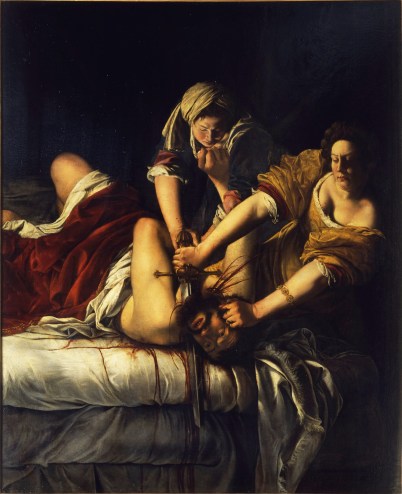
I can relate to this work of art, the chiaroscuro (something I emulate in photography), the story-telling and the reported story behind her painting it more than I can relate to Crewdson’s photographed images. Artemisia Gentileschi (1593-1653), Judith Beheading Holofernes (1620/21), w1625 x h1990 mm, Oil on canvas Source: https://artsandculture.google.com/asset/judith-and-holofernes/oQF3gDEYNkutBA?hl=en-GB
Personal Journeys and Fictional Autobiography
This is probably where I am most at home. But my own personal journey is not as gritty, exciting or exotic as some of the examples we are given in the course folder; Goldin, Mapplethorpe, Billingham. I know this shouldn’t matter – but of course, it’s hard not to feel it does. Nevertheless, there is a lot of drama in my life and as Kauffman’s film above demonstrates, we are all the main characters in our own drama – but making work about my dramas has limited appeal. That’s not to say I don’t use the things I experience to inform work. I just prefer to avoid what I – perhaps a bit impatiently and unkindly – refer to as ‘woe is me’ type documentary. Perhaps I will say more when discussing conceptual photography.
Larry Sultan’s Pictures from Home and Sally Mann’s lifelong work exploring her children and family were the earliest examples of work I was encouraged to look at, which is why I probably initially headed down that path. Even so, I feel quite ambivalent about continuing to do so. I continue to document my family life, sometimes candid, sometimes set-up and generally submit those type of images to photography competitions, or share them as they are the ones I feel people respond to, even though they are not in my mind the most interesting work I am making. But there are aspects of my own family story which belongs to the other people in it and they may not want me to bare their issues and problems with life online or in photographs – so I would always be quite wary and need to toe a personal line.
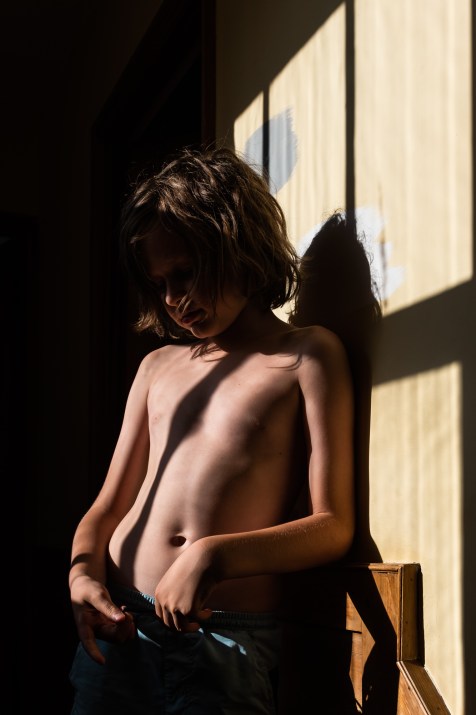
My Mother’s Name is Eve, 2014 (TAOP) heavily inlfuenced by Jennifer McClure.Alfie after the beach, Summer 2018 –
However, the boys and I will make some fictional work over the summer (if they want to which they claim to for now – well two of them do) which will no doubt be personal too. I may be influenced by the Random Short Story notes… or maybe not.
I will respond to the other genres mentioned in the folder in the next blog.



 SJField - OCA Level Three Study Blog