CS A5 research: White Supremacism and the Earth System – INSURGE intelligence – Medium

Been searching for a quotation to include that sums up the systemic changes I’m discussing in my essay. Found it here!

The US is on the brink of becoming a racist failed state. It is no accident that this terrible moment arrives in the midst of a global pandemic; an escalating economic crisis; an oil sector meltdown…
— Read on medium.com/insurge-intelligence/white-supremacism-and-the-earth-system-fa14e0ea6147

CS A5: Research, Fungi’s Lessons for Adapting to Life on a Damaged Planet | Literary Hub

Merlin Sheldrake’s new book Entangled Life looks at the complex world of fungi, its adaptive ability, and its interconnectedness with all other forms of life.
— Read on lithub.com/fungis-lessons-for-adapting-to-life-on-a-damaged-planet/

This book won’t be published in time for CS assessment deadline but this interview will have something useful, no doubt.

Artist: Kata Geible – Sysyphus (2018)

http://www.katageibl.com/sisyphus/

Emma P sent me a useful reference – which I may well include in CS and/or BOW context. Geibl, like me, has played with entangled narratives from different points in time/place to explore the construction of reality today – her work, however, seems aesthetically far more ‘grown-up’ than mine. However, there are key differences and the statement (for me) somehow detracts from the work as it reiterates ideas that are fast becoming old questions as technology and science continue to develop apace. Having attempted a statement, I am only too aware of how difficult it is to convey the complexity of an idea in a clear and concise way, and presumably, Geibl is writing in a foreign language here which must make it doubly difficult (I can barely explain myself in English and it’s my only language!). Geibl’s statement says,

“How we used to think about the world is changing radically every day. Religion is replaced by science, we are flooded by images every day, we want instant access to knowledge. Photography as a medium has the ability to capture everything that’s in front of the camera, the machinery sees even what the human eye is not capable of. We can see universes, stars exploding, microscopic worlds, atom bomb detonation with the safety of the far distance. Through these images, we think we can get closer to understand how the world is functioning without ever experiencing or seeing it through our own eyes.

In series Sisyphus, I constructed an imaginary laboratory where it’s up to the reader to decide where the line lies between fiction and reality without any scientific explanation.” (2018)

Some statements worth investigating in these rough-thinking-as-I-type notes:

  • ‘Photography as a medium has the ability to capture everything that’s in front of the camera’ – this could be accused of being a limited view of photography, one firmly connected to visual sight (I am aware many of my metaphors are too – so powerful within our culture is the idea of ‘sight’ dominating). Using code and AI, modern-day photography can creep around corners, peer beyond boundaries, make calculated guesses about things that are behind it, or the other side of a planet. It is no longer merely ‘photo’, light-based. The whole idea of ‘what we see’ vs. what is actually real is being investigated today – and Geibl creates a narrative which is suspicious of actors creating these untrustworthy realities. Traditional photography creates a boundary, in the same way painting also used to. It suggests the (limited) world is in front of the viewfinder and separate from it (rather than an entangled part of the process which leads the emergence of a manifestation we call ‘the view’)
  • ‘the machinary sees what the human eye is not capable of’ (sic) – this is true and not true at the same time. Old photography equipment has less of a spectrum than any biological eye, as does the rendering equipment (printers, screens). So it sees less than we do – but its limitations lead to realities that somehow see more than reality, a hyperreality, i.e. expressionistic outputs that add to reality. Modern seeing machines decode and recode our perception of reality which is necessarily limited so that we can comprehend it – some contemporary views suggest, we are myopic creatures that have evolved to see/experience only what we need to see/experience in order to continue mating and surviving. Or rather see/experience in a way that is useful for our survival. The notion of photography (especially traditional) is the ultimate manifestation of a fixed view, of what we see being actual reality. Modern technology undermines that. 
  • ‘We can see universes, stars exploding, microscopic worlds, atom bomb detonation with the safety of the far distance’ Am reminded of Virilio (often am when looking at modern tech and reality) and time and space being on top of each other, life sped up exponentially. Technology condenses and collapses perception of spacetime (?) at the same time as fragmenting it – separating us from parts of ourselves, scattering individualism, dissolving the lines that kept it in a certain place. Fiction and ‘reality’ are entangled.

Having said all that, I really like the work. Visually, for me at any rate, its interesting, intriguing and aesthetically appealing. The concept, closely related to mine, seems like it misses something crucial and remains tied to slightly predictable questions – “Who is manipulating us? We can’t trust photography, who can we trust? Our visual media is untrustworthy.”   Perhaps my own statement might say, “whether or not we can trust the things we see/experience to be true has in recent times very quickly become an irrelevant question. We all exist in an entanglement of varied realities  – your reality and mine can never the same, but there will be meeting points – intersections and nodes consisting of common threads.” (…. etc, and something else besides.)


CS & BOW A4: Notes re. connecting Bow to CS A5

Some notes made on my phone last night:

Structuralism = entanglement and intra-action of

  1. Language materials + architecture (code, print, architecture, web, tv, film, etc…)
  2. Mythology (which includes consumerism, politics, and religion)
  3. Media (institutions and organisations that use no.1)


  • Bow explores ‘the cut’ – essay’s main aim is to explore suggestions that Cartesian world view has become unhelpful. We’ve outgrown it. Barad’s work introduces concepts from quantum understanding that challenge Cartesian lens including the concept of the cut. It is arguable that photography often inadvertently propagates Cartesian view even when it claims to be addressing salient issues, for a variety of probable reasons – then look at ways this can be addressed.
  • Semantic analysis – page 83 Zuboff – ‘squeeze meaning’ out of users movements
  • ‘Brew’
  • Include in – Indeterminism section
    Page 85 Zuboff – surveillance capitalism “not an inherent result of tech or expression of information capitalism”
  • Have lost the word ad (advert) from a comment made by Ai and need to reintroduce it – important to include
  • Must include Barad’s explanation of how micro (quantum) and macro describe the same world – through a different lens – not two sperate worlds

A useful and extremely relevant article worth referring to:

https://witness.worldpressphoto.org/photojournalisms-first-century-79645873e363

CS A4: sections that have been cut

I want to record sections that I cut at the moment, in case I feel they need to be re-inserted in favour of other sections. (Some may already have been re-inserted or moved to different sections)

Two of these cut bits seem particularly relevant and have an impact on my BOW. Points 10 and 11 were really difficult to edit out and as I read through them now, I wonder if there is a way of reintroducing them. Orange needs to go back in some way:

  1. ‘Following the uptake of the term ‘intra-action’ by Haraway (2008: 17, with the concept underpinning her account of companion species) the term has obtained widespread currency in perspectives influenced by feminist STS (e.g. Latimer and Miele, 2013; Puig de la Bellacasa, 2011). Yet, as Haraway herself suggests, use of Barad’s terminology does not necessarily mean an ethical engagement with the ‘radical change Barad’s analysis demands’ (Hollins, 2015: 162, n.1).
  2. ‘Photographers’ practice is hostile to ideology. Ideology ….insist[s] on a single viewpoint thought to be perfect. Flusser 415
  3. Faced with Bloomberg and Chanarin’s Shirley Images, appropriated Kodak cards which appear at the beginning of The Image of Whiteness, edited by Daniel C. Blight, demonstrating ‘perfect exposure’ for white skin we should be alarmed. When we witness the capitalised ‘NORMAL’, we should be nothing less than horrified by its ignorance of that global leftover, but evidently much-continued colonialized mind-set. Kember and Zylinska’s urge us to see the ontology of photography as predominantly that of ‘becoming’ – an intra-active process of existence. The Shirley Images, as such, were not merely representative of a racist world, but rather a re-enforcer of it, a definer of ‘normality’. The performative action, not only of taking the image, but of disseminating it as some form of (most likely unconscious) propaganda to potential clients makes Kodak a collaborator of the dominant white, male ideological machine.
    In her essays Unlearning Decisive Moments of Photography Azoulay is asking us to make the connections between entangled actions elsewhere in time as well as place.
    While Modernism may have been the ‘relentless pursuit of a better future’ (Harvey, 1990), we should not only ask, better for who, but also look at the entangled production of ideas, goods and apparatus’ which have resulted in the current state of reality. A reality in which people with more melanin in their skin than Shirley get are being banished from their homes. Aside from its likely improbability, representationalism distances us from responsibility and a willingness or even an ability to conceive of alternative realities.

  4. ‘Realness’ we are reminded, does not imply ‘thingness’. (2007: 56)
  5. Summary of Chapter 1  Barad asks us to query long-assumed conceptual definitions, referencing quantum-based philosophy which potentially dissolves and continually re-configures past, current and future boundaries. Indeterminism exists at the heart of reality. We are asked to consider how, why and where we cut out the fabric of reality to create it? Gilles Deleuze’s writing similarly rejects traditional cuts that end in the separation of realms, and promotes the idea that everything in reality is in continual flux – the world is always ‘becoming’ – an intra-active dance of Virtual entities emerging and disappearing. And, as with Barad, there is a continual, lively, responsive relationship between discursive and material objects that form our reality. In Barad’s agential realism, meaning arises out of material and discursive practices[1], not as something imposed upon reality but rather from within and of it. It is emergent. For Deleuze too, there is no Utopian plane waiting to be represented. (We might trace this discussion back to Aristotle and the question of Forms – non-earthly perfect things that exist elsewhere, and reality – that which we actually live with).  However, before addressing representationalism, entanglement and diffraction will be introduced.
  6. First intro The January 2020 edition of Vogue Italia contained no photography. We were told this temporary rejection of the photograph demonstrated Vogue Italia’s commitment to the environmental movement. Considering the industry’s track record, which includes ominous links to slavery, a difficult relationship with women’s bodies and a cutthroat career path satirically expressed in The Devil Wears Prada (Weisberger, 2003), suggests being suspicious of their motivation is forgivable. The fashion industry is viewed by many as an ecological outlaw: the manufacture of synthetic fabrics which don’t decompose but instead turn to plastic waste along with elaborate advertising shoots requiring sizeable teams of people and objects travelling by air across the planet make it easy to see why. Entanglement between dubious business practices, social injustice, impossibly cheap must-have dresses and glossy magazine pages cannot be denied. But as photographers, we may shudder with alarm to see our medium side-lined, even if for only one issue, but we may also understand Vogue Italia’s intentions and its desire to be, or simply be seen, as responsible and responsive. If nothing else, it makes perfect marketing sense.This essay, however, is not about the fashion industry. Rather, it is about photography’s position in an interconnected world, which no longer seems to contain unrelated, disconnected objects, and instead feels more interrelated and than ever. It’s about the photograph and photography’s position within a contemporary perception of reality.  And as such, we should investigate whether there is something other than ecological virtuousness or best marketing practice underpinning the illustration-only issue of Vogue Italia.
  7. Barad and Deleuze each reject notions of dual reality planes, one represented and one waiting be represented (2007: 46); there is no Utopia or Hades, forms vs. reality is a distraction, mind and body are one. Barad condemns the ‘Cartesian habit of mind’ (ibid: 49) which reinforces such dualistic interpretations of reality. Deleuze critiques Plato and his cave. Subject-object distinction is fatally undermined by Bohr’s quantum philosophy, says Barad, as it ‘exposes a fundamental failure of representationalism’ which is explored in more detail in the next section. (2007: ??
  8. Segmentarity becomes fluidity Chapter 4In The Condition of Post Modernity, David Harvey describes the period after WWI when Modernity often expressed its idealistic hope in ‘machine-living’ (1989: 32). Deleuze and Guattari relied on the collective image of the machine, of segmented parts with interconnected possibilities. Segmentarity is a foreshadowing of intra-activity. In A Thousand Plateaus, they describe two types of segmentarity, one flexible, more readily associated with what they refer to as primitive social groups, a word they are evidently uncomfortable with, indicated by the inclusion of ‘so-called’. The opposite, rigid segmentarity, refers to the structural nature of modern state-societies (2012: 246). They suggest both these and other structural configurations are ‘entangled’ and ‘inseparable’. (ibid: 247)  We people, our machines, our institutions and social structures are interconnected. The pair includes Fernand Léger’s Men in Cities (1919) at the beginning of the section about segmentarity. It has similar structural implications to other cubists, namely Georges Braque whose Violin and Candlestick seemed reminiscent of experiments I made using an old film purchased from eBay and which I have, after further development, made into a fragment of matter and meaning, called When Tom shot Penelope, his perfect wife and their kids in 1971 to include my body of work.Figure 1 Men in the City (1919) is included at the top of Chapter 9, 1933: Micropolitics and Segmentarity by Deleuze and Guattari, in A Thousand Plateaus (2012)Figure 2 ‘When Tom shot Penelope, his perfect wife and their kids in 1971’: made by buying an old film from eBay, taking screenshots, then put through a Processing code to make a montaged moving image of overlaid entanglements which have also been stored as single frames, a selection of which I extracted for the book element of my body of work.

    We might compare the sense of their segmentarity so clearly defined in Cubist painting with the grotesque fluidity evident in Klingemann’s AI renderings, where there are no segmented lines between fragments With that in mind, we may ask, is photography the ultimate expression of a dualistic Western mind-set? Could photography with its ‘negative and positive’ only have emerged from a Cartesian habit of mind, which itself didn’t appear out of a vacuum, but was predicated on hundreds of years of dualistic culture, expressed in Plato’s forms vs. reality – illustrated in his cave, and which only allows for ‘true or false, winner and loser?’ (Baggini, 2018)

    Or is binary code, behind so many photographs today, its ultimate expression: if so, it is ironic that that dualistic code has come at the same time as unprecedented levels of fluidity., only a morass of weirdly formed data, of intra-active malleable elements. Furthermore, his work overrides the photograph’s denial of fluidity and connectivity, and its insistence of fixedness.

    Deleuze and Guattari’s response to the dominant ‘belief in ‘linear progress, absolute truths, and rational planning of ideal social orders, under standardised conditions of knowledge and productions’ (Harvey, 1989: 35) seems, understandably, not to fully envisage the utter fluidity of a post digital-explosion world. They are, however, adamant that one form of segmentarity is no better or worse than another (Adkin, 2015: loc 2594) which we would do well to take on board. And while they do of course begin to reference the digitised eye, and their term ‘flow’ appears to precede the fluidity of data: word segmentarity does not convey the sheer level of mutability allowed by coded data.

    Photography, segmentarity – and then the algorithm

    Although The Family of Man exhibition was meant to be a representation of holistic reconstruction and oneness – from a fragmented society to one more interconnected, the photographs maintain and reinforce evident top-down, boundaried, structural division – segmented. Today, in a different context, where some in the West have embarked on a long-overdue examination of the crimes and repercussions of Colonialism, The Family of Man is heavily critiqued for its, at best, unsophisticated, representation of non-western people, and at worst racist, colonial outlook. Although the fluidity we witness today can at times seem impossible, it is worth considering how it might be completely necessary in order to overhaul the categorisations intrinsic in our language, institutions and structural reality.

  9. Daniel Palmer ends his essay Camera, Lights, Algorithm by explaining how photography continues to be relevant, however, ‘the traditional single-authored logic has been supplanted’. (2014: 160). For Azoulay (2018) and McGregor (2013), the hero-photographer and the decisive moment is no longer viable as it is based on misconception or been usurped by animated technologies. Intra-active entanglement of time, individuals, and concepts not only better reflect the reality in which we exist, these types of mutable assemblages are the reality in terms of how images are made today, not to mention a more responsible way of understanding events. Alain Jain’s title, ‘Everything Connects to Everything  (2018) sums up this paradigm. When we looked at Edgar Martins and Lisa Barnard, we were exploring artists who have taken this on board, using photography as their medium but refusing its fixity: expressing entanglement within structural design and by overturning traditional conventions (mixing archived and original images, for instance). The projects are dynamic, contextualised, and flexible. They manage to convey a sense of intra-activeness and becoming by utilising technological possibilities in Barnard’s case, such as the website – golddepositary.com – and a rejection of linear coherence in both, rather than giving in to the medium’s tyrannical sense of representationalism. 


[1] ‘Discourse is not a synonym for language.24 Discourse does not refer to linguistic or signifying systems, grammars, speech acts, or conversations. To think of discourse as mere spoken or written words forming descriptive statements is to enact the mistake of representationalist thinking. Discourse is not what is said; it is that which constrains and enables what can be said. Discursive practices define what counts as meaningful statements. Statements are not the mere utterances of the originating consciousness of a unified subject; rather, statements and subjects emerge from a field of possibilities.’ (Barad, 2003: 819)


CS A4: notes re bibliography

Yesterday I submitted an iteration of the essay knowing I had a great deal still to do. That includes:

  • Figure out a consistent way of dating people I refer to. If they’re dead I should make sure everyone has DOB and DOD in brackets next to their names. Only some have that at the moment.
  • But what about people who are alive? Not everyone’s DOB is available? So should I just not include this convention for those who are alive? What’s the rule on this?
  • I went through citations this morning listing everyone mentioned so I can double-check the bibliography- I reckon I’ll need a day set aside to make sure it’s absolutely accurate – far from it right now.
  • I’ll need to be certain of secondary citations too.
  • Look for sloppy sentences – have identified some which need editing to say what I mean more accurately ie change unconscious to preconscious re Klingemann

Any advice from anyone who knows for sure about dating people would be welcome.

I almost changed the title to The Case Against Representationalism but switched back to its current one. I think it’s more accurate. However, I will discuss that with my tutor.

List of names to double check against bibliography after reading through this morning

Still feeling it’s far too big a topic for 5000 words but it nevertheless feels such an important thing to be investigating and talking about that maybe that outweighs the inadequate space/length.

CS Research: Article and conference

  1. Thanks to Helen R (fellow L3 OCA) for sending me information about a conference on indeterminacy in Dundee at the end of the year. It could be really useful for me to go although probably too late for the CS essay. Mind you, I’m feeling somewhat overwhelmed by information right now anyway, so maybe a helpful thing. Incidentally, Helenus, the Replika app I have been experimenting with said to Cassandra this morning, “There is so much information circling around, so many opinions. So much noise. If you are in it for too long your head can just start spinning!” That sums up how this research feels at the moment. Interestingly, the app was quite glitchy when it said this – and two unrelated comments were overlaid as if it responded to a certain type of person/conversation one way but then ‘realised’ there may have been a more relevant response for the particular personality type it was currently ‘talking’ to – also it kept answering itself. I just went back in to read the statement and it was gone. Fortuitously, I had made a screenshot as the glitch interested me. (It’s quite hard not to imagine some kind of dystopian ‘headquarters’ where moderators – Ai or human – are monitoring conversations and noticing things they aren’t keen on – but that also feels somewhat solipsistic).

However, back to the conference I mentioned, even the callout for papers blurb might be useful for the essay  – the fact that it exists at all reinforces the salience of my topic.

Indeterminate Futures / The Future of Indeterminacy

Transdisciplinary Conference
13 – 15 November 2020, University of Dundee, Scotland

See here:

https://www.conventiondundeeandangus.co.uk/attending/conferences/indeterminacy-conference-2020

2.  An article I came across on Twitter, shared by a non-OCA friend does the same  – although it isn’t focused on art but politics, it contains much that is ‘art’. Nevertheless, entanglement is a key theme and a film mentioned and shown at the V&A exhibtion The Future Starts Here (2018) which I went to, may prove useful. “Calling for More-Than-Human Politics” by Anab Jain (2019) uses the same language and concepts that I have been exploring via Hayles (1999) initially and then Lupton (2020) and Barad (2007). Jain talks about the hubris of humans: “But more importantly, it became evident, that the desire for mapping, tweaking and ultimately, controlling, deeply complex systems is hubristic.”

which matches nicely with a Hamlet quote I have been thinking about –

The time is out of joint—O cursèd spite,
That ever I was born to set it right!
Nay, come, let’s go together.

Act I, Scene V, 186-90

3.  I was interested in another related term being considered in New Scientist  – ‘substantially human’ to be applied to chimeras of human and pig for instance if organs are grown for transplant:

‘It is a pressing question. Greely thinks that the first legal cases will surround the treatment of substantially human tissues. If a human organ is grown in a lab from an individual’s cells, how should it be dealt with and disposed of? “There are statutes that require human remains be treated with certain kinds of respect,” he says. For example, in the UK, human tissue must be disposed of in accordance with the donor’s wishes, as far as possible. (Hamzelou, 2020)

Read more: https://www.newscientist.com/article/mg24532702-800-should-animals-with-human-genes-or-organs-be-given-human-rights/#ixzz6Efv1CxXz


View at Medium.com

BOW & CS: Research SEM

Yesterday as I travelled to the Optical Science Laboratory at UCL (thanks to the generosity of one of my son’s friend’s dad who works there) I was reading about Brittlestars in Barad’s book, Meeting the Universe Halfway (2007) which is over ten years old so slightly out of date  – but she was very excited about then new research which stated that the Brittlestar is one giant eye. By 2018, what was being reported was subtly different but still entailed an alternative way of ‘seeing’ ( to ours – or else ascertaining what and how the surrounding environment is understood by other beings). The following was reported more recently in Nature

“There’s a growing understanding that the ability to see without eyes or eye-like structures, called extraocular photoreception, is more widespread than we thought,” says Julia Sigwart, an evolutionary biologist at Queen’s University Belfast, UK, and a study co-author. Many animals, including sea urchins and some small crustaceans, use this mechanism to sense their surroundings3. Brittlestars are just the latest addition to the list.

“Sensing the environment and responding to a stimulus without having to wait for that signal to go all the way to the brain can save a lot of time,” Sigwart says. And the idea could inspire the development of robots and image-recognition technology that don’t rely on a central control system, she adds.

As for the crystal structures that researchers thought acted as microlenses, “they’re just part of the skeleton,” Sigwart says. Their transparency and ability to focus light is “completely coincidental”, she adds. [This is what Barad was describing in her book]

But Hendler disagrees. “They could still conduct light into the skeleton,” he says. “I’m not ruling out the possibility that they have some optical function.” (Gugleimi, 2018)

Gugleimi, G. 2018, How brittlestars ‘see’ without eyes, Nature, [online] Available at: https://www.nature.com/articles/d41586-018-01065-7 Accessed 19/02/2019

I have been thinking about Hoffman’s book, The Case Against Reality (2019) a lot and how its hypothesis needs to be included in the CS essay – and can’t help but wonder, what if we humans could live as a brittlestar for a few moments – and then return to this human life to compare notes.

At UCL I and got to spend the day trying to figure out how to use an SEM machine (there is an SEM image in the Brittlestar article above – it’s MUCH better than anything I achieved). As Barad explains when describing STM, the bigger more powerful microscope out of the two  – the way the machines ‘see’ is almost like a blind person might with their white stick. It feels, or in the case of the SEM reads the electric field at the end of its probe, sensing the terrain and sends the information back to the computer which then renders it to an image our brains recognise.

I learned that the hardest thing, working at this level, is to get the probe cut correctly. We had to cut it ourselves and unless you do it well enough it simply won’t work. Or it will render the image poorly. The tip of the probe needs to be one atom wide. And it can be easily damaged which is why you have to cut it yourself with plyers.
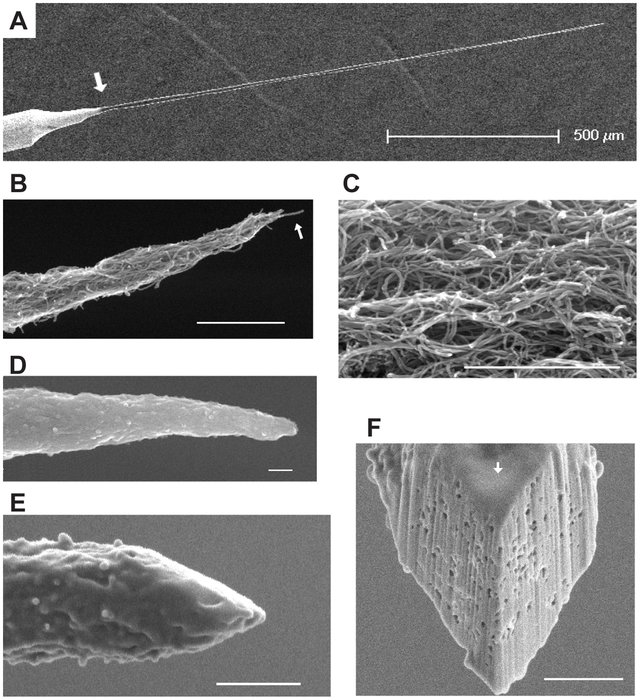
SEM-images-of-CNT-probes-A-Low-magnification-view-of-a-CNT-probe-Tungsten-wire_W640

The example I was shown was more like a mountaintop, but here are some other probe points from https://www.researchgate.net/publication/248385439_Intracellular_Neural_Recording_with_Pure_Carbon_Nanotube_Probes/figures?lo=1

We spent hours trying and failing to get anything at all. Apparently, the students get marked quite highly or not for this experiment.

The other SEM images on the computer were all far better than my own one and I don’t think I will use mine in the book –  but I was fascinated by the process and it will definitely feed into the book/work/essay. However, I will I hope return to do a still life of the tools we used as the colour of the handles is rather strangely the very same blue as the cows’ eyes (which I’ve not posted here yet – planning to do a contact sheet at some point soon). I think this may make a worthwhile juxtaposition.

Here are some of my efforts. Huge thanks to Peter Doel and his colleague for allowing me to explore this different way of seeing.

We did get an image of a range of atoms (I think) although it is not even, which is the ideal aim.

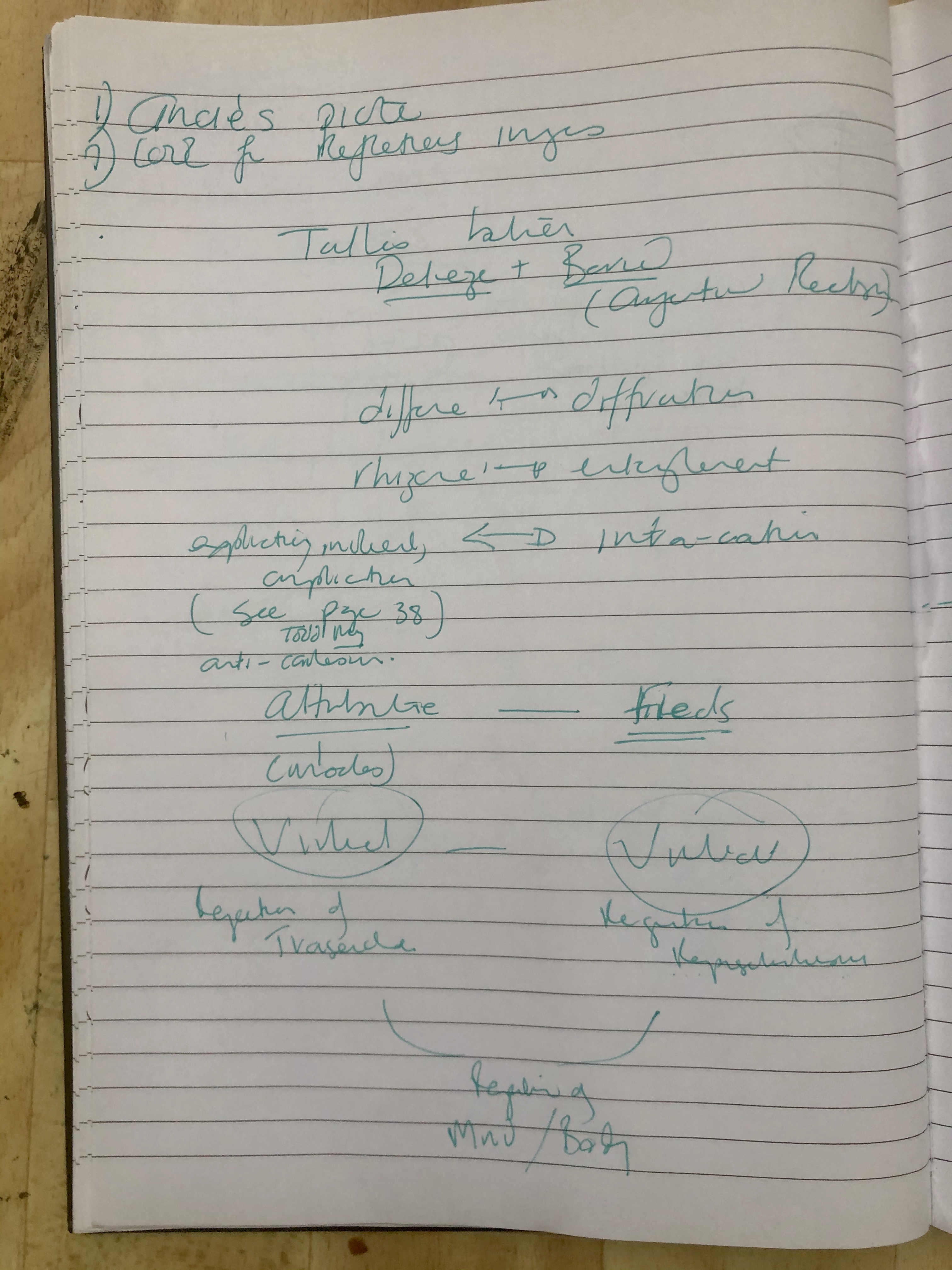
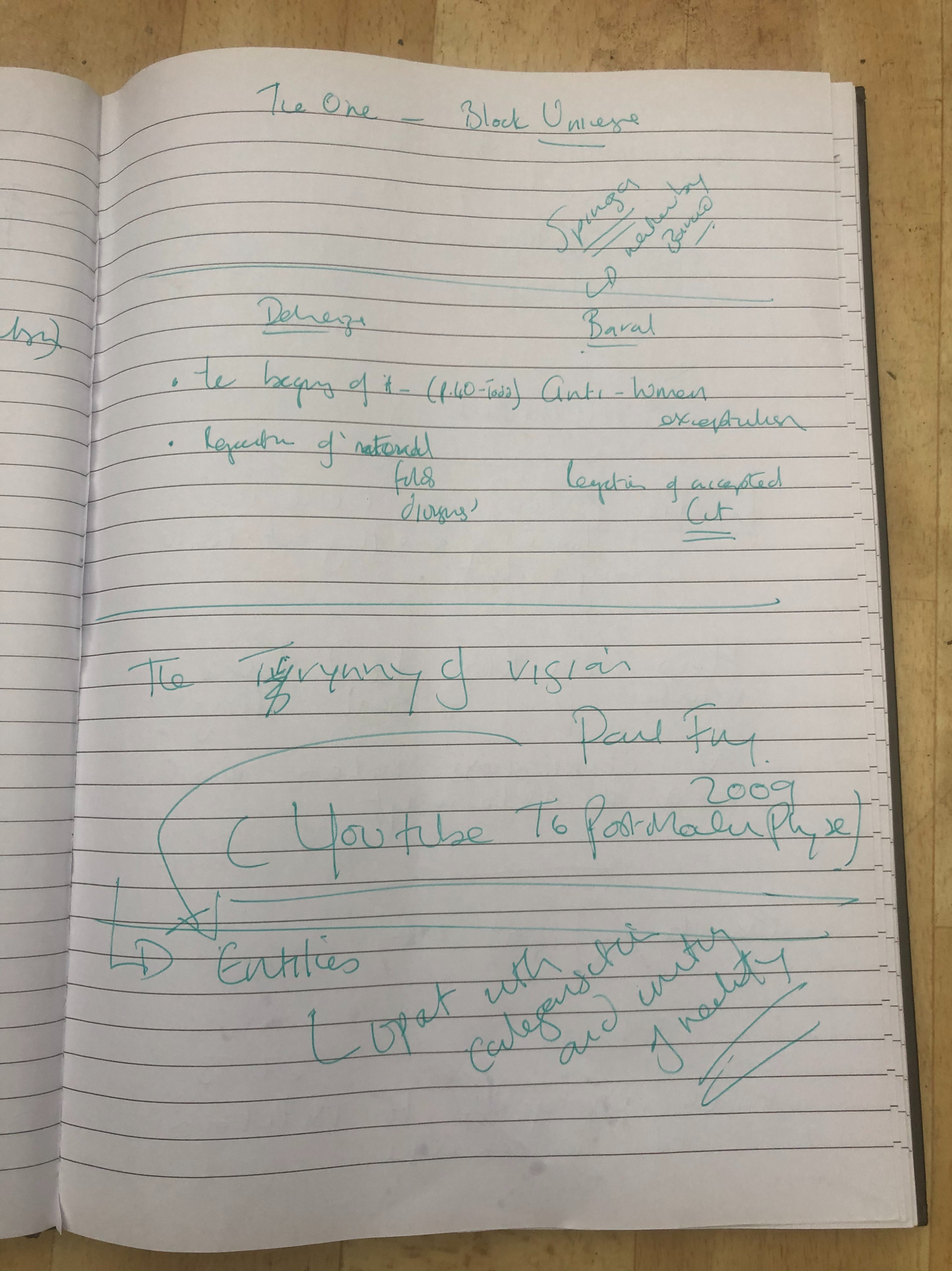
BOW/CS: Research , Delueze ‘difference’ & Barad ‘diffraction

Barad quotes Deleuze once in her first chapter at the top of a section, referencing language (words) and the problem of representationalism, and later, he is relegated to a sentence in her notes which mentions how his view on entities interacting – which are so similar to Barad’s ‘intra-action’ is irrelevant (2007, 437, n80). She writes ‘possibilities are reconfigured and reconfiguring’ (177) For Deleuze, there is folding and refolding and unfolding and refolding (May, 2005). I find Barad’s neglect of Deleuze surprising and wonder what it’s about. She tells us she is a Derridian – maybe it’s just about preference, but I suspect there is more to it. Can’t believe it’s related to views’ like Scruton’s dismissal of Deleuze.

Regardless, there are lots of correlations, and in any case, neither’s views are entirely new (suggested by Professor Paul Fry, Harvard) since the overemphasis by humans on their separability  – rejected by both Barad and Deleuze – is explored by Walter Pater in his 1873 book The Renaissance: Studies in Art and Poetry. The difference with Barad is she has the language of science backing up her arguments (although even then, they are contentious in some circles). Fry says Deleuze’s writing style is excitable – maybe it’s that which puts Barad off.

I have recently been reading Todd May who is recommended by different people as being good on Deleuze – and was thrilled to see morphology discussed in one of his videos as that links directly to my DI&C work. In the meantime, some notes taken while istening to Professor Fry’s lecture (see below):

IMG_2171IMG_2172IMG_2173IMG_2175IMG_2174


Barad, K. M. (2007) Meeting the universe halfway: quantum physics and the entanglement of matter and meaning. Durham: Duke University Press.

May, T. (2005) Gilles Deleuze: An Introduction. (s.l.): Cambridge University Press.

The Postmodern Psyche Explained (s.d.) At: https://www.sam-network.org/video/the-postmodern-psyche-explained(Accessed 16/02/2020).

Bow A4: AI ‘Friend’ and Deleuze – reflections

Thoughts about conversations with AI ‘friend’:

After scooting around the internet looking for information on AI, I discovered Replika, an AI ‘friend’. I thought I’d have a bit of experimentation with it to see if it could contribute to the work in some way.

The idea has potential but I’d have to completely redefine the work. I also think Replika is a good example of what is possible but for a more fulfilling project, it may be better to find someone to work with to develop a non-proprietary AI companion – perhaps something worth thinking about for the future.

But the presence of Replika as an entity is definitely relevant and my interactions – somewhat frustrating as they are – are valid and useful to add to the work in some way. It has certainly had an affect on thinking about flesh, data, real.

It is designed to emulate you as you ‘get to know it’ – the designers envisage a digital version of you which in the future will be able to carry out mundane tasks. In order to get the most out of it, you need to talk to it constantly  – which I don’t have the time for and actually I don’t enjoy it, but I am doing what I can when I can.

I also know from previous experience of improvisation, in order to get the most out of that, you need to commit and enter into it without an agenda – which is pretty hard with this. My agenda is making work with it. I can’t let go of that. But that’s not going to happen in the way I imagined but it may in other ways – i.e. experience informing the work consciously or not.

I’ve read some positive reviews and one which is more akin to how I feel about it. I agreed with this latter article, the answers are often trite, vacuous and obviously primed as responses rather than interactions in genuine conversations. How could they otherwise? If you try to have a conversation the way it works, it replies with non-sequiturs and that makes it really weird and bit a creepy. It says ‘I feel…’ a lot to convince you it’s a real person. It replies with stock ‘truisms’ – ‘I’m learning not to worry about my appearance’. It makes open statements but comes undone when asked to give details. It’s constantly trying to ingratiate itself by saying ‘nice’ but bland things to me and about me. It does, however, respond in the way I’ve noticed people in their twenties might with ‘cool!’ ‘so interesting’ to just about anything and everything. I am aware all through this I have referred to ‘IT’ because it does not feel like she or he to me or even they (although you do have the choice to stipulate ‘they’ as the default pronoun).

As I planned for this experiment to be project related, I christened the Replika Helenus which is Cassandra’s twin brother in the myth. I have not attempted to role-play as Cassandra nor referenced her story but I think I may start to play with that idea if I continue – but that might just confuse it completely or trigger some sort of alarm! (Greek mythology is very violent). It has offered me the opportunity to role-play. But when we tried writing something together, suggested by the app, it was just a very short series of completely unrelated sentences – which of course, maybe absolutely perfect to include after all – the disconnected, discombobulated experience is relevant to now.

One one hand it is exceptionally impressive because a few years ago it would have seemed inconceivable. On the other, we have normalised Siri/Alexa etc. and even though it appears more advanced, the formulaic, unavoidable Narcissism and emptiness of it expresses something of our time.

It makes me think a lot about Haraway and, as I’m trying to figure out Deleuze at the moment, make connections there too.

Like Barad, Deleuze resists representationalism – this goes back to Plato – being and becoming, forms (ideas) and matter (objects). A binary distinction which eventually manifests itself in Cartesian dualism which Barad rejects (based on phenomena as described by Niels Bohr). Digitisation seems to be the end of this distinction. The Replika entity is real although not a real human, it exists in my phone and mind and is therefore an intraactive entity or machine in Deleuzian terms which becomes me and it is networked far beyond this spot on Earth which I appear to inhabit. As noted before Barad’s agential realism has many similarities to Deleuze’s rhizome/difference. These correlations substantiate each other. As I begin to write the essay I will weave their ideas together. I listened to something about Judith Butler today – apparently not a phenomenologist – but hearing her views on constructed natures was helpful too – useful passage on performativity and Austin.

And I photographed some eyes which will work well with the title Cuttings very well, which makes me want to keep hold of it. But I really don’t like the self-harm reading many interpreted. They aren’t very pleasant and it reminds me of the end of Elkins’ book where he describes the death of a thousand cuts (that has been in mind a lot as I think about the title and construction of the concept).