CS: A2 Tutor Feedback

Scroll to the bottom for PDF link or read additional notes first:

I had an extremely useful and relatively long tutorial with a new CS tutor after my previous tutor resigned from the OCA. As is usual with me, I submitted knowing there was still much to do but I reach a point where it’s helpful to get it the work off my hands and receive constructive, meaningful feedback even though I know things are still quite murky.

I have read significantly more since finishing the draft I handed in and am continuing to do so, refining and zoning in on the one hand, but also delving further into such a rich and fantastically difficult/confusing vein of knowledge on the other – that I am still in a thinking place.

I think I mentioned elsewhere that Matt advised me to write my plan/research question (A3) then return to A2 to strip out the unnecessary stuff and focus more on the key topic, not that I know yet what that is, but I am getting a clearer idea. For a while, I thought it was performativity which I have been busy investigating and how that relates to representation and ultimately photography/moving image. I still think that is the case but I keep thinking about boundaries and the collapse of them – also representation,  – a lot of the creative writing I am doing over on Sketchbook is tackling the issues I’m thinking about but in a more instinctive way than one might do so academically. I think that is a better way of working for me. I write, then read what I have and out of that I begin to see what my concerns are.

As far as performativity goes, it seems to have two paths leading to it (Lloyd, 2015) – one theatrical and the other sociological (Austin). One is about acting – playing the role of being a person in the scheme of things, and one is about reaching potential or expectations (or not) i.e. this hoover is not performing as well as advertised; to be a female non-subject one must live up to certain expectations – the  performativity of being a ‘girl’ / ‘women’ = e.g. taking care of one’s looks/physique, acquiescing (don’t be too bolshy or difficult  – that is underperforming  – think Kate in The Taming of the Shrew), having a certain a maternal aura, kind, gentle, quiet when necessary etc. Some women perform ‘well’ (like a hoover – they match up to requirements) others, myself included, ‘fail’ to. I think that is the very basic difference between the two versions of performativity and that needs to go into my Lit Review. Then there is theatricality – dismissed by the modernists and many more besides (Fried, 2008/1967) – especially nowadays when it’s de rigueur to be slapdash or else anti-commodified, or to give the impression of being so even when not.

I need to figure out how to tie (or if I must) this in with photography being ‘boring’ (Elkins, 2011 – and many more, including me.) Incidentally, I don’t necessarily dislike any of those anti -things, and really like them at times. However, I have noticed I can be far more ‘mundane and every day -ish in my writing than I can be in my photography.

I have yet to really get anywhere near to grips with Barad’s use of performativity at the quantum level but I have just ordered her Meeting the Universe Half Way, and I think there will be plenty of direct passages that can help me with my research there.

I am also wondering if I should have a glossary – is that allowed? There are some tricky words that I don’t want to spend too long explaining  – or waste too many words explaining unless it is necessary – I need to find out if this is considered acceptable or not.

Here is the feedback which I wrote up following the tutorial. A2 CS Feedback Form


BOW/CS A3: Research/Sketches, Reality Evolution, perception

According to Donald Hoffman’s theory which I have discussed several times (Literature review ),  we did not evolve to see reality as it truly is, as has been argued. Rather, we evolved to see the sort of reality we need to see to for ‘optimal fitness’. We perceive far less than there actually is because to see it all would be unhelpful. What’s more, according to Hoffman, the objects we see, including space and time are like desktop icons – constructed objects that represent the goal we are either after or trying to avoid. As hard as this is to understand, and Hoffman admits he may very well be wrong but that his theory makes the ‘hard problem’ of consciousness approachable, his idea sits well with many of the other theories I have been reading about since I picked up The Ego Trip by Julian Baggini (2011) (when I began UVC) followed by a raft of other books exploring similar themes.

I have been trying to express and understand these subjects in my writing, and looking at and photographing objects and phenomena in the world. The photoshopped images below are attempts to explore these ways of thinking about the world.

Fred Ritchin’s After Photography (2009) has some good sentences which I will introduce into my Lit Review and no doubt take forward into the essay.


“…some quantum theorists, foremost amongst them, Neils Bhor and Heisenberg himself, argued that fundamental reality is essentially indeterminate, that there is no clear fixed, underlying ‘something’ to our daily existence that can ever be known. Everything about reality is and remains a matter of probabilities […] We have tried to use the photograph to concretize the probabilities (isn’t that what the “decisive moment” is all about?), reassuring us that reality is more solid than what our theories tell us.” (180)

In Data Selves (2019) Deborah Lupton quotes Kember and Zylinska (2012) to describe how photography is an “agential cut” aimed at imposing “meaning and order” and “delimiting choices” (29). As Ritchin says an alternative “may be too disconcerting, if not terrifying.” (ibid)  As he describes, digital technology and photography in particular “can begin to be receptive to the oddities described by newer theories” [quantum and consciousness related]. (177) Superpositions, endless possibilities, entanglement, for instance, can all be alluded to using malleable data either as a process or a representation (which if one takes Hoffman’s idea on board are completely intra-related in any case).

Some sketches – I wonder if these would benefit from more contemporary mixes (a bit like Flowers for Donald). Still a bit Guardian headline pics for my liking :


IMG_9765iiilow-
Isle of White – windswept hilltop
Landscape with Bridge - The Metropolitan Museum of Art
Similar to above but layered with an anonymous 17th-century pencil landscape downloaded from Google Art and supplied by the Metropolitan Museum of Art


Windswept tree  – shaped by the elements – differentiation reduced by processing decisions.


(See Orpheus story – trees to this day in shape of dance to his music)


Hoffman, D. D. (2019) The case against reality: how evolution hid the truth from our eyes. London: Allen Lane.

Lupton, D. (2019) Data selves: more-than-human perspectives. Cambridge, UK ; Medford, MA: Polity.
Landscape with Bridge – Anonymous, Italian, 17th century (s.d.) At: https://artsandculture.google.com/asset/landscape-with-bridge-anonymous-italian-17th-century/EwHp9J9QWhanmw (Accessed 10/11/2019).

Baggini, J. (2011) The Ego Trick. [Kindle edition] London: Granta Books.

CS & Bow Notes: More re. Performativity

One of things about studying this way (as opposed to in a classroom) is there’s plenty of freedom to go off and explore – which I do a-plenty. But because I tend to stray quite far (which is a good thing, I think, despite unavoidable pitfalls) I am prone to missing out on some basics which would make things simpler for me if I’d visited them before approaching certain topics, or at the start of doing so. I probably should have read the following and along with notes on philosopher John Austin before tackling Karen Barad’s paper. Having done a bit of digging, I get a much clearer picture about her rejection of language in favour of matter although I probably stand by my arguments for seeing language as a form of matter. I am also certain my experience of ‘actioning’ a script is going to inform my understanding and will be invaluable. I will add to this post once I’ve read Moya Lloyd’s chapter below.

To read and makes notes:

  • Metaphore widely used – perform
  • Derives from performance studies  – dramatic terms OR sociology to perform a function in everyday life
  • Connote different things  – 1 to act out or 2 to achieve an acceptable level of proficiency – a 50s man reached pique performance if he went to work and provided for the wife who achieved hers if she provided supper and slippers, etc. (no matter the cost to either)  – etymologically different:
    “late a5c., “accomplishment” (of something), from perform + -ance. Meaning “a thing performed” is from 1590s; that of “action of performing a play, etc.” is from 1610s; that of “a public entertainment” is from 1709. Performance art is attested from 1971.”
  • Difference between performance – performance studies and performativity from linguistic studies – (verbal acts which have an effect on the world)
  • Bulter in Gender trouble suggests both gender and sex are performative (3)
  • Austin JL  – originates from
  • Beauvoir (Second Sex) body is not a ‘natural fact’ but an ‘historical idea’ (4)
  • An identity through a ‘stylized repetition of acts’ (Beauvior, 1988-519) (5)
  • Butler – Turner, life as a ritual social drama – depends on repetition of social performances – (see Chater) page 6
  • repeated social performances (6)
  • replication of corporeal repertoire (7)
  • a gendered subject is produced (little autonomy or volition) NBNBNB
  • Collective rules around acting out gender and sexuality
  • Page 11/12/13 Erving Goffman – “frames”
  • Sociological sorting 1977:302-3
  • Doing gender is unavoidable page 14/15 west and Zimmerman 1987:137
  • Differences in gender performance between Goffman and Butler page 17
  • (Remember entanglement – Barrie who wants value non-linguistic elements of an assembly that results in)
  • How to do things with words
  • MacKinnon 1987: 171 page 18 pornography see example in S&O – nail polish NB page

Lloyd, M. (2015) ‘Performance and Performativity’ In: Ditsch, Lisa and Hawkesworth, Mary (eds.) The Oxford Handbook of Feminist Theory. Oxford: Oxford University Press. pp.572–592. At: https://repository.lboro.ac.uk/articles/Performativity_and_performance/9470270 (Accessed 07/11/2019).

Research: CA A2 Daniel C Blight’s response to Charlotte Cotton’s Photography is Magic – Photography​ is Not Magic

I just discovered this as a draft – but never posted. The following passage is great.

“We might also beg questions of photography’s current relationship to non-representational theory here, a space in which we attempt to do away with the linguistic connotations of “reading photographs”. For as Piere Taminiaux notes in his The Paradox of Photography (2009) ‘Photography thus signifies both an end and a beginning to representation.’ Whichever theory of representation one might support, let’s remember John Harvey’s lines in his Photography and Spirit (2007), as both a criticism and a warning against such inconsistencies, which seem to forget that in the context of photography (and pertinently in the case of the algorithm), magic might not be made by the makers of photographs at all: ‘Pseudo-photographic relics and spirit photographs share not only the mystery and miracle of their manufacture but also the status of being representations of the spirit by the spirit’ [my italics].” (2015)

Update after finding post:

It seems that scientific theory is heading towards rendering representation key to our existence (Hoffman, 2019), I am not sure what to make of “Photography thus signifies both an end and a beginning to representation.’ It’s an odd sentence which I can’t make head nor tale of.

I do know Representation is under suspicion. On the one hand, science tells us we might only exist in a world of representation and reality is an illusion – on the other, science suggests phenomena rather than representation matters most. (Barad, 2003)  Barad’s critique/thesis “refuses the representationalist fixation on “words” and “things” and the problematic of their relationality, advocating instead a causal relationship between specific exclusionary practices embodied as specific material configurations of the world (i.e., discursive practices/(con)figurations rather than “words”) and specific material phenomena (i.e., relations rather than “things”).”

Daniel Rubenstein argues against Michael Freid’s negation of theatre as art, quoting Lyotard. ” In Libidinal Economy Lyotard proposed that the role of the artist is to lay bare the mechanisms of theatrical [perhaps here we don’t even need the word theatrical] representation, to show that if there is anything real about representation, it is because there also exists a fully real virtual domain constructed not from objects and things, but from intensities, desires and surfaces” (2017)

As I figure out what my A3 research question is – the word representation seems to be one of the key subjects along with performativity and the collapse of fixed and certain boundaries (which representation seems so reliant on).  I keep thinking about the conundrum of maths  – supposedly the least emotive language that exists. Is maths a language or is it a real thing. Apparently, the clever people can’t make up their minds. But what if it’s both?

Hoffman’s book on reality paints a picture (see the video on Aeon in references) that seems to suggest that our reality is *one giant representation – a user interface, the purpose of which is to ‘hide reality’ which allows us to ‘control [our] reality’. Our objects are icons that we recognise to work out our best fitness choices – otherwise, we would be distracted by reality. Not sure yet where the maths conundrum fits here  – but I do think if Hoffman’s theory has any credence then the illusion we create is the only reality we know and have, therefore it is real to us least, even though it is also representation. (“As an actor, I was not trying to fake it – I was trying to live it” – the most extreme example, the Method.)

*”When I see an apple it is a data structure  – I am rendering it when I look at it. This rendering happens in everyday life (a description of fitness payoffs.)

  • data structure
  • rendering
  • space-time itself is a data structure
  • conscious agents – passing experiences back and forth
  • reality is like a vast social network
  • Emergence
  • Entanglement


Barad, K. (2003) ‘Posthumanist Performativity: Toward an Understanding of How Matter Comes to Matter‘ In: Signs: Journal of Women in Culture and Society 28 (3) pp.801–831. At: https://www.journals.uchicago.edu/doi/abs/10.1086/345321 (Accessed 30/10/2019).

Blight, D. C. (2015) Photography Is Not Magic: Photographic Images and their Digital Spirit.  (AXA Online] At: https://americansuburbx.com/2015/10/photography-is-not-magic-photographic-images-and-their-digital-spirit.html (Accessed 06/11/2019).

Aeon (2019) It’s impossible to see the world as it is, argues a cognitive neuroscientist | Aeon Videos  At: https://aeon.co/videos/its-impossible-to-see-the-world-as-it-is-argues-a-cognitive-neuroscientist (Accessed 06/11/2019).

Rubinstein, D. (2017) ‘Failure to Engage: Art Criticism in the Age of Simulacrum‘ In: Journal of Visual Culture 16 (1) pp.43–55. At: http://journals.sagepub.com/doi/10.1177/1470412917690970 (Accessed 06/11/2019).


CS & BOW: Reflection

Where I’m at right now….

  • I have a  meeting with Matt White on Monday and waiting to hear from Ruth te A2.
  • I feel the Pic London project introduced me to useful ideas, concepts, and practices that were good to come into contact with. The actual work produced feels more exploratory and research-led than anything  – however, the image of the inside of the cave which has been in my work previously seems to have played a significant role. I am not sure how I take some of my frustrations forward re. the group’s inability to make the improvisations function. I have thought about attempting it with other people. I could suggest trying it with the Pic London group but I am not sure they are up for it. It’s very difficult to read what’s going on there – perhaps because we were only ever able to talk online, I cannot work it out. One of the things I noticed in the Ballpark Collective’s statement is how very clear the rules were and how they didn’t speak about the work outside of the game:
  • “The parameters of this involve creating a moving image from 5 individual works, each made by one of the artists. Through the random act of ‘pulling sticks,’ the collective decided on a chronological order to respond and react. The artist who pulled the shortest straw started the process by creating a moving image piece based on their response to the theme Interdependence. The work was presented to the next artist, who then responded with a work informed by their interpretation, or reaction to it. There was no discussion between the artists outside the ritual of passing the work to the next, allowing the process to highlight individual perspectives and the gaps in communication. When the process was complete, each of the works was edited together to create a whole.” (2019)
  • The cave is something I looked at as far back at TAOP (before I’d looked at Plato’s Cave in UVC) See – https://www.sarahjanefield.co.uk/Colour-Assignment-Slideshow/n-GMdPr/
  • These images seemed to be expressing a sense of existing in what I referred to as my ‘grief cave’. I think I even wrote a short thing about it – falling into the cave and bumping into a projection down there, an imp who played tricks and wasn’t real but was.
  • untitled--7
  • I need to revisit some work I began last year which I called “Manipulated: My Leica and I, Leica Amateurs show their Pictures (1937) rephotographed, edited, uploaded; phone & proprietary apps only (c)SJField2018. Some examples from the page at the end of this blog. However, I am not sure about continuing with the Leica book for BOW but I may transfer the basic premise to another or film or text of some description. https://www.instagram.com/fieldsarahjane Also, the experiments there are too static, not dynamic enough. (Not that all need to be the same – variety of unstable imagery was what I was going for – also the base image needs to move and come out of its place.)
  • There is so much that makes me cringe in this S&O A3 project but it was a turning point while studying with the OCA for me and is definitely worth revisiting. https://ocasjf.wordpress.com/2018/01/09/draft-assignment-3-filters-voice-and-speech-lessons-for-the-theatre/
  • Returning to the TAOP A3 (colour) assignment briefly – As far back as then I was focused on the use of the word theatre which has so often been associated with photography  – I included the following slide at the start of the assignment:
  • Untitled-1
  • It’s been fascinating reading through Fried and then various responses to his thoughts on theatricality and anti-theatricality, and then seeing the use of the words performativity used by Barad. I’ve noticed several related words on the Contents page of Feminist Futures of Spatial Practice: Materialisms, Activisms, Dialogues, Pedagogies, Projections 2017 [PDF] – such as dance, masked, imaginary, rehearsal, acting out, play. I think Fried’s negation of theatre is a complete misnomer and that theatre and theatricality are at the core of what it is to be.
  • I really had no idea that I would find myself revisiting the first dissertation (1994). This has all come about after asking other students for an alternative view to James Elkins’ statement that photography might actually be rather dull. Freid was recommended and now here I am – See previous blogs on Barad – performativity, and Rubenstein on theatricality and Fried. I have no copy of my first dissertation and no way of finding one. I could barely write at the time but I suspect it dragged my overall grade up from a 2.2 to a 2.1.  I looked at the ritualistic origins of theatre. I explored ‘commune’. One of the things I noticed in the Rubenstein response to Freid was how everyone sees theatre as intrinsically about representation, a separateness between viewer and action, othering – but it strikes me that the origins of theatre are about oneness – an attempt to re-engage with the universe rather than draw away from it. It’s an early church.
  • I wrote about trying to create a universe in my BOW A2. Theatre is a reality laboratory. It’s not about trying to create a fake. Well, at least, once Stanislavski got hold of it, it no longer was. And then there’s the Method. Maybe Stansilavski was simply taking theatre back to its origins. Isn’t it funny that the fakeness of a diorama is where photography purportedly began (putting aside Azoulay’s ant-Cartesian reading of the origins of photography). I feel I do need to revisit these ideas – although I am not sure how just yet.

Below – a couple of the Manipulated (2018) posts. Visit for more.


CS: Notes on what ‘Performativity’ means in new materialism terms

From – https://newmaterialism.eu/almanac/p/performativity.html

  • re Derrida and Austin’s Theory of Speech Acts, Judith Bulter develops the idea of sexuality and gender as performative
  • “Butler has put it herself: “This very concept of sex-as-matter, sex-as-instrument-of-cultural-signification […] is a discursive formation […]” (ibid., p. 50).”
  • “Haraway’s notion of the material-semiotic that thinks the material, bodily fleshiness and the discursive-linguistic together, and thus breaks through the long-standing nature/culture divide (see e.g. Haraway, 1988 and 1997) – critical re-readings and re-engagements with Butler’s notion of (gender) performativity slowly but surely came into being”
  • “For Barad, performativity is not only linked to the coming into being of the human subject and the (gendered) materialization of bodies, and the socio-political interpellation process that goes along with it (i.e. Butler’s more recent understanding of performativity as articulated in Bodies), but is about the processes of the materialization of “all bodies” and the “material-discursive practices” that engender differences between for example human and non-human bodies (Barad 2003, 810).”
  • Matter is not a passive actor – (i.e. body/camera, body/phone – see Charlotte Prodger, phone shot on phone)
  • Barad “moves away from an individualistic atomistic metaphysics, the modern Cartesian mind/body split, our strong cultural belief in representationalism, our Western tendency to thingify or basically objectify, and a mere discursive-linguistic concept of performativity”
  • “but bodies themselves “come to matter through the world’s iterative intra-activity – its performativity” (ibid., p. 824).” So  – intra-activity is performativity in Barad’s theory. Rovelli talks about reality being relational  – “reality is reduced to relation” “We, like waves, and like all objects, are a flux of events; we are processes, for a brief time monotonous…” Events, therefore, are performances, using Barad’s language.  (Rovelli, 115/116)
  • “Reality, according to Barad, is rather “a dynamic process of intra-activity” or “an ongoing open process of mattering through which ‘mattering’ itself acquires meaning and form in the realization of different agential possibilities” (ibid., p. 817).” So – therefore exactly what I have been unraveling and which is explained in the Hoffman book, Systems Theory, Rovelli etc. Barad applies it to the humanities and is interdisciplinary or in her words discursive and diffractive (I think?).
  • “Materiality is no longer “either given or a mere effect of human agency,” but rather “an active factor in processes of materialization” (ibid., p. 827)” See the previous point.

Susan Yi Sencindiver on the Oxford Bibliography website writes: “Important as this [constructivist] ideological vigilance has been for unearthing and denaturalizing power relations, and whose abiding urgency new materialism does not forego, the emphasis on discourse has compromised inquiry by circumscribing it to the self-contained sphere of sociocultural mediation, whereby an anthropocentric purview and nature-culture dualism, which constructivists sought to deconstruct, is inadvertently reinscribed.” (2017)  https://www.oxfordbibliographies.com/view/document/obo-9780190221911/obo-9780190221911-0016.xml


CS: Notes on Posthuman Performativity by Karen Barad

Edit 2024: throughout I refer to Her/she. This is wrong. Barad is a they/them as far as I’m aware. I was not aware when making the notes originally. Please adjust accordingly as reading.

Following the previous two posts where I attempted to pinpoint what I have been exploring in one way or another, I have identified what seems like a perfect paper by Karen Barad called,

Posthumanist Performativity: Toward an Understanding of How Matter Comes to Matter

However, Barad’s rejection of language and signification in relation to ‘matter’ are in opposition to my own interest in language. This paper reflects so much I am interested in but devalues language in the process and gives higher value to other elements, in particular matter – although perhaps she is simply trying to even things out. Incidentally, Lupton refers to more-than-human rather than posthuman and I think I may prefer this adjustment.

  • I love this quote KB has at the top of the paper: “We are far too impressed by our own cleverness and self-consciousness. . . . We need to stop telling ourselves the same old anthropocentric bedtime stories.”
    —Steve Shaviro 1997 (However, I think the stories make an otherwise terrifying existence bearable – just about. People are foolish, immature, vain and silly –  how would we cope without our bedtime stories – I sense very little forgiveness or tolerance in some.)
  • “Language has been granted too much power” – starts Barad. This seems to be a rallying cry against Judo-Christian and therefore Western (paternalistic) doctrine which has been the foundation of our civilisation for centuries, i.e. “In the beginning was the Word, and the Word was with God, and the Word was God.” The Gospel of John. The word is apparently – forgive the Wiki quote and I am aware I would need to dig deeper if included in an essay but it’s a useful start for this non-believer. “The phrase “the Word” (a translation of the Greek word “Logos”) is widely interpreted as referring to Jesus, as indicated in other verses later in the same chapter” Wiki.  The relationship between mythology and science tells me this is really crucial; universal cognition, matter, liveliness and life cycle of particles, superposition  – all of this could be interpreted via the story contained in that one line. The opening line of John also carries so much paternalistic fixedness which Sarah Lucas’ work God is Dad explores. If the word Jesus represents supposedly God’s flesh – is it not a metaphor for the manifestation of the emergence of matter?
  • “Language matters. Discourse matters. Culture matters. There is an important sense in which the only thing that does not seem to matter anymore is matter”, she says.

But, and I know Barad is about addressing an imbalance  – Language IS matter. Even if only focused on linguistics – and then only spoken, i.e. no text: breathe is expelled as part of the breathing process: we interrupt its journey out of the body with our epiglottis, and then our tongue, teeth, skull cavities, cheeks, etc help to form the breathe (material) into something shaped despite its apparent ephemerality. Add some vibrations with the help of your vocal nodes and you have sound. Plosives, implosives, glottal stops all contribute to making the breath and vibrations into a shaped sound that is then carried as/on a wave and interacts with the eardrum; and might also be understood in conjunction with sight and touch and smell  – all forming a material interaction with whoever is listening even if the only one hearing is the same person who made the sound in the first place. The shaped breath/sound vibrations’ impact in the world may not be so ephemeral. The impact may indeed be long-lasting and extremely powerful, causing a definitive reaction visible in the material world.

I do not know enough about her ideas yet, but if the term assemblage which Lupton used so frequently emerges from Barad’s theories or related ones, then surely language is one of many emergent elements. The rejection feels like an understandable response to logocentrism and also the theories of structuralism which were dominated (as so much was/is) by men and misogynistic, racist, colonialist attitudes and beliefs, but I wonder if it risks chucking the ‘baby out with the bathwater’.

I find myself agreeing with so much Barad says and her highly educated ability to link quantum science to the humanities would have been so helpful when I wrote the essay for DI&C. Ariella Azoulay’s analysis of history which I referenced seems very much influenced by the same thought processes.

  • When I explained what underlies all my work to the first CS tutor, I said, I am driven by the desire to figure out why people say things which bare no relation to what they actually mean or intend even when they have no idea that may be the case. i.e. “John is a feminist and he tells everyone who will listen that he is one. Even so, John demands to know why his wife has not packed his cufflinks, or why she failed to wash his jeans because, in John’s mind, he’s the one earning the money and therefore it is not unfair to expect his wife to fulfill these domestic duties. John believes in feminism but says things like “No wife of mine will …. (insert things wives ‘shouldn’t’ be seen doing) ” John moans about his wife to his male friends when they are doing the same. When questioned about it, John insists it’s just banter. John cheats on his wife and lies to her and believes that’s just how men are. It doesn’t prevent him from being a feminist. John’s wife tells him he’s verbally abusive. John thinks this is ridiculous – because, he tells his wife, “You’re lucky to be with me.  I’m a feminist and always have been. I would never hurt you. You’ve got no idea what other men do to their wives. Because John is a feminist, he cannot see why any of the above is anti-feminist.” Is John lying on purpose, does he really believe he is a feminist? Or does he know that’s the ‘right’ thing to be in his world but the role of Husband is so entrenched and deeply embedded that he simply can’t see outside the reality that he has constructed or that has been constructed as the landscape in which he exists? Perhaps this is an extreme example but it is one which represents how language is tied up with constant performance, and to dismiss it or devalue it feels strange. Even though, I can see we also need to value other elements of reality.
  • Architecture – the most obvious ‘matter’ – is a language – in semiotics, it might be referred to as a text just as a film or photograph or a book can be.
  • “The belief that grammatical categories reflect the underlying structure of the world is a continuing seductive habit of mind worth questioning. Indeed, the representationalist belief in the power of words to mirror preexisting phenomena is the metaphysical substrate that supports social constructivist, as well as traditional realist, beliefs.” I’ve highlighted the phrase I think is critical – if words aren’t mirroring pre-existing phenomena but rather emergent creating and being the phenomena as they do then does this problem over overvaluing the word in favour of all else go away? I can’t help thinking about Hoffman’s book where he suggests we exist in an interface and that we recognise ‘things’ but these work along the same line as desktop icons. In Hoffman’s theory representation is really important even though its an illusion. (Hoffman’s book does have some extraordinary and surprising misogynistic thinking in it which I am still trying to figure out).
  • Barad makes no apologies about using language herself, which can at times separate her ideas from people without PhDs in physics or gender or critical studies trying to understand what she is saying. At a very basic level, she is saying the very nature of reality cannot be isolated from the knowing about it and being it; that both being and knowing are undergoing seismic reconfigurations upending everything we have thought for thousands of years. (This reconfiguration is taking place throughout our world as the technology we use is founded on the principles and science that began the transformation – and is involved in a feedback loop – we are instantiating (Hayles, 1999)) the technology, no longer expecting things to be present or absent but instead to be patterned, assembled, having come into being as intra-active relational phenomena. (Icons on our desktop, web pages, animated objects that appear to react and interact). Carlo Rovelli who writes specifically for non-physics-, critical theory- etc. PhDs, says, “Kant was perhaps right when he affirmed that the subject of knowledge and its object are inseparable” (169)

Having read the whole paper, I am yet to fully get my head around what Barad means by performative  –given that is what the paper aims to explain, I feel a bit daft but its such a dense paper, for the central point becomes lost (having looked again -see next post – I’m pretty sure she means quantum events and processes). I am also slightly in the dark about the use of the word discursive/nondiscursive and need to understand that. Diffraction I get – perhaps it is similar.

Below are some useful quotations which I may refer back to in any future writing:


there are assumed to be two distinct and independent kinds of entities—representations and entities to be represented.

The fact that representationalism has come under suspicion in the domain of science studies is less well known but of no less significance

where they differ is on the question of referent, whether scientific knowledge represents things in the world as they really are (i.e., “Nature”) or “objects” that are the product of social activities (i.e., “Culture”), but both groups subscribe to representationalism.

Having read Hoffman’s book, I came to a different conclusion – representation matters because it’s all we have. It’s the illusion with which we exist, and therefore how it functions and manifests is critical. Even if it cannot represent a place before representation as no such place exists – representation represents our parochial and myopic situation. 

anthropological philosophy, representations were unproblematic prior to Democritus: “the word ‘real’ first meant just unqualified likeness” (142).

The presumption that we can know what we mean, or what our verbal performances say, more readily than we can know the objects those sayings are about is a Cartesian legacy, a linguistic variation on Descartes’ insistence that we have a direct and privileged access to the contents of our thoughts that we lack towards the “external” world. (1996, 209) I do not think we know what we mean – I think people have no idea what they mean. The stories we tell ourselves are the only comfort we have in an otherwise terrifying universe where there is no meaning. 

Indeed, it is possible to develop coherent philosophical positions that deny that there are representations on the one hand and ontologically separate entities awaiting representation on the other.

In this article, I propose a specifically posthumanist notion of performativity—one that incorporates important material and discursive, social and scientific, human and nonhuman, and natural and cultural factors. A posthumanist account calls into question the givenness of the differential categories of “human” and “nonhuman,” examining the practices through which these differential 9

boundaries are stabilized and destabilized. Donna Haraway’s scholarly
opus—from primates to cyborgs to companion species—epitomizes this point.

Foucault – – – “show how the deployments of power are directly connected to the body—to bodies, functions, physiological processes, sensations, and pleasures; far from the body having to be effaced, what is needed is to make it visible through an analysis in which the biological and the historical are not consecutive to one another . . . but are bound together in an increasingly complex fashion in accordance with the development of the modern technologies of power that take life as their objective. Hence, I do not envision a “history of mentalities” that would take account of bodies only through the manner in which they have been perceived and given meaning and value; but a “his- tory of bodies” and the manner in which what is most material and most vital in them has been invested. (1980a, 151–52)

a diffraction grating for reading important insights from feminist and queer studies and science studies through one another while simultaneously proposing a materialist and posthumanist reworking of the notion of performativity. This entails a reworking of the familiar notions of discursive practices, materialization, agency, and causality, among others.

On an agential realist account, it is once again possible to acknowledge nature, the body, and materiality in the fullness of their becoming without resorting to the optics of transparency or opacity, the geometries of absolute exteriority or interiority, and the theoretization of the human as either pure cause or pure effect while at the same time remaining resolutely accountable for the role “we” play in the intertwined practices of knowing and becoming.

Physicist Niels Bohr won the Nobel Prize for his quantum model of the atom, which marks the beginning of his seminal contributions to the development of the quantum theory.

were inseparable for him) poses a radical challenge not only to Newtonian physics but also to Cartesian epistemology and its representationalist triadic structure of words, knowers, and things

This account refuses the representationalist fixation on “words” and “things” and the problematic of their relationality, advocating instead a causal relationship between specific exclusionary practices embodied as specific material configurations of the world (i.e., discursive practices/(con)figurations rather than “words”) and specific material phenomena (i.e., relations rather than “things”). This causal relationship between the apparatuses of bodily production and the phenomena produced is one of “agential intra-action.”

Therefore, according to Bohr, the primary epistemological unit is not
independent objects with inherent boundaries and properties but rather
phenomena.

relata do not preexist relations; rather, relata- within-phenomena emerge through specific intra-actions.

The notion of agential separability is of fundamental importance, for in the absence of a classical ontological condition of exteriority between observer and observed it provides the condition for the possibility of objectivity.

In my further elaboration of Bohr’s insights, apparatuses are not mere static arrangements in the world, but rather apparatuses are dynamic (re)configurings of the world, specific agential practices/intra-actions/performances through which specific exclusionary boundaries are enacted. Apparatuses have no inherent “outside” boundary. This indeterminacy of the “outside” boundary represents the impossibility of closure—the ongoing intra-activity in the iterative reconfiguring of the apparatus of bodily production

This ongoing flow of agency through which “part” of the world makes itself differentially intelligible to another “part” of the world and through which local causal structures, boundaries, and properties are stabilized and destabilized does not take place in space and time but in the making of spacetime itself.

Temporality and spatiality emerge in this processual

they enact a local cut that produces “objects” of particular knowledge practices within the particular phenomena produced.

, or meanings apart from their mutual intra-actions, Bohr offers a new epistemological framework that calls into question the dualisms of object/subject, knower/known, nature/culture, and word/world.

Meaning is not a property of individual words or groups of words but an ongoing performance of the world in its differential intelligibility. I

What constitutes the “human” (and the “nonhuman”) is not a fixed or pregiven notion, but nor is it a free-floating ideality

Nature is neither a passive surface awaiting the mark of culture nor the end product of cultural performances.

matter is not a fixed essence; rather, matter is substance in its intra-active becoming—not a thing but a doing, a congealing of agency

” are not outside observers of the world. Nor are we simply located at particular places in the world; rather, we are part of the world in its ongoing intra-activity.

Click to access barad_posthumanist-performativity.pdf

https://en.wikipedia.org/wiki/John_1:1


CS A2: Student Feedback

Feedback as it arrives which may influence any further edits I am bound to make after some distance and before assessment. (I have already seen much I will adjust or hone).

  1. From someone whose clarity of thought I always envy:

Really interesting read. A few hyper-critical comments:

  • Title: intriguing, draws in the reader – but for me the subtitle doesn’t add much
  • Intro: describing the digital revolution as “1950 to date” distracted me… I accept there might be an argument for that claim but in isolation and without further justification it looks odd
  • Page 6: personal opinion, but I think any discussion of Bourdieu’s theory of photography as a fundamentally bourgeois endeavour should recognise that whilst this was true of most of the medium’s existence, it is much less so in the democratised, pervasive and low-cost digital photography / social sharing era
  • Page 10: you could explain Verfremdungseffekt for the casual reader (i.e. me) 🙂
  • Pages 10-12: I’m not sure whether including your own work is considered appropriate for a Lit Review? It’s definitely encouraged for the final essay but the Lit Review is intended to draw from established sources (no offence!)
  • Conclusion: “according to the latest scientific philosophy” should probably have a reference attached


2.  More useful suggestions –

  • 5 – re reality and bourgeoisie limited view of it: This is a really interesting idea and as I read it I am reminded of social media and the use of it to display ‘perfection’ in our lives, rather than ‘reality’ (if such things exist!)
  • And likewise here – do I now think in twitter or facebook comments when I have an experience? I wonder how much social media has changed our experiences of life…
  • 6 –  Re the growing public ‘show’ of emotions: And how we have all embraced this diminishing of privacy in our own lives – willingly giving all to advertisers to use as they like!
  • 7 –  Re Sontag’s statement about images becoming art: Such as archive photographs becoming more elevated in importance with time?
  • 9  – Love this link to physics! You may need a reference here?  – I agree but it comes from lots of reading and was confirmed for my in the Systems theory book but Karen Barad’s description shifts the meaning slightly and I need to think about it more before I re-write this section.
  • Include a Muholi image – good idea


3. approximation of what was said – you discuss 9 or so texts but you’ve probably read about 50 and my feeling was you have sold yourself short. I replied but I only have so many words and if I mentioned all those texts then I’d only be able to write one or two sentences about each book. And under these circumstances, I wonder if this assignment can only ever be a snapshot of where I am at the moment.

CS & BOW: Notes following online presentation with Dr. Ariadne Xenou 24/10/19

It was good to hear someone say don’t separate CS & BOW. Students keep saying, you don’t need to connect CS to BOW and I can’t for the life of me understand why you wouldn’t connect them or why you’d want to disconnect them either. I have actually been thinking about these reflections which are are usually relevant for both and wondering how to rearrange the menu system as both modules become more and more interconnected.

It was also useful to think CS A3 as a research document setting out my plans and suggested research question – which I have yet to identify.

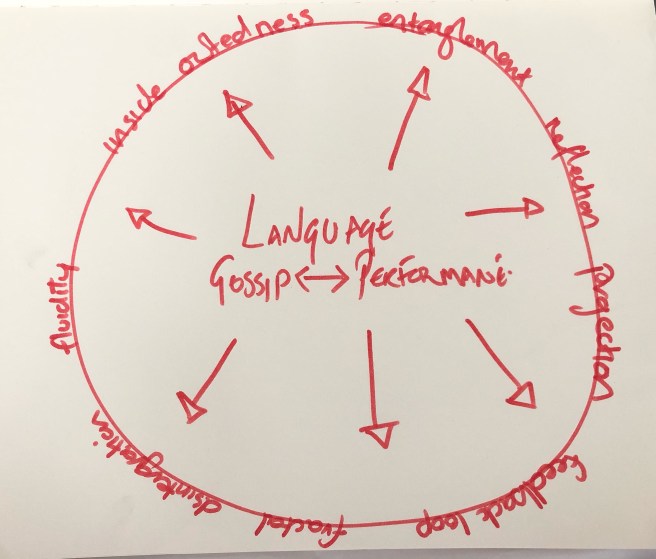
The other useful thing that came out of the session for me was thinking about overarching topics I’ve been investigating since the end of UVC, and how I can put those into some kind of tangible form. Here is an attempt to pin down some of these very big themes and links to relevant subtopics.

Inside Outedness

From my Sketchbook blog:

For millennia, language was on the outside. We could, in retrospect, usually see it. On walls, in caves, then tablets, scrolls and eventually in books. [Lately on advertising hoarding and signs telling us how fast we can drive, where we can park, if we play, enter, stay out, smoke, shop, make noise, and of course, what we can buy, how much better we will be if we buy whatever it is.]

Today, as many but not all are aware, it [language] somehow exists more and more on the inside [but not the inside of us as it did before emerging – although I think it is generally thought of as outside – rather the inside of machines and devices]. And in places it can’t be seen.

This means we often have no idea what’s being said. We are less able to read the signs [Or even see them]. Vast dynamic archives of language exist – somewhere – affecting everything. We know they are there. But they’re invisible. We see the flimsy surface only.

It’s true, in the past archives tended to be secreted, were often sacred, and contained as well as emanated power.

Very few would have had access.

It’s just that today the whole world is one big archive. And it’s hard to imagine how anyone escapes. [Could do with expanding the final thought.]

Random notes for a short story #12

Derrida’s Archive Fever, University of Chicago Press; Reprint edition (19 Sept. 2017)(The first chapter may be useful here)

Chapter 7, Turning Reality Inside Out and Right Side Out: Boundary Work in the Mid Sixties of Philip K. Dick, Hayles, K. (1999) How we became posthuman: virtual bodies in cybernetics, literature, and informatics. Chicago, Ill: University of Chicago Press.


When I was a child a boy in my class used to turn his eyelids out. It revolted me. The other boys found it hilarious. I hated seeing him do it. It hurt to look at and to think about, and still does. Seeing my reaction, he did it all the more to taunt me. 


Gossip & Performance

I believe these aspects of our existence are inter-related. From my BOW A2 assignment:

As part of my on-going research into language, culture and reality, I’d been reading Richard Wrangham’s The Goodness Paradox (2019) and books by Nicholas Christakis who wrote Connected (2009) which is about social networks (in general, not just digital ones.)

Wrangham’s book centres around the idea that human beings evolved with an ability to temper their immediate aggression, while simultaneously developing a propensity for calm, rationally-considered, pre-planned violence. Humans also became hyper-co-operative; today collaboration is part of our DNA. Wrangham suggests these trends are underwritten by our ability to talk to and about each other, and that we have an ever-present unconscious fear someone might be watching, gossiping, and planning to do away with us if we don’t conform. Gossip allows us to conjure up stories, deny and blame others, and plan punishment for anyone deemed a deviant. Wrangham’s theory along with Christakis’ ideas about connection sit at the centre of my contribution to the project. (2019a)

Performance grows out of the knowledge we will be seen and so we must ‘act’ the part in order to be accepted, to survive in the group. However, as Karen Barad tells us – entanglement is critical and without it perhaps nothing at all emerges. Her description changes my understanding of the conscious agent which I wrote about CS A2 – assuming a notion which I accepted in books about systems. However, Barad says something which fundamentally changes the underlying nature of performance and I’m still trying to get my ehad around it: ““A phenomenon is a specific intra-action of an ‘object’; and the ‘measuring agencies’; the object and the measuring agencies emerge from, rather than precede, the intra-action that produces them.” (Barad, 2007, p. 128). From Sauzet, 2018 – https://newmaterialism.eu/almanac/p/phenomena-agential-realism.html Accessed 21/10/2019 From https://sjflevel3.photo.blog/2019/10/21/bow-cs-notes-research-karen-barad/

Today we appear to perform for ourselves and the manifestation of such is available for all to see on social media. But there are also more private performances which people don’t necessarily share widely (although some do) which emerges from tracking devices. See Lupton’s Data Selves book.


Langauge

At the beginning of Self & Other I wrote about Léopold Szondi. After reading The Body & the Archive by Allan Sekula I was reminded about his thoughts on language. I said, “Szondi was also I believe interested in those ‘in-between spaces’ I’m so keen to find out more about. “language is a ‘social fact’. It is the glue that holds society together; through ‘language a child becomes integrated with a social community,’ and ‘it serves to maintain social interaction’. Since dialogue is the primary vehicle of interpersonal relations – what Szondi calls the sphere of the between -it lords it over traditional theatre” (Holmberg, 1996; 67).”

Notes: The Body and the Archive Allan Sekula

I am interested in the changing nature of language, the structural implications of a language which is coded and incomprehensible to most of us. Flusser’s thoughts on the ease with which we use devices compared to the complex nature of them which bypasses most of us may be useful to revisit.

Flusser, V. (2012) Towards a philosophy of photography. London: Reaktion Books.

Data Selves by Deborah Lupton also contains useful content about language and its relationship to new materialism. “In new materialism, the poststructuralist emphasis on language, discourse, and symbolic representation is enhanced by a turn towards the material: particularly human embodied practices and interactions with objects, space and place.” (2019: 15) However, she also writes a great deal about how data (language) manifests as those things – so although data seems immaterial, “things that are generated in and through material devices (smartphones, computers, sensors), stored in material archives (data repositories), materialised in a range of formats that invite human sensory responses and have material effects on human bodies (documenting and having recursive effects on human flesh” (19).

I need to revisit Barthes’ Myth Today (1957) https://uvcsjf.wordpress.com/2016/07/18/notes-project-3-3-myth-is-a-type-of-speech/


I suspect Karen Barad’s ideas are going to be important. And I suspect they will inform all three of these key themes. I need to investigate further before adding them here. However, I think I have identified three key topics: Inside Outedness, Gossip & Performance and Language. I wonder if the latter is the umbrella under which Inside Outedness, Gossip & Performance exist.  And the term assemblage which I’ve talked about quite a lot lately is not a theme but rather a structural reality, and our modern form of assemblages are what’s resulting in inside outedness. How I bring any of this into a semi-coherent work yet is anyone’s guess a this time!