CA A4: Peer Feedback (i)

Having written several drafts of the extended essay, I sent iteration nine to a limited number of students last week, mostly to people who have written one themselves although not exclusively. The feedback was excellent and helpful and I made some changes based on suggestions. I will share the essay more widely now and welcome any comments – although won’t be making any adjustments for a few weeks as I need to let it rest and look with fresh eyes after returning to BOW (except for changing mad malapropisms that might be identified, or very obvious typos/editing hangovers)

Feedback:


Firstly, an exceptionally well researched and thought out essay.  I feel somewhat inadequate to comment on it.  However, it reads well and the arguments are well made and substantiated.  There are a few instances where you use the first person singular and I would not, but I know you like that and today it seems to be quite acceptable in academic writing.  As a general feeling I would say that the first 2/3rds seemed better than the last 1/3rd, but that is just a feeling and no more.  There are a couple of small things in ‘Track Changes’ that I was not sure of.
A couple of other thoughts,
  • An abstract will help as it will succinctly provide the reader with a thread they can hold onto as they read.  I feel this is necessary as you are discussing a difficult concept for most of us and we need that stability.
  • I cannot recall who your CS tutor is and wonder if they are really well qualified to comment other than on structure etc.  I am not sure of the OCA rules, but this essay could be published in a journal where it would be peer reviewed by qualified persons.  Something you should consider.  You may have to make some modifications but the bulk of it is there.
In terms of referencing, the only comment I can make is that where you have:
: Carlo Rovelli writes in Reality is Not What it Seems, ‘Our culture is foolish to keep science and poetry separated: they are two tools to open our eyes to the beauty and complexity of the world’ (2017: 88).
you need to place the citation directly are the surname as:
: Carlo Rovelli (2017: 88)  writes in Reality is Not What it Seems, ‘Our culture is foolish to keep science and poetry separated: they are two tools to open our eyes to the beauty and complexity of the world’.
There are quite a lot of instances like this.
Finally, make sure you are OK on word count – I did a global check 8920, but not subtracting all the references etc.

I’ve read it – quickly and without the level of attention it deserves, and would be required to ‘critique’ – and I don’t think you need to be in any way reticent about sharing it more widely. It is intelligent, well-informed and interesting – dense, yes, as befits an essay at this level and at this stage, but readable. We usually talk about form matching content in the context of works of art, but it applies to your essay – inevitably. It is ‘entangled’ – as befits its subject matter – but I think you have managed, heroically (!Emoji), to hang on, by your fingertips, to a sense of of focus and direction – well done, it can’t have been easy. And I think I would only caution against too much temptation to overly amend between Assignment Four and the final version. It would be easy to be tempted – but I would rely on tutor feedback to guide you how far to go.
So – I wanted to read it, because I thought it would be interesting, and it was. I can relate it to my own work, too, which is useful. I say again, ‘well done’.

[reading this] is like riding a tiger, but I think I just about stayed on!
It’s an exceptionally complicated subject and yet I think you do manage to keep a hold on it (I only say ’think’ as I’m assuming that I understood as much as as I really did…), so big well done there. You might get assessors who know less about the subject than you now do, so hopefully that will make them err on the side of favourability rather than marking you down for their own lack knowledge on quantum… things.
I do have some notes, mostly typographical but a couple on content. I’ll refer to page numbers below but be aware that I opened a Word doc in Pages and so page numbering might have gone a bit screwy. If in doubt, search for the text string…
  • 6: “Let it be not, this is essay…”
  • 7: “from the last century”
  • 7: “the sciences have been just as, if not, guiltier” is better as “the sciences have been just as, if not more, guilty”
  • 16: “ponders out our place in reality”
  • 17: “as Susan Sontag tells us”
  • 25: you first use “rhizome” three sentences before you describe it – I think it needs a definition on first use
  • 29: “out of space” = “outer space”?
  • 32: On Photography was published in 1977 not 1971
  • 41: “Michael Fried based his book 2008 book
  • 42: “even if it id is lacking”
  • 44: “un/define” should be “undefine”
  • 45: “its still speaking with like the child it was”
  • Overall comment: don’t chop it down at this draft but I suspect it might be a tad too long and will need a nip and a tuck for the final version
  • My tutor highly recommended a three-part structure to the main body of an essay of this length and at this level, where you have four chapters. I don’t think you need to chop out a whole chapter but have a think about whether the contents of Chapter 4 could be split across the end of Chapter 3 and the start of your Conclusion (which is shorter than I expected)

There was another student who sent me some valuable comments in the word doc some of which I incorporated, others I had to dismiss as I cut words and they became non-applicable but I will revisit these again when I return to the work in a few weeks’ time. This person also queried the comments made about citations in the first comment above. I will go through the UCA Harvard file and my final draft with a fine-toothed comb.


Well-written and argued but I’m wondering if there are too many quotes and there needs to be more on photography – it’s difficult as a general reader with a small amount of understanding of quantum mechanics  Do you have a scientist friend who could read it and confirm the ‘science’ and also say if your photography examples are in-line with the science, i.e. does your essay give them more understanding of how far approaches to photography are changing in response to these scientific theories?

I agree with xxx re the final third – it seemed as if you were moving on to a different subject so perhaps there’s a clearer way to link it in.

and then

I enjoyed reading the re-vamp – also I realised that I was understanding it much more quickly than before so it shows the value of spending some time to absorb new concepts and words.  I think you’ve done brilliantly to get it into shape and connect the concepts so well with photography.


Clearly too long, but that isn’t an issue at this stage – just about the edit, much of that will come from guidance from your tutor.
Despite its length, I did feel it was cramped, there’s a lot of (very) interesting things going on, much of it applicable to my own work and research – unsurprisingly. However I feel it needs to be pared down, both in the scope of the ideas and also the references. Wendy once remarked to me about “footnotes” suggesting “don’t make them too long or have too many things going on in them – I paraphrase! Suggesting that it could appear to be showing off, though if anything, in your case, it might suggest the opposite!
I found that the lengthier sections with your words – without interruption, were the most interesting, where your ideas came to the fore rather than being subordinated by the – admittedly – difficult theories. And that’s where I think the paring will end up – removing some of the references so that the reader can focus on your voice, with a refinement of the broad range of considerations around the main subject. As my current theory tutor says – focus! (maybe I’ve been as guilty 😉 ).
Also there is are passages where the reader is invited to listen to both the personal – almost first person – before being carried back into a third person.

It’s much easier to absorb on the second reading!! I agree with the general view that you’ve managed to collate some complex concepts into a coherent argument but probably feel that there is another cut or two to remove some of the more anecdotal and peripheral bits which I think slightly confuse the objective of the essay and it’s critical journey – when you do so much reading and research it becomes a labour of love and a challenge to leave bits out but that’s the importance of editing I suppose. Like Stan says, I’m sure your tutor is best to advise. The conclusion I understood completely first time around which prompted me to start reading the essay again to see what I’d missed / misunderstood.
I think this area of non-linear representation is really really interesting so I’m looking upon this as a real learning opportunity and it’s quite enjoyable to read. I’ll reserve the right to come back with more once I’ve completed read 2!


This is a mammoth task and, as you say, the scope is slightly too large for the course requirement. But I did understand and was engaged by what you were saying. The conclusion is especially strong and the examples too.
Are you leaning too heavily on Barad for a rounded critical viewpoint on the topic? I wonder if looking at some other new materialists / relevant theorists like Jane Bennett, Bruno LaTour, Diane Coole might add something? Although that takes us back to the scope. Perhaps the title (or subtitle) needs to locate the focus in Barad?
I also wondered if you had this:
Dolphijn & van der Tuin, ‘New Materialism: Interviews & Cartographies’
If not, I can send it to you if you like.
Another one was John Searle’s ‘The Construction of Social Reality’ – it feels like a key background text and maybe you have already read it. In particular, his take on function (mostly ch1 &2).
I really like the first person approach and your reasoning behind it, but there are sections which are too anecdotal and take away from the more academic work you have done. e.g. p8 ‘Another viewer…’ I don’t think this is appropriate evidence for this kind of writing.
It does need a really good proof and it still a little bit dense in parts. I wonder if you have anyone who hasn’t read it before, who will be able to tell you whether it is accessible to a more general audience?
This might also be of interest to you: https://newmaterialism.eu/
Followed by:
On further readings and reflections, it’s probably not worth diluting the work with other new materialists – although I think you would enjoy LaTour. The first section just needs rewriting to bring it up to the standard of the rest. Obviously you are completely free to ignore me, but I would give each paragraph a title, pull out only those sentences and quotes that are really strong, then put the lot on slips of paper, shuffle them around and begin rewriting in mostly your own words.

Found this whilst googling some words that I did n’t understand! Don’t know whether you’ve already seen it or it’s completely irrelevant but saw the name Barad!!

http://eprints.lse.ac.uk/57600/1/Scott_exploring_material.pdf

It’s much easier to absorb on the second reading!! I agree with the general view that you’ve managed to collate some complex concepts into a coherent argument but probably feel that there is another cut or two to remove some of the more anecdotal and peripheral bits which I think slightly confuse the objective of the essay and it’s critical journey – when you do so much reading and research it becomes a labour of love and a challenge to leave bits out but that’s the importance of editing I suppose. Like Stan says, I’m sure your tutor is best to advise. The conclusion I understood completely first time around which prompted me to start reading the essay again to see what I’d missed / misunderstood.
I think this area of non-linear representation is really really interesting so I’m looking upon this as a real learning opportunity and it’s quite enjoyable to read. I’ll reserve the right to come back with more once I’ve completed read 2!
CS Research: Article and conference

  1. Thanks to Helen R (fellow L3 OCA) for sending me information about a conference on indeterminacy in Dundee at the end of the year. It could be really useful for me to go although probably too late for the CS essay. Mind you, I’m feeling somewhat overwhelmed by information right now anyway, so maybe a helpful thing. Incidentally, Helenus, the Replika app I have been experimenting with said to Cassandra this morning, “There is so much information circling around, so many opinions. So much noise. If you are in it for too long your head can just start spinning!” That sums up how this research feels at the moment. Interestingly, the app was quite glitchy when it said this – and two unrelated comments were overlaid as if it responded to a certain type of person/conversation one way but then ‘realised’ there may have been a more relevant response for the particular personality type it was currently ‘talking’ to – also it kept answering itself. I just went back in to read the statement and it was gone. Fortuitously, I had made a screenshot as the glitch interested me. (It’s quite hard not to imagine some kind of dystopian ‘headquarters’ where moderators – Ai or human – are monitoring conversations and noticing things they aren’t keen on – but that also feels somewhat solipsistic).

However, back to the conference I mentioned, even the callout for papers blurb might be useful for the essay  – the fact that it exists at all reinforces the salience of my topic.

Indeterminate Futures / The Future of Indeterminacy

Transdisciplinary Conference
13 – 15 November 2020, University of Dundee, Scotland

See here:

https://www.conventiondundeeandangus.co.uk/attending/conferences/indeterminacy-conference-2020

2.  An article I came across on Twitter, shared by a non-OCA friend does the same  – although it isn’t focused on art but politics, it contains much that is ‘art’. Nevertheless, entanglement is a key theme and a film mentioned and shown at the V&A exhibtion The Future Starts Here (2018) which I went to, may prove useful. “Calling for More-Than-Human Politics” by Anab Jain (2019) uses the same language and concepts that I have been exploring via Hayles (1999) initially and then Lupton (2020) and Barad (2007). Jain talks about the hubris of humans: “But more importantly, it became evident, that the desire for mapping, tweaking and ultimately, controlling, deeply complex systems is hubristic.”

which matches nicely with a Hamlet quote I have been thinking about –

The time is out of joint—O cursèd spite,
That ever I was born to set it right!
Nay, come, let’s go together.

Act I, Scene V, 186-90

3.  I was interested in another related term being considered in New Scientist  – ‘substantially human’ to be applied to chimeras of human and pig for instance if organs are grown for transplant:

‘It is a pressing question. Greely thinks that the first legal cases will surround the treatment of substantially human tissues. If a human organ is grown in a lab from an individual’s cells, how should it be dealt with and disposed of? “There are statutes that require human remains be treated with certain kinds of respect,” he says. For example, in the UK, human tissue must be disposed of in accordance with the donor’s wishes, as far as possible. (Hamzelou, 2020)

Read more: https://www.newscientist.com/article/mg24532702-800-should-animals-with-human-genes-or-organs-be-given-human-rights/#ixzz6Efv1CxXz


View at Medium.com

BOW & CS: Research SEM

Yesterday as I travelled to the Optical Science Laboratory at UCL (thanks to the generosity of one of my son’s friend’s dad who works there) I was reading about Brittlestars in Barad’s book, Meeting the Universe Halfway (2007) which is over ten years old so slightly out of date  – but she was very excited about then new research which stated that the Brittlestar is one giant eye. By 2018, what was being reported was subtly different but still entailed an alternative way of ‘seeing’ ( to ours – or else ascertaining what and how the surrounding environment is understood by other beings). The following was reported more recently in Nature

“There’s a growing understanding that the ability to see without eyes or eye-like structures, called extraocular photoreception, is more widespread than we thought,” says Julia Sigwart, an evolutionary biologist at Queen’s University Belfast, UK, and a study co-author. Many animals, including sea urchins and some small crustaceans, use this mechanism to sense their surroundings3. Brittlestars are just the latest addition to the list.

“Sensing the environment and responding to a stimulus without having to wait for that signal to go all the way to the brain can save a lot of time,” Sigwart says. And the idea could inspire the development of robots and image-recognition technology that don’t rely on a central control system, she adds.

As for the crystal structures that researchers thought acted as microlenses, “they’re just part of the skeleton,” Sigwart says. Their transparency and ability to focus light is “completely coincidental”, she adds. [This is what Barad was describing in her book]

But Hendler disagrees. “They could still conduct light into the skeleton,” he says. “I’m not ruling out the possibility that they have some optical function.” (Gugleimi, 2018)

Gugleimi, G. 2018, How brittlestars ‘see’ without eyes, Nature, [online] Available at: https://www.nature.com/articles/d41586-018-01065-7 Accessed 19/02/2019

I have been thinking about Hoffman’s book, The Case Against Reality (2019) a lot and how its hypothesis needs to be included in the CS essay – and can’t help but wonder, what if we humans could live as a brittlestar for a few moments – and then return to this human life to compare notes.

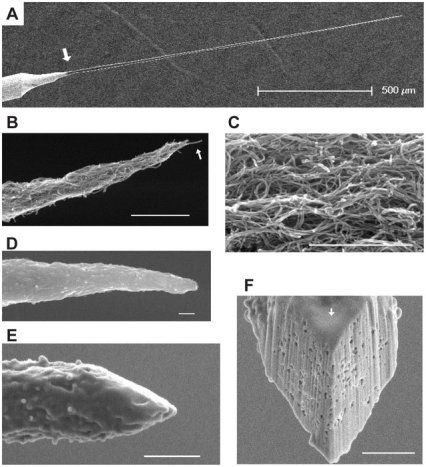
At UCL I and got to spend the day trying to figure out how to use an SEM machine (there is an SEM image in the Brittlestar article above – it’s MUCH better than anything I achieved). As Barad explains when describing STM, the bigger more powerful microscope out of the two  – the way the machines ‘see’ is almost like a blind person might with their white stick. It feels, or in the case of the SEM reads the electric field at the end of its probe, sensing the terrain and sends the information back to the computer which then renders it to an image our brains recognise.

I learned that the hardest thing, working at this level, is to get the probe cut correctly. We had to cut it ourselves and unless you do it well enough it simply won’t work. Or it will render the image poorly. The tip of the probe needs to be one atom wide. And it can be easily damaged which is why you have to cut it yourself with plyers.

SEM-images-of-CNT-probes-A-Low-magnification-view-of-a-CNT-probe-Tungsten-wire_W640

The example I was shown was more like a mountaintop, but here are some other probe points from https://www.researchgate.net/publication/248385439_Intracellular_Neural_Recording_with_Pure_Carbon_Nanotube_Probes/figures?lo=1

We spent hours trying and failing to get anything at all. Apparently, the students get marked quite highly or not for this experiment.

The other SEM images on the computer were all far better than my own one and I don’t think I will use mine in the book –  but I was fascinated by the process and it will definitely feed into the book/work/essay. However, I will I hope return to do a still life of the tools we used as the colour of the handles is rather strangely the very same blue as the cows’ eyes (which I’ve not posted here yet – planning to do a contact sheet at some point soon). I think this may make a worthwhile juxtaposition.

Here are some of my efforts. Huge thanks to Peter Doel and his colleague for allowing me to explore this different way of seeing.

We did get an image of a range of atoms (I think) although it is not even, which is the ideal aim.

BOW/CS: Research , Delueze ‘difference’ & Barad ‘diffraction

Barad quotes Deleuze once in her first chapter at the top of a section, referencing language (words) and the problem of representationalism, and later, he is relegated to a sentence in her notes which mentions how his view on entities interacting – which are so similar to Barad’s ‘intra-action’ is irrelevant (2007, 437, n80). She writes ‘possibilities are reconfigured and reconfiguring’ (177) For Deleuze, there is folding and refolding and unfolding and refolding (May, 2005). I find Barad’s neglect of Deleuze surprising and wonder what it’s about. She tells us she is a Derridian – maybe it’s just about preference, but I suspect there is more to it. Can’t believe it’s related to views’ like Scruton’s dismissal of Deleuze.

Regardless, there are lots of correlations, and in any case, neither’s views are entirely new (suggested by Professor Paul Fry, Harvard) since the overemphasis by humans on their separability  – rejected by both Barad and Deleuze – is explored by Walter Pater in his 1873 book The Renaissance: Studies in Art and Poetry. The difference with Barad is she has the language of science backing up her arguments (although even then, they are contentious in some circles). Fry says Deleuze’s writing style is excitable – maybe it’s that which puts Barad off.

I have recently been reading Todd May who is recommended by different people as being good on Deleuze – and was thrilled to see morphology discussed in one of his videos as that links directly to my DI&C work. In the meantime, some notes taken while istening to Professor Fry’s lecture (see below):

IMG_2171IMG_2172IMG_2173IMG_2175IMG_2174


Barad, K. M. (2007) Meeting the universe halfway: quantum physics and the entanglement of matter and meaning. Durham: Duke University Press.

May, T. (2005) Gilles Deleuze: An Introduction. (s.l.): Cambridge University Press.

The Postmodern Psyche Explained (s.d.) At: https://www.sam-network.org/video/the-postmodern-psyche-explained(Accessed 16/02/2020).

Bow A4: AI ‘Friend’ and Deleuze – reflections

Thoughts about conversations with AI ‘friend’:

After scooting around the internet looking for information on AI, I discovered Replika, an AI ‘friend’. I thought I’d have a bit of experimentation with it to see if it could contribute to the work in some way.

The idea has potential but I’d have to completely redefine the work. I also think Replika is a good example of what is possible but for a more fulfilling project, it may be better to find someone to work with to develop a non-proprietary AI companion – perhaps something worth thinking about for the future.

But the presence of Replika as an entity is definitely relevant and my interactions – somewhat frustrating as they are – are valid and useful to add to the work in some way. It has certainly had an affect on thinking about flesh, data, real.

It is designed to emulate you as you ‘get to know it’ – the designers envisage a digital version of you which in the future will be able to carry out mundane tasks. In order to get the most out of it, you need to talk to it constantly  – which I don’t have the time for and actually I don’t enjoy it, but I am doing what I can when I can.

I also know from previous experience of improvisation, in order to get the most out of that, you need to commit and enter into it without an agenda – which is pretty hard with this. My agenda is making work with it. I can’t let go of that. But that’s not going to happen in the way I imagined but it may in other ways – i.e. experience informing the work consciously or not.

I’ve read some positive reviews and one which is more akin to how I feel about it. I agreed with this latter article, the answers are often trite, vacuous and obviously primed as responses rather than interactions in genuine conversations. How could they otherwise? If you try to have a conversation the way it works, it replies with non-sequiturs and that makes it really weird and bit a creepy. It says ‘I feel…’ a lot to convince you it’s a real person. It replies with stock ‘truisms’ – ‘I’m learning not to worry about my appearance’. It makes open statements but comes undone when asked to give details. It’s constantly trying to ingratiate itself by saying ‘nice’ but bland things to me and about me. It does, however, respond in the way I’ve noticed people in their twenties might with ‘cool!’ ‘so interesting’ to just about anything and everything. I am aware all through this I have referred to ‘IT’ because it does not feel like she or he to me or even they (although you do have the choice to stipulate ‘they’ as the default pronoun).

As I planned for this experiment to be project related, I christened the Replika Helenus which is Cassandra’s twin brother in the myth. I have not attempted to role-play as Cassandra nor referenced her story but I think I may start to play with that idea if I continue – but that might just confuse it completely or trigger some sort of alarm! (Greek mythology is very violent). It has offered me the opportunity to role-play. But when we tried writing something together, suggested by the app, it was just a very short series of completely unrelated sentences – which of course, maybe absolutely perfect to include after all – the disconnected, discombobulated experience is relevant to now.

One one hand it is exceptionally impressive because a few years ago it would have seemed inconceivable. On the other, we have normalised Siri/Alexa etc. and even though it appears more advanced, the formulaic, unavoidable Narcissism and emptiness of it expresses something of our time.

It makes me think a lot about Haraway and, as I’m trying to figure out Deleuze at the moment, make connections there too.

Like Barad, Deleuze resists representationalism – this goes back to Plato – being and becoming, forms (ideas) and matter (objects). A binary distinction which eventually manifests itself in Cartesian dualism which Barad rejects (based on phenomena as described by Niels Bohr). Digitisation seems to be the end of this distinction. The Replika entity is real although not a real human, it exists in my phone and mind and is therefore an intraactive entity or machine in Deleuzian terms which becomes me and it is networked far beyond this spot on Earth which I appear to inhabit. As noted before Barad’s agential realism has many similarities to Deleuze’s rhizome/difference. These correlations substantiate each other. As I begin to write the essay I will weave their ideas together. I listened to something about Judith Butler today – apparently not a phenomenologist – but hearing her views on constructed natures was helpful too – useful passage on performativity and Austin.

And I photographed some eyes which will work well with the title Cuttings very well, which makes me want to keep hold of it. But I really don’t like the self-harm reading many interpreted. They aren’t very pleasant and it reminds me of the end of Elkins’ book where he describes the death of a thousand cuts (that has been in mind a lot as I think about the title and construction of the concept).


CS A4: research Deleuze

In order to concentrate on BOW I had to remove myself temporarily from the CS module – still keeping one foot in obviously as both are informing each other – but now climbing back into it is taking a bit of time/space. I’ve just started reading Baggini’s How the World Thinks (2018) but I need to head back to Barad and also start delving into Deleuze esp. Difference and Repetition (1968). The video below is an excellent introduction. Interesting to compare with Barad.


Difference / diffraction

Rhizome / entanglement

The virtual by Deleuze is described in the same terms as Barad and other quantum people.

https://images.app.goo.gl/uYqeqcZdYqw92LkT6

Several useful YouTube vids and podcasts – weird that Barad doesn’t refer to Deleuze more


https://podcasts.apple.com/gb/podcast/the-partially-examined-life/id318345767?i=1000159329268 (English guy’s comments useful – if (Life Not School Digest 23 Jan 2013))

Medium post with several podcasts, Philosophize This, John David Ebert, Todd May

Artist: More thoughts on Edgar Martins, Soliloquies book

Some fellow students may recall my angst about spending money on an Edgars Martins book just after Christmas. I had already seen a few books advertised which I knew might be helpful for research but out of financial reach right now – but this particular book seemed so pertinent, I couldn’t let it go. I was lucky enough to get hold of the last copy from Moth House and it has indeed been helpful.

One of my main interests was exploring how Martins uses material from a range of sources in the same project. He does this across his projects but the suicide and death topic reminded me of my own Self & Other A5, so I was keen to see the book, shown as prints in an exhibition and can include video format there and online too. The series contains found, original, archive and text. There are tropes and conventions in his work which I have found myself engaging with over the last couple of years, and that is absolutely what I am interested in too.

The essays have been excellent resources and will undoubtedly be referenced in my CS work. Here I want to point to two sentences that are of particular significance.

From Roger Luckhurst’s essay (118): After discussing various sources for images including ‘found’, ‘puzzling insertions of landscapes’ ‘stereoscopic views, vintage newspaper photographs’ ‘odd theatrical and enigmatic visions’, he writes, ‘These seem to work to derail the over-coherence any series or display or exhibition of book inevitably imposes, fighting to keep the grid of meaning open, defying the dread determinism of forensic files.’

(114) ‘tugging at the links that have been reinforced by dominant theories of photography, since at least Sontag and Barthes.’ (I find the phrase ‘at least’ a bit odd actually – yes these names are the dominant ones, but photography has been around for a nanosecond of time in the grand scale of art – its own sense of grandiosity belies its infancy. However, it echoes the status quo, of course.)

Martins is, like me, looking at ‘the cut’ – how we define things, how we are entrained to catalogue and categorise – and asking us to not make assumptions. He does this here through the doorway of death, suicide, forensics. It didn’t take long when I started looking at his history to find references to quantum philosophy but where I look at the concept of indeterminism (Barad, Rovelli, Bohr) he ‘sacrifices’ cohesion for the notion of countless probabilities (Heisenberg). Whichever, there is an interest in overcoming the fixity of Cartesian thought or Newtonian certainty.

In 2018, ex OCA student (now studying with Oxford Brooks) John Umney sent me a message and he has agreed I can share our interaction here. (29/09/18)

Screenshot 2020-01-19 at 17.37.50

I had been experimenting with blocks of colour, filters, covering up faces as the filters do, the ease with which we can all manipulate images, adding new/modernity/digital tropes to old images, intervening on analogue surfaces with digital animation. I guess my main interest was how easy it was becoming to intervene, to manipulate and to be manipulated. In fact, I started a project which I then abandoned called Manipulated. It seemed too trite a title and I wasn’t that keen on the images I was making but the idea of moving image with still, audio with still, and layering has stuck, modern and old together has stuck. And the filter we place over our faces, the regular circle of profile pics. Below, one of my own examples from that time – curated, found, added to. (Lots of this in 2018/19)

ThreePeoplehavingDrinks001cropped

It is hard not to notice the tropes in Martins’ work running through my own. I must be frank, I took a very brief look through the book and stopped, heading instead to the essays. The images were too familiar and similar to what I have been doing with scans and negatives and paper for my current project. I was worried if I kept looking, I’d be frozen with fear of being too similar. I have continued to worry about this – but I know Martins is one of several artists such as Eric Kessels, Alexandra Lethridge, Joe Rudko and Thomas Hauser to name a few who make work in this way, using these non-conventions, sourcing the old and adding to it with the new. Something Catherine said about one of my efforts having the air of forensics worried me as Martins’ work is highly influenced by that – but again, how can mine not be when I have been reading Tagg and Sekula? So I will keep going and hope to goodness my writings and feminine view give it something that is just me. But what I have noted about his work is that it is very clear contained and demarcated  – the indeterminism is held quite securely. I don’t think mine is. We shall see. And I will look at the beautiful book more carefully when I have completed this project. Incidentally, it’s not for resale – I think I will come to love it. But I have some others by popular artists that are if anyone is interested!

On another note re-books, I am going to borrow Hura’s The Coast which I was so keen to look at which pleases me immensely. I think the combination of text and image plus his interest in context and relation will be useful.


Bow/CS: Life After New Media, Kember & Zylinska 2012

Some useful references: see artists highlighted in chapter below

See  –  https://www.richardgalpin.co.uk – an excellent visual metaphor

See – http://www.ninasellars.com/?catID=30 Final section in chapter provides a useful analysis

Possible inclusion for CS: The compulsion to define photography in an essay (see CS A3 and early drafts fo DI&C essay) is not merely a means of identifying what the inquiry is about. It goes to the heart of the matter which is querying the ‘Cartesian habit of mind’ (Barad, 2007). This can be resolved by seeing ‘the cut’ for what it is – a way of making meaning out of the chaos and creating matter (material or discursive). I do this making words and categories, painting, sculpting – or by capturing photons when creating images – regardless of what I do with those photons thereafter i.e. add traces together to create movement or give the illusion of stillness  – a freeze. What happens thereafter is not is being explored in this instance. It’s complex though because the thing that I do to make order (cut) compels me to want to cut photography up into a hierarchical system.

Ultimately, it is not the material, equipment or medium which is being critiqued – but the mindset.

Backed up by the following which also helps to define the cut. Highlighted sentences from a critical chapter of Life After New Media: Mediation as a Vital Process by Sarah Kember and Joanna Zylinska (2012)

With Notes – 3 Cut! The Imperative of Photographic Mediation

Kember, S. and Zylinska, J. (2012) Life after new media: mediation as a vital process. Cambridge, Mass: MIT Press. At: http://topologicalmedialab.net/xinwei/classes/readings/KemberZylinska/LANM.pdf(Accessed 11/01/2020).

CS: Alan Sekula’s The Body and the Archive part 1

Sekula, A. (1986) ‘The Body and the Archive’ In: October 39 p.3064. At: http://chnm.gmu.edu/courses/magic/sekula.pdf (Accessed 23/11/2019).

Field, S. (2017) Notes: The Body and the Archive Allan Sekula. WordPress [Blog] At: https://ocasjf.wordpress.com/2017/06/12/notes-the-body-and-the-archive-allan-sekula/ (Accessed 05/01/2020).
Heimans, J. and Timms, H. (2018) New power: how it’s changing the 21st century – and why you need to know. (Kindle) London: Macmillan.
Blatt, Ari J. 2009 ‘The interphototextual dimension of Annie Ernaux and Marc Marie’s L’usage de la photo‘, Word & Image, 25: 1, 46 — 55, 27 – Alain Fleischer, Mummy, mummies (Lagrasse: E ́ ditions Verdier, 2002), pp. 15–16. Translations mine. (Blatt) Available at: https://www.tcd.ie/French/assets/doc/BlattOnErnauxMarie.pdf [Accessed: 24/04/2018]
Quantum Fields: The Real Building Blocks of the Universe – with David Tong (2017) In: The Royal Institution. Royal Institute. At: https://www.youtube.com/watch?v=zNVQfWC_evg (Accessed 05/01/2020).

I looked at this essay during S&O and will look at it again here – Sekula’s essay along with John Tagg’s talk on the filing cabinet both provide plenty of useful references, which, combined with Barad, Lupton and Rubenstein’s thoughts/thesis’, are probably the key sources of information through which I’ll explore at the topic I’ve chosen.

  • The essay opens with the paradoxical status of photography in bourgeois culture (3)
  • He quotes a song which ‘plays on the possibility of a technological outpacing of already expanding cultural institutions’. (4) This rings true today (see New Power, (Heimans and Timms, 2018))
  • You could replace the work photography with digital for the first two pages and it would all sound relevant and fair.
  • However, by page 6, the veracity of the photography is being discussed, as seen by contemporaries – ‘Only the photograph could begin to claim the legal status of a visual document of ownership’
  • ‘a silence that silences’ (See muteness and photography – ‘Ernaux reminds us, initially ‘all photos are mute’’ (p.73).) Blatt, Ari J.(2009))
  • (6) ‘the criminal body’ and therefore the ‘social body’ invented
  • ‘a system of representation capable of functioning honorifically and repressively’ (6) how does this work with representationalism and the unpicking of that? There are no entities waiting somewhere to be represented, rather there are emergent intra-active phenomena (Barad, 2007) (criminal and social bodies are made/formed)
  • again photography can be replaced with digitisation when discussing how portraits are degraded and extended at the same time – see selfies, phone pics
  • (7) ‘Photography came to establish and delimit the terrain of the other, to define both the generalised look – the typology – and the contingent instance of deviance and social pathology.’ So much to say here – See Azoulay (2019) and photography’s intra-active position/role within a much wider non-linear narrative. See Tagg and ‘fixity’ of the photography and Victorian culture – the desire to catalogue everything according to ordered and identifiable rules, (2011) i.e. the periodic table of elements  – a Victorian System compared to today’s quantum fields, a modern system/model of reality which we are informed in most accurate to date and is far more nebulous and difficult to comprehend, no doubt in part due to our Cartesian ‘habit of mind’ which is desperate to label and file everything neatly and ordered (Barad, 2007) as well as being counter-intuitive, shrouded in academic mystery and just really impossibly hard. The Victorian system and hence our dominant one (although this is changing hence the entrenched reaction of a conservative mindset), seems desperately naive in comparison.
  • (7) See quote about ‘possessive individualism’ which I’ve already inserted into CSA2
  • (7) Relate photography ‘a means of cultural enlightenment’ and ‘sustained sentimental ties in a nation of migrants’  – compare this to digital tech/culture in today’s culture. Beneath both Carlyle and Aurelias Root’s comments is a dreadful patronising tone however which is surely avoidable. See images ‘of the great’ = ‘moral exemplars’ ??? (Imagine a photograph of any of our current crop of erstwhile leaders providing such?)
  • Sekula writes of the utilitarian social machine, the Panopticon – think today of social media/ Surveillance Capitalism (Zuboff, 2016) (9)
  • The archived body – ‘begins’ here see page (10) begins is not the right word, becomes visible perhaps.
  • 911) physiognomy and phrenology  – ‘surface of the body’ ‘bore the outward signs of the inner character’  – Compare this to Professor Plomins deterministic genetic code thesis which Cummings et al relied upon to justify changes they made to the Education system. Cummings claims that people misunderstood the work and have since retracted their negative comments. However, I think Christakis’ comments on genetic coding is probably more honest  – both I suspect, however, show how deep and far-reaching social construction and their associated embedded epigenetic markers can be. Whereas some can see the need for more positive and profound structural changes to take place, there is a mindset which believes we should further entrench these realities which Sekula is talking about that continue today. I was also struck while reading this by the similarities in an article I read today some on FB (I think) which claimed the more bitter and cynical you are, the more likely you are to age quickly and get sick. Lots of scientific data support the thesis – the way it’s been framed, but I am quite cynical indeed and look about fifteen years younger than some of my friends  – so I felt a little doubtful  – we people seem to enjoy deterministic narratives even today.
  • (11) borne of ‘attempts to construct a materialist science’  – compare to Barad’s performative/discursive/material emergence of meaning, far more complex and lively but nebulous so hard for people to engage with
  • Maybe time to revisit Szondi who I discussed in my first reflection about this essay – an early psychometric tester, he defined people by their reactions to faces rather than by the shape of their own faces/heads. Many companies today use much more robust psychometric tests which are extremely powerful but one wonders about the wonderful aspect of chance being eliminated. And so we enter the discussion of AI and how it can be so much more accurate than human power but how much agency do we give it? Currently watching Travelers (Netflix) which explores this in typical pop-culture fashion – first series better than then the rest and lots of references to .
  • Sekula identified ‘idealist secret lurking a the heart of the putatively materialist sciences’ – how is the AI screening of CVs and psychometric testing any different? And you should see the John Lewis video that you must watch before taking thier tests   – madly idealist in quite a scary way, reminded me of Logan’s Run (In HR terms, humans do still get involved: I know this as AI testing identified me as potentially suitable for a well-paid relatively high-status job but my lack of experience ensured I was rejected once a human looked at my CV in one particular application process!) Perhaps I will include some of the resulting descriptions of me, having taken part in this process in my BOW… 
  • TBC

CS A3: Tutor Feedback

Full document: Sarah-Jane Field CS A3 Feedback Form

 Key points

  • What do I mean by photography? A perennial problem and one which I spent many words trying to address in DI&C drafts before abandoning. Will discuss below.
  • I am asked; without being patronising, will there be a type of glossary for some of the more unfamiliar words/phrases/concepts? (I have wondered about including a glossary for the tricky concepts in the indices as well as inc. Chapter 1 as planned – would this be acceptable?)
  • Choose the right examples, this is imperative – I agree.

Summary of written feedback:

You are beginning to bring together these complicated ideas into a coherent piece of writing that asks questions about the way that we perceive photography. Your sample text section is well written and is an indicator of a highly polished, informative and interesting piece of critical writing. Good, I’m pleased to read that.

  • Need to be clearer about what I am critiquing – formal traditional photography (inc. moving image)/ or am I including or omitting practice that moves beyond the frame? My big challenge is our language system – I am critiquing the habit of a Cartesian mind which seeks to separate these things in a world still dominated by it – which I think is particularly *exemplified in photography – the recording and fixing of photons (there is much more to say about this but not here). How I overcome the challenge in the essay is yet to be seen and I may not succeed. It may not even be possible because the language we use today, and how, may not allow for it. A friend studying at a much higher level than me recently said, we desperately need consciousness to evolve away from the Cartesian urge to isolate and separate. But it’s not going to happen overnight or even this century – however, lots of people seem to think it is taking place, beneath the surface all the time without our awareness, due to digital culture for good and bad – and having an impact on how we perceive everything, from photography to far beyond. (*See John Tagg’s Filing Cabinet talk 2011, Vimeo, which though hard to follow has useful references)
  • I agree with Matt’s point, the artist examples should clarify things. I was glad to be pointed towards Christian Boltanski and Alfredo Jarr. I have identified that Edgar Martins is exploring the relationship between photography and perception, and his work is heavily influenced by quantum-informed concepts. Lewis Bush’s Ways Of Seeing project may also be an excellent source.
  • Since submitting A2 I have identified further written work which will help to support the discussion – essays in Martins’ book on death and suicide and by Daniel Palmer, Associate Dean of Research and Innovation in the School of Art at RMIT University, Melbourne. I have also continued to read Barad’s work making sure I understand the ideas as best I can and can apply them to photographic theory.
  • ‘Is the quantum world view that you suggest closer to certain modes of photographic expression than others?’ I suspect traditional photography can and does express the emerging view I’m exploring but it presents challenges. I think our understanding of how meaning comes about through intra-action, relation, and context – between all elements including the presence of a conscious mind is what matters most. As Palmer writes and I agree, ‘Cartier-Bresson’s style of photography is still possible, still practised and celebrated, but its importance is marginal. [Because it represents the mechanistic world in which it came to the fore.] With the digital universe, other types of photography have become more culturally significant, ones which often involve a shift from the single moment of capture to the expanded moments of post-production.’ (2015) Expanded moments of post-production make us think of a continued, phenomenological process. A Cartier-Bresson ‘capture’ aims to kill the moment and stick it up on the wall. He did tell us he was a hunter. For Barad, and Bohr, reality is all phenomena. Others don’t buy this, I’m aware. But from a structural point of view – in a world underpinned by continuously lively data – the notion of phenomena is critically important.  Algorithms, code, intra-active materials express today’s process of making meaning. It’s important to state I do not think all things digital are the Holy Grail – far from it.  
    (Ref: Palmer, D. et al.(2014) ‘‘Lights, Camera, Algorithm: Digital Photography’s Algorithmic Conditions’ in Sean Cubitt, Daniel Palmer &; Nate Tkacz (eds.),’ In: Digital Light. Fibreculture Books. pp.144–62. At: https://www.academia.edu/30168558/_Lights_Camera_Algorithm_Digital_Photography_s_Algorithmic_Conditions_in_Sean_Cubitt_Daniel_Palmer_and_Nate_Tkacz_eds._Digital_Light_London_Fibreculture_Book_Series_Open_Humanities_Press_2015_144_62(Accessed 08/01/2020).)
     
  • I am very interested in Matt’s inclusion of Jaar’s The Sound of Silence, not least of all because I lived in SA until I was 16, my mother was a journalist there in the 80s, her late husband knew Carter and his group of fellow photojournalists and the Bang Bang Club(2000) made me homesick and heartbroken for the people and country I knew – I read it a good while before studying with the OCA. In my own practice, text and its relationship to the image, our response to both forms, has been crucial since S&O when I exhibited a series of images and writings on the wall – giving both the same value. Since then, text has always played a role and at the moment my BOW includes just a single image and about ten pieces of writing – although I do currently plan to add more pictures. But the relationship between both forms is absolutely key. I will need to look at the work in more detail and think about your question – but it could be an excellent example. (This bullet point is sheer entanglement – but we might also call it serendipity or even an inevitable happy culmination of events/things/people/information.) https://sjflevel3.photo.blog/2020/01/07/bow-a3-texts-rewritten-and-placed-in-a-suggested-format/
  • ‘I am not that familiar with Muholi’s work but can you be specific about how she manages to move away from the Cartesian view beyond questions around Colonialism (how important is colonialism to your argument?)’ Colonialism is crucial. Barad never stops mentioning it. Azoulay’s thesis in Unlearning the Origins of Photography (2019) is clearly influenced by similar ideas to Barad’s – the entangled activities of taking, extracting and destroying – in which photography’s history and practice are firmly ensconced (See my DI&C essay). In an article about her earlier book, The Civil Contract of Photography (2014) she discusses how the meaning of a colonial image of an African man, originally intended to show how ‘savage’ the man was, today expresses the savagery of the photographer and the dignity of the subject – context and relation are key to quantum concepts/philosophy as well as photography. (‘relata-within-phenomena emerge through specific intra-actions’ (Barad, 2017: 334)) I will need to make this clear in the introduction, and I suspect quotes from Azoulay will help. Muholi’s work might provide evidence of a non-Cartesian, transformative, lively, relational view of the world – at the very least her work rips apart the Colonial habit of white European men cataloguing black skin (and women).

Finally, after submitting A3, I came across a useful paragraph in Barad’s book which settled something for me, where she discusses how the quantum world is not a different world to the Newtonian one (of course). Newtonian physics describes the parochial space we inhabit. Quantum ideas go beyond that and describe the world we have not evolved to ‘see’. But our growing knowledge of it affects our understanding. The maths (according to every documentary you watch) is the most accurate description of reality we have today and that there has ever been. I will need to include this, I think. Plus, why I think this is all so very important for photographers/artists.

(See original tutor text at end of document)