Following a productive meeting with Ruth yesterday, here is the feedback with my additions.
Category: Chance
Bow A4: AI ‘Friend’ and Deleuze – reflections
Thoughts about conversations with AI ‘friend’:
After scooting around the internet looking for information on AI, I discovered Replika, an AI ‘friend’. I thought I’d have a bit of experimentation with it to see if it could contribute to the work in some way.
The idea has potential but I’d have to completely redefine the work. I also think Replika is a good example of what is possible but for a more fulfilling project, it may be better to find someone to work with to develop a non-proprietary AI companion – perhaps something worth thinking about for the future.
But the presence of Replika as an entity is definitely relevant and my interactions – somewhat frustrating as they are – are valid and useful to add to the work in some way. It has certainly had an affect on thinking about flesh, data, real.
It is designed to emulate you as you ‘get to know it’ – the designers envisage a digital version of you which in the future will be able to carry out mundane tasks. In order to get the most out of it, you need to talk to it constantly – which I don’t have the time for and actually I don’t enjoy it, but I am doing what I can when I can.
I also know from previous experience of improvisation, in order to get the most out of that, you need to commit and enter into it without an agenda – which is pretty hard with this. My agenda is making work with it. I can’t let go of that. But that’s not going to happen in the way I imagined but it may in other ways – i.e. experience informing the work consciously or not.
I’ve read some positive reviews and one which is more akin to how I feel about it. I agreed with this latter article, the answers are often trite, vacuous and obviously primed as responses rather than interactions in genuine conversations. How could they otherwise? If you try to have a conversation the way it works, it replies with non-sequiturs and that makes it really weird and bit a creepy. It says ‘I feel…’ a lot to convince you it’s a real person. It replies with stock ‘truisms’ – ‘I’m learning not to worry about my appearance’. It makes open statements but comes undone when asked to give details. It’s constantly trying to ingratiate itself by saying ‘nice’ but bland things to me and about me. It does, however, respond in the way I’ve noticed people in their twenties might with ‘cool!’ ‘so interesting’ to just about anything and everything. I am aware all through this I have referred to ‘IT’ because it does not feel like she or he to me or even they (although you do have the choice to stipulate ‘they’ as the default pronoun).
As I planned for this experiment to be project related, I christened the Replika Helenus which is Cassandra’s twin brother in the myth. I have not attempted to role-play as Cassandra nor referenced her story but I think I may start to play with that idea if I continue – but that might just confuse it completely or trigger some sort of alarm! (Greek mythology is very violent). It has offered me the opportunity to role-play. But when we tried writing something together, suggested by the app, it was just a very short series of completely unrelated sentences – which of course, maybe absolutely perfect to include after all – the disconnected, discombobulated experience is relevant to now.
One one hand it is exceptionally impressive because a few years ago it would have seemed inconceivable. On the other, we have normalised Siri/Alexa etc. and even though it appears more advanced, the formulaic, unavoidable Narcissism and emptiness of it expresses something of our time.
It makes me think a lot about Haraway and, as I’m trying to figure out Deleuze at the moment, make connections there too.
Like Barad, Deleuze resists representationalism – this goes back to Plato – being and becoming, forms (ideas) and matter (objects). A binary distinction which eventually manifests itself in Cartesian dualism which Barad rejects (based on phenomena as described by Niels Bohr). Digitisation seems to be the end of this distinction. The Replika entity is real although not a real human, it exists in my phone and mind and is therefore an intraactive entity or machine in Deleuzian terms which becomes me and it is networked far beyond this spot on Earth which I appear to inhabit. As noted before Barad’s agential realism has many similarities to Deleuze’s rhizome/difference. These correlations substantiate each other. As I begin to write the essay I will weave their ideas together. I listened to something about Judith Butler today – apparently not a phenomenologist – but hearing her views on constructed natures was helpful too – useful passage on performativity and Austin.
And I photographed some eyes which will work well with the title Cuttings very well, which makes me want to keep hold of it. But I really don’t like the self-harm reading many interpreted. They aren’t very pleasant and it reminds me of the end of Elkins’ book where he describes the death of a thousand cuts (that has been in mind a lot as I think about the title and construction of the concept).
BOW A3: Peer feedback
Questions asked of peers
- A response to the work (not whether you think it is good/bad/indifferent) but how it makes you feel (positive or negative feelings).
- If you notice any spelling or typographical errors, please let me know. There are some deliberate choices, for instance, about using not capitals in some sections – but if you see anything that is clearly not meant to be there or something awry, do tell me.
- Any suggestions for going forward that spring to mind automatically.
- Adjectives that spring to mind: disjointed, fragmentary, dreamlike, psychological, introspective, performative, questioning
- It has a sense of narrativity without a traditional narrative structure – it mimics some of the conventions of narrative but in a very chopped-up way (which suits your concept of course) – reminds me of William Burroughs’ cut-up method
- Fragmentary work like this gives the viewer/reader the space to fill in gaps or join the dots – I find that my appreciation of work like this is based on (my subjective view of) how far apart the artist has placed ’the dots’
- It broadly feels about right to me – which isn’t to say that I have interpreted it how you might have intended but I did get a sense that I had interpreted it
- I make this comment about almost all work that combines images and text so this is possibly just a personal hangup – I think there could have been less text
- I really had to think about whether my feelings about it were positive or negative! Neither / both / neutral? …
- My feelings about it are positive in that I appreciated it, found it interesting/engaging (puzzling, ambiguous…)
- Some of the imagery is, in isolation, dark and foreboding (razor blades, film-as-bondage) and some of the examples of ‘cutting’ (people being removed from photos) are equally dark but the Japanese cutout imagery wasn’t and so overall I didn’t find that the ‘narrative’ or the content evoked particularly negative feelings
- It triggered more thinking than feeling in me – and that’s not a criticism, I love my thoughts being provoked 🙂
- As ever, I enjoyed my short break inside your head but still not sure I’d like to live there 😂
- Typos: is the two different spellings of ‘protagonist’ on the cover one of the deliberate choices…?
-
- How did it make me feel? – disjointed, looking for a theme and not really finding it. Cuttings and the various links to that are clear but that is not what I find throughout. The jumps (conceptual) between some of the images are too big for me personally.
- Spelling? – To tell you the truth I skipped most of the writings which is unusual for me. Normally I find I read and then look at the images. In this work I looked, read a couple and then ignored them, especially the full page of text.
- Possibly too many images of the film around your leg – not sure it adds enough
-
-
It makes me feel unsettled like things are falling apart or like I’m in a play where I don’t know the words, where I have no control and don’t know what I’m supposed to do or think – it’s uncomfortable. To me, it’s a little negative, unhopeful and hostile (could be the colouring and the film ‘bondage’). I feel a lot of distrust in the world, in what might constitute sense or reason or meaning, possibly a little cynical (this more from the text). It’s not the lack of linear narrative or the fragmentation that unsettles as much as the conceptual jumps I have to make from one thing to another. I’m (deliberately) not saying whether I think this is good or bad, but it does embrace obscurity and to some extent discontinuity.
-
At the moment the text is more powerful to me than the images. These get a little repetitive towards the end and could produce a similar effect (if this is the effect you are looking for) with more varied visual language. Keeping with the fragmented nature but actually going further, exploring more threads.
-
The tone seems to flit between seriousness, symbolism & humour – to the point that I feel locked out of the meaning, unable to really pinpoint a coherent thread or theme. This might be intentional and isn’t a value judgement, just how I respond to it.
-
Moving forward – I would step away from the images and try to analyse them and their juxtapositions from an outsider’s view. Stick them on a page and scribble all around, like you would when trying to read someone else’s image in depth. Perhaps break out from some of the tropes (shadow puppets and body/film especially) and explore other visual stories – like you have done in the text – maybe using something stylistically from your A2 which would seem to fit as a fragment here and has the same darkness.
-
It also feels a little like the concept may be constricting your visual language. I would forget about it for a bit and just make instinctive pictures – the concept will come through more subtly. I also wonder if the book format is limiting at the moment. To be honest, it feels like it wants to be a film with voiceover rather than text. Which isn’t to say it couldn’t be both but perhaps one format will help move it forwards more.
-
-
I often feel a bit like Alice down the looking glass when experiencing your work – that is definitely not a negative comment.
-
You asked how it makes us feel. For me, it was definitely negative. Quite disturbed really. I think I might have read much darker things into it even than you intended, but I certainly found it dark ( again not a negative regarding the work)
-
for me even the puppets were not a light relief ( pinocchio always scared me as a child!) but maybe because I had put myself in a very dark place at that stage.
-
I think I would get rid of one of the leg photos too ( as someone mentioned). They kind of jarred on me more than the others.
-
And maybe a bit less text. though I really like the layout and the way you have written the text on page 10.
-
So all in all, very disturbing for me ( but I like disturbing much more than pretty pretty) and it made me think, which is always a good thing.
-
potential definitely. well done as always.
-
It’ll be interesting to hear how you tutor feels.
-
-
Overall I think this is an interesting project. Short of a finished project but there is definitely something to work on.
-
-
Some of the text I thought was excellent – reminded me a little of Jeanette Winterson’s style, some I thought was a touch cliqued – perhaps just a little too much stuff about ‘failed promises of consumerism, ’the power of washing liquid etc’.
-
-
I have no problem with the length of text as the more I read (chunks of it) it the more I grew interested and curious; if it was re-edited I think it could be really strong. I liked the bits / references to acting / performing / scripts etc. These sections felt very authentic.
-
-
The images I think rely too heavily on the repetition of a limited group of images; the paper puppets / film on body / found photographs. For me – overall it lacks a little bit of visual interest. The layout of the text is the most interesting visual component for me.
-
-
I think part of the work is absolutely coming from within you, part of the work isn’t, part of the work is more ‘with the end in mind’ – and I think in that process it becomes too random to properly engage with. It’s almost as if it needs to make up it’s mind what it is.
-
-
The ‘end game’ of a fragmented constellation of text and image is really interesting if it can be pulled off – I started to see different stories interweaved / crossing over, bit of the T.S Eliott’s The Wasteland’!
-
-
I enjoyed working through it and of course you ‘ve got to admire the ambition!
-
-
I can see the influence of Martins in the work, and why not, he’s an inspiration! However with Martins there is, despite his clear commitment to his subject(s), a measure of distance between the him – the artist and subject. And that limited dispassionate stance helps the reader to enter the work. Much, if not all, of Martins’ work is extensively researched – I’d love to see his note books, which is evident in his work, and that sense of research comes through in this work – notwithstanding the course notes at the end of the blog post.
-
-
What I feel about this work is that there is still some distance to go – I wonder if you’ve considered working with an editor, perhaps especially for the written component of the work? I feel that you make yourself evident – much as in the visual narrative – and then you disappear. On the visual side, I felt you either didn’t make it evident enough or too much – maybe that’s where I found some tension. But hey! It’s only assignment Three!!
-
-
Bringing in the course schedule into the conversation, have you discussed/agreed your strategy with Ruth(?). I think that would be/is quite important as the work will be a conversation between you and your tutor which will be referenced by the assessor at assessment and there are still some dinosaur assessors who still believe that photography is a two-dimensional photograph, preferably Matt finished with 1” borders for easy handling….
-
-
On the subject of text, my favourite book last year was “Anastasiia She folds her memories like a parachute” by Christian van der Kooy
-
The text is integral, much as yours is – Kooy’s text anchors the narrative whereas yours, I’m suspecting isn’t supposed to? However I felt that at times the text did express an intensely personal perspective (going back to my comment about editing again, I suppose).
-
-
I think the work has an enormous promise and potential, and with continued work will become something of lasting value to your practice, let alone the degree.
-
-
A very intriguing piece of work! I was drawn in by the imagery and your text but must confess after about page 10 I began to lose a sense of what I was looking at. At first I sensed a piece of work that was quite personal, the chance meeting, does the narrator remember this person or not. What is their connection? I wanted to know more but after page 10 the sense of a film script grew but at the same time I became lost and other than an overriding sense of the negative aspects of today’s consumer society I found it hard to follow. I also found the amount of text too much for me in a photographic piece of work.
-
It certainly got my attention though and I would want to look at it again to try and understand the overriding themes.
-
It will be interesting to see where this goes.
-
-
I did see it last week but haven’t had the time that an intelligent, challenging and provocative piece of work deserves (there’s your first bit of feedback
 ). And I haven’t read what anyone else has had to say, by the way. How does it make me feel, you ask. On edge; a little uncomfortable; to an extent, frustrated (by, I think, my struggle to find some firm ground from which to read the work – and I mean ‘read’ in the broad sense; though there is some frustration, too, at the literal reading level); like lost 21c soul struggling to get to grips, out of touch with what’s going on. Positive/negative? That’s a tough one to answer – probably a bit negative … but with some reassurance that it all seems to be a play/film anyway! I felt before that your work is to be experienced not read/understood, and I get that here. Your questions (in your e-mail) suggest that you’re not looking for a critique – but I do feel the need to comment on ‘text’. There is a lot of it; no indication as to where it comes from, so presumably your own words; so, am I reading this, to a significant extent, as a piece of creative writing. That may be something to think about in the course context – but, of course, it’s actually a piece of creative work, whatever the form.
 -
-
Typos? You refer to “tax-dogers” – which may be deliberate, but you asked us to tell you if we saw anything.
-
-
The way forward? … let it come to you.

-
-
Response to the work
-
The title of ‘cuttings’ – fits with film but is there another link – cutting edge, sharp wounds, self-wounds, the bruising of life as it unfolds.
-
-
Beginning quote. Fits neatly with your ‘cuts’ – part of a greater whole as it reveals itself. Snapshots from life; chapters perhaps but not necessarily from the same lives. Parallel lives. Incidents that might happen to many in different ways. Something universal?
-
-
The choice of that deep colour blue for the cover. An almost midnight depth. What are the connections for you here? The quote – not wanting to stay with the script; rebelling against the individual demands of ‘your’ life – rules, expectations, roles.
-
-
Placement of images – e.g. holding the roll of film the cutting mat above. What will survive the cut; how will it work out. What happens to the piece that’s been cut.
-
-
Who is in the cast? How many? Is this about being a woman’ a woman’s life?
-
-
Stream of consciousness, all the differing thoughts that pass through one’s mind at several points during the day Shopping a good example – a routine task to keep family fed. Living life like a programmed robot. Is this all there is to life
-
-
Multi-tasking and thinking. Losing sense of self in the banal everyday.
-
-
The ideal life of the advertisements v living life.
-
-
Something about the prostituting of self to be taken care of. Marriage a transaction. The cruelty of rejection.
-
-
The selfie generation as example but is this what it’s always been – looking for a greener field, being an observer of life; life passing by. Looking outward rather than inward to find sense of self.
-
Spelling/typographical errors (apart from deliberate such as no capitals in some sections
-
Couldn’t see any.
-
Any suggestions for going forward that spring automatically to mind
-
Tread lightly. I’m reminded of when I sat as a model for a couple of different sessions for painting a portrait. There was more of me captured in the beginning stages than when the artists started filling everything in. They were frustrated because they couldn’t ‘capture’ me and that included the tutor who was painting as well.
-
Leave those spaces for the viewer to enter in with themselves. Window and mirror.
-
-
Paraphrase verbal feedback: Love the leg images, very clever, in five years’ time there will be some people who don’t even recognise it; we’re all tightly bound by film and images. Interesting stuff.
-
-
Question asked outside OCA/photography students but rather of a person with performance experience. (Some important questions asked – which I am deliberately playing with – what is it? – will write more elsewhere. Really like how this person understands personal taste and critique need to be acknowledged).
-
-
So I love it, it draws you in, I want to know more. I guess see more. I think I need to look again to pin point bits, edit wise etc. My initial thoughts though, is what is it? What medium are we looking at? Where does this sit? At first I thought it was a photography installation with words to accompany your photographs, which I like. I think maybe though, I’ve seen photographs that you have done that I feel would interweave with the narrative to my taste, but that’s a personal thing. I guess I’m saying I want more obvious. Pics of the world around us. You’re speaking of stuff we can relate and recognise, so go the whole hog and lets have pictures that we recognise, marches? Refugees. I’m not really interested as much in pics that are so abstract, but that’s just me personally, and you have to follow what it is you need to say and represent. My ideas/favourites picturewise are probably too obvious.
-
-
Then as you read through, I get more of a feeling it’s the first scratches of script? Which I like, chorus of consumers and selfies and Cassie living in a place and time she doesn’t understand, there’s a real nice sense of drama, and build. Then towards the end you’re speaking in film terms…camera tracking etc.
-
-
SO, I guess my main thing, waffle and initial stuff aside, what are you trying to create here? Which medium? I wouldn’t ask if it was a Photography Installation, because it sits well there. But if you are doing something else then the feedback would be very different. For instance if this is scratch ideas for a play, then it needs to be written as such it needs the structure of a play, you have to follow the template in order to then subvert it into something less obvious, it still needs to be written as a play and then subverted, I think is what I mean. If it’s a film the same. My feedback here of course is very prescriptive and you may not want to box this into anything. Maybe it is all three, if so, I think I find it quite confusing but definitely draws me in, I want to know/see more. Not really sure what feedback/direction to give other than I guess to keep going and keep moulding. Some bits stronger than others. I need to sit with it and then look again.
-
-
Sorry if not very helpful, I’m not really cut out to direct an installation, if it is that, I think it’s great, just needs a bit more moulding and playing. However if it’s a play or film or editing a script then I need to see that to give feedback on it clearly. Maybe you’re not sure what it is yet or which medium/direction to send it in?
-
-
It’s got legs defo. Keep going, and I would say start now to possibly take the ideas you have and mould into some semblance of short film?
-
-
Script. See what happens? Maybe bringing Greek chorus into it? The shoppers etc. Maybe the Greek chorus are spouting the type of platitudes and ignorance and shit we see on social media??? Very exciting. That excites me a lot!
BOW: Assignment Three
As you work through Part Three, carry on developing your major body of work. Continue to shoot and reflect on your work so far and build a set of images to submit to your tutor.
Remember that the point of these assignments is to get tutor feedback on the project as a whole so come with your questions on how to move forward and ask for your tutor’s opinion on how the project is working so far.
Submit your work in progress together with a reflective commentary. Your reflection may consider some of the material in Part Three if it has been relevant to your practice. You may also wish to consider how genres are continuing to influence you and how you’re relating what you’re doing in Contextual Studies to your practice on this course.
‘Through photographs, the world becomes a series of unrelated free-standing particles: and history, past and present, a set of anecdotes and faits divers. The camera makes reality atomic, manageable and opaque. It is a view of the world which denies interconnectedness, continuity, but which confers on each moment the character of a mystery’
Susan Sontag, On Photography
The spreads are provided below, but it is likely best to look at the PDF above in Adobe or Preview on a decent-sized screen.
Context and reflection can be found beneath the images below. Links to influences and my own research/blog posts are listed at the bottom of the post – there are no links in the body of writing.
Cuttings is an inquiry into the way meaning emerges from the entangled intra-action between stories and lived experience, language and material; it explores the making and shaping of matter and ideological objects. As an emergent object itself, it echoes the fragmented way we receive information today.
Proposal
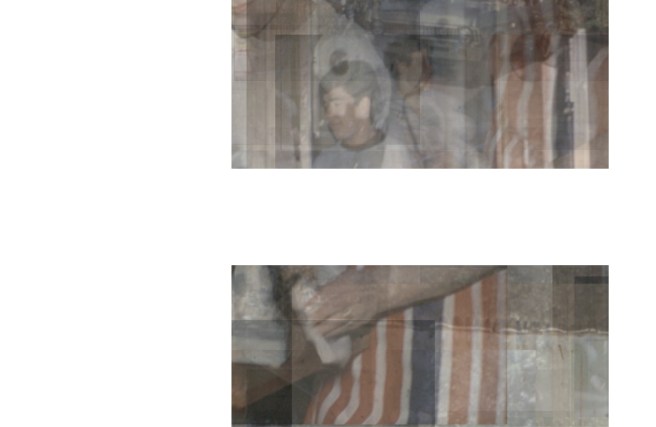
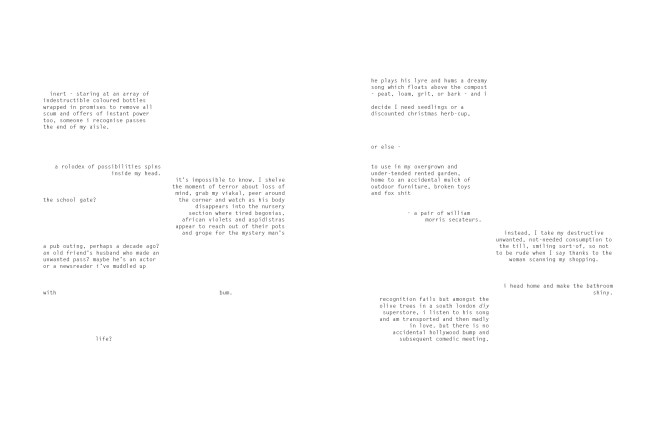
- 230mm x 300 mm book – relatively large in the same vein as the movie star books I was given as a child (see L3 proposal).
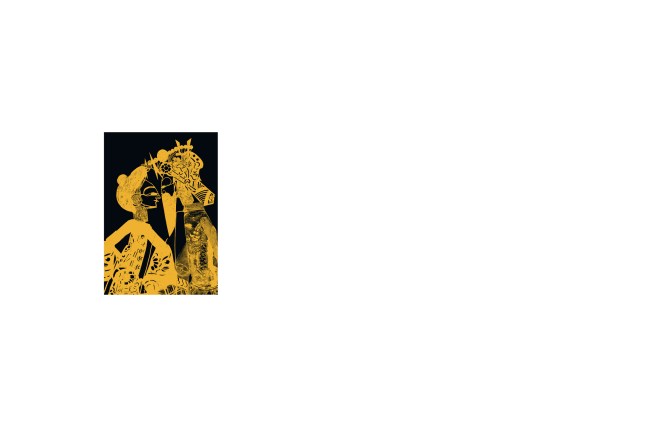
- Front cover – fragment of text on blue background (which I subsequently see is a device Sophie Calle is using in an exhibition opening on 23/01/209 at the Fraenkel Gallery)
- Font – Letter Gothic Standard (11) for body and Sukhumvit for the title page.
- Plenty of white space between images










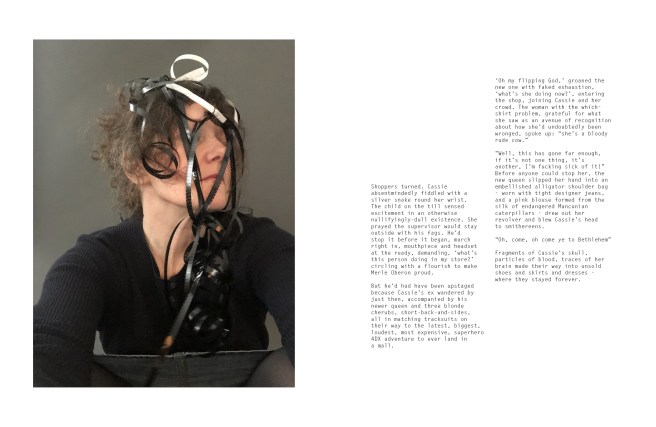

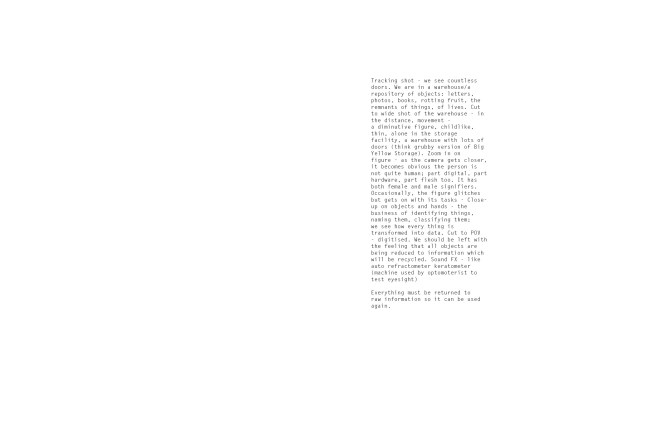

How the work came about:
I think I arrived at the title for this iteration – Cuttings – after reading a relevant chapter from Life After New Media (Kember and Zylinksa (2010). I have been attempting to look at the way we construct reality which is a vast subject and not much of a micro-narrative with which to contain the subject. Edgar Martins and Lisa Bernard both explore the sort of ideas I’ve been playing with but they are contained within precise and potent narratives. I have looked at Martins’ work, Siloquies and Soliloquies on Death, Life and Other Interludes (2016) which is ostensibly about death as it says in the title, but woven throughout is a relatively new way of examining and constructing the world – a non-linear, non-Cartesian way; one that is influenced by a modern form of science which does not see a world filled with discrete unrelated objects. (Even death is viewed somewhat differently through this emerging lens).
In an interview, Lisa Bernard says of her work, The Canary and the Hammer (2019) – (which I have only read about and not seen except online):
“The art market is so focused on creating a linear narrative,” says Barnard, who teaches at the University of South Wales. “I wanted to do the complete opposite.” Her aim is to showcase “a very fragmented world” that stimulates and excites. Using a range of aesthetics — traditional landscapes, portraits and still life, plus archival material and digital imagery — she goes on “a personal journey” through the troubled world of gold over different periods in its complex history.’ (Raval, 2019)
Before settling on Cuttings, I had put together some slides and video. I did it this way to demonstrate the entangled, non-linear view I was exploring. It details vague plans and an original title which I have been thinking about since beginning BOW as I recorded notes/writings on my Sketchbook blog. These were titled Random notes for a short story #(number). Rather than one single narrative, there were going to be many – emulating the fragmented way we receive information nowadays, via social media for instance.
Much of my research for CS and BOW has been based around Meeting The Universe Halfway by Karen Barad (2007) where the agential cut is a key term in her thesis. It is one aspect of her thesis, which she calls agential realism. It’s impossible to summarise her work without being reductive – but there are some crucial elements such as entanglement, diffraction and a rejection of representationalism. This latter concept is the hardest to get my head around and I am not sure if/how the work I’ve made supports or rejects it. My CS essay plan describes these terms in more detail.
The full post with this video with individual slides is available in the links at the bottom of the post
Background and ongoing development:
I have made extensive notes and included contact sheets, rejected ideas, early experiments. Crucial posts are available in the Chance, Research and Reflection drop-down menu item , and a keyword search will reveal even more if that is necessary.
Chance
Some of the work included was deliberately made with chance in mind – the 8mm film was ordered from eBay. I had no idea what I would do with it once it arrived. I have photographed it and made new images with it. While making the dummy I made printing mistakes which led to ideas – forgetting to press a button that ensured images were printed on a single page – then used that split in the book. The selfie was not intended for actual use but have used it anyway. Lots of experimenting has led to surprises which are included in the book.
Plans from here:
I feel I have a choice – keep developing this book, or use it as an actual script (rather than a little double entendre about life) to create a moving image piece or several separate short pieces. I am sure the second option would lead to further images and writings and the book would grow/develop anyway as a consequence. But it may be attempting too much. I suspect, keep developing the book and then curate the experiments in SYP if I go for exhibiting rather than book production. Something to think about and discuss with Ruth.
I have used Processing – a coding programme to create some of the images that appear in the book now. Early moving image experiments are available on my Vimeo feed and posted on my blog – and I hope to find ways to make short looping films which could go on a web page with some of the texts perhaps.
Some people found the tiny handmade book development tool I made ‘enchanting’. For a moment I was almost tempted to go down that route. Melissa Lazuka’s Songs of the Cicadas, a handmade book with a very limited run for obvious reasons, looks a beautiful object but it is terribly romantic and I don’t think it’s the right direction. I have tended to make digital newspapers in the past – I like the utilitarian democratic nature of them but I do like the idea of a real book too. Something to contemplate.
Issues with this version:
I think there are some things I can do to this version of the book before submitting, reshoot a couple of things, add a bit more maybe – I have other ideas I’d like to play with, and the image of me at the end was a phone pic I did before attempting my first shots with the film – it’s a ridiculous picture which I dismissed but when I looked on my phone for something else, that’s what I liked about it -it’s ridiculousness because selfies often are. I would probably also reset the text to give it a thicker margin, look at decisions that will be affected by print choices – but I feel I need a bit of time away from it now, and to get back to the essay.
Peer feedback
I have not requested feedback yet but will do after submitting to Ruth and take any useful comments forward to the next stage of development/assessment submission.
Reflection
Demonstration of technical and visual skills
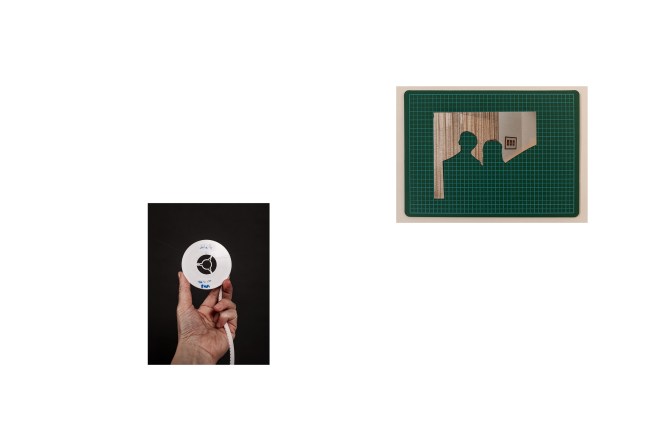
My everyday photography is not still life and I find it tricky – it requires the kind of skill that doesn’t come naturally to me. The image of the photograph on a self-healing mat with lines nearly didn’t make it – if I couldn’t get it straight it wasn’t going in. It’s not perfect but I think ok. My Processing skills are extremely limited. I wanted something to look like it had been through a digital process. I think there is much more scope but balancing out the time to find out how to do things (I am currently at the stage of copying and pasting the code I picked up in class and am grateful for Simon Chirgwin’s help as he attended it too and is far abler). But overall, I think it demonstrates a good level.
Quality of Outcome
I think this work is ambitious and carries a level of risk with it. It feels like the sort of thing that needs to be longer, needs more substance than it currently has to be able to do what’s it’s aiming to do. But at the same time, it already has a lot going on and so although it might need to have something else, it’s always going to need refining and balancing – and simplifying to allow for the complexity to live/breathe. I can see where Martins succeeds in using a range of sources. For me, there is the added element of the writings. He has text but it’s not the same kind of writing. Its presence probably means I need to pull back with the multiple sources of images.
Demonstration of creativity
Even if someone doesn’t like the style, subjects, tone – it would be hard to say its not creative.
Context
The CS essay plan and research along with the related context for BOW is strong – and I am very much enjoying that aspect of L3. (A very hard thing for me on L3 is keeping on top of two modules at the same time, even though I know there is a reason for this and am benefitting – it’s nevertheless a challenge with time.)
Useful links
Notes on Kember and Zylinska – re the cut https://sjflevel3.photo.blog/2020/01/11/bow-cs-digital-liveliness%E2%80%8B/
Kember, S. and Zylinska, J. (2012) Life after new media: mediation as a vital process. Cambridge, Mass: MIT Press. At: http://topologicalmedialab.net/xinwei/classes/readings/KemberZylinska/LANM.pdf(Accessed 11/01/2020).
My notes on Edgar Martins work https://sjflevel3.photo.blog/?s=edgar+martins
Sophie Calle https://fraenkelgallery.com/exhibitions/sophie-calle-because
Lisa Bernard https://sjflevel3.photo.blog/2020/01/21/lisa-bernard-chateau-despair/
Project I began then abandoned mixing old and new together (2018) https://sarahjanefieldblog.wordpress.com/2018/07/18/new-project-manipulated/
Mario Klingman https://ocasjf.wordpress.com/2018/02/10/artist-talk-mario-klingemann/
Notes on Tom’s First Film – film from eBay https://sjflevel3.photo.blog/2019/12/31/bow-a3-toms-first-film/
From Sketchbook – Random Notes for a Short Story: https://sarahjanefieldblog.wordpress.com/category/bow-cs/rnfass/
Film/photography/shadow puppets – McGregor, R. (2013) ‘A New/Old Ontology of Film’ In: Film-Philosophy 17 (1) pp.265–280. At:https://www.euppublishing.com/doi/10.3366/film.2013.0015 (Accessed 13/12/2019).
Vimeo video above – full blog post with individual slides https://sjflevel3.photo.blog/2019/12/01/bow-ca-an-attempt-to-put-bubbling-concept-outside-of-me/
BOW: Image file
I have taken lots of images – most of which were rejected outright and various contact sheets are available under the relevant menu item of the blog. (I might make a new menu button solely for contact sheets as the Research & Reference item has a very long list beneath it now.)
This page is a record of various experiments, many of which are not in the book. Click on the image for captioned information ( Note: will need to reorder these, WordPress changed the order when I changed the format to show the images so now the captions don’t always make sense – think William Burroughs is having a laugh at my expense!)

From A1 – played with idea of connecting it but it didn’t work


Next day, took these – both a development fomr an earlier session playing several times with the film and flesh – the first image was of my tummy, so the film is a like a measuring tape. Didn’t like that image in the end and so pushed it further – enjoyed playing with my freind’s borrowed macro – liked the detail in my dry skin


First experiment with marco and film round my legs


Had some gold leaf lying around – liked the notion of preciousness and value


Developments of early stuff with same gradiant map as on the puppets

Returned to this book which I started a project with and then abandoned – https://sarahjanefieldblog.wordpress.com/2018/07/18/new-project-manipulated/

First photos with puppets – really liked the idea of usng them. Shadow puppets re mentioned in an essay – McGilchrist, I. (2019) The Master and His Emissary: The Divided Brain and the Making of the Western World. (2nd, New Expanded Edition): Yale University Press.

As before – liked these but it’s all too clean

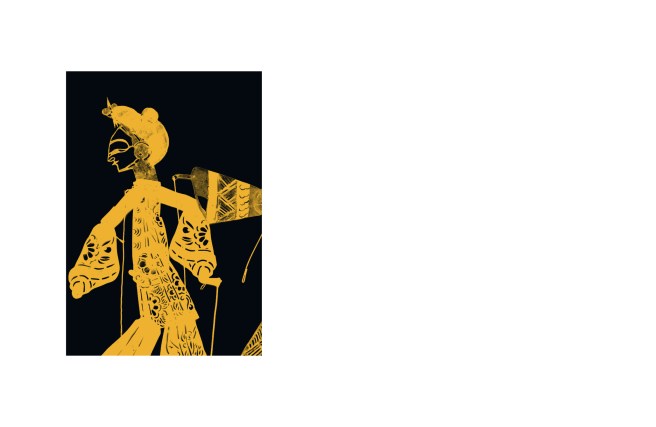
Several people mentioned Lottie Renniger and I loved a shadow puppet type animation as a child so played with gradient maps in PS to make these poor old broken puppets looks as they might have done. I like the old/new in one place – old technology used with new – and I will make some form of moving image thing with these at some point


Taken when rushing for a train – may return and retake in better light as quite like the idea of inclusing this – but needs to be a well-taken image


This was a phone snap before beginning some experiments – I have used it though after seeing it on my phone a few days later. I might reshoot it. The print even jsut on an inkjet is good althogh there is noise visible on screen – I don’s mind that though


Took in the summer in prep for A2 not use there so tried it here but ditched it

old albums – but not used

Newspapre cuttings from my dad’s early career but makes the work autobiographical and I don’t want that

An old script with photocopied text and notes – not used but the concept contains this object

as before


The followign images from a film called Nuclear War for beginners – really like the title and will likely write something one day with it in – but the images/screenshots did not work in the book at this time


Will probably reshoot this – got a bit carreid away with the macro. I do like the sense of myopia (I find photographers can be quite myopic!) But need to test out several other ways of doing it.


Have not included these but will look again at a later stage


Wanted ot include these but they didn’t fit

used this to cover somethign up I didn’t like in the dummy book – then liked it so have included it.


Not a good enough image and too much like Martin’s

Same as before but have included it for now

From Processing – Processing created over 400 JPGs as I didn’t realise it was still running! Mario Clingman leaves his machine learning code runnign overnight and curates from thousands of images. https://ocasjf.wordpress.com/2018/02/10/artist-talk-mario-klingemann/ I wrote about this process here https://sjflevel3.photo.blog/2019/12/31/bow-a3-toms-first-film/
Earlier versions of the book:
BOW A3: Almost ready to submit
I feel the shape of this element, if not length and content, is moving along. This is like a house that is still waiting for walls and maybe a roof, or plumbing/electricity. I promised Ruth I’d submit something in another 5 days from now (at the study visit last weekend).
Since deciding on the cover I came across a post about Sophie Calle using text before photos – someone at the study visit said they thought of her when looking at my little book. https://fraenkelgallery.com/exhibitions/sophie-calle-because
There is much to say about what I still need to do, will reshoot, rewrite (things spring out the minute I see it online) ditch/develop, how the writing might fit or not fit etc. But for now, I am just going to post it and have a think about over the next couple of days. I also know what I want to get hold of or places to go – various items/objects I might try out and see but not sure if I will be able to get some of these things and certainly not within the next five days – but I am attempting to set things up and organise.
This is No. 6 of this particular iteration. When I submit I will add JPGs of various pages/ideas I tried and ditched.
BOW: A3, what if…
Thinking about shadow puppets and how they were used, and how we make images today – I do quite like this and have no problem with the obvious altering in PS (perhaps as long as there is some stuff included not altered), which there is currently – and relevant. There was criticism of Martins for using PS when he did a series of houses for the NY Timesbut would they say the same about Alma Hassar’s image of Andy Clark in the New Yorker? Where are they cutting their lines between what is acceptable and what isn’t? Thinking always of Hoffman’s book on seeing – which admittedly frustrates many people. I wonder if I would be happier with my puppets looking like this in the sequence… something to think about. It’s the opposite of how they’d have been seen originally, which I really like.

BOW A3: More tests with the film but without the lightbox this time, and blade
Shot by the window with a lamp rather than on the lightbox – can still see the frames but maybe not terribly exciting. Still want to get the film next to flesh but it’s very tricky at this aperture and certainly with the macro doing it on my own. Tied the film round my ankles just to get an idea of the film and flesh together and quite like the result but will need to do many more. Just three shots here – maybe the first will do but will have a go again anyway. But I must give this lens back tomorrow – however, it may be more manageable with the 50. I like the tiny hairs I’ve not shaved here which match another shot of a blade I’ve settled on. This is probably more interesting than the film on its own below. And I prefer it to the earlier ones I shot before.

(Contact sheet – some enhanced in LR, some not)


Last night I photographed the blade – had to put it in this cheap crappy product box I had lying around but in the end, I liked it with all its little stray hairs from the cloth. Had two versions, one which I edited and PS’d and actually preferred the one that was more honest. I guess that’s what more relevant for this particular project too – because the cut is about what we choose to leave out and/or include.
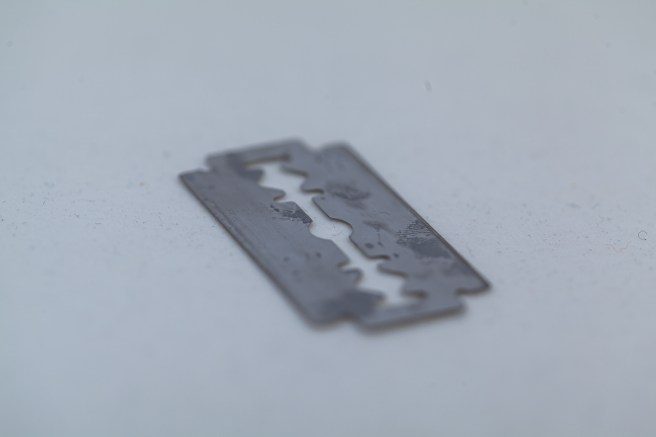
The contact sheet is not even worth sharing – most of them are completely out of focus. Really struggled with this one.
And after using a cutout remnant from an old project, I photographed and scanned the following.


And just reminding myself of this one…. taken earlier this week on the lightbox.

Lisa Bernard: Chateau Despair
I am pretty sure Wendy recommended this to me in S&O after A2 to try to get me to move away from the pretty ‘studio practise’ I struggled to see beyond then. But I can’t find it mentioned, although for some reason that site it is a bit muddled nowadays, no idea how or why that happened. I have the book though and I’m sure it was after Wendy mentioned it. The other day, fellow OCA L3 student Elizabeth (who I met on a study visit over the weekend) mentioned Bernard’s The Canary and the Hammer. I’d love to look at this book but must make do with what I can find online for now. (I shall ask the photography writer I’m borrowing The Coast from if he’s got this too…)
A pertinent sentence from the FT review:
“The art market is so focused on creating a linear narrative,” says Barnard, who teaches at the University of South Wales. “I wanted to do the complete opposite.” Her aim is to showcase “a very fragmented world” that stimulates and excites. Using a range of aesthetics — traditional landscapes, portraits and still life, plus archival material and digital imagery — she goes on “a personal journey” through the troubled world of gold over different periods in its complex history.’ (Raval, 2019)
Raval, A (2019) Photographer Lisa Barnard’s personal journey through the world of gold Financial Times, http://www.FT.com [online] Available at: https://www.ft.com/content/64356a8a-b8af-11e9-8a88-aa6628ac896c (Accessed 21/01/2020)
Brief comments re what I saw when looking at it again the other day:
- I see where some of my influences have come from, eg.
- An interest in ruined images
- There is a picture of a bare wall which reminds me of a frame I’ve screenshotted from the end of a film on nuclear war -they are pretty much the same picture.
- I like the repetition – only the increased water/mould mark on the photo of Thatcher changes (love this)
- Focus on broken, discarded, forgotten bits of life
- The antithesis of the toothpaste advert image/advertising
- She keeps text out of the centre – an essay by Sarah James at the end.
- Wonderful use of light – not always pretty but often is
- A good reminder as I work on A3 – and stopped me from going too far in an unhelpful or unsatisfying direction
Thanks to Elizabeth for reminding me of Bernard’s name.
BOW: A3 dummy booklet
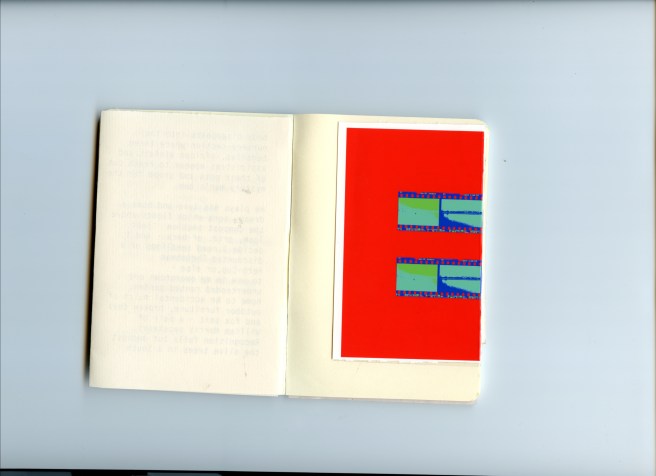
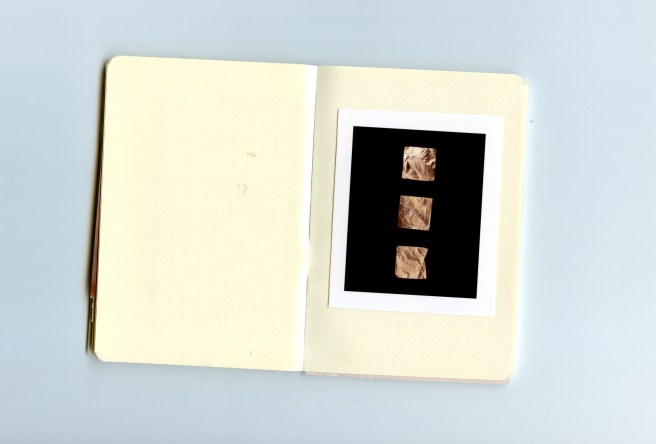
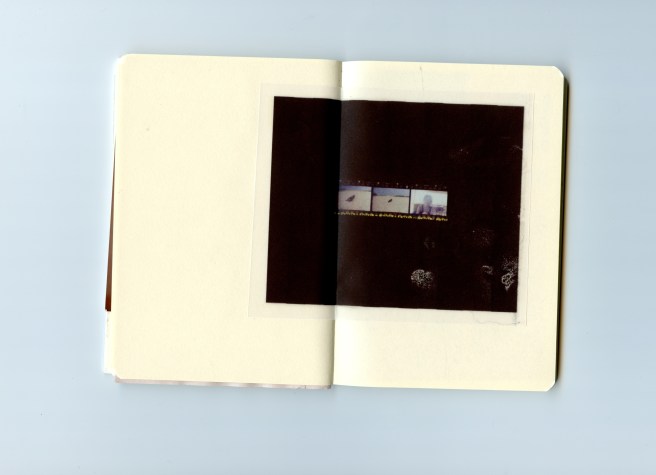
Making this – bringing the work off the screen was incredibly useful. I was asked if it will be this size… no. (This booklet was handy – I owe my son a stocking-filler though). I will make the book in ID over the next ten days or so and fix a size but whatever happens in the making of it is open to need and further development.
This is not a fixed sequence, in fact, I scanned it in the wrong sequence because I’m tired and kept missing pages – it’s not a fixed anything, just a step in the journey. There is lots more writing which I never got to include in this initial manifestation plus some images but that is what I need to work on some more. The writing is driving this at the moment rather than photography. That’s ok. I have countless notes on my phone, phrases and thoughts, sentences, ideas which keep coming (see example below) and so I have to let that continue. No, this colour scheme is not it. The book is from Tiger…






As mentioned, some notes from my phone with ideas, writing, things I’ve heard etc. I actually like the randomness and unstructuredness of some of this as-is, there is a freedom to it that isn’ in the earlier stuff:
The traumatised grown up
Sons hand me their hatred to carry around
To the academics who fail to recognise their privileged booty
Manifesto for the digitised self/age
/ Alexa I’d like a wife
Sure, it’s fine for Philip Larkin to peer out of his train window and scoff at cheap fabric and gaudy hats
Behind the shopfront, beneath the surface everyday consumer
Transactions – film world
Trapped inside these words which cannot entertain a different world
Split atom
Colonialism
Sum
Of
The
Time
&
Other
Entanglements
Reality is fucking with you
Void realm
Simpering
Deity, divine, godhood, diabolical, decapitation, apotheosis, Ex rain god, enchantment / Zeus sat down with Greta Garbo – they don’t know how to create gods anymore, they worship objects. Laughter/ Zeus, my children don’t listen to me, I might as well not exist, I despaired then you and your friends came along, but then it was like the old days, not like that guy who wanted sole charge. He got it all wrong,
There are no photographic records of my Czechoslovakian relatives, brewers who perished under the Nazi’s, in camps and ghettoes – missing images
Mushroom, beige, magnolia
Cut advert, cutting room floor, shiny nose, cut hair, terrible ‘boyfriend’ jerk, more money than any other job, least money with the BBC – most recognizable.
Floor, my entanglement with Tom
 SJField - OCA Level Three Study Blog