Later this month I am booked to attend a study visit led by Jayne Taylor to see the Sherman exhibition at NPG.
This is a sort of placeholder at the moment – a place to store some links. Although I have resisted Sherman’s work as an influence, I do feel it will be valuable to me here, and I do keep stumbling upon it in various places right now, including in OCA colleague, Selina Wallace’s CS A5.
She is quoted as saying, ““The work is what it is and hopefully it’s seen as feminist work, or feminist-advised work … []… But I’m not going to go around espousing theoretical bullshit about feminist stuff.” (Cain, 2016) The belittling of feminism theory makes me bristle, not to mention the elitist institutionalisation of the Sherman brand.
I will return to this page after the visit.
https://www.artsy.net/article/artsy-editorial-is-cindy-sherman-a-feminist
Last week, as discussed, said study visit took place. We began the day with a bit of a disappointing talk which seemed to be aimed at A level or lower rather than degree HE level. The speaker started by stating, “these are not selfies”, and it never really improved from there.
Following the talk, we had time to look at the work – and there is a lot of it – before gathering to discuss what we had seen.
Comments made by other students:
- A female artist has made a career without getting her kit off during the vast majority of it. This is to be commended. I very much agree. If she ever does play with nudity, she opts for highlighting the grotesque, using prosthesis and puppets.
- Her work nowadays seems quite distant from the everyday. When she was starting she emulated scenes we’d all seen on the cinema screen. Nowadays, she tends to play with the masks that the super-rich construct.
- Her work parodies the world she lives within. They love her for it. So it can seem like an in-joke for her circle and possibly even irrelevant to “the average” person.
- She is a very good actor
- The Untitled trope (all her work is labeled such with #number) became tedious
- The clowns were creepy (well, yes)
- A student asked, “did anyone hate it?”
- Sherman is a performance artist.
Perhaps, a bit unimaginatively, I was mostly drawn to the very well-known Untitled Stills (1977-1980). I also enjoyed seeing Sherman’s student work; she had already begun dressing up but in these early examples there is something quite Dada-esque or surreal about these images and it was interesting to see her early experiments with identity. The later work reminded me of characters from the Capitol in Suzanne Collins’ Hunger Games books (2008-2011) later adapted for the cinema, where citizens are spoilt, rich, culturally violent, wholly lacking in empathy, hedonistic, dressed in over-designed fashion, and complicit in the alienation of people who are kept away from the economic centre, while tortured and some murdered and forced to live in abject poverty.
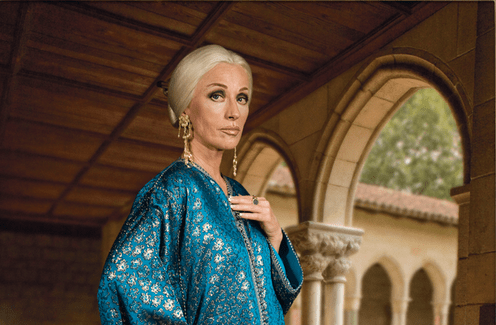
Given her habit of drawing on popular culture to create her images, it isn’t surprising I make this connection with a Hollywood franchise (along with what the narrative represents) when I think about some of Sherman’s work. A couple of the fashion images which appeared in Vogue are very striking too. I noted there were no examples of the Instagram selfies where Sherman pushes some of the transformative technology available to create monstrous images of women (many of which have disappeared from her Instagram feed).
The Guardian review ends with, “Who is Cindy, what is she? It is almost impossible to fix upon her in this slippery image. As in life, so in art: Sherman makes herself up as she goes along; and her camera catches the truth, that we may all be strangers to ourselves.” (Cumming, 2019) I’m not sure trying to figure out who Sherman is, is the point – although it is difficult to avoid being drawn into that conundrum, which I address in the penultimate paragraph. Even Sherman, in a childhood document, seems overly concerned with stating the obvious to herself by repeating “thats me, thats me, thats me”, which might be read as an inverted insecurity about the truth of that statement. Of course, we should avoid imposing individual-focused pop-psychology on her work.
But it’s so tempting to (which makes me wonder about avoiding doing so) and perhaps it says something about the tensions at work in our society between female subjectivity and the gaze (male or otherwise). “Sherman remained unwilling to directly tie her work to feminist theory” and “own expressly non-theoretical, even anti-theoretical stance.” (Cain, 2016) For me, one the most interesting aspects of Sherman’s work might be the gaze and female representation. I don’t’ know enough to say whether her reported dismissals of feminist theory are genuine, over-reported or attention seeking-affectation.

Either way, when you look at her work, she’s either dedicated her whole career to exploring female representation, or she’s simply addicted to dressing up and taking pictures of herself on her own in a room while searching for a stable persona. Whatever the case, we end up thinking about and querying the way women are seen and see themselves when we look at her work.
But perhaps more crucially, we can’t help but look for a place to situate her, to place in context, to fulfill a recognition which often remains elusive. In a useful blog/article titled Subverting the Male Gaze for Curating the Contemporary (artists and curators platform blog), Sherman is quoted;
“When I prepare each character I have to consider what I’m working against; that people are going to look under the make-up and wigs for that common denominator, the recognizable. I’m trying to make other people recognize something of themselves rather than me.” (quoted in Schulz-Hoffman, 1991: 30).” (Sorrentino, 2014)
The very first image in the exhibition is large and shows us a groomed, polished, middle-aged woman with french manicured hands, highlights, straightened hair, heavily made-up, wearing expensive looking sports clothing. She appears rich, and like so many women on TV or the cinema, or who I might have met when doing corporate headshots – the bosses of companies, never the workers – or photographed at charity events or parties. I spent ages trying to place my recognition. She seemed so very, very familiar. It was like seeing someone in B&Q and thinking they’re your friend or a person you’ve met, only to eventually realise you’ve seen them somewhere on the ‘telly’.

Whatever else it might be evoking, Sherman’s work is exploring celebrity, simulacra and simulation, the way modern culture gaslights us into thinking so much of what we experience is real, while it, in fact, often lacks ‘the real’. And how that is only ever linked to consumerism – a lifestyle which is being sold to us and is completely and utterly false and made up. And consumerism is without a doubt heavily invested in selling femininity to us. But I wonder if women and disenfranchised men are victims of this nowadays – leaving so many of us unsure of who we are, hence selfie culture which, like Sherman’s childhood diary are attempts to reassure ourselves – THIS IS ME!! It is, it is, it is, it is, I tell you!! So, while we should be wary of imposing pop-psychology on Sherman herself, it might point us towards clues which help us to understand how her work expresses something on behalf of all of us.
Perhaps a most memorable moment for me was listening to three women talk about the picture I just described. They turned to look at the image opposite, where Sherman is dressed as some sort of quirky media boss. Like all her later work, both are powerful caricatures. “Ooooh! said on the viewers, is it the same woman?” They discussed this possibility for a while by comparing features and decided, in the end, it was not the same person. They then proceeded onwards to look at the rest of the exhibition. I couldn’t help wondering if they ever twigged and what they might have gained from the exhibition if not!
Thanks to Jayne Taylor for organising.
https://artlead.net/content/journal/modern-classics-cindy-sherman-untitled-film-stills/
http://theconversation.com/heres-looking-at-cindy-sherman-head-shots-59444
 SJField - OCA Level Three Study Blog